talk-data.com talk-data.com

Topic

Hive

Apache Hive

data_warehouse sql hadoop

100

tagged

Activity Trend

9 peak/qtr
2020-Q1 2026-Q1

Activities

100 activities · Newest first

Summary

Any software system that survives long enough will require some form of migration or evolution. When that system is responsible for the data layer the process becomes more challenging. Sriram Panyam has been involved in several projects that required migration of large volumes of data in high traffic environments. In this episode he shares some of the valuable lessons that he learned about how to make those projects successful.

Announcements

Hello and welcome to the Data Engineering Podcast, the show about modern data management Data lakes are notoriously complex. For data engineers who battle to build and scale high quality data workflows on the data lake, Starburst is an end-to-end data lakehouse platform built on Trino, the query engine Apache Iceberg was designed for, with complete support for all table formats including Apache Iceberg, Hive, and Delta Lake. Trusted by teams of all sizes, including Comcast and Doordash. Want to see Starburst in action? Go to dataengineeringpodcast.com/starburst and get $500 in credits to try Starburst Galaxy today, the easiest and fastest way to get started using Trino. This episode is supported by Code Comments, an original podcast from Red Hat. As someone who listens to the Data Engineering Podcast, you know that the road from tool selection to production readiness is anything but smooth or straight. In Code Comments, host Jamie Parker, Red Hatter and experienced engineer, shares the journey of technologists from across the industry and their hard-won lessons in implementing new technologies. I listened to the recent episode "Transforming Your Database" and appreciated the valuable advice on how to approach the selection and integration of new databases in applications and the impact on team dynamics. There are 3 seasons of great episodes and new ones landing everywhere you listen to podcasts. Search for "Code Commentst" in your podcast player or go to dataengineeringpodcast.com/codecomments today to subscribe. My thanks to the team at Code Comments for their support. Your host is Tobias Macey and today I'm interviewing Sriram Panyam about his experiences conducting large scale data migrations and the useful strategies that he learned in the process

Interview

Introduction How did you get involved in the area of data management? Can you start by sharing some of your experiences with data migration projects?

As you have gone through successive migration projects, how has that influenced the ways that you think about architecting data systems?

How would you categorize the different types and motivations of migrations?

How does the motivation for a migration influence the ways that you plan for and execute that work?

Can you talk us through one or two specific projects that you have taken part in? Part 1: The Triggers

Section 1: Technical Limitations triggering Data Migration

Scaling bottlenecks: Performance issues with databases, storage, or network infrastructure Legacy compatibility: Difficulties integrating with modern tools and cloud platforms System upgrades: The need to migrate data during major software changes (e.g., SQL Server version upgrade)

Section 2: Types of Migrations for Infrastructure Focus

Storage migration: Moving data between systems (HDD to SSD, SAN to NAS, etc.) Data center migration: Physical relocation or consolidation of data centers Virtualization migration: Moving from physical servers to virtual machines (or vice versa)

Section 3: Technical Decisions Driving Data Migrations

End-of-life support: Forced migration when older software or hardware is sunsetted Security and compliance: Adopting new platforms with better security postures Cost Optimization: Potential savings of cloud vs. on-premise data centers

Part 2: Challenges (and Anxieties)

Section 1: Technical Challenges

Data transformation challenges: Schema changes, complex data mappings Network bandwidth and latency: Transferring large datasets efficiently Performance tes
Summary

The purpose of business intelligence systems is to allow anyone in the business to access and decode data to help them make informed decisions. Unfortunately this often turns into an exercise in frustration for everyone involved due to complex workflows and hard-to-understand dashboards. The team at Zenlytic have leaned on the promise of large language models to build an AI agent that lets you converse with your data. In this episode they share their journey through the fast-moving landscape of generative AI and unpack the difference between an AI chatbot and an AI agent.

Announcements

Hello and welcome to the Data Engineering Podcast, the show about modern data management This episode is supported by Code Comments, an original podcast from Red Hat. As someone who listens to the Data Engineering Podcast, you know that the road from tool selection to production readiness is anything but smooth or straight. In Code Comments, host Jamie Parker, Red Hatter and experienced engineer, shares the journey of technologists from across the industry and their hard-won lessons in implementing new technologies. I listened to the recent episode "Transforming Your Database" and appreciated the valuable advice on how to approach the selection and integration of new databases in applications and the impact on team dynamics. There are 3 seasons of great episodes and new ones landing everywhere you listen to podcasts. Search for "Code Commentst" in your podcast player or go to dataengineeringpodcast.com/codecomments today to subscribe. My thanks to the team at Code Comments for their support. Data lakes are notoriously complex. For data engineers who battle to build and scale high quality data workflows on the data lake, Starburst is an end-to-end data lakehouse platform built on Trino, the query engine Apache Iceberg was designed for, with complete support for all table formats including Apache Iceberg, Hive, and Delta Lake. Trusted by teams of all sizes, including Comcast and Doordash. Want to see Starburst in action? Go to dataengineeringpodcast.com/starburst and get $500 in credits to try Starburst Galaxy today, the easiest and fastest way to get started using Trino. Your host is Tobias Macey and today I'm interviewing Ryan Janssen and Paul Blankley about their experiences building AI powered agents for interacting with your data

Interview

Introduction How did you get involved in data? In AI? Can you describe what Zenlytic is and the role that AI is playing in your platform? What have been the key stages in your AI journey?

What are some of the dead ends that you ran into along the path to where you are today? What are some of the persistent challenges that you are facing?

So tell us more about data agents. Firstly, what are data agents and why do you think they're important? How are data agents different from chatbots? Are data agents harder to build? How do you make them work in production? What other technical architectures have you had to develop to support the use of AI in Zenlytic? How have you approached the work of customer education as you introduce this functionality? What are some of the most interesting or erroneous misconceptions that you have heard about what the AI can and can't do? How have you balanced accuracy/trustworthiness with user experience and flexibility in the conversational AI, given the potential for these models to create erroneous responses? What are the most interesting, innovative, or unexpected ways that you have seen your AI agent used? What are the most interesting, unexpected, or challenging lessons that you have learned while working on building an AI agent for business intelligence? When is an AI agent the wrong choice? What do you have planned for the future of AI in the Zenlytic product?

Contact Info

Ryan

LinkedIn

Paul

LinkedIn

Parting Question

From your perspective, what is the biggest gap in the tooling or technology for data management today?

Closing Announce

Summary

Building a data platform is a substrantial engineering endeavor. Once it is running, the next challenge is figuring out how to address release management for all of the different component parts. The services and systems need to be kept up to date, but so does the code that controls their behavior. In this episode your host Tobias Macey reflects on his current challenges in this area and some of the factors that contribute to the complexity of the problem.

Announcements

Hello and welcome to the Data Engineering Podcast, the show about modern data management This episode is supported by Code Comments, an original podcast from Red Hat. As someone who listens to the Data Engineering Podcast, you know that the road from tool selection to production readiness is anything but smooth or straight. In Code Comments, host Jamie Parker, Red Hatter and experienced engineer, shares the journey of technologists from across the industry and their hard-won lessons in implementing new technologies. I listened to the recent episode "Transforming Your Database" and appreciated the valuable advice on how to approach the selection and integration of new databases in applications and the impact on team dynamics. There are 3 seasons of great episodes and new ones landing everywhere you listen to podcasts. Search for "Code Commentst" in your podcast player or go to dataengineeringpodcast.com/codecomments today to subscribe. My thanks to the team at Code Comments for their support. Data lakes are notoriously complex. For data engineers who battle to build and scale high quality data workflows on the data lake, Starburst is an end-to-end data lakehouse platform built on Trino, the query engine Apache Iceberg was designed for, with complete support for all table formats including Apache Iceberg, Hive, and Delta Lake. Trusted by teams of all sizes, including Comcast and Doordash. Want to see Starburst in action? Go to dataengineeringpodcast.com/starburst and get $500 in credits to try Starburst Galaxy today, the easiest and fastest way to get started using Trino. Your host is Tobias Macey and today I want to talk about my experiences managing the QA and release management process of my data platform

Interview

Introduction As a team, our overall goal is to ensure that the production environment for our data platform is highly stable and reliable. This is the foundational element of establishing and maintaining trust with the consumers of our data. In order to support this effort, we need to ensure that only changes that have been tested and verified are promoted to production. Our current challenge is one that plagues all data teams. We want to have an environment that mirrors our production environment that is available for testing, but it’s not feasible to maintain a complete duplicate of all of the production data. Compounding that challenge is the fact that each of the components of our data platform interact with data in slightly different ways and need different processes for ensuring that changes are being promoted safely.

Contact Info

LinkedIn Website

Closing Announcements

Thank you for listening! Don't forget to check out our other shows. Podcast.init covers the Python language, its community, and the innovative ways it is being used. The Machine Learning Podcast helps you go from idea to production with machine learning. Visit the site to subscribe to the show, sign up for the mailing list, and read the show notes. If you've learned something or tried out a project from the show then tell us about it! Email [email protected] with your story.

Links

Data Platforms and Leaky Abstractions Episode Building A Data Platform From Scratch Airbyte

Podcast Episode

Trino dbt Starburst Galaxy Superset Dagster LakeFS

Podcast Episode

Nessie

Podcast Episode

Iceberg Snowflake LocalStack DSL == Domain Specific Language

The intro and outro music is from The Hug by The Freak Fandango Orchestra / CC BY-S

Google Cloud pinball machine that provides stats and events using Google Cloud tech. Write your own code to interact with the pinball game. Receive live events from the machine and send messages back to see how it changes the game.

Click the blue “Learn more” button above to tap into special offers designed to help you implement what you are learning at Google Cloud Next 25.

Hot Wheels go head-to-head in a Big Data race! Sensors track stats, while Google Cloud processes everything from storage to analysis in real-time. Watch the action, guess the winner, and witness the power of cloud data solutions.

Click the blue “Learn more” button above to tap into special offers designed to help you implement what you are learning at Google Cloud Next 25.

Sketch your dream webpage and watch AI bring it to life! Draw the layout, and our technology will transform it into functional code, instantly. No coding skills required, just your imagination and Google Cloud's cutting-edge AI.

Click the blue “Learn more” button above to tap into special offers designed to help you implement what you are learning at Google Cloud Next 25.

Big Data Computing

This book primarily aims to provide an in-depth understanding of recent advances in big data computing technologies, methodologies, and applications along with introductory details of big data computing models such as Apache Hadoop, MapReduce, Hive, Pig, Mahout in-memory storage systems, NoSQL databases, and big data streaming services.

Lakehouse Federation: Access and Governance of External Data Sources from Unity Catalog

Are you tired of spending time and money moving data across multiple sources and platforms to access the right data at the right time? Join our session and discover Databricks new Lakehouse Federation feature, which allows you to access, query, and govern your data in place without leaving the Lakehouse. Our experts will demonstrate how you can leverage the latest enhancements in Unity Catalog, including query federation, Hive interface, and Delta Sharing, to discover and govern all your data in one place, regardless of where it lives.

Talk by: Can Efeoglu and Todd Greenstein

Connect with us: Website: https://databricks.com Twitter: https://twitter.com/databricks LinkedIn: https://www.linkedin.com/company/databricks Instagram: https://www.instagram.com/databricksinc Facebook: https://www.facebook.com/databricksinc

A Technical Deep Dive into Unity Catalog's Practitioner Playbook

Get ready to take a deep dive into Unity Catalog and explore how it can simplify data, analytics and AI governance across multiple clouds. In this session, take a deep dive into Unity Catalog and the expert Databricks team will guide you through a hands-on demo, showcasing the latest features and best practices for data governance. You'll learn how to master Unity Catalog and gain a practical understanding of how it can streamline your analytics and AI initiatives. Whether you're migrating from Hive Metastore or just looking to expand your knowledge of Unity Catalog, this session is for you. Join us for a practical, hands-on deep dive into Unity Catalog and learn how to achieve seamless data governance while following best practices for data, analytics and AI governance.

Talk by: Zeashan Pappa and Ifigeneia Derekli

Connect with us: Website: https://databricks.com Twitter: https://twitter.com/databricks LinkedIn: https://www.linkedin.com/company/databricks Instagram: https://www.instagram.com/databricksinc Facebook: https://www.facebook.com/databricksin

Summary

All of the advancements in our technology is based around the principles of abstraction. These are valuable until they break down, which is an inevitable occurrence. In this episode the host Tobias Macey shares his reflections on recent experiences where the abstractions leaked and some observances on how to deal with that situation in a data platform architecture.

Announcements

Hello and welcome to the Data Engineering Podcast, the show about modern data management RudderStack helps you build a customer data platform on your warehouse or data lake. Instead of trapping data in a black box, they enable you to easily collect customer data from the entire stack and build an identity graph on your warehouse, giving you full visibility and control. Their SDKs make event streaming from any app or website easy, and their extensive library of integrations enable you to automatically send data to hundreds of downstream tools. Sign up free at dataengineeringpodcast.com/rudderstack Your host is Tobias Macey and today I'm sharing some thoughts and observances about abstractions and impedance mismatches from my experience building a data lakehouse with an ELT workflow

Interview

Introduction impact of community tech debt

hive metastore new work being done but not widely adopted

tensions between automation and correctness data type mapping

integer types complex types naming things (keys/column names from APIs to databases)

disaggregated databases - pros and cons

flexibility and cost control not as much tooling invested vs. Snowflake/BigQuery/Redshift

data modeling

dimensional modeling vs. answering today's questions

What are the most interesting, unexpected, or challenging lessons that you have learned while working on your data platform? When is ELT the wrong choice? What do you have planned for the future of your data platform?

Contact Info

LinkedIn

Parting Question

From your perspective, what is the biggest gap in the tooling or technology for data management today?

Closing Announcements

Thank you for listening! Don't forget to check out our other shows. Podcast.init covers the Python language, its community, and the innovative ways it is being used. The Machine Learning Podcast helps you go from idea to production with machine learning. Visit the site to subscribe to the show, sign up for the mailing list, and read the show notes. If you've learned something or tried out a project from the show then tell us about it! Email [email protected]) with your story. To help other people find the show please leave a review on Apple Podcasts and tell your friends and co-workers

Links

dbt Airbyte

Podcast Episode

Dagster

Podcast Episode

Trino

Podcast Episode

ELT Data Lakehouse Snowflake BigQuery Redshift Technical Debt Hive Metastore AWS Glue

The intro and outro music is from The Hug by The Freak Fandango Orchestra / CC BY-SA Sponsored By: Rudderstack: Rudderstack

RudderStack provides all your customer data pipelines in one platform. You can collect, transform, and route data across your entire stack with its event streaming, ETL, and reverse ETL pipelines.

RudderStack’s warehouse-first approach means it does not store sensitive information, and it allows you to leverage your existing data warehouse/data lake infrastructure to build a single source of truth for every team.

RudderStack also supports real-time use cases. You can Implement RudderStack SDKs once, then automatically send events to your warehouse and 150+ business tools, and you’ll never have to worry about API changes again.

Visit dataengineeringpodcast.com/rudderstack to sign up for free today, and snag a free T-Shirt just for being a Data Engineering Podcast listener.Support Data Engineering Podcast

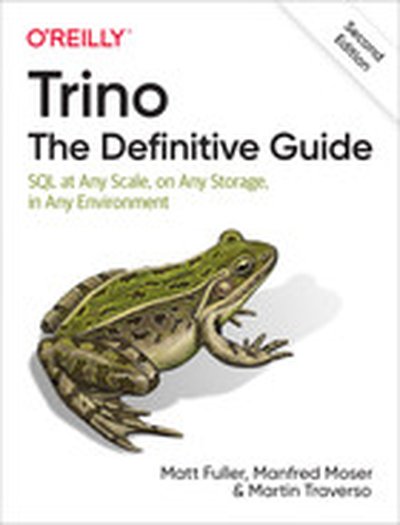
Trino: The Definitive Guide, 2nd Edition

Perform fast interactive analytics against different data sources using the Trino high-performance distributed SQL query engine. In the second edition of this practical guide, you'll learn how to conduct analytics on data where it lives, whether it's a data lake using Hive, a modern lakehouse with Iceberg or Delta Lake, a different system like Cassandra, Kafka, or SingleStore, or a relational database like PostgreSQL or Oracle. Analysts, software engineers, and production engineers learn how to manage, use, and even develop with Trino and make it a critical part of their data platform. Authors Matt Fuller, Manfred Moser, and Martin Traverso show you how a single Trino query can combine data from multiple sources to allow for analytics across your entire organization. Explore Trino's use cases, and learn about tools that help you connect to Trino for querying and processing huge amounts of data Learn Trino's internal workings, including how to connect to and query data sources with support for SQL statements, operators, functions, and more Deploy and secure Trino at scale, monitor workloads, tune queries, and connect more applications Learn how other organizations apply Trino successfully

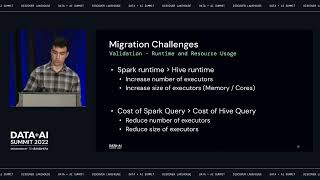
Advanced Migrations: From Hive to SparkSQL

Learn how Pinterest moved over 6000 Hive queries to SparkSQL, achieved a 2x runtime-weighted speed up and made significant savings in compute resources. In order to do migrations at this scale. Companies often take one of two approaches, either employ hundreds of engineers to manually migrate or completely change the query engine to be compatible with Hive both of which take significant engineering time. In this session you will learn how Pinterest took a hybrid approach and the tools and tricks Pinterest used to safely migrate thousands of queries at scale.

Connect with us: Website: https://databricks.com Facebook: https://www.facebook.com/databricksinc Twitter: https://twitter.com/databricks LinkedIn: https://www.linkedin.com/company/data... Instagram: https://www.instagram.com/databricksinc/

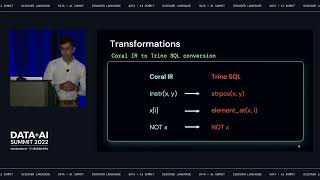
Coral and Transport Portable SQL and UDFs for the Interoperability of Spark and Other Engines

In this talk, we present two open source projects, Coral and Transport, that enable deep SQL and UDF interoperability between Spark and other engines, such as Trino and Hive. Coral is a SQL analysis, rewrite, and translation engine that enables compute engines to interoperate and analyze different SQL dialects and plans, through the conversion to a common relational algebraic intermediate representation. Transport is a UDF framework that enables users to write UDFs against a single API but execute them as native UDFs of multiple engines, such as Spark, Trino, and Hive. Further, we discuss how LinkedIn leverages Coral and Transport, and present a production use case for accessing views of other engines in Spark as well as enhancing Spark DataFrame and Dataset view schema. We discuss other potential applications such as automatic data governance and data obfuscation, query optimization, materialized view selection, incremental compute, and data source SQL and UDF communication.

Connect with us: Website: https://databricks.com Facebook: https://www.facebook.com/databricksinc Twitter: https://twitter.com/databricks LinkedIn: https://www.linkedin.com/company/data... Instagram: https://www.instagram.com/databricksinc/

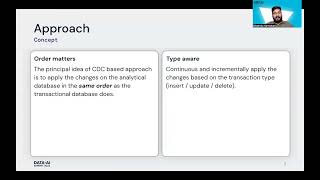
Self-Serve, Automated and Robust CDC pipeline using AWS DMS, DynamoDB Streams and Databricks Delta

Many companies are trying to solve the challenges of ingesting transactional data in Data lake and dealing with late-arriving updates and deletes.

To address this at Swiggy, we have built CDC(Change Data Capture) system, an incremental processing framework to power all business-critical data pipelines at low latency and high efficiency.

It offers: Freshness: It operates in near real-time with configurable latency requirements. Performance: Optimized read and write performance with tuned compaction parameters and partitions and delta table optimization. Consistency: It supports reconciliation based on transaction types. Basically applying insert, update, and delete on existing data.

To implement this system, AWS DMS helped us with initial bootstrapping and CDC replication for Mysql sources. AWS Lambda and DynamoDB streams helped us to solve the bootstrapping and CDC replication for DynamoDB source.

After setting up the bootstrap and cdc replication process we have used Databricks delta merge to reconcile the data based on the transaction types.

To support the merge we have implemented supporting features - * Deduplicating multiple mutations of the same record using log offset and time stamp. * Adding optimal partition of the data set. * Infer schema and apply proper schema evolutions(Backward compatible schema) * We have extended the delta table snapshot generation technique to create a consistent partition for partitioned delta tables.

FInally to read the data we are using Spark sql with Hive metastore and Snowflake. Delta tables read with Spark sql have implicit support for hive metastore. We have built our own implementation of the snowflake sync process to create external, internal tables and materialized views on Snowflake.

Stats: 500m CDC logs/day 600+ tables

Connect with us: Website: https://databricks.com Facebook: https://www.facebook.com/databricksinc Twitter: https://twitter.com/databricks LinkedIn: https://www.linkedin.com/company/data... Instagram: https://www.instagram.com/databricksinc/