talk-data.com talk-data.com

Topic

HTML

HyperText Markup Language (HTML)

web_development markup_language front_end

370

tagged

Activity Trend

15 peak/qtr
2020-Q1 2026-Q1

Activities

370 activities · Newest first

Web Scraping with Python, 2nd Edition

If programming is magic then web scraping is surely a form of wizardry. By writing a simple automated program, you can query web servers, request data, and parse it to extract the information you need. The expanded edition of this practical book not only introduces you web scraping, but also serves as a comprehensive guide to scraping almost every type of data from the modern web. Part I focuses on web scraping mechanics: using Python to request information from a web server, performing basic handling of the server's response, and interacting with sites in an automated fashion. Part II explores a variety of more specific tools and applications to fit any web scraping scenario you're likely to encounter. Parse complicated HTML pages Develop crawlers with the Scrapy framework Learn methods to store data you scrape Read and extract data from documents Clean and normalize badly formatted data Read and write natural languages Crawl through forms and logins Scrape JavaScript and crawl through APIs Use and write image-to-text software Avoid scraping traps and bot blockers Use scrapers to test your website

D3.js in Action, Second Edition

D3.js in Action, Second Edition is completely revised and updated for D3 v4 and ES6. It's a practical tutorial for creating interactive graphics and data-driven applications using D3. About the Technology Visualizing complex data is hard. Visualizing complex data on the web is darn near impossible without D3.js. D3 is a JavaScript library that provides a simple but powerful data visualization API over HTML, CSS, and SVG. Start with a structure, dataset, or algorithm; mix in D3; and you can programmatically generate static, animated, or interactive images that scale to any screen or browser. It's easy, and after a little practice, you'll be blown away by how beautiful your results can be! About the Book D3.js in Action, Second Edition is a completely updated revision of Manning's bestselling guide to data visualization with D3. You'll explore dozens of real-world examples in full-color, including force and network diagrams, workflow illustrations, geospatial constructions, and more! Along the way, you'll pick up best practices for building interactive graphics, animations, and live data representations. You'll also step through a fully interactive application created with D3 and React. What's Inside Rich full-color diagrams and illustrations Updated for D3 v4 and ES6 Reusable layouts and components Geospatial data visualizations Mixed-mode rendering About the Reader Suitable for web developers with HTML, CSS, and JavaScript skills. No specialized data science skills required. About the Author Elijah Meeks is a senior data visualization engineer at Netflix. Quotes From basic to complex, this book gives you the tools to create beautiful data visualizations. - Claudio Rodriguez, Cox Media Group The best reference for one of the most useful DataViz tools. - Jonathan Rioux, TD Insurance From toy examples to techniques for real projects. Shows how all the pieces fit together. - Scott McKissock, USAID A clever way to immerse yourself in the D3.js world. - Felipe Vildoso Castillo, University of Chile

Learning D3.js 5 Mapping - Second Edition

This book, "Learning D3.js 5 Mapping", guides developers through the process of creating dynamic and interactive data visualizations. With a focus on D3.js, you'll learn to harness the power of JavaScript to create maps and graphical objects that inform and engage. What this Book will help me do Gain expertise in working with SVG geometric shapes to design compelling graphics. Learn techniques to manage, process, and use geographic data effectively. Master adding interactivity to visual maps to provide an immersive user experience. Understand how to optimize and manipulate geoJSON files using topoJSON. Learn to create varied map types, such as hexbins and globes, using D3.js and Canvas. Author(s) None Newton and Oscar Villarreal, among others, collaborated to author this guide. They are experienced in front-end development and data visualization, bringing a practical and hands-on approach to learning through this book. Their backgrounds ensure the book addresses common challenges faced during implementation, offering thoughtful solutions. Who is it for? "Learning D3.js 5 Mapping" is perfect for web developers familiar with HTML, CSS, and JavaScript who want to expand their expertise in data visualization and mapping. If you're looking to incorporate interactive charts or maps into your web applications, this book will provide practical guidance and solid fundamentals. No prior experience with D3.js is necessary.

SamsTeachYourself PHP, MySQL & JavaScript: All in One, 6th Edition

In just a short time, you can learn how to use PHP, MySQL, and JavaScript together to create dynamic, interactive websites and applications using three leading web development technologies. No previous programming experience is required. Using a straightforward, step-by-step approach, each lesson in this book builds on the previous ones, enabling you to learn the essentials of full-stack web application development – from HTML, CSS, and JavaScript on the front end, to PHP scripting and MySQL databases on the server. Regardless of whether you run Linux, Windows, or MacOS, the book includes complete instructions to install all the software you need to set up a stable environment for learning, testing, and production. Step-by-step instructions carefully walk you through the most common web application development tasks. Practical, hands-on examples show you how to apply what you learn. Quizzes and exercises help you test your knowledge and stretch your skills. Learn how to: Build web pages with HTML5 and CSS Use JavaScript to build dynamic, interactive web pages Get PHP, MySQL, and JavaScript to work together to create modern, standards-compliant web applications Enhance interactivity with AJAX Leverage JavaScript libraries such as jQuery Work with cookies and user sessions Get user input with web-based forms Use basic SQL commands Interact with the MySQL database using PHP Write maintainable code and get started with version control Decide when frameworks such as Bootstrap, Foundation, React, Angular, and Laravel can be useful Create a web-based discussion forum or calendar Add a storefront and shopping cart to your site Contents at a Glance PART I Web Application Basics 1 Understanding How the Web Works 2 Structuring HTML and Using Cascading Style Sheets 3 Understanding the CSS Box Model and Positioning 4 Introducing JavaScript 5 Introducing PHP PART II Getting Started with Dynamic Web Sites 6 Understanding Dynamic Web Sites and HTML5 Applications 7 JavaScript Fundamentals: Variables, Strings, and Arrays 8 JavaScript Fundamentals: Functions, Objects, and Flow Control 9 Understanding JavaScript Event Handling 10 The Basics of Using jQuery PART III Taking Your Web Applications to the Next Level 11 AJAX: Getting Started with Remote Scripting 12 PHP Fundamentals: Variables, Strings, and Arrays 13 PHP Fundamentals: Functions, Objects, and Flow Control 14 Working with Cookies and User Sessions 15 Working with Web-Based Forms PART IV Integrating a Database into Your Applications 16 Understanding the Database Design Process 17 Learning Basic SQL Commands 18 Interacting with MySQL Using PHP PART V Getting Started with Application Development 19 Creating a Simple Discussion Forum 20 Creating an Online Storefront 21 Creating a Simple Calendar 22 Managing Web Applications PART VI Appendixes A Installation QuickStart with XAMPP B Installing and Configuring MySQL C Installing and Configuring Apache D Installing and Configuring PHP

Web Development with MongoDB and Node - Third Edition

Explore the power of combining Node.js and MongoDB to build modern, scalable web applications in 'Web Development with MongoDB and Node.' You'll not only learn how to integrate these two technologies effectively, but you'll also gain practical insights into using modern frameworks like Express and Angular to build feature-rich web apps. What this Book will help me do Master core concepts of Node.js and MongoDB for efficient web development. Learn to build and configure a web server using the Express.js framework. Implement data persistence with MongoDB using the Mongoose ODM library. Automate testing using tools like Mocha and streamline workflows with Gulp. Deploy applications to cloud platforms like Heroku, AWS, and Microsoft Azure. Author(s) Jason Krol and None Joseph D'mello, along with None Satheesh, bring extensive experience in web development and technical writing to this book. The authors have collectively worked on cutting-edge web technologies for years and are passionate about sharing their expertise to help developers create efficient web applications. Who is it for? This book is perfect for JavaScript developers at any proficiency level who are looking to expand their skills into full-stack development with Node.js and MongoDB. Even if you have a basic understanding of JavaScript and HTML, this book will guide you through building complete web applications from scratch. If you're eager to learn and create performant, scalable web apps, this book is for you.

Data & Analytics Bi-Weekly Newsletter Cast Aug 31, 2017

Wanna chip-in to help #Houston? Here's the link: https://www.nytimes.com/2017/08/28/us/donate-harvey-charities-scams.html

About #Podcast:

FutureOfData podcast is a conversation starter to bring leaders, influencers and lead practitioners to come on show and discuss their journey in creating the data driven future.

Wanna Join? If you or any you know wants to join in, Register your interest @ http://play.analyticsweek.com/guest/

Want to sponsor? Email us @ [email protected]

Keywords: FutureOfData Data Analytics Leadership Podcast Big Data Strategy

Interactive Data Visualization for the Web, 2nd Edition

Create and publish your own interactive data visualization projects on the webâ??even if you have little or no experience with data visualization or web development. Itâ??s inspiring and fun with this friendly, accessible, and practical hands-on introduction. This fully updated and expanded second edition takes you through the fundamental concepts and methods of D3, the most powerful JavaScript library for expressing data visually in a web browser. Ideal for designers with no coding experience, reporters exploring data journalism, and anyone who wants to visualize and share data, this step-by-step guide will also help you expand your web programming skills by teaching you the basics of HTML, CSS, JavaScript, and SVG. Learn D3 4.xâ??the latest D3 versionâ??with downloadable code and over 140 examples Create bar charts, scatter plots, pie charts, stacked bar charts, and force-directed graphs Use smooth, animated transitions to show changes in your data Introduce interactivity to help users explore your data Create custom geographic maps with panning, zooming, labels, and tooltips Walk through the creation of a complete visualization project, from start to finish Explore inspiring case studies with nine accomplished designers talking about their D3-based projects

IBM DB2 Web Query for i: The Nuts and Bolts

Abstract Business Intelligence (BI) is a broad term that relates to applications that analyze data to understand and act on the key metrics that drive profitability in an enterprise. Key to analyzing that data is providing fast, easy access to it while delivering it in formats or tools that best fit the needs of the user. At the core of any BI solution are user query and reporting tools that provide intuitive access to data supporting a spectrum of users from executives to “power users,” from spreadsheet aficionados to the external Internet consumer. IBM® DB2® Web Query for i offers a set of modernized tools for a more robust, extensible, and productive reporting solution than the popular IBM Query for System i® tool (also known as IBM Query/400). IBM DB2 Web Query for i preserves investments in the reports that are developed with Query/400 by offering a choice of importing definitions into the new technology or continuing to run existing Query/400 reports as is. But, it also offers significant productivity and performance enhancements by leveraging the latest in DB2 for i query optimization technology. The DB2 Web Query for i product is a web-based query and report writing product that offers enhanced capabilities over the IBM Query for iSeries product (also commonly known as Query/400). IBM DB2 Web Query for i includes Query for iSeries technology to assist customers in their transition to DB2 Web Query. It offers a more modernized, Java based solution for a more robust, extensible, and productive reporting solution. DB2 Web Query provides the ability to query or build reports against data that is stored in DB2 for i (or Microsoft SQL Server) databases through browser-based user interface technologies: Build reports with ease through the web-based, ribbon-like InfoAssist tool that leverages a common look and feel that can extend the number of personnel that can generate their own reports. Simplify the management of reports by significantly reducing the number of report definitions that are required through the use of parameter driven reports. Deliver data to users in many different formats, including directly into spreadsheets, or in boardroom-quality PDF format, or viewed from the browser in HTML. Leverage advanced reporting functions, such as matrix reporting, ranking, color coding, drill-down, and font customization to enhance the visualization of DB2 data. DB2 Web Query offers features to import Query/400 definitions and enhance their look and functions. By using it, you can add OLAP-like slicing and dicing to the reports or view reports in disconnected mode for users on the go. This IBM Redbooks® publication provides a broad understanding of what can be done with the DB2 Web Query product. This publication is a companion of DB2 Web Query Tutorials, SG24-8378, which has a group of self-explanatory tutorials to help you get up to speed quickly.

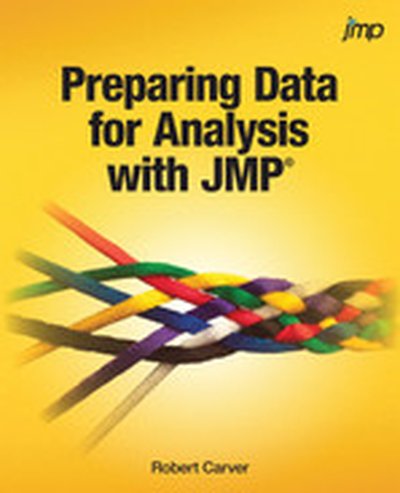
Preparing Data for Analysis with JMP

Access and clean up data easily using JMP®! Data acquisition and preparation commonly consume approximately 75% of the effort and time of total data analysis. JMP provides many visual, intuitive, and even innovative data-preparation capabilities that enable you to make the most of your organization's data. Preparing Data for Analysis with JMP® is organized within a framework of statistical investigations and model-building and illustrates the new data-handling features in JMP, such as the Query Builder. Useful to students and programmers with little or no JMP experience, or those looking to learn the new data-management features and techniques, it uses a practical approach to getting started with plenty of examples. Using step-by-step demonstrations and screenshots, this book walks you through the most commonly used data-management techniques that also include lots of tips on how to avoid common problems. With this book, you will learn how to: Manage database operations using the JMP Query Builder Get data into JMP from other formats, such as Excel, csv, SAS, HTML, JSON, and the web Identify and avoid problems with the help of JMP’s visual and automated data-exploration tools Consolidate data from multiple sources with Query Builder for tables Deal with common issues and repairs that include the following tasks: reshaping tables (stack/unstack) managing missing data with techniques such as imputation and Principal Components Analysis cleaning and correcting dirty data computing new variables transforming variables for modelling reconciling time and date Subset and filter your data Save data tables for exchange with other platforms

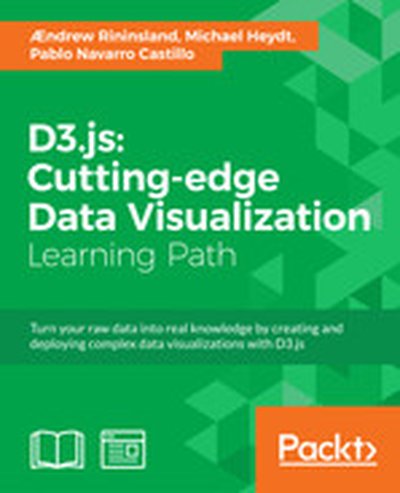
D3.js: Cutting-edge Data Visualization

Turn your raw data into real knowledge by creating and deploying complex data visualizations with D3.js About This Book Understand how to best represent your data by developing the right kind of visualization Explore the concepts of D3.js through examples that enable you to quickly create visualizations including charts, network diagrams, and maps Get practical examples of visualizations using real-world data sets that show you how to use D3.js to visualize and interact with information to glean its underlying meaning Who This Book Is For Whether you are new to data and data visualization, a seasoned data scientist, or a computer graphics specialist, this Learning Path will provide you with the skills you need to create web-based and interactive data visualizations. Some basic JavaScript knowledge is expected, but no prior experience with data visualization or D3 is required What You Will Learn Gain a solid understanding of the common D3 development idioms Find out how to write basic D3 code for servers using Node.js Install and use D3.js to create HTML elements within a document Create and style graphical elements such as circles, ellipses, rectangles, lines, paths, and text using SVG Turn your data into bar and scatter charts, and add margins, axes, labels, and legends Use D3.js generators to perform the magic of creating complex visualizations from data Add interactivity to your visualizations, including tool-tips, sorting, hover-to-highlight, and grouping and dragging of visuals Write, test, and distribute a D3-based charting package Make a real-time application with Node and D3 In Detail D3 has emerged as one of the leading platforms to develop beautiful, interactive visualizations over the web. We begin the course by setting up a strong foundation, then build on this foundation as we take you through the entire world of reimagining data using interactive, animated visualizations created in D3.js. In the first module, we cover the various features of D3.js to build a wide range of visualizations. We also focus on the entire process of representing data through visualizations. By the end of this module, you will be ready to use D3 to transform any data into a more engaging and sophisticated visualization. In the next module, you will learn to master the creation of graphical elements from data. Using practical examples provided, you will quickly get to grips with the features of D3.js and use this learning to create your own spectacular data visualizations with D3.js. Over the last leg of this course, you will get acquainted with how to integrate D3 with mapping libraries to provide reverse geocoding and interactive maps among many other advanced features of D3. This module culminates by showing you how to create enterprise-level dashboards to display real-time data. This Learning Path combines some of the best that Packt has to offer in one complete, curated package. It includes content from the following Packt products: Learning D3.js Data Visualization, Second Edition by Andrew H. Rininsland D3.js By Example by Michael Heydt Mastering D3.js by Pablo Navarro Castillo Style and approach This course provides a comprehensive explanation of how to leverage the power of D3.js to create powerful and creative visualizations through step-by-step instructions in the form of modules. Each module help you skill up a level in creating meaningful visualizations. Downloading the example code for this book. You can download the example code files for all Packt books you have purchased from your account at http://www.PacktPub.com. If you purchased this book elsewhere, you can visit http://www.PacktPub.com/support and register to have the code file.

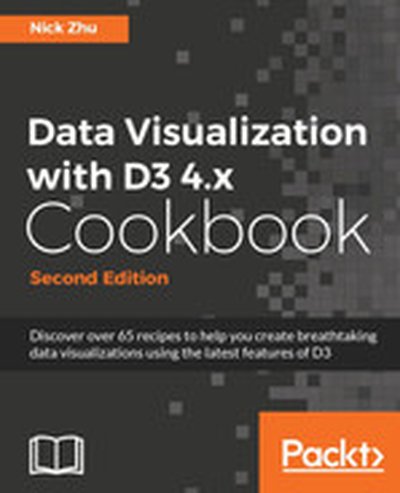
Data Visualization with D3 4.x Cookbook - Second Edition

This book, 'Data Visualization with D3 4.x Cookbook' by Nick Zhu, is your ultimate guide to mastering data visualization using D3.js. Through practical recipes, you'll learn to create dynamic, data-driven visualizations and tackle real-world visualization challenges. The book also introduces techniques to manage and present data powerfully. What this Book will help me do Master D3.js 4.x features to create efficient data visualizations. Utilize pre-built recipes to generate diverse charts and graphs. Acquire expertise in manipulating datasets for visualization. Develop interactive, dynamic web applications with D3. Overcome common visualization challenges with practical solutions. Author(s) Nick Zhu is a professional data engineer and an expert in creating data-driven applications. With years of experience using D3.js, Nick brings his wealth of knowledge to writing, making complex concepts accessible to learners. He creates resources to help others enhance their data visualization skills. Who is it for? This book is ideal for developers and data analysts familiar with web technologies like HTML, CSS, and JavaScript, aiming to expand their skills with D3.js. Whether you're new to D3 or experienced and looking for a comprehensive reference, this book will empower you to create professional-grade visualizations.

Professional Microsoft SQL Server 2016 Reporting Services and Mobile Reports

Optimize reporting and BI with Microsoft SQL Server 2016 Professional Microsoft SQL Server 2016 Reporting Services and Mobile Reports provides a comprehensive lesson in business intelligence (BI), operational reporting and Reporting Services architecture using a clear, concise tutorial approach. You'll learn effective report solution design based upon many years of experience with successful report solutions. Improve your own reports with advanced, best-practice design, usability, query design, and filtering techniques. Expert guidance provides insight into common report types and explains where each could be made more efficient, while providing step-by step instruction on Microsoft SQL Server 2016. All changes to the 2016 release are covered in detail, including improvements to the Visual Studio Report Designer (SQL Server Data Tools) and Report Builder, Mobile Dashboard Designer, the new Report Portal Interface, HTML-5 Rendering, Power BI integration, Custom Parameters Pane, and more. The Microsoft SQL Server 2016 release will include significant changes. New functionality, new capabilities, re-tooled processes, and changing support require a considerable update to existing knowledge. Whether you're starting from scratch or simply upgrading, this book is an essential guide to report design and business intelligence solutions. Understand BI fundamentals and Reporting Services architecture Learn the ingredients to a successful report design Get up to speed on Microsoft SQL Server 2016 Grasp the purpose behind common designs to optimize your reporting Microsoft SQL Server Reporting Services makes reporting faster, easier, and more powerful than ever in web, desktop and portal solutions. Compatibility with an extensive variety of data sources makes it a go-to solution for organizations across the globe. The 2016 release brings some of the biggest changes in years, and the full depth and breadth of these changes can create a serious snag in your workflow. For a clear tutorial geared toward the working professional, Professional Microsoft SQL Server 2016 Reporting Services and Mobile Reports is the ideal guide for getting up to speed and producing successful reports.

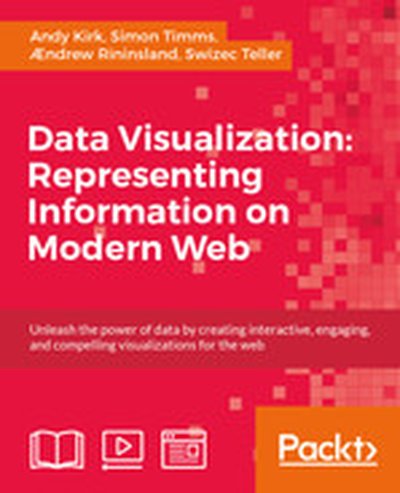
Data Visualization: Representing Information on Modern Web

Unleash the power of data by creating interactive, engaging, and compelling visualizations for the web About This Book Get a portable, versatile, and flexible data visualization design approach that will help you navigate the complex path towards success Get thorough explanation of the many visual variables and visualization taxonomy to provide you with a menu of creative options A comprehensive and contemporary introduction to data-driven visualization design and the most effective approaches to designing impact-maximizing and cognition-amplifying visualizations Who This Book Is For This course is for developers who are excited about data and who want to share that excitement with others and it will be handy for the web developers or data scientists who want to create interactive visualizations for the web. Prior knowledge of developing web applications is required. You should have a working knowledge of both JavaScript and HTML. What You Will Learn Harness the power of D3 by building interactive and real-time data-driven web visualizations Find out how to use JavaScript to create compelling visualizations of social data Identify the purpose of your visualization and your project's parameters to determine overriding design considerations across your project's execution Apply critical thinking to visualization design and get intimate with your dataset to identify its potential visual characteristics Explore the various features of HTML5 to design creative visualizations Discover what data is available on Stack Overflow, Facebook, Twitter, and Google+ Gain a solid understanding of the common D3 development idioms Find out how to write basic D3 code for server using Node.js In Detail Do you want to create more attractive charts? Or do you have huge data sets and need to unearth the key insights in a visual manner? Data visualization is the representation and presentation of data, using proven design techniques to bring alive the patterns, stories, and key insights that are locked away. This learning path is divided into three modules. The first module will equip you with the key techniques required to overcome contemporary data visualization challenges. After getting familiar with key concepts of data visualization, it's time to incorporate it with various technologies. In the second module, Social Data Visualization with HTML5 and JavaScript, it teaches you how to leverage HTML5 techniques through JavaScript to build visualizations. It also clears up how the often complicated OAuth protocol works to help you unlock a universe of social media data from sites such as Twitter, Facebook, and Google+. Once you are familiar with the concepts of incorporating data visualization with HTML5 and JavaScript, third module, Learning d3.js Data Visualization, will lead you to D3, which has emerged as one of the leading platforms to develop beautiful, interactive visualizations over the web. This module provides a strong foundation in designing compelling web visualizations with D3.js. By the end of this course, you will have unlocked the mystery behind successful data visualizations. This Learning Path combines some of the best that Packt has to offer in one complete, curated package. It includes content from the following Packt products: Data Visualization: a successful design process by Andy Kirk Social Data Visualization with HTML5 and JavaScript by Simon Timms Learning d3.js Data Visualization, Second Edition by Ændrew Rininsland and Swizec Teller Style and approach This course includes all the resources that will help you jump into creating interactive and engaging visualizations for the web. Through this comprehensive course, you’ll learn how to create engaging visualizations for the web to represent your data from start to finish! Downloading the example code for this book. You can download the example code files for all Packt books you have purchased from your account at http://www.PacktPub.com. If you purchased this book elsewhere, you can visit http://www.PacktPub.com/support and register to have the code file.

Exploratory Factor Analysis with SAS

Explore the mysteries of Exploratory Factor Analysis (EFA) with SAS with an applied and user-friendly approach.

Exploratory Factor Analysis with SAS focuses solely on EFA, presenting a thorough and modern treatise on the different options, in accessible language targeted to the practicing statistician or researcher. This book provides real-world examples using real data, guidance for implementing best practices in the context of SAS, interpretation of results for end users, and it provides resources on the book's author page. Faculty teaching with this book can utilize these resources for their classes, and individual users can learn at their own pace, reinforcing their comprehension as they go.

Exploratory Factor Analysis with SAS reviews each of the major steps in EFA: data cleaning, extraction, rotation, interpretation, and replication. The last step, replication, is discussed less frequently in the context of EFA but, as we show, the results are of considerable use. Finally, two other practices that are commonly applied in EFA, estimation of factor scores and higher-order factors, are reviewed. Best practices are highlighted throughout the chapters.

A rudimentary working knowledge of SAS is required but no familiarity with EFA or with the SAS routines that are related to EFA is assumed.

Using SAS University Edition? You can use the code and data sets provided with this book. This helpful link will get you started: http://support.sas.com/publishing/import_ue.data.html

Web Application Development with R Using Shiny Second Edition - Second Edition

This book dives into the practical application of R's power combined with Shiny's simplicity to build web-based analytics and interactive data summary tools. By following this step-by-step guide, you'll go from the basics of building with R and Shiny to creating sophisticated custom dashboards and interactive web apps. What this Book will help me do Create interactive web apps and dashboards using Shiny with impressive user interfaces. Integrate Shiny applications into custom HTML and CSS-based web pages for enhanced flexibility. Produce user-friendly Shiny applications extended with JavaScript and jQuery for added functionality. Develop web solutions that include interactive graphics, maps, and data analysis summaries. Deliver and deploy web apps securely using cloud solutions or self-hosted servers. Author(s) Chris Beeley, an experienced R developer and teacher, has a robust background in statistical programming and data analysis. Chris is passionate about sharing knowledge through practical examples and hands-on exercises. As the author of this book, Chris ensures that readers receive a clear and approachable entry into web application development using Shiny. Who is it for? This book is ideal for data enthusiasts, analysts, and developers looking to transition their analytic skills to the web. It caters to readers with basic programming knowledge but does not require prior experience with R or Shiny. It is perfect for professionals and learners wanting to create interactive analytics tools, dashboards, or data-driven web applications.

Web Development with MongoDB and NodeJS - Second Edition

Discover how to build a full-featured, interactive web application from scratch using Node.js and MongoDB in this comprehensive guide. You will learn to set up your development environment, create a web server with Express.js, and integrate MongoDB for data persistence. By the end of this book, you will have the knowledge and skills to develop and deploy robust web applications ready for the cloud. What this Book will help me do Set up a Node.js development environment and connect it to MongoDB. Develop a web server using Express.js and write integrated APIs. Implement dynamic HTML pages leveraging the Handlebars template engine. Build efficient and scalable data-driven features using Mongoose ODM. Deploy web applications seamlessly to cloud platforms like Heroku, AWS, or Azure. Author(s) This book was co-authored by experts None Satheesh, None Joseph D'mello, and Jason Krol, who bring years of experience in software development and expertise in modern web technologies. With a focus on practical application and best practices, the authors aim to empower readers to succeed in real-world development projects using the innovative Node.js and MongoDB stack. Who is it for? This book is tailored for developers who have a basic understanding of JavaScript and HTML and wish to advance their web development skills. If you are motivated to learn how to leverage Node.js and MongoDB for full-stack development or are curious about building and deploying complete web applications, this book is ideal for you. It addresses learners from early career to experienced developers looking to strengthen their skills in modern development stacks.

Introduction to JavaScript Object Notation

What is JavaScript Object Notation (JSON) and how can you put it to work? This concise guide helps busy IT professionals get up and running quickly with this popular data interchange format, and provides a deep understanding of how JSON works. Author Lindsay Bassett begins with an overview of JSON syntax, data types, formatting, and security concerns before exploring the many ways you can apply JSON today. From Web APIs and server-side language libraries to NoSQL databases and client-side frameworks, JSON has emerged as a viable alternative to XML for exchanging data between different platforms. If you have some programming experience and understand HTML and JavaScript, this is your book. Learn why JSON syntax represents data in name-value pairs Explore JSON data types, including object, string, number, and array Find out how you can combat common security concerns Learn how the JSON schema verifies that data is formatted correctly Examine the relationship between browsers, web APIs, and JSON Understand how web servers can both request and create data Discover how jQuery and other client-side frameworks use JSON Learn why the CouchDB NoSQL database uses JSON to store data

Toad for Oracle Unleashed

Bert Scalzo and Dan Hotka have written the definitive, up-to-date guide to Version 12.x, Dell’s powerful new release of Toad for Oracle. Packed with step-by-step recipes, detailed screen shots, and hands-on exercises, Toad for Oracle Unleashed shows both developers and DBAs how to maximize their productivity. Drawing on their unsurpassed experience running Toad in production Oracle environments, Scalzo and Hotka thoroughly cover every area of Toad’s functionality. You’ll find practical insights into each of Toad’s most useful tools, from App Designer to Doc Generator, ER Diagrammer to Code Road Map. The authors offer proven solutions you can apply immediately to solve a wide variety of problems, from maintaining code integrity to automating performance and scalability testing. Learn how to… Install and launch Toad, connect to a database, and explore Toad’s new features Customize Toad to optimize productivity in your environment Use the Editor Window to execute SQL and PL/SQL, and view, save, or convert data Browse your schema, and create and edit objects Quickly generate useful reports with FastReport and Report Manager Clarify your database’s tables and data with the powerful Entity Relationship Diagrammer (ERD) and HTML documentation generator Work more efficiently with PL/SQL using code templates, snippets, and shortcuts Automate actions and applications with Automation Designer Perform key DBA tasks including database health checks, tablespace management, database and schema comparisons, and object rebuilding Identify and optimize poorlyperforming SQL and applications ON THE WEB:Download all examples and source code presented in this book from informit.com/title/9780134131856 as it becomes available.

Designing and Operating a Data Reservoir

Together, big data and analytics have tremendous potential to improve the way we use precious resources, to provide more personalized services, and to protect ourselves from unexpected and ill-intentioned activities. To fully use big data and analytics, an organization needs a system of insight. This is an ecosystem where individuals can locate and access data, and build visualizations and new analytical models that can be deployed into the IT systems to improve the operations of the organization. The data that is most valuable for analytics is also valuable in its own right and typically contains personal and private information about key people in the organization such as customers, employees, and suppliers. Although universal access to data is desirable, safeguards are necessary to protect people's privacy, prevent data leakage, and detect suspicious activity. The data reservoir is a reference architecture that balances the desire for easy access to data with information governance and security. The data reservoir reference architecture describes the technical capabilities necessary for a system of insight, while being independent of specific technologies. Being technology independent is important, because most organizations already have investments in data platforms that they want to incorporate in their solution. In addition, technology is continually improving, and the choice of technology is often dictated by the volume, variety, and velocity of the data being managed. A system of insight needs more than technology to succeed. The data reservoir reference architecture includes description of governance and management processes and definitions to ensure the human and business systems around the technology support a collaborative, self-service, and safe environment for data use. The data reservoir reference architecture was first introduced in Governing and Managing Big Data for Analytics and Decision Makers, REDP-5120, which is available at: http://www.redbooks.ibm.com/redpieces/abstracts/redp5120.html. This IBM® Redbooks publication, Designing and Operating a Data Reservoir, builds on that material to provide more detail on the capabilities and internal workings of a data reservoir.