talk-data.com talk-data.com

Topic

IoT

Internet of Things (IoT)

connected_devices sensors data_collection

16

tagged

Activity Trend

11 peak/qtr
2020-Q1 2026-Q1

Activities

16 activities · Newest first

AWS re:Invent 2025 - Building an AI-powered waste classification using Amazon Nova & IoT (AIM256)

AWS Chile revolutionized waste management by developing an intelligent classification system using Amazon Nova, IoT, and serverless architecture. This revolutionary solution processes waste items in under 3 seconds with 95% accuracy, while keeping implementation costs below $300 USD and operational costs under $3 per 1,000 images. Explore the technical architecture integrating edge computing, computer vision, and AI to create a real-time classification system that improved recycling efficiency by 52%, preventing 644.7 kg of CO2 emissions in six months. Learn to implement this cost-effective solution in your organization using AWS, and understand key challenges and lessons learned from this sustainability initiative.

Learn more: More AWS events: https://go.aws/3kss9CP

Subscribe: More AWS videos: http://bit.ly/2O3zS75 More AWS events videos: http://bit.ly/316g9t4

ABOUT AWS: Amazon Web Services (AWS) hosts events, both online and in-person, bringing the cloud computing community together to connect, collaborate, and learn from AWS experts. AWS is the world's most comprehensive and broadly adopted cloud platform, offering over 200 fully featured services from data centers globally. Millions of customers—including the fastest-growing startups, largest enterprises, and leading government agencies—are using AWS to lower costs, become more agile, and innovate faster.


AWSreInvent #AWSreInvent2025 #AWS

Sponsored by: Redpanda | IoT for Fun & Prophet: Scaling IoT and predicting the future with Redpanda, Iceberg & Prophet

In this talk, we’ll walk through a complete real-time IoT architecture—from an economical, high-powered ESP32 microcontroller publishing environmental sensor data to AWS IoT, through Redpanda Connect into a Redpanda BYOC cluster, and finally into Apache Iceberg for long-term analytical storage. Once the data lands, we’ll query it using Python and perform linear regression with Prophet to forecast future trends. Along the way, we’ll explore the design of a scalable, cloud-native pipeline for streaming IoT data. Whether you're tracking the weather or building the future, this session will help you architect with confidence—and maybe even predict it.

Sponsored by: Anomalo | Reconciling IoT, Policy, and Insurer Data to Deliver Better Customer Discounts

As insurers increasingly leverage IoT data to personalize policy pricing, reconciling disparate datasets across devices, policies, and insurers becomes mission-critical. In this session, learn how Nationwide transitioned from prototype workflows in Dataiku to a hardened data stack on Databricks, enabling scalable data governance and high-impact analytics. Discover how the team orchestrates data reconciliation across Postgres, Oracle, and Databricks to align customer driving behavior with insurer and policy data—ensuring more accurate, fair discounts for policyholders. With Anomalo’s automated monitoring layered on top, Nationwide ensures data quality at scale while empowering business units to define custom logic for proactive stewardship. We’ll also look ahead to how these foundations are preparing the enterprise for unstructured data and GenAI initiatives.

How Blue Origin Accelerates Innovation With Databricks and AWS GovCloud

Blue Origin is revolutionizing space exploration with a mission-critical data strategy powered by Databricks on AWS GovCloud. Learn how they leverage Databricks to meet ITAR and FedRAMP High compliance, streamline manufacturing and accelerate their vision of a 24/7 factory. Key use cases include predictive maintenance, real-time IoT insights and AI-driven tools that transform CAD designs into factory instructions. Discover how Delta Lake, Structured Streaming and advanced Databricks functionalities like Unity Catalog enable real-time analytics and future-ready infrastructure, helping Blue Origin stay ahead in the race to adopt generative AI and serverless solutions.

From Prediction to Prevention: Transforming Risk Management in Insurance

Protecting insurers against emerging threats is critical. This session reveals how leading companies use Databricks’ Data Intelligence Platform to transform risk management, enhance fraud detection, and ensure compliance. Learn how advanced analytics, AI, and machine learning process vast data in real time to identify risks and mitigate threats. Industry leaders will share strategies for building resilient operations that protect against financial losses and reputational harm. Key takeaways: AI-powered fraud prevention using anomaly detection and predictive analytics Real-time risk assessment models integrating IoT, behavioral, and external data Strategies for robust compliance and governance with operational efficiency Discover how data intelligence is revolutionizing insurance risk management and safeguarding the industry’s future.

Real-Time Analytics Pipeline for IoT Device Monitoring and Reporting

This session will show how we implemented a solution to support high-frequency data ingestion from smart meters. We implemented a robust API endpoint that interfaces directly with IoT devices. This API processes messages in real time from millions of distributed IoT devices and meters across the network. The architecture leverages cloud storage as a landing zone for the raw data, followed by a streaming pipeline built on Lakeflow Declarative Pipelines. This pipeline implements a multi-layer medallion architecture to progressively clean, transform and enrich the data. The pipeline operates continuously to maintain near real-time data freshness in our gold layer tables. These datasets connect directly to Databricks Dashboards, providing stakeholders with immediate insights into their operational metrics. This solution demonstrates how modern data architecture can handle high-volume IoT data streams while maintaining data quality and providing accessible real-time analytics for business users.

Sponsored by: Domo | Orchestrating Fleet Intelligence with AI Agents and Real-Time IoT With Databricks + DOMO

In today’s logistics landscape, operational continuity depends on real time awareness and proactive decision making. This session presents an AI agent driven solution built on Databricks that transforms real time fleet IoT data into autonomous workflows. Streaming telemetry such as bearing vibration data is ingested and analyzed using FFT to detect anomalies. When a critical pattern is found, an AI agent diagnoses root causes and simulates asset behavior as a digital twin, factoring in geolocation, routing, and context. The agent then generates a corrective strategy by identifying service sites, skilled personnel, and parts, estimating repair time, and orchestrating reroutes. It evaluates alternate delivery vehicles and creates transfer plans for critical shipments. The system features human AI collaboration, enabling teams to review and execute plans. Learn how this architecture reduces downtime and drives resilient, adaptive fleet management.

Event Driven Real-Time Supply Chain Ecosystem Powered by Lakehouse

As the backbone of Australia’s supply chain, the Australia Rail Track Corporation (ARTC) plays a vital role in the management and monitoring of goods transportation across 8,500km of its rail network throughout Australia. ARTC provides weighbridges along their track which read train weights as they pass at speeds of up to 60 kilometers an hour. This information is highly valuable and is required both by ARTC and their customers to provide accurate haulage weight details, analyze technical equipment, and help ensure wagons have been loaded correctly.

A total of 750 trains run across a network of 8500 km in a day and generate real-time data at approximately 50 sensor platforms. With the help of structured streaming and Delta Lake, ARTC was able to analyze and store:

  • Precise train location
  • Weight of the train in real-time
  • Train crossing time to the second level
  • Train speed, temperature, sound frequency, and friction
  • Train schedule lookups

Once all the IoT data has been pulled together from an IoT event hub, it is processed in real-time using structured streaming and stored in Delta Lake. To understand the train GPS location, API calls are then made per minute per train from the Lakehouse. API calls are made in real-time to another scheduling system to lookup customer info. Once the processed/enriched data is stored in Delta Lake, an API layer was also created on top of it to expose this data to all consumers.

The outcome: increased transparency on weight data as it is now made available to customers; we built a digital data ecosystem that now ARTC’s customers use to meet their KPIs/ planning; the ability to determine temporary speed restrictions across the network to improve train scheduling accuracy and also schedule network maintenance based on train schedules and speed.

Talk by: Deepak Sekar and Harsh Mishra

Connect with us: Website: https://databricks.com Twitter: https://twitter.com/databricks LinkedIn: https://www.linkedin.com/company/databricks Instagram: https://www.instagram.com/databricksinc Facebook: https://www.facebook.com/databricksinc

Sponsored: AWS-Real Time Stream Data & Vis Using Databricks DLT, Amazon Kinesis, & Amazon QuickSight

Amazon Kinesis Data Analytics is a managed service that can capture streaming data from IoT devices. Databricks Lakehouse platform provides ease of processing streaming and batch data using Delta Live Tables. Amazon Quicksight with powerful visualization capabilities can provides various advanced visualization capabilities with direct integration with Databricks. Combining these services, customers can capture, process, and visualize data from hundreds and thousands of IoT sensors with ease.

Talk by: Venkat Viswanathan

Here’s more to explore: Big Book of Data Engineering: 2nd Edition: https://dbricks.co/3XpPgNV The Data Team's Guide to the Databricks Lakehouse Platform: https://dbricks.co/46nuDpI

Connect with us: Website: https://databricks.com Twitter: https://twitter.com/databricks LinkedIn: https://www.linkedin.com/company/databricks Instagram: https://www.instagram.com/databricksinc Facebook: https://www.facebook.com/databricksinc

Leveraging IoT Data at Scale to Mitigate Global Water Risks Using Apache Spark™ Streaming and Delta

Every year, billions of dollars are lost due to water risks from storms, floods, and droughts. Water data scarcity and excess are issues that risk models cannot overcome, creating a world of uncertainty. Divirod is building a platform of water data by normalizing diverse data sources of varying velocity into one unified data asset. In addition to publicly available third-party datasets, we are rapidly deploying our own IoT sensors. These sensors ingest signals at a rate of about 100,000 messages per hour into preprocessing, signal-processing, analytics, and postprocessing workloads in one spark-streaming pipeline to enable critical real-time decision-making processes. By leveraging streaming architecture, we were able to reduce end-to-end latency from tens of minutes to just a few seconds.

We are leveraging Delta Lake to provide a single query interface across multiple tables of this continuously changing data. This enables data science and analytics workloads to always use the most current and comprehensive information available. In addition to the obvious schema transformations, we implement data quality metrics and datum conversions to provide a trustworthy unified dataset.

Talk by: Adam Wilson and Heiko Udluft

Here’s more to explore: Big Book of Data Engineering: 2nd Edition: https://dbricks.co/3XpPgNV The Data Team's Guide to the Databricks Lakehouse Platform: https://dbricks.co/46nuDpI

Connect with us: Website: https://databricks.com Twitter: https://twitter.com/databricks LinkedIn: https://www.linkedin.com/company/databricks Instagram: https://www.instagram.com/databricksinc Facebook: https://www.facebook.com/databricksinc

Apache Spark™ Streaming and Delta Live Tables Accelerates KPMG Clients For Real Time IoT Insights

Unplanned downtime in manufacturing costs firms up to a trillion dollars annually. Time that materials spend sitting on a production line is lost revenue. Even just 15 hours of downtime a week adds up to over 800 hours of downtime yearly. The use of Internet of Things or IoT devices can cut this time down by providing details of machine metrics. However, IoT predictive maintenance is challenged by the lack of effective, scalable infrastructure and machine learning solutions. IoT data can be the size of multiple terabytes per day and can come in a variety of formats. Furthermore, without any insights and analysis, this data becomes just another table.

The KPMG Databricks IoT Accelerator is a comprehensive solution enabling manufacturing plant operators to have a bird’s eye view of their machines’ health and empowers proactive machine maintenance across their portfolio of IoT devices. The Databricks Accelerator ingests IoT streaming data at scale and implements the Databricks Medallion architecture while leveraging Delta Live Tables to clean and process data. Real time machine learning models are developed from IoT machine measurements and are managed in MLflow. The AI predictions and IoT device readings are compiled in the gold table powering downstream dashboards like Tableau. Dashboards inform machine operators of not only machines’ ailments, but action they can take to mitigate issues before they arise. Operators can see fault history to aid in understanding failure trends, and can filter dashboards by fault type, machine, or specific sensor reading. 

Talk by: MacGregor Winegard

Connect with us: Website: https://databricks.com Twitter: https://twitter.com/databricks LinkedIn: https://www.linkedin.com/company/databricks Instagram: https://www.instagram.com/databricksinc Facebook: https://www.facebook.com/databricksin

Detecting Data Anomalies via an Inspection Layer

Let's face it, we can't get enough data these days and often ingest from various sources like vendors, IoT devices, and more. Unfortunately, you've likely encountered times when the data just isn't what you're expecting. For instance; when the data has nulls, duplicates, is arranged differently than the schema specification, or others - this can be a weak point for many data pipelines. We'll showcase a way to handle this using dbt native methods to implement an inspection layer to ensure erroneous data sets can be flagged and quarantined while the rest can load uninterrupted.

Check the slides here: https://docs.google.com/presentation/d/11Q9wwMfyz6xuxMXCPizFg4DKSY_zOIHPNOrsNI8oBn8/edit?usp=sharing

Coalesce 2023 is coming! Register for free at https://coalesce.getdbt.com/.

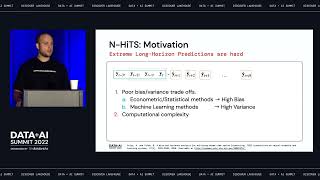
Nixtla: Deep Learning for Time Series Forecasting

Time series forecasting has a wide range of applications: finance, retail, healthcare, IoT, etc. Recently deep learning models such as ESRNN or N-BEATS have proven to have state-of-the-art performance in these tasks. Nixtlats is a python library that we have developed to facilitate the use of these state-of-the-art models to data scientists and developers, so that they can use them in productive environments. Written in pytorch, its design is focused on usability and reproducibility of experiments. For this purpose, nixtlats has several modules:

Data: contains datasets of various time series competencies. Models: includes state-of-the-art models. Evaluation: has various loss functions and evaluation metrics.

Objective:

  • To introduce attendees to the challenges of time series forecasting with deep learning.
  • Commercial applications of time series forecasting.
  • Describe nixtlats, their components and best practices for training and deploying state-of-the-art models in production.
  • Reproduction of state-of-the-art results using nixtlats from the winning model of the M4 time series competition (ESRNN).

Project repository: https://github.com/Nixtla/nixtlats.

Connect with us: Website: https://databricks.com Facebook: https://www.facebook.com/databricksinc Twitter: https://twitter.com/databricks LinkedIn: https://www.linkedin.com/company/data... Instagram: https://www.instagram.com/databricksinc/

Revolutionizing agriculture with AI: Delivering smart industrial solutions built upon a Lakehouse

John Deere is leveraging big data and AI to deliver ‘smart’ industrial solutions that are revolutionizing agriculture and construction, driving sustainability and ultimately helping to feed the world. The John Deere Data Factory that is built upon the Databricks Lakehouse Platform is at the core of this innovation. It ingests petabytes of data and trillions of records to give data teams fast, reliable access to standardized data sets supporting 100s of ML and analytics use cases across the organization. From IoT sensor-enabled equipment driving proactive alerts that prevent failures, to precision agriculture that maximizes field output, to optimizing operations in the supply chain, finance and marketing, John Deere is providing advanced products, technology and services for customers who cultivate, harvest, transform, enrich, and build upon the land.

Connect with us: Website: https://databricks.com Facebook: https://www.facebook.com/databricksinc Twitter: https://twitter.com/databricks LinkedIn: https://www.linkedin.com/company/data... Instagram: https://www.instagram.com/databricksinc/

Redis: A Multi-Model DB for IoT and Beyond by Dr. Christoph Zimmermann

Big Data Europe Onsite and online on 22-25 November in 2022 Learn more about the conference: https://bit.ly/3BlUk9q

Join our next Big Data Europe conference on 22-25 November in 2022 where you will be able to learn from global experts giving technical talks and hand-on workshops in the fields of Big Data, High Load, Data Science, Machine Learning and AI. This time, the conference will be held in a hybrid setting allowing you to attend workshops and listen to expert talks on-site or online.

Forging new frontiers: How Forza Steel built an AI-ready foundation

Enterprise leaders are driving continuous transformation to stay at the forefront of real-time intelligent growth. Join us to learn how Forza Steel collaborated with Kyndryl and Microsoft to build a unified AI platform with Microsoft Fabric, Power BI, and Azure IoT to drive real-time insights, automation, and predictive analytics across manufacturing, logistics, and finance, as well as migrate their on-prem SAP to RISE on Azure.