talk-data.com talk-data.com

Topic

Parquet

Apache Parquet

columnar_storage big_data compression file_format storage

20

tagged

Activity Trend

5 peak/qtr
2020-Q1 2026-Q1

Activities

20 activities · Newest first

When Rivers Speak: Analyzing Massive Water Quality Datasets using USGS API and Remote SSH in Positron

Rivers have long been storytellers of human history. From the Nile to the Yangtze, they have shaped trade, migration, settlement, and the rise of civilizations. They reveal the traces of human ambition... and the costs of it. Today, from the Charles to the Golden Gate, US rivers continue to tell stories, especially through data.

Over the past decades, extensive water quality monitoring efforts have generated vast public datasets: millions of measurements of pH, dissolved oxygen, temperature, and conductivity collected across the country. These records are more than environmental snapshots; they are archives of political priorities, regulatory choices, and ecological disruptions. Ultimately, they are evidence of how societies interact with their environments, often unevenly.

In this talk, I’ll explore how Python and modern data workflows can help us "listen" to these stories at scale. Using the United States Geological Survey (USGS) Water Data APIs and Remote SSH in Positron, I’ll process terabytes of sensor data spanning several years and regions. I’ll demonstrate that, while Parquet and DuckDB enable scalable exploration of historical records, using Remote SSH is paramount in order to enable large-scale data analysis. By doing so, I hope to answer some analytical questions that can surface patterns linked to industrial growth, regulatory shifts, and climate change.

By treating rivers as both ecological systems and social mirrors, we can begin to see how environmental data encodes histories of inequality, resilience, and transformation.

Whether your interest lies in data engineering, environmental analytics, or the human dimensions of climate and infrastructure, this talk will explore topics at the intersection of environmental science, will offer both technical methods and sociological lenses to understand the stories rivers continue to tell.
AWS re:Invent 2025 - Using graphs over your data lake to power generative AI applications (DAT447)

In this session, learn about new Amazon Neptune capabilities for high-performance graph analytics and queries over data lakes to unlock the implicit and explicit relationships in your data, driving more accurate, trustworthy generative AI responses. We'll demonstrate building knowledge graphs from structured and unstructured data, combining graph algorithms (PageRank, Louvain clustering, path optimization) with semantic search, and executing Cypher queries on Parquet and Iceberg formats in Amazon S3. Through code samples and benchmarks, learn advanced architectures to use Neptune for multi-hop reasoning, entity linking, and context enrichment at scale. This session assumes familiarity with graph concepts and data lake architectures.

Learn more: More AWS events: https://go.aws/3kss9CP

Subscribe: More AWS videos: http://bit.ly/2O3zS75 More AWS events videos: http://bit.ly/316g9t4

ABOUT AWS: Amazon Web Services (AWS) hosts events, both online and in-person, bringing the cloud computing community together to connect, collaborate, and learn from AWS experts. AWS is the world's most comprehensive and broadly adopted cloud platform, offering over 200 fully featured services from data centers globally. Millions of customers—including the fastest-growing startups, largest enterprises, and leading government agencies—are using AWS to lower costs, become more agile, and innovate faster.

AWSreInvent #AWSreInvent2025 #AWS

Wrangling Internet-scale Image Datasets

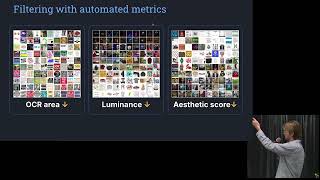
Building and curating datasets at internet scale is both powerful and messy. At Irreverent Labs, we recently released Re-LAION-Caption19M, a 19-million–image dataset with improved captions, alongside a companion arXiv paper. Behind the scenes, the project involved wrangling terabytes of raw data and designing pipelines that could produce a research-quality dataset while remaining resilient, efficient, and reproducible. In this talk, we’ll share some of the practical lessons we learned while engineering data at this scale. Topics include: strategies for ensuring data quality through a mix of automated metrics and human inspection; why building file manifests pays off when dealing with millions of files; effective use of Parquet, WDS and JSONL for metadata and intermediate results; pipeline patterns that favor parallel processing and fault tolerance; and how logging and dashboards can turn long-running jobs from opaque into observable. Whether you’re working with images, text, or any other massive dataset, these patterns and pitfalls may help you design pipelines that are more robust, maintainable, and researcher-friendly.

State of Parquet 2025: Structure, Optimizations, and Recent Innovations

If you worked with large amounts of tabular data, chances are you have dealt with Parquet files. Apache Parquet is an open source, column-oriented data file format designed for efficient storage and retrieval. It employs high performance compression and encoding schemes to handle complex data at scale and is supported in many programming language and analytics tools. This talk will give a technical overview of Parquet format file structure, explain how the data is represented and stored in Parquet and why and how some of the possible configuration options might better match your specific use case.

We will also highlight some recent developments the and discussions in the Parquet community including Hugging Face's proposed content defined chunking - an approach that reduces required storage space by ten percent on realistic training datasets. We will also examine the geometry and geography types added to the Parquet specification in 2025, which enable efficient storage of spatial data and have catalyzed Parquet's growing adoption within the geospatial community.

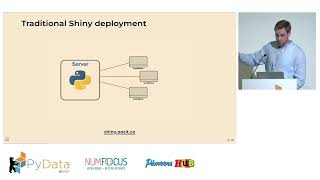
Building Reactive Data Apps with Shinylive and WebAssembly

WebAssembly is reshaping how Python applications can be delivered - allowing fully interactive apps that run directly in the browser, without a traditional backend server. In this talk, I’ll demonstrate how to build reactive, data-driven web apps using Shinylive for Python, combining efficient local storage with Parquet and extending functionality with optional FastAPI cloud services. We’ll explore the benefits and limitations of this architecture, share practical design patterns, and discuss when browser-based Python is the right choice. Attendees will leave with hands-on techniques for creating modern, lightweight, and highly responsive Python data applications.

No More Fragile Pipelines: Kafka and Iceberg the Declarative Way

Moving data between operational systems and analytics platforms is often painful. Traditional pipelines become complex, brittle, and expensive to maintain.Take Kafka and Iceberg: batching on Kafka causes ingestion bottlenecks, while streaming-style writes to Iceberg create too many small Parquet files—cluttering metadata, degrading queries, and increasing maintenance overhead. Frequent updates further strain background table operations, causing retries—even before dealing with schema evolution. But much of this complexity is avoidable. What if Kafka Topics and Iceberg Tables were treated as two sides of the same coin? By establishing a transparent equivalence, we can rethink pipeline design entirely. This session introduces Tableflow—a new approach to bridging streaming and table-based systems. It shifts complexity away from pipelines and into a unified layer, enabling simpler, declarative workflows. We’ll cover schema evolution, compaction, topic-to-table mapping, and how to continuously materialize and optimize thousands of topics as Iceberg tables. Whether modernizing or starting fresh, you’ll leave with practical insights for building resilient, scalable, and future-proof data architectures.

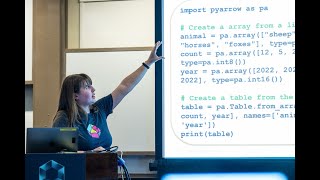
Jay Alexander Clifford: A 101 in Time Series Analytics with Apache Arrow, Pandas and Parquet

Join Jay Alexander Clifford in a deep dive into Time Series Analytics with Apache Arrow, Pandas, and Parquet. 📈🐍 Explore the power of columnar databases, and learn how to build efficient and scalable analytics applications for time series data using open-source tools. 🚀 #TimeSeries #analytics

✨ H I G H L I G H T S ✨

🙌 A huge shoutout to all the incredible participants who made Big Data Conference Europe 2023 in Vilnius, Lithuania, from November 21-24, an absolute triumph! 🎉 Your attendance and active participation were instrumental in making this event so special. 🌍

Don't forget to check out the session recordings from the conference to relive the valuable insights and knowledge shared! 📽️

Once again, THANK YOU for playing a pivotal role in the success of Big Data Conference Europe 2023. 🚀 See you next year for another unforgettable conference! 📅 #BigDataConference #SeeYouNextYear

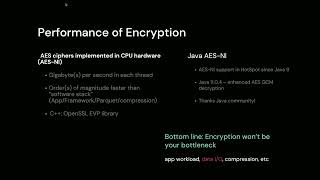
Managing Data Encryption in Apache Spark™

Sensitive data sets can be encrypted directly by new Apache Spark™ versions (3.2 and higher). Setting several configuration parameters and DataFrame options will trigger the Apache Parquet modular encryption mechanism that protects select columns with column-specific keys. The upcoming Spark 3.4 version will also support uniform encryption, where all DataFrame columns are encrypted with the same key.

Spark data encryption is already leveraged by a number of companies to protect personal or business confidential data in their production environments. The main integration effort is focused on key access control and on building a Spark/Parquet plug-in code that can interact with company’s key management service (KMS).

In this session, we will briefly cover the basics of Spark/Parquet encryption usage, and dive into the details of encryption key management that will help in integrating this Spark data protection mechanism in your deployment. You will learn how to run a HelloWorld encryption sample, and how to extend it into a real world production code integrated with your organization’s KMS and access control policies. We will talk about the standard envelope encryption approach to big data protection, the performance-vs-security trade-offs between single and double envelope wrapping, internal and external key metadata storage. We will see a demo, and discuss the new features such as uniform encryption and two-tier management of encryption keys.

Talk by: Gidon Gershinsky

Here’s more to explore: Data, Analytics, and AI Governance: https://dbricks.co/44gu3YU

Connect with us: Website: https://databricks.com Twitter: https://twitter.com/databricks LinkedIn: https://www.linkedin.com/company/databricks Instagram: https://www.instagram.com/databricksinc Facebook: https://www.facebook.com/databricksinc

Data Extraction and Sharing Via The Delta Sharing Protocol

The Delta Sharing open protocol for secure sharing and distribution of Lakehouse data is designed to reduce friction in getting data to users. Delivering custom data solutions from this protocol further leverages the technical investment committed to your Delta Lake infrastructure. There are key design and computational concepts unique to Delta Sharing to know when undertaking development. And there are pitfalls and hazards to avoid when delivering modern cloud data to traditional data platforms and users.

In this session, we introduce Delta Sharing Protocol development and examine our journey and the lessons learned while creating the Delta Sharing Excel Add-in. We will demonstrate scenarios of overfetching, underfetching, and interpretation of types. We will suggest methods to overcome these development challenges. The session will combine live demonstrations that exercise the Delta Sharing REST protocol with detailed analysis of the responses. The demonstrations will elaborate on optional capabilities of the protocol’s query mechanism, and how they are used and interpreted in real-life scenarios. As a reference baseline for data professionals, the Delta Sharing exercises will be framed relative to SQL counterparts. Specific attention will be paid to how they differ, and how Delta Sharing’s Change Data Feed (CDF) can power next-generation data architectures. The session will conclude with a survey of available integration solutions for getting the most out of your Delta Sharing environment, including frameworks, connectors, and managed services.

Attendees are encouraged to be familiar with REST, JSON, and modern programming concepts. A working knowledge of Delta Lake, the Parquet file format, and the Delta Sharing Protocol are advised.

Talk by: Roger Dunn

Here’s more to explore: A New Approach to Data Sharing: https://dbricks.co/44eUnT1

Connect with us: Website: https://databricks.com Twitter: https://twitter.com/databricks LinkedIn: https://www.linkedin.com/company/databricks Instagram: https://www.instagram.com/databricksinc Facebook: https://www.facebook.com/databricksinc

US Army Corp of Engineers Enhanced Commerce & National Sec Through Data-Driven Geospatial Insight

The US Army Corps of Engineers (USACE) is responsible for maintaining and improving nearly 12,000 miles of shallow-draft (9'-14') inland and intracoastal waterways, 13,000 miles of deep-draft (14' and greater) coastal channels, and 400 ports, harbors, and turning basins throughout the United States. Because these components of the national waterway network are considered assets to both US commerce and national security, they must be carefully managed to keep marine traffic operating safely and efficiently.

The National DQM Program is tasked with providing USACE a nationally standardized remote monitoring and documentation system across multiple vessel types with timely data access, reporting, dredge certifications, data quality control, and data management. Government systems have often lagged commercial systems in modernization efforts, and the emergence of the cloud and Data Lakehouse Architectures have empowered USACE to successfully move into the modern data era.

This session incorporates aspects of these topics: Data Lakehouse Architecture: Delta Lake, platform security and privacy, serverless, administration, data warehouse, Data Lake, Apache Iceberg, Data Mesh GIS: H3, MOSAIC, spatial analysis data engineering: data pipelines, orchestration, CDC, medallion architecture, Databricks Workflows, data munging, ETL/ELT, lakehouses, data lakes, Parquet, Data Mesh, Apache Spark™ internals. Data Streaming: Apache Spark Structured Streaming, real-time ingestion, real-time ETL, real-time ML, real-time analytics, and real-time applications, Delta Live Tables. ML: PyTorch, TensorFlow, Keras, scikit-learn, Python and R ecosystems data governance: security, compliance, RMF, NIST data sharing: sharing and collaboration, delta sharing, data cleanliness, APIs.

Talk by: Jeff Mroz

Connect with us: Website: https://databricks.com Twitter: https://twitter.com/databricks LinkedIn: https://www.linkedin.com/company/databricks Instagram: https://www.instagram.com/databricksinc Facebook: https://www.facebook.com/databricksinc

Vector Data Lakes

Vector databases such as ElasticSearch and Pinecone offer fast ingestion and querying on vector embeddings with ANNs. However, they typically do not decouple compute and storage, making them hard to integrate in production data stacks. Because data storage in these databases is expensive and not easily accessible, data teams typically maintain ETL pipelines to offload historical embedding data to blob stores. When that data needs to be queried, they get loaded back into the vector database in another ETL process. This is reminiscent of loading data from OLTP database to cloud storage, then loading said data into an OLAP warehouse for offline analytics.

Recently, “lakehouse” offerings allow direct OLAP querying on cloud storage, removing the need for the second ETL step. The same could be done for embedding data. While embedding storage in blob stores cannot satisfy the high TPS requirements in online settings, we argue it’s sufficient for offline analytics use cases like slicing and dicing data based on embedding clusters. Instead of loading the embedding data back into the vector database for offline analytics, we propose direct processing on embeddings stored in Parquet files in Delta Lake. You will see that offline embedding workloads typically touch a large portion of the stored embeddings without the need for random access.

As a result, the workload is entirely bound by network throughput instead of latency, making it quite suitable for blob storage backends. On a test one billion vector dataset, ETL into cloud storage takes around one hour on a dedicated GPU instance, while batched nearest neighbor search can be done in under one minute with four CPU instances. We believe future “lakehouses” will ship with native support for these embedding workloads.

Talk by: Tony Wang and Chang She

Here’s more to explore: State of Data + AI Report: https://dbricks.co/44i2HBp Databricks named a Leader in 2022 Gartner® Magic QuadrantTM CDBMS: https://dbricks.co/3phw20d

Connect with us: Website: https://databricks.com Twitter: https://twitter.com/databricks LinkedIn: https://www.linkedin.com/company/databricks Instagram: https://www.instagram.com/databricksinc Facebook: https://www.facebook.com/databricksinc

Ten years of building open source standards: From Parquet to Arrow to OpenLineage | Astronomer

ABOUT THE TALK: Over the last decade I have been lucky enough to contribute a few successful open source projects to the data ecosystem. In this talk

Julien Le Dem shares the story of his contribution to successful open source projects to the data ecosystem and what made their success possible. From the ideation process and early growth of the Apache Parquet columnar format and how this led to the creation of its in-memory alter-ego Apache Arrow. Julian will end with showing how this experience enabled the success of OpenLineage, an LFAI & Data project that brings observability to the data ecosystem.

ABOUT THE SPEAKER: Julien Le Dem is the Chief Architect of Astronomer and Co-Founder of Datakin. He co-created Apache Parquet and is involved in several open source projects including OpenLineage, Marquez (LFAI&Data), Apache Arrow, Apache Iceberg and a few others. Previously, he was a senior principal at Wework; principal architect at Dremio; and tech lead for Twitter’s data processing tools and principal engineer working on content platforms at Yahoo, where he received his Hadoop initiation.

ABOUT DATA COUNCIL: Data Council (https://www.datacouncil.ai/) is a community and conference series that provides data professionals with the learning and networking opportunities they need to grow their careers.

Make sure to subscribe to our channel for the most up-to-date talks from technical professionals on data related topics including data infrastructure, data engineering, ML systems, analytics and AI from top startups and tech companies.

FOLLOW DATA COUNCIL: Twitter: https://twitter.com/DataCouncilAI LinkedIn: https://www.linkedin.com/company/datacouncil-ai/

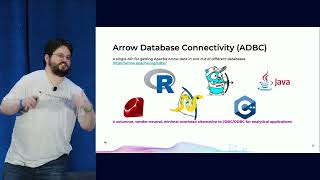
Making Moves with Arrow Data: Introducing Arrow Database Connectivity (ADBC) | Voltron Data

ABOUT THE TALK: In this talk, we'll dive into one of the newest Apache Arrow subprojects, Arrow Database Connectivity (ADBC), an API specification for Arrow-based database access.

Over the course of this session, you’ll get a crash course in ADBC and learn how it communicates with different data APIs (like Arrow Flight SQL and Postgres) using Arrow-native in-memory data. By the end, you’ll understand the use cases it can conquer and know where to access the resources you need to get started.

This talk will cover goals, use-cases, and examples of using ADBC to communicate with different Data APIs (such as Flight SQL or postgres) with Arrow Native in-memory data.

ABOUT THE SPEAKER: Matthew Topol is a committer for the Apache Arrow project, frequently enhancing the Golang Arrow and Parquet libraries among other enhancements and helping to grow the Arrow Community. Recently, Matt has joined Voltron Data in order to work on the Apache Arrow libraries full time and grow the Arrow Golang community. In June 2022, Matt's first book was published, which is the first (and currently only) book on Apache Arrow titled "In-Memory Analytics with Apache Arrow".

ABOUT DATA COUNCIL: Data Council (https://www.datacouncil.ai/) is a community and conference series that provides data professionals with the learning and networking opportunities they need to grow their careers.

Make sure to subscribe to our channel for the most up-to-date talks from technical professionals on data related topics including data infrastructure, data engineering, ML systems, analytics and AI from top startups and tech companies.

FOLLOW DATA COUNCIL: Twitter: https://twitter.com/DataCouncilAI LinkedIn: https://www.linkedin.com/company/datacouncil-ai/

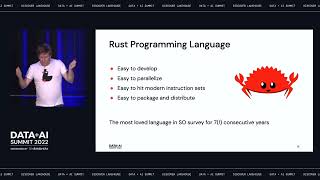
Sound Data Engineering in Rust—From Bits to DataFrames

Spark applications often need to query external data sources such as file-based data sources or relational data sources. In order to do this, Spark provides Data Source APIs to access structured data through Spark SQL.

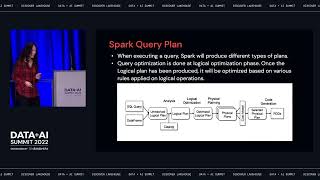
Data Source APIs have optimization rules such as filter push down and column pruning to reduce the amount of data that needs to be processed to improve query performance. As part of our ongoing project to provide generic Data Source V2 push down APIs, we have introduced partial aggregate push down, which significantly speeds up spark jobs by dramatically reducing the amount of data transferred between data sources and Spark. We have implemented aggregate push down in both JDBC and parquet.

Connect with us: Website: https://databricks.com Facebook: https://www.facebook.com/databricksinc Twitter: https://twitter.com/databricks LinkedIn: https://www.linkedin.com/company/data... Instagram: https://www.instagram.com/databricksinc/

Spark Data Source V2 Performance Improvement: Aggregate Push Down

Spark applications often need to query external data sources such as file-based data sources or relational data sources. In order to do this, Spark provides Data Source APIs to access structured data through Spark SQL.

Data Source APIs have optimization rules such as filter push down and column pruning to reduce the amount of data that needs to be processed to improve query performance. As part of our ongoing project to provide generic Data Source V2 push down APIs, we have introduced partial aggregate push down, which significantly speeds up spark jobs by dramatically reducing the amount of data transferred between data sources and Spark. We have implemented aggregate push down in both JDBC and parquet.

Connect with us: Website: https://databricks.com Facebook: https://www.facebook.com/databricksinc Twitter: https://twitter.com/databricks LinkedIn: https://www.linkedin.com/company/data... Instagram: https://www.instagram.com/databricksinc/

Delta Lake, the Foundation of Your Lakehouse

Delta Lake is the open source storage layer that makes the Databricks Lakehouse Platform possible by adding reliability, performance, and scalability to your data, wherever it is located. Join this session for an inside look at what is under the hood of Databricks - see how Delta Lake, by adding ACID transactions and versioning to Parquet files together with the Photon engine, provides customers with huge performance gains and the ability to address new challenges. This session will include a demo and overview of customer use cases unlocked by Delta Lake, and the benefits of running Delta Lake workloads on Databricks.

Connect with us: Website: https://databricks.com Facebook: https://www.facebook.com/databricksinc Twitter: https://twitter.com/databricks LinkedIn: https://www.linkedin.com/company/data... Instagram: https://www.instagram.com/databricksinc/

Recent Parquet Improvements in Apache Spark

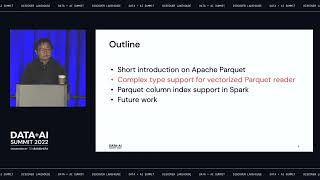
Apache Parquet is a very popular columnar file format supported by Apache Spark. In a typical Spark job, scanning Parquet files is sometimes one of the most time consuming steps, as it incurs high CPU and IO overhead. Therefore, optimizing Parquet scan performance is crucial to job latency and cost efficiency.

Spark currently have two Parquet reader implementations: a vectorized one and a non-vectorized one. The former was implemented from scratch and offers much better performance than the latter. However, it currently doesn’t support complex types (e.g., array, list, map) at the moment and will fallback to the latter when encountering them. In addition to the reader implementation, predicate pushdown is also crucial to Parquet scan performance as it enables Spark to skip those data that do not satisfy the predicates, before the scan. Currently, Spark constructs predicates itself and rely on Parquet-MR to do the heavy lifting, which does the filtering based on various information such as statistics, dictionary, bloom filter or column index.

This talk will go through two recent improvements for Parquet scan performance: 1) vectorized read support for complex types, which allows Spark to achieve 10x+ improvement when reading Parquet data of complex types, and 2) Parquet column index support, which enables Spark to leverage Parquet column index feature during predicate pushdown. Last but not least, Chao go over some future work items that can further enhance Parquet read performance.

Connect with us: Website: https://databricks.com Facebook: https://www.facebook.com/databricksinc Twitter: https://twitter.com/databricks LinkedIn: https://www.linkedin.com/company/data... Instagram: https://www.instagram.com/databricksinc/