
talk-data.com talk-data.com

Topic

Python

programming_language data_science web_development

29

tagged

Activity Trend

185 peak/qtr
2020-Q1 2026-Q1

Activities

Showing filtered results

Filtering by: Databricks DATA + AI Summit 2023 ×
X-FIPE: eXtended Feature Impact for Prediction Explanation

Many enterprises have built their own machine learning platforms in the cloud using Databricks, e.g. Humana FlorenceAI. In order to effectively drive the adoption of predictive models in daily business operations, data scientists and business teams need to work closely to make sure they serve the consumer needs in compliance with regulatory rules. Model interpretability is key. In this talk, we would like to share an explainable AI algorithm developed at Humana, X-FIPE, eXtended Feature Impact for Prediction Explanation.

X-FIPE is a top-driver algorithm to calculate feature importance for any machine learning predictive models, whether it is Python or PySpark, at a local level. Instead of showing the feature importance on a population level, it can find the top drivers for each observation or member. These top drivers could differ widely from one member to another member in the population. it not only helps explain the predictive model, but also offer users actionable insights.

Compared with widely used algorithms, e.g. LIME, SHAP, and FIPE, X-FIPE improves the time complexity from linear O(n) to logarithmic O(log(n)), where n is the number of used model features. Also, we discovered the connection between X-FIPE value and Shapley value -- X-FIPE a first order approximation of Shapley value. Our observation shows that the most contribution of Shapley value of a feature comes from the marginal contribution when it is first added and when it is last removed from the full features. This is why the X-FIPE keeps enough accuracy and also reduces the computation.

Hopefully this talk will provide you a path forward to include explainable AI into your machine learning workflows, you are encouraged to try out and contribute to our open source Python package xfipe soon to come.

Connect with us: Website: https://databricks.com Facebook: https://www.facebook.com/databricksinc Twitter: https://twitter.com/databricks LinkedIn: https://www.linkedin.com/company/data... Instagram: https://www.instagram.com/databricksinc/
dbt and Python—Better Together

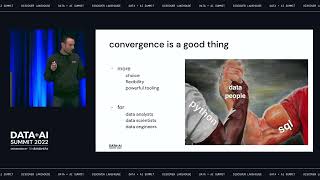
Drew Banin is the co-founder of dbt Labs and one of the maintainers of dbt Core, the open source standard in data modeling and transformation. In this talk, he will demonstrate an approach to unifying SQL and Python workloads under a single dbt execution graph, illustrating the powerful, flexible nature of dbt running on Databricks.

Connect with us: Website: https://databricks.com Facebook: https://www.facebook.com/databricksinc Twitter: https://twitter.com/databricks LinkedIn: https://www.linkedin.com/company/data... Instagram: https://www.instagram.com/databricksinc/
dbt + Machine Learning: What Makes a Great Baton Pass?

dbt has done a great job of building an elegant, common interface between data engineers and data analysts: uniting on SQL. As the data industry evolves, there's plenty of pain and room to grow in building that interface between data scientists and data analysts. There isn't a good answer for when things go wrong in the machine learning arena: should the data analyst own fine-tuning the pre-processing data(think: prepping transformed data even more for machine learning models to better work with the data). Should we increase the SQL surface area to build ML models or should we leave that to non-SQL interfaces(python/scala/etc.)? Does this have to be an either/or future? Whatever the interface evolves into, it must center people, create a low bar and high ceiling, and focus on outcomes and not the mystique of features/tools behind a learning curve.

Connect with us: Website: https://databricks.com Facebook: https://www.facebook.com/databricksinc Twitter: https://twitter.com/databricks LinkedIn: https://www.linkedin.com/company/data... Instagram: https://www.instagram.com/databricksinc/
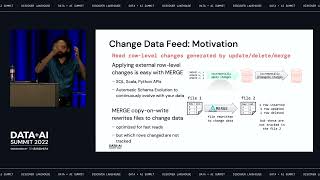
Delta Lake 2.0 Overview

After three years of hard work by the Delta community, we are proud to announce the release of Delta Lake 2.0. Completing the work to open-source all of Delta Lake while tens of thousands of organizations were running in production was no small feat and we have the ever-expanding Delta community to thank! Join this session to learn about how the wider Delta community collaborated together to bring these features and integrations together.

Join this session to learn about how the wider Delta community collaborated together to bring these features and integrations together. This includes the Integrations with Apache Spark™, Apache Flink, Apache Pulsar, Presto, Trino, and more.

Features such as OPTIMIZE ZORDER, data skipping using column stats, S3 multi-cluster writes, Change Data Feed, and more.

Language APIs including Rust, Python, Ruby, GoLang, Scala, and Java.

Connect with us: Website: https://databricks.com Facebook: https://www.facebook.com/databricksinc Twitter: https://twitter.com/databricks LinkedIn: https://www.linkedin.com/company/data... Instagram: https://www.instagram.com/databricksinc/
ÀLaSpark: Gousto's Recipe for Building Scalable PySpark Pipelines

Find out how Gousto is developing its data pipelines at scale in a repeatable manner. At Gousto, we’ve developed Goustospark - a wrapper around pyspark that allows us to quickly and easily build data pipelines that are deployed into our Databricks environment.

This wrapper abstracts repetitive components of all data pipelines such as spark configurations and metastore interactions. This allows a developer to simply specify the blueprints of the pipeline before turning their attention to more pressing issues, such as data quality and data governance, whilst enjoying a high level of performance and reliability.

In this session we will deep dive into the design patterns we followed, some unique approaches we’ve taken on how we structure pipelines and show a live demo of implementing a new spark streaming pipeline in Databricks from scratch. We will even share some example python code and snippets to help you build your own.

Connect with us: Website: https://databricks.com Facebook: https://www.facebook.com/databricksinc Twitter: https://twitter.com/databricks LinkedIn: https://www.linkedin.com/company/data... Instagram: https://www.instagram.com/databricksinc/

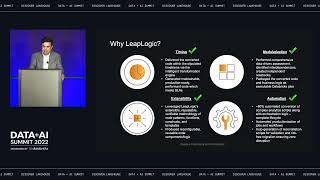
How AARP Services, Inc. automated SAS transformation to Databricks using LeapLogic

While SAS has been a standard in analytics and data science use cases, it is not cloud-native and does not scale well. Join us to learn how AARP automated the conversion of hundreds of complex data processing, model scoring, and campaign workloads to Databricks using LeapLogic, an intelligent code transformation accelerator that can transform any and all legacy ETL, analytics, data warehouse and Hadoop to modern data platforms.

In this session experts from AARP and Impetus will share about collaborating with Databricks and how they were able to: • Automate modernization of SAS marketing analytics based on coding best practices • Establish a rich library of Spark and Python equivalent functions on Databricks with the same capabilities as SAS procedures, DATA step operations, macros, and functions • Leverage Databricks-native services like Delta Live Tables to implement waterfall techniques for campaign execution and simplify pipeline monitoring

Connect with us: Website: https://databricks.com Facebook: https://www.facebook.com/databricksinc Twitter: https://twitter.com/databricks LinkedIn: https://www.linkedin.com/company/data... Instagram: https://www.instagram.com/databricksinc/
Polars: Blazingly Fast DataFrames in Rust and Python

This talk will introduce Polars a blazingly fast DataFrame library written in Rust on top of Apache Arrow. Its a DataFrame library that brings exploratory data analysis closer to the lessons learned in database research.

CPU's today's come with many cores and with their superscalar designs and SIMD registers allow for even more parallelism. Polars is written from the ground up to fully utilize the CPU's of this generation.

Besides blazingly fast algorithms, cache efficient memory layout and multi-threading, it consist of a lazy query engine, allowing Polars to do several optimizations that may improve query time and memory usage.

Read more:

https://github.com/pola-rs/polars https://www.ritchievink.com/blog/2021/02/28/i-wrote-one-of-the-fastest-dataframe-libraries/

Join the talk to learn more.

Connect with us: Website: https://databricks.com Facebook: https://www.facebook.com/databricksinc Twitter: https://twitter.com/databricks LinkedIn: https://www.linkedin.com/company/data... Instagram: https://www.instagram.com/databricksinc/
Privacy Preserving Machine Learning and Big Data Analytics Using Apache Spark

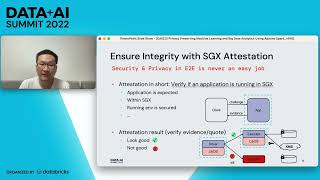
In recent years, latest privacy laws & regulations bring a fundamental shift in the protection of data and privacy, placing new challenges to data applications. To resolve these privacy & security challenges in big data ecosystem without impacting existing applications, several hardware TEE (Trusted Execution Environment) solutions have been proposed for Apache Spark, e.g., PySpark with Scone and Opaque etc. However, to the best of our knowledge, none of them provide full protection to data pipelines in Spark applications. An adversary may still get sensitive information from unprotected components and stages. Furthermore, some of them greatly narrowed supported applications, e.g., only support SparkSQL. In this presentation, we will present a new PPMLA (privacy preserving machine learning and analytics) solution built on top of Apache Spark, BigDL, Occlum and Intel SGX. It ensures all spark components and pipelines are fully protected by Intel SGX, and existing Spark applications written in Scala, Java or Python can be migrated into our platform without any code change. We will demonstrate how to build distributed end-to-end SparkML/SparkSQL workloads with our solution on untrusted cloud environment and share real-world use cases for PPMLA.

Connect with us: Website: https://databricks.com Facebook: https://www.facebook.com/databricksinc Twitter: https://twitter.com/databricks LinkedIn: https://www.linkedin.com/company/data... Instagram: https://www.instagram.com/databricksinc/

Time Series Forecasting with PyCaret

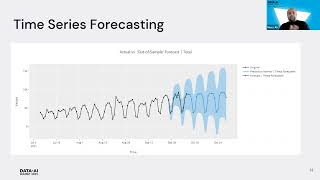
PyCaret is an open-source, low-code machine learning library in Python that automates machine learning workflows. It is an end-to-end machine learning and model management tool that speeds up the experiment cycle exponentially and makes you more productive.

This presentation will demo the time series forecasting use case using PyCaret's new low-code time series forecasting module.

Connect with us: Website: https://databricks.com Facebook: https://www.facebook.com/databricksinc Twitter: https://twitter.com/databricks LinkedIn: https://www.linkedin.com/company/data... Instagram: https://www.instagram.com/databricksinc/