talk-data.com talk-data.com

Topic

SQL

Structured Query Language (SQL)

database_language data_manipulation data_definition programming_language

1751

tagged

Activity Trend

107 peak/qtr
2020-Q1 2026-Q2

Activities

1751 activities · Newest first

Sponsored by: dbt Labs | Empowering the Enterprise for the Next Era of AI and BI

The next era of data transformation has arrived. AI is enhancing developer workflows, enabling downstream teams to collaborate effectively through governed self-service. Additionally, SQL comprehension is producing detailed metadata that boosts developer efficiency while ensuring data quality and cost optimization. Experience this firsthand with dbt’s data control plane, a centralized platform that provides organizations with repeatable, scalable, and governed methods to succeed with Databricks in the modern age.

Accelerating Analytics: Integrating BI and Partner Tools to Databricks SQL

This session is repeated. Did you know that you can integrate with your favorite BI tools directly from Databricks SQL? You don’t even need to stand up an additional warehouse. This session shows the integrations with Microsoft Power Platform, Power BI, Tableau and dbt so you can have a seamless integration experience. Directly connect your Databricks workspace with Fabric and Power BI workspaces or Tableau to publish and sync data models, with defined primary and foreign keys, between the two platforms.

In this course, you'll learn concepts and perform labs that showcase workflows using Unity Catalog - Databricks' unified and open governance solution for data and AI. We'll start off with a brief introduction to Unity Catalog, discuss fundamental data governance concepts, and then dive into a variety of topics including using Unity Catalog for data access control, managing external storage and tables, data segregation, and more. Pre-requisites: Beginner familiarity with the Databricks Data Intelligence Platform (selecting clusters, navigating the Workspace, executing notebooks), cloud computing concepts (virtual machines, object storage, etc.), production experience working with data warehouses and data lakes, intermediate experience with basic SQL concepts (select, filter, groupby, join, etc), beginner programming experience with Python (syntax, conditions, loops, functions), beginner programming experience with the Spark DataFrame API (Configure DataFrameReader and DataFrameWriter to read and write data, Express query transformations using DataFrame methods and Column expressions, etc.) Labs: Yes Certification Path: Databricks Certified Data Engineer Associate

In this course, you’ll learn how to orchestrate data pipelines with Lakeflow Jobs (previously Databricks Workflows) and schedule dashboard updates to keep analytics up-to-date. We’ll cover topics like getting started with Lakeflow Jobs, how to use Databricks SQL for on-demand queries, and how to configure and schedule dashboards and alerts to reflect updates to production data pipelines. Pre-requisites: Beginner familiarity with the Databricks Data Intelligence Platform (selecting clusters, navigating the Workspace, executing notebooks), cloud computing concepts (virtual machines, object storage, etc.), production experience working with data warehouses and data lakes, intermediate experience with basic SQL concepts (select, filter, groupby, join, etc), beginner programming experience with Python (syntax, conditions, loops, functions), beginner programming experience with the Spark DataFrame API (Configure DataFrameReader and DataFrameWriter to read and write data, Express query transformations using DataFrame methods and Column expressions, etc.) Labs: No Certification Path: Databricks Certified Data Engineer Associate

Getting Started With Lakeflow Connect

Hundreds of customers are already ingesting data with Lakeflow Connect from SQL Server, Salesforce, ServiceNow, Google Analytics, SharePoint, PostgreSQL and more to unlock the full power of their data. Lakeflow Connect introduces built-in, no-code ingestion connectors from SaaS applications, databases and file sources to help unlock data intelligence. In this demo-packed session, you’ll learn how to ingest ready-to-use data for analytics and AI with a few clicks in the UI or a few lines of code. We’ll also demonstrate how Lakeflow Connect is fully integrated with the Databricks Data Intelligence Platform for built-in governance, observability, CI/CD, automated pipeline maintenance and more. Finally, we’ll explain how to use Lakeflow Connect in combination with downstream analytics and AI tools to tackle common business challenges and drive business impact.

The Future of Real Time Insights with Databricks and SAP

Tired of waiting on SAP data? Join this session to see how Databricks and SAP make it easy to query business-ready data—no ETL. With Databricks SQL, you’ll get instant scale, automatic optimizations, and built-in governance across all your enterprise analytics data. Fast and AI-powered insights from SAP data are finally possible—and this is how.

ThredUp’s Journey with Databricks: Modernizing Our Data Infrastructure

Building an AI-ready data platform requires strong governance, performance optimization, and seamless adoption of new technologies. At ThredUp, our Databricks journey began with a need for better data management and evolved into a full-scale transformation powering analytics, machine learning, and real-time decision-making. In this session, we’ll cover: Key inflection points: Moving from legacy systems to a modernized Delta Lake foundation Unity Catalog’s impact: Improving governance, access control, and data discovery Best practices for onboarding: Ensuring smooth adoption for engineering and analytics teams What’s next? Serverless SQL and conversational analytics with Genie Whether you’re new to Databricks or scaling an existing platform, you’ll gain practical insights on navigating the transition, avoiding pitfalls, and maximizing AI and data intelligence.

In this course, you’ll learn how to use the features Databricks provides for business intelligence needs: AI/BI Dashboards and AI/BI Genie. As a Databricks Data Analyst, you will be tasked with creating AI/BI Dashboards and AI/BI Genie Spaces within the platform, managing the access to these assets by stakeholders and necessary parties, and maintaining these assets as they are edited, refreshed, or decommissioned over the course of their lifespan. This course intends to instruct participants on how to design dashboards for business insights, share those with collaborators and stakeholders, and maintain those assets within the platform. Participants will also learn how to utilize AI/BI Genie Spaces to support self-service analytics through the creation and maintenance of these environments powered by the Databricks Data Intelligence Engine. Pre-requisites: The content was developed for participants with these skills/knowledge/abilities: A basic understanding of SQL for querying existing data tables in Databricks. Prior experience or basic familiarity with the Databricks Workspace UI. A basic understanding of the purpose and use of statistical analysis results. Familiarity with the concepts around dashboards used for business intelligence. Labs: Yes

In this course, you’ll learn how to define and schedule data pipelines that incrementally ingest and process data through multiple tables on the Data Intelligence Platform, using Lakeflow Declarative Pipelines in Spark SQL and Python. We’ll cover topics like how to get started with Lakeflow Declarative Pipelines, how Lakeflow Declarative Pipelines tracks data dependencies in data pipelines, how to configure and run data pipelines using the Lakeflow Declarative Pipelines. UI, how to use Python or Spark SQL to define data pipelines that ingest and process data through multiple tables on the Data Intelligence Platform, using Auto Loader and Lakeflow Declarative Pipelines, how to use APPLY CHANGES INTO syntax to process Change Data Capture feeds, and how to review event logs and data artifacts created by pipelines and troubleshoot syntax.By streamlining and automating reliable data ingestion and transformation workflows, this course equips you with the foundational data engineering skills needed to help kickstart AI use cases. Whether you're preparing high-quality training data or enabling real-time AI-driven insights, this course is a key step in advancing your AI journey.Pre-requisites: Beginner familiarity with the Databricks Data Intelligence Platform (selecting clusters, navigating the Workspace, executing notebooks), cloud computing concepts (virtual machines, object storage, etc.), production experience working with data warehouses and data lakes, intermediate experience with basic SQL concepts (select, filter, groupby, join, etc), beginner programming experience with Python (syntax, conditions, loops, functions), beginner programming experience with the Spark DataFrame API (Configure DataFrameReader and DataFrameWriter to read and write data, Express query transformations using DataFrame methods and Column expressions, etc.)Labs: NoCertification Path: Databricks Certified Data Engineer Associate

In this course, you’ll learn how to apply patterns to securely store and delete personal information for data governance and compliance on the Data Intelligence Platform. We’ll cover topics like storing sensitive data appropriately to simplify granting access and processing deletes, processing deletes to ensure compliance with the right to be forgotten, performing data masking, and configuring fine-grained access control to configure appropriate privileges to sensitive data.Pre-requisites: Ability to perform basic code development tasks using the Databricks workspace (create clusters, run code in notebooks, use basic notebook operations, import repos from git, etc), intermediate programming experience with SQL and PySpark (extract data from a variety of file formats and data sources, apply a number of common transformations to clean data, reshape and manipulate complex data using advanced built-in functions), intermediate programming experience with Delta Lake (create tables, perform complete and incremental updates, compact files, restore previous versions etc.). Beginner experience with Lakeflow Declarative Pipelines and streaming workloads.Labs: YesCertification Path: Databricks Certified Data Engineer Professional

Data Warehousing with Databricks

This course is designed for data professionals who want to explore the data warehousing capabilities of Databricks. Assuming no prior knowledge of Databricks, it provides an introduction to leveraging Databricks as a modern cloud-based data warehousing solution. Learners will explore how use the Databricks Data Intelligence Platform to ingest, transform, govern, and analyze data efficiently. Learners will also explore Genie, an innovative Databricks feature that simplifies data exploration through natural language queries. By the end of this course, participants will be equipped with the foundational skills to implement and optimize a data warehouse using Databricks. Pre-requisites: Basic understanding of SQL and data querying concepts General knowledge of data warehousing concepts, including tables, schemas, and ETL/ELT processes is recommended Some experience with BI and/or data visualization tools is helpful but not required Labs: Yes

In this course, you’ll learn how to optimize workloads and physical layout with Spark and Delta Lake and and analyze the Spark UI to assess performance and debug applications. We’ll cover topics like streaming, liquid clustering, data skipping, caching, photons, and more. Pre-requisites: Ability to perform basic code development tasks using the Databricks workspace (create clusters, run code in notebooks, use basic notebook operations, import repos from git, etc), intermediate programming experience with SQL and PySpark (extract data from a variety of file formats and data sources, apply a number of common transformations to clean data, reshape and manipulate complex data using advanced built-in functions), intermediate programming experience with Delta Lake (create tables, perform complete and incremental updates, compact files, restore previous versions etc.). Labs: Yes Certification Path: Databricks Certified Data Engineer Professional

In this course, you’ll learn how to Incrementally process data to power analytic insights with Structured Streaming and Auto Loader, and how to apply design patterns for designing workloads to perform ETL on the Data Intelligence Platform with Lakeflow Declarative Pipelines. First, we’ll cover topics including ingesting raw streaming data, enforcing data quality, implementing CDC, and exploring and tuning state information. Then, we’ll cover options to perform a streaming read on a source, requirements for end-to-end fault tolerance, options to perform a streaming write to a sink, and creating an aggregation and watermark on a streaming dataset. Pre-requisites: Ability to perform basic code development tasks using the Databricks workspace (create clusters, run code in notebooks, use basic notebook operations, import repos from git, etc.), intermediate programming experience with SQL and PySpark (extract data from a variety of file formats and data sources, apply a number of common transformations to clean data, reshape and manipulate complex data using advanced built-in functions), intermediate programming experience with Delta Lake (create tables, perform complete and incremental updates, compact files, restore previous versions etc.). Beginner experience with streaming workloads and familiarity with Lakeflow Declarative Pipelines. Labs: No Certification Path: Databricks Certified Data Engineer Professional

Data Ingestion with Lakeflow Connect

In this course, you’ll learn how to have efficient data ingestion with Lakeflow Connect and manage that data. Topics include ingestion with built-in connectors for SaaS applications, databases and file sources, as well as ingestion from cloud object storage, and batch and streaming ingestion. We'll cover the new connector components, setting up the pipeline, validating the source and mapping to the destination for each type of connector. We'll also cover how to ingest data with Batch to Streaming ingestion into Delta tables, using the UI with Auto Loader, automating ETL with Lakeflow Declarative Pipelines or using the API.This will prepare you to deliver the high-quality, timely data required for AI-driven applications by enabling scalable, reliable, and real-time data ingestion pipelines. Whether you're supporting ML model training or powering real-time AI insights, these ingestion workflows form a critical foundation for successful AI implementation.Pre-requisites: Beginner familiarity with the Databricks Data Intelligence Platform (selecting clusters, navigating the Workspace, executing notebooks), cloud computing concepts (virtual machines, object storage, etc.), production experience working with data warehouses and data lakes, intermediate experience with basic SQL concepts (select, filter, groupby, join, etc), beginner programming experience with Python (syntax, conditions, loops, functions), beginner programming experience with the Spark DataFrame API (Configure DataFrameReader and DataFrameWriter to read and write data, Express query transformations using DataFrame methods and Column expressions, etc.Labs: NoCertification Path: Databricks Certified Data Engineer Associate

This course offers a deep dive into designing data models within the Databricks Lakehouse environment, and understanding the data products lifecycle. Participants will learn to align business requirements with data organization and model design leveraging Delta Lake and Unity Catalog for defining data architectures, and techniques for data integration and sharing. Prerequisites: Foundational knowledge equivalent to Databricks Certified Data Engineer Associate and familiarity with many topics covered in Databricks Certified Data Engineer Professional. Experience with: Basic SQL queries and table creation on Databricks Lakehouse architecture fundamentals (medallion layers) Unity Catalog concepts (high-level) [Optional] Familiarity with data warehousing concepts (dimensional modeling, 3NF, etc.) is beneficial but not mandatory. Labs: Yes
Customer 360: Unlocking Actionable Insights with AI-Powered Customer Intelligence | Data Apps

As companies scale, retaining and accessing institutional knowledge becomes increasingly challenging. Customer Success teams often navigate multiple platforms to piece together customer histories, making it difficult to maintain continuity and provide efficient service across account transitions.

In this session, Curtis de Castro will demonstrate how Sigma:

Built an AI-powered repository that consolidates all customer interactions into a single, searchable platform Enabled real-time filtering and analysis of customer interactions across chat, email, and tickets Implemented AI-driven features for sentiment analysis, meeting agenda generation, and churn risk detection Developed a scalable solution that maintains data security by leveraging Snowflake Cortex Designed an intuitive interface that makes advanced insights accessible without SQL expertise Previously, deep customer analysis took hours—sometimes days. Now, AI surfaces key insights in minutes, enabling teams to focus on action instead of searching for data. Join this session for a demo of how Sigma built an enterprise-grade AI-powered data app to modernize customer intelligence, while maintaining enterprise-grade security and governance.

➡️ Learn more about Data Apps: https://www.sigmacomputing.com/product/data-applications?utm_source=youtube&utm_medium=organic&utm_campaign=data_apps_conference&utm_content=pp_data_apps


➡️ Sign up for your free trial: https://www.sigmacomputing.com/go/free-trial?utm_source=youtube&utm_medium=video&utm_campaign=free_trial&utm_content=free_trial

sigma #sigmacomputing #dataanalytics #dataanalysis #businessintelligence #cloudcomputing #clouddata #datacloud #datastructures #datadriven #datadrivendecisionmaking #datadriveninsights #businessdecisions #datadrivendecisions #embeddedanalytics #cloudcomputing #SigmaAI #AI #AIdataanalytics #AIdataanalysis #GPT #dataprivacy #python #dataintelligence #moderndataarchitecture

Imagine writing SQL and getting instant results as you type? Yes, this is reality now. It's amazing!DuckDB/MotherDuck's Instant SQL made a big splash at last month's Data Council. Hamilton Ulmer gives a demo of Instant SQL at the Practical Data Community.----------------------------Instant SQL: https://motherduck.com/blog/introducing-instant-sql/Practical Data Community Discord: https://discord.gg/gNfw5AKWSK

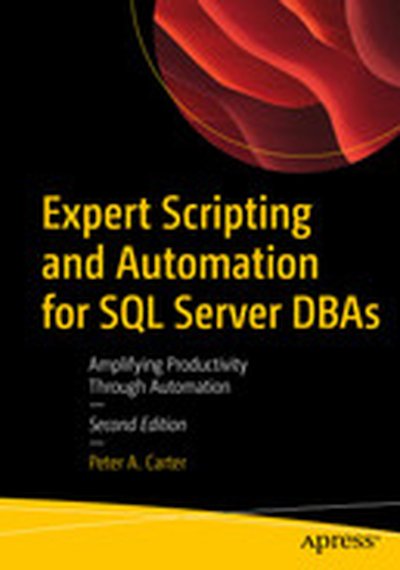
Expert Scripting and Automation for SQL Server DBAs: Amplifying Productivity Through Automation

The market is trending toward a much smaller ratio of DBAs to SQL Server instances, but this book will help you meet this new reality by harnessing automation to continue building and maintaining reliable database platform services for your SQL Server enterprise. The book will help you automate your workload and manage more databases and instances with greater ease and efficiency by combining metadata-driven automation with the power of PowerShell. You'll soon be able to automate your new instance-builds and centralize your maintenance. This book walks you through automating the SQL Server build processes and maintenance of multiple instances from a single location, as well as how to use database metadata to drive your automation. With a heavier focus on PowerShell, this 2nd edition highlights modern techniques, such as configuration management. Also new in this edition, you will learn how to use PowerShell modules such as SqlServer and DBATools, which is a popular community module that you can rely on to keep your database estate running smoothly. You will understand the benefits of centralizing maintenance to better keep your enterprise responding with reliable performance to the loads placed upon it by your business. The book helps you become faster and better at what you do for a living, and thus will boost your value within the job market. What You Will Learn Automate SQL Server installation and configuration Apply techniques such as Desired State Configuration to prevent drift on your servers and instances Increase your value to your organization by automating low-value tasks and focusing your time on the higher-value ones Take advantage of database metadata to drive automation, allowing you to build intelligent automated routines Promote and demonstrate how to modernize database maintenance across your enterprise Apply tools such as PowerShell with modern techniques to increase your value in the job market Who This Book Is For SQL Server DBAs who want to increase their productivity by embracing automation

There is no value from AI without a Data Strategy. AI hallucinations are a significant risk in delivering ROI across the enterprise. Stardog’s knowledge graph-powered agentic architecture delivers an AI-ready data foundation with a semantic layer that provides facts and grounding needed to eliminate hallucinations. Learn why traditional Retrieval-Augmented Generation and straight Text-to-SQL approaches can be insufficient and how you can broaden AI's access to diverse and dense data and ensure timely, secure, and, most importantly, hallucination-free answers from your own data.

In this episode, Tristan Handy and Lukas Schulte, co-founder of SDF Labs and now part of dbt Labs, dive deep into the world of compilers—what they are, how they work, and what they mean for the data ecosystem. SDF, recently acquired by dbt Labs, builds a world-class SQL compiler aimed at abstracting away the complexity of warehouse-specific SQL. Join Tristan and members of the SDF team at the dbt Launch showcase to learn more about the brand new dbt engine. Register at https://www.getdbt.com/resources/webinars/2025-dbt-cloud-launch-showcase For full show notes and to read 8+ years of back issues of the podcast's companion newsletter, head to https://roundup.getdbt.com. The Analytics Engineering Podcast is sponsored by dbt Labs.