Unlock the power of generative AI and data. Join experts from LlamaIndex and Google Cloud databases and learn how to seamlessly integrate LlamaIndex with AlloyDB and Cloud SQL for PostgreSQL, enabling your apps to reason, act on your data, and leverage the performance of Google Cloud. We’ll share real-world examples and code. Discover new possibilities for building advanced gen AI applications.
 talk-data.com
Topic
SQL
Structured Query Language (SQL)
database_language
data_manipulation
data_definition
programming_language
1751
tagged
Activity Trend
107
peak/qtr
2020-Q1
2026-Q2
Top Events
O'Reilly Data Engineering Books
780
Data Engineering Podcast
233
O'Reilly SQL Books
103
Data + AI Summit 2025
89
O'Reilly Data Science Books
82
Databricks DATA + AI Summit 2023
73
Microsoft Ignite 2025
46
Google Cloud Next '25
29
O'Reilly Business Intelligence Books
25
Google Cloud Next '24
21
Data Career Podcast: Helping You Land a Data Analyst Job FAST
18
dbt Coalesce 2022
14
Unlock the power of AI-assisted coding in BigQuery with this hands-on lab. Learn how to generate SQL queries using natural language prompts, utilize BigQuery's code explanation and transformation features, and collaborate with Gemini to review, debug, and optimize your SQL code. Whether you're looking to streamline query development or troubleshoot issues, this session will enhance your ability to write and refine code efficiently using Gemini's intelligent capabilities in BigQuery.
If you register for a Learning Center lab, please ensure that you sign up for a Google Cloud Skills Boost account for both your work domain and personal email address. You will need to authenticate your account as well (be sure to check your spam folder!). This will ensure you can arrive and access your labs quickly onsite. You can follow this link to sign up!
Join us to learn how you can build on Google’s intelligent, open, and unified Data Cloud to accelerate your AI transformation. This session covers deep integrations between BigQuery and Google’s operational databases, such as Spanner, AlloyDB, Bigtable, Cloud SQL. Mercado Libre will share how Spanner and Bigtable Data Boost enable near-zero impact analytics on their operational data. Plus, discover how Datastream and change streams simplify data movement to BigQuery, and how reverse ETL (extract, transform, and load) from BigQuery powers operational analytics.
Join this session to learn how to ground your AI with relevant data with retrieval-augmented generation (RAG) from Firebase Data Connect, which brings rapid development and intelligent context from your Cloud SQL database to your generative AI experiences. Data Connect makes it easy to connect your app, data, and AI all together, and seamlessly integrates Vertex AI and Cloud SQL to make RAG easy and ready for AI agents.
Are you an Amazon Web Services (AWS) developer exploring Google Cloud for the first time, or looking to deepen your multi-cloud skills? Join us for a whirlwind tour exploring the ins and outs of Google Cloud, from resource and access management, to networking and SDKs. We’ll cover Google Cloud’s framework for hyperscaler migrations. Then, we will demonstrate migrating an AWS application to Google Kubernetes Engine (GKE) and Cloud SQL, including Database Migration Service (DMS), GKE cluster creation, container image migration, and CI/CD. You'll leave with a core understanding of how Google Cloud works, key similarities and differences with AWS, and resources to get started.
This hands-on lab guides you through importing real-world data from CSV files into a Cloud SQL database. Using a flight dataset from the US Bureau of Transport Statistics, you'll gain hands-on experience with data ingestion and basic analysis. You'll learn to create a Cloud SQL instance and database, effectively import your data, and build a foundational data model using SQL queries.
If you register for a Learning Center lab, please ensure that you sign up for a Google Cloud Skills Boost account for both your work domain and personal email address. You will need to authenticate your account as well (be sure to check your spam folder!). This will ensure you can arrive and access your labs quickly onsite. You can follow this link to sign up!
Join this Cloud Talk to explore how Large Language Models (LLMs) can revolutionize your data workflows. Learn to automate SQL query generation and stream results into Confluent using Vertex AI for real-time analytics and decision-making. Dive into integrating advanced AI into data pipelines, simplifying SQL creation, enhancing workflows, and leveraging Vertex AI for scalable machine learning. Discover how to optimize your data infrastructure and drive insights with Confluent’s Data Streaming Platform and cutting-edge AI technology.
This Session is hosted by a Google Cloud Next Sponsor.
Visit your registration profile at g.co/cloudnext to opt out of sharing your contact information with the sponsor hosting this session.
Debugging modern applications demands a new level of observability expertise. Traditional monitoring struggles with these complex distributed environments. This session goes beyond dashboards, exploring expert observability strategies tailored for the generative AI era. We’ll cover essential instrumentation with OpenTelemetry and eBPF, system health overviews using Metrics Explorer and Trace Explorer, and in-depth data analysis with SQL queries in Observability Analytics.
This session presents Schnucks’, a midwest grocer’s migration of their E-commerce application from Oracle Database to Cloud SQL PostgreSQL. It will cover challenges such as addressing the complexities of even "simple" schemas, testing data movement possibilities to minimize downtime, and transforming the database tier. Hear about the business impact, including cost savings, increased database-application proximity and the potential for similar future migrations, allowing for direct integration options from Google CloudSQL to Google Gemini AI.
This Session is hosted by a Google Cloud Next Sponsor.
Visit your registration profile at g.co/cloudnext to opt out of sharing your contact information with the sponsor hosting this session.
In this hands-on lab, you'll explore data with BigQuery's intuitive table explorer and data insight features, enabling you to gain valuable insights without writing SQL queries from scratch. Learn how to generate key insights from order item data, query location tables, and interact with your data seamlessly. By the end, you’ll be equipped to navigate complex datasets and uncover actionable insights quickly and efficiently.
If you register for a Learning Center lab, please ensure that you sign up for a Google Cloud Skills Boost account for both your work domain and personal email address. You will need to authenticate your account as well (be sure to check your spam folder!). This will ensure you can arrive and access your labs quickly onsite. You can follow this link to sign up!
Redpanda, a leading Kafka API-compatible streaming platform, now supports storing topics in Apache Iceberg, seamlessly fusing low-latency streaming with data lakehouses using BigQuery and BigLake in GCP. Iceberg Topics eliminate complex & inefficient ETL between streams and tables, making real-time data instantly accessible for analysis in BigQuery This push-button integration eliminates the need for costly connectors or custom pipelines, enabling both simple and sophisticated SQL queries across streams and other datasets. By combining Redpanda and Iceberg, GCP customers gain a secure, scalable, and cost-effective solution that transforms their agility while reducing infrastructure and human capital costs.
This Session is hosted by a Google Cloud Next Sponsor.
Visit your registration profile at g.co/cloudnext to opt out of sharing your contact information with the sponsor hosting this session.
Using LLM agents in production makes it easier to access live data without writing SQL queries or predefined reports. I'll share how we utilized LLM-powered agents in a chatbot to automatically query production databases and deliver structured insights in response to user requests.
This blog discusses how GenAI and natural language processing are transforming SQL query generation, allowing non-technical users to access and query data easily. Published at: https://www.eckerson.com/articles/from-4gl-to-genai-how-sql-automation-has-evolved
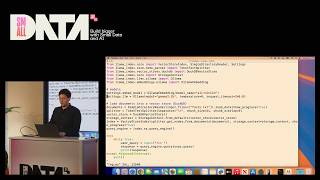
It's finally possible to bring the awesome power of Large Language Models (LLMs) to your laptop. This talk will explore how to run and leverage small, openly available LLMs to power common tasks involving data, including selecting the right models, practical use cases for running small models, and best practices for deploying small models effectively alongside databases.
Bio: Jeffrey Morgan is the founder of Ollama, an open-source tool to get up and run large language models. Prior to founding Ollama, Jeffrey founded Kitematic, which was acquired by Docker and evolved into Docker Desktop. He has previously worked at companies including Docker, Twitter, and Google.
➡️ Follow Us LinkedIn: https://www.linkedin.com/company/small-data-sf/ X/Twitter : https://twitter.com/smalldatasf Website: https://www.smalldatasf.com/
Discover how to run large language models (LLMs) locally using Ollama, the easiest way to get started with small AI models on your Mac, Windows, or Linux machine. Unlike massive cloud-based systems, small open source models are only a few gigabytes, allowing them to run incredibly fast on consumer hardware without network latency. This video explains why these local LLMs are not just scaled-down versions of larger models but powerful tools for developers, offering significant advantages in speed, data privacy, and cost-effectiveness by eliminating hidden cloud provider fees and risks.
Learn the most common use case for small models: combining them with your existing factual data to prevent hallucinations. We dive into retrieval augmented generation (RAG), a powerful technique where you augment a model's prompt with information from a local data source. See a practical demo of how to build a vector store from simple text files and connect it to a model like Gemma 2B, enabling you to query your own data using natural language for fast, accurate, and context-aware responses.
Explore the next frontier of local AI with small agents and tool calling, a new feature that empowers models to interact with external tools. This guide demonstrates how an LLM can autonomously decide to query a DuckDB database, write the correct SQL, and use the retrieved data to answer your questions. This advanced tutorial shows you how to connect small models directly to your data engineering workflows, moving beyond simple chat to create intelligent, data-driven applications.
Get started with practical applications for small models today, from building internal help desks to streamlining engineering tasks like code review. This video highlights how small and large models can work together effectively and shows that open source models are rapidly catching up to their cloud-scale counterparts. It's never been a better time for developers and data analysts to harness the power of local AI.
CockroachDB is the distributed SQL database that handles the demands of today's data-driven applications. The second edition of this popular hands-on guide shows software developers, architects, and DevOps/SRE teams how to use CockroachDB for applications that scale elastically and provide seamless delivery for end users while remaining indestructible. Data professionals will learn how to migrate existing applications to CockroachDB's performant, cloud-native data architecture. You'll also quickly discover the benefits of strong data correctness and consistency guarantees, plus optimizations for delivering ultra-low latencies to globally distributed end users. Uncover the power of distributed SQL Learn how to start, manage, and optimize projects in CockroachDB Explore best practices for data modeling, schema design, and distributed infrastructure Discover strategies for migrating data into CockroachDB See how to read, write, and run ACID transactions across distributed systems Maximize resiliency in multiregion clusters Secure, monitor, and fine-tune your CockroachDB deployment for peak performance
A friendly illustrated guide to designing and implementing your first database. Grokking Relational Database Design makes the principles of designing relational databases approachable and engaging. Everything in this book is reinforced by hands-on exercises and examples. In Grokking Relational Database Design, you’ll learn how to: Query and create databases using Structured Query Language (SQL) Design databases from scratch Implement and optimize database designs Take advantage of generative AI when designing databases A well-constructed database is easy to understand, query, manage, and scale when your app needs to grow. In Grokking Relational Database Design you’ll learn the basics of relational database design including how to name fields and tables, which data to store where, how to eliminate repetition, good practices for data collection and hygiene, and much more. You won’t need a computer science degree or in-depth knowledge of programming—the book’s practical examples and down-to-earth definitions are beginner-friendly. About the Technology Almost every business uses a relational database system. Whether you’re a software developer, an analyst creating reports and dashboards, or a business user just trying to pull the latest numbers, it pays to understand how a relational database operates. This friendly, easy-to-follow book guides you from square one through the basics of relational database design. About the Book Grokking Relational Database Design introduces the core skills you need to assemble and query tables using SQL. The clear explanations, intuitive illustrations, and hands-on projects make database theory come to life, even if you can’t tell a primary key from an inner join. As you go, you’ll design, implement, and optimize a database for an e-commerce application and explore how generative AI simplifies the mundane tasks of database designs. What's Inside Define entities and their relationships Minimize anomalies and redundancy Use SQL to implement your designs Security, scalability, and performance About the Reader For self-taught programmers, software engineers, data scientists, and business data users. No previous experience with relational databases assumed. About the Authors Dr. Qiang Hao and Dr. Michail Tsikerdekis are both professors of Computer Science at Western Washington University. Quotes If anyone is looking to improve their database design skills, they can’t go wrong with this book. - Ben Brumm, DatabaseStar Goes beyond SQL syntax and explores the core principles. An invaluable resource! - William Jamir Silva, Adjust Relational database design is best done right the first time. This book is a great help to achieve that! - Maxim Volgin, KLM Provides necessary notions to design and build databases that can stand the data challenges we face. - Orlando Méndez, Experian
How Google SREs use Canary Analysis to help ensure safe deployments for one of the largest No-SQL databases on the planet with 5 9's reliability SLA with no maintenance downtime
Michal Wegorek is a Staff Software and Site Reliability Engineer at Google, specializing in the intricate world of distributed systems, particularly those at extreme scale. He's part of the Bigtable team. The Bigtable database handles over 10 Exabytes of data, sustains 7 billion queries per second, and maintains an impressive five nines of reliability. As a technical lead, he guides his team through complex design challenges, ensuring robust and scalable solutions. Though he now primarily focuses on architectural design and reviews, his passion for coding remains as strong as ever. Michal is energized by the collaborative spirit of his colleagues, valuing the diverse perspectives that contribute to their collective success. Outside of work, Michal channels his energy into tennis, striving for daily workouts to maintain both physical and mental agility. He believes in the power of teamwork, both on and off the court. He's always eager to connect with fellow engineers and discuss the advancements in distributed systems.
Learn the technical and soft skills you need to succeed in your career as a data analyst. You’ve learned how to use Python, R, SQL, and the statistical skills needed to get started as a data analyst—so, what’s next? Effective Data Analysis bridges the gap between foundational skills and real-world application. This book provides clear, actionable guidance on transforming business questions into impactful data projects, ensuring you’re tracking the right metrics, and equipping you with a modern data analyst’s essential toolbox. In Effective Data Analysis, you’ll gain the skills needed to excel as a data analyst, including: Maximizing the impact of your analytics projects and deliverables Identifying and leveraging data sources to enhance organizational insights Mastering statistical tests, understanding their strengths, limitations, and when to use them Overcoming the challenges and caveats at every stage of an analytics project Applying your expertise across a variety of domains with confidence Effective Data Analysis is full of sage advice on how to be an effective data analyst in a real production environment. Inside, you’ll find methods that enhance the value of your work—from choosing the right analysis approach, to developing a data-informed organizational culture. About the Technology Data analysts need top-notch knowledge of statistics and programming. They also need to manage clueless stakeholders, navigate messy problems, and advocate for resources. This unique book covers the essential technical topics and soft skills you need to be effective in the real world. About the Book Effective Data Analysis helps you lock down those skills along with unfiltered insight into what the job really looks like. You’ll build out your technical toolbox with tips for defining metrics, testing code, automation, sourcing data, and more. Along the way, you’ll learn to handle the human side of data analysis, including how to turn vague requirements into efficient data pipelines. And you’re sure to love author Mona Khalil’s illustrations, industry examples, and a friendly writing style. What's Inside Identify and incorporate external data Communicate with non-technical stakeholders Apply and interpret statistical tests Techniques to approach any business problem About the Reader Written for early-career data analysts, but useful for all. About the Author Mona Khalil is the Senior Manager of Analytics Engineering at Justworks. Quotes Your roadmap to becoming a standout data analyst! An intriguing blend of technical expertise and practical wisdom. - Chester Ismay, MATE Seminars A thoughtful guide to delivering real-world data analysis. It will be an eye-opening read for all data professionals! - David Lee, Justworks Inc. Compelling insights into the relationship between organizations and data. The real-life examples will help you excel in your data career. - Jeremy Moulton, Greenhouse Mona’s wide range of experience shines in her thoughtful, relevant examples. - Jessica Cherny, Fivetran
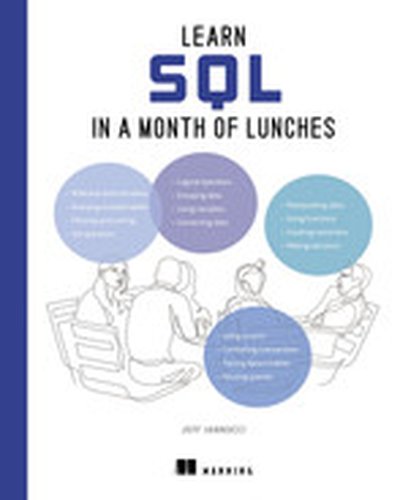
Use SQL to get the data you need in no time at all! Learn to read and write basic queries, troubleshoot common problems, and control your own business data in just 24 short lessons–no programming experience required! SQL has been designed to be as close to English as possible—anyone can learn it! Learn SQL in a Month of Lunches helps you add this lucrative and highly sought-after skill to your resume in just 24 fun and friendly lessons. The book emphasizes practical uses for the language in the real-world, so you’ll just learn the most useful skills for business data analysis. Inside Learn SQL in a Month of Lunches you’ll discover how to: Set up your first database with MySQL Write your own SQL queries See only the data you need from large datasets Connect different sets of data Analyze data with functions and aggregations Master basic data manipulation techniques Save queries in stored procedures and views Create tables to store data efficiently Read and improve SQL written by others If you use Excel, Tableau, or PowerBI to crunch business data, you’ve probably seen a lot of SQL already. And guess what? It’s easy to master the most useful parts of SQL! In just a few quick lessons, Learn SQL in a Month of Lunches will get you writing your own queries, modifying existing SQL statements, and working with data like a pro. 25-year SQL veteran Jeff Iannucci makes SQL a snap through hands-on lab exercises, relevant code examples, and easy-to-understand language. About the Technology SQL, Structured Query Language, is the standard way to query, create, and manage relational databases like SQL Server, PostgreSQL, and Oracle. It’s also a superpower for data analysts who need to go beyond spreadsheets and BI dashboarding tools. SQL is easy to read and understand, and with this book (and a little practice) you’ll be pulling data, tweaking tables, and cranking out amazing reports and presentations in no time at all! About the Book Learn SQL in a Month of Lunches introduces SQL to data analysts and other aspiring data pros with no prior experience using relational databases. In it, you’ll complete 24 short lessons, each of which teaches an essential SQL skill for retrieving, filtering, and analyzing data. You’ll practice each new technique with a friendly hands-on lab designed to take about 15 minutes, as you learn to write queries that deliver the exact data you need. Along the way, you’ll build a valuable intuition for how databases operate in real business scenarios. What's Inside Get the data you need from any relational database Filter, sort, and group data Combine data from multiple tables Create, update, and delete data About the Reader For students, aspiring data analysts, software developers, and anyone else who wants to work with relational databases. About the Author Jeff Iannucci is a Senior Consultant with Straight Path Solutions. For over 20 years, he has worked extensively with SQL in sectors such as healthcare, finance, retail sales, and government. Quotes An essential guide. Jeff has carefully developed each chapter to ensure clarity and comprehensiveness, making complex concepts accessible and practical. - Buck Woody, Microsoft The fastest and the most effective way to learn SQL, regardless of your background or technical knowledge level. - Kevin Kline, author of SQL in a Nutshell Explains concepts straightforwardly to help the reader grow their skills over a month of sessions. - Steve Jones, SQL Server Central Great selection of bite-sized, digestible courses to complement your lunch arrangement. It leaves you smarter every day. - Simon Tschöke, Databricks