Join Sam to discover a powerful new feature in Grafana, unlocking more power from your data and revolutionising your experience: SQL Expressions. What we’ll cover: Performing last-mile transformations: show, hide, rename, filter, and order columns; Using SQL features like subqueries and CTEs for in-memory data manipulation; Joining data from unlimited data source queries.
 talk-data.com
Topic
SQL
Structured Query Language (SQL)
database_language
data_manipulation
data_definition
programming_language
1751
tagged
Activity Trend
107
peak/qtr
2020-Q1
2026-Q2
Top Events
O'Reilly Data Engineering Books
780
Data Engineering Podcast
233
O'Reilly SQL Books
103
Data + AI Summit 2025
89
O'Reilly Data Science Books
82
Databricks DATA + AI Summit 2023
73
Microsoft Ignite 2025
46
Google Cloud Next '25
29
O'Reilly Business Intelligence Books
25
Google Cloud Next '24
21
Data Career Podcast: Helping You Land a Data Analyst Job FAST
18
dbt Coalesce 2022
14
Luca Bigon racconta la sua esperienza a Bauplan Labs, illustrando come applica pratiche di sviluppo software come branching e TimeTravel su Apache Iceberg in SQL e Python.
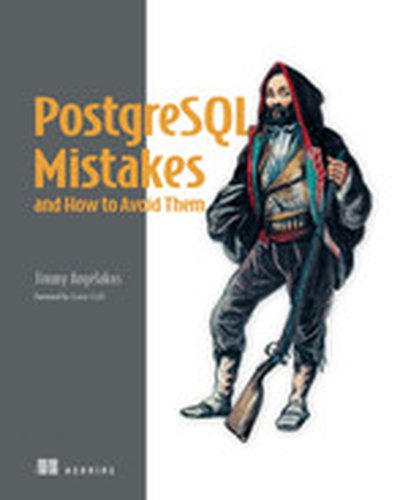
Recognize and avoid these common PostgreSQL mistakes! The best mistakes to learn from are ones made by other people! In PostgreSQL Mistakes and How To Avoid Them you’ll explore dozens of common PostgreSQL errors so you can easily avoid them in your own projects, learning proactively why certain approaches fail and others succeed. In PostgreSQL Mistakes and How To Avoid Them you’ll learn how to: Avoid configuration and operation issues Maximize PostgreSQL utility and performance Fix bad SQL practices Solve common security and administration issues Ensure smooth migration and upgrades Diagnose and fix a bad database As PostgreSQL continues its rise as a leading open source database, mastering its intricacies is crucial. PostgreSQL Mistakes and How To Avoid Them is full of tested best practices to ensure top performance, and future-proof your database systems for seamless change and growth. Each of the mistakes is carefully described and accompanied by a demo, along with an explanation that expands your knowledge of PostgreSQL internals and helps you to build a stronger mental model of how the database engine works. About the Technology Fixing mistakes in PostgreSQL databases can be time-consuming and risky—especially when you’re making live changes to an in-use system. Fortunately, you can learn from the mistakes other Postgres pros have already made! This incredibly practical book lays out how to find and avoid the most common, dangerous, and sneaky errors you’ll encounter using PostgreSQL. About the Book PostgreSQL Mistakes and How To Avoid Them identifies Postgres problems in key areas like data types, features, security, and high availability. For each mistake you’ll find a real-world narrative that illustrates the pattern and provides concrete recommendations for improvement. You’ll especially appreciate the illustrative code snippets, schema samples, mind maps, and tables that show the pros and cons of different approaches. What's Inside Diagnose configuration and operation issues Fix bad SQL code Address security and administration issues Ensure smooth migration and upgrades About the Reader For PostgreSQL database administrators and application developers. About the Author Jimmy Angelakos is a systems and database architect and PostgreSQL Contributor. He works as a Senior Principal Engineer at Deriv. Quotes I’ve run into many of these mistakes. Read up to get prepared! - Milorad Imbra, FEVO Navigates PostgreSQL pitfalls with clarity. I highly recommend it. - Manohar Sai Jasti, Workday A straightforward style and real-world examples make it an essential read. - Potito Coluccelli, Econocom Italia Provides valuable tips to avoid common PostgreSQL pitfalls. - Fernando Bugni, Grupo QuintoAndar
Learn how to efficiently run analytics over unstructured data, geospatial data and other advanced formats with Snowflake's latest SQL functions. Join us for new product and feature overviews, best practices and live demos.
Learn how to efficiently scale and manage data engineering pipelines with Snowflake's latest capabilities for SQL- and Python-based transformations. Join us for new product and feature overviews, best practices and live demos.
In our recent study, an overwhelming majority—80% of respondents—reported using AI in their day-to-day workflows. This marks a significant increase from just a year ago, when only 30% were doing so.
But what about data quality? Can you trust your data?
In this session, we’ll discuss how dbt can help organizations increase trust in their data, improve performance and governance, and control costs more effectively.
dbt is widely regarded as the industry standard for AI on structured data. Its Fusion engine, with deep SQL comprehension, powers the next generation of dbt use cases.
Join us for an insightful Ask Me Anything (AMA) session on Declarative Pipelines — a powerful approach to simplify and optimize data workflows. Learn how to define data transformations using high-level, SQL-like semantics, reducing boilerplate code while improving performance and maintainability. Whether you're building ETL processes, feature engineering pipelines, or analytical workflows, this session will cover best practices, real-world use cases and how Declarative Pipelines can streamline your data applications. Bring your questions and discover how to make your data processing more intuitive and efficient!
Data warehousing in enterprise and mission-critical environments needs special consideration for price/performance. This session will explain how Databricks SQL addresses the most challenging requirements for high-concurrency, low-latency performance at scale. We will also cover the latest advancements in resource-based scheduling, autoscaling and caching enhancements that allow for seamless performance and workload management.
Databricks SQL has added significant features in the last year at a fast pace. This session will share the most impactful features and the customer use cases that inspired them. We will highlight the new SQL editor, SQL coding features, streaming tables and materialized views, BI integrations, cost management features, system tables and observability features, and more. We will also share AI-powered performance optimizations.
In this session we’ll dive into the SQL kitchen and use a combination of SQL staples and nouvelle cuisine such as recursive queries, temporary tables, and stored procedures. We’ll leave you with well-scripted recipes to execute immediately or store for later consumption in your Unity Catalog. Think of this session as building your go-to cookbook of SQL techniques. Bon appétit!
This session is repeated. This introductory workshop caters to data engineers seeking hands-on experience and data architects looking to deepen their knowledge. The workshop is structured to provide a solid understanding of the following data engineering and streaming concepts: Introduction to Lakeflow and the Data Intelligence Platform Getting started with Lakeflow Declarative Pipelines for declarative data pipelines in SQL using Streaming Tables and Materialized Views Mastering Databricks Workflows with advanced control flow and triggers Understanding serverless compute Data governance and lineage with Unity Catalog Generative AI for Data Engineers: Genie and Databricks Assistant We believe you can only become an expert if you work on real problems and gain hands-on experience. Therefore, we will equip you with your own lab environment in this workshop and guide you through practical exercises like using GitHub, ingesting data from various sources, creating batch and streaming data pipelines, and more.
Want to learn how to build your own custom data intelligence applications directly in Databricks? In this workshop, we’ll guide you through a hands-on tutorial for building a Streamlit web app that leverages many of the key products at Databricks as building blocks. You’ll integrate a live DB SQL warehouse, use Genie to ask questions in natural language, and embed AI/BI dashboards for interactive visualizations. In addition, we’ll discuss key concepts and best practices for building production-ready apps, including logging and observability, scalability, different authorization models, and deployment. By the end, you'll have a working AI app—and the skills to build more.
Join this session for a concise tour of Apache Spark™ 4.0’s most notable enhancements: SQL features: ANSI by default, scripting, SQL pipe syntax, SQL UDF, session variable, view schema evolution, etc. Data type: VARIANT type, string collation Python features: Python data source, plotting API, etc. Streaming improvements: State store data source, state store checkpoint v2, arbitrary state v2, etc. Spark Connect improvements: More API coverage, thin client, unified Scala interface, etc. Infrastructure: Better error message, structured logging, new Java/Scala version support, etc. Whether you’re a seasoned Spark user or new to the ecosystem, this talk will prepare you to leverage Spark 4.0’s latest innovations for modern data and AI pipelines.
Writing SQL is a core part of any data analyst’s workflow, but small inefficiencies can add up, slowing down analysis and making it harder to iterate quickly. In this session, we’ll explore our powerful features in the Databricks SQL editor and notebook that help you to be more productive when writing SQL on Databricks. We’ll demo the new features and the customer use cases that inspired them.
How do you transform a data pipeline from sluggish 10-hour batch processing into a real-time powerhouse that delivers insights in just 10 minutes? This was the challenge we tackled at one of France's largest manufacturing companies, where data integration and analytics were mission-critical for supply chain optimization. Power BI dashboards needed to refresh every 15 minutes. Our team struggled with legacy Azure Data Factory batch pipelines. These outdated processes couldn’t keep up, delaying insights and generating up to three daily incident tickets. We identified Lakeflow Declarative Pipelines and Databricks SQL as the game-changing solution to modernize our workflow, implement quality checks, and reduce processing times.In this session, we’ll dive into the key factors behind our success: Pipeline modernization with Lakeflow Declarative Pipelines: improving scalability Data quality enforcement: clean, reliable datasets Seamless BI integration: Using Databricks SQL to power fast, efficient queries in Power BI
Redox & Databricks direct integration can streamline your interoperability workflows from responding in record time to preauthorization requests to letting attending physicians know about a change in risk for sepsis and readmission in near real time from ADTs. Data engineers will learn how to create fully-streaming ETL pipelines for ingesting, parsing and acting on insights from Redox FHIR bundles delivered directly to Unity Catalog volumes. Once available in the Lakehouse, AI/BI Dashboards and Agentic Frameworks help write FHIR messages back to Redox for direct push down to EMR systems. Parsing FHIR bundle resources has never been easier with SQL combined with the new VARIANT data type in Delta and streaming table creation against Serverless DBSQL Warehouses. We'll also use Databricks accelerators dbignite and redoxwrite for writing and posting FHIR bundles back to Redox integrated EMRs and we'll extend AI/BI with Unity Catalog SQL UDFs and the Redox API for use in Genie.
Migrating your Snowflake data warehouse to the Databricks Data Intelligence Platform can accelerate your data modernization journey. Though a cloud platform-to-cloud platform migration should be relatively easy, the breadth of the Databricks Platform provides flexibility and hence requires careful planning and execution. In this session, we present the migration methodology, technical approaches, automation tools, product/feature mapping, a technical demo and best practices using real-world case studies for migrating data, ELT pipelines and warehouses from Snowflake to Databricks.
Looking for a practical workshop on building an AI Agent on Databricks? Well, we have just the thing for you.This hands-on workshop takes you through the process of creating intelligent agents that can reason their way to useful outcomes. You'll start by building your own toolkit of SQL and Python functions that give your agent practical capabilities. Then we'll explore how to select the right foundation model for your needs, connect your custom tools, and watch as your agent tackles complex challenges through visible reasoning paths.The workshop doesn't just stop at building—you'll dive into evaluation techniques using evaluation datasets to identify where your agent shines and where it needs improvement. After implementing and measuring your changes, we'll explore deployment strategies, including a feedback collection interface that enables continuous improvement and governance mechanisms to ensure responsible AI usage in production environments.
Most organizations run complex cloud data architectures that silo applications, users and data. Join this interactive hands-on workshop to learn how Databricks SQL allows you to operate a multi-cloud lakehouse architecture that delivers data warehouse performance at data lake economics — with up to 12x better price/performance than traditional cloud data warehouses. Here’s what we’ll cover: How Databricks SQL fits in the Data Intelligence Platform, enabling you to operate a multicloud lakehouse architecture that delivers data warehouse performance at data lake economics How to manage and monitor compute resources, data access and users across your lakehouse infrastructure How to query directly on your data lake using your tools of choice or the built-in SQL editor and visualizations How to use AI to increase productivity when querying, completing code or building dashboards Ask your questions during this hands-on lab, and the Databricks experts will guide you.
HP Print's data platform team took on a migration from a monolithic, shared resource of AWS Redshift, to a modular and scalable data ecosystem on Databricks lakehouse. The result was 30–40% cost savings, scalable and isolated resources for different data consumers and ETL workloads, and performance optimization for a variety of query types. Through this migration, there were technical challenges and learnings relating to the ETL migrations with DBT, new Databricks features like Liquid Clustering, predictive optimization, Photon, SQL serverless warehouses, managing multiple teams on Unity Catalog, and others. This presentation dives into both the business and technical sides of this migration. Come along as we share our key takeaways from this journey.