talk-data.com talk-data.com

Topic

Teradata

data_warehouse analytics big_data olap

37

tagged

Activity Trend

5 peak/qtr
2020-Q1 2026-Q1

Activities

37 activities · Newest first

In this podcast, Justin Borgman talks about his journey of starting a data science start, doing an exit, and jumping on another one. The session is filled with insights for leadership, looking for entrepreneurial wisdom to get on a data-driven journey.

Timeline: 0:28 Justin's journey. 3:22 Taking the plunge to start a new company. 5:49 Perception vs. reality of starting a data warehouse company. 8:15 Bringing in something new to the IT legacy. 13:20 Getting your first few customers. 16:16 Right moment for a data warehouse company to look for a new venture. 18:20 Right person to have as a co-founder. 20:29 Advantages of going seed vs. series A. 22:13 When is a company ready for seeding or series A? 24:40 Who's a good adviser? 26:35 Exiting Teradata. 28:54 Teradata to starting a new company. 31:24 Excitement of starting something from scratch. 32:24 What is Starburst? 37:15 Presto, a great engine for cloud platforms. 40:30 How can a company get started with Presto. 41:50 Health of enterprise data. 44:15 Where does Presto not fit in? 45:19 Future of enterprise data. 46:36 Drawing parallels between proprietary space and open source space. 49:02 Does align with open-source gives a company a better chance in seeding. 51:44 John's ingredients for success. 54:05 John's favorite reads. 55:01 Key takeaways.

Paul's Recommended Read: The Outsiders Paperback – S. E. Hinton amzn.to/2Ai84Gl

Podcast Link: https://futureofdata.org/running-a-data-science-startup-one-decision-at-a-time-futureofdata-podcast/

Justin's BIO: Justin has spent the better part of a decade in senior executive roles building new businesses in the data warehousing and analytics space. Before co-founding Starburst, Justin was Vice President and General Manager at Teradata (NYSE: TDC), where he was responsible for the company’s portfolio of Hadoop products. Prior to joining Teradata, Justin was co-founder and CEO of Hadapt, the pioneering "SQL-on-Hadoop" company that transformed Hadoop from file system to analytic database accessible to anyone with a BI tool. Teradata acquired Hadapt in 2014.

Justin earned a BS in Computer Science from the University of Massachusetts at Amherst and an MBA from the Yale School of Management.

About #Podcast:

FutureOfData podcast is a conversation starter to bring leaders, influencers, and lead practitioners to discuss their journey to create the data-driven future.

Want to sponsor? Email us @ [email protected]

Keywords:
FutureOfData #DataAnalytics #Leadership #Podcast #BigData #Strategy

Teradata Cookbook

Are you ready to master Teradata, one of the leading relational database management systems for data warehousing? In the "Teradata Cookbook," you will find over 85 recipes covering vital tasks like querying, performance tuning, and administrative operations. With clear and practical instructions, this book will equip you with the skills necessary to optimize data storage and analytics in your organization. What this Book will help me do Master Teradata's advanced features for efficient data warehousing applications. Understand and employ Teradata SQL for effective data manipulation and analytics. Explore practical solutions for Teradata administration tasks, including user and security management. Learn performance tuning techniques to enhance the efficiency of your queries and processes. Acquire detailed knowledge about Teradata's architecture and its unique capabilities. Author(s) The authors of "Teradata Cookbook" are experienced professionals in database management and data warehousing. With a deep understanding of Teradata's architecture and use in real-world applications, they bring a wealth of knowledge to each of the book's recipes. Their focus is to provide practical, actionable insights to help you tackle challenges you may face. Who is it for? This book is ideal for database administrators, data analysts, and professionals working with data warehousing who want to leverage the power of Teradata. Whether you are new to this database management system or looking to enhance your expertise, this cookbook provides practical solutions and in-depth insights, making it an essential resource.

In this episode, Wayne Eckerson and Lenin Gali discuss the past and future of the cloud and big data.

Gali is a data analytics practitioner who has always been on the leading edge of where business and technology intersect. He was one of the first to move data analytics to the cloud when he was BI director at ShareThis, a social media based services provider. He was instrumental in defining an enterprise analytics strategy, developing a data platform that brought games and business data together to enable thousands of data users to build better games and services by using Hadoop & Teradata while at Ubisoft. He is now spearheading the creation of a Hadoop-based data analytics platform at Quotient, a digital marketing technology firm in the retail industry.

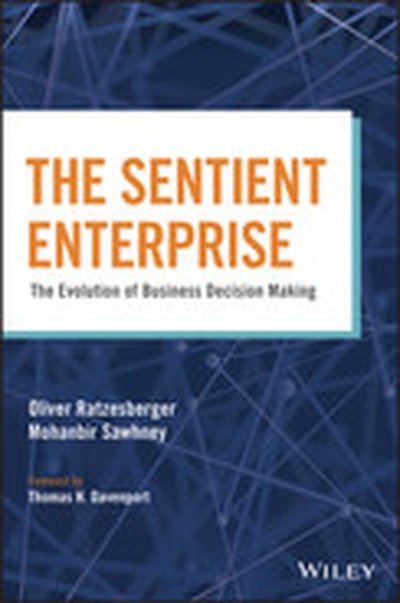
The Sentient Enterprise

Mohan and Oliver have been very fortunate to have intimate views into the data challenges that face the largest organizations and institutions across every possible industry—and what they have been hearing about for some time is how the business needs to use data and analytics to their advantage. They continually hear the same issues, such as: We're spending valuable meeting time wondering why everyone's data doesn't match up. We can't leverage our economies of scale while remaining agile with data. We need self-serve apps that let the enterprise experiment with data and accelerate the development process. We need to get on a more predictive curve to ensure long-term success. To really address the data concerns of today's enterprise, they wanted to find a way to help enterprises achieve the success they seek. Not as a prescriptive process—but a methodology to become agile and leverage data and analytics to drive a competitive advantage. You know, it's amazing what can happen when two people with very different perspectives get together to solve a big problem. This evolutionary guide resulted from the a-ha moment between these two influencers at the top of their fields—one, an academic researcher and consultant, and the other, a longtime analytics practitioner and chief product officer at Teradata. Together, they created a powerful framework every type of business can use to connect analytic power, business practices, and human dynamics in ways that can transform what is currently possible.

Understanding Metadata

One viable option for organizations looking to harness massive amounts of data is the data lake, a single repository for storing all the raw data, both structured and unstructured, that floods into the company. But that isn’t the end of the story. The key to making a data lake work is data governance, using metadata to provide valuable context through tagging and cataloging. This practical report examines why metadata is essential for managing, migrating, accessing, and deploying any big data solution. Authors Federico Castanedo and Scott Gidley dive into the specifics of analyzing metadata for keeping track of your data—where it comes from, where it’s located, and how it’s being used—so you can provide safeguards and reduce risk. In the process, you’ll learn about methods for automating metadata capture. This report also explains the main features of a data lake architecture, and discusses the pros and cons of several data lake management solutions that support metadata. These solutions include: Traditional data integration/management vendors such as the IBM Research Accelerated Discovery Lab Tooling from open source projects, including Teradata Kylo and Informatica Startups such as Trifacta and Zaloni that provide best of breed technology

Getting Analytics Right

Ask vital questions before you dive into data Are your big data and analytics capabilities up to par? Nearly half of the global company executives in a recent Forbes Insight/Teradata survey certainly don’t think theirs are. This new book from O’Reilly examines how things typically go wrong in the data analytics process, and introduces a question-first, data-second strategy that can help your company close the gap between being analytics-invested and truly data-driven. Authors from Tamr, Inc. share insights into why analytics projects often fail, and offer solutions based on their combined experience in engineering, architecture, product strategizing, and marketing. You’ll learn how projects often start from the wrong place, take too long, and don’t go far enough—missteps that lead to incomplete, late, or useless answers to critical business questions. Find out how their question-first, data-second approach—fueled by vastly improved data preparation platforms and cataloging software—can help you create human-machine analytics solutions designed specifically to produce better answers, faster. Getting Analytics Right was written and presented by people at Tamr, Inc., including Nidhi Aggarwal, Product and Strategy Lead; Byron Berk, Customer Success Lead; Gideon Goldin, Senior UX Architect; Matt Holzapfel, Product Marketing; and Eliot Knudsen, Field Engineer. Tamr, a Cambridge, Massachusetts-based startup, helps companies understand and unify their disparate databases.

Structured Search for Big Data

The WWW era made billions of people dramatically dependent on the progress of data technologies, out of which Internet search and Big Data are arguably the most notable. Structured Search paradigm connects them via a fundamental concept of key-objects evolving out of keywords as the units of search. The key-object data model and KeySQL revamp the data independence principle making it applicable for Big Data and complement NoSQL with full-blown structured querying functionality. The ultimate goal is extracting Big Information from the Big Data. As a Big Data Consultant, Mikhail Gilula combines academic background with 20 years of industry experience in the database and data warehousing technologies working as a Sr. Data Architect for Teradata, Alcatel-Lucent, and PayPal, among others. He has authored three books, including The Set Model for Database and Information Systems and holds four US Patents in Structured Search and Data Integration. Conceptualizes structured search as a technology for querying multiple data sources in an independent and scalable manner. Explains how NoSQL and KeySQL complement each other and serve different needs with respect to big data Shows the place of structured search in the internet evolution and describes its implementations including the real-time structured internet search

Bitemporal Data

Bitemporal data has always been important. But it was not until 2011 that the ISO released a SQL standard that supported it. Currently, among major DBMS vendors, Oracle, IBM and Teradata now provide at least some bitemporal functionality in their flagship products. But to use these products effectively, someone in your IT organization needs to know more than how to code bitemporal SQL statements. Perhaps, in your organization, that person is you. To correctly interpret business requests for temporal data, to correctly specify requirements to your IT development staff, and to correctly design bitemporal databases and applications, someone in your enterprise needs a deep understanding of both the theory and the practice of managing bitemporal data. Someone also needs to understand what the future may bring in the way of additional temporal functionality, so their enterprise can plan for it. Perhaps, in your organization, that person is you. This is the book that will show the do-it-yourself IT professional how to design and build bitemporal databases and how to write bitemporal transactions and queries, and will show those who will direct the use of vendor-provided bitemporal DBMSs exactly what is going on "under the covers" of that software. Explains the business value of bitemporal data in terms of the information that can be provided by bitemporal tables and not by any other form of temporal data, including history tables, version tables, snapshot tables, or slowly-changing dimensions Provides an integrated account of the mathematics, logic, ontology and semantics of relational theory and relational databases, in terms of which current relational theory and practice can be seen as unnecessarily constrained to the management of nontemporal and incompletely temporal data Explains how bitemporal tables can provide the time-variance and nonvolatility hitherto lacking in Inmon historical data warehouses Explains how bitemporal dimensions can replace slowly-changing dimensions in Kimball star schemas, and why they should do so Describes several extensions to the current theory and practice of bitemporal data, including the use of episodes, "whenever" temporal transactions and queries, and future transaction time Points out a basic error in the ISO’s bitemporal SQL standard, and warns practitioners against the use of that faulty functionality. Recommends six extensions to the ISO standard which will increase the business value of bitemporal data Points towards a tritemporal future for bitemporal data, in which an Aristotelian ontology and a speech-act semantics support the direct management of the statements inscribed in the rows of relational tables, and add the ability to track the provenance of database content to existing bitemporal databases This book also provides the background needed to become a business ontologist, and explains why an IT data management person, deeply familiar with corporate databases, is best suited to play that role. Perhaps, in your organization, that person is you

Apache Sqoop Cookbook

Integrating data from multiple sources is essential in the age of big data, but it can be a challenging and time-consuming task. This handy cookbook provides dozens of ready-to-use recipes for using Apache Sqoop, the command-line interface application that optimizes data transfers between relational databases and Hadoop. Sqoop is both powerful and bewildering, but with this cookbook’s problem-solution-discussion format, you’ll quickly learn how to deploy and then apply Sqoop in your environment. The authors provide MySQL, Oracle, and PostgreSQL database examples on GitHub that you can easily adapt for SQL Server, Netezza, Teradata, or other relational systems. Transfer data from a single database table into your Hadoop ecosystem Keep table data and Hadoop in sync by importing data incrementally Import data from more than one database table Customize transferred data by calling various database functions Export generated, processed, or backed-up data from Hadoop to your database Run Sqoop within Oozie, Hadoop’s specialized workflow scheduler Load data into Hadoop’s data warehouse (Hive) or database (HBase) Handle installation, connection, and syntax issues common to specific database vendors

Don’t miss this fireside chat! Join Teradata, Google Cloud, and HSBC to discover how Teradata VantageCloud migrated HSBC’s UK data platform. Learn how Teradata’s Cloud Vantage EDW enabled scalable, secure solutions and improved decision-making. With over 4 billion queries, 2,500 applications, and 35 integrated systems, this hybrid cloud solution offers unparalleled resilience and cost-efficiency.

Teradata activates AI for CX with MCP: Real-time intelligence engine

Explore how Teradata is transforming customer experience with a cutting-edge intelligence architecture designed for real-time decision-making. This compelling demo reveals how data scientists, engineers, and architects can build autonomous systems that sense, decide, and act—powered by Teradata’s MCP. Join Vidhal Bhonsle, Teradata Developer Advocate, for an accessible walkthrough of this next-gen solution and a preview of how it’s evolving to support future integrations.