talk-data.com talk-data.com

Topic

Vector DB

ai

80

tagged

Activity Trend

10 peak/qtr
2020-Q1 2026-Q1

Activities

80 activities · Newest first

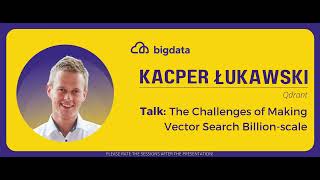
Kacper Łukawski: The Challenges of Making Vector Search Billion-scale

Join Kacper Łukawski as he delves into 'The Challenges of Making Vector Search Billion-scale.' 🔍🌐 Explore the intricacies of semantic search with large-scale embeddings and discover the lessons learned from scaling a vector database at Qdrant. Dive deep into design choices and the robust infrastructure behind them in this enlightening session.💡🚀 #VectorSearch #Scaling #semantics

✨ H I G H L I G H T S ✨

🙌 A huge shoutout to all the incredible participants who made Big Data Conference Europe 2023 in Vilnius, Lithuania, from November 21-24, an absolute triumph! 🎉 Your attendance and active participation were instrumental in making this event so special. 🌍

Don't forget to check out the session recordings from the conference to relive the valuable insights and knowledge shared! 📽️

Once again, THANK YOU for playing a pivotal role in the success of Big Data Conference Europe 2023. 🚀 See you next year for another unforgettable conference! 📅 #BigDataConference #SeeYouNextYear

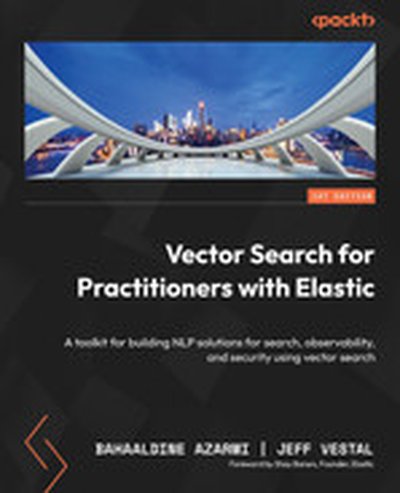
Vector Search for Practitioners with Elastic

The book "Vector Search for Practitioners with Elastic" provides a comprehensive guide to leveraging vector search technology within Elastic for applications in NLP, cybersecurity, and observability. By exploring practical examples and advanced techniques, this book teaches you how to optimize and implement vector search to address complex challenges in modern data management. What this Book will help me do Gain a deep understanding of implementing vector search with Elastic. Learn techniques to optimize vector data storage and retrieval for practical applications. Understand how to apply vector search for image similarity in Elastic. Discover methods for utilizing vector search for security and observability enhancements. Develop skills to integrate modern NLP tools with vector databases and Elastic. Author(s) Bahaaldine Azarmi, with his extensive experience in Elastic and NLP technologies, brings a practitioner's insight into the world of vector search. Co-author None Vestal contributes expertise in observability and system optimization. Together, they deliver practical and actionable knowledge in a clear and approachable manner. Who is it for? This book is designed for data professionals seeking to deepen their expertise in vector search and Elastic technologies. It is ideal for individuals in observability, search technology, or cybersecurity roles. If you have foundational knowledge in machine learning models, Python, and Elastic, this book will enable you to effectively utilize vector search in your projects.

Summary

The rapid growth of machine learning, especially large language models, have led to a commensurate growth in the need to store and compare vectors. In this episode Louis Brandy discusses the applications for vector search capabilities both in and outside of AI, as well as the challenges of maintaining real-time indexes of vector data.

Announcements

Hello and welcome to the Data Engineering Podcast, the show about modern data management Introducing RudderStack Profiles. RudderStack Profiles takes the SaaS guesswork and SQL grunt work out of building complete customer profiles so you can quickly ship actionable, enriched data to every downstream team. You specify the customer traits, then Profiles runs the joins and computations for you to create complete customer profiles. Get all of the details and try the new product today at dataengineeringpodcast.com/rudderstack This episode is brought to you by Datafold – a testing automation platform for data engineers that finds data quality issues before the code and data are deployed to production. Datafold leverages data-diffing to compare production and development environments and column-level lineage to show you the exact impact of every code change on data, metrics, and BI tools, keeping your team productive and stakeholders happy. Datafold integrates with dbt, the modern data stack, and seamlessly plugs in your data CI for team-wide and automated testing. If you are migrating to a modern data stack, Datafold can also help you automate data and code validation to speed up the migration. Learn more about Datafold by visiting dataengineeringpodcast.com/datafold You shouldn't have to throw away the database to build with fast-changing data. You should be able to keep the familiarity of SQL and the proven architecture of cloud warehouses, but swap the decades-old batch computation model for an efficient incremental engine to get complex queries that are always up-to-date. With Materialize, you can! It’s the only true SQL streaming database built from the ground up to meet the needs of modern data products. Whether it’s real-time dashboarding and analytics, personalization and segmentation or automation and alerting, Materialize gives you the ability to work with fresh, correct, and scalable results — all in a familiar SQL interface. Go to dataengineeringpodcast.com/materialize today to get 2 weeks free! If you’re a data person, you probably have to jump between different tools to run queries, build visualizations, write Python, and send around a lot of spreadsheets and CSV files. Hex brings everything together. Its powerful notebook UI lets you analyze data in SQL, Python, or no-code, in any combination, and work together with live multiplayer and version control. And now, Hex’s magical AI tools can generate queries and code, create visualizations, and even kickstart a whole analysis for you – all from natural language prompts. It’s like having an analytics co-pilot built right into where you’re already doing your work. Then, when you’re ready to share, you can use Hex’s drag-and-drop app builder to configure beautiful reports or dashboards that anyone can use. Join the hundreds of data teams like Notion, AllTrails, Loom, Mixpanel and Algolia using Hex every day to make their work more impactful. Sign up today at dataengineeringpodcast.com/hex to get a 30-day free trial of the Hex Team plan! Your host is Tobias Macey and today I'm interviewing Louis Brandy about building vector indexes in real-time for analytics and AI applications

Interview

Introduction How did you get involved in the area of data management? Can you describe what vector search is and how it differs from other search technologies?

What are the technical challenges related to providing vector search? What are the applications for vector search that merit the added complexity?

Vector databases have been gaining a lot of attention recently with the proliferation of LLM applicati

Generative AI initiatives require new data pipelines that prepare text files for querying by language models. Data engineers, scientists, and other stakeholders collaborate to design and implement these pipelines, which span text sources, tokens, vectors, vector databases, and LMs. Published at: https://www.eckerson.com/articles/the-new-data-pipeline-for-generative-ai-where-and-how-it-works

Gen AI, LLMs, AI assistants and intelligent agents are powering next-generation customer experiences, transforming every business. But there is no AI without Data. And only the right data delivers accurate, relevant results, with the context, scale and security you need.

"I Love AI" will unlock the power of Generative AI for you, with unique insights into the data platform and AI solutions you need, delivered by experts with real-world experience making AI a reality. This virtual event will help application architects, software developers, practitioners and CTOs learn how to:

  • Deliver AI outcomes with extreme accuracy and relevance
  • Build Generative AI apps with scale, governance and data security
  • Overcome the biggest obstacles keeping Gen AI from being enterprise ready
  • Deploy powerful vector search capabilities at a fraction of the cost
  • Use cutting edge innovations in the biggest, most powerful vector database

Gen AI, LLMs, AI assistants and intelligent agents are powering next-generation customer experiences, transforming every business. But there is no AI without Data. And only the right data delivers accurate, relevant results, with the context, scale and security you need.

"I Love AI" will unlock the power of Generative AI for you, with unique insights into the data platform and AI solutions you need, delivered by experts with real-world experience making AI a reality. This virtual event will help application architects, software developers, practitioners and CTOs learn how to:

  • Deliver AI outcomes with extreme accuracy and relevance
  • Build Generative AI apps with scale, governance and data security
  • Overcome the biggest obstacles keeping Gen AI from being enterprise ready
  • Deploy powerful vector search capabilities at a fraction of the cost
  • Use cutting edge innovations in the biggest, most powerful vector database

We talked about:

Meryam's background The constant evolution of startups How Meryam became interested in LLMs What is an LLM (generative vs non-generative models)? Why LLMs are important Open source models vs API models What TitanML does How fine-tuning a model helps in LLM use cases Fine-tuning generative models How generative models change the landscape of human work How to adjust models over time Vector databases and LLMs How to choose an open source LLM or an API Measuring input data quality Meryam's resource recommendations

Links:

Website: https://www.titanml.co/ Beta docs: https://titanml.gitbook.io/iris-documentation/overview/guide-to-titanml... Using llama2.0 in TitanML Blog: https://medium.com/@TitanML/the-easiest-way-to-fine-tune-and-inference-llama-2-0-8d8900a57d57 Discord: https://discord.gg/83RmHTjZgf Meryem LinkedIn: https://www.linkedin.com/in/meryemarik/

Free MLOps course: https://github.com/DataTalksClub/mlops-zoomcamp Join DataTalks.Club: https://datatalks.club/slack.html Our events: https://datatalks.club/events.html

Scaling AI Applications with Databricks, HuggingFace and Pinecone

The production and management of large-scale vector embeddings can be a challenging problem. The integration of Databricks, Hugging Face and Pinecone offers a powerful solution. Vector embeddings have become an essential tool in the development of AI powered applications. Embeddings are representations of data learned by machine models. High quality embeddings are unlocking use cases like semantic search, recommendation engines, and anomaly detection. Databricks' Apache Spark™ ecosystem together with Hugging Face's Transformers library enable large-scale vector embeddings production using GPU processing, Pinecone's vector database provides ultra-low latency querying and upserting of billions of embeddings, allowing for high-quality embeddings at scale for real-time AI apps.

In this session, we will present a concrete use case of this integration in the context of a natural language processing application. We will demonstrate how Pinecone's vector database can be integrated with Databricks and Hugging Face to produce large-scale vector embeddings of text data and how these embeddings can be used to improve the performance of various AI applications. You will see the benefits of this integration in terms of speed, scalability, and cost efficiency. By leveraging the GPU processing capabilities of Databricks and the ultra low-latency querying capabilities of Pinecone, we can significantly improve the performance of NLP tasks while reducing the cost and complexity of managing large-scale vector embeddings. You will learn about the technical details of this integration and how it can be implemented in your own AI projects, and gain insights into the speed, scalability, and cost efficiency benefits of using this solution.

Talk by: Roie Schwaber-Cohen

Connect with us: Website: https://databricks.com Twitter: https://twitter.com/databricks LinkedIn: https://www.linkedin.com/company/databricks Instagram: https://www.instagram.com/databricksinc Facebook: https://www.facebook.com/databricksinc

Vector Data Lakes

Vector databases such as ElasticSearch and Pinecone offer fast ingestion and querying on vector embeddings with ANNs. However, they typically do not decouple compute and storage, making them hard to integrate in production data stacks. Because data storage in these databases is expensive and not easily accessible, data teams typically maintain ETL pipelines to offload historical embedding data to blob stores. When that data needs to be queried, they get loaded back into the vector database in another ETL process. This is reminiscent of loading data from OLTP database to cloud storage, then loading said data into an OLAP warehouse for offline analytics.

Recently, “lakehouse” offerings allow direct OLAP querying on cloud storage, removing the need for the second ETL step. The same could be done for embedding data. While embedding storage in blob stores cannot satisfy the high TPS requirements in online settings, we argue it’s sufficient for offline analytics use cases like slicing and dicing data based on embedding clusters. Instead of loading the embedding data back into the vector database for offline analytics, we propose direct processing on embeddings stored in Parquet files in Delta Lake. You will see that offline embedding workloads typically touch a large portion of the stored embeddings without the need for random access.

As a result, the workload is entirely bound by network throughput instead of latency, making it quite suitable for blob storage backends. On a test one billion vector dataset, ETL into cloud storage takes around one hour on a dedicated GPU instance, while batched nearest neighbor search can be done in under one minute with four CPU instances. We believe future “lakehouses” will ship with native support for these embedding workloads.

Talk by: Tony Wang and Chang She

Here’s more to explore: State of Data + AI Report: https://dbricks.co/44i2HBp Databricks named a Leader in 2022 Gartner® Magic QuadrantTM CDBMS: https://dbricks.co/3phw20d

Connect with us: Website: https://databricks.com Twitter: https://twitter.com/databricks LinkedIn: https://www.linkedin.com/company/databricks Instagram: https://www.instagram.com/databricksinc Facebook: https://www.facebook.com/databricksinc

Summary

Data has been one of the most substantial drivers of business and economic value for the past few decades. Bob Muglia has had a front-row seat to many of the major shifts driven by technology over his career. In his recent book "Datapreneurs" he reflects on the people and businesses that he has known and worked with and how they relied on data to deliver valuable services and drive meaningful change.

Announcements

Hello and welcome to the Data Engineering Podcast, the show about modern data management Introducing RudderStack Profiles. RudderStack Profiles takes the SaaS guesswork and SQL grunt work out of building complete customer profiles so you can quickly ship actionable, enriched data to every downstream team. You specify the customer traits, then Profiles runs the joins and computations for you to create complete customer profiles. Get all of the details and try the new product today at dataengineeringpodcast.com/rudderstack Your host is Tobias Macey and today I'm interviewing Bob Muglia about his recent book about the idea of "Datapreneurs" and the role of data in the modern economy

Interview

Introduction How did you get involved in the area of data management? Can you describe what your concept of a "Datapreneur" is?

How is this distinct from the common idea of an entreprenur?

What do you see as the key inflection points in data technologies and their impacts on business capabilities over the past ~30 years? In your role as the CEO of Snowflake you had a first-row seat for the rise of the "modern data stack". What do you see as the main positive and negative impacts of that paradigm?

What are the key issues that are yet to be solved in that ecosmnjjystem?

For technologists who are thinking about launching new ventures, what are the key pieces of advice that you would like to share? What do you see as the short/medium/long-term impact of AI on the technical, business, and societal arenas? What are the most interesting, innovative, or unexpected ways that you have seen business leaders use data to drive their vision? What are the most interesting, unexpected, or challenging lessons that you have learned while working on the Datapreneurs book? What are your key predictions for the future impact of data on the technical/economic/business landscapes?

Contact Info

LinkedIn

Parting Question

From your perspective, what is the biggest gap in the tooling or technology for data management today?

Closing Announcements

Thank you for listening! Don't forget to check out our other shows. Podcast.init covers the Python language, its community, and the innovative ways it is being used. The Machine Learning Podcast helps you go from idea to production with machine learning. Visit the site to subscribe to the show, sign up for the mailing list, and read the show notes. If you've learned something or tried out a project from the show then tell us about it! Email [email protected]) with your story. To help other people find the show please leave a review on Apple Podcasts and tell your friends and co-workers

Links

Datapreneurs Book SQL Server Snowflake Z80 Processor Navigational Database System R Redshift Microsoft Fabric Databricks Looker Fivetran

Podcast Episode

Databricks Unity Catalog RelationalAI 6th Normal Form Pinecone Vector DB

Podcast Episode

Perplexity AI

The intro and outro music is from The Hug by The Freak Fandango Orchestra / CC BY-SA Sponsored By: Rudderstack: Rudderstack

Introducing RudderStack Profiles. RudderStack Profiles takes the SaaS guesswork and SQL grunt work out of building complete customer profiles so you can quickly ship actionable, enriched data to every downstream team. You specify the customer traits, then Profiles runs the joins and computations for you to create complete customer profiles. Get all of the details and try the new product today at dataengineeringpodcast.com/rudderstackSupport Data Engineering Podcast

The first is recording patient-doctor consultations: transcription using audio-to-text models, and then summarising and reformatting into professional clinical documentation using LLMs. The second is using NLP and vector databases to do efficient search of clinical guideline documents, and ability to interact with the guidelines using NLP.

Embeddings are a learned way of representing data in space. Vector databases make it easier to work with embeddings generated from deep learning models. They will become an essential tool in the AI stack because they reduce the time to structure data and train models. Published at: https://www.eckerson.com/articles/the-why-what-who-and-where-of-vector-databases

Image retrieval is the process of searching for images in a large database that are similar to one or more query images. A classical approach is to transform the database images and the query images into embeddings via a feature extractor (e.g., a CNN or a ViT), so that they can be compared via a distance metric. Self-supervised learning (SSL) can be used to train a feature extractor without the need for expensive and time-consuming labeled training data. We will use DINO's SSL method to build a feature extractor and Milvus, an open-source vector database built for evolutionary similarity search, to index image representation vectors for efficient retrieval. We will compare the SSL approach with supervised and pre-trained feature extractors.

Innovations such as sentence-transformers, neural search and vector databases fueled a very fast development of question-answering systems recently. At scieneers, we wanted to test those components to satisfy our own information needs using a slack-bot that will answer our questions by reading through our internal documents and slack-conversations. We therefore leveraged the HayStack QA-Framework in combination with a Weaviate vector database and many fine-tuned NLP-models. This talk will give you insights in both, the technical challenges we faced and the organizational learnings we took.

Summary The optimal format for storage and retrieval of data is dependent on how it is going to be used. For analytical systems there are decades of investment in data warehouses and various modeling techniques. For machine learning applications relational models require additional processing to be directly useful, which is why there has been a growth in the use of vector databases. These platforms store direct representations of the vector embeddings that machine learning models rely on for computing relevant predictions so that there is no additional processing required to go from input data to inference output. In this episode Frank Liu explains how the open source Milvus vector database is implemented to speed up machine learning development cycles, how to think about proper storage and scaling of these vectors, and how data engineering and machine learning teams can collaborate on the creation and maintenance of these data sets.

Announcements

Hello and welcome to the Data Engineering Podcast, the show about modern data management When you’re ready to build your next pipeline, or want to test out the projects you hear about on the show, you’ll need somewhere to deploy it, so check out our friends at Linode. With their new managed database service you can launch a production ready MySQL, Postgres, or MongoDB cluster in minutes, with automated backups, 40 Gbps connections from your application hosts, and high throughput SSDs. Go to dataengineeringpodcast.com/linode today and get a $100 credit to launch a database, create a Kubernetes cluster, or take advantage of all of their other services. And don’t forget to thank them for their continued support of this show! Data stacks are becoming more and more complex. This brings infinite possibilities for data pipelines to break and a host of other issues, severely deteriorating the quality of the data and causing teams to lose trust. Sifflet solves this problem by acting as an overseeing layer to the data stack – observing data and ensuring it’s reliable from ingestion all the way to consumption. Whether the data is in transit or at rest, Sifflet can detect data quality anomalies, assess business impact, identify the root cause, and alert data teams’ on their preferred channels. All thanks to 50+ quality checks, extensive column-level lineage, and 20+ connectors across the Data Stack. In addition, data discovery is made easy through Sifflet’s information-rich data catalog with a powerful search engine and real-time health statuses. Listeners of the podcast will get $2000 to use as platform credits when signing up to use Sifflet. Sifflet also offers a 2-week free trial. Find out more at dataengineeringpodcast.com/sifflet today! RudderStack helps you build a customer data platform on your warehouse or data lake. Instead of trapping data in a black box, they enable you to easily collect customer data from the entire stack and build an identity graph on your warehouse, giving you full visibility and control. Their SDKs make event streaming from any app or website easy, and their state-of-the-art reverse ETL pipelines enable you to send enriched data to any cloud tool. Sign up free… or just get the free t-shirt for being a listener of the Data Engineering Podcast at dataengineeringpodcast.com/rudder. Data teams are increasingly under pressure to deliver. According to a recent survey by Ascend.io, 95% in fact reported being at or over capacity. With 72% of data experts reporting demands on their team going up faster than they can hire, it’s no surprise they are increasingly turning to automation. In fact, while only 3.5% report having current investments in automation, 85% of data teams plan on investing in automation in the next 12 months. 85%!!! That’s where our friends at Ascend.io come in. The Ascend Data Automation Cloud provides a unified platform for data ingestion, transformation, orchestration, and observability. Ascend users love its declarative pipelines

Emerging Data Architectures & Approaches for Real-Time AI using Redis

As more applications harness the power of real-time data, it’s important to architect and implement a data stack to meet the broad requirements of operational ML and be able to seamlessly integrate neural embeddings into applications.

Real-time ML requires more than just deploying ML models to production using MLOps tooling; it requires a fast and scalable operational database that easily integrates into the MLOps workflow. Milliseconds matter and can make the difference in delivering fast online predictions whether it’s personalized recommendations, detecting fraud, or figuring out the most optimal food delivery route.

Attend this session to explore how a modern data stack can be used for real-time operational ML and building AI-infused applications. The session will over the following topics:

Emerging architectural components for operational ML such as the online feature store for real-time serving.

Operational excellence in managing globally distributed ML data and feature pipelines

Foundational data types of Redis including the representation of data using vector embeddings.

Using Redis as a vector database to build vector similarity search applications.

Connect with us: Website: https://databricks.com Facebook: https://www.facebook.com/databricksinc Twitter: https://twitter.com/databricks LinkedIn: https://www.linkedin.com/company/data... Instagram: https://www.instagram.com/databricksinc/

Summary The vast majority of data tools and platforms that you hear about are designed for working with structured, text-based data. What do you do when you need to manage unstructured information, or build a computer vision model? Activeloop was created for exactly that purpose. In this episode Davit Buniatyan, founder and CEO of Activeloop, explains why he is spending his time and energy on building a platform to simplify the work of getting your unstructured data ready for machine learning. He discusses the inefficiencies that teams run into from having to reprocess data multiple times, his work on the open source Hub library to solve this problem for everyone, and his thoughts on the vast potential that exists for using computer vision to solve hard and meaningful problems.

Announcements

Hello and welcome to the Data Engineering Podcast, the show about modern data management When you’re ready to build your next pipeline, or want to test out the projects you hear about on the show, you’ll need somewhere to deploy it, so check out our friends at Linode. With their managed Kubernetes platform it’s now even easier to deploy and scale your workflows, or try out the latest Helm charts from tools like Pulsar and Pachyderm. With simple pricing, fast networking, object storage, and worldwide data centers, you’ve got everything you need to run a bulletproof data platform. Go to dataengineeringpodcast.com/linode today and get a $100 credit to try out a Kubernetes cluster of your own. And don’t forget to thank them for their continued support of this show! Are you bored with writing scripts to move data into SaaS tools like Salesforce, Marketo, or Facebook Ads? Hightouch is the easiest way to sync data into the platforms that your business teams rely on. The data you’re looking for is already in your data warehouse and BI tools. Connect your warehouse to Hightouch, paste a SQL query, and use their visual mapper to specify how data should appear in your SaaS systems. No more scripts, just SQL. Supercharge your business teams with customer data using Hightouch for Reverse ETL today. Get started for free at dataengineeringpodcast.com/hightouch. Have you ever had to develop ad-hoc solutions for security, privacy, and compliance requirements? Are you spending too much of your engineering resources on creating database views, configuring database permissions, and manually granting and revoking access to sensitive data? Satori has built the first DataSecOps Platform that streamlines data access and security. Satori’s DataSecOps automates data access controls, permissions, and masking for all major data platforms such as Snowflake, Redshift and SQL Server and even delegates data access management to business users, helping you move your organization from default data access to need-to-know access. Go to dataengineeringpodcast.com/satori today and get a $5K credit for your next Satori subscription. Your host is Tobias Macey and today I’m interviewing Davit Buniatyan about Activeloop, a platform for hosting and delivering datasets optimized for machine learning

Interview

Introduction How did you get involved in the area of data management? Can you describe what Activeloop is and the story behind it? How does the form and function of data storage introduce friction in the development and deployment of machine learning projects? How does the work that you are doing at Activeloop compare to vector databases such as Pinecone? You have a focus on image oriented data and computer vision projects. How does the specific applications of ML/DL influence the format and interactions with the data? Can you describe how the Activeloop platform is architected?

How have the design and goals of the system changed or evolved since you began working on it?

What are the feature and performance tradeoffs between self-managed storage locations (e.g. S3, GCS) and the Activeloop platform? What is the process for sourcing, processing, and storing

Summary Machine learning models use vectors as the natural mechanism for representing their internal state. The problem is that in order for the models to integrate with external systems their internal state has to be translated into a lower dimension. To eliminate this impedance mismatch Edo Liberty founded Pinecone to build database that works natively with vectors. In this episode he explains how this technology will allow teams to accelerate the speed of innovation, how vectors make it possible to build more advanced search functionality, and how Pinecone is architected. This is an interesting conversation about how reconsidering the architecture of your systems can unlock impressive new capabilities.

Announcements

Hello and welcome to the Data Engineering Podcast, the show about modern data management When you’re ready to build your next pipeline, or want to test out the projects you hear about on the show, you’ll need somewhere to deploy it, so check out our friends at Linode. With their managed Kubernetes platform it’s now even easier to deploy and scale your workflows, or try out the latest Helm charts from tools like Pulsar and Pachyderm. With simple pricing, fast networking, object storage, and worldwide data centers, you’ve got everything you need to run a bulletproof data platform. Go to dataengineeringpodcast.com/linode today and get a $100 credit to try out a Kubernetes cluster of your own. And don’t forget to thank them for their continued support of this show! RudderStack’s smart customer data pipeline is warehouse-first. It builds your customer data warehouse and your identity graph on your data warehouse, with support for Snowflake, Google BigQuery, Amazon Redshift, and more. Their SDKs and plugins make event streaming easy, and their integrations with cloud applications like Salesforce and ZenDesk help you go beyond event streaming. With RudderStack you can use all of your customer data to answer more difficult questions and then send those insights to your whole customer data stack. Sign up free at dataengineeringpodcast.com/rudder today. When it comes to serving data for AI and ML projects, do you feel like you have to rebuild the plane while you’re flying it across the ocean? Molecula is an enterprise feature store that operationalizes advanced analytics and AI in a format designed for massive machine-scale projects without having to manage endless one-off information requests. With Molecula, data engineers manage one single feature store that serves the entire organization with millisecond query performance whether in the cloud or at your data center. And since it is implemented as an overlay, Molecula doesn’t disrupt legacy systems. High-growth startups use Molecula’s feature store because of its unprecedented speed, cost savings, and simplified access to all enterprise data. From feature extraction to model training to production, the Molecula feature store provides continuously updated feature access, reuse, and sharing without the need to pre-process data. If you need to deliver unprecedented speed, cost savings, and simplified access to large scale, real-time data, visit dataengineeringpodcast.com/molecula and request a demo. Mention that you’re a Data Engineering Podcast listener, and they’ll send you a free t-shirt. Your host is Tobias Macey and today I’m interviewing Edo Liberty about Pinecone, a vector database for powering machine learning and similarity search

Interview

Introduction How did you get involved in the area of data management? Can you start by describing what Pinecone is and the story behind it? What are some of the contexts where someone would want to perform a similarity search?

What are the considerations that someone should be aware of when deciding between Pinecone and Solr/Lucene for a search oriented use case?

What are some of the other use cases that Pinecone enables? In the absence of Pinecone, what kinds of systems and solutions are people b

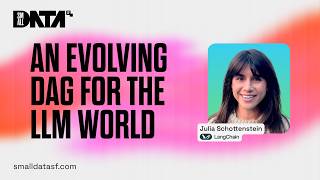
An Evolving DAG for the LLM world - Julia Schottenstein of LangChain at Small Data SF

Directed Acyclic Graphs (DAGs) are the foundation of most orchestration frameworks. But what happens when you allow an LLM to act as the router? Acyclic graphs now become cyclic, which means you have to design for the challenges resulting from all this extra power. We'll cover the ins and outs of agentic applications and how to best use them in your work as a data practitioner or developer building today.

➡️ Follow Us LinkedIn: https://www.linkedin.com/company/small-data-sf/ X/Twitter : https://twitter.com/smalldatasf Website: https://www.smalldatasf.com/


Discover LangChain, the open-source framework for building powerful agentic systems. Learn how to augment LLMs with your private data, moving beyond their training cutoffs. We'll break down how LangChain uses "chains," which are essentially Directed Acyclic Graphs (DAGs) similar to data pipelines you might recognize from dbt. This structure is perfect for common patterns like Retrieval Augmented Generation (RAG), where you orchestrate steps to fetch context from a vector database and feed it to an LLM to generate an informed response, much like preparing data for analysis.

Dive into the world of AI agents, where the LLM itself determines the application's control flow. Unlike a predefined DAG, this allows for dynamic, cyclic graphs where an agent can iterate and improve its response based on previous attempts. We'll explore the core challenges in building reliable agents: effective planning and reflection, managing shared memory across multiple agents in a cognitive architecture, and ensuring reliability against task ambiguity. Understand the critical trade-offs between the dependability of static chains and the flexibility of dynamic LLM agents.

Introducing LangGraph, a framework designed to solve the agent reliability problem by balancing agent control with agency. Through a live demo in LangGraph Studio, see how to build complex AI applications using a cyclic graph. We'll demonstrate how a router agent can delegate tasks, execute a research plan with multiple steps, and use cycles to iterate on a problem. You'll also see how human-in-the-loop intervention can steer the agent for improved performance, a critical feature for building robust and observable agentic systems.

Explore some of the most exciting AI agents in production today. See how Roblox uses an AI assistant to generate virtual worlds from a prompt, how TripAdvisor’s agent acts as a personal travel concierge to create custom itineraries, and how Replit’s coding agent automates code generation and pull requests. These real-world examples showcase the practical power of moving from simple DAGs to dynamic, cyclic graphs for solving complex, agentic problems.

Python shines in RAG (Retrieval-Augmented Generation) systems due to its efficiency in orchestrating various processes and its extensive libraries, such as LangChain and Hugging Face Transformers. The building blocks for RAG include data extraction and preprocessing, transforming data into vectors via embedding models, and using vector databases for retrieval. Python excels in setting up data pipelines for indexing, retrieval, and generation, integrating different components, and ensuring low-latency, high-efficiency real-time processing. Real-world applications of RAG systems showcase Python's benefits and challenges in implementation, demonstrating its versatility and robustness in managing complex data flows and interactions.