talk-data.com talk-data.com

Event

O'Reilly Data Science Books

2013-08-09 – 2026-02-25 Oreilly Visit website ↗

Activities tracked

2118

Collection of O'Reilly books on Data Science.

Sessions & talks

Showing 951–975 of 2118 · Newest first

Search within this event →
Data Science with Java

Data Science is booming thanks to R and Python, but Java brings the robustness, convenience, and ability to scale critical to today’s data science applications. With this practical book, Java software engineers looking to add data science skills will take a logical journey through the data science pipeline. Author Michael Brzustowicz explains the basic math theory behind each step of the data science process, as well as how to apply these concepts with Java. You’ll learn the critical roles that data IO, linear algebra, statistics, data operations, learning and prediction, and Hadoop MapReduce play in the process. Throughout this book, you’ll find code examples you can use in your applications. Examine methods for obtaining, cleaning, and arranging data into its purest form Understand the matrix structure that your data should take Learn basic concepts for testing the origin and validity of data Transform your data into stable and usable numerical values Understand supervised and unsupervised learning algorithms, and methods for evaluating their success Get up and running with MapReduce, using customized components suitable for data science algorithms

Business in Real-Time Using Azure IoT and Cortana Intelligence Suite: Driving Your Digital Transformation

Learn how today’s businesses can transform themselves by leveraging real-time data and advanced machine learning analytics. This book provides prescriptive guidance for architects and developers on the design and development of modern Internet of Things (IoT) and Advanced Analytics solutions. In addition, Business in Real-Time Using Azure IoT and Cortana Intelligence Suite offers patterns and practices for those looking to engage their customers and partners through Software-as-a-Service solutions that work on any device. Whether you're working in Health & Life Sciences, Manufacturing, Retail, Smart Cities and Buildings or Process Control, there exists a common platform from which you can create your targeted vertical solutions. Business in Real-Time Using Azure IoT and Cortana Intelligence Suite uses a reference architecture as a road map. Building on Azure’s PaaS services, you'll see how a solution architecture unfolds that demonstrates a complete end-to-end IoT and Advanced Analytics scenario. What You'll Learn: Automate your software product life cycle using PowerShell, Azure Resource Manager Templates, and Visual Studio Team Services Implement smart devices using Node.JS and C# Use Azure Streaming Analytics to ingest millions of events Provide both "Hot" and "Cold" path outputs for real-time alerts, data transformations, and aggregation analytics Implement batch processing using Azure Data Factory Create a new form of Actionable Intelligence (AI) to drive mission critical business processes Provide rich Data Visualizations across a wide variety of mobile and web devices Who This Book is For: Solution Architects, Software Developers, Data Architects, Data Scientists, and CIO/CTA Technical Leadership Professionals

Metaprogramming in R: Advanced Statistical Programming for Data Science, Analysis and Finance

Learn how to manipulate functions and expressions to modify how the R language interprets itself. This book is an introduction to metaprogramming in the R language, so you will write programs to manipulate other programs. Metaprogramming in R shows you how to treat code as data that you can generate, analyze, or modify. R is a very high-level language where all operations are functions and all functions are data that can be manipulated. This book shows you how to leverage R's natural flexibility in how function calls and expressions are evaluated, to create small domain-specific languages to extend R within the R language itself. What You'll Learn Find out about the anatomy of a function in R Look inside a function call Work with R expressions and environments Manipulate expressions in R Use substitutions Who This Book Is For Those with at least some experience with R and certainly for those with experience in other programming languages

Design and Analysis of Experiments, 9th Edition

Design and Analysis of Experiments, 9th Edition continues to help senior and graduate students in engineering, business, and statistics--as well as working practitioners--to design and analyze experiments for improving the quality, efficiency and performance of working systems. This bestselling text maintains its comprehensive coverage by including: new examples, exercises, and problems (including in the areas of biochemistry and biotechnology); new topics and problems in the area of response surface; new topics in nested and split-plot design; and the residual maximum likelihood method is now emphasized throughout the book.

Python Web Scraping - Second Edition

"Python Web Scraping" is a practical guide to extracting and processing online data using the Python programming language. With this book, you'll learn step-by-step how to build web scrapers and crawlers that can handle a range of data sources and structures. After reading this, you will be equipped to tackle real-world web scraping challenges effectively. What this Book will help me do Learn how to extract structured data from standard webpages using Python. Gain proficiency with libraries such as Selenium and PyQt for handling dynamic and JavaScript-dependent content. Build concurrent scrapers to efficiently process large volumes of web pages in parallel. Understand and implement form interaction automation for data extraction from complex websites. Develop advanced scrapers using Scrapy to handle sophisticated web crawling tasks. Author(s) None Jarmul is an experienced data scientist and programmer with extensive knowledge in Python. They bring practical expertise from working on real-world web scraping projects. In their work, they focus on creating content that empowers readers by demystifying complex technical topics. Who is it for? This book is perfect for software developers eager to dive into web scraping using Python, even if they're new to the subject. If you have basic to intermediate Python skills and want to automate data collection and processing, this is the book for you. The techniques here are valuable for tackling diverse data extraction scenarios.

Learning Social Media Analytics with R

Explore the intricacies of using R for social media analytics with 'Learning Social Media Analytics with R'. This comprehensive guide introduces readers to tools and techniques to extract, analyze, and visualize data from popular platforms like Twitter and Facebook. Gain insights into advanced methods such as sentiment analysis, topic modeling, and social network analysis. What this Book will help me do Master the art of leveraging R to retrieve, process, and clean data from major social media platforms. Use actionable insights from sentiment analysis and topic modeling to improve decision-making processes. Develop an understanding of social network structures by analyzing community connections and user interactions. Create impactful data visualizations that showcase trends and insights effectively using the R ecosystem. Integrate advanced R packages such as ggplot2, dplyr, and caret to streamline data analysis workflows. Author(s) The authors of this book, None Sarkar, Karthik Ganapathy, Raghav Bali, and None Sharma, are experts in data science and R programming with extensive experience in the industry. They bring a passion for teaching and a clear, step-by-step methodology to help learners grasp complex concepts. Who is it for? This book is ideal for data scientists, analysts, IT professionals, and social media marketers who aim to gain actionable insights from social data. Whether you're a beginner or have some experience with R, this book is highly approachable and beneficial. Readers will find practical examples and comprehensive tutorials tailored for their level of expertise.

Practical Statistics for Data Scientists

Statistical methods are a key part of of data science, yet very few data scientists have any formal statistics training. Courses and books on basic statistics rarely cover the topic from a data science perspective. This practical guide explains how to apply various statistical methods to data science, tells you how to avoid their misuse, and gives you advice on what's important and what's not. Many data science resources incorporate statistical methods but lack a deeper statistical perspective. If you’re familiar with the R programming language, and have some exposure to statistics, this quick reference bridges the gap in an accessible, readable format. With this book, you’ll learn: Why exploratory data analysis is a key preliminary step in data science How random sampling can reduce bias and yield a higher quality dataset, even with big data How the principles of experimental design yield definitive answers to questions How to use regression to estimate outcomes and detect anomalies Key classification techniques for predicting which categories a record belongs to Statistical machine learning methods that “learn” from data Unsupervised learning methods for extracting meaning from unlabeled data

Breaking Data Science Open

Over the past decade, data science has come out of the back office to become a force of change across the entire organization. At the forefront of this change is the open data science movement that advocates the use of open source tools in a powerful, connected ecosystem. This report explores how open data science can help your organization break free from the shackles of proprietary tools, embrace a more open and collaborative work style, and unleash new intelligent applications quickly. Authors Michele Chambers and Christine Doig explain how open source tools have helped bring about many facets of the data science evolution, including collaboration, self-service, and deployment. But you’ll discover that open data science is about more than tools; it’s about a new way of working as an organization. Learn how data science—particularly open data science—has become part of everyday business Understand how open data science engages people from other disciplines, not just statisticians Examine tools and practices that enable data science to be open across technical, operational, and organizational aspects Learn benefits of open data science, including rich resources, agility, transparency, and collective intelligence Explore case studies that demonstrate different ways to implement open data science Discover how open data science can help you break down department barriers and make bold market moves Michele Chambers, Chief Marketing Officer and VP Products at Continuum Analytics, is an entrepreneurial executive with over 25 years of industry experience. Prior to Continuum Analytics, Michele held executive leadership roles at several database and analytic companies, including Netezza, IBM, Revolution Analytics, MemSQL, and RapidMiner. Christine Doig is a senior data scientist at Continuum Analytics, where she's worked on several projects, including MEMEX, a DARPA-funded open data science project to help stop human trafficking. She has 5+ years of experience in analytics, operations research, and machine learning in a variety of industries.

Preparing Data for Analysis with JMP

Access and clean up data easily using JMP®! Data acquisition and preparation commonly consume approximately 75% of the effort and time of total data analysis. JMP provides many visual, intuitive, and even innovative data-preparation capabilities that enable you to make the most of your organization's data. Preparing Data for Analysis with JMP® is organized within a framework of statistical investigations and model-building and illustrates the new data-handling features in JMP, such as the Query Builder. Useful to students and programmers with little or no JMP experience, or those looking to learn the new data-management features and techniques, it uses a practical approach to getting started with plenty of examples. Using step-by-step demonstrations and screenshots, this book walks you through the most commonly used data-management techniques that also include lots of tips on how to avoid common problems. With this book, you will learn how to: Manage database operations using the JMP Query Builder Get data into JMP from other formats, such as Excel, csv, SAS, HTML, JSON, and the web Identify and avoid problems with the help of JMP’s visual and automated data-exploration tools Consolidate data from multiple sources with Query Builder for tables Deal with common issues and repairs that include the following tasks: reshaping tables (stack/unstack) managing missing data with techniques such as imputation and Principal Components Analysis cleaning and correcting dirty data computing new variables transforming variables for modelling reconciling time and date Subset and filter your data Save data tables for exchange with other platforms

Research Methods in Human-Computer Interaction, 2nd Edition

Research Methods in Human-Computer Interaction is a comprehensive guide to performing research and is essential reading for both quantitative and qualitative methods. Since the first edition was published in 2009, the book has been adopted for use at leading universities around the world, including Harvard University, Carnegie-Mellon University, the University of Washington, the University of Toronto, HiOA (Norway), KTH (Sweden), Tel Aviv University (Israel), and many others. Chapters cover a broad range of topics relevant to the collection and analysis of HCI data, going beyond experimental design and surveys, to cover ethnography, diaries, physiological measurements, case studies, crowdsourcing, and other essential elements in the well-informed HCI researcher's toolkit. Continual technological evolution has led to an explosion of new techniques and a need for this updated 2nd edition, to reflect the most recent research in the field and newer trends in research methodology. This Research Methods in HCI revision contains updates throughout, including more detail on statistical tests, coding qualitative data, and data collection via mobile devices and sensors. Other new material covers performing research with children, older adults, and people with cognitive impairments. Comprehensive and updated guide to the latest research methodologies and approaches, and now available in EPUB3 format (choose any of the ePub or Mobi formats after purchase of the eBook) Expanded discussions of online datasets, crowdsourcing, statistical tests, coding qualitative data, laws and regulations relating to the use of human participants, and data collection via mobile devices and sensors New material on performing research with children, older adults, and people with cognitive impairments, two new case studies from Google and Yahoo!, and techniques for expanding the influence of your research to reach non-researcher audiences, including software developers and policymakers

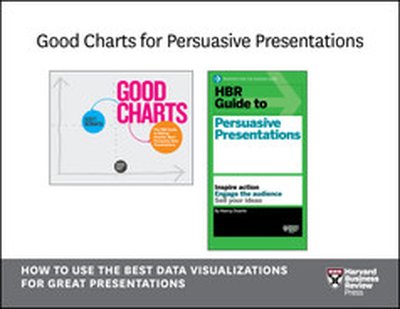
Good Charts for Persuasive Presentations

The right visual revealed at the right time can turn an unremarkable presentation into a resonant, emotional experience. This two-book collection provides you with the tools you need to craft and deliver presentations that will impress your audience, increase your influence in your organization, and advance your career. Good Charts: The HBR Guide to Making Smarter, More Persuasive Data Visualizations shows how a good visualization can communicate the nature and potential impact of information and ideas more powerfully than any other form of communication. For a long time "dataviz" was left to specialists--data scientists and professional designers. No longer. A new generation of tools and massive amounts of available data make it easy for anyone to create visualizations that communicate ideas far more effectively than generic spreadsheet charts ever could. What's more, building good charts is quickly becoming a need-to-have skill for managers. If you're not doing it, other managers are, and they're getting noticed for it and getting credit for contributing to your company's success. In Good Charts, dataviz maven Scott Berinato provides an essential guide to how visualization works and how to use this new language to impress and persuade. Dataviz today is where spreadsheets and word processors were in the early 1980s—on the cusp of changing how we work. Berinato lays out a system for thinking visually and building better charts through a process of talking, sketching, and prototyping. This book is much more than a set of static rules for making visualizations. It taps into both well-established and cutting-edge research in visual perception and neuroscience, as well as the emerging field of visualization science, to explore why good charts (and bad ones) create "feelings behind our eyes." Along the way, Berinato also includes many engaging vignettes of dataviz pros, illustrating the ideas in practice. Good Charts will help you turn plain, uninspiring charts that merely present information into smart, effective visualizations that powerfully convey ideas. HBR Guide to Persuasive Presentations will teach you to how to take the pain out of presentations. Terrified of speaking in front of a group? Or simply looking to polish your skills? No matter where you are on the spectrum, this guide will give you the confidence and the tools you need to get results. Written by presentation expert Nancy Duarte, the HBR Guide to Persuasive Presentations will help you: (1) Win over tough crowds, (2) Organize a coherent narrative, (3) Create powerful messages and visuals, (4) Connect with and engage your audience, (5) Show people why your ideas matter to them, and (6) Strike the right tone, in any situation.

Budgeting, Forecasting and Planning In Uncertain Times

Budgeting, planning and forecasting are critical management tasks that not only impact the future success of an organization, but can threaten its very survival if done badly. Yet in spite of their importance, the speed and complexity of today’s business environment has caused a rapid decrease in the planning time horizon. As a consequence the traditional planning processes have become unsuitable for most organization’s needs. In this book readers will find new, original insights, including: 7 planning models that every organization needs to plan and manage performance 6 ways in which performance can be viewed A planning framework based on best management practices that can cope with an unpredictable business environment The application of technology to planning and latest developments in systems Results of the survey conducted for the book on the state of planning in organizations

Mastering Machine Learning with R - Second Edition

Dive into the world of advanced machine learning techniques with "Mastering Machine Learning with R, Second Edition." This comprehensive guide equips you with the skills to implement sophisticated algorithms and create powerful prediction models using R 3.x. You will explore topics such as supervised and unsupervised learning, decision trees, ensemble methods, and deep learning. What this Book will help me do Implement machine learning workflows using a variety of R packages like XGBOOST. Effectively use linear and logistic regression for statistical analysis and pattern recognition. Develop skills in advanced methods such as support vector machines and neural networks. Learn actionable techniques to create recommendation engines and perform text mining. Gain hands-on experience running R-based machine learning analyses on cloud platforms. Author(s) None Lesmeister, a seasoned data scientist, combines extensive hands-on experience and a passion for teaching to deliver technical concepts in a practical, engaging manner. With a strong background in statistical analysis and machine learning, they are dedicated to providing readers with actionable knowledge and step-by-step guidance. Who is it for? This book is ideal for data scientists, analysts, and machine learning practitioners aiming to deepen their expertise in R. Readers should have a fundamental understanding of machine learning concepts and a basic knowledge of R programming. If you're looking to master advanced learning methods and apply them effectively, this book is tailored for you.

The Big Book of Dashboards

The definitive reference book with real-world solutions you won't find anywhere else The Big Book of Dashboards presents a comprehensive reference for those tasked with building or overseeing the development of business dashboards. Comprising dozens of examples that address different industries and departments (healthcare, transportation, finance, human resources, marketing, customer service, sports, etc.) and different platforms (print, desktop, tablet, smartphone, and conference room display) The Big Book of Dashboards is the only book that matches great dashboards with real-world business scenarios. By organizing the book based on these scenarios and offering practical and effective visualization examples, The Big Book of Dashboards will be the trusted resource that you open when you need to build an effective business dashboard. In addition to the scenarios there's an entire section of the book that is devoted to addressing many practical and psychological factors you will encounter in your work. It's great to have theory and evidenced-based research at your disposal, but what will you do when somebody asks you to make your dashboard 'cooler' by adding packed bubbles and donut charts? The expert authors have a combined 30-plus years of hands-on experience helping people in hundreds of organizations build effective visualizations. They have fought many 'best practices' battles and having endured bring an uncommon empathy to help you, the reader of this book, survive and thrive in the data visualization world. A well-designed dashboard can point out risks, opportunities, and more; but common challenges and misconceptions can make your dashboard useless at best, and misleading at worst. The Big Book of Dashboards gives you the tools, guidance, and models you need to produce great dashboards that inform, enlighten, and engage.

Analyzing Data with Power BI and Power Pivot for Excel, First Edition

Renowned DAX experts Alberto Ferrari and Marco Russo teach you how to design data models for maximum efficiency and effectiveness. How can you use Excel and Power BI to gain real insights into your information? As you examine your data, how do you write a formula that provides the numbers you need? The answers to both of these questions lie with the data model. This book introduces the basic techniques for shaping data models in Excel and Power BI. It’s meant for readers who are new to data modeling as well as for experienced data modelers looking for tips from the experts. If you want to use Power BI or Excel to analyze data, the many real-world examples in this book will help you look at your reports in a different way—like experienced data modelers do. As you’ll soon see, with the right data model, the correct answer is always a simple one! By reading this book, you will: • Gain an understanding of the basics of data modeling, including tables, relationships, and keys • Familiarize yourself with star schemas, snowflakes, and common modeling techniques • Learn the importance of granularity • Discover how to use multiple fact tables, like sales and purchases, in a complex data model • Manage calendar-related calculations by using date tables • Track historical attributes, like previous addresses of customers or manager assignments • Use snapshots to compute quantity on hand • Work with multiple currencies in the most efficient way • Analyze events that have durations, including overlapping durations • Learn what data model you need to answer your specific business questions About This Book • For Excel and Power BI users who want to exploit the full power of their favorite tools • For BI professionals seeking new ideas for modeling data

Theory of Probability

First issued in translation as a two-volume work in 1975, this classic book provides the first complete development of the theory of probability from a subjectivist viewpoint. It proceeds from a detailed discussion of the philosophical mathematical aspects to a detailed mathematical treatment of probability and statistics. De Finetti’s theory of probability is one of the foundations of Bayesian theory. De Finetti stated that probability is nothing but a subjective analysis of the likelihood that something will happen and that that probability does not exist outside the mind. It is the rate at which a person is willing to bet on something happening. This view is directly opposed to the classicist/ frequentist view of the likelihood of a particular outcome of an event, which assumes that the same event could be identically repeated many times over, and the 'probability' of a particular outcome has to do with the fraction of the time that outcome results from the repeated trials.

Statistical Intervals, 2nd Edition

Describes statistical intervals to quantify sampling uncertainty,focusing on key application needs and recently developed methodology in an easy-to-apply format Statistical intervals provide invaluable tools for quantifying sampling uncertainty. The widely hailed first edition, published in 1991, described the use and construction of the most important statistical intervals. Particular emphasis was given to intervals—such as prediction intervals, tolerance intervals and confidence intervals on distribution quantiles—frequently needed in practice, but often neglected in introductory courses. Vastly improved computer capabilities over the past 25 years have resulted in an explosion of the tools readily available to analysts. This second edition—more than double the size of the first—adds these new methods in an easy-to-apply format. In addition to extensive updating of the original chapters, the second edition includes new chapters on: • Likelihood-based statistical intervals • Nonparametric bootstrap intervals • Parametric bootstrap and other simulation-based intervals • An introduction to Bayesian intervals • Bayesian intervals for the popular binomial, Poisson and normal distributions • Statistical intervals for Bayesian hierarchical models • Advanced case studies, further illustrating the use of the newly described methods New technical appendices provide justification of the methods and pathways to extensions and further applications. A webpage directs readers to current readily accessible computer software and other useful information. Statistical Intervals: A Guide for Practitioners and Researchers, Second Edition is an up-to-date working guide and reference for all who analyze data, allowing them to quantify the uncertainty in their results using statistical intervals. William Q. Meeker is Professor of Statistics and Distinguished Professor of Liberal Arts and Sciences at Iowa State University. He is co-author of Statistical Methods for Reliability Data (Wiley, 1998) and of numerous publications in the engineering and statistical literature and has won many awards for his research. Gerald J. Hahn served for 46 years as applied statistician and manager of an 18-person statistics group supporting General Electric and has co-authored four books. His accomplishments have been recognized by GE’s prestigious Coolidge Fellowship and 19 professional society awards. Luis A. Escobar is Professor of Statistics at Louisiana State University. He is co-author of Statistical Methods for Reliability Data (Wiley, 1998) and several book chapters. His publications have appeared in the engineering and statistical literature and he has won several research and teaching awards.

R: Predictive Analysis

Master the art of predictive modeling About This Book Load, wrangle, and analyze your data using the world's most powerful statistical programming language Familiarize yourself with the most common data mining tools of R, such as k-means, hierarchical regression, linear regression, Naïve Bayes, decision trees, text mining and so on. We emphasize important concepts, such as the bias-variance trade-off and over-fitting, which are pervasive in predictive modeling Who This Book Is For If you work with data and want to become an expert in predictive analysis and modeling, then this Learning Path will serve you well. It is intended for budding and seasoned practitioners of predictive modeling alike. You should have basic knowledge of the use of R, although it’s not necessary to put this Learning Path to great use. What You Will Learn Get to know the basics of R’s syntax and major data structures Write functions, load data, and install packages Use different data sources in R and know how to interface with databases, and request and load JSON and XML Identify the challenges and apply your knowledge about data analysis in R to imperfect real-world data Predict the future with reasonably simple algorithms Understand key data visualization and predictive analytic skills using R Understand the language of models and the predictive modeling process In Detail Predictive analytics is a field that uses data to build models that predict a future outcome of interest. It can be applied to a range of business strategies and has been a key player in search advertising and recommendation engines. The power and domain-specificity of R allows the user to express complex analytics easily, quickly, and succinctly. R offers a free and open source environment that is perfect for both learning and deploying predictive modeling solutions in the real world. This Learning Path will provide you with all the steps you need to master the art of predictive modeling with R. We start with an introduction to data analysis with R, and then gradually you’ll get your feet wet with predictive modeling. You will get to grips with the fundamentals of applied statistics and build on this knowledge to perform sophisticated and powerful analytics. You will be able to solve the difficulties relating to performing data analysis in practice and find solutions to working with “messy data”, large data, communicating results, and facilitating reproducibility. You will then perform key predictive analytics tasks using R, such as train and test predictive models for classification and regression tasks, score new data sets and so on. By the end of this Learning Path, you will have explored and tested the most popular modeling techniques in use on real-world data sets and mastered a diverse range of techniques in predictive analytics. This Learning Path combines some of the best that Packt has to offer in one complete, curated package. It includes content from the following Packt products: Data Analysis with R, Tony Fischetti Learning Predictive Analytics with R, Eric Mayor Mastering Predictive Analytics with R, Rui Miguel Forte Style and approach Learn data analysis using engaging examples and fun exercises, and with a gentle and friendly but comprehensive "learn-by-doing" approach. This is a practical course, which analyzes compelling data about life, health, and death with the help of tutorials. It offers you a useful way of interpreting the data that’s specific to this course, but that can also be applied to any other data. This course is designed to be both a guide and a reference for moving beyond the basics of predictive modeling. Downloading the example code for this book. You can download the example code files for all Packt books you have purchased from your account at http://www.PacktPub.com. If you purchased this book elsewhere, you can visit http://www.PacktPub.com/support and register to have the code file.

An Introduction to SAS Visual Analytics

When it comes to business intelligence and analytical capabilities, SAS Visual Analytics is the premier solution for data discovery, visualization, and reporting. An Introduction to SAS Visual Analytics will show you how to make sense of your complex data with the goal of leading you to smarter, data-driven decisions without having to write a single line of code – unless you want to! You will be able to use SAS Visual Analytics to access, prepare, and present your data to anyone anywhere in the world. SAS Visual Analytics automatically highlights key relationships, outliers, clusters, trends and more. These abilities will guide you to critical insights that inspire action from your data. With this book, you will become proficient using SAS Visual Analytics to present data and results in customizable, robust visualizations, as well as guided analyses through auto-charting. With interactive dashboards, charts, and reports, you will create visualizations which convey clear and actionable insights for any size and type of data. This book largely focuses on the version of SAS Visual Analytics on SAS 9.4, although it is available on both 9.4 and SAS Viya platforms. Each version is considered the latest release, with subsequent releases planned to continue on each platform; hence, the Viya version works similarly to the 9.4 version and will look familiar. This book covers new features of each and important differences between the two. With this book, you will learn how to: Build your first report using the SAS Visual Analytics Designer Prepare a dashboard and determine the best layout Effectively use geo-spatial objects to add location analytics to reports Understand and use the elements of data visualizations Prepare and load your data with the SAS Visual Analytics Data Builder Analyze data with a variety of options, including forecasting, word clouds, heat maps, correlation matrix, and more Understand administration activities to keep SAS Visual Analytics humming along Optimize your environment for considerations such as scalability, availability, and efficiency between components of your SAS software deployment and data providers

Statistical Analysis with R For Dummies

Understanding the world of R programming and analysis has never been easier Most guides to R, whether books or online, focus on R functions and procedures. But now, thanks to Statistical Analysis with R For Dummies, you have access to a trusted, easy-to-follow guide that focuses on the foundational statistical concepts that R addresses—as well as step-by-step guidance that shows you exactly how to implement them using R programming. People are becoming more aware of R every day as major institutions are adopting it as a standard. Part of its appeal is that it's a free tool that's taking the place of costly statistical software packages that sometimes take an inordinate amount of time to learn. Plus, R enables a user to carry out complex statistical analyses by simply entering a few commands, making sophisticated analyses available and understandable to a wide audience. Statistical Analysis with R For Dummies enables you to perform these analyses and to fully understand their implications and results. Gets you up to speed on the #1 analytics/data science software tool Demonstrates how to easily find, download, and use cutting-edge community-reviewed methods in statistics and predictive modeling Shows you how R offers intel from leading researchers in data science, free of charge Provides information on using R Studio to work with R Get ready to use R to crunch and analyze your data—the fast and easy way!

Creating a Data-Driven Enterprise with DataOps

Many companies are busy collecting massive amounts of data, but few are taking advantage of this treasure horde to build a truly data insights-driven organization. To do so, the data team must democratize both data and the insights in a way that provides real-time access to all employees in the organization. This report explores DataOps, the process, culture, tools, and people required to scale big data pervasively across the enterprise. Just as DevOps has enabled organizations to improve coordination between developers and the operations team, DataOps closely connects everyone who handles data, including engineers, data scientists, analysts, and business users. Democratizing data with this approach requires removing barriers typical of siloed data, teams, and systems. In this report, Apache Hive creators Ashish Thusoo and Joydeep Sen Sarma examine the characteristics of a data-driven organization that supports a self-service model. Explore related topics such as data lakes, metadata, cloud architecture, and data-infrastructure-as-a-service Examine conclusions from a survey of more than 400 senior executives whose companies are in various stages of data maturity Learn how data pioneers at Facebook, Uber, LinkedIn, Twitter, and eBay created data-driven cultures and self-service data infrastructures for their organizations

Monetizing Your Data

Transforming data into revenue generating strategies and actions Organizations are swamped with data—collected from web traffic, point of sale systems, enterprise resource planning systems, and more , but what to do with it? Monetizing your Data provides a framework and path for business managers to convert ever-increasing volumes of data into revenue generating actions through three disciplines: decision architecture, data science, and guided analytics. There are large gaps between understanding a business problem and knowing which data is relevant to the problem and how to leverage that data to drive significant financial performance. Using a proven methodology developed in the field through delivering meaningful solutions to Fortune 500 companies, this book gives you the analytical tools, methods, and techniques to transform data you already have into information into insights that drive winning decisions. Beginning with an explanation of the analytical cycle, this book guides you through the process of developing value generating strategies that can translate into big returns. The companion website, www.monetizingyourdata.com, provides templates, checklists, and examples to help you apply the methodology in your environment, and the expert author team provides authoritative guidance every step of the way. This book shows you how to use your data to: Monetize your data to drive revenue and cut costs Connect your data to decisions that drive action and deliver value Develop analytic tools to guide managers up and down the ladder to better decisions Turning data into action is key; data can be a valuable competitive advantage, but only if you understand how to organize it, structure it, and uncover the actionable information hidden within it through decision architecture and guided analytics. From multinational corporations to single-owner small businesses, companies of every size and structure stand to benefit from these tools, methods, and techniques; Monetizing your Data walks you through the translation and transformation to help you leverage your data into value creating strategies.

Translating Statistics to Make Decisions: A Guide for the Non-Statistician

Examine and solve the common misconceptions and fallacies that non-statisticians bring to their interpretation of statistical results. Explore the many pitfalls that non-statisticians—and also statisticians who present statistical reports to non-statisticians—must avoid if statistical results are to be correctly used for evidence-based business decision making. Victoria Cox, senior statistician at the United Kingdom's Defence Science and Technology Laboratory (Dstl), distills the lessons of her long experience presenting the actionable results of complex statistical studies to users of widely varying statistical sophistication across many disciplines: from scientists, engineers, analysts, and information technologists to executives, military personnel, project managers, and officials across UK government departments, industry, academia, and international partners. The author shows how faulty statistical reasoning often undermines the utility of statistical results even among those with advanced technical training. Translating Statistics teaches statistically naive readers enough about statistical questions, methods, models, assumptions, and statements that they will be able to extract the practical message from statistical reports and better constrain what conclusions cannot be made from the results. To non-statisticians with some statistical training, this book offers brush-ups, reminders, and tips for the proper use of statistics and solutions to common errors. To fellow statisticians, the author demonstrates how to present statistical output to non-statisticians to ensure that the statistical results are correctly understood and properly applied to real-world tasks and decisions. The book avoids algebra and proofs, but it does supply code written in R for those readers who are motivated to work out examples. Pointing along the way to instructive examples of statistics gone awry, Translating Statistics walks readers through the typical course of a statistical study, progressing from the experimental design stage through the data collection process, exploratory data analysis, descriptive statistics, uncertainty, hypothesis testing, statistical modelling and multivariate methods, to graphs suitable for final presentation. The steady focus throughout the book is on how to turn the mathematical artefacts and specialist jargon that are second nature to statisticians into plain English for corporate customers and stakeholders. The final chapter neatly summarizes the book's lessons and insights for accurately communicating statistical reports to the non-statisticians who commission and act on them. What You'll Learn Recognize and avoid common errors and misconceptions that cause statistical studies to be misinterpreted and misused by non-statisticians in organizational settings Gain a practical understanding of the methods, processes, capabilities, and caveats of statistical studies to improve the application of statistical data to business decisions See how to code statistical solutions in R Who This Book Is For Non-statisticians—including both those with and without an introductory statistics course under their belts—who consume statistical reports in organizational settings, and statisticians who seek guidance for reporting statistical studies to non-statisticians in ways that will be accurately understood and will inform sound business and technical decisions