talk-data.com talk-data.com

Topic

Analytics

data_analysis insights metrics

4552

tagged

Activity Trend

398 peak/qtr
2020-Q1 2026-Q1

Activities

4552 activities · Newest first

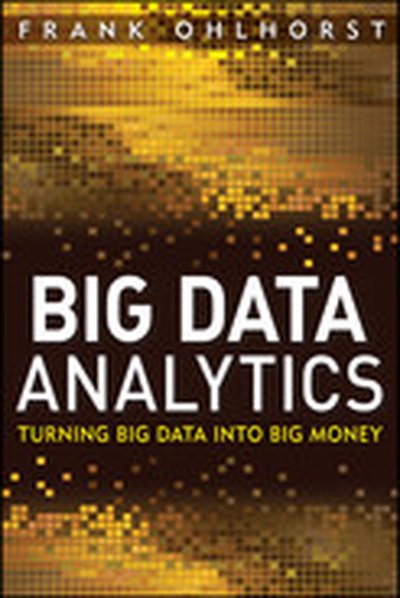
Big Data Analytics: Turning Big Data into Big Money

Unique insights to implement big data analytics and reap big returns to your bottom line Focusing on the business and financial value of big data analytics, respected technology journalist Frank J. Ohlhorst shares his insights on the newly emerging field of big data analytics in Big Data AnalyticsM. This breakthrough book demonstrates the importance of analytics, defines the processes, highlights the tangible and intangible values and discusses how you can turn a business liability into actionable material that can be used to redefine markets, improve profits and identify new business opportunities. Reveals big data analytics as the next wave for businesses looking for competitive advantage Takes an in-depth look at the financial value of big data analytics Offers tools and best practices for working with big data Once the domain of large on-line retailers such as eBay and Amazon, big data is now accessible by businesses of all sizes and across industries. From how to mine the data your company collects, to the data that is available on the outside, Big Data Analytics shows how you can leverage big data into a key component in your business's growth strategy.
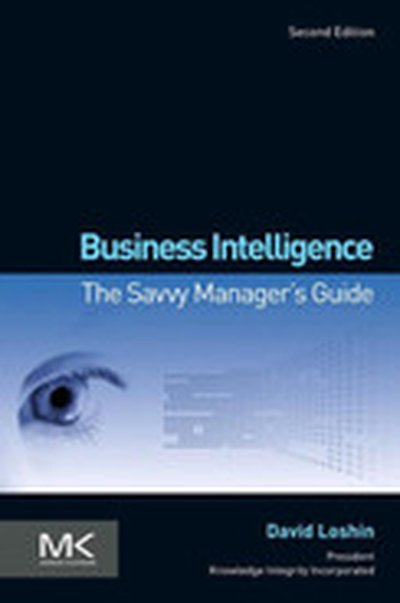
Business Intelligence, 2nd Edition

Business Intelligence: The Savvy Managers Guide, Second Edition, discusses the objectives and practices for designing and deploying a business intelligence (BI) program. It looks at the basics of a BI program, from the value of information and the mechanics of planning for success to data model infrastructure, data preparation, data analysis, integration, knowledge discovery, and the actual use of discovered knowledge. Organized into 21 chapters, this book begins with an overview of the kind of knowledge that can be exposed and exploited through the use of BI. It then proceeds with a discussion of information use in the context of how value is created within an organization, how BI can improve the ways of doing business, and organizational preparedness for exploiting the results of a BI program. It also looks at some of the critical factors to be taken into account in the planning and execution of a successful BI program. In addition, the reader is introduced to considerations for developing the BI roadmap, the platforms for analysis such as data warehouses, and the concepts of business metadata. Other chapters focus on data preparation and data discovery, the business rules approach, and data mining techniques and predictive analytics. Finally, emerging technologies such as text analytics and sentiment analysis are considered. This book will be valuable to data management and BI professionals, including senior and middle-level managers, Chief Information Officers and Chief Data Officers, senior business executives and business staff members, database or software engineers, and business analysts. Guides managers through developing, administering, or simply understanding business intelligence technology Keeps pace with the changes in best practices, tools, methods and processes used to transform an organization’s data into actionable knowledge Contains a handy, quick-reference to technologies and terminology

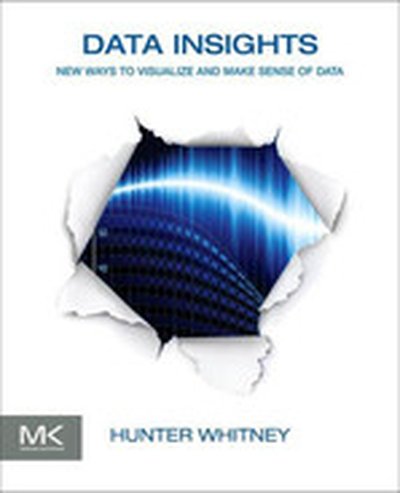
Data Insights

Data Insights: New Ways to Visualize and Make Sense of Data offers thought-provoking insights into how visualization can foster a clearer and more comprehensive understanding of data. The book offers perspectives from people with different backgrounds, including data scientists, statisticians, painters, and writers. It argues that all data is useless, or misleading, if we do not know what it means.Organized into seven chapters, the book explores some of the ways that data visualization and other emerging approaches can make data meaningful and therefore useful. It also discusses some fundamental ideas and basic questions in the data lifecycle; the process of interactions between people, data, and displays that lead to better questions and more useful answers; and the fundamentals, origins, and purposes of the basic building blocks that are used in data visualization. The reader is introduced to tried and true approaches to understanding users in the context of user interface design, how communications can get distorted, and how data visualization is related to thinking machines. Finally, the book looks at the future of data visualization by assessing its strengths and weaknesses. Case studies from business analytics, healthcare, network monitoring, security, and games, among others, as well as illustrations, thought-provoking quotes, and real-world examples are included.This book will prove useful to computer professionals, technical marketing professionals, content strategists, Web and product designers, and researchers. Demonstrates, with a variety of case studies, how visualizations can foster a clearer and more comprehensive understanding of data Answers the question, "How can data visualization help me?" with discussions of how it fits into a wide array of purposes and situations Makes the case that data visualization is not just about technology; it also involves a deeply human process

HBase in Action

HBase in Action has all the knowledge you need to design, build, and run applications using HBase. First, it introduces you to the fundamentals of distributed systems and large scale data handling. Then, you'll explore real-world applications and code samples with just enough theory to understand the practical techniques. You'll see how to build applications with HBase and take advantage of the MapReduce processing framework. And along the way you'll learn patterns and best practices. About the Technology HBase is a NoSQL storage system designed for fast, random access to large volumes of data. It runs on commodity hardware and scales smoothly from modest datasets to billions of rows and millions of columns. About the Book HBase in Action is an experience-driven guide that shows you how to design, build, and run applications using HBase. First, it introduces you to the fundamentals of handling big data. Then, you'll explore HBase with the help of real applications and code samples and with just enough theory to back up the practical techniques. You'll take advantage of the MapReduce processing framework and benefit from seeing HBase best practices in action. What's Inside When and how to use HBase Practical examples Design patterns for scalable data systems Deployment, integration, and design About the Reader Written for developers and architects familiar with data storage and processing. No prior knowledge of HBase, Hadoop, or MapReduce is required. About the Authors Nick Dimiduk is a Data Architect with experience in social media analytics, digital marketing, and GIS. Amandeep Khurana is a Solutions Architect focused on building HBase-driven solutions. Quotes Timely, practical ... explains in plain language how to use HBase. - From the Foreword by Michael Stack, Chair of the Apache HBase Project Management Committee A difficult topic lucidly explained. - John Griffin, coauthor of "Hibernate Search in Action" Amusing tongue-in-cheek style that doesn’t detract from the substance. - Charles Pyle, APS Healthcare Learn how to think the HBase way. - Gianluca Righetto, Menttis

Business Intelligence Applied: Implementing an Effective Information and Communications Technology Infrastructure

Expert guidance for building an information communication and technology infrastructure that provides best in business intelligence Enterprise performance management (EPM) technology has been rapidly advancing, especially in the areas of predictive analysis and cloud-based solutions. Business intelligence caught on as a concept in the business world as the business strategy application of data warehousing in the early 2000s. With the recent surge in interest in data analytics and big data, it has seen a renewed level of interest as the ability of a business to find the valuable data in a timely—and competitive—fashion. Business Intelligence Applied reveals essential information for building an optimal and effective information and communication technology (ICT) infrastructure. Defines ICT infrastructure Examines best practices for documenting business change and for documenting technology recommendations Includes examples and cases from Europe and Asia Written for business intelligence staff, CIOs, CTOs, and technology managers With examples and cases from Europe and Asia, Business Intelligence Applied expertly covers business intelligence, a hot topic in business today as a key element to business and data analytics.

Python for Data Analysis

Python for Data Analysis is concerned with the nuts and bolts of manipulating, processing, cleaning, and crunching data in Python. It is also a practical, modern introduction to scientific computing in Python, tailored for data-intensive applications. This is a book about the parts of the Python language and libraries you’ll need to effectively solve a broad set of data analysis problems. This book is not an exposition on analytical methods using Python as the implementation language. Written by Wes McKinney, the main author of the pandas library, this hands-on book is packed with practical cases studies. It’s ideal for analysts new to Python and for Python programmers new to scientific computing. Use the IPython interactive shell as your primary development environment Learn basic and advanced NumPy (Numerical Python) features Get started with data analysis tools in the pandas library Use high-performance tools to load, clean, transform, merge, and reshape data Create scatter plots and static or interactive visualizations with matplotlib Apply the pandas groupby facility to slice, dice, and summarize datasets Measure data by points in time, whether it’s specific instances, fixed periods, or intervals Learn how to solve problems in web analytics, social sciences, finance, and economics, through detailed examples

Service-Oriented Distributed Knowledge Discovery

A new approach to distributed large-scale data mining, service-oriented knowledge discovery extracts useful knowledge from often unmanageable volumes of data by exploiting data mining and machine learning distributed models and techniques in service-oriented infrastructures. Service-Oriented Distributed Knowledge Discovery presents techniques, algorithms, and systems based on the service-oriented paradigm. It explains how to design services for data analytics, describes real systems for implementing distributed knowledge discovery applications, and explores mobile data mining models.

IBM Cognos Dynamic Cubes

IBM® Cognos® Business Intelligence (BI) provides a proven enterprise BI platform with an open data strategy, providing customers with the ability to leverage data from any source, package it into a business model, and make it available to consumers in various interfaces that are tailored to the task. IBM Cognos Dynamic Cubes complements the existing Cognos BI capabilities and continues the tradition of an open data model. It focuses on extending the scalability of the IBM Cognos platform to enable speed-of-thought analytics over terabytes of enterprise data, without having to invest in a new data warehouse appliance. This capability adds a new level of query intelligence so you can unleash the power of your enterprise data warehouse. This IBM Redbooks® publication addresses IBM Cognos Business Intelligence V10.2 and specifically, the IBM Cognos Dynamic Cubes capabilities. This book can help you in the following ways: Understand core features of the Dynamic Cubes capabilities of IBM Cognos BI V10.2 Learn by example with practical scenarios using the IBM Cognos samples

Solving Operational Business Intelligence with InfoSphere Warehouse Advanced Edition

IBM® InfoSphere® Warehouse is the IBM flagship data warehouse platform for departmental data marts and enterprise data warehouses. It offers leading architecture, performance, backup, and recovery tools that help improve efficiency and reduce time to market through increased understanding of current data assets, while simplifying the daily operations of managing complex warehouse deployments. InfoSphere Warehouse Advanced Enterprise Edition delivers an enhanced set of database performance, management, and design tools. These tools assist companies in maintaining and increasing value from their warehouses, while helping to reduce the total cost of maintaining these complex environments. In this IBM Redbooks® publication we explain how you can build a business intelligence system with InfoSphere Warehouse Advanced Enterprise to manage and support daily business operations for an enterprise, to generate more income with lower cost. We describe the foundation of the business analytics, the Data Warehouse features and functions, and the solutions that can deliver immediate analytics solutions and help you drive better business outcomes. We show you how to use the advanced analytics of InfoSphere Warehouse Advanced Enterprise Edition and integrated tools for data modeling, mining, text analytics, and identifying and meeting the data latency requirements. We describe how the performance and storage optimization features can make building and managing a large data warehouse more affordable, and how they can help significantly reduce the cost of ownership. We also cover data lifecycle management and the key features of IBM Cognos® Business Intelligence. This book is intended for data warehouse professionals who are interested in gaining in-depth knowledge about the operational business intelligence solution for a data warehouse that the IBM InfoSphere Warehouse Advanced Enterprise Edition offers.

Enterprise Analytics: Optimize Performance, Process, and Decisions Through Big Data

The Definitive Guide to Enterprise-Level Analytics Strategy, Technology, Implementation, and Management Organizations are capturing exponentially larger amounts of data than ever, and now they have to figure out what to do with it. Using analytics, you can harness this data, discover hidden patterns, and use this knowledge to act meaningfully for competitive advantage. Suddenly, you can go beyond understanding “how, when, and where” events have occurred, to understand why – and use this knowledge to reshape the future. Now, analytics pioneer Tom Davenport and the world-renowned experts at the International Institute for Analytics (IIA) have brought together the latest techniques, best practices, and research on analytics in a single primer for maximizing the value of enterprise data. Enterprise Analytics is today’s definitive guide to analytics strategy, planning, organization, implementation, and usage. It covers everything from building better analytics organizations to gathering data; implementing predictive analytics to linking analysis with organizational performance. The authors offer specific insights for optimizing supply chains, online services, marketing, fraud detection, and many other business functions. They support their powerful techniques with many real-world examples, including chapter-length case studies from healthcare, retail, and financial services. Enterprise Analytics will be an invaluable resource for every business and technical professional who wants to make better data-driven decisions: operations, supply chain, and product managers; product, financial, and marketing analysts; CIOs and other IT leaders; data, web, and data warehouse specialists, and many others.

Getting Started with Storm

Even as big data is turning the world upside down, the next phase of the revolution is already taking shape: real-time data analysis. This hands-on guide introduces you to Storm, a distributed, JVM-based system for processing streaming data. Through simple tutorials, sample Java code, and a complete real-world scenario, you’ll learn how to build fast, fault-tolerant solutions that process results as soon as the data arrives. Discover how easy it is to set up Storm clusters for solving various problems, including continuous data computation, distributed remote procedure calls, and data stream processing. Learn how to program Storm components: spouts for data input and bolts for data transformation Discover how data is exchanged between spouts and bolts in a Storm topology Make spouts fault-tolerant with several commonly used design strategies Explore bolts—their life cycle, strategies for design, and ways to implement them Scale your solution by defining each component’s level of parallelism Study a real-time web analytics system built with Node.js, a Redis server, and a Storm topology Write spouts and bolts with non-JVM languages such as Python, Ruby, and Javascript

Complete Analytics with IBM DB2 Query Management Facility: Accelerating Well-Informed Decisions Across the Enterprise

There is enormous pressure today for businesses across all industries to cut costs, enhance business performance, and deliver greater value with fewer resources. To take business analytics to the next level and drive tangible improvements to the bottom line, it is important to manage not only the volume of data, but the speed with which actionable findings can be drawn from a wide variety of disparate sources. The findings must be easily communicated to those responsible for making both strategic and tactical decisions. At the same time, strained IT budgets require that the solution be self-service for everyone from DBAs to business users, and easily deployed to thin, browser-based clients. Business analytics hosted in the Query Management Facility™ (QMF™) on DB2® and System z® allow you to tackle these challenges in a practical way, using new features and functions that are easily deployed across the enterprise and easily consumed by business users who do not have prior IT experience. This IBM® Redbooks® publication provides step-by-step instructions on using these new features: Access to data that resides in any JDBC-compliant data source OLAP access through XMLA 150+ new analytical functions Graphical query interfaces and graphical reports Graphical, interactive dashboards Ability to integrate QMF functions with third-party applications Support for the IBM DB2 Analytics Accelerator A new QMF Classic perspective in QMF for Workstation Ability to start QMF for TSO as a DB2 for z/OS stored procedure New metadata capabilities, including ER diagrams and capability to federate data into a single virtual source

Optimizing DB2 Queries with IBM DB2 Analytics Accelerator for z/OS

The IBM® DB2® Analytics Accelerator Version 2.1 for IBM z/OS® (also called DB2 Analytics Accelerator or Query Accelerator in this book and in DB2 for z/OS documentation) is a marriage of the IBM System z® Quality of Service and Netezza® technology to accelerate complex queries in a DB2 for z/OS highly secure and available environment. Superior performance and scalability with rapid appliance deployment provide an ideal solution for complex analysis. This IBM Redbooks® publication provides technical decision-makers with a broad understanding of the IBM DB2 Analytics Accelerator architecture and its exploitation by documenting the steps for the installation of this solution in an existing DB2 10 for z/OS environment. In this book we define a business analytics scenario, evaluate the potential benefits of the DB2 Analytics Accelerator appliance, describe the installation and integration steps with the DB2 environment, evaluate performance, and show the advantages to existing business intelligence processes. Please note that the additional material referenced in the text is not available from IBM.

IBM Real Time Compression Appliance Application Integration Guide

Continuing its commitment to developing and delivering industry-leading storage technologies, IBM® is introducing the IBM Real-time Compression Appliances for NAS, an innovative new storage offering that delivers essential storage efficiency technologies, combined with exceptional ease of use and performance. In an era when the amount of information, particularly in unstructured files, is exploding, but budgets for storing that information are stagnant, IBM Real-time Compression technology offers a powerful tool for better information management, protection, and access. IBM Real-time Compression can help slow the growth of storage acquisition, reducing storage costs while simplifying both operations and management. It also enables organizations to keep more data available for use rather than storing it offsite or on harder-to-access tape, so they can support improved analytics and decision making. IBM Real-time Compression Appliances provide online storage optimization through real-time data compression, delivering dramatic cost reduction without performance degradation. This IBM Redbooks® publication is an easy-to-follow guide that describes how to design solutions successfully using IBM Real-time Compression Appliances (IBM RTCAs). It explains best practices for RTCA solution design, application integration, and practical RTCA use cases. This is a companion book to Introduction to IBM Real-time Compression Appliances, SG24-7953.

Microsoft® SQL Server® 2012 Analysis Services: The BISM Tabular Model

Build agile and responsive Business Intelligence solutions Analyze tabular data using the BI Semantic Model (BISM) in Microsoft SQL Server 2012 Analysis Services—and discover a simpler method for creating corporate-level BI solutions. Led by three BI experts, you’ll learn how to build, deploy, and query a BISM tabular model with step-by-step guides, examples, and best practices. This hands-on book shows you how the tabular model’s in-memory database enables you to perform rapid analytics—whether you’re a professional BI developer new to Analysis Services or familiar with its multidimensional model. Discover how to: Determine when a tabular or multidimensional model is right for your project Build a tabular model using SQL Server Data Tools in Microsoft Visual Studio 2010 Integrate data from multiple sources into a single, coherent view of company information Use the Data Analysis eXpressions (DAX) language to create calculated columns, measures, and queries Choose a data modeling technique that meets your organization’s performance and usability requirements Optimize your data model for better performance with xVelocity storage engine Manage complex data relationships, such as multicolumn, banding, and many-to-many Implement security by establishing administrative and data user roles

Principles of Data Integration

Principles of Data Integration is the first comprehensive textbook of data integration, covering theoretical principles and implementation issues as well as current challenges raised by the semantic web and cloud computing. The book offers a range of data integration solutions enabling you to focus on what is most relevant to the problem at hand. Readers will also learn how to build their own algorithms and implement their own data integration application. Written by three of the most respected experts in the field, this book provides an extensive introduction to the theory and concepts underlying today's data integration techniques, with detailed, instruction for their application using concrete examples throughout to explain the concepts. This text is an ideal resource for database practitioners in industry, including data warehouse engineers, database system designers, data architects/enterprise architects, database researchers, statisticians, and data analysts; students in data analytics and knowledge discovery; and other data professionals working at the R&D and implementation levels. Offers a range of data integration solutions enabling you to focus on what is most relevant to the problem at hand Enables you to build your own algorithms and implement your own data integration applications

Fundamentals of Predictive Analytics with JMP

Fundamentals of Predictive Analytics with JMP bridges the gap between courses on basic statistics, which focus on univariate and bivariate analysis, and courses on data mining/predictive analytics. This book provides the technical knowledge and problem-solving skills needed to perform real data multivariate analysis. Utilizing JMP 10 and JMP Pro, this book offers new and enhanced resources, including an add-in to Microsoft Excel, Graph Builder, and data mining capabilities.

Written for students in undergraduate and graduate statistics courses, this book first teaches students to recognize when it is appropriate to use the tool, to understand what variables and data are required, and to know what the results might be. Second, it teaches them how to interpret the results, followed by step-by-step instructions on how and where to perform and evaluate the analysis in JMP.

With the new emphasis on business intelligence, business analytics and predictive analytics, this book is invaluable to everyone who needs to expand their knowledge of statistics and apply real problem-solving analysis.

This book is part of the SAS Press program.

IBM Cognos Business Intelligence 10: The Official Guide

The only authorized guide to IBM Cognos Business Intelligence v10.1 Updated for the latest release of the software, IBM Cognos Business Intelligence 10: The Official Guide explains how to create, implement, and manage an enterprise BI solution. Maximize all of the new and enhanced features, including the powerful modeling, monitoring, and analytics capabilities. Build and deliver reports that foster informed business decisions and better results. Filled with real-world examples and expert advice, this practical resource is ideal for anyone working with IBM Cognos Business Intelligence v10.1--from administrators to end users. Monitor performance using dashboards and scorecards Assign user roles and privileges Provide a single access point to application-specific data via Cognos Connection Access content from Microsoft Office applications and mobile devices Collect and analyze BI data in an interactive dashboard with Cognos Business Insight Use Cognos Administration tools for system management Implement appropriate security measures Create BI reports with relational and dimensional data using Business Insight Advanced Use Report Studio to build dimensional reports and statistical analyses Identify and deliver mission-critical information using Event Studio Monitor business performance with Metric Studio Create, modify, organize, and publish a model in Framework Manager Ensure report integrity with Lifecycle Manager

Taming The Big Data Tidal Wave: Finding Opportunities in Huge Data Streams with Advanced Analytics

You receive an e-mail. It contains an offer for a complete personal computer system. It seems like the retailer read your mind since you were exploring computers on their web site just a few hours prior.... As you drive to the store to buy the computer bundle, you get an offer for a discounted coffee from the coffee shop you are getting ready to drive past. It says that since you're in the area, you can get 10% off if you stop by in the next 20 minutes.... As you drink your coffee, you receive an apology from the manufacturer of a product that you complained about yesterday on your Facebook page, as well as on the company's web site.... Finally, once you get back home, you receive notice of a special armor upgrade available for purchase in your favorite online video game. It is just what is needed to get past some spots you've been struggling with.... Sound crazy? Are these things that can only happen in the distant future? No. All of these scenarios are possible today! Big data. Advanced analytics. Big data analytics. It seems you can't escape such terms today. Everywhere you turn people are discussing, writing about, and promoting big data and advanced analytics. Well, you can now add this book to the discussion. What is real and what is hype? Such attention can lead one to the suspicion that perhaps the analysis of big data is something that is more hype than substance. While there has been a lot of hype over the past few years, the reality is that we are in a transformative era in terms of analytic capabilities and the leveraging of massive amounts of data. If you take the time to cut through the sometimes-over-zealous hype present in the media, you'll find something very real and very powerful underneath it. With big data, the hype is driven by genuine excitement and anticipation of the business and consumer benefits that analyzing it will yield over time. Big data is the next wave of new data sources that will drive the next wave of analytic innovation in business, government, and academia. These innovations have the potential to radically change how organizations view their business. The analysis that big data enables will lead to decisions that are more informed and, in some cases, different from what they are today. It will yield insights that many can only dream about today. As you'll see, there are many consistencies with the requirements to tame big data and what has always been needed to tame new data sources. However, the additional scale of big data necessitates utilizing the newest tools, technologies, methods, and processes. The old way of approaching analysis just won't work. It is time to evolve the world of advanced analytics to the next level. That's what this book is about. Taming the Big Data Tidal Wave isn't just the title of this book, but rather an activity that will determine which businesses win and which lose in the next decade. By preparing and taking the initiative, organizations can ride the big data tidal wave to success rather than being pummeled underneath the crushing surf. What do you need to know and how do you prepare in order to start taming big data and generating exciting new analytics from it? Sit back, get comfortable, and prepare to find out!

Advanced Web Metrics with Google Analytics, 3rd Edition

Get the latest information about using the #1 web analytics tool from this fully updated guide Google Analytics is the free tool used by millions of web site owners to assess the effectiveness of their efforts. Its revised interface and new features will offer even more ways to increase the value of your web site, and this book will teach you how to use each one to best advantage. Featuring new content based on reader and client requests, the book helps you implement new methods and concepts, track social and mobile visitors, use the new multichannel funnel reporting features, understand which filters to use, and much more. Gets you up and running with all the new tools in the revamped Google Analytics, and includes content requested by readers and users especially for new GA users Covers social media analytics features, advanced segmentation displays, multi-dashboard configurations, and using Top 20 reports Provides a detailed best-practices implementation guide covering advanced topics, such as how to set up GA to track dynamic web pages, banners, outgoing links, and contact forms Includes case studies and demonstrates how to optimize pay-per-click accounts, integrate AdSense, work with new reports and reporting tools, use ad version testing, and more Make your web site a more effective business tool with the detailed information and advice about Google Analytics in Advanced Web Metrics with Google Analytics, 3nd Edition.