Joseph Toma is the Cloud and AI Director for Media and Communications. Joseph’s career spans across enterprise, scale-up, and start-up environments, most notably as the CEO of Jugo, an innovative AI SaaS platform. His tenure as Managing Partner at Kyndryl and various leadership roles at IBM, including Hybrid Cloud and Red Hat Sales Director, took him to three continents and has equipped him with a unique perspective that shapes his approach to supporting customers. Joseph is based in London where he lives with his wife, young child, and cavapoo.
 talk-data.com
Topic
Cloud Computing
infrastructure
saas
iaas
4055
tagged
Activity Trend
471
peak/qtr
2020-Q1
2026-Q2
Top Events
Google Cloud Next '24
911
Google Cloud Next '25
662
O'Reilly Data Engineering Books
499
AWS re:Invent 2024
341
Data Engineering Podcast
237
Microsoft Ignite 2025
227
Databricks DATA + AI Summit 2023
99
O'Reilly Data Science Books
96
Data + AI Summit 2025
86
Dbt Coalesce 2024
86
Making Data Simple
49
Secrets of Data Analytics Leaders
30
Discover how to build a powerful AI Lakehouse and unified data fabric natively on Google Cloud. Leverage BigQuery's serverless scale and robust analytics capabilities as the core, seamlessly integrating open data formats with Apache Iceberg and efficient processing using managed Spark environments like Dataproc. Explore the essential components of this modern data environment, including data architecture best practices, robust integration strategies, high data quality assurance, and efficient metadata management with Google Cloud Data Catalog. Learn how Google Cloud's comprehensive ecosystem accelerates advanced analytics, preparing your data for sophisticated machine learning initiatives and enabling direct connection to services like Vertex AI.
https://www.bigdataldn.com/en-gb/conference/session-details.4500.251876.building-an-ai_ready-open-lakehouse-on-google-cloud.html
Get ready for a customer story that’s as bold as it is eye-opening. In this session, Eutelsat and DataOps.live pull back the curtain on what it really takes to deliver business-changing outcomes with a specific focus on the Use Cases addressed by Apache at the core. And these Use Cases are BIG – think about big, big numbers, and you still aren’t even close!
You’ll hear the inside story of how Eutelsat found itself with two “competing” cloud data platforms. What could have been an expensive headache turned out to be an advantage: Iceberg made it not only possible but cheaper and simpler to use both together, unlocking agility and cost savings that no single platform alone could provide.
The impact is already tangible. Telemetry pipelines are live and delivering massive value. Next up: interoperable Data Products seamlessly moving from Snowflake to Cloudera and vice versa, driving cross-platform innovation. And that’s just the start—Eutelsat is also positioning Iceberg as a future-proof standard for data sharing and export.
This is a story of scale, speed, and simplification—the kind of transformation only possible when a visionary team meets the right technology.
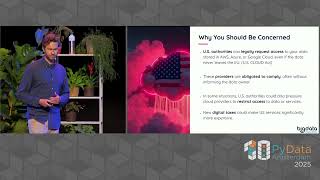
When you store data in the cloud, do you know who really controls it? In an era of increasing geopolitical tension and growing awareness around digital sovereignty, Dutch research institutes have already begun repatriating sensitive data from US servers to Dutch-controlled storage. This talk explores the hidden risks behind common cloud choices, from legal access by foreign governments to the ethical implications of supporting politically active tech giants. We’ll look at what it means to own your data, how regional storage might not be enough, and what it takes to build an EU-hosted, open-source data platform stack. If you’re a data engineer, architect, or technology leader who cares about privacy, control, and sustainable infrastructure, this talk will equip you with the insight—and motivation—to make different choices.
Brought to You By: • Statsig — The unified platform for flags, analytics, experiments, and more. Statsig built a complete set of data tools that allow engineering teams to measure the impact of their work. This toolkit is SO valuable to so many teams, that OpenAI - who was a huge user of Statsig - decided to acquire the company, the news announced last week. Talk about validation! Check out Statsig. • Linear – The system for modern product development. Here’s an interesting story: OpenAI switched to Linear as a way to establish a shared vocabulary between teams. Every project now follows the same lifecycle, uses the same labels, and moves through the same states. Try Linear for yourself. — What does it take to do well at a hyper-growth company? In this episode of The Pragmatic Engineer, I sit down with Charles-Axel Dein, one of the first engineers at Uber, who later hired me there. Since then, he’s gone on to work at CloudKitchens. He’s also been maintaining the popular Professional programming reading list GitHub repo for 15 years, where he collects articles that made him a better programmer. In our conversation, we dig into what it’s really like to work inside companies that grow rapidly in scale and headcount. Charles shares what he’s learned about personal productivity, project management, incidents, interviewing, plus how to build flexible skills that hold up in fast-moving environments. Jump to interesting parts: • 10:41 – the reality of working inside a hyperscale company • 41:10 – the traits of high-performing engineers • 1:03:31 – Charles’ advice for getting hired in today’s job market We also discuss: • How to spot the signs of hypergrowth (and when it’s slowing down) • What sets high-performing engineers apart beyond shipping • Charles’s personal productivity tips, favorite reads, and how he uses reading to uplevel his skills • Strategic tips for building your resume and interviewing • How imposter syndrome is normal, and how leaning into it helps you grow • And much more! If you’re at a fast-growing company, considering joining one, or looking to land your next role, you won’t want to miss this practical advice on hiring, interviewing, productivity, leadership, and career growth. — Timestamps (00:00) Intro (04:04) Early days at Uber as engineer #20 (08:12) CloudKitchens’ similarities with Uber (10:41) The reality of working at a hyperscale company (19:05) Tenancies and how Uber deployed new features (22:14) How CloudKitchens handles incidents (26:57) Hiring during fast-growth (34:09) Avoiding burnout (38:55) The popular Professional programming reading list repo (41:10) The traits of high-performing engineers (53:22) Project management tactics (1:03:31) How to get hired as a software engineer (1:12:26) How AI is changing hiring (1:19:26) Unexpected ways to thrive in fast-paced environments (1:20:45) Dealing with imposter syndrome (1:22:48) Book recommendations (1:27:26) The problem with survival bias (1:32:44) AI’s impact on software development (1:42:28) Rapid fire round — The Pragmatic Engineer deepdives relevant for this episode: • Software engineers leading projects • The Platform and Program split at Uber • Inside Uber’s move to the Cloud • How Uber built its observability platform • From Software Engineer to AI Engineer – with Janvi Kalra — Production and marketing by https://penname.co/. For inquiries about sponsoring the podcast, email [email protected].
Get full access to The Pragmatic Engineer at newsletter.pragmaticengineer.com/subscribe
Learn how BP and Kingfisher scale data quality across cloud, analytics, and AI—driving reliable insights and business outcomes with Anomalo.
The most sought-after products don’t just appear on shelves—they arrive at the perfect moment, in perfect condition, thanks to data that works as fast as the business moves.
From premium meats to peak-season produce, Morrisons, one of the UK’s largest retailers, is building a future where shelves are stocked with exactly what customers want, when they want it.
In this session, Peter Laflin, Chief Data Officer at Morrisons, joins Striim to share how real-time data streaming into Google Cloud enables smarter, faster, and more autonomous retail operations. He’ll unpack how Morrisons is moving beyond predictive models to build AI-native, agentic systems that can sense, decide, and act at scale. Topics include:
Live store operations that respond instantly to real-world signals
AI architectures that move from “data-informed” to “data-delegated” decisions
Practical lessons from embedding real-time thinking across teams and tech stacks
This is a session for retail and data leaders who are ready to move beyond dashboards and start building intelligent systems that deliver both customer delight and operational agility.
Are you ready to build the next generation of data-driven applications? This session demystifies the world of Autonomous Agents, explaining what they are and why they are the future of AI. We’ll dive into Google Cloud's comprehensive platform for creating and deploying these agents, from our multimodal data handling to the seamless integration of Gemini models. You will learn the principles behind building your own custom data agents and understand why Google Cloud provides the definitive platform for this innovation. Join us to gain the knowledge and tools needed to architect and deploy intelligent, self-sufficient data solutions.
DuckDB is well-loved by SQL-ophiles to handle their small data workloads. How do you make it scale? What happens when you feed it Big Data? What is this DuckLake thing I've been hearing about? This talk will help answer these questions from real-world experience running a DuckDB service in the cloud.
Ophthalmology generates vast amounts of imaging and clinical data. Yet fragmentation of this data slows both care and research. In this session, Matt Barnfield, Lead Data Engineer at Softwire, will share how we tackled these challenges in two partnerships: Moorfields Eye Hospital (UK) and Retina Consultants of America (US).
We’ll compare the parallel difficulties we encountered and the shared patterns we used to overcome them, focusing on the new, powerful tools available for trusted researchers – from clinical trial recruitments to retrospective studies.
We’ll dive into how we built cloud data platforms that ingest tens of millions of images from disparate silos and harmonise them with health records, transforming dataset curation from a manual process that took months into an automated pipeline that takes minutes. Through these case studies, we’ll show how modern data architecture can facilitate cutting-edge research and ultimately improve lives.
Learn how Salesforce's Data Cloud enables you to deliver great, omnichannel experiences while knowing your customer data is safe and secure.
Learn how Salesforce's Data Cloud enables you to deliver great, omnichannel experiences while knowing your customer data is safe and secure.
The growth of connected data has made graph databases essential, yet organisations often face a dilemma: choosing between an operational graph for real-time queries or an analytical engine for large-scale processing. This division leads to data silos and complex ETL pipelines, hindering the seamless integration of real-time insights with deep analytics and the ability to ground AI models in factual, enterprise-specific knowledge. Google Cloud aims to solve this with a unified "Graph Fabric," introducing Spanner Graph, which extends Spanner with native support for the ISO standard Graph Query Language (GQL). This session will cover how Google Cloud has developed a Unified Graph Solution with BigQuery and Spanner graphs to serve a full spectrum of graph needs from operational to analytical.
Ready to move beyond passive data cataloging and unlock true AI-driven value? Join us for an in-depth session on data.world, now fully integrated with ServiceNow’s Workflow Data Fabric. We’ll show how you can unify, govern, and activate your enterprise data—across cloud, hybrid, and on-prem environments—to fuel agentic AI and intelligent automation. See a live demo of data.world’s knowledge graph in action: discover how to connect and contextualize data from any source, automate governance and compliance, and deliver trusted, explainable insights at scale. We’ll walk through real-world use cases, from rapid data discovery to automated policy enforcement and lineage tracking, and show how organizations are accelerating time-to-value and reducing risk. Whether you’re a data leader, architect, or practitioner, you’ll leave with practical strategies and a clear vision for making your data estate truly AI-ready.
SAP Business Data Cloud is a fully managed solution that unifies and governs all SAP data while seamlessly integrating with third-party sources. With SAP Business Data Cloud, organisations can accelerate decision-making by empowering business users to make more impactful choices. It also provides a trusted foundation for AI, ensuring that data across applications and operations is reliable, responsible, and relevant—enabling organisations to harness the full potential of generative AI.
Discover how Dun & Bradstreet and other global enterprises use Data Observability to ensure Quality & Efficiency, and enforce compliance across on-prem and cloud environments. Learn proven strategies to operationalize governance, accelerate cloud migrations, and deliver trusted data for AI and analytics at scale. Join us to learn how Data Observability and Agentic Data Management empowers leaders, engineers, and business teams to drive efficiency and savings at petabyte scale.
Discover how Google Cloud's AI-native platform is transforming data science, moving beyond traditional methods to empower you with an intuitive experience, an open ecosystem, and the ability to build intelligent, data-native AI agents. This shift eliminates integration headaches and scales your impact, enabling you to innovate faster and drive real-world outcomes. Explore how these advancements unify your workflows and unlock unprecedented possibilities for real-time, agent-driven insights.
https://www.bigdataldn.com/en-gb/conference/session-details.4500.251872.reimagining-data-science-for-the-agentic-era-with-googles-data-cloud
Comprehensive guide offering actionable strategies for enhancing human-centered AI, efficiency, and productivity in industrial and systems engineering through the power of AI. Advances in Artificial Intelligence Applications in Industrial and Systems Engineering is the first book in the Advances in Industrial and Systems Engineering series, offering insights into AI techniques, challenges, and applications across various industrial and systems engineering (ISE) domains. Not only does the book chart current AI trends and tools for effective integration, but it also raises pivotal ethical concerns and explores the latest methodologies, tools, and real-world examples relevant to today’s dynamic ISE landscape. Readers will gain a practical toolkit for effective integration and utilization of AI in system design and operation. The book also presents the current state of AI across big data analytics, machine learning, artificial intelligence tools, cloud-based AI applications, neural-based technologies, modeling and simulation in the metaverse, intelligent systems engineering, and more, and discusses future trends. Written by renowned international contributors for an international audience, Advances in Artificial Intelligence Applications in Industrial and Systems Engineering includes information on: Reinforcement learning, computer vision and perception, and safety considerations for autonomous systems (AS) (NLP) topics including language understanding and generation, sentiment analysis and text classification, and machine translation AI in healthcare, covering medical imaging and diagnostics, drug discovery and personalized medicine, and patient monitoring and predictive analysis Cybersecurity, covering threat detection and intrusion prevention, fraud detection and risk management, and network security Social good applications including poverty alleviation and education, environmental sustainability, and disaster response and humanitarian aid. Advances in Artificial Intelligence Applications in Industrial and Systems Engineering is a timely, essential reference for engineering, computer science, and business professionals worldwide.