talk-data.com talk-data.com

Topic

data-engineering

3395

tagged

Activity Trend

1 peak/qtr
2020-Q1 2026-Q1

Activities

3395 activities · Newest first

Data Engineering with Databricks Cookbook

In "Data Engineering with Databricks Cookbook," you'll learn how to efficiently build and manage data pipelines using Apache Spark, Delta Lake, and Databricks. This recipe-based guide offers techniques to transform, optimize, and orchestrate your data workflows. What this Book will help me do Master Apache Spark for data ingestion, transformation, and analysis. Learn to optimize data processing and improve query performance with Delta Lake. Manage streaming data processing with Spark Structured Streaming capabilities. Implement DataOps and DevOps workflows tailored for Databricks. Enforce data governance policies using Unity Catalog for scalable solutions. Author(s) Pulkit Chadha, the author of this book, is a Senior Solutions Architect at Databricks. With extensive experience in data engineering and big data applications, he brings practical insights into implementing modern data solutions. His educational writings focus on empowering data professionals with actionable knowledge. Who is it for? This book is ideal for data engineers, data scientists, and analysts who want to deepen their knowledge in managing and transforming large datasets. Readers should have an intermediate understanding of SQL, Python programming, and basic data architecture concepts. It is especially well-suited for professionals working with Databricks or similar cloud-based data platforms.

The Ultimate Guide to Snowpark

The Ultimate Guide to Snowpark serves as a comprehensive resource to help you master the Snowflake Snowpark framework using Python. You'll learn how to manage data engineering, data science, and data applications in Snowpark, coupled with practical implementations and examples. By following this guide, you'll gain the skills needed to efficiently process and analyze data in the Snowflake Data Cloud. What this Book will help me do Master Snowpark with Python for data engineering, data science, and data application workloads. Develop and deploy robust data pipelines using Snowpark in Python. Design, implement, and produce machine learning models using Snowpark. Learn to monetize and operationalize Snowflake-native applications. Effectively adopt Snowpark in production for scalable, efficient data solutions. Author(s) Shankar Narayanan SGS and Vivekanandan SS are experienced professionals in data engineering and Snowflake technologies. Shankar has extensive experience in utilizing Snowflake Snowpark to manage and enhance data solutions. Vivekanandan brings expertise in the intersection of Python programming and cloud-based data processing. Together, their combined knowledge and approachable writing style make this book an invaluable resource to readers. Who is it for? This book is designed for data engineers, data scientists, developers, and seasoned data practitioners. Ideal candidates are those looking to expand their skills in implementing Snowpark solutions using Python. A prior understanding of SQL, Python programming, and familiarity with Snowflake is beneficial for readers to fully leverage the techniques presented.

Tuning the Snowflake Data Cloud: Optimizing Your Data Platform to Minimize Cost and Maximize Performance

This project-oriented book presents a hands-on approach to identifying migration and performance issues with experience drawn from real-world examples. As you work through the book, you will develop skills, knowledge, and deep understanding of Snowflake tuning options and capabilities while preparing for later incorporation of additional Snowflake features as they become available. Your Snowflake platform will cost less to run and will improve your customer experience. Written by a seasoned Snowflake practitioner, this book is full of practical, hands-on guidance and advice specifically designed to further accelerate your Snowflake journey. Tuning the Snowflake Data Cloud provides you a pathway to success by equipping you with the skills, knowledge, and expertise needed to elevate your Snowflake experience. The book shows you how to leverage what you already know, adds what you don’t, and helps you apply it toward delivering for your Snowflake accounts. Read this book to embark on a voyage of advancement and equip your organization to deliver consistent Snowflake performance. What You Will Learn Recognize and understand the root cause of performance bottlenecks Know how to resolve performance issues Develop a deep understanding of Snowflake performance tuning options Reduce expensive mistakes, remediate poorly performing code Manage Snowflake costs

Kafka Streams in Action, Second Edition

Everything you need to implement stream processing on Apache KafkaⓇ using Kafka Streams and the kqsIDB event streaming database. Kafka Streams in Action, Second Edition guides you through setting up and maintaining your streaming processing with Kafka. Inside, you’ll find comprehensive coverage of not only Kafka Streams, but the entire toolbox you’ll need for effective streaming—from the components of the Kafka ecosystem, to Producer and Consumer clients, Connect, and Schema Registry. In Kafka Streams in Action, Second Edition you’ll learn how to: Design streaming applications in Kafka Streams with the KStream and the Processor API Integrate external systems with Kafka Connect Enforce data compatibility with Schema Registry Build applications that respond immediately to events in either Kafka Streams or ksqlDB Craft materialized views over streams with ksqlDB This totally revised new edition of Kafka Streams in Action has been expanded to cover more of the Kafka platform used for building event-based applications. You’ll also find full coverage of ksqlDB, an event streaming database that makes it a snap to create applications that respond immediately to events, such as real-time push and pull updates. About the Technology Enterprise applications need to handle thousands—even millions—of data events every day. With an intuitive API and flawless reliability, the lightweight Kafka Streams library has earned a spot at the center of these systems. Kafka Streams provides exactly the power and simplicity you need to manage real-time event processing or microservices messaging. About the Book Kafka Streams in Action, Second Edition teaches you how to create event streaming applications on the amazing Apache Kafka platform. This thoroughly revised new edition now covers a wider range of streaming architectures and includes data integration with Kafka Connect. As you go, you’ll explore real-world examples that introduce components and brokers, schema management, and the other essentials. Along the way, you’ll pick up practical techniques for blending Kafka with Spring, low-level control of processors and state stores, storing event data with ksqlDB, and testing streaming applications. What's Inside Design efficient streaming applications Integrate external systems with Kafka Connect Enforce data compatibility with Schema Registry About the Reader For Java developers. No knowledge of Kafka or streaming applications required. About the Author Bill Bejeck is a Confluent engineer and a Kafka Streams contributor with over 15 years of software development experience. Bill is also a committer on the Apache KafkaⓇ project. Quotes Comprehensive streaming data applications are only a few years away from becoming the reality, and this book is the guide the industry has been waiting for to move beyond the hype. - Adi Polak, Director, Developer Experience Engineering, Confluent Covers all the key aspects of building applications with Kafka Streams. Whether you are getting started with stream processing or have already built Kafka Streams applications, it is an essential resource. - Mickael Maison, Principal Software Engineer, Red Hat Serves as both a learning and a resource guide, offering a perfect blend of ‘how-to’ and ‘why-to.’ Even if you have been using Kafka Streams for many years, I highly recommend this book. - Neil Buesing, CTO & Co-founder, Kinetic Edge

Concept Of Database Management System by Pearson

Concepts of Database Management System is designed to meet the syllabi requirements of undergraduate students of computer applications and computer science. It describes the concepts in an easy-to-understand language with sufficient number of examples. The overview of emerging trends in databases is thoroughly explained. A brief introduction to PL/SQL, MS-Access and Oracle is discussed to help students get a flavor of different types of database management systems.

IBM z14 (3906) Technical Guide

This IBM® Redbooks® publication describes the new member of the IBM Z® family, IBM z14™. IBM z14 is the trusted enterprise platform for pervasive encryption, integrating data, transactions, and insights into the data. A data-centric infrastructure must always be available with a 99.999% or better availability, have flawless data integrity, and be secured from misuse. It also must be an integrated infrastructure that can support new applications. Finally, it must have integrated capabilities that can provide new mobile capabilities with real-time analytics that are delivered by a secure cloud infrastructure. IBM z14 servers are designed with improved scalability, performance, security, resiliency, availability, and virtualization. The superscalar design allows z14 servers to deliver a record level of capacity over the prior IBM Z platforms. In its maximum configuration, z14 is powered by up to 170 client characterizable microprocessors (cores) running at 5.2 GHz. This configuration can run more than 146,000 million instructions per second (MIPS) and up to 32 TB of client memory. The IBM z14 Model M05 is estimated to provide up to 35% more total system capacity than the IBM z13® Model NE1. This Redbooks publication provides information about IBM z14 and its functions, features, and associated software support. More information is offered in areas that are relevant to technical planning. It is intended for systems engineers, consultants, planners, and anyone who wants to understand the IBM Z servers functions and plan for their usage. It is intended as an introduction to mainframes. Readers are expected to be generally familiar with existing IBM Z technology and terminology.

IBM z14 ZR1 Technical Guide

This IBM® Redbooks® publication describes the new member of the IBM Z® family, IBM z14™ Model ZR1 (Machine Type 3907). It includes information about the Z environment and how it helps integrate data and transactions more securely, and can infuse insight for faster and more accurate business decisions. The z14 ZR1 is a state-of-the-art data and transaction system that delivers advanced capabilities, which are vital to any digital transformation. The z14 ZR1 is designed for enhanced modularity, in an industry standard footprint. A data-centric infrastructure must always be available with a 99.999% or better availability, have flawless data integrity, and be secured from misuse. It also must be an integrated infrastructure that can support new applications. Finally, it must have integrated capabilities that can provide new mobile capabilities with real-time analytics that are delivered by a secure cloud infrastructure. IBM z14 ZR1 servers are designed with improved scalability, performance, security, resiliency, availability, and virtualization. The superscalar design allows z14 ZR1 servers to deliver a record level of capacity over the previous IBM Z platforms. In its maximum configuration, z14 ZR1 is powered by up to 30 client characterizable microprocessors (cores) running at 4.5 GHz. This configuration can run more than 29,000 million instructions per second and up to 8 TB of client memory. The IBM z14 Model ZR1 is estimated to provide up to 54% more total system capacity than the IBM z13s® Model N20. This Redbooks publication provides information about IBM z14 ZR1 and its functions, features, and associated software support. More information is offered in areas that are relevant to technical planning. It is intended for systems engineers, consultants, planners, and anyone who wants to understand the IBM Z servers functions and plan for their usage. It is intended as an introduction to mainframes. Readers are expected to be generally familiar with IBM Z technology and terminology.

IBM z15 (8561) Technical Guide

This IBM® Redbooks® publication describes the features and functions the latest member of the IBM Z® platform, the IBM z15™ (machine type 8561). It includes information about the IBM z15 processor design, I/O innovations, security features, and supported operating systems. The z15 is a state-of-the-art data and transaction system that delivers advanced capabilities, which are vital to any digital transformation. The z15 is designed for enhanced modularity, which is in an industry standard footprint. This system excels at the following tasks: Making use of multicloud integration services Securing data with pervasive encryption Accelerating digital transformation with agile service delivery Transforming a transactional platform into a data powerhouse Getting more out of the platform with IT Operational Analytics Accelerating digital transformation with agile service delivery Revolutionizing business processes Blending open source and Z technologies This book explains how this system uses new innovations and traditional Z strengths to satisfy growing demand for cloud, analytics, and open source technologies. With the z15 as the base, applications can run in a trusted, reliable, and secure environment that improves operations and lessens business risk.

IBM z15 (8562) Technical Guide

This IBM® Redbooks® publication describes the features and functions the latest member of the IBM Z® platform, the IBM z15™ Model T02 (machine type 8562). It includes information about the IBM z15 processor design, I/O innovations, security features, and supported operating systems. The z15 is a state-of-the-art data and transaction system that delivers advanced capabilities, which are vital to any digital transformation. The z15 is designed for enhanced modularity, which is in an industry standard footprint. This system excels at the following tasks: Making use of multicloud integration services Securing data with pervasive encryption Accelerating digital transformation with agile service delivery Transforming a transactional platform into a data powerhouse Getting more out of the platform with IT Operational Analytics Accelerating digital transformation with agile service delivery Revolutionizing business processes Blending open source and Z technologies This book explains how this system uses new innovations and traditional Z strengths to satisfy growing demand for cloud, analytics, and open source technologies. With the z15 as the base, applications can run in a trusted, reliable, and secure environment that improves operations and lessens business risk.

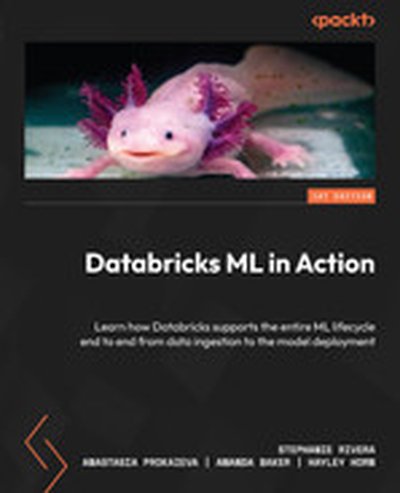
Databricks ML in Action

Dive into the Databricks Data Intelligence Platform and learn how to harness its full potential for creating, deploying, and maintaining machine learning solutions. This book covers everything from setting up your workspace to integrating state-of-the-art tools such as AutoML and VectorSearch, imparting practical skills through detailed examples and code. What this Book will help me do Set up and manage a Databricks workspace tailored for effective data science workflows. Implement monitoring to ensure data quality and detect drift efficiently. Build, fine-tune, and deploy machine learning models seamlessly using Databricks tools. Operationalize AI projects including feature engineering, data pipelines, and workflows on the Databricks Lakehouse architecture. Leverage integrations with popular tools like OpenAI's ChatGPT to expand your AI project capabilities. Author(s) This book is authored by Stephanie Rivera, Anastasia Prokaieva, Amanda Baker, and Hayley Horn, seasoned experts in data science and machine learning from Databricks. Their collective years of expertise in big data and AI technologies ensure a rich and insightful perspective. Through their work, they strive to make complex concepts accessible and actionable. Who is it for? This book serves as an ideal guide for machine learning engineers, data scientists, and technically inclined managers. It's well-suited for those transitioning to the Databricks environment or seeking to deepen their Databricks-based machine learning implementation skills. Whether you're an ambitious beginner or an experienced professional, this book provides clear pathways to success.

Database Management Systems by Pearson

Express Learning is a series of books designed as quick reference guides to important undergraduate computer courses. The organized and accessible format of these books allows students to learn important concepts in an easy-to-understand, question-and-answer format. These portable learning tools have been designed as one-stop references for students to understand and master the subjects by themselves.

Features –

• Designed as a student-friendly self-learning guide. The book is written in a clear, concise, and lucid manner. • Easy-to-understand question-and-answer format. • Includes previously asked as well as new questions organized in chapters. • All types of questions including MCQs, short and long questions are covered. • Solutions to numerical questions asked at examinations are provided. • All ideas and concepts are presented with clear examples. • Text is well structured and well supported with suitable diagrams. • Inter-chapter dependencies are kept to a minimum

Book Contents –

1: Database System 2: Conceptual Modelling 3: Relational Model 4: Relational Algebra and Calculus 5: Structured Query Language 6: Relational Database Design 7: Data Storage and Indexing 8: Query Processing and Optimization 9: Introduction to Transaction Processing 10: Concurrency Control Techniques 11: Database Recovery System 12: Database Security 13: Database System Architecture 14: Data Warehousing, OLAP, and Data Mining 15: Information Retrieval 16: Miscellaneous Questions

Express Learning - Data Warehousing and Data Mining, 1st Edition by Pearson

Express Learning is a series of books designed as quick reference guides to important undergraduate courses. The organized and accessible format of these books allows students to learn important concepts in an easy-to-understand, question-and-answer format. These portable learning tools have been designed as one-stop references for students to understand and master the subjects by themselves.

Book Contents –

Chapter 1: Introduction to Data Warehouse Chapter 2: Building a Data Warehouse Chapter 3: Data Warehouse: Architecture Chapter 4: OLAP Technology Chapter 5: Introduction to Data Mining Chapter 6: Data Preprocessing Chapter 7: Mining Association Rules Chapter 8: Classification and Prediction Chapter 9: Cluster Analysis Chapter 10: Advanced Techniques of Data Mining and Its Applications Index

Hands-On Differential Privacy

Many organizations today analyze and share large, sensitive datasets about individuals. Whether these datasets cover healthcare details, financial records, or exam scores, it's become more difficult for organizations to protect an individual's information through deidentification, anonymization, and other traditional statistical disclosure limitation techniques. This practical book explains how differential privacy (DP) can help. Authors Ethan Cowan, Michael Shoemate, and Mayana Pereira explain how these techniques enable data scientists, researchers, and programmers to run statistical analyses that hide the contribution of any single individual. You'll dive into basic DP concepts and understand how to use open source tools to create differentially private statistics, explore how to assess the utility/privacy trade-offs, and learn how to integrate differential privacy into workflows. With this book, you'll learn: How DP guarantees privacy when other data anonymization methods don't What preserving individual privacy in a dataset entails How to apply DP in several real-world scenarios and datasets Potential privacy attack methods, including what it means to perform a reidentification attack How to use the OpenDP library in privacy-preserving data releases How to interpret guarantees provided by specific DP data releases

XML and Related Technologies

About The Author – Atul Kahate has over 13 years of experience in Information Technology in India and abroad in various capacities. He has done his Bachelor of Science degree in Statistics and his Master of Business Administration in Computer Systems. He has authored 17 highly acclaimed books on various areas of Information Technology. Several of his books are being used as course textbooks or sources of reference in a number of universities/colleges/IT companies all over the world. Atul has been writing articles in newspapers about cricket, since the age of 12. He has also authored two books on cricket and has written over 2000 articles on IT and cricket. He has a deep interest in teaching, music, and cricket besides technology. He has conducted several training programs, in a number of educational institutions and IT organisations, on a wide range of technologies. Some of the prestigious institutions where he has conducted training programs, include IIT, Symbiosis, I2IT, MET, Indira Institute of Management, Fergusson College, MIT, VIIT, MIT, Walchand Government Engineering College besides numerous other colleges in India.

Book Content – 1. Introduction to XML, 2. XML Syntaxes, 3. Document Type Definitions, 4. XML Schemas 5. Cascading Style Sheets, 6. Extensible Stylesheet Language, 7. XML and Java, 8. XML and ASP.NET, 9. Web Services and AJAX, 10. XML Security, Appendix – Miscellaneous Topics

IBM Storage DS8900F Architecture and Implementation: Updated for Release 9.3.2

This IBM® Redbooks® publication describes the concepts, architecture, and implementation of the IBM Storage DS8900F family. The book provides reference information to assist readers who need to plan for, install, and configure the DS8900F systems. This edition applies to DS8900F systems with IBM Storage DS8000® Licensed Machine Code (LMC) 7.9.30 (bundle version 89.30.xx.x), referred to as Release 9.3. The DS8900F systems are all-flash exclusively, and they are offered as three classes: DS8980F: Analytic Class: The DS8980F Analytic Class offers best performance for organizations that want to expand their workload possibilities to artificial intelligence (AI), Business Intelligence (BI), and machine learning (ML). IBM DS8950F: Agility Class: The Agility Class consolidates all your mission-critical workloads for IBM Z®, IBM LinuxONE, IBM Power, and distributed environments under a single all-flash storage solution. IBM DS8910F: Flexibility Class: The Flexibility Class reduces complexity while addressing various workloads at the lowest DS8900F family entry cost. The DS8900F architecture relies on powerful IBM POWER9™ processor-based servers that manage the cache to streamline disk input/output (I/O), which maximizes performance and throughput. These capabilities are further enhanced by High-Performance Flash Enclosures (HPFE) Gen2. Like its predecessors, the DS8900F supports advanced disaster recovery (DR) solutions, business continuity solutions, and thin provisioning.

Supervised and Unsupervised Data Engineering for Multimedia Data

SUPERVISED and UNSUPERVISED DATA ENGINEERING for MULTIMEDIA DATA Explore the cutting-edge realms of data engineering in multimedia with Supervised and Unsupervised Data Engineering for Multimedia Data, where expert contributors delve into innovative methodologies, offering invaluable insights to empower both novices and seasoned professionals in mastering the art of manipulating multimedia data with precision and efficiency. Supervised and Unsupervised Data Engineering for Multimedia Data presents a groundbreaking exploration into the intricacies of handling multimedia data through the lenses of both supervised and unsupervised data engineering. Authored by a team of accomplished experts in the field, this comprehensive volume serves as a go-to resource for data scientists, computer scientists, and researchers seeking a profound understanding of cutting-edge methodologies. The book seamlessly integrates theoretical foundations with practical applications, offering a cohesive framework for navigating the complexities of multimedia data. Readers will delve into a spectrum of topics, including artificial intelligence, machine learning, and data analysis, all tailored to the challenges and opportunities presented by multimedia datasets. From foundational principles to advanced techniques, each chapter provides valuable insights, making this book an essential guide for academia and industry professionals alike. Whether you’re a seasoned practitioner or a newcomer to the field, Supervised and Unsupervised Data Engineering for Multimedia Data illuminates the path toward mastery in manipulating and extracting meaningful insights from multimedia data in the modern age.

Digital Transformation of SAP Supply Chain Processes: Build Mobile Apps Using SAP BTP and SAP Mobile Services

Take a high-level tour of SAP oDATA integrations with frontend technologies like Angular using the SAP Mobile Services Platform. This book will give you a different perspective on executing SAP transactions on iOS using Angular instead of SAP-provided Fiori-based applications. You’ll start by learning about SAP supply chain processes such as Goods Receipt, Transfer Posting, Goods Issue, and Inventory Search. You’ll then move on to understanding the thought process involved in integrating SAP's backend (SAP ECC) with Angular iOS app using SAP Mobile Services running on SAP BTP. All this will serve as a guide tailored to SAP functional and technical consultants actively engaged in client-facing roles. You’ll follow a roadmap for modernizing and streamlining supply chain operations by leveraging Angular iOS apps. Digital Transformation of SAP Supply Chain Processes provides the essential tools for businesses looking to stay competitive in today's technology-driven landscape. What You Will Learn Study the fundamental procedures to set up the Authorization Endpoint, Token Endpoint, and base URL within SAP Mobile Services. Manage attachments in mobile applications and store them in an external content repository. Gain proficiency in testing OData services using the POSTMAN API client with OAuth protocol. Acquire knowledge about the JSON messages, CORS protocol, and X-CSRF token exchange. Link Zebra Printers through the Zebra Native Printing app on iOS App to print SAP forms on mobile printers. Who This Book Is For SAP Consultants with an interest in the Digital Transformation of SAP Supply Chain Processes to iOS-based SAP transactions.

ArcGIS Pro 3.x Cookbook - Second Edition

ArcGIS Pro 3.x Cookbook teaches you to master the powerful tools available in Esri's ArcGIS Pro application for geospatial data management and analysis. You'll discover practical recipes that guide you through creating, editing, visualizing, and analyzing GIS data in 2D and 3D. Whether you are transitioning from ArcMap or starting fresh, this book will empower you to build impressive geospatial projects. What this Book will help me do Navigate and make effective use of the ArcGIS Pro user interface and tools. Create, edit, and publish detailed 2D and 3D geospatial maps. Manage data efficiently using geodatabases, relationships, and topology tools. Perform comprehensive spatial analyses including proximity, clustering, and 3D analysis. Apply geospatial data validation techniques to ensure data consistency and integrity. Author(s) Tripp Corbin, GISP, is an experienced Geographic Information Systems Professional with extensive expertise in Esri's GIS ecosystem. Tripp has taught numerous colleagues about ArcGIS Pro and its capabilities, bringing clarity and focus to complex GIS concepts. His engaging teaching style and comprehensive technical knowledge make this book both helpful and approachable for readers. Who is it for? This book is designed for GIS professionals, geospatial analysts, and technicians looking to expand their skills with ArcGIS Pro. It's well-suited for architects and specialists who want to visualize, analyze, and create GIS projects effectively. Beginner GIS users will find clear guidance without needing prior experience, and experienced ArcMap users will learn how to transition smoothly to ArcGIS Pro.

Apache Iceberg: The Definitive Guide

Traditional data architecture patterns are severely limited. To use these patterns, you have to ETL data into each tool—a cost-prohibitive process for making warehouse features available to all of your data. The lack of flexibility with these patterns requires you to lock into a set of priority tools and formats, which creates data silos and data drift. This practical book shows you a better way. Apache Iceberg provides the capabilities, performance, scalability, and savings that fulfill the promise of an open data lakehouse. By following the lessons in this book, you'll be able to achieve interactive, batch, machine learning, and streaming analytics with this high-performance open source format. Authors Tomer Shiran, Jason Hughes, and Alex Merced from Dremio show you how to get started with Iceberg. With this book, you'll learn: The architecture of Apache Iceberg tables What happens under the hood when you perform operations on Iceberg tables How to further optimize Iceberg tables for maximum performance How to use Iceberg with popular data engines such as Apache Spark, Apache Flink, and Dremio Discover why Apache Iceberg is a foundational technology for implementing an open data lakehouse.

Mastering MySQL Administration: High Availability, Security, Performance, and Efficiency

This book is your one-stop resource on MySQL database installation and server management for administrators. It covers installation, upgrades, monitoring, high availability, disaster recovery, security, and performance and troubleshooting. You will become fluent in MySQL 8.2, the latest version of the highly scalable and robust relational database system. With a hands-on approach, the book offers step-by-step guidance on installing, upgrading, and establishing robust high availability and disaster recovery capabilities for MySQL databases. It also covers high availability with InnoDB and NDB clusters, MySQL routers and enterprise MySQL tools, along with robust security design and performance techniques. Throughout, the authors punctuate concepts with examples taken from their experience with large-scale implementations at companies such as Meta and American Airlines, anchoring this practical guide to MySQL 8.2 administration in the real world. What YouWill Learn Understand MySQL architecture and best practices for administration of MySQL server Configure high availability, replication, disaster recovery with InnoDB and NDB engines Back up and restore with MySQL utilities and tools, and configure the database for zero data loss Troubleshoot with steps for real-world critical errors and detailed solutions Who This Book Is For Technical professionals, database administrators, developers, and engineers seeking to optimize MySQL databases for scale, security, and performance