talk-data.com talk-data.com

Topic

data-engineering

3395

tagged

Activity Trend

1 peak/qtr
2020-Q1 2026-Q1

Activities

3395 activities · Newest first

Take Control of Securing Your Apple Devices

Keep your Mac, iPhone, and iPad safe! Version 1.1.1, published September 28, 2025 Secure your Mac, iPhone, or iPad against attacks from the internet, physical intrusion, and more with the greatest of ease. Glenn Fleishman guides you through protecting yourself from phishing, email, and other exploits, as well as network-based invasive behavior. Learn about built-in privacy settings, the Secure Enclave, FileVault, hardware encryption keys, sandboxing, privacy settings, Advanced Data Protection, Lockdown Mode, resetting your password when all hope seems lost, and much more. The digital world is riddled with danger, even as Apple has done a fairly remarkable job at keeping our Macs, iPhones, and iPads safe. But the best security strategy is staying abreast of past risks and anticipating future ones. This book gives you all the insight and directions you need to ensure your Apple devices and their data are safe. It's up to date with macOS 26 Tahoe, iOS 26, and iPadOS 26. You’ll learn about the enhanced Advanced Data Protection option for iCloud services, allowing you to keep all your private data inaccessible not just to thieves and unwarranted government intrusion, but even to Apple! Also get the rundown on Lockdown Mode to deter direct network and phishing attacks, passkeys and hardware secure keys for the highest level of security for Apple Account and website logins, and Mac-specific features such as encrypted startup volumes and FileVault’s login protection process. Security and privacy are tightly related, and this book helps you understand how macOS, iOS, and iPadOS have increasingly compartmentalized and protected your personal data, and how to allow only the apps you want to access specific folders, your contacts, and other information. Here’s what this book has to offer:

Master the privacy settings on your Mac, iPhone, and iPad Calculate your level of risk and your tolerance for it Use Apple’s Stolen Device Protection feature for iPhone that deflects thieves who extract your passcode through coercion or misdirection. Learn why you’re asked to give permission for apps to access folders and personal data on your Mac Moderate access to your audio, video, screen actions, and other hardware inputs and outputs Get to know the increasing layers of system security deployed over the past few years Prepare against a failure or error that might lock you out of your device Share files and folders securely over a network and through cloud services Upgrade your iCloud data protection to use end-to-end encryption Control other low-level security options to reduce the risk of someone gaining physical access to your Mac—or override them to install system extensions Understand FileVault encryption and protection for Mac, and avoid getting locked out Investigate the security of a virtual private network (VPN) to see whether you should use one Learn how the Secure Enclave in Macs with a T2 chip or M-series Apple silicon affords hardware-level protections Dig into ransomware, the biggest potential threat to Mac users (though rare in practice) Discover recent security and privacy technologies, such as Lockdown Mode and passkeys Learn why your iPhone may restart automatically if it's been idle for several days
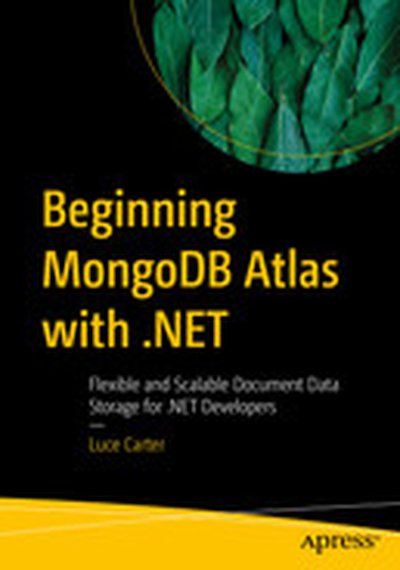
Beginning MongoDB Atlas with .NET: Flexible and Scalable Document Data Storage for .NET Developers

This book is a tutorial on MongoDB customized for developers working in Microsoft .NET 6, .NET 7, and beyond. It explains the differences between relational database systems and the document model supported by MongoDB, and shows how to build .NET applications that run against a MongoDB database, especially one in the cloud. Author Luce Carter kicks things off by teaching you how to determine when to use a document database versus a relational engine. After that, she walks you through building a Microsoft .NET project combining the MongoDB Atlas cloud database as a service solution with a .NET. application. In the process, you will learn how to create, read, update, and delete data in MongoDB from any .NET project. You will come away from this book with a solid understanding of MongoDB’s Developer Data Platform and how to use it from your .NET applications. You’ll be able to connect to MongoDB in the cloud and take advantage of the flexibility and scalability that MongoDB’s document storage model provides, and you’ll understand how to craft your applications to run using document storage and the MongoDB database engine. What You Will Learn Know when to use the MongoDB document model Build .NET applications that connect to MongoDB for data storage Create MongoDB clusters on the MongoDB Atlas cloud platform Store data in MongoDB Atlas Create, Read, Update, and Delete (CRUD) data from .NET Web API projects Test your CRUD endpoints using RESTful operations Validate schemas to help protect against breaking changes Who This Book Is For .NET developers who are looking for an alternative to relational databases, and those looking for a flexible and scalable document storage solution for use from .NET applications. Additionally, anyone wanting to learn MongoDB in the context of .NET and C# will benefit from this book.

Implementing Data Mesh

As data continues to grow and become more complex, organizations seek innovative solutions to manage their data effectively. Data mesh is one solution that provides a new approach to managing data in complex organizations. This practical guide offers step-by-step guidance on how to implement data mesh in your organization. In this book, Jean-Georges Perrin and Eric Broda focus on the key components of data mesh and provide practical advice supported by code. Data engineers, architects, and analysts will explore a simple and intuitive process for identifying key data mesh components and data products. You'll learn a consistent set of interfaces and access methods that make data products easy to consume. This approach ensures that your data products are easily accessible and the data mesh ecosystem is easy to navigate. This book helps you: Identify, define, and build data products that interoperate within an enterprise data mesh Build a data mesh fabric that binds data products together Build and deploy data products in a data mesh Establish the organizational structure to operate data products, data platforms, and data fabric Learn an innovative architecture that brings data products and data fabric together into the data mesh About the authors: Jean-Georges "JG" Perrin is a technology leader focusing on building innovative and modern data platforms. Eric Broda is a technology executive, practitioner, and founder of a boutique consulting firm that helps global enterprises realize value from data.

Amazon DynamoDB - The Definitive Guide

Master Amazon DynamoDB, the serverless NoSQL database designed for lightning-fast performance and scalability, with this definitive guide. You'll delve into its features, learn advanced concepts, and acquire practical skills to harness DynamoDB for modern application development. What this Book will help me do Understand AWS DynamoDB fundamentals for real-world applications. Model and optimize NoSQL databases with advanced techniques. Integrate DynamoDB into scalable, high-performance architectures. Utilize DynamoDB indexing, caching, and analytical features effectively. Plan and execute RDBMS to NoSQL data migrations successfully. Author(s) None Dhingra, an AWS DynamoDB solutions expert, and None Mackay, a seasoned NoSQL architect, bring their combined expertise straight from Amazon Web Services to guide you step-by-step in mastering DynamoDB. Combining comprehensive technical knowledge with approachable explanations, they empower readers to implement practical and efficient data strategies. Who is it for? This book is ideal for software developers and architects seeking to deepen their knowledge about AWS solutions like DynamoDB, engineering managers aiming to incorporate scalable NoSQL solutions into their projects, and data professionals transitioning from RDBMS towards a serverless data approach. Individuals with basic knowledge in cloud computing or database systems and those ready to advance in DynamoDB will find this book particularly beneficial.

Full Stack FastAPI, React, and MongoDB - Second Edition

Full Stack FastAPI, React, and MongoDB guides you step-by-step through creating web applications using the FARM stack. This hands-on resource teaches you how to integrate FastAPI, a modern Python framework, React for front-end development, and MongoDB for data storage to build and deploy powerful, scalable web applications. What this Book will help me do Master the essentials of MongoDB, including creating and managing document-based databases. Gain proficiency in building APIs using FastAPI and Python for robust backend systems. Develop dynamic frontends using React, integrating seamlessly with a FastAPI backend. Securely authenticate and authorize users using JSON Web Tokens in your applications. Explore advanced features like integrating AI models and building with Next.js for production-ready development. Author(s) Marko Aleksendrić, Shrey Batra, Rachelle Palmer, and Shubham Ranjan combine their expertise in web development and software engineering in this book. Together, they bring years of professional experience and a passion for teaching developers to create modern web applications effectively using cutting-edge tools. Who is it for? Intermediate web developers who possess foundational JavaScript and Python skills are the ideal audience for this book. If you want to advance your skills by mastering modern web application development with the FARM stack, this book will guide you comprehensively. With practical, real-world examples, it is designed for developers aiming to build production-grade applications.

Streaming Databases

Real-time applications are becoming the norm today. But building a model that works properly requires real-time data from the source, in-flight stream processing, and low latency serving of its analytics. With this practical book, data engineers, data architects, and data analysts will learn how to use streaming databases to build real-time solutions. Authors Hubert Dulay and Ralph M. Debusmann take you through streaming database fundamentals, including how these databases reduce infrastructure for real-time solutions. You'll learn the difference between streaming databases, stream processing, and real-time online analytical processing (OLAP) databases. And you'll discover when to use push queries versus pull queries, and how to serve synchronous and asynchronous data emanating from streaming databases. This guide helps you: Explore stream processing and streaming databases Learn how to build a real-time solution with a streaming database Understand how to construct materialized views from any number of streams Learn how to serve synchronous and asynchronous data Get started building low-complexity streaming solutions with minimal setup

MuleSoft Platform Architect's Guide

The "MuleSoft Platform Architect's Guide" is your essential resource for mastering API-driven solutions using MuleSoft Anypoint Platform. This book enables you to design, deploy, and operate scalable, secure, and high-performance API architectures in enterprise settings while preparing for MuleSoft Platform Architect certification. What this Book will help me do Design robust API integration solutions using MuleSoft Anypoint Platform. Successfully deploy applications to CloudHub and Runtime Fabric environments. Monitor and operate APIs with advanced management tools. Implement scalable solutions aligned with business outcomes. Prepare confidently for the MuleSoft Platform Architect certification. Author(s) Jitendra Bafna is a Senior Solution Architect with years of experience optimizing MuleSoft implementations. Jim Andrews, a MuleSoft Evangelist, has dedicated his career to guiding others in achieving enterprise-ready API solutions. Together, they share practical knowledge, step-by-step guidance, and expertise in API and integration mastery. Who is it for? This book is perfect for IT architects and senior developers experienced in API development, especially those familiar with MuleSoft. It's tailored for professionals aiming to master Anypoint Platform or pursue MuleSoft Platform Architect certification. Readers should have basic experience with integration platforms and a willingness to explore advanced API design.

Practical Lakehouse Architecture

This concise yet comprehensive guide explains how to adopt a data lakehouse architecture to implement modern data platforms. It reviews the design considerations, challenges, and best practices for implementing a lakehouse and provides key insights into the ways that using a lakehouse can impact your data platform, from managing structured and unstructured data and supporting BI and AI/ML use cases to enabling more rigorous data governance and security measures. Practical Lakehouse Architecture shows you how to: Understand key lakehouse concepts and features like transaction support, time travel, and schema evolution Understand the differences between traditional and lakehouse data architectures Differentiate between various file formats and table formats Design lakehouse architecture layers for storage, compute, metadata management, and data consumption Implement data governance and data security within the platform Evaluate technologies and decide on the best technology stack to implement the lakehouse for your use case Make critical design decisions and address practical challenges to build a future-ready data platform Start your lakehouse implementation journey and migrate data from existing systems to the lakehouse

Database Design and Modeling with PostgreSQL and MySQL

Discover how to design and optimize modern databases efficiently using PostgreSQL and MySQL. This book guides you through database design for scalability and performance, covering data modeling, query optimization, and real-world application integration. What this Book will help me do Build efficient and scalable relational database schemas for real-world applications. Master data modeling with normalization and denormalization techniques. Understand query optimization strategies for better database performance. Learn database strategies such as sharding, replication, and backup management. Integrate relational databases with applications and explore future database trends. Author(s) Alkin Tezuysal and Ibrar Ahmed are seasoned database professionals with decades of experience. Alkin specializes in database scalability and performance, while Ibrar brings expertise in database systems and development. Together, they bring a hands-on approach, providing clear and insightful guidance for database professionals. Who is it for? This book is oriented towards software developers, database administrators, and IT professionals looking to enhance their knowledge in database design using PostgreSQL and MySQL. Beginners in database design will find its structured approach approachable. Advanced professionals will appreciate its depth on cutting-edge topics and practical optimizations.

Big Data on Kubernetes

Big Data on Kubernetes is your comprehensive guide to leveraging Kubernetes for scalable and efficient big data solutions. You will learn key concepts of Kubernetes architecture and explore tools like Apache Spark, Airflow, and Kafka. Gain hands-on experience building complete data pipelines to tackle real-world data challenges. What this Book will help me do Understand Kubernetes architecture and learn to deploy and manage clusters. Build and orchestrate big data pipelines using Spark, Airflow, and Kafka. Develop scalable and resilient data solutions with Docker and Kubernetes. Integrate and optimize data tools for real-time ingestion and processing. Apply concepts to hands-on projects addressing actual big data scenarios. Author(s) Neylson Crepalde is an experienced data specialist with extensive knowledge of Kubernetes and big data solutions. With deep practical experience, Neylson brings real-world insights to his writing. His approach emphasizes actionable guidance and relatable problem-solving with a strong foundation in scalable architecture. Who is it for? This book is ideal for data engineers, BI analysts, data team leaders, and tech managers familiar with Python, SQL, and YAML. Targeted at professionals seeking to develop or expand their expertise in scalable big data solutions, it provides practical insights into Docker, Kubernetes, and prominent big data tools.

Information Modeling and Relational Databases, 3rd Edition

Information Modeling and Relational Databases, Third Edition, provides an introduction to ORM (Object-Role Modeling) and much more. In fact, it is the only book to go beyond introductory coverage and provide all of the in-depth instruction you need to transform knowledge from domain experts into a sound database design. This book is intended for anyone with a stake in the accuracy and efficacy of databases: systems analysts, information modelers, database designers and administrators, and programmers. Dr. Terry Halpin and Dr. Tony Morgan, pioneers in the development of ORM, blend conceptual information with practical instruction that will let you begin using ORM effectively as soon as possible. The all-new Third Edition includes coverage of advances and improvements in ORM and UML, nominalization, relational mapping, SQL, XML, data interchange, NoSQL databases, ontological modeling, and post-relational databases. Supported by examples, exercises, and useful background information, the authors’ step-by-step approach teaches you to develop a natural-language-based ORM model, and then, where needed, abstract ER and UML models from it. This book will quickly make you proficient in the modeling technique that is proving vital to the development of accurate and efficient databases that best meet real business objectives. "This book is an excellent introduction to both information modeling in ORM and relational databases. The book is very clearly written in a step-by-step manner and contains an abundance of well-chosen examples illuminating practice and theory in information modeling. I strongly recommend this book to anyone interested in conceptual modeling and databases." — Dr. Herman Balsters, Director of the Faculty of Industrial Engineering, University of Groningen, The Netherlands Presents the most in-depth coverage of object-role modeling, including a thorough update of the book for the latest versions of ORM, ER, UML, OWL, and BPMN modeling. Includes clear coverage of relational database concepts as well as the latest developments in SQL, XML, information modeling, data exchange, and schema transformation. Case studies and a large number of class-tested exercises are provided for many topics. Includes all-new chapters on data file formats and NoSQL databases.

IBM FlashCore Module (FCM) Product Guide: Features the newly available FCM4 with AI-powered ransomware detection

This IBM® Redpaper® Product Guide describes the IBM FlashCore Module (FCM) history, a general overview and then a deeper dive on the way IBM leads the field in the adoption of high speed, low latency storage. The IBM FlashCore Module is used in the latest IBM FlashSystem® solutions, which is are next-generation IBM FlashSystem control enclosures. The IBM FlashCore Module combines the performance of flash and a Non-Volatile Memory Express (NVMe) optimized architecture with the reliability and innovation of IBM FlashCore® technology and the rich feature set and high availability (HA) with IBM Storage Virtualize software.

SAP HANA on IBM Power Systems Architectural Summary

This IBM Redpaper publication delivers SAP HANA architectural concepts for successful implementation on IBM Power Systems servers. This update is designed to introduce the Power10 product line and how it enhances support for SAP HANA. Also discussed is the addition of support for Red Hat Enterprise Linux as a supported operating system for SAP workloads. This publication addresses topics for sellers, IT architects, IT specialists, and anyone who wants to understand how to take advantage of running SAP HANA workloads on Power Systems servers. Moreover, this document provides information to transfer how-to skills to the technical teams, and it provides solution guidance to the sales team. This publication complements documentation that is available at IBM Knowledge Center, and it aligns with educational materials that are provided by IBM Systems.

Forms and Functions of Meta-Discourse

This book constitutes the first systematic analysis of meta-discourse in the spoken domain, addressing the question of how, why, and when speakers switch from discourse to meta-discourse by means of comment clauses (e.g., ‘I think’). The case of Present-day Italian is considered, exploring the internal properties of comment clauses (e.g., morphosyntax and semantics of the verb), their relations with the surrounding discourse (e.g., position of comment clause), and their prosodic profiles. This study shows that speakers recur to meta-discourse to convey a non-random set of functions, having mainly to do with the online process of reference construction (e.g., approximation and reformulation) and with the degree of speaker’s commitment (e.g., epistemicity and emphasis). Comment clauses are also used as attention-getting or topic-resuming devices, though less frequently. One of the most interesting results of this study is the identification of a close relation between meta-discourse and stance-taking in spoken domain, with speakers recurring to comment clauses to convey their attitude. Finally, meta-discourse turns out to be highly influenced, if not constrained, by universal properties of the spoken domain (i.e., non-linearity).

Data Migration Management for SAP S/4HANA: A Practical Guide

Enhance your data transfer and storage skills with this comprehensive step-by-step guide to managing data migration for new on-premises SAP S/4HANA implementations. This book is tailored towards small to large projects, with a focus on the managerial aspects of the data migration process rather than the technical details. You’ll follow a project-led approach, enriched with a practical case study, and a comprehensive methodology for data migration planning and documentation. Athen traverse through a detailed plan on managing and documenting data migration throughout the project lifecycle. This book utilizes the general SAP Activate methodology for on-premises solutions as its foundational framework, enhancing it with specific strategies for data migration. Structured in alignment with the project phases of the SAP Activate methodology, Data Migration Management for SAP S/4HANA methodically covers planning, organizing, and controlling the data migration process. It serves as an essential guide for professionals tasked with implementing SAP S/4HANA in their business, ensuring a thorough understanding of each data migration phase on the project. What You'll Learn Significantly decrease the time needed for both the preparation and execution of data migration activities. Foster clear transparency in data migration processes for all stakeholders, including the customer and the project team. Facilitate a seamless and timely data migration process. Establish a benchmark for data migration management in future projects. Address and remedy any deficiencies in the SAP Activate methodology pertaining to data migration. Who This Book Is For SAP projects and data migration workstreams leads, already well-versed in SAP Activate methodology and possessing moderate experience in project and workstream management, who are seeking to enhance their skills in professionally managing data migration in implementation projects.

Elastic Stack 8.x Cookbook

Unlock the potential of the Elastic Stack with the "Elastic Stack 8.x Cookbook." This book provides over 80 hands-on recipes, guiding you through ingesting, processing, and visualizing data using Elasticsearch, Logstash, Kibana, and more. You'll also explore advanced features like machine learning and observability to create data-driven applications with ease. What this Book will help me do Implement a robust workflow for ingesting, transforming, and visualizing diverse datasets. Utilize Kibana to create insightful dashboards and visual analytics. Leverage Elastic Stack's AI capabilities, such as natural language processing and machine learning. Develop search solutions and integrate advanced features like vector search. Monitor and optimize your Elastic Stack deployments for performance and security. Author(s) Huage Chen and Yazid Akadiri are experienced professionals in the field of Elastic Stack. They bring years of practical experience in data engineering, observability, and software development. Huage and Yazid aim to provide a clear, practical pathway for both beginners and experienced users to get the most out of the Elastic Stack's capabilities. Who is it for? This book is perfect for developers, data engineers, and observability practitioners looking to harness the power of Elastic Stack. It caters to both beginners and experts, providing clear instructions to help readers understand and implement powerful data solutions. If you're working with search applications, data analysis, or system observability, this book is an ideal resource.

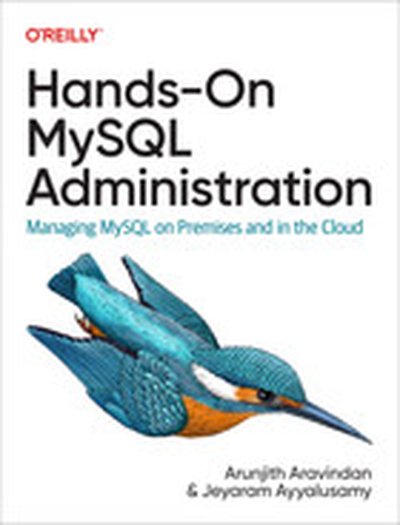
Hands-On MySQL Administration

Geared to intermediate- to advanced-level DBAs and IT professionals looking to enhance their MySQL skills, this guide provides a comprehensive overview on how to manage and optimize MySQL databases. You'll learn how to create databases and implement backup and recovery, security configurations, high availability, scaling techniques, and performance tuning. Using practical techniques, tips, and real-world examples, authors Arunjith Aravindan and Jeyaram Ayyalusamy show you how to deploy and manage MySQL, Amazon RDS, Amazon Aurora, and Azure MySQL. By the end of the book, you'll have the knowledge and skills necessary to administer, manage, and optimize MySQL databases effectively. Design and implement a scalable and reliable database infrastructure using MySQL 8 on premises and cloud Install and configure software, manage user accounts, and optimize database performance Use backup and recovery strategies, security measures, and high availability solutions Apply best practices for database schema design, indexing strategies, and replication techniques Implement advanced database features and techniques such as replication, clustering, load balancing, and high availability Troubleshoot common issues and errors, using diagnostic tools and techniques to identify and resolve problems quickly and efficiently Facilitate major MySQL upgrades including MySQL 5.7 to MySQL 8

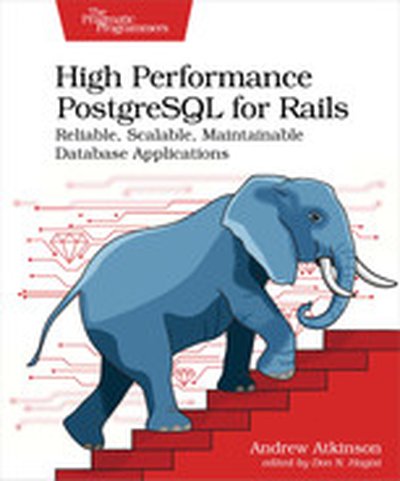
High Performance PostgreSQL for Rails

Build faster, more reliable Rails apps by taking the best advanced PostgreSQL and Active Record capabilities, and using them to solve your application scale and growth challenges. Gain the skills needed to comfortably work with multi-terabyte databases, and with complex Active Record, SQL, and specialized Indexes. Develop your skills with PostgreSQL on your laptop, then take them into production, while keeping everything in sync. Make slow queries fast, perform any schema or data migration without errors, use scaling techniques like read/write splitting, partitioning, and sharding, to meet demanding workload requirements from Internet scale consumer apps to enterprise SaaS. Deepen your firsthand knowledge of high-scale PostgreSQL databases and Ruby on Rails applications with dozens of practical and hands-on exercises. Unlock the mysteries surrounding complex Active Record. Make any schema or data migration change confidently, without downtime. Grow your experience with modern and exclusive PostgreSQL features like SQL Merge, Returning, and Exclusion constraints. Put advanced capabilities like Full Text Search and Publish Subscribe mechanisms built into PostgreSQL to work in your Rails apps. Improve the quality of the data in your database, using the advanced and extensible system of types and constraints to reduce and eliminate application bugs. Tackle complex topics like how to improve query performance using specialized indexes. Discover how to effectively use built-in database functions and write your own, administer replication, and make the most of partitioning and foreign data wrappers. Use more than 40 well-supported open source tools to extend and enhance PostgreSQL and Ruby on Rails. Gain invaluable insights into database administration by conducting advanced optimizations - including high-impact database maintenance - all while solving real-world operational challenges. Take your new skills into production today and then take your PostgreSQL and Rails applications to a whole new level of reliability and performance. What You Need: A computer running macOS, Linux, or Windows and WSL2 PostgreSQL version 16, installed by package manager, compiled, or running with Docker An Internet connection

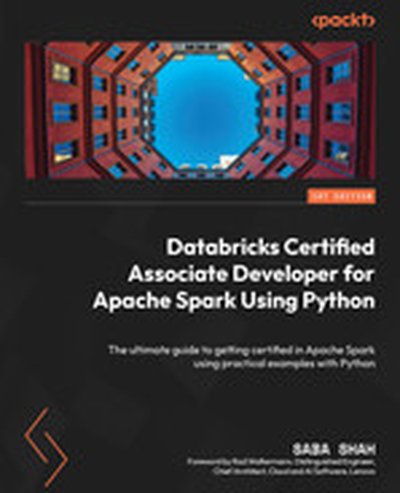
Databricks Certified Associate Developer for Apache Spark Using Python

This book serves as the ultimate preparation for aspiring Databricks Certified Associate Developers specializing in Apache Spark. Deep dive into Spark's components, its applications, and exam techniques to achieve certification and expand your practical skills in big data processing and real-time analytics using Python. What this Book will help me do Deeply understand Apache Spark's core architecture for building big data applications. Write optimized SQL queries and leverage Spark DataFrame API for efficient data manipulation. Apply advanced Spark functions, including UDFs, to solve complex data engineering tasks. Use Spark Streaming capabilities to implement real-time and near-real-time processing solutions. Get hands-on preparation for the certification exam with mock tests and practice questions. Author(s) Saba Shah is a seasoned data engineer with extensive experience working at Databricks and leading data science teams. With her in-depth knowledge of big data applications and Spark, she delivers clear, actionable insights in this book. Her approach emphasizes practical learning and real-world applications. Who is it for? This book is ideal for data professionals such as engineers and analysts aiming to achieve Databricks certification. It is particularly helpful for individuals with moderate Python proficiency who are keen to understand Spark from scratch. If you're transitioning into big data roles, this guide prepares you comprehensively.