talk-data.com talk-data.com

Topic

data-science-tasks

849

tagged

Activity Trend

1 peak/qtr
2020-Q1 2026-Q1

Activities

849 activities · Newest first

Tableau Desktop Certified Associate: Exam Guide

Tableau Desktop Certified Associate: Exam Guide is your companion for mastering Tableau and preparing for the certification exam with confidence. Through this book, you will gain a comprehensive understanding of Tableau Desktop's features and learn to implement them in practical scenarios to solve analytics challenges. What this Book will help me do Understand and apply Tableau best practices for analyzing and visualizing data effectively. Visualize geographic data using vector maps and gain insights into spatial distributions. Leverage advanced analytics techniques such as forecasting to predict key metrics. Build effective dashboards that convey information clearly and efficiently. Gain confidence in tackling Tableau Desktop Certified Associate exam questions with expert tips and mock exams. Author(s) The authors, Dmitry Anoshin, JC Gillet, Peri Biyani, and others, are experienced professionals in data analytics and business intelligence. With significant expertise in teaching and applying Tableau, they bring a wealth of knowledge to this guide, offering clear instructions and practical insights. Their dedication to empowering learners fosters a supportive and assured journey through this book. Who is it for? This book is ideal for business analysts, BI professionals, and data analysts aiming to become certified Tableau Desktop Associates. If you have a foundational understanding of Tableau Desktop and are looking to deepen your expertise while preparing for certification, this book is tailored to help you achieve that goal.
Effective Data Storytelling

Master the art and science of data storytelling—with frameworks and techniques to help you craft compelling stories with data. The ability to effectively communicate with data is no longer a luxury in today’s economy; it is a necessity. Transforming data into visual communication is only one part of the picture. It is equally important to engage your audience with a narrative—to tell a story with the numbers. Effective Data Storytelling will teach you the essential skills necessary to communicate your insights through persuasive and memorable data stories. Narratives are more powerful than raw statistics, more enduring than pretty charts. When done correctly, data stories can influence decisions and drive change. Most other books focus only on data visualization while neglecting the powerful narrative and psychological aspects of telling stories with data. Author Brent Dykes shows you how to take the three central elements of data storytelling—data, narrative, and visuals—and combine them for maximum effectiveness. Taking a comprehensive look at all the elements of data storytelling, this unique book will enable you to: Transform your insights and data visualizations into appealing, impactful data stories Learn the fundamental elements of a data story and key audience drivers Understand the differences between how the brain processes facts and narrative Structure your findings as a data narrative, using a four-step storyboarding process Incorporate the seven essential principles of better visual storytelling into your work Avoid common data storytelling mistakes by learning from historical and modern examples Effective Data Storytelling: How to Drive Change with Data, Narrative and Visuals is a must-have resource for anyone who communicates regularly with data, including business professionals, analysts, marketers, salespeople, financial managers, and educators.

Prepare Your Data for Tableau: A Practical Guide to the Tableau Data Prep Tool

Focus on the most important and most often overlooked factor in a successful Tableau project—data. Without a reliable data source, you will not achieve the results you hope for in Tableau. This book does more than teach the mechanics of data preparation. It teaches you: how to look at data in a new way, to recognize the most common issues that hinder analytics, and how to mitigate those factors one by one. Tableau can change the course of business, but the old adage of "garbage in, garbage out" is the hard truth that hides behind every Tableau sales pitch. That amazing sales demo does not work as well with bad data. The unfortunate reality is that almost all data starts out in a less-than-perfect state. Data prep is hard. Traditionally, we were forced into the world of the database where complex ETL (Extract, Transform, Load) operations created by the data team did all the heavy lifting for us. Fortunately, we have moved past those days. With the introduction of the Tableau Data Prep tool you can now handle most of the common Data Prep and cleanup tasks on your own, at your desk, and without the help of the data team. This essential book will guide you through: The layout and important parts of the Tableau Data Prep tool Connecting to data Data quality and consistency The shape of the data. Is the data oriented in columns or rows? How to decide? Why does it matter? What is the level of detail in the source data? Why is that important? Combining source data to bring in more fields and rows Saving the data flow and the results of our data prep work Common cleanup and setup tasks in Tableau Desktop What You Will Learn Recognize data sources that are good candidates for analytics in Tableau Connect tolocal, server, and cloud-based data sources Profile data to better understand its content and structure Rename fields, adjust data types, group data points, and aggregate numeric data Pivot data Join data from local, server, and cloud-based sources for unified analytics Review the steps and results of each phase of the Data Prep process Output new data sources that can be reviewed in Tableau or any other analytics tool Who This Book Is For Tableau Desktop users who want to: connect to data, profile the data to identify common issues, clean up those issues, join to additional data sources, and save the newly cleaned, joined data so that it can be used more effectively in Tableau

Introduction to Stochastic Processes and Simulation

Mastering chance has, for a long time, been a preoccupation of mathematical research. Today, we possess a predictive approach to the evolution of systems based on the theory of probabilities. Even so, uncovering this subject is sometimes complex, because it necessitates a good knowledge of the underlying mathematics. This book offers an introduction to the processes linked to the fluctuations in chance and the use of numerical methods to approach solutions that are difficult to obtain through an analytical approach. It takes classic examples of inventory and queueing management, and addresses more diverse subjects such as equipment reliability, genetics, population dynamics, physics and even market finance. It is addressed to those at Master's level, at university, engineering school or management school, but also to an audience of those in continuing education, in order that they may discover the vast field of decision support.

Mining Social Media

Did fake Twitter accounts help sway a presidential election? What can Facebook and Reddit archives tell us about human behavior? In Mining Social Media, senior BuzzFeed reporter Lam Thuy Vo shows you how to use Python and key data analysis tools to find the stories buried in social media. Whether you’re a professional journalist, an academic researcher, or a citizen investigator, you’ll learn how to use technical tools to collect and analyze data from social media sources to build compelling, data-driven stories. Learn how to: •Write Python scripts and use APIs to gather data from the social web •Download data archives and dig through them for insights •Inspect HTML downloaded from websites for useful content •Format, aggregate, sort, and filter your collected data using Google Sheets •Create data visualizations to illustrate your discoveries •Perform advanced data analysis using Python, Jupyter Notebooks, and the pandas library •Apply what you’ve learned to research topics on your own Social media is filled with thousands of hidden stories just waiting to be told. Learn to use the data-sleuthing tools that professionals use to write your own data-driven stories.

Avoiding Data Pitfalls

Avoid data blunders and create truly useful visualizations Avoiding Data Pitfalls is a reputation-saving handbook for those who work with data, designed to help you avoid the all-too-common blunders that occur in data analysis, visualization, and presentation. Plenty of data tools exist, along with plenty of books that tell you how to use them—but unless you truly understand how to work with data, each of these tools can ultimately mislead and cause costly mistakes. This book walks you step by step through the full data visualization process, from calculation and analysis through accurate, useful presentation. Common blunders are explored in depth to show you how they arise, how they have become so common, and how you can avoid them from the outset. Then and only then can you take advantage of the wealth of tools that are out there—in the hands of someone who knows what they're doing, the right tools can cut down on the time, labor, and myriad decisions that go into each and every data presentation. Workers in almost every industry are now commonly expected to effectively analyze and present data, even with little or no formal training. There are many pitfalls—some might say chasms—in the process, and no one wants to be the source of a data error that costs money or even lives. This book provides a full walk-through of the process to help you ensure a truly useful result. Delve into the "data-reality gap" that grows with our dependence on data Learn how the right tools can streamline the visualization process Avoid common mistakes in data analysis, visualization, and presentation Create and present clear, accurate, effective data visualizations To err is human, but in today's data-driven world, the stakes can be high and the mistakes costly. Don't rely on "catching" mistakes, avoid them from the outset with the expert instruction in Avoiding Data Pitfalls.

Advanced Statistics with Applications in R

Advanced Statistics with Applications in R fills the gap between several excellent theoretical statistics textbooks and many applied statistics books where teaching reduces to using existing packages. This book looks at what is under the hood. Many statistics issues including the recent crisis with p-value are caused by misunderstanding of statistical concepts due to poor theoretical background of practitioners and applied statisticians. This book is the product of a forty-year experience in teaching of probability and statistics and their applications for solving real-life problems. There are more than 442 examples in the book: basically every probability or statistics concept is illustrated with an example accompanied with an R code. Many examples, such as Who said π? What team is better? The fall of the Roman empire, James Bond chase problem, Black Friday shopping, Free fall equation: Aristotle or Galilei, and many others are intriguing. These examples cover biostatistics, finance, physics and engineering, text and image analysis, epidemiology, spatial statistics, sociology, etc. Advanced Statistics with Applications in R teaches students to use theory for solving real-life problems through computations: there are about 500 R codes and 100 datasets. These data can be freely downloaded from the author's website dartmouth.edu/~eugened. This book is suitable as a text for senior undergraduate students with major in statistics or data science or graduate students. Many researchers who apply statistics on the regular basis find explanation of many fundamental concepts from the theoretical perspective illustrated by concrete real-world applications.

Data Mining for Business Analytics

Data Mining for Business Analytics: Concepts, Techniques, and Applications in Python presents an applied approach to data mining concepts and methods, using Python software for illustration Readers will learn how to implement a variety of popular data mining algorithms in Python (a free and open-source software) to tackle business problems and opportunities. This is the sixth version of this successful text, and the first using Python. It covers both statistical and machine learning algorithms for prediction, classification, visualization, dimension reduction, recommender systems, clustering, text mining and network analysis. It also includes: A new co-author, Peter Gedeck, who brings both experience teaching business analytics courses using Python, and expertise in the application of machine learning methods to the drug-discovery process A new section on ethical issues in data mining Updates and new material based on feedback from instructors teaching MBA, undergraduate, diploma and executive courses, and from their students More than a dozen case studies demonstrating applications for the data mining techniques described End-of-chapter exercises that help readers gauge and expand their comprehension and competency of the material presented A companion website with more than two dozen data sets, and instructor materials including exercise solutions, PowerPoint slides, and case solutions Data Mining for Business Analytics: Concepts, Techniques, and Applications in Python is an ideal textbook for graduate and upper-undergraduate level courses in data mining, predictive analytics, and business analytics. This new edition is also an excellent reference for analysts, researchers, and practitioners working with quantitative methods in the fields of business, finance, marketing, computer science, and information technology. “This book has by far the most comprehensive review of business analytics methods that I have ever seen, covering everything from classical approaches such as linear and logistic regression, through to modern methods like neural networks, bagging and boosting, and even much more business specific procedures such as social network analysis and text mining. If not the bible, it is at the least a definitive manual on the subject.” —Gareth M. James, University of Southern California and co-author (with Witten, Hastie and Tibshirani) of the best-selling book An Introduction to Statistical Learning, with Applications in R

Clustering Methodology for Symbolic Data

Covers everything readers need to know about clustering methodology for symbolic data—including new methods and headings—while providing a focus on multi-valued list data, interval data and histogram data This book presents all of the latest developments in the field of clustering methodology for symbolic data—paying special attention to the classification methodology for multi-valued list, interval-valued and histogram-valued data methodology, along with numerous worked examples. The book also offers an expansive discussion of data management techniques showing how to manage the large complex dataset into more manageable datasets ready for analyses. Filled with examples, tables, figures, and case studies, Clustering Methodology for Symbolic Data begins by offering chapters on data management, distance measures, general clustering techniques, partitioning, divisive clustering, and agglomerative and pyramid clustering. Provides new classification methodologies for histogram valued data reaching across many fields in data science Demonstrates how to manage a large complex dataset into manageable datasets ready for analysis Features very large contemporary datasets such as multi-valued list data, interval-valued data, and histogram-valued data Considers classification models by dynamical clustering Features a supporting website hosting relevant data sets Clustering Methodology for Symbolic Data will appeal to practitioners of symbolic data analysis, such as statisticians and economists within the public sectors. It will also be of interest to postgraduate students of, and researchers within, web mining, text mining and bioengineering.

Spatial Analysis Using Big Data

Spatial Analysis Using Big Data: Methods and Urban Applications helps readers understand the most powerful, state-of-the-art spatial econometric methods, focusing particularly on urban research problems. The methods represent a cluster of potentially transformational socio-economic modeling tools that allow researchers to capture real-time and high-resolution information to potentially reveal new socioeconomic dynamics within urban populations. Each method, written by leading exponents of the discipline, uses real-time urban big data to solve research problems in spatial science. Urban applications of these methods are provided in unsurpassed depth, with chapters on surface temperature mapping, view value analysis, community clustering and spatial-social networks, among many others. Reviews some of the most powerful and challenging modern methods to study big data problems in spatial science Provides computer codes written in R, MATLAB and Python to help implement methods Applies these methods to common problems observed in urban and regional economics

Pro D3.js: Use D3.js to Create Maintainable, Modular, and Testable Charts

Go beyond the basics of D3.js to create maintainable, modular, and testable charts and to package them into a library that can be distributed as open source software or kept for private use. This book will show you how to transform regular D3.js chart code into reusable and extendable modules.You know the basics of working with D3.js, but it's time to become a professional D3.js practitioner. This book is your launching pad to refactoring code, composing complex visualizations from small components, working as a team with other developers, and integrating charts with a Continuous Integration system. You'll begin by creating a production-ready chart using D3.js v5, ES2015, and a test-driven approach and then move on to using and extending Britecharts, the reusable charting library based on Reusable API patterns. Finally, you'll see how to use D3.js along with React to document and build your charts to compose a charting library you can release into the NPM repository. With Pro D3.js, you'll become an accomplished D3.js developer in no time. What You Will Learn Create v5 D3.js charts with ES2016 and unit tests Develop modular, testable and extensible code with the Reusable API pattern Work with and extend Britecharts, a reusable charting library created at Eventbrite Use Webpack and npm to create and publish a charting library from your own chart collections Write reference documentation and build a documentation homepage for your library. Who This Book Is For Data scientists, data visualization engineers, and frontend developers with a fundamental knowledge of D3.js and some experience with JavaScript, as well as data journalists and consultants.

Business Statistics with Solutions in R

Business Statistics with Solutions in R covers a wide range of applications of statistics in solving business related problems. It will introduce readers to quantitative tools that are necessary for daily business needs and help them to make evidence-based decisions. The book provides an insight on how to summarize data, analyze it, and draw meaningful inferences that can be used to improve decisions. It will enable readers to develop computational skills and problem-solving competence using the open source language, R. Mustapha Abiodun Akinkunmi uses real life business data for illustrative examples while discussing the basic statistical measures, probability, regression analysis, significance testing, correlation, the Poisson distribution, process control for manufacturing, time series analysis, forecasting techniques, exponential smoothing, univariate and multivariate analysis including ANOVA and MANOVA and more in this valuable reference for policy makers, professionals, academics and individuals interested in the areas of business statistics, applied statistics, statistical computing, finance, management and econometrics.

Practical Time Series Analysis

Time series data analysis is increasingly important due to the massive production of such data through the internet of things, the digitalization of healthcare, and the rise of smart cities. As continuous monitoring and data collection become more common, the need for competent time series analysis with both statistical and machine learning techniques will increase. Covering innovations in time series data analysis and use cases from the real world, this practical guide will help you solve the most common data engineering and analysis challengesin time series, using both traditional statistical and modern machine learning techniques. Author Aileen Nielsen offers an accessible, well-rounded introduction to time series in both R and Python that will have data scientists, software engineers, and researchers up and running quickly. You’ll get the guidance you need to confidently: Find and wrangle time series data Undertake exploratory time series data analysis Store temporal data Simulate time series data Generate and select features for a time series Measure error Forecast and classify time series with machine or deep learning Evaluate accuracy and performance

Applied Statistics

Instructs readers on how to use methods of statistics and experimental design with R software Applied statistics covers both the theory and the application of modern statistical and mathematical modelling techniques to applied problems in industry, public services, commerce, and research. It proceeds from a strong theoretical background, but it is practically oriented to develop one's ability to tackle new and non-standard problems confidently. Taking a practical approach to applied statistics, this user-friendly guide teaches readers how to use methods of statistics and experimental design without going deep into the theory. Applied Statistics: Theory and Problem Solutions with R includes chapters that cover R package sampling procedures, analysis of variance, point estimation, and more. It follows on the heels of Rasch and Schott's Mathematical Statistics via that book's theoretical background—taking the lessons learned from there to another level with this book’s addition of instructions on how to employ the methods using R. But there are two important chapters not mentioned in the theoretical back ground as Generalised Linear Models and Spatial Statistics. Offers a practical over theoretical approach to the subject of applied statistics Provides a pre-experimental as well as post-experimental approach to applied statistics Features classroom tested material Applicable to a wide range of people working in experimental design and all empirical sciences Includes 300 different procedures with R and examples with R-programs for the analysis and for determining minimal experimental sizes Applied Statistics: Theory and Problem Solutions with R will appeal to experimenters, statisticians, mathematicians, and all scientists using statistical procedures in the natural sciences, medicine, and psychology amongst others.

A Gentle Introduction to Statistics Using SASⓇ Studio

Point and click your way to performing statistics! Many people are intimidated by learning statistics, but A Gentle Introduction to Statistics Using SAS Studio is here to help. Whether you need to perform statistical analysis for a project or, perhaps, for a course in education, psychology, sociology, economics, or any other field that requires basic statistical skills, this book teaches the fundamentals of statistics, from designing your experiment through calculating logistic regressions. Serving as an introduction to many common statistical tests and principles, it explains concepts in a non-technical way with little math and very few formulas. Once the basic statistical concepts are covered, the book then demonstrates how to use them with SAS Studio and SAS University Edition’s easy point-and-click interface. Topics included in this book are: How to install and use SAS University Edition Descriptive statistics One-sample tests T tests (for independent or paired samples) One-way analysis of variance (ANOVA) N-way ANOVA Correlation analysis Simple and multiple linear regression Binary logistic regression Categorical data, including two-way tables and chi-square Power and sample size calculations Questions are provided to test your knowledge and practice your skills.

Probably Not, 2nd Edition

A revised edition that explores random numbers, probability, and statistical inference at an introductory mathematical level Written in an engaging and entertaining manner, the revised and updated second edition of Probably Not continues to offer an informative guide to probability and prediction. The expanded second edition contains problem and solution sets. In addition, the book’s illustrative examples reveal how we are living in a statistical world, what we can expect, what we really know based upon the information at hand and explains when we only think we know something. The author introduces the principles of probability and explains probability distribution functions. The book covers combined and conditional probabilities and contains a new section on Bayes Theorem and Bayesian Statistics, which features some simple examples including the Presecutor’s Paradox, and Bayesian vs. Frequentist thinking about statistics. New to this edition is a chapter on Benford’s Law that explores measuring the compliance and financial fraud detection using Benford’s Law. This book: Contains relevant mathematics and examples that demonstrate how to use the concepts presented Features a new chapter on Benford’s Law that explains why we find Benford’s law upheld in so many, but not all, natural situations Presents updated Life insurance tables Contains updates on the Gantt Chart example that further develops the discussion of random events Offers a companion site featuring solutions to the problem sets within the book Written for mathematics and statistics students and professionals, the updated edition of Probably Not: Future Prediction Using Probability and Statistical Inference, Second Edition combines the mathematics of probability with real-world examples. LAWRENCE N. DWORSKY, PhD, is a retired Vice President of the Technical Staff and Director of Motorola’s Components Research Laboratory in Schaumburg, Illinois, USA. He is the author of Introduction to Numerical Electrostatics Using MATLAB from Wiley.

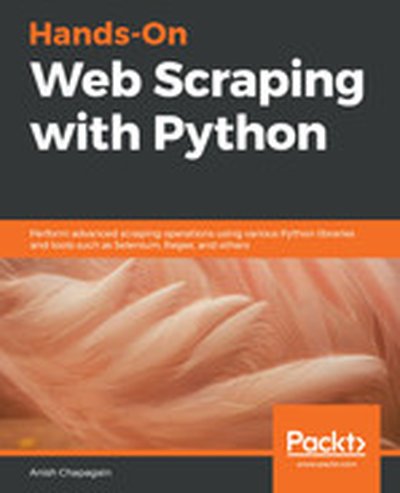
Hands-On Web Scraping with Python

This book, "Hands-On Web Scraping with Python", is your comprehensive guide to mastering web scraping techniques and tools. Harnessing the power of Python libraries like Scrapy, Beautiful Soup, and Selenium, you'll learn how to extract and analyze data from websites effectively and efficiently. What this Book will help me do Master the foundational concepts of web scraping using Python. Efficiently use libraries such as Scrapy, Beautiful Soup, and Selenium for data extraction. Handle advanced scenarios such as forms, logins, and dynamic content in scraping. Leverage XPath, CSS selectors, and Regex for precise data targeting and processing. Improve scraping reliability and manage challenges like cookies, API use, and web security. Author(s) None Chapagain is an accomplished Python programmer and an expert in web scraping methodologies. With years of experience in applying Python to solve practical data challenges, they bring a clear and insightful approach to teaching these skills. Readers appreciate their practical examples and ready-to-use guidance for real-world applications. Who is it for? This book is designed for Python developers and data enthusiasts eager to master web scraping. Whether you're a beginner looking to dep dive into new techniques or an analyst needing reliable data extraction methods, this book offers clear guidance. A basic understanding of Python is recommended to fully benefit from this text.

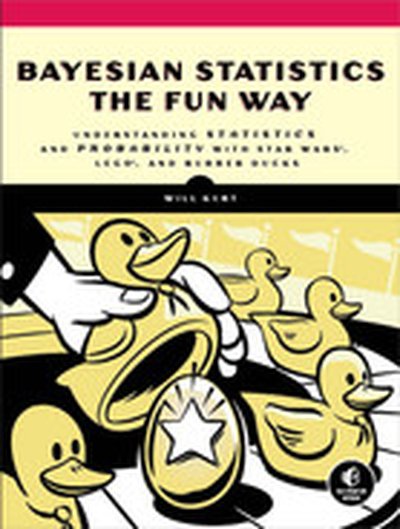
Bayesian Statistics the Fun Way

Probability and statistics are increasingly important in a huge range of professions. But many people use data in ways they don’t even understand, meaning they aren’t getting the most from it. Bayesian Statistics the Fun Way will change that. This book will give you a complete understanding of Bayesian statistics through simple explanations and un-boring examples. Find out the probability of UFOs landing in your garden, how likely Han Solo is to survive a flight through an asteroid belt, how to win an argument about conspiracy theories, and whether a burglary really was a burglary, to name a few examples. By using these off-the-beaten-track examples, the author actually makes learning statistics fun. And you’ll learn real skills, like how to: •How to measure your own level of uncertainty in a conclusion or belief •Calculate Bayes theorem and understand what it’s useful for •Find the posterior, likelihood, and prior to check the accuracy of your conclusions •Calculate distributions to see the range of your data •Compare hypotheses and draw reliable conclusions from them Next time you find yourself with a sheaf of survey results and no idea what to do with them, turn to Bayesian Statistics the Fun Way to get the most value from your data.

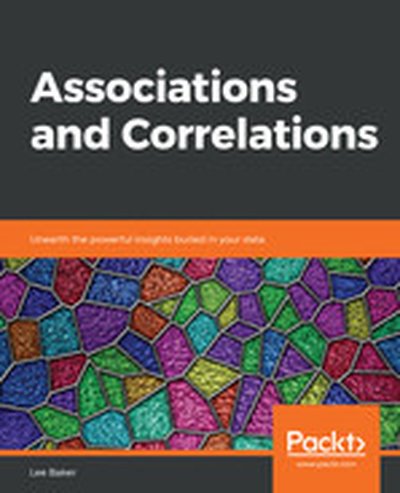
Associations and Correlations

"Associations and Correlations: Unearth the powerful insights buried in your data" is a comprehensive guide for understanding and utilizing associations and correlations in data analysis. This book walks you through methods of classifying data, selecting appropriate statistical tests, and interpreting results effectively. By the end, you'll have mastered how to reveal data insights clearly and reliably. What this Book will help me do Identify and prepare datasets suitable for analysis with confidence. Understand and apply the principles of associations and correlations in data analytics. Use statistical tests to uncover univariate and multivariate relationships. Classify and interpret data into qualitative and quantitative segments effectively. Develop visual representations of data relationships to communicate insights clearly. Author(s) Lee Baker is an experienced statistician and data scientist with a passion for education. With years of teaching and mentoring professionals in data analysis, Lee excels in breaking down complex statistical concepts into understandable insights. Lee's approachable style aims to empower learners to harness their data's full potential. Who is it for? This book is designed for budding data analysts and data scientists, targeting those starting their journey into data analytics. It serves well as an introduction to the fundamentals of associations and correlations, making it suitable for beginners. If you seek a foundational understanding or a recap of key concepts, this book is for you.

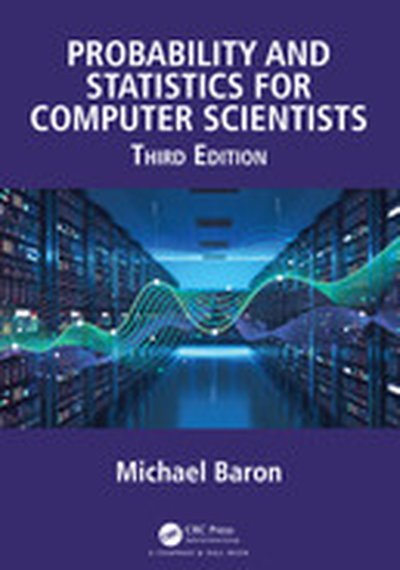
Probability and Statistics for Computer Scientists, 3rd Edition

Probability and statistical methods, simulation techniques, and modeling tools. This third edition textbook adds R, including codes for data analysis examples, helps students solve problems, make optimal decisions in select stochastic models, probabilities and forecasts, and evaluate performance of computer systems and networks.