talk-data.com talk-data.com

Topic

data

5765

tagged

Activity Trend

3 peak/qtr
2020-Q1 2026-Q1

Activities

5765 activities · Newest first

IBM DS8000 Copy Services: Updated for IBM DS8000 Release 9.1

This IBM® Redbooks® publication helps you plan, install, configure, and manage Copy Services on the IBM DS8000® operating in an IBM Z® or Open Systems environment. This book helps you design and implement a new Copy Services installation or migrate from an existing installation. It includes hints and tips to maximize the effectiveness of your installation, and information about tools and products to automate Copy Services functions. It is intended for anyone who needs a detailed and practical understanding of the DS8000 Copy Services. This edition is an update for the DS8900 Release 9.1. Note that the Safeguarded Copy feature is covered in IBM DS8000 Safeguarded Copy, REDP-5506.

Web Scraping with Python, 3rd Edition

If programming is magic, then web scraping is surely a form of wizardry. By writing a simple automated program, you can query web servers, request data, and parse it to extract the information you need. This thoroughly updated third edition not only introduces you to web scraping but also serves as a comprehensive guide to scraping almost every type of data from the modern web. Part I focuses on web scraping mechanics: using Python to request information from a web server, performing basic handling of the server's response, and interacting with sites in an automated fashion. Part II explores a variety of more specific tools and applications to fit any web scraping scenario you're likely to encounter. Parse complicated HTML pages Develop crawlers with the Scrapy framework Learn methods to store the data you scrape Read and extract data from documents Clean and normalize badly formatted data Read and write natural languages Crawl through forms and logins Scrape JavaScript and crawl through APIs Use and write image-to-text software Avoid scraping traps and bot blockers Use scrapers to test your website

IBM and CMTG Cyber Resiliency: Building an Automated, VMware Aware Safeguarded Copy Solution to Provide Data Resilience

This IBM Blueprint outlines how CMTG and IBM have partnered to provide cyber resilient services to their clients. CMTG is one of Australia's leading private cloud providers based in Perth, Western Australia. The solution is based on IBM Storage FlashSystem, IBM Safeguarded Copy and IBM Storage Copy Data Management. The target audience for this Blueprint is IBM Storage technical specialists and storage admins.

Deciphering Data Architectures

Data fabric, data lakehouse, and data mesh have recently appeared as viable alternatives to the modern data warehouse. These new architectures have solid benefits, but they're also surrounded by a lot of hyperbole and confusion. This practical book provides a guided tour of these architectures to help data professionals understand the pros and cons of each. James Serra, big data and data warehousing solution architect at Microsoft, examines common data architecture concepts, including how data warehouses have had to evolve to work with data lake features. You'll learn what data lakehouses can help you achieve, as well as how to distinguish data mesh hype from reality. Best of all, you'll be able to determine the most appropriate data architecture for your needs. With this book, you'll: Gain a working understanding of several data architectures Learn the strengths and weaknesses of each approach Distinguish data architecture theory from reality Pick the best architecture for your use case Understand the differences between data warehouses and data lakes Learn common data architecture concepts to help you build better solutions Explore the historical evolution and characteristics of data architectures Learn essentials of running an architecture design session, team organization, and project success factors Free from product discussions, this book will serve as a timeless resource for years to come.

IBM Storage Virtualize, IBM Storage FlashSystem, and IBM SAN Volume Controller Security Feature Checklist - For IBM Storage Virtualize 8.6

IBM® Storage Virtualize based storage systems are secure storage platforms that implement various security-related features, in terms of system-level access controls and data-level security features. This document outlines the available security features and options of IBM Storage Virtualize based storage systems. It is not intended as a "how to" or best practice document. Instead, it is a checklist of features that can be reviewed by a user security team to aid in the definition of a policy to be followed when implementing IBM FlashSystem®, IBM SAN Volume Controller, and IBM Storage Virtualize for Public Cloud. IBM Storage Virtualize features the following levels of security to protect against threats and to keep the attack surface as small as possible: The first line of defense is to offer strict verification features that stop unauthorized users from using login interfaces and gaining access to the system and its configuration. The second line of defense is to offer least privilege features that restrict the environment and limit any effect if a malicious actor does access the system configuration. The third line of defense is to run in a minimal, locked down, mode to prevent damage spreading to the kernel and rest of the operating system. The fourth line of defense is to protect the data at rest that is stored on the system from theft, loss, or corruption (malicious or accidental). The topics that are discussed in this paper can be broadly split into two categories: System security: This type of security encompasses the first three lines of defense that prevent unauthorized access to the system, protect the logical configuration of the storage system, and restrict what actions users can perform. It also ensures visibility and reporting of system level events that can be used by a Security Information and Event Management (SIEM) solution, such as IBM QRadar®. Data security: This type of security encompasses the fourth line of defense. It protects the data that is stored on the system against theft, loss, or attack. These data security features include Encryption of Data At Rest (EDAR) or IBM Safeguarded Copy (SGC). This document is correct as of IBM Storage Virtualize 8.6.

Hands-On Entity Resolution

Entity resolution is a key analytic technique that enables you to identify multiple data records that refer to the same real-world entity. With this hands-on guide, product managers, data analysts, and data scientists will learn how to add value to data by cleansing, analyzing, and resolving datasets using open source Python libraries and cloud APIs. Author Michael Shearer shows you how to scale up your data matching processes and improve the accuracy of your reconciliations. You'll be able to remove duplicate entries within a single source and join disparate data sources together when common keys aren't available. Using real-world data examples, this book helps you gain practical understanding to accelerate the delivery of real business value. With entity resolution, you'll build rich and comprehensive data assets that reveal relationships for marketing and risk management purposes, key to harnessing the full potential of ML and AI. This book covers: Challenges in deduplicating and joining datasets Extracting, cleansing, and preparing datasets for matching Text matching algorithms to identify equivalent entities Techniques for deduplicating and joining datasets at scale Matching datasets containing persons and organizations Evaluating data matches Optimizing and tuning data matching algorithms Entity resolution using cloud APIs Matching using privacy-enhancing technologies

Mastering MongoDB 7.0 - Fourth Edition

Discover the many capabilities of MongoDB 7.0 with this comprehensive guide designed to take your database skills to new heights. By exploring advanced features like aggregation pipelines, role-based security, and MongoDB Atlas, you will gain in-depth expertise in modern data management. This book empowers you to create secure, high-performance database applications. What this Book will help me do Understand and implement advanced MongoDB queries for detailed data analysis. Apply optimized indexing techniques to maximize query performance. Leverage MongoDB Atlas for robust monitoring, efficient backups, and advanced integrations. Develop secure applications with role-based access control, auditing, and encryption. Create scalable and innovative solutions using the latest features in MongoDB 7.0. Author(s) Marko Aleksendrić, Arek Borucki, and their co-authors are accomplished experts in database engineering and MongoDB development. They bring collective experience in teaching and practical application of MongoDB solutions across various industries. Their goal is to simplify complex topics, making them approachable and actionable for developers worldwide. Who is it for? This book is written for developers, software engineers, and database administrators with experience in MongoDB who want to deepen their expertise. An understanding of basic database operations and queries is recommended. If you are looking to master advanced concepts and create secure, optimized, and scalable applications, this is the book for you.

Analyzing Websites

From a cluster of interconnected HTML pages to online service platforms, websites are constantly changing in form and function. These transformations have led, on the one hand, to human and social sciences renewing or inventing analytical methodologies; and on the other hand, to a reconsideration of the practices of non-specialists and digital professionals. The Web factory is equally included on the agenda of communication training, according to an alternative approach that is complementary to the one that has been implemented for computer scientists. From these two perspectives and drawing upon several case studies, Analyzing Websites presents epistemological and methodological contributions from researchers in Information and Communication Sciences exploring websites as sociotechnical, semi-discursive and communicational devices. This study covers website design as well as their integration into the digital strategies of organizations in the public, associative and private sectors.

IBM Storage Fusion Multicloud Object Gateway

This Redpaper provides an overview of IBM Storage Fusion Multicloud Object Gateway (MCG) and can be used as a quick reference guide for the most common use cases. The intended audience is cloud and application administrators, as well as other technical staff members who wish to learn how MCG works, how to set it up, and usage of a Backing Store or Namespace Store, as well as object caching.

Principles of Data Science - Third Edition

Principles of Data Science offers an end-to-end introduction to data science fundamentals, blending key mathematical concepts with practical programming. You'll learn how to clean and prepare data, construct predictive models, and leverage modern tools like pre-trained models for NLP and computer vision. By integrating theory and practice, this book sets the foundation for impactful data-driven decision-making. What this Book will help me do Develop a solid understanding of foundational statistics and machine learning. Learn how to clean, transform, and visualize data for impactful analysis. Explore transfer learning and pre-trained models for advanced AI tasks. Understand ethical implications, biases, and governance in AI and ML. Gain the knowledge to implement complete data pipelines effectively. Author(s) Sinan Ozdemir is an experienced data scientist, educator, and author with a deep passion for making complex topics accessible. With a background in computer science and applied statistics, Sinan has taught data science at leading institutions and authored multiple books on the topic. His practical approach to teaching combines real-world examples with insightful explanations, ensuring learners gain both competence and confidence. Who is it for? This book is ideal for beginners in data science who want to gain a comprehensive understanding of the field. If you have a background in programming or mathematics and are eager to combine these skills to analyze and extract insights from data, this book will guide you. Individuals working with machine learning or AI who need to solidify their foundational knowledge will find it invaluable. Some familiarity with Python is recommended to follow along seamlessly.

MATLAB for Machine Learning - Second Edition

"MATLAB for Machine Learning" is your comprehensive guide to leveraging MATLAB's powerful tools and toolbox for machine learning and deep learning tasks. Through this book, you will explore practical applications and processes that streamline the development of machine learning models while tackling real-world problems effectively. What this Book will help me do Gain proficiency in utilizing MATLAB's Machine Learning Toolbox for developing machine learning algorithms. Learn how to handle data preprocessing, from data cleansing to visualization, within MATLAB. Explore and implement foundational to advanced machine learning techniques, such as classification and regression models. Comprehend and apply the principles of neural networks for pattern recognition and cluster analysis. Dive into advanced concepts of deep learning, including convolutional networks, natural language processing, and time series analysis, using MATLAB's inbuilt functionality. Author(s) Giuseppe Ciaburro is an expert in the field of machine learning and MATLAB programming. With a robust academic background in data science and years of experience in applying these principles across domains, Giuseppe provides a clear and approachable pathway for learners in his writing. Who is it for? This book is ideal for machine learning professionals, data scientists, and engineers specializing in fields such as deep learning, computer vision, and natural language processing. It is suitable for those with a fundamental understanding of programming concepts who seek to apply MATLAB in solving complex learning problems. A prior familiarity with MATLAB basics will be advantageous.

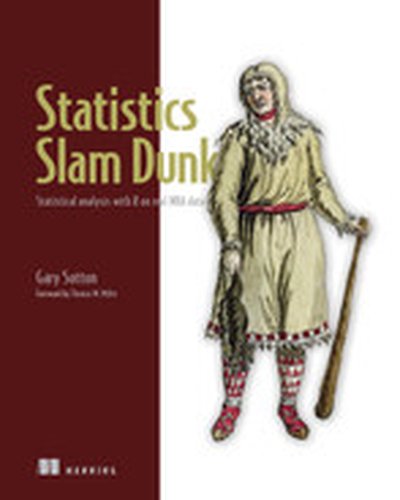
Statistics Slam Dunk

Learn statistics by analyzing professional basketball data! In this action-packed book, you’ll build your skills in exploratory data analysis by digging into the fascinating world of NBA games and player stats using the R language. Statistics Slam Dunk is an engaging how-to guide for statistical analysis with R. Each chapter contains an end-to-end data science or statistics project delving into NBA data and revealing real-world sporting insights. Written by a former basketball player turned business intelligence and analytics leader, you’ll get practical experience tidying, wrangling, exploring, testing, modeling, and otherwise analyzing data with the best and latest R packages and functions. In Statistics Slam Dunk you’ll develop a toolbox of R programming skills including: Reading and writing data Installing and loading packages Transforming, tidying, and wrangling data Applying best-in-class exploratory data analysis techniques Creating compelling visualizations Developing supervised and unsupervised machine learning algorithms Executing hypothesis tests, including t-tests and chi-square tests for independence Computing expected values, Gini coefficients, z-scores, and other measures If you’re looking to switch to R from another language, or trade base R for tidyverse functions, this book is the perfect training coach. Much more than a beginner’s guide, it teaches statistics and data science methods that have tons of use cases. And just like in the real world, you’ll get no clean pre-packaged data sets in Statistics Slam Dunk. You’ll take on the challenge of wrangling messy data to drill on the skills that will make you the star player on any data team. About the Technology Statistics Slam Dunk is a data science manual with a difference. Each chapter is a complete, self-contained statistics or data science project for you to work through—from importing data, to wrangling it, testing it, visualizing it, and modeling it. Throughout the book, you’ll work exclusively with NBA data sets and the R language, applying best-in-class statistics techniques to reveal fun and fascinating truths about the NBA. About the Book Is losing basketball games on purpose a rational strategy? Which hustle statistics have an impact on wins and losses? Does spending more on player salaries translate into a winning record? You’ll answer all these questions and more. Plus, R’s visualization capabilities shine through in the book’s 300 plots and charts, including Pareto charts, Sankey diagrams, Cleveland dot plots, and dendrograms. What's Inside Transforming, tidying, and wrangling data Applying best-in-class exploratory data analysis techniques Developing supervised and unsupervised machine learning algorithms Executing hypothesis tests and effect size tests About the Reader For readers who know basic statistics. No advanced knowledge of R—or basketball—required. About the Author Gary Sutton is a former basketball player who has built and led high-performing business intelligence and analytics organizations across multiple verticals. Quotes In this journey of exploration, every computer scientist will find a valuable ally in understanding the language of data. - Kim Lokøy, areo Transcends other R titles by revealing the hidden narratives that lie within the numbers. - Christian Sutton, Shell International Exploration and Production Seamlessly blending theory and practical insights, this book serves as an indispensable guide for those venturing into the field of data analytics. - Juan Delgado, Sodexo BRS

Take Control of iOS & iPadOS Privacy and Security, 4th Edition

Master networking, privacy, and security for iOS and iPadOS! Version 4.2, updated January 29, 2024 Ensuring that your iPhone or iPad’s data remains secure and in your control and that your private data remains private isn’t a battle—if you know what boxes to check and how to configure iOS and iPadOS to your advantage. Take Control of iOS & iPadOS Privacy and Security takes you into the intricacies of Apple’s choices when it comes to networking, data sharing, and encryption—and protecting your personal safety. Substantially updated to cover dozens of changes and new features in iOS 17 and iPadOS 17! Your iPhone and iPad have become the center of your digital identity, and it’s easy to lose track of all the ways in which Apple and other parties access your data legitimately—or without your full knowledge and consent. While Apple nearly always errs on the side of disclosure and permission, many other firms don’t. This book comprehensively explains how to configure iOS 17, iPadOS 17, and iCloud-based services to best protect your privacy with messaging, email, browsing, and much more. The book also shows you how to ensure your devices and data are secure from intrusion from attackers of all types. You’ll get practical strategies and configuration advice to protect yourself against psychological and physical threats, including restrictions on your freedom and safety. For instance, you can now screen images that may contain nude images, while Apple has further enhanced Lockdown Mode to block potential attacks by governments, including your own. Take Control of iOS & iPadOS Privacy and Security covers how to configure the hundreds of privacy and data sharing settings Apple offers in iOS and iPadOS, and which it mediates for third-party apps. Safari now has umpteen different strategies built in by Apple to protect your web surfing habits, personal data, and identity, and new features in Safari, Mail, and Messages that block tracking of your movement across sites, actions on ads, and even when you open and view an email message. In addition to privacy and security, this book also teaches you everything you need to know about networking, whether you’re using 3G, 4G LTE, or 5G cellular, Wi-Fi or Bluetooth, or combinations of all of them; as well as about AirDrop, AirPlay, Airplane Mode, Personal Hotspot, and tethering. You’ll learn how to:

Twiddle 5G settings to ensure the best network speeds on your iPhone or iPad. Master the options for a Personal Hotspot for yourself and in a Family Sharing group. Set up a device securely from the moment you power up a new or newly restored iPhone or iPad. Manage Apple’s built-in second factor verification code generator for extra-secure website and app logins. Create groups of passwords and passkeys you can share securely with other iPhone, iPad, and Mac users. Decide whether Advanced Data Protection in iCloud, an enhanced encryption option that makes nearly all your iCloud data impossible for even Apple to view, makes sense for you. Use passkeys, a high-security but easy-to-use website login system with industry-wide support. Block unknown (and unwanted) callers, iMessage senders, and phone calls, now including FaceTime. Protect your email by using Hide My Email, a iCloud+ tool to generate an address Apple manages and relays messages through for you—now including email used with Apple Pay transactions. Use Safari’s blocking techniques and how to review websites’ attempts to track you, including the latest improvements in iOS 17 and iPadOS 17. Use Communication Safety, a way to alert your children about sensitive images—but now also a tool to keep unsolicited and unwanted images of private parts from appearing on your devices. Understand why Apple might ask for your iPhone, iPad, or Mac password when you log in on a new device using two-factor authentication. Keep yourself safe when en route to a destination by creating a Check In partner who will be alerted if you don’t reach your intended end point or don’t respond within a period of time. Dig into Private Browsing’s several new features in iOS 17/iPadOS 17, designed to let you leave no trace of your identity or actions behind, while protecting your iPhone or iPad from prying eyes, too. Manage data usage across two phone SIMs (or eSIMS) at home and while traveling. Use a hardware encryption key to strongly protect your Apple ID account. Share a Wi-Fi password with nearby contacts and via a QR Code. Differentiate between encrypted data sessions and end-to-end encryption. Stream music and video to other devices with AirPlay 2. Use iCloud+’s Private Relay, a privacy-protecting browsing service that keeps your habits and locations from prying marketing eyes. Deter brute-force cracking by relying on an Accessories timeout for devices physically being plugged in that use USB and other standards. Configure Bluetooth devices. Enjoy enhanced AirDrop options that let you tap two iPhones to transfer files and continue file transfers over the internet when you move out of range. Protect Apple ID account and iCloud data from unwanted access at a regular level and via the new Safety Check, designed to let you review or sever digital connections with people you know who may wish you harm.

Building Information Modeling

This book presents how Building Information Modeling (BIM) and the use of shared representation of built assets facilitate design, construction and operation processes (ISO 19650). The modeling of public works data disrupts the art of construction. Written by both academics and engineers who are heavily involved in the French research project Modélisation des INformations INteropérables pour les INfrastructues Durables (MINnD) as well as in international standardization projects, this book presents the challenges of BIM from theoretical and practical perspectives. It provides knowledge for evolving in an ecosystem of federated models and common data environments, which are the basis of the platforms and data spaces. BIM makes it possible to handle interoperability very concretely, using open standards, which lead to openBIM. The use of a platform allows for the merging of business software and for approaches such as a Geographic Information System (GIS) to be added to the processes. In organizations, BIM meets the life cycles of structures and circular economy. It is not only a technique that reshapes cooperation and trades around a digital twin but can also disrupt organizations and business models.

Extending Dynamics 365 Finance and Operations Apps with Power Platform

This book, "Extending Dynamics 365 Finance and Operations Apps with Power Platform", is your comprehensive guide to mastering the integration of Power Platform tools with Dynamics 365 Finance and Operations (F&O). Dive into practical scenarios and learn how to leverage tools like Power Automate, Power Apps, and Power BI to maximize efficiency and streamline operations. What this Book will help me do Learn to extend Dynamics 365 F&O functionalities using Dataverse and other Power Platform tools. Understand practical integration techniques including dual-write and virtual tables. Explore automation of workflows and tasks with Power Automate in an F&O context. Utilize Power BI for creating insightful reports with Azure Data Lake Storage. Gain insights into governance and lifecycle management for the Power Platform in your F&O projects. Author(s) Adrià Ariste Santacreu, a seasoned expert in Power Platform and Microsoft Dynamics, shares his rich industry experience through this book. He has implemented numerous real-world solutions integrating Power Platform with Dynamics 365, and his expertise is evident in the clear and actionable guidance provided herein. Adrià's approach helps both novices and experts discover the true potential of these technologies. Who is it for? This book is ideal for Dynamics 365 Finance & Operations consultants and Power Platform professionals seeking to extend their knowledge and capabilities. It is particularly suitable for technical and solutions architects who aim to implement innovative solutions for business requirements using the Power Platform. If you aim to leverage low-code/no-code tools for dynamics projects, this book has you covered.

IBM SAN Volume Controller Model SV3 Product Guide (for IBM Storage Virtualize V8.6)

This IBM® Redpaper® Product Guide describes the IBM SAN Volume Controller model SV3 solution, which is a next-generation IBM SAN Volume Controller. Built with IBM Storage Virtualize software and part of the IBM Storage family, IBM SAN Volume Controller is an enterprise-class storage system. It helps organizations achieve better data economics by supporting the large-scale workloads that are critical to success. Data centers often contain a mix of storage systems. This situation can arise as a result of company mergers or as a deliberate acquisition strategy. Regardless of how they arise, mixed configurations add complexity to the data center. Different systems have different data services, which make it difficult to move data from one to another without updating automation. Different user interfaces increase the need for training and can make errors more likely. Different approaches to hybrid cloud complicate modernization strategies. Also, many different systems mean more silos of capacity, which can lead to inefficiency. To simplify the data center and to improve flexibility and efficiency in deploying storage, enterprises of all types and sizes turn to IBM SAN Volume Controller, which is built with IBM Spectrum Virtualize software. This software simplifies infrastructure and eliminates differences in management, function, and even hybrid cloud support. IBM SAN Volume Controller introduces a common approach to storage management, function, replication, and hybrid cloud that is independent of storage type. It is the key to modernizing and revitalizing your storage, but is as easy to understand. IBM SAN Volume Controller provides a rich set of software-defined storage (SDS) features that are delivered by IBM Storage Virtualize, including the following examples: Data reduction and deduplication Dynamic tiering Thin-provisioning Snapshots Cloning Replication and data copy services Data-at-rest encryption Cyber resilience Transparent Cloud Tiering IBM HyperSwap® including three-site replication for high availability (HA) This Redpaper applies to IBM Storage Virtualize V8.6.