talk-data.com talk-data.com

Topic

Data Engineering

etl data_pipelines big_data

1127

tagged

Activity Trend

127 peak/qtr
2020-Q1 2026-Q1

Activities

1127 activities · Newest first

Sponsored: AWS-Real Time Stream Data & Vis Using Databricks DLT, Amazon Kinesis, & Amazon QuickSight

Amazon Kinesis Data Analytics is a managed service that can capture streaming data from IoT devices. Databricks Lakehouse platform provides ease of processing streaming and batch data using Delta Live Tables. Amazon Quicksight with powerful visualization capabilities can provides various advanced visualization capabilities with direct integration with Databricks. Combining these services, customers can capture, process, and visualize data from hundreds and thousands of IoT sensors with ease.

Talk by: Venkat Viswanathan

Here’s more to explore: Big Book of Data Engineering: 2nd Edition: https://dbricks.co/3XpPgNV The Data Team's Guide to the Databricks Lakehouse Platform: https://dbricks.co/46nuDpI

Connect with us: Website: https://databricks.com Twitter: https://twitter.com/databricks LinkedIn: https://www.linkedin.com/company/databricks Instagram: https://www.instagram.com/databricksinc Facebook: https://www.facebook.com/databricksinc

Sponsored: dbt Labs | Modernizing the Data Stack: Lessons Learned From Evolution at Zurich Insurance

In this session, we will explore the path Zurich Insurance took to modernize its data stack and data engineering practices, and the lessons learned along the way. We'll touch on how and why the team chose to:

  • Adopt community standards in code quality, code coverage, code reusability, and CI/CD
  • Rebuild the way data engineering collaborates with business teams
  • Explore data tools accessible to non-engineering users, with considerations for code-first and no-code interfaces
  • Structure our dbt project and orchestration — and the factors that played into our decisions

Talk by: Jose L Sanchez Ros and Gerard Sola

Here’s more to explore: Why the Data Lakehouse Is Your next Data Warehouse: https://dbricks.co/3Pt5unq Lakehouse Fundamentals Training: https://dbricks.co/44ancQs

Connect with us: Website: https://databricks.com Twitter: https://twitter.com/databricks LinkedIn: https://www.linkedin.com/company/databricks Instagram: https://www.instagram.com/databricksinc Facebook: https://www.facebook.com/databricksinc

How the Texas Rangers Revolutionized Baseball Analytics with a Modern Data Lakehouse

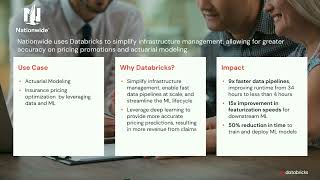
Don't miss this session where we demonstrate how the Texas Rangers baseball team organized their predictive models by using MLflow and the MLRegistry inside Databricks. They started using Databricks as a simple solution to centralizing our development on the cloud. This helped lessen the issue of siloed development in our team, and allowed us to leverage the benefits of distributed cloud computing.

But we quickly found that Databricks was a perfect solution to another problem that we faced in our data engineering stack. Specifically, cost, complexity, and scalability issues hampered our data architecture development for years, and we decided we needed to modernize our stack by migrating to a lakehouse. With Databricks Lakehouse, ad-hoc-analytics, ETL operations, and MLOps all living within Databricks, development at scale has never been easier for our team.

Going forward, we hope to fully eliminate the silos of development, and remove the disconnect between our analytics and data engineering teams. From computer vision, pose analytics, and player tracking, to pitch design, base stealing likelihood, and more, come see how the Texas Rangers are using innovative cloud technologies to create action-driven reports from the current sea of big data.

Talk by: Alexander Booth and Oliver Dykstra

Connect with us: Website: https://databricks.com Twitter: https://twitter.com/databricks LinkedIn: https://www.linkedin.com/company/databricks Instagram: https://www.instagram.com/databricksinc Facebook: https://www.facebook.com/databricksinc

Leveraging IoT Data at Scale to Mitigate Global Water Risks Using Apache Spark™ Streaming and Delta

Every year, billions of dollars are lost due to water risks from storms, floods, and droughts. Water data scarcity and excess are issues that risk models cannot overcome, creating a world of uncertainty. Divirod is building a platform of water data by normalizing diverse data sources of varying velocity into one unified data asset. In addition to publicly available third-party datasets, we are rapidly deploying our own IoT sensors. These sensors ingest signals at a rate of about 100,000 messages per hour into preprocessing, signal-processing, analytics, and postprocessing workloads in one spark-streaming pipeline to enable critical real-time decision-making processes. By leveraging streaming architecture, we were able to reduce end-to-end latency from tens of minutes to just a few seconds.

We are leveraging Delta Lake to provide a single query interface across multiple tables of this continuously changing data. This enables data science and analytics workloads to always use the most current and comprehensive information available. In addition to the obvious schema transformations, we implement data quality metrics and datum conversions to provide a trustworthy unified dataset.

Talk by: Adam Wilson and Heiko Udluft

Here’s more to explore: Big Book of Data Engineering: 2nd Edition: https://dbricks.co/3XpPgNV The Data Team's Guide to the Databricks Lakehouse Platform: https://dbricks.co/46nuDpI

Connect with us: Website: https://databricks.com Twitter: https://twitter.com/databricks LinkedIn: https://www.linkedin.com/company/databricks Instagram: https://www.instagram.com/databricksinc Facebook: https://www.facebook.com/databricksinc

Sponsored by: Striim | Powering a Delightful Travel Experience with a Real-Time Operational Data Hub

American Airlines champions operational excellence in airline operations to provide the most delightful experience to our customers with on-time flights and meticulously maintained aircraft. To modernize and scale technical operations with real-time, data-driven processes, we delivered a DataHub that connects data from multiple sources and delivers it to analytics engines and systems of engagement in real-time. This enables operational teams to use any kind of aircraft data from almost any source imaginable and turn it into meaningful and actionable insights with speed and ease. This empowers maintenance hubs to choose the best service and determine the most effective ways to utilize resources that can impact maintenance outcomes and costs. The end-product is a smooth and scalable operation that results in a better experience for travelers. In this session, you will learn how we combine an operational data store (MongoDB) and a fully managed streaming engine (Striim) to enable analytics teams using Databricks with real-time operational data.

Talk by: John Kutay and Ganesh Deivarayan

Here’s more to explore: Big Book of Data Engineering: 2nd Edition: https://dbricks.co/3XpPgNV The Data Team's Guide to the Databricks Lakehouse Platform: https://dbricks.co/46nuDpI

Connect with us: Website: https://databricks.com Twitter: https://twitter.com/databricks LinkedIn: https://www.linkedin.com/company/databricks Instagram: https://www.instagram.com/databricksinc Facebook: https://www.facebook.com/databricksin

Sponsored by: Toptal | Enable Data Streaming within Multicloud Strategies

Join Toptal as we discuss how we can help organizations handle their data streaming needs in an environment utilizing multiple cloud providers. We will delve into the data scientist and data engineering perspective on this challenge. Embracing an open format, utilizing open source technologies while managing the solution through code are the keys to success.

Talk by: Christina Taylor and Matt Kroon

Here’s more to explore: Big Book of Data Engineering: 2nd Edition: https://dbricks.co/3XpPgNV The Data Team's Guide to the Databricks Lakehouse Platform: https://dbricks.co/46nuDpI

Connect with us: Website: https://databricks.com Twitter: https://twitter.com/databricks LinkedIn: https://www.linkedin.com/company/databricks Instagram: https://www.instagram.com/databricksinc Facebook: https://www.facebook.com/databricksin

US Army Corp of Engineers Enhanced Commerce & National Sec Through Data-Driven Geospatial Insight

The US Army Corps of Engineers (USACE) is responsible for maintaining and improving nearly 12,000 miles of shallow-draft (9'-14') inland and intracoastal waterways, 13,000 miles of deep-draft (14' and greater) coastal channels, and 400 ports, harbors, and turning basins throughout the United States. Because these components of the national waterway network are considered assets to both US commerce and national security, they must be carefully managed to keep marine traffic operating safely and efficiently.

The National DQM Program is tasked with providing USACE a nationally standardized remote monitoring and documentation system across multiple vessel types with timely data access, reporting, dredge certifications, data quality control, and data management. Government systems have often lagged commercial systems in modernization efforts, and the emergence of the cloud and Data Lakehouse Architectures have empowered USACE to successfully move into the modern data era.

This session incorporates aspects of these topics: Data Lakehouse Architecture: Delta Lake, platform security and privacy, serverless, administration, data warehouse, Data Lake, Apache Iceberg, Data Mesh GIS: H3, MOSAIC, spatial analysis data engineering: data pipelines, orchestration, CDC, medallion architecture, Databricks Workflows, data munging, ETL/ELT, lakehouses, data lakes, Parquet, Data Mesh, Apache Spark™ internals. Data Streaming: Apache Spark Structured Streaming, real-time ingestion, real-time ETL, real-time ML, real-time analytics, and real-time applications, Delta Live Tables. ML: PyTorch, TensorFlow, Keras, scikit-learn, Python and R ecosystems data governance: security, compliance, RMF, NIST data sharing: sharing and collaboration, delta sharing, data cleanliness, APIs.

Talk by: Jeff Mroz

Connect with us: Website: https://databricks.com Twitter: https://twitter.com/databricks LinkedIn: https://www.linkedin.com/company/databricks Instagram: https://www.instagram.com/databricksinc Facebook: https://www.facebook.com/databricksinc

Data & AI Products on Databricks: Making Data Engineering & Consumption Self-Service Data Platforms

Our client, a large IT and business consulting firm, embarked on a journey to create “Data As a Product” for both their internal and external stakeholders. In this project, Infosys took a data platform approach and leveraged Delta Sharing, API endpoints, and Unity Catalog to effectively create a realization of Data and AI Products (Data Mesh) architecture. This session presents the three primary design patterns used, providing valuable insights for your evolution toward a no-code/low-code approach.

Talk by: Ankit Sharma

Connect with us: Website: https://databricks.com Twitter: https://twitter.com/databricks LinkedIn: https://www.linkedin.com/company/databricks Instagram: https://www.instagram.com/databricksinc Facebook: https://www.facebook.com/databricksinc

Build Your Data Lakehouse with a Modern Data Stack on Databricks

Are you looking for an introduction to the Lakehouse and what the related technology is all about? This session is for you. This session explains the value that lakehouses bring to the table using examples of companies that are actually modernizing their data, showing demos throughout. The data lakehouse is the future for modern data teams that want to simplify data workloads, ease collaboration, and maintain the flexibility and openness to stay agile as a company scales.

Come to this session and learn about the full stack, including data engineering, data warehousing in a lakehouse, data streaming, governance, and data science and AI. Learn how you can create modern data solutions of your own.

Talk by: Ari Kaplan and Pearl Ubaru

Connect with us: Website: https://databricks.com Twitter: https://twitter.com/databricks LinkedIn: https://www.linkedin.com/company/databricks Instagram: https://www.instagram.com/databricksinc Facebook: https://www.facebook.com/databricksinc

Top Mistakes to Avoid in Streaming Applications

Are you a data engineer seeking to enhance the performance of your streaming applications? Join our session where we will share valuable insights and best practices gained from handling diverse customer streaming use cases using Apache Spark™ Structured Streaming.

In this session, we will delve into the common pitfalls that can hinder your streaming workflows. Learn practical tips and techniques to overcome these challenges during different stages of application development. By avoiding these errors, you can unlock faster performance, improved data reliability, and smoother data processing.

Don't miss out on this opportunity to level up your streaming skills and excel in your data engineering journey. Join us to gain valuable knowledge and practical techniques that will empower you to optimize your streaming applications and drive exceptional results.

Talk by: Vikas Reddy Aravabhumi

Connect with us: Website: https://databricks.com Twitter: https://twitter.com/databricks LinkedIn: https://www.linkedin.com/company/databricks Instagram: https://www.instagram.com/databricksinc Facebook: https://www.facebook.com/databricksinc

Learn How to Reliably Monitor Your Data and Model Quality in the Lakehouse

Developing and upkeep of production data engineering and machine learning pipelines is a challenging process for many data teams. Even more challenging is monitoring the quality of your data and models once they go into production. Building upon untrustworthy data can cause many complications for data teams. Without a monitoring service, it is challenging to proactively discover when your ML models degrade over time, and the root causes behind it. Furthermore, with a lack of lineage tracking, it is even more painful to debug errors in your models and data. Databricks Lakehouse Monitoring offers a unified service to monitor the quality of all your data and ML assets.

In this session, you’ll learn how to:

  • Use one unified tool to monitor the quality of any data product: data or AI 
  • Quickly diagnose errors in your data products with root cause analysis
  • Set up a monitor with low friction, requiring only a button click or a single API call to start and automatically generate out-of-the-box metrics
  • Enable self-serve experiences for data analysts by providing reliability status for every data asset

Talk by: Kasey Uhlenhuth and Alkis Polyzotis

Connect with us: Website: https://databricks.com Twitter: https://twitter.com/databricks LinkedIn: https://www.linkedin.com/company/databricks Instagram: https://www.instagram.com/databricksinc Facebook: https://www.facebook.com/databricksinc

Introduction to Data Engineering on the Lakehouse

Data engineering is a requirement for any data, analytics or AI workload. With the increased complexity of data pipelines, the need to handle real-time streaming data and the challenges of orchestrating reliable pipelines, data engineers require the best tools to help them achieve their goals. The Databricks Lakehouse Platform offers a unified platform to ingest, transform and orchestrate data and simplifies the task of building reliable ETL pipelines.

This session will provide an introductory overview of the end-to-end data engineering capabilities of the platform, including Delta Live Tables and Databricks Workflows. We’ll see how these capabilities come together to provide a complete data engineering solution and how they are used in the real world by organizations leveraging the lakehouse turning raw data into insights.

Talk by: Jibreal Hamenoo and Ori Zohar

Connect with us: Website: https://databricks.com Twitter: https://twitter.com/databricks LinkedIn: https://www.linkedin.com/company/databricks Instagram: https://www.instagram.com/databricksinc Facebook: https://www.facebook.com/databricksinc

Ryan Boyd and I chat about the evolution and future of databases, the pendulum between single-server and distributed computing, DuckDB and Motherduck, and much more.

We also talk about developer relations, which I consider Ryan as one of the OG's in the field.

Note - this was recorded the week of Databricks Summit 2023.


If you like this show, give it a 5-star rating on your favorite podcast platform.

Purchase Fundamentals of Data Engineering at your favorite bookseller.

Subscribe to my Substack: https://joereis.substack.com/

Summary

Real-time data processing has steadily been gaining adoption due to advances in the accessibility of the technologies involved. Despite that, it is still a complex set of capabilities. To bring streaming data in reach of application engineers Matteo Pelati helped to create Dozer. In this episode he explains how investing in high performance and operationally simplified streaming with a familiar API can yield significant benefits for software and data teams together.

Announcements

Hello and welcome to the Data Engineering Podcast, the show about modern data management Introducing RudderStack Profiles. RudderStack Profiles takes the SaaS guesswork and SQL grunt work out of building complete customer profiles so you can quickly ship actionable, enriched data to every downstream team. You specify the customer traits, then Profiles runs the joins and computations for you to create complete customer profiles. Get all of the details and try the new product today at dataengineeringpodcast.com/rudderstack Modern data teams are using Hex to 10x their data impact. Hex combines a notebook style UI with an interactive report builder. This allows data teams to both dive deep to find insights and then share their work in an easy-to-read format to the whole org. In Hex you can use SQL, Python, R, and no-code visualization together to explore, transform, and model data. Hex also has AI built directly into the workflow to help you generate, edit, explain and document your code. The best data teams in the world such as the ones at Notion, AngelList, and Anthropic use Hex for ad hoc investigations, creating machine learning models, and building operational dashboards for the rest of their company. Hex makes it easy for data analysts and data scientists to collaborate together and produce work that has an impact. Make your data team unstoppable with Hex. Sign up today at dataengineeringpodcast.com/hex to get a 30-day free trial for your team! Your host is Tobias Macey and today I'm interviewing Matteo Pelati about Dozer, an open source engine that includes data ingestion, transformation, and API generation for real-time sources

Interview

Introduction How did you get involved in the area of data management? Can you describe what Dozer is and the story behind it?

What was your decision process for building Dozer as open source?

As you note in the documentation, Dozer has overlap with a number of technologies that are aimed at different use cases. What was missing from each of them and the center of their Venn diagram that prompted you to build Dozer? In addition to working in an interesting technological cross-section, you are also targeting a disparate group of personas. Who are you building Dozer for and what were the motivations for that vision?

What are the different use cases that you are focused on supporting? What are the features of Dozer that enable engineers to address those uses, and what makes it preferable to existing alternative approaches?

Can you describe how Dozer is implemented?

How have the design and goals of the platform changed since you first started working on it? What are the architectural "-ilities" that you are trying to optimize for?

What is involved in getting Dozer deployed and integrated into an existing application/data infrastructure? How can teams who are using Dozer extend/integrate with Dozer?

What does the development/deployment workflow look like for teams who are building on top of Dozer?

What is your governance model for Dozer and balancing the open source project against your business goals? What are the most interesting, innovative, or unexpected ways that you have seen Dozer used? What are the most interesting, unexpected, or challenging lessons that you have learned while working on Dozer? When is Dozer the wrong choice? What do you have planned for the future of Dozer?

Contact Info

LinkedIn @pelatimtt on Twitter

Parting Question

From your perspective, what is the bigge

Is Kimball still relevant? Or should we just throw columnar storage and unlimited compute to solve our analytical needs?

Because I like to live on the edge, I respond to a comment online that I think highlights the rot in our industry as it relates to how we view data modeling today.

Data Modeling With Joe Reis - Understanding What Data Modeling Is And Where It's Going (Seattle Data Guy): https://www.youtube.com/watch?v=NKo02ThtAto


If you like this show, give it a 5-star rating on your favorite podcast platform.

Purchase Fundamentals of Data Engineering at your favorite bookseller.

Subscribe to my Substack: https://joereis.substack.com/

Joshua Bowles is a linguist and data scientist turned software engineer. This is a wide-ranging chat between two old-school data scientists/ML practitioners about the past, present, and future of ML and AI.

LinkedIn: https://www.linkedin.com/in/joshua-bowles-ailgroup/

Mastadon: https://infosec.exchange/explore


If you like this show, give it a 5-star rating on your favorite podcast platform.

Purchase Fundamentals of Data Engineering at your favorite bookseller.

Subscribe to my Substack: https://joereis.substack.com/

Benny and I chat about whether data is a profession (in the traditional sense), moving from CDO at a large company to solo consulting, building an audience and staying consistent with content, and much more.

LinkedIn: https://www.linkedin.com/in/bennybenford/

Elevating Data to a Profession (link): https://www.datent.com/p/elevating-data-to-a-profession-why

Blog: https://www.datent.com


If you like this show, give it a 5-star rating on your favorite podcast platform.

Purchase Fundamentals of Data Engineering at your favorite bookseller.

Subscribe to my Substack: https://joereis.substack.com/

Summary

Data has been one of the most substantial drivers of business and economic value for the past few decades. Bob Muglia has had a front-row seat to many of the major shifts driven by technology over his career. In his recent book "Datapreneurs" he reflects on the people and businesses that he has known and worked with and how they relied on data to deliver valuable services and drive meaningful change.

Announcements

Hello and welcome to the Data Engineering Podcast, the show about modern data management Introducing RudderStack Profiles. RudderStack Profiles takes the SaaS guesswork and SQL grunt work out of building complete customer profiles so you can quickly ship actionable, enriched data to every downstream team. You specify the customer traits, then Profiles runs the joins and computations for you to create complete customer profiles. Get all of the details and try the new product today at dataengineeringpodcast.com/rudderstack Your host is Tobias Macey and today I'm interviewing Bob Muglia about his recent book about the idea of "Datapreneurs" and the role of data in the modern economy

Interview

Introduction How did you get involved in the area of data management? Can you describe what your concept of a "Datapreneur" is?

How is this distinct from the common idea of an entreprenur?

What do you see as the key inflection points in data technologies and their impacts on business capabilities over the past ~30 years? In your role as the CEO of Snowflake you had a first-row seat for the rise of the "modern data stack". What do you see as the main positive and negative impacts of that paradigm?

What are the key issues that are yet to be solved in that ecosmnjjystem?

For technologists who are thinking about launching new ventures, what are the key pieces of advice that you would like to share? What do you see as the short/medium/long-term impact of AI on the technical, business, and societal arenas? What are the most interesting, innovative, or unexpected ways that you have seen business leaders use data to drive their vision? What are the most interesting, unexpected, or challenging lessons that you have learned while working on the Datapreneurs book? What are your key predictions for the future impact of data on the technical/economic/business landscapes?

Contact Info

LinkedIn

Parting Question

From your perspective, what is the biggest gap in the tooling or technology for data management today?

Closing Announcements

Thank you for listening! Don't forget to check out our other shows. Podcast.init covers the Python language, its community, and the innovative ways it is being used. The Machine Learning Podcast helps you go from idea to production with machine learning. Visit the site to subscribe to the show, sign up for the mailing list, and read the show notes. If you've learned something or tried out a project from the show then tell us about it! Email [email protected]) with your story. To help other people find the show please leave a review on Apple Podcasts and tell your friends and co-workers

Links

Datapreneurs Book SQL Server Snowflake Z80 Processor Navigational Database System R Redshift Microsoft Fabric Databricks Looker Fivetran

Podcast Episode

Databricks Unity Catalog RelationalAI 6th Normal Form Pinecone Vector DB

Podcast Episode

Perplexity AI

The intro and outro music is from The Hug by The Freak Fandango Orchestra / CC BY-SA Sponsored By: Rudderstack: Rudderstack

Introducing RudderStack Profiles. RudderStack Profiles takes the SaaS guesswork and SQL grunt work out of building complete customer profiles so you can quickly ship actionable, enriched data to every downstream team. You specify the customer traits, then Profiles runs the joins and computations for you to create complete customer profiles. Get all of the details and try the new product today at dataengineeringpodcast.com/rudderstackSupport Data Engineering Podcast

Imagine two extremes. On one end, data modeling is done perfectly and harmoniously across the data lifecycle. On the other end, data modeling is ignored and thrown into the dustbin of history. Along this spectrum, where do you think we are as a data industry?

I'm leaving this question open-ended right for now and would appreciate your thoughts.


If you like this show, give it a 5-star rating on your favorite podcast platform.

Purchase Fundamentals of Data Engineering at your favorite bookseller.

Subscribe to my Substack: https://joereis.substack.com/

Live from the Lakehouse: Machine Learning, LLM, Delta Lake, and data engineering

Hear from two guests. First, Caryl Yuhas (Global Practice Lead, Solutions Architect, Databricks) on Machine Learning & LLMs. Second guest, Jason Pohl (Sr. Director, Field Engineering), discusses Delta Lake and data engineering. Hosted by Holly Smith (Sr Resident Solutions Architect, Databricks) and Jimmy Obeyeni (Strategic Account Executive, Databricks)

Connect with us: Website: https://databricks.com Twitter: https://twitter.com/databricks LinkedIn: https://www.linkedin.com/company/databricks Instagram: https://www.instagram.com/databricksinc Facebook: https://www.facebook.com/databricksinc