talk-data.com talk-data.com

Topic

Databricks

big_data analytics spark

1286

tagged

Activity Trend

515 peak/qtr
2020-Q1 2026-Q1

Activities

1286 activities · Newest first

Summary AirBnB pioneered a number of the organizational practices that have become the goal of modern data teams. Out of that culture a number of successful businesses were created to provide the tools and methods to a broader audience. In this episode several almuni of AirBnB’s formative years who have gone on to found their own companies join the show to reflect on their shared successes, missed opportunities, and lessons learned.

Announcements

Hello and welcome to the Data Engineering Podcast, the show about modern data management When you’re ready to build your next pipeline, or want to test out the projects you hear about on the show, you’ll need somewhere to deploy it, so check out our friends at Linode. With their new managed database service you can launch a production ready MySQL, Postgres, or MongoDB cluster in minutes, with automated backups, 40 Gbps connections from your application hosts, and high throughput SSDs. Go to dataengineeringpodcast.com/linode today and get a $100 credit to launch a database, create a Kubernetes cluster, or take advantage of all of their other services. And don’t forget to thank them for their continued support of this show! Data stacks are becoming more and more complex. This brings infinite possibilities for data pipelines to break and a host of other issues, severely deteriorating the quality of the data and causing teams to lose trust. Sifflet solves this problem by acting as an overseeing layer to the data stack – observing data and ensuring it’s reliable from ingestion all the way to consumption. Whether the data is in transit or at rest, Sifflet can detect data quality anomalies, assess business impact, identify the root cause, and alert data teams’ on their preferred channels. All thanks to 50+ quality checks, extensive column-level lineage, and 20+ connectors across the Data Stack. In addition, data discovery is made easy through Sifflet’s information-rich data catalog with a powerful search engine and real-time health statuses. Listeners of the podcast will get $2000 to use as platform credits when signing up to use Sifflet. Sifflet also offers a 2-week free trial. Find out more at dataengineeringpodcast.com/sifflet today! The biggest challenge with modern data systems is understanding what data you have, where it is located, and who is using it. Select Star’s data discovery platform solves that out of the box, with an automated catalog that includes lineage from where the data originated, all the way to which dashboards rely on it and who is viewing them every day. Just connect it to your database/data warehouse/data lakehouse/whatever you’re using and let them do the rest. Go to dataengineeringpodcast.com/selectstar today to double the length of your free trial and get a swag package when you convert to a paid plan. Data teams are increasingly under pressure to deliver. According to a recent survey by Ascend.io, 95% in fact reported being at or over capacity. With 72% of data experts reporting demands on their team going up faster than they can hire, it’s no surprise they are increasingly turning to automation. In fact, while only 3.5% report having current investments in automation, 85% of data teams plan on investing in automation in the next 12 months. 85%!!! That’s where our friends at Ascend.io come in. The Ascend Data Automation Cloud provides a unified platform for data ingestion, transformation, orchestration, and observability. Ascend users love its declarative pipelines, powerful SDK, elegant UI, and extensible plug-in architecture, as well as its support for Python, SQL, Scala, and Java. Ascend automates workloads on Snowflake, Databricks, BigQuery, and open source Spark, and can be deployed in AWS, Azure, or GCP. Go to dataengineeringpodcast.com/ascend and sign up for a free trial. If you’re a data engineering podcast listener, you get credits worth $5,000 when you become a customer. Your host is Tobias Macey and today I’m interviewin
Summary Data has permeated every aspect of our lives and the products that we interact with. As a result, end users and customers have come to expect interactions and updates with services and analytics to be fast and up to date. In this episode Shruti Bhat gives her view on the state of the ecosystem for real-time data and the work that she and her team at Rockset is doing to make it easier for engineers to build those experiences.

Announcements

Hello and welcome to the Data Engineering Podcast, the show about modern data management When you’re ready to build your next pipeline, or want to test out the projects you hear about on the show, you’ll need somewhere to deploy it, so check out our friends at Linode. With their new managed database service you can launch a production ready MySQL, Postgres, or MongoDB cluster in minutes, with automated backups, 40 Gbps connections from your application hosts, and high throughput SSDs. Go to dataengineeringpodcast.com/linode today and get a $100 credit to launch a database, create a Kubernetes cluster, or take advantage of all of their other services. And don’t forget to thank them for their continued support of this show! Data stacks are becoming more and more complex. This brings infinite possibilities for data pipelines to break and a host of other issues, severely deteriorating the quality of the data and causing teams to lose trust. Sifflet solves this problem by acting as an overseeing layer to the data stack – observing data and ensuring it’s reliable from ingestion all the way to consumption. Whether the data is in transit or at rest, Sifflet can detect data quality anomalies, assess business impact, identify the root cause, and alert data teams’ on their preferred channels. All thanks to 50+ quality checks, extensive column-level lineage, and 20+ connectors across the Data Stack. In addition, data discovery is made easy through Sifflet’s information-rich data catalog with a powerful search engine and real-time health statuses. Listeners of the podcast will get $2000 to use as platform credits when signing up to use Sifflet. Sifflet also offers a 2-week free trial. Find out more at dataengineeringpodcast.com/sifflet today! The biggest challenge with modern data systems is understanding what data you have, where it is located, and who is using it. Select Star’s data discovery platform solves that out of the box, with an automated catalog that includes lineage from where the data originated, all the way to which dashboards rely on it and who is viewing them every day. Just connect it to your database/data warehouse/data lakehouse/whatever you’re using and let them do the rest. Go to dataengineeringpodcast.com/selectstar today to double the length of your free trial and get a swag package when you convert to a paid plan. Data teams are increasingly under pressure to deliver. According to a recent survey by Ascend.io, 95% in fact reported being at or over capacity. With 72% of data experts reporting demands on their team going up faster than they can hire, it’s no surprise they are increasingly turning to automation. In fact, while only 3.5% report having current investments in automation, 85% of data teams plan on investing in automation in the next 12 months. 85%!!! That’s where our friends at Ascend.io come in. The Ascend Data Automation Cloud provides a unified platform for data ingestion, transformation, orchestration, and observability. Ascend users love its declarative pipelines, powerful SDK, elegant UI, and extensible plug-in architecture, as well as its support for Python, SQL, Scala, and Java. Ascend automates workloads on Snowflake, Databricks, BigQuery, and open source Spark, and can be deployed in AWS, Azure, or GCP. Go to dataengineeringpodcast.com/ascend and sign up for a free trial. If you’re a data engineering podcast listener, you get credits worth $5,000 when you become a customer. Your host is Tobias Macey and today I’m interviewing

Summary Data engineers have typically left the process of data labeling to data scientists or other roles because of its nature as a manual and process heavy undertaking, focusing instead on building automation and repeatable systems. Watchful is a platform to make labeling a repeatable and scalable process that relies on codifying domain expertise. In this episode founder Shayan Mohanty explains how he and his team are bringing software best practices and automation to the world of machine learning data preparation and how it allows data engineers to be involved in the process.

Announcements

Hello and welcome to the Data Engineering Podcast, the show about modern data management When you’re ready to build your next pipeline, or want to test out the projects you hear about on the show, you’ll need somewhere to deploy it, so check out our friends at Linode. With their new managed database service you can launch a production ready MySQL, Postgres, or MongoDB cluster in minutes, with automated backups, 40 Gbps connections from your application hosts, and high throughput SSDs. Go to dataengineeringpodcast.com/linode today and get a $100 credit to launch a database, create a Kubernetes cluster, or take advantage of all of their other services. And don’t forget to thank them for their continued support of this show! Data stacks are becoming more and more complex. This brings infinite possibilities for data pipelines to break and a host of other issues, severely deteriorating the quality of the data and causing teams to lose trust. Sifflet solves this problem by acting as an overseeing layer to the data stack – observing data and ensuring it’s reliable from ingestion all the way to consumption. Whether the data is in transit or at rest, Sifflet can detect data quality anomalies, assess business impact, identify the root cause, and alert data teams’ on their preferred channels. All thanks to 50+ quality checks, extensive column-level lineage, and 20+ connectors across the Data Stack. In addition, data discovery is made easy through Sifflet’s information-rich data catalog with a powerful search engine and real-time health statuses. Listeners of the podcast will get $2000 to use as platform credits when signing up to use Sifflet. Sifflet also offers a 2-week free trial. Find out more at dataengineeringpodcast.com/sifflet today! The biggest challenge with modern data systems is understanding what data you have, where it is located, and who is using it. Select Star’s data discovery platform solves that out of the box, with an automated catalog that includes lineage from where the data originated, all the way to which dashboards rely on it and who is viewing them every day. Just connect it to your database/data warehouse/data lakehouse/whatever you’re using and let them do the rest. Go to dataengineeringpodcast.com/selectstar today to double the length of your free trial and get a swag package when you convert to a paid plan. Data teams are increasingly under pressure to deliver. According to a recent survey by Ascend.io, 95% in fact reported being at or over capacity. With 72% of data experts reporting demands on their team going up faster than they can hire, it’s no surprise they are increasingly turning to automation. In fact, while only 3.5% report having current investments in automation, 85% of data teams plan on investing in automation in the next 12 months. 85%!!! That’s where our friends at Ascend.io come in. The Ascend Data Automation Cloud provides a unified platform for data ingestion, transformation, orchestration, and observability. Ascend users love its declarative pipelines, powerful SDK, elegant UI, and extensible plug-in architecture, as well as its support for Python, SQL, Scala, and Java. Ascend automates workloads on Snowflake, Databricks, BigQuery, and open source Spark, and can be deployed in AWS, Azure, or GCP. Go to dataengineeringpodcast.com/ascend and sign up for a free trial. If you’re

Summary Data is useless if it isn’t being used, and you can’t use it if you don’t know where it is. Data catalogs were the first solution to this problem, but they are only helpful if you know what you are looking for. In this episode Shinji Kim discusses the challenges of data discovery and how to collect and preserve additional context about each piece of information so that you can find what you need when you don’t even know what you’re looking for yet.

Announcements

Hello and welcome to the Data Engineering Podcast, the show about modern data management When you’re ready to build your next pipeline, or want to test out the projects you hear about on the show, you’ll need somewhere to deploy it, so check out our friends at Linode. With their new managed database service you can launch a production ready MySQL, Postgres, or MongoDB cluster in minutes, with automated backups, 40 Gbps connections from your application hosts, and high throughput SSDs. Go to dataengineeringpodcast.com/linode today and get a $100 credit to launch a database, create a Kubernetes cluster, or take advantage of all of their other services. And don’t forget to thank them for their continued support of this show! Data stacks are becoming more and more complex. This brings infinite possibilities for data pipelines to break and a host of other issues, severely deteriorating the quality of the data and causing teams to lose trust. Sifflet solves this problem by acting as an overseeing layer to the data stack – observing data and ensuring it’s reliable from ingestion all the way to consumption. Whether the data is in transit or at rest, Sifflet can detect data quality anomalies, assess business impact, identify the root cause, and alert data teams’ on their preferred channels. All thanks to 50+ quality checks, extensive column-level lineage, and 20+ connectors across the Data Stack. In addition, data discovery is made easy through Sifflet’s information-rich data catalog with a powerful search engine and real-time health statuses. Listeners of the podcast will get $2000 to use as platform credits when signing up to use Sifflet. Sifflet also offers a 2-week free trial. Find out more at dataengineeringpodcast.com/sifflet today! The biggest challenge with modern data systems is understanding what data you have, where it is located, and who is using it. Select Star’s data discovery platform solves that out of the box, with an automated catalog that includes lineage from where the data originated, all the way to which dashboards rely on it and who is viewing them every day. Just connect it to your database/data warehouse/data lakehouse/whatever you’re using and let them do the rest. Go to dataengineeringpodcast.com/selectstar today to double the length of your free trial and get a swag package when you convert to a paid plan. Data teams are increasingly under pressure to deliver. According to a recent survey by Ascend.io, 95% in fact reported being at or over capacity. With 72% of data experts reporting demands on their team going up faster than they can hire, it’s no surprise they are increasingly turning to automation. In fact, while only 3.5% report having current investments in automation, 85% of data teams plan on investing in automation in the next 12 months. 85%!!! That’s where our friends at Ascend.io come in. The Ascend Data Automation Cloud provides a unified platform for data ingestion, transformation, orchestration, and observability. Ascend users love its declarative pipelines, powerful SDK, elegant UI, and extensible plug-in architecture, as well as its support for Python, SQL, Scala, and Java. Ascend automates workloads on Snowflake, Databricks, BigQuery, and open source Spark, and can be deployed in AWS, Azure, or GCP. Go to dataengineeringpodcast.com/ascend and sign up for a free trial. If you’re a data engineering podcast listener, you get credits worth $5,000 when you become a customer. Your host is Tobias M

Summary Exploratory data analysis works best when the feedback loop is fast and iterative. This is easy to achieve when you are working on small datasets, but as they scale up beyond what can fit on a single machine those short iterations quickly become long and tedious. The Arkouda project is a Python interface built on top of the Chapel compiler to bring back those interactive speeds for exploratory analysis on horizontally scalable compute that parallelizes operations on large volumes of data. In this episode David Bader explains how the framework operates, the algorithms that are built into it to support complex analyses, and how you can start using it today.

Announcements

Hello and welcome to the Data Engineering Podcast, the show about modern data management When you’re ready to build your next pipeline, or want to test out the projects you hear about on the show, you’ll need somewhere to deploy it, so check out our friends at Linode. With their new managed database service you can launch a production ready MySQL, Postgres, or MongoDB cluster in minutes, with automated backups, 40 Gbps connections from your application hosts, and high throughput SSDs. Go to dataengineeringpodcast.com/linode today and get a $100 credit to launch a database, create a Kubernetes cluster, or take advantage of all of their other services. And don’t forget to thank them for their continued support of this show! Data stacks are becoming more and more complex. This brings infinite possibilities for data pipelines to break and a host of other issues, severely deteriorating the quality of the data and causing teams to lose trust. Sifflet solves this problem by acting as an overseeing layer to the data stack – observing data and ensuring it’s reliable from ingestion all the way to consumption. Whether the data is in transit or at rest, Sifflet can detect data quality anomalies, assess business impact, identify the root cause, and alert data teams’ on their preferred channels. All thanks to 50+ quality checks, extensive column-level lineage, and 20+ connectors across the Data Stack. In addition, data discovery is made easy through Sifflet’s information-rich data catalog with a powerful search engine and real-time health statuses. Listeners of the podcast will get $2000 to use as platform credits when signing up to use Sifflet. Sifflet also offers a 2-week free trial. Find out more at dataengineeringpodcast.com/sifflet today! RudderStack helps you build a customer data platform on your warehouse or data lake. Instead of trapping data in a black box, they enable you to easily collect customer data from the entire stack and build an identity graph on your warehouse, giving you full visibility and control. Their SDKs make event streaming from any app or website easy, and their state-of-the-art reverse ETL pipelines enable you to send enriched data to any cloud tool. Sign up free… or just get the free t-shirt for being a listener of the Data Engineering Podcast at dataengineeringpodcast.com/rudder. Data teams are increasingly under pressure to deliver. According to a recent survey by Ascend.io, 95% in fact reported being at or over capacity. With 72% of data experts reporting demands on their team going up faster than they can hire, it’s no surprise they are increasingly turning to automation. In fact, while only 3.5% report having current investments in automation, 85% of data teams plan on investing in automation in the next 12 months. 85%!!! That’s where our friends at Ascend.io come in. The Ascend Data Automation Cloud provides a unified platform for data ingestion, transformation, orchestration, and observability. Ascend users love its declarative pipelines, powerful SDK, elegant UI, and extensible plug-in architecture, as well as its support for Python, SQL, Scala, and Java. Ascend automates workloads on Snowflake, Databricks, BigQuery, and open source Spark, and can be deployed in AWS, Azure, or GCP. Go to dataengineeringpodc

Summary The current stage of evolution in the data management ecosystem has resulted in domain and use case specific orchestration capabilities being incorporated into various tools. This complicates the work involved in making end-to-end workflows visible and integrated. Dagster has invested in bringing insights about external tools’ dependency graphs into one place through its "software defined assets" functionality. In this episode Nick Schrock discusses the importance of orchestration and a central location for managing data systems, the road to Dagster’s 1.0 release, and the new features coming with Dagster Cloud’s general availability.

Announcements

Hello and welcome to the Data Engineering Podcast, the show about modern data management When you’re ready to build your next pipeline, or want to test out the projects you hear about on the show, you’ll need somewhere to deploy it, so check out our friends at Linode. With their new managed database service you can launch a production ready MySQL, Postgres, or MongoDB cluster in minutes, with automated backups, 40 Gbps connections from your application hosts, and high throughput SSDs. Go to dataengineeringpodcast.com/linode today and get a $100 credit to launch a database, create a Kubernetes cluster, or take advantage of all of their other services. And don’t forget to thank them for their continued support of this show! RudderStack helps you build a customer data platform on your warehouse or data lake. Instead of trapping data in a black box, they enable you to easily collect customer data from the entire stack and build an identity graph on your warehouse, giving you full visibility and control. Their SDKs make event streaming from any app or website easy, and their state-of-the-art reverse ETL pipelines enable you to send enriched data to any cloud tool. Sign up free… or just get the free t-shirt for being a listener of the Data Engineering Podcast at dataengineeringpodcast.com/rudder. Data teams are increasingly under pressure to deliver. According to a recent survey by Ascend.io, 95% in fact reported being at or over capacity. With 72% of data experts reporting demands on their team going up faster than they can hire, it’s no surprise they are increasingly turning to automation. In fact, while only 3.5% report having current investments in automation, 85% of data teams plan on investing in automation in the next 12 months. 85%!!! That’s where our friends at Ascend.io come in. The Ascend Data Automation Cloud provides a unified platform for data ingestion, transformation, orchestration, and observability. Ascend users love its declarative pipelines, powerful SDK, elegant UI, and extensible plug-in architecture, as well as its support for Python, SQL, Scala, and Java. Ascend automates workloads on Snowflake, Databricks, BigQuery, and open source Spark, and can be deployed in AWS, Azure, or GCP. Go to dataengineeringpodcast.com/ascend and sign up for a free trial. If you’re a data engineering podcast listener, you get credits worth $5,000 when you become a customer. Your host is Tobias Macey and today I’m interviewing Nick Schrock about software defined assets and improving the developer experience for data orchestration with Dagster

Interview

Introduction How did you get involved in the area of data management? What are the notable updates in Dagster since the last time we spoke? (November, 2021) One of the core concepts that you introduced and then stabilized in recent releases is the "software defined asset" (SDA). How have your users reacted to this capability?

What are the notable outcomes in development and product practices that you have seen as a result?

What are the changes to the interfaces and internals of Dagster that were necessary to support SDA? How did the API design shift from the initial implementation once the community started providing feedback? You’re releasing the stable 1.0 version of Dagster as part of something call

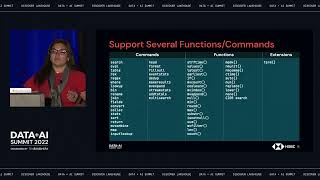
Cutting the Edge in Fighting Cybercrime: Reverse-Engineering a Search Language to Cross-Compile

Traditional cybersecurity Security Information and Event Management (SIEM) ways do not scale well for data sources with 30TiB per day, leading HSBC to create a Cybersecurity Lakehouse with Delta and Spark. Creating a platform to overcome several conventional technical constraints, the limitation in the amount of data for long-term analytics available in traditional platforms and query languages is difficult to scale and time-consuming to run. In this talk, we’ll learn how to implement (or actually reverse-engineer) a language with Scala and translate it into what Apache Spark understands, the Catalyst engine. We’ll guide you through the technical journey of building equivalents of a query language into Spark. We’ll learn how HSBC business benefited from this cutting-edge innovation, like decreasing time and resources for Cyber data processing migration, improving Cyber threat Incident Response, and fast onboarding of HSBC Cyber Analysts on Spark with Cybersecurity Lakehouse platform.

Connect with us: Website: https://databricks.com Facebook: https://www.facebook.com/databricksinc Twitter: https://twitter.com/databricks LinkedIn: https://www.linkedin.com/company/data... Instagram: https://www.instagram.com/databricksinc/

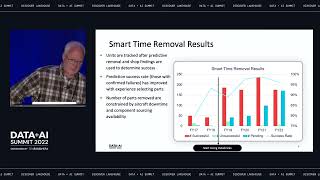
Applied Predictive Maintenance in Aviation: Without Sensor Data

We will show how using Azure Databricks Lakehouse is modernizing our data & analytics environment which has given us new capability to create custom predictive models for hundreds of families of aircraft components without sensor data. We currently have over 95% success rate with over $1.3 million in avoided operational impact costs in FY21.

Connect with us: Website: https://databricks.com Facebook: https://www.facebook.com/databricksinc Twitter: https://twitter.com/databricks LinkedIn: https://www.linkedin.com/company/data... Instagram: https://www.instagram.com/databricksinc/

Introducing Zipline: An Open Source Feature Engineering Platform

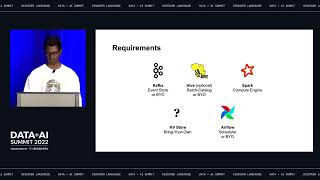
This talk will introduce Zipline, a declarative feature engineering platform developed at Airbnb, which will be open-sourced in March. We will talk about core capabilities and concepts of zipline, and will include a 5 minute demo of developing real-time features for training and for inference.

This talk will be mainly focused on guiding the audience on how to deploy and use zipline in their organizations.

Connect with us: Website: https://databricks.com Facebook: https://www.facebook.com/databricksinc Twitter: https://twitter.com/databricks LinkedIn: https://www.linkedin.com/company/data... Instagram: https://www.instagram.com/databricksinc/

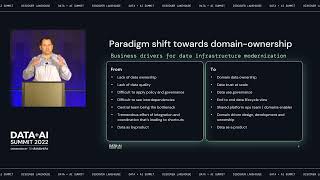
Accelerating Hybrid Data Mesh Implementation

How to get started on your hybrid data mesh journey? Where does Databricks fit into new decentralized analytical data estates? How does it fuel the next generation of domain driven data products, and data marketplace? In this session, you'll hear about practical examples informed by our client experience on how to frame the business challenge and value, define the required building blocks (architecture, governance, automation, people and organization), and jumpstart incremental

Connect with us: Website: https://databricks.com Facebook: https://www.facebook.com/databricksinc Twitter: https://twitter.com/databricks LinkedIn: https://www.linkedin.com/company/data... Instagram: https://www.instagram.com/databricksinc/ adoption.

Building a Lakehouse for Data Science at DoorDash

DoorDash was using a data warehouse but found that they needed more data transparency, lower costs, and the ability to handle streaming data as well as batch data. With an engineering team rooted in big data backgrounds at Uber and LinkedIn, they moved to a Lakehouse architecture intuitively, without knowing about the term. In this session, learn more about how they arrived at that architecture, the process of making the move, and the results they have seen. While addressing both data analysts and data scientists from their lakehouse, this session will focus on their machine learning operations, and how their efficiencies are enabling them to tackle more advanced use cases such as NLP and image classification.

Connect with us: Website: https://databricks.com Facebook: https://www.facebook.com/databricksinc Twitter: https://twitter.com/databricks LinkedIn: https://www.linkedin.com/company/data... Instagram: https://www.instagram.com/databricksinc/

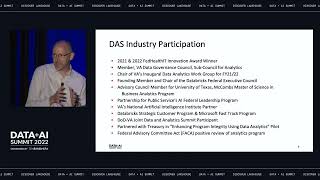
Cloud and Data Science Modernization of Veterans Affairs Financial Service Center with Azure Databri

The Department of Veterans Affairs (VA) is home to over 420,000 employees, provides health care for 9.16 million enrollees and manages the benefits of 5.75 million recipients. The VA also hosts an array of financial management, professional, and administrative services at their Financial Service Center (FSC), located in Austin, Texas. The FSC is divided into various service groups organized around revenue centers and product lines, including the Data Analytics Service (DAS). To support the VA mission, in 2021 FSC DAS continued to press forward with their cloud modernization efforts, successfully achieving four key accomplishments:

Office of Community Care (OCC) Financial Time Series Forecast - Financial forecasting enhancements to predict claims CFO Dashboard - Productivity and capability enhancements for financial and audit analytics Datasets Migrated to the Cloud - Migration of on-prem datasets to the cloud for down-stream analytics (includes a supply chain proof-of-concept) Data Science Hackathon - A hackathon to predict bad claims codes and demonstrate DAS abilities to accelerate a ML use case using Databricks AutoML

This talk discusses FSC DAS’ cloud and data science modernization accomplishments in 2021, lessons learned, and what’s ahead.

Connect with us: Website: https://databricks.com Facebook: https://www.facebook.com/databricksinc Twitter: https://twitter.com/databricks LinkedIn: https://www.linkedin.com/company/data... Instagram: https://www.instagram.com/databricksinc/

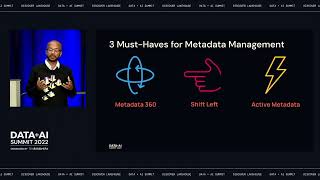
Connecting the Dots with DataHub: Lakehouse and Beyond

You’ve successfully built your data lakehouse. Congratulations! But what happens when your operational data stores, streaming systems like Apache Kafka or data ingestion systems produce bad data into the lakehouse? Can you be proactive when it comes to preventing bad data from affecting your business? How can you take advantage of automation to ensure that raw data assets become well maintained data products (clear ownership, documentation and sensitivity classification) without requiring people to do redundant work across operational, ingestion and lakehouse systems? How do you get live and historical visibility into your entire data ecosystem (schemas, pipelines, data lineage, models, features and dashboards) within and across your production services, ingestion pipelines and data lakehouse? Data engineers struggle with data quality and data governance issues constantly interrupting their day and limiting their upside impact on the business.

In this talk, we will share how data engineers from our 3K+ strong DataHub community are using DataHub to track lineage, understand data quality, and prevent failures from impacting their important dashboards, ML models and features. The talk will include details of how DataHub extracts lineage automatically from Spark, schema and statistics from Delta Lake and shift-left strategies for developer-led governance.

Connect with us: Website: https://databricks.com Facebook: https://www.facebook.com/databricksinc Twitter: https://twitter.com/databricks LinkedIn: https://www.linkedin.com/company/data... Instagram: https://www.instagram.com/databricksinc/

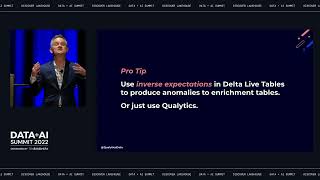
Mapping Data Quality Concerns to Data Lake Zones

A common pattern in Data Lake and Lakehouse design is structuring data into zones, with Bronze, Silver and Gold being typical labels. Each zone is suitable for different workloads and different consumers: for instance, machine learning algorithms typically process against Bronze or Silver, while analytic dashboards often query Gold. This prompts the question: which layer is best suited for applying data quality rules and actions? Our answer: all of them.

In this session, we’ll expand on our answer by describing the purposes of the different zones, and mapping the categories of data quality relevant for each by assessing its qualitative requirements. We’ll describe Data Enrichment: the practice of making observed anomalies available as inputs to downstream data pipelines, and provide recommendations for when to merely alert, when to quarantine data, when to halt pipelines, and when to apply automated corrective actions.

Connect with us: Website: https://databricks.com Facebook: https://www.facebook.com/databricksinc Twitter: https://twitter.com/databricks LinkedIn: https://www.linkedin.com/company/data... Instagram: https://www.instagram.com/databricksinc/

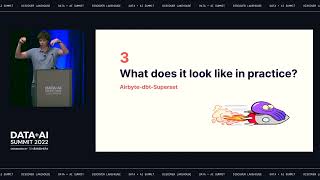
Open Source Powers the Modern Data Stack

Lakehouses like Databricks’ Delta Lake are becoming the central brain for all data systems. But Lakehouses are only one component of the data stack. There are many building blocks required for tackling data needs, including data integrations, data transformation, data quality, observability, orchestration etc.

In this session, we will present how open source powers companies' approach to building a modern data stack. We will talk about technologies like Airbyte, Airflow, dbt, Preset, and how to connect them in order to build a customized and extensible data platform centered around Databricks.

Connect with us: Website: https://databricks.com Facebook: https://www.facebook.com/databricksinc Twitter: https://twitter.com/databricks LinkedIn: https://www.linkedin.com/company/data... Instagram: https://www.instagram.com/databricksinc/

Powering Up the Business with a Lakehouse

Within Wehkamp we required a uniform way to provide reliable and on time data to the business, while making this access compliant with GDPR. Unlocking all the data sources that we have scattered across the company and democratize the data access was of the utmost importance, allowing us to empower the business with more, better and faster data.

Focusing on open source technologies, we've built a data platform almost from the ground up that focuses on 3 levels of data curation - bronze, silver and gold - which follows the LakeHouse Architecture. The ingestion into bronze is where the PII fields are pseudonymized, making the use of the data within the delta lake compliant and, since there is no visible user data, it means everyone can use the entire delta lake for exploration and new use cases. Naturally, specific teams are allowed to see some user data that is necessary for their use cases. Besides the standard architecture, we've developed a library that allows us to ingest new data sources by adding a JSON config file with the characteristics. This combined with the ACID transactions that delta provides and the efficient Structured Stream provided through Auto Loader has allowed a small team to maintain 100+ streams with insignificant downtime.

Some other components of this platform are the following: - Alerting to Slack - Data quality checks - CI/CD - Stream processing with the delta engine

The feedback so far has been encouraging, as more and more teams across the company are starting to use the new platform and taking advantage of all its perks. It is still a long time until we get to turn off some of the components of the old data platform, but it has come a long way.

Connect with us: Website: https://databricks.com Facebook: https://www.facebook.com/databricksinc Twitter: https://twitter.com/databricks LinkedIn: https://www.linkedin.com/company/data... Instagram: https://www.instagram.com/databricksinc/

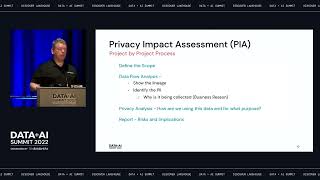
Scaling Privacy: Practical Architectures and Experiences

At Spark Data & AI 2021, We presented the use case around Privacy in an Insurance Landscape using Privacera. Scaling Privacy in a Spark Ecosystem (https://www.youtube.com/watch?v=cjJEMlNcg5k). In one year, the concept of privacy and security have taken off as a major need to solve and the ability to embed this into business process to empower data democratization has become mandatory. The concept that data is a product is now commonplace and that ability to rapidly innovate those products hinges on the ability to balance a dual mandate. One mandate: Move Fast. Second Mandate: Manage Privacy and Security. How do we make this happen? Let's dig into the real details and experiences and show the blueprint for success.

Connect with us: Website: https://databricks.com Facebook: https://www.facebook.com/databricksinc Twitter: https://twitter.com/databricks LinkedIn: https://www.linkedin.com/company/data... Instagram: https://www.instagram.com/databricksinc/

Secure Data Distribution and Insights with Databricks on AWS

Every industry must comply with some form of compliance or data security in order to operate. As data becomes more mission critical to the organization, so does the need to protect and secure it.

Public Sector organizations are responsible for securing sensitive data sets and complying with regulatory programs such as HIPAA, FedRAMP, and StateRAMP.

This does not come as a surprise given the many different attacks targeted at the industry and the extremely sensitive nature of the large volumes of data stored and analyzed. For a product owner or DBA, this can be extremely overwhelming with a security team issuing more restrictions and data access becoming more of a common request among business users. It can be difficult finding an effective governance model to democratize data while also managing compliance across your hybrid estate.

In this session, we will discuss challenges faced in the public sector when expanding to AWS cloud. We will review best practices for managing access and data integrity for a cloud-based data lakehouse with Databricks, and discuss recommended approaches for securing your AWS Cloud environment. We will highlight ways to enable compliance by developing a continuous monitoring strategy and providing tips for implementation of defense in depth. This guide will provide critical questions to ask, an overall strategy, and specific recommendations to serve all security leaders and data engineers in the Public Sector.

This talk is intended to educate on security design considerations when extending your data warehouse to the cloud. This guidance is expected to grow and evolve as new standards and offerings emerge for local, state, and federal government.

Connect with us: Website: https://databricks.com Facebook: https://www.facebook.com/databricksinc Twitter: https://twitter.com/databricks LinkedIn: https://www.linkedin.com/company/data... Instagram: https://www.instagram.com/databricksinc/

Serving Near Real-Time Features at Scale

This presentation will first introduce the use case, which generates the price adjustments based on the network effect, and the corresponding model relies on the 108 near real-time features computed by Flink pipelines with the raw demand and supply events. Here is the simplified computation logic:

-The pipelines need to process the raw real-time events at the rate of 300k/s including both demand and supply -Each event needs to be computed on the geospatial, temporal and other dimensions -Each event contributes to the computation on the original hexagon and the 1K+ neighbours due to the fan-out effect of Kring smooth -Each event contributions to the aggregation on multiple window sizes up to 32 minutes, sliding by 1 minute, or 63 windows in total

Next the presentation will briefly go through the DAG of the Flink pipeline before optimization and the issues we faced: the pipeline could not run stably due to OOM and backpressure. The presentation will discuss how to optimize a streaming pipeline with the generic performance tuning framework, which focuses on three areas: Network, CPU and Memory, and five domains: Parallelism, Partition, Remote Call, Algorithm and Garbage Collector. The presentation will also show some example techniques being applied onto the pipelines by following the performance tuning framework.

Then the presentation will discuss one particular optimization technique: Customized Sliding Window.

Powering machine learning models with near real-time features can be quite challenging, due to computation logic complexity, write throughput, serving SLA, etc. In this talk, we have introduced some of the problems that we faced and our solutions to them, in the hope of aiding our peers in similar use cases.

Connect with us: Website: https://databricks.com Facebook: https://www.facebook.com/databricksinc Twitter: https://twitter.com/databricks LinkedIn: https://www.linkedin.com/company/data... Instagram: https://www.instagram.com/databricksinc/

So Fresh and So Clean: Learn How to Build Real-Time Warehouses on Lakehouse

Warehouses? Where we are going, we won't need warehouses! Join Dillon, Franco, and Shannon as they take an industry-standard Data Warehouse integration benchmark, called TPC-DI, which is a typical 80s style data warehouse, and bring it into the future. We will review how to implement standard data warehousing practices on Lakehouse, and show you how to deliver optimal price/performance in the cloud and keep your data so fresh and so clean. We will take an assortment of structured, semi-structured, and unstructured data in the form of CSV, TXT, XML, and Fixed-Width files, and transform them warehouse-style into Lakehouse with a historical load and incremental CDC loads.

Connect with us: Website: https://databricks.com Facebook: https://www.facebook.com/databricksinc Twitter: https://twitter.com/databricks LinkedIn: https://www.linkedin.com/company/data... Instagram: https://www.instagram.com/databricksinc/