talk-data.com talk-data.com

Topic

GitHub

version_control collaboration code_hosting

661

tagged

Activity Trend

79 peak/qtr
2020-Q1 2026-Q1

Activities

661 activities · Newest first

In this episode, Conor and Bryce close out their conversation with Sean Parent and learn why he left Apple to join Adobe. Link to Episode 139 on WebsiteDiscuss this episode, leave a comment, or ask a question (on GitHub)How To Get Involved With Val DM Sean on TwitterVal Lang on GitHubVal Teams MeetingClick here to join the meetingMeeting ID: 298 158 296 273Passcode: D2beKFWhen: Tues/Thurs 12:30-1:00 PSTVal SlackTwitter ADSP: The PodcastConor HoekstraBryce Adelstein LelbachAbout the Guest: Sean Parent is a senior principal scientist and software architect managing Adobe’s Software Technology Lab. Sean first joined Adobe in 1993 working on Photoshop and is one of the creators of Photoshop Mobile, Lightroom Mobile, and Lightroom Web. In 2009 Sean spent a year at Google working on Chrome OS before returning to Adobe. From 1988 through 1993 Sean worked at Apple, where he was part of the system software team that developed the technologies allowing Apple’s successful transition to PowerPC.

Show Notes

Date Recorded: 2023-06-29 Date Released: 2023-07-21 ADSP Episode 137: Sean Parent on Val (vs Rust)!ADSP Episode 138: Sean Parent on Val! (Part 2)C++ On Sea ConferenceAll Sean Parent ADSP EpisodesAdobe Software Technology LabADSP Episode 40: Star Trek vs PowerPC (with Sean Parent)PostScriptJohn WarnockCharles (Chuck) GeschkeSean Parent photo with John WarnockIntro Song Info Miss You by Sarah Jansen https://soundcloud.com/sarahjansenmusic Creative Commons — Attribution 3.0 Unported — CC BY 3.0 Free Download / Stream: http://bit.ly/l-miss-you Music promoted by Audio Library https://youtu.be/iYYxnasvfx8

🕵️‍♂️ Curious about the mysterious hiring process of a data career? Find out how Megan McGuire narrows down candidates and assesses skills in the podcast. Get insider knowledge on code assessments, interviews, and what it takes to land the dream data role! 💪📈

📊 Come to my next free “How to Land Your First Data Job” training

🏫 Check out my 10-week data analytics bootcamp

Timestamps:

(02:14) - The Value of Junior Analysts

(12:12) - Curiosity and Problem Solving in Data Analytics

(21:46) - Be the perfect candidate for specific company rather than a pretty good candidate

(24:15) - How drive, experience and upskilling set up interviewee success

(28:59) - Show off your skills with your Tableau Public or GitHub Profile

(36:53) - Rejections aren't necessarily your fault

Connect with Avery:

📺 Subscribe on YouTube

🎙Listen to My Podcast

👔 Connect with me on LinkedIn

📸 Instagram

🎵 TikTok

Mentioned in this episode: Join the last cohort of 2025! The LAST cohort of The Data Analytics Accelerator for 2025 kicks off on Monday, December 8th and enrollment is officially open!

To celebrate the end of the year, we’re running a special End-of-Year Sale, where you’ll get: ✅ A discount on your enrollment 🎁 6 bonus gifts, including job listings, interview prep, AI tools + more

If your goal is to land a data job in 2026, this is your chance to get ahead of the competition and start strong.

👉 Join the December Cohort & Claim Your Bonuses: https://DataCareerJumpstart.com/daa https://www.datacareerjumpstart.com/daa

Links:

Book: https://www.manning.com/books/machine-learning-system-design?utm_source=AGMLBookcamp&utm_medium=affiliate&utm_campaign=book_babushkin_machine_4_25_23&utm_content=twitter Discount: poddatatalks21 (35% off) Evidently: https://www.evidentlyai.com/ Article: https://medium.com/people-ai-engineering/design-documents-for-ml-models-bbcd30402ff7

Free MLOps course: https://github.com/DataTalksClub/mlops-zoomcamp

Join DataTalks.Club: https://datatalks.club/slack.html

Our events: https://datatalks.club/events.html

In this episode, Conor and Bryce continue their interview with Sean Parent live from C++ On Sea 2023 about the Val programming language! Link to Episode 138 on WebsiteDiscuss this episode, leave a comment, or ask a question (on GitHub)Twitter ADSP: The PodcastConor HoekstraBryce Adelstein LelbachAbout the Guest: Sean Parent is a senior principal scientist and software architect managing Adobe’s Software Technology Lab. Sean first joined Adobe in 1993 working on Photoshop and is one of the creators of Photoshop Mobile, Lightroom Mobile, and Lightroom Web. In 2009 Sean spent a year at Google working on Chrome OS before returning to Adobe. From 1988 through 1993 Sean worked at Apple, where he was part of the system software team that developed the technologies allowing Apple’s successful transition to PowerPC.

How To Get Involved With Val DM Sean on TwitterVal Lang on GitHubVal Teams MeetingClick here to join the meetingMeeting ID: 298 158 296 273Passcode: D2beKFWhen: Tues/Thurs 12:30-1:00 PSTVal SlackShow Notes Date Recorded: 2023-06-29 Date Released: 2023-07-14 ADSP Episode 137: Sean Parent on Val (vs Rust)!C++ On Sea ConferenceAll Sean Parent ADSP EpisodesAdobe Software Technology LabConor Hoekstra - Concepts vs Typeclasses vs Traits vs Protocols - Meeting C++ 2020Programming Languages Virtual MeetupThe Val Programming LanguageThe Rust Programming LanguageThe Swift Programming LanguageHalide LanguageADSP Dave Abrahams EpisodesCircle CompilerJakt Programming LanguageCppCast Episode 355 - Carbon, with Richard SmithC++ on Sea 2023: Keynote: All the Safeties - Sean ParentRust iterx libraryThe Carbon Programming LanguageIntro Song Info Miss You by Sarah Jansen https://soundcloud.com/sarahjansenmusic Creative Commons — Attribution 3.0 Unported — CC BY 3.0 Free Download / Stream: http://bit.ly/l-miss-you Music promoted by Audio Library https://youtu.be/iYYxnasvfx8

Summary

For business analytics the way that you model the data in your warehouse has a lasting impact on what types of questions can be answered quickly and easily. The major strategies in use today were created decades ago when the software and hardware for warehouse databases were far more constrained. In this episode Maxime Beauchemin of Airflow and Superset fame shares his vision for the entity-centric data model and how you can incorporate it into your own warehouse design.

Announcements

Hello and welcome to the Data Engineering Podcast, the show about modern data management Introducing RudderStack Profiles. RudderStack Profiles takes the SaaS guesswork and SQL grunt work out of building complete customer profiles so you can quickly ship actionable, enriched data to every downstream team. You specify the customer traits, then Profiles runs the joins and computations for you to create complete customer profiles. Get all of the details and try the new product today at dataengineeringpodcast.com/rudderstack Your host is Tobias Macey and today I'm interviewing Max Beauchemin about the concept of entity-centric data modeling for analytical use cases

Interview

Introduction How did you get involved in the area of data management? Can you describe what entity-centric modeling (ECM) is and the story behind it?

How does it compare to dimensional modeling strategies? What are some of the other competing methods Comparison to activity schema

What impact does this have on ML teams? (e.g. feature engineering)

What role does the tooling of a team have in the ways that they end up thinking about modeling? (e.g. dbt vs. informatica vs. ETL scripts, etc.)

What is the impact on the underlying compute engine on the modeling strategies used?

What are some examples of data sources or problem domains for which this approach is well suited?

What are some cases where entity centric modeling techniques might be counterproductive?

What are the ways that the benefits of ECM manifest in use cases that are down-stream from the warehouse?

What are some concrete tactical steps that teams should be thinking about to implement a workable domain model using entity-centric principles?

How does this work across business domains within a given organization (especially at "enterprise" scale)?

What are the most interesting, innovative, or unexpected ways that you have seen ECM used?

What are the most interesting, unexpected, or challenging lessons that you have learned while working on ECM?

When is ECM the wrong choice?

What are your predictions for the future direction/adoption of ECM or other modeling techniques?

Contact Info

mistercrunch on GitHub LinkedIn

Parting Question

From your perspective, what is the biggest gap in the tooling or technology for data management today?

Closing Announcements

Thank you for listening! Don't forget to check out our other shows. Podcast.init covers the Python language, its community, and the innovative ways it is being used. The Machine Learning Podcast helps you go from idea to production with machine learning. Visit the site to subscribe to the show, sign up for the mailing list, and read the show notes. If you've learned something or tried out a project from the show then tell us about it! Email [email protected]) with your story. To help other people find the show please leave a review on Apple Podcasts and tell your friends and co-workers

Links

Entity Centric Modeling Blog Post Max's Previous Apperances

Defining Data Engineering with Maxime Beauchemin Self Service Data Exploration And Dashboarding With Superset Exploring The Evolving Role Of Data Engineers Alumni Of AirBnB's Early Years Reflect On What They Learned About Building Data Driven Organizations

Apache Airflow Apache Superset Preset Ubisoft Ralph Kimball The Rise Of The Data Engineer The Downfall Of The Data Engineer The Rise Of The Data Scientist Dimensional Data Modeling Star Schema Databas

O cientista brasileiro Jonatas Grosman alcançou o topo do ranking de modelos mais baixados do #HuggingFace, superando até mesmo o BERT da #Google. O modelo do Jonatas é um fine-tunning do modelo Wav2Vec2-XLSR-53 do Facebook, que faz reconhecimento de fala em inglês.

E atendendo o pedido da comunidade Data Hackers — a maior comunidade de AI e Data Science do Brasil, em um papo muito divertido, conheçam o Jonatas Grosman — Doutor em Ciência da Computação e Pesquisador na PUC-Rio; que conta neste episódio sobre sua história, como foi a construção do modelo, e ele que também traz a provocação para criarmos a conexão entre universidade, pesquisa e mercado.

Lembrando que você pode encontrar todos os podcasts da família Data Hackers no Spotify, iTunes, Google Podcast, Castbox e muitas outras plataformas. Caso queira, você também pode ouvir o episódio aqui no post mesmo!

Link do Medium: https://medium.com/data-hackers/o-brasileiro-com-a-ia-mais-baixada-do-mundo-data-hackers-podcast-70-e13a8c66fbcd

Hah .. o Jonatas pediu pra avisar a comunidade Data Hackers que o Departamento de Informática da PUC-Rio( http://www.inf.puc-rio.br), está com as inscrições pro Mestrado e Doutorado abertas, vão até dia 16/07. 😉

Conheça nossos convidados:

Jonatas Grosman — Doutor em Ciência da Computação e Pesquisador na PUC-Rio (https://www.linkedin.com/in/jonatasgrosman/)

Bancada Data Hackers:

Gabriel Lages  Allan Sene  Paulo Vasconcellos  Monique Femme 

Falamos no episódioLinks de referências:

Participe do Challenge'23 do Data Hackers: https://www.kaggle.com/datasets/datahackers/state-of-data-2022/discussion/415994 Hugging Face do Jonatas: https://huggingface.co/jonatasgrosman Departamento de Informática da PUC-Rio: http://www.inf.puc-rio.br (inscrições pro Mestrado e Doutorado estão abertas, vão até dia 16/07 😉) Laboratório ExACTa: https://exacta.inf.puc-rio.br (esse é o Lab coordenado pelo orientador do Jonatas que tenta juntar mercado e universidade) Github do Jonatas: https://github.com/jonatasgrosman Relógio atomico: http://www.cepa.if.usp.br/e-fisica/mecanica/pesquisahoje/cap3/defaultframebaixo.htm Supercomputador do LNCC: https://www.gov.br/lncc/pt-br/supercomputador-santos-dumont Video do Supercomputador LNCC: https://www.youtube.com/watch?v=nN6v0ExmQD4 Zelador desativa ‘alarme irritante’ e universidade dos EUA perde 20 anos de pesquisa científica: https://gq.globo.com/noticias/noticia/2023/06/zelador-desliga-alarme-irritante-com-pesquisa-cientifica-e-universidade-perde-20-anos-de-pesquisa.ghtml

In this episode, Conor and Bryce interview Sean Parent live from C++ On Sea 2023 about the Val programming language and how it compares to Rust, Swift and C++. Link to Episode 137 on WebsiteDiscuss this episode, leave a comment, or ask a question (on GitHub)Twitter ADSP: The PodcastConor HoekstraBryce Adelstein LelbachAbout the Guest: Sean Parent is a senior principal scientist and software architect managing Adobe’s Software Technology Lab. Sean first joined Adobe in 1993 working on Photoshop and is one of the creators of Photoshop Mobile, Lightroom Mobile, and Lightroom Web. In 2009 Sean spent a year at Google working on Chrome OS before returning to Adobe. From 1988 through 1993 Sean worked at Apple, where he was part of the system software team that developed the technologies allowing Apple’s successful transition to PowerPC. Show Notes Date Recorded: 2023-06-29 Date Released: 2023-07-07 C++ On Sea ConferenceAll Sean Parent ADSP EpisodesAdobe Software Technology LabASL LibrariesThe Val Programming LanguageThe Rust Programming LanguageThe Swift Programming LanguageMutable Value SemanticsLLVMRust TraitsCppNorth 2022 Keynote: The Tragedy of C++, Parts One & Two - Sean ParentC++ Seasoning - Sean ParentSean Parent: “Now What? A vignette in three parts” - C++Now 2012Adobe ASL Adam & Eve ArchitectureHalide LanguageIntro Song Info Miss You by Sarah Jansen https://soundcloud.com/sarahjansenmusic Creative Commons — Attribution 3.0 Unported — CC BY 3.0 Free Download / Stream: http://bit.ly/l-miss-you Music promoted by Audio Library https://youtu.be/iYYxnasvfx8

Discover the transformation of Airflow at GoDaddy: from its initial deployment on-prem to its migration to the cloud, and finally to a Single Pane Orchestration Model. This evolution has streamlined our Data Platform and improved governance. Our experience will be beneficial for anyone seeking to optimize their Airflow implementation and simplify their orchestration processes. History and Use-cases Design, Organization decisions, and Governance: Examining the decision-making process and governance structure. Migration to Cloud:Process of transitioning Airflow from on-premises to the cloud. Data Processing engines used with Airflow for Data Processing. Challenges: Obstacles faced during and after migration and how they were overcome. *Demonstrating how Airflow can be integrated with a central Glue Catalog and Data Lake Mesh model. Single Pane Orchestration (PAAS) and custom re-usable Github Actions: Examining benefits of using a Single Pane Orchestration model Monitoring

Airflow’s KubernetesExecutor has supported multi_namespace_mode for long time. This feature is great at allowing Airflow jobs to run in different namespaces on the same Kubernetes clusters for better isolation and easier management. However, this feature requires cluster-role for the Airflow scheduler, which can create security problems or be a blocker for some users. PR https://github.com/apache/airflow/pull/28047 , which will become available in Airflow 2.6.0, resolves this issue by allowing Airflow users to specify multi_namespace_mode_namespace_list when using multi_namespace_mode, so that no cluster-role is needed and user only needs to ensure the Scheduler has permissions to certain namespaces rather than all namespaces on the Kubernetes cluster. This talk aims to help you better understand KubernetesExecutor and how to set it up in a more secure manner.

As user of Airflow we often use DagRun.conf attributes to control content and flow of a DAG run. Previously the Airflow UI only allowed to launch via JSON in the UI. This was technically feasible but not user friendly. A user needs to model, check and understand the JSON and enter parameters manually without the option to validate before trigger. Similar like Jenkins or Github/Azure pipelines we desire an UI option to trigger with a UI and specifying parameters. With Airflow 2.6.0 now the DAG.params are used to render a nice entry form and with a bit of options a user friendly trigger UI can be implemented. This session is showing how the new feature works and provides some examples how to use it for your purposes.

System tests are executable DAGs for example and testing purposes. With a simple pytest command, you can run an entire DAG. From a provider point of view, they can be viewed as integration tests for all provider related operators and sensors. Running these system tests frequently and monitoring the results allow us to enforce stability amongst many other benefits. In this presentation we will explore how AWS built their system test environment, from the GitHub fork to the health dashboard that exists today…but more importantly, why you should do it as well!

Apache Airflow is one of the largest Apache projects by many metrics but it ranks particularly high in the number of contributors involved in the project. This leads to hundreds of Github Issues, Pull Requests and Discussions being submitted to the project every month. So it is critical to have an ample number of Committers to support the community. In this talk I will summarize my personal experience working towards, and ultimately achieving, committer status in Apache Airflow. I’ll cover the lessons I learned along the way as well as provide some advice and best practices to help others achieve committer status themselves.

Open Source doc edits provide a low-stakes way for new users to first contribute. Ideally, new users find opportunities and feel welcome to fix docs as they learn, engaging with the community from the start. But, I found that contributing docs to Airflow had some surprising obstacles. In this talk, I’ll share my first docs contribution journey, including problems and fixes. For example, you must understand how Airflow uses Sphinx and know when to choose to edit in the GitHub UI or locally. But it wasn’t documented that GitHub renders only Markdown previews and since Sphinx uses markup, you must build docs locally to check formatting; an opportunity for me to add to the Contributor Guide for docs. In addition to examples of reducing obstacles, this talk covers the importance of docs for community and available resources to start writing. If you already contribute and want to create opportunities for others, I’ll also share characteristics of good first issues and docs projects.

We talked about:

Simon's background What MLOps is and what it isn't Skills needed to build an ML platform that serves 100s of models Ranking the importance of skills The point where you should think about building an ML platform The importance of processes in ML platforms Weighing your options with SaaS platforms The exploratory setup, experiment tracking, and model registry What comes after deployment? Stitching tools together to create an ML platform Keeping data governance in mind when building a platform What comes first – the model or the platform? Do MLOps engineers need to have deep knowledge of how models work? Is API design important for MLOps? Simon's recommendations for furthering MLOps knowledge

Links:

LinkedIn: https://www.linkedin.com/in/simonstiebellehner/ Github: https://github.com/stiebels Medium: https://medium.com/@sistel

Free MLOps course: https://github.com/DataTalksClub/mlops-zoomcamp

Join DataTalks.Club: https://datatalks.club/slack.html

Our events: https://datatalks.club/events.html

In this episode, Conor and Bryce record live from C++ On Sea 2023 and interview all the other C++ podcasts: TLB HIT, Two’s Complement and CppCast! Link to Episode 136 on WebsiteDiscuss this episode, leave a comment, or ask a question (on GitHub)Twitter ADSP: The PodcastConor HoekstraBryce Adelstein LelbachGuests Interviewed JF BastienMatt GodboltJonathan Müller (Briefly)Tristan Brindle (Briefly)Phil NashTimur DoumlerShow Notes Date Recorded: 2023-06-29 Date Released: 2023-06-30 C++ On Sea ConferenceC++ On Sea 2023 Keynote: Endnote: AI-Assisted Software Engineering - Bryce Adelstein LelbachC++ Club PodcastTLB HIT PodcastJust-in-Time Compilation - JF Bastien - CppCon 2020C++ On Sea 2023: (char)0 = 0; - JF BastienTranslation lookaside buffer (TLB)Photo of JF, Bryce and Conor on TwitterTwo’s Complement PodcastCroc: Legend of the GobbosCompiler ExplorerC++ On Sea 2023: Throwing Tools at Ranges - Tina UlbrichCircle CompilerC++ On Sea 2023: What’s New in Compiler Explorer? - Matt GodboltThink-Cell Is HiringC++ On Sea 2023: Iteration Revisited - Tristan BrindleCppCast PodcastC++ on Sea 2023: C++ and Safety - Timur DoumlerC++ on Sea 2023 Keynote: All the Safeties - Sean ParentC++ Lambda Idioms - Timur Doumler - CppNorth 2022Intro Song Info Miss You by Sarah Jansen https://soundcloud.com/sarahjansenmusic Creative Commons — Attribution 3.0 Unported — CC BY 3.0 Free Download / Stream: http://bit.ly/l-miss-you Music promoted by Audio Library https://youtu.be/iYYxnasvfx8

Summary

Data transformation is a key activity for all of the organizational roles that interact with data. Because of its importance and outsized impact on what is possible for downstream data consumers it is critical that everyone is able to collaborate seamlessly. SQLMesh was designed as a unifying tool that is simple to work with but powerful enough for large-scale transformations and complex projects. In this episode Toby Mao explains how it works, the importance of automatic column-level lineage tracking, and how you can start using it today.

Announcements

Hello and welcome to the Data Engineering Podcast, the show about modern data management RudderStack helps you build a customer data platform on your warehouse or data lake. Instead of trapping data in a black box, they enable you to easily collect customer data from the entire stack and build an identity graph on your warehouse, giving you full visibility and control. Their SDKs make event streaming from any app or website easy, and their extensive library of integrations enable you to automatically send data to hundreds of downstream tools. Sign up free at dataengineeringpodcast.com/rudderstack- Your host is Tobias Macey and today I'm interviewing Toby Mao about SQLMesh, an open source DataOps framework designed to scale data transformations with ease of collaboration and validation built in

Interview

Introduction How did you get involved in the area of data management? Can you describe what SQLMesh is and the story behind it?

DataOps is a term that has been co-opted and overloaded. What are the concepts that you are trying to convey with that term in the context of SQLMesh?

What are the rough edges in existing toolchains/workflows that you are trying to address with SQLMesh?

How do those rough edges impact the productivity and effectiveness of teams using those

Can you describe how SQLMesh is implemented?

How have the design and goals evolved since you first started working on it?

What are the lessons that you have learned from dbt which have informed the design and functionality of SQLMesh? For teams who have already invested in dbt, what is the migration path from or integration with dbt? You have some built-in integration with/awareness of orchestrators (currently Airflow). What are the benefits of making the transformation tool aware of the orchestrator? What do you see as the potential benefits of integration with e.g. data-diff? What are the second-order benefits of using a tool such as SQLMesh that addresses the more mechanical aspects of managing transformation workfows and the associated dependency chains? What are the most interesting, innovative, or unexpected ways that you have seen SQLMesh used? What are the most interesting, unexpected, or challenging lessons that you have learned while working on SQLMesh? When is SQLMesh the wrong choice? What do you have planned for the future of SQLMesh?

Contact Info

tobymao on GitHub @captaintobs on Twitter Website

Parting Question

From your perspective, what is the biggest gap in the tooling or technology for data management today?

Closing Announcements

Thank you for listening! Don't forget to check out our other shows. Podcast.init covers the Python language, its community, and the innovative ways it is being used. The Machine Learning Podcast helps you go from idea to production with machine learning. Visit the site to subscribe to the show, sign up for the mailing list, and read the show notes. If you've learned something or tried out a project from the show then tell us about it! Email [email protected]) with your story. To help other people find the show please leave a review on Apple Podcasts and tell your friends and co-workers

Links

SQLMesh Tobiko Data SAS AirBnB Minerva SQLGlot Cron AST == Abstract Syntax Tree Pandas Terraform dbt

Podcast Episode

SQLFluff

Podcast.init Episode

The intro and outro music is from The Hug by The Freak Fandango Orc

We talked about:

Santona's background Focusing on data workflows Upsolver vs DBT ML pipelines vs Data pipelines MLOps vs DataOps Tools used for data pipelines and ML pipelines The “modern data stack” and today's data ecosystem Staging the data and the concept of a “lakehouse” Transforming the data after staging What happens after the modeling phase Human-centric vs Machine-centric pipeline Applying skills learned in academia to ML engineering Crafting user personas based on real stories A framework of curiosity Santona's book and resource recommendations

Links:

LinkedIn: https://www.linkedin.com/in/santona-tuli/ Upsolver website: upsolver.com Why we built a SQL-based solution to unify batch and stream workflows: https://www.upsolver.com/blog/why-we-built-a-sql-based-solution-to-unify-batch-and-stream-workflows

Free MLOps course: https://github.com/DataTalksClub/mlops-zoomcamp

Join DataTalks.Club: https://datatalks.club/slack.html

Our events: https://datatalks.club/events.html

In this episode, Conor and Bryce record live from Austria while driving and chat about algorithms including scans, unique and more! Link to Episode 135 on WebsiteDiscuss this episode, leave a comment, or ask a question (on GitHub)Twitter ADSP: The PodcastConor HoekstraBryce Adelstein LelbachShow Notes Date Recorded: 2023-06-18 Date Released: 2023-06-23 Lambda Days 2023 WebsiteItalian C++KX Con 2023: Algorithms in q - Conor HoekstraSkyline Problem in Top 10scan in BQNdistinct in qdedup in Ruststd::unique in C++C++Now 2019: Conor Hoekstra “Algorithm Intuition”Rainwater Problem in Top 10C++20 std::views::filterC++20 std::views::takeC++20 std::views::dropIntro Song Info Miss You by Sarah Jansen https://soundcloud.com/sarahjansenmusic Creative Commons — Attribution 3.0 Unported — CC BY 3.0 Free Download / Stream: http://bit.ly/l-miss-you Music promoted by Audio Library https://youtu.be/iYYxnasvfx8

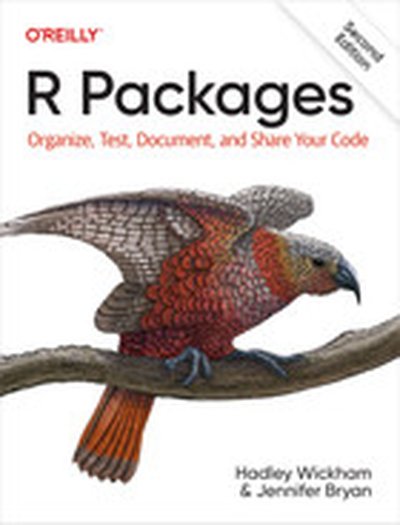
R Packages, 2nd Edition

Turn your R code into packages that others can easily install and use. With this fully updated edition, developers and data scientists will learn how to bundle reusable R functions, sample data, and documentation together by applying the package development philosophy used by the team that maintains the "tidyverse" suite of packages. In the process, you'll learn how to automate common development tasks using a set of R packages, including devtools, usethis, testthat, and roxygen2. Authors Hadley Wickham and Jennifer Bryan from Posit (formerly known as RStudio) help you create packages quickly, then teach you how to get better over time. You'll be able to focus on what you want your package to do as you progressively develop greater mastery of the structure of a package. With this book, you will: Learn the key components of an R package, including code, documentation, and tests Streamline your development process with devtools and the RStudio IDE Get tips on effective habits such as organizing functions into files Get caught up on important new features in the devtools ecosystem Learn about the art and science of unit testing, using features in the third edition of testthat Turn your existing documentation into a beautiful and user friendly website with pkgdown Gain an appreciation of the benefits of modern code hosting platforms, such as GitHub