talk-data.com talk-data.com

Topic

JSON

JavaScript Object Notation (JSON)

data_format lightweight web_development file_format

63

tagged

Activity Trend

9 peak/qtr
2020-Q1 2026-Q1

Activities

Showing filtered results

Filtering by: O'Reilly Data Engineering Books ×
Java XML and JSON

Java XML and JSON is your one-stop guide to mastering the XML metalanguage and JSON data format along with significant Java APIs for parsing and creating XML/JSON documents (and more). The first six chapters focus on XML along with the SAX, DOM, StAX, XPath, and XSLT APIs. The remaining four chapters focus on JSON along with the mJson, GSON, and JsonPath APIs. Each chapter ends with select exercises designed to challenge your grasp of the chapter's content. An appendix provides the answers to these exercises. What You'll Learn Master the XML language Learn how to validate XML documents Learn how to parse XML documents with the SAX, DOM, and StAX APIs Learn how to create XML documents with the DOM and StAX APIs Learn how to extract values from XML documents with the XPath API Learn how to transform XML documents with the XSLT API Master the JSON format Learn how to validate JSON documents Learn how to parse and create JSON documents with the mJson and Gson APIs Learn how to extract values from JSON documents with the JsonPath API Who This Book Is For Intermediate or advanced Java programmers/developers.
JSON Quick Syntax Reference

This compact quick scripting syntax reference on JSON covers syntax and parameters central to JSON object definitions, using the NetBeans 8.1 open source and Eclipse IDE software tool packages. JSON Quick Syntax Reference covers the syntax used in the JSON object definition language, logically organized by topical chapters, and getting more advanced as chapters progress, covering structures and file formats which are best for use with HTML5. Furthermore, this book includes the key factors regarding the data footprint optimization work process, the in-lining of .CSS and .JS files, and why a data footprint optimization work process is important.

XQuery, 2nd Edition

The W3C XQuery 3.1 standard provides a tool to search, extract, and manipulate content, whether it's in XML, JSON or plain text. With this fully updated, in-depth tutorial, you’ll learn to program with this highly practical query language. Designed for query writers who have some knowledge of XML basics, but not necessarily advanced knowledge of XML-related technologies, this book is ideal as both a tutorial and a reference. You’ll find background information for namespaces, schemas, built-in types, and regular expressions that are relevant to writing XML queries.

Advanced Data Management

Advanced data management has always been at the core of efficient database and information systems. Recent trends like big data and cloud computing have aggravated the need for sophisticated and flexible data storage and processing solutions. This book provides a comprehensive coverage of the principles of data management developed in the last decades with a focus on data structures and query languages. It treats a wealth of different data models and surveys the foundations of structuring, processing, storing and querying data according these models. Starting off with the topic of database design, it further discusses weaknesses of the relational data model, and then proceeds to convey the basics of graph data, tree-structured XML data, key-value pairs and nested, semi-structured JSON data, columnar and record-oriented data as well as object-oriented data. The final chapters round the book off with an analysis of fragmentation, replication and consistency strategies for data management in distributed databases as well as recommendations for handling polyglot persistence in multi-model databases and multi-database architectures. While primarily geared towards students of Master-level courses in Computer Science and related areas, this book may also be of benefit to practitioners looking for a reference book on data modeling and query processing. It provides both theoretical depth and a concise treatment of open source technologies currently on the market.

Pro MongoDB™ Development

Pro MongoDB Development is a critical reference for anyone using MongoDB, a NoSQL database based on the BSON (binary JSON) document model. The book explores many aspects of implementing MongoDB in web applications, whether you are using Java, PHP, Ruby, and JavaScript. Noted expert Deepak Vohra walks you through accessing MongoDB databases with all these languages and working with various other technologies and databases. Vohra discusses using Java EE frameworks Kundera and Spring Data with MongoDB. You learn the nuts and bolts of migrating data from other NoSQL databases (Apache Cassandra and Couchbase) and from relational databases (Oracle Database). And, because NoSQL databases are commonly used with the Hadoop ecosystem, the book also covers using MongoDB with Apache Hive. Each chapter includes details about the software you need and hands on examples of working with MongoDB and these technologies so you know exactly what to do, whatever your MongoDB implementation requires.

Oracle SOA Suite 12c Handbook

Master Oracle SOA Suite 12 c Design, implement, manage, and maintain a highly flexible service-oriented computing infrastructure across your enterprise using the detailed information in this Oracle Press guide. Written by an Oracle ACE director, Oracle SOA Suite 12c Handbook uses a start-to-finish case study to illustrate each concept and technique. Learn expert techniques for designing and implementing components, assembling composite applications, integrating Java, handling complex business logic, and maximizing code reuse. Runtime administration, governance, and security are covered in this practical resource. Get started with the Oracle SOA Suite 12 c development and run time environment Deploy and manage SOA composite applications Expose SOAP/XML REST/JSON through Oracle Service Bus Establish interactions through adapters for Database, JMS, File/FTP, UMS, LDAP, and Coherence Embed custom logic using Java and the Spring component Perform fast data analysis in real time with Oracle Event Processor Implement Event Drive Architecture based on the Event Delivery Network (EDN) Use Oracle Business Rules to encapsulate logic and automate decisions Model complex processes using BPEL, BPMN, and human task components Establish KPIs and evaluate performance using Oracle Business Activity Monitoring Control traffic, audit system activity, and encrypt sensitive data

Introduction to JavaScript Object Notation

What is JavaScript Object Notation (JSON) and how can you put it to work? This concise guide helps busy IT professionals get up and running quickly with this popular data interchange format, and provides a deep understanding of how JSON works. Author Lindsay Bassett begins with an overview of JSON syntax, data types, formatting, and security concerns before exploring the many ways you can apply JSON today. From Web APIs and server-side language libraries to NoSQL databases and client-side frameworks, JSON has emerged as a viable alternative to XML for exchanging data between different platforms. If you have some programming experience and understand HTML and JavaScript, this is your book. Learn why JSON syntax represents data in name-value pairs Explore JSON data types, including object, string, number, and array Find out how you can combat common security concerns Learn how the JSON schema verifies that data is formatted correctly Examine the relationship between browsers, web APIs, and JSON Understand how web servers can both request and create data Discover how jQuery and other client-side frameworks use JSON Learn why the CouchDB NoSQL database uses JSON to store data

Pro Couchbase Development: A NoSQL Platform for the Enterprise

Pro Couchbase Development: A NoSQL Platform for the Enterprise discusses programming for Couchbase using Java and scripting languages, querying and searching, handling migration, and integrating Couchbase with Hadoop, HDFS, and JSON. It also discusses migration from other NoSQL databases like MongoDB. This book is for big data developers who use Couchbase NoSQL database or want to use Couchbase for their web applications as well as for those migrating from other NoSQL databases like MongoDB and Cassandra. For example, a reason to migrate from Cassandra is that it is not based on the JSON document model with support for a flexible schema without having to define columns and supercolumns. The target audience is largely Java developers but the book also supports PHP and Ruby developers who want to learn about Couchbase. The author supplies examples in Java, PHP, Ruby, and JavaScript. After reading and using this hands-on guide for developing with Couchbase, you'll be able to build complex enterprise, database and cloud applications that leverage this powerful platform.

The JavaScript JSON Cookbook

Take your understanding of JSON to the next level with "The JavaScript JSON Cookbook." This in-depth guide equips developers of all levels with practical recipes to integrate JSON into a variety of applications such as web, mobile, and server-side systems, enabling efficient data exchange and manipulation. What this Book will help me do Master the fundamentals of JSON formatting, data exchange, and manipulation. Work with JSON in popular libraries and frameworks like AngularJS, jQuery, and AJAX. Integrate JSON seamlessly with databases such as MongoDB and CouchDB. Utilize JSON in mobile platform development for Android and iOS. Learn advanced techniques such as querying JSON using JSON Path and representing binary objects. Author(s) Ray Rischpater is an accomplished software developer and author with extensive experience in programming and web development. He has a deep understanding of JavaScript and JSON, and his practical approach to solving complex technical challenges makes his books invaluable resources. Ray's instructional style is clear and comprehensive, aiming to empower programmers to achieve their goals. Who is it for? This book is ideal for software developers working with web, mobile, or backend systems who want to expand their expertise in JSON. Whether you're a frontend, backend, or full-stack developer at any skill level, the recipes in this cookbook will enhance your ability to create efficient, data-driven applications. If you aim to use JSON for tasks like data exchange, web services, or database integration, this book is for you. By working through the examples, you will gain actionable skills to implement JSON in diverse real-world scenarios.

Beginning JSON

Beginning JSON is the definitive guide to JSON - JavaScript Object Notation - today’s standard in data formatting for the web. The book starts with the basics, and walks you through all aspects of using the JSON format. Beginning JSON covers all areas of JSON from the basics of data formats to creating your own server to store and retrieve persistent data. Beginning JSON provides you with the skill set required for reading and writing properly validated JSON data. The first two chapters of the book will discuss the foundations of JavaScript for those who need it, and provide the necessary understandings for later chapters. Chapters 3 through 12 will uncover what data is, how to convert that data into a transmittable/storable format, how to use AJAX to send and receive JSON, and, lastly, how to reassemble that data back into a proper JavaScript object to be used by your program. The final chapters put everything you learned into practice.

Field Guide to Hadoop

If your organization is about to enter the world of big data, you not only need to decide whether Apache Hadoop is the right platform to use, but also which of its many components are best suited to your task. This field guide makes the exercise manageable by breaking down the Hadoop ecosystem into short, digestible sections. You’ll quickly understand how Hadoop’s projects, subprojects, and related technologies work together. Each chapter introduces a different topic—such as core technologies or data transfer—and explains why certain components may or may not be useful for particular needs. When it comes to data, Hadoop is a whole new ballgame, but with this handy reference, you’ll have a good grasp of the playing field. Topics include: Core technologies—Hadoop Distributed File System (HDFS), MapReduce, YARN, and Spark Database and data management—Cassandra, HBase, MongoDB, and Hive Serialization—Avro, JSON, and Parquet Management and monitoring—Puppet, Chef, Zookeeper, and Oozie Analytic helpers—Pig, Mahout, and MLLib Data transfer—Scoop, Flume, distcp, and Storm Security, access control, auditing—Sentry, Kerberos, and Knox Cloud computing and virtualization—Serengeti, Docker, and Whirr

ElasticSearch Cookbook - Second Edition

The "ElasticSearch Cookbook - Second Edition" is a hands-on guide featuring over 130 advanced recipes to help you harness the power of ElasticSearch, a leading search and analytics engine. Through insightful examples and practical guidance, you'll learn to implement efficient search solutions, optimize queries, and manage ElasticSearch clusters effectively. What this Book will help me do Design and configure ElasticSearch topologies optimized for your specific deployment needs. Develop and utilize custom mappings to optimize your data indexes. Execute advanced queries and filters to refine and retrieve search results effectively. Set up and monitor ElasticSearch clusters for optimal performance. Extend ElasticSearch capabilities through plugin development and integrations using Java and Python. Author(s) Alberto Paro is a technology expert with years of experience working with ElasticSearch, Big Data solutions, and scalable cloud architecture. He has authored multiple books and technical articles on ElasticSearch, leveraging his extensive knowledge to provide practical insights. His approachable and detail-oriented style makes complex concepts accessible to technical professionals. Who is it for? This book is best suited for software developers and IT professionals looking to use ElasticSearch in their projects. Readers should be familiar with JSON, as well as basic programming skills in Java. It is ideal for those who have an understanding of search applications and want to deepen their expertise. Whether you're integrating ElasticSearch into a web application or optimizing your system's search capabilities, this book will provide the skills and knowledge you need.

Beginning Apache Cassandra Development

Beginning Apache Cassandra Development introduces you to one of the most robust and best-performing NoSQL database platforms on the planet. Apache Cassandra is a document database following the JSON document model. It is specifically designed to manage large amounts of data across many commodity servers without there being any single point of failure. This design approach makes Apache Cassandra a robust and easy-to-implement platform when high availability is needed. Apache Cassandra can be used by developers in Java, PHP, Python, and JavaScript—the primary and most commonly used languages. In Beginning Apache Cassandra Development, author and Cassandra expert Vivek Mishra takes you through using Apache Cassandra from each of these primary languages. Mishra also covers the Cassandra Query Language (CQL), the Apache Cassandra analog to SQL. You'll learn to develop applications sourcing data from Cassandra, query that data, and deliver it at speed to your application's users. Cassandra is one of the leading NoSQL databases, meaning you get unparalleled throughput and performance without the sort of processing overhead that comes with traditional proprietary databases. Beginning Apache Cassandra Development will therefore help you create applications that generate search results quickly, stand up to high levels of demand, scale as your user base grows, ensure operational simplicity, and—not least—provide delightful user experiences.

Implementing IBM CICS JSON Web Services for Mobile Applications

This IBM® Redbooks® publication provides information about how you can connect mobile devices to IBM Customer Information Control System (CICS®) Transaction Server (CICS TS), using existing enterprise services already hosted on CICS, or to develop new services supporting new lines of business. This book describes the steps to develop, configure, and deploy a mobile application that connects either directly to CICS TS, or to CICS via IBM Worklight® Server. It also describes the advantages that your organization can realize by using Worklight Server with CICS. In addition, this Redbooks publication provides a broad understanding of the new CICS architecture that enables you to make new and existing mainframe applications available as web services using JavaScript Object Notation (JSON), and provides support for the transformation between JSON and application data. While doing so, we provide information about each resource definition, and its role when CICS handles or makes a request. We also describe how to move your CICS applications, and business, into the mobile space, and how to prepare your CICS environment for the following scenarios: Taking an existing CICS application and exposing it as a JSON web service Creating a new CICS application, based on a JSON schema Using CICS as a JSON client This Redbooks publication provides information about the installation and configuration steps for both Worklight Studio and Worklight Server. Worklight Studio is the Eclipse interface that a developer uses to implement a Worklight native or hybrid mobile application, and can be installed into an Eclipse instance. Worklight Server is where components developed for the server side (written in Worklight Studio), such as adapters and custom server-side authentication logic, run. CICS applications and their associated data constitute some of the most valuable assets owned by an enterprise. Therefore, the protection of these assets is an essential part of any CICS mobile project. This Redbooks publication, after a review of the main mobile security challenges, outlines the options for securing CICS JSON web services, and reviews how products, such as Worklight and IBM DataPower®, can help. It then shows examples of security configurations in CICS and Worklight.

JavaScript and JSON Essentials

"JavaScript and JSON Essentials" is a focused tutorial that introduces you to the lightweight JSON data format, essential for effective data storage and transfer with JavaScript. By following this book, you'll gain the expertise to work with JSON in web applications, including tasks such as serialization, asynchronous calls, and debugging. What this Book will help me do Fully understand the structure and use of JSON and how it integrates with JavaScript. Learn to implement synchronous and asynchronous data transfers using JSON. Develop skills in creating, updating, and manipulating JSON objects effectively. Master the design of web functionalities like the Carousel application using JSON. Gain knowledge about best practices in debugging and optimizing JSON for web applications. Author(s) Sai S. Sriparasa is a seasoned developer and educator with extensive experience in JavaScript and related technologies. Having worked on numerous data-driven projects, Sai integrates real-world scenarios into his writing. His tutorials are crafted to be approachable and practical, aimed at demystifying complex concepts for a diverse audience. Who is it for? This book is ideal for web developers who are familiar with JavaScript and seek to expand their understanding of JSON. Suitable for programmers who have a basic knowledge of HTML and some exposure to server-side languages like PHP or Python. Those aiming to integrate efficient data exchange formats into their web applications will find it highly beneficial. It's also a good resource for JavaScript developers wanting to delve deeper into the synchronous and asynchronous handling of data.

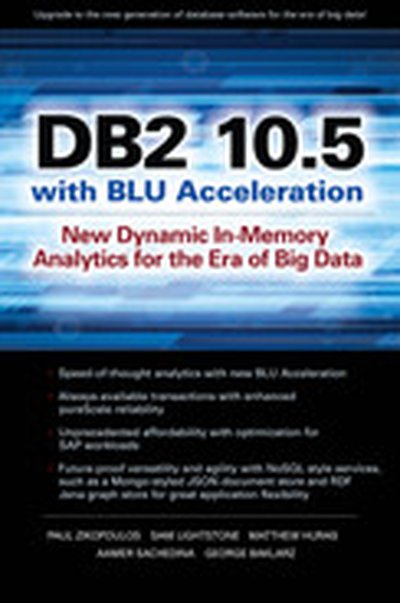
DB2 10.5 with BLU Acceleration

UPGRADE TO THE NEW GENERATION OF DATABASE SOFTWARE FOR THE ERA OF BIG DATA! If big data is an untapped natural resource, how do you find the gold hidden within? Leaders realize that big data means all data, and are moving quickly to extract more value from both structured and unstructured application data. However, analyzing this data can prove costly and complex, especially while protecting the availability, performance and reliability of essential business applications. In the new era of big data, businesses require data systems that can blend always-available transactions with speed-of-thought analytics. DB2 10.5 with BLU Acceleration provides this speed, simplicity, and affordability while making it easier to build next-generation applications with NoSQL features, such as a mongo-styled JSON document store, a graph store, and more. Dynamic in-memory columnar processing and other innovations deliver faster insights from more data, and enhanced pureScale clustering technology delivers high-availability transactions with application-transparent scalability for business continuity. With this book, you'll learn about the power and flexibility of multiworkload, multi-platform database software. Use the comprehensive knowledge from a team of DB2 developers and experts to get started with the latest DB2 trial version you can download at ibm.com/developerworks/downloads/im/db2/. Stay up to date on DB2 by visiting ibm.com/db2/.

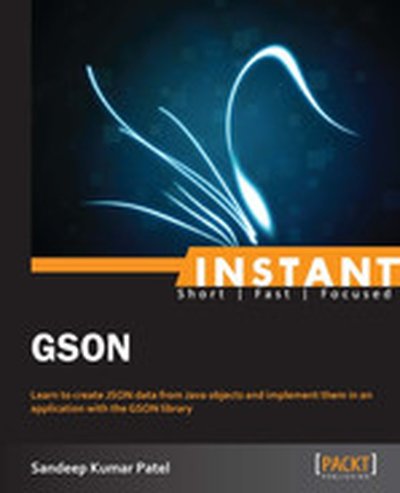
Instant GSON

Explore the powerful features of the GSON library in this concise and practical book. "Instant GSON" provides a hands-on guide to efficiently handling JSON data using Google's GSON library. In this book, you'll learn essential techniques to convert Java objects to JSON and vice versa, utilize field exclusion strategies, and implement GSON in real-world applications. What this Book will help me do Convert Java objects into JSON format and retrieve Java objects from JSON data. Understand and work with GSON's handling of generic types and nested classes. Learn how to implement field exclusion strategies and write custom JSON converters. Gain knowledge on pretty-printing JSON and utilizing versioning support. Effectively use GSON in various practical Java-based applications, including web projects. Author(s) Sandeep Patel is an experienced software developer specializing in Java programming and JSON data interchange. With years of hands-on experience working with GSON, Sandeep has a deep understanding of its capabilities and nuances. His writing style is focused on practical examples and clear explanations, aimed at helping readers efficiently integrate advanced JSON management into their programming projects. Who is it for? If you are a Java developer who is new to the GSON library and keen to incorporate it into your projects, this book is for you. "Instant GSON" will appeal to software developers aiming to boost productivity and master JSON data handling. Readers should have a basic understanding of Java programming and an interest in JSON serialization and deserialization. This book provides guidance tailored to beginner and intermediate skill levels.

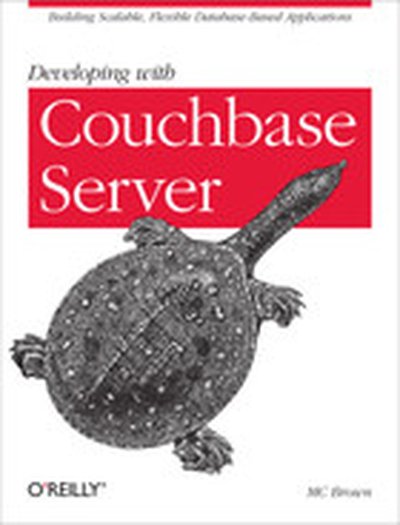
Developing with Couchbase Server

Today’s highly interactive websites pose a challenge for traditional SQL databases—the ability to scale rapidly and serve loads of concurrent users. With this concise guide, you’ll learn how to build web applications on top of Couchbase Server 2.0, a NoSQL database that can handle websites and social media where hundreds of thousands of users read and write large volumes of information. Using food recipe information as examples, this book demonstrates how to take advantage of Couchbase’s document-oriented database design, and how to store and query data with various CRUD operations. Discover why Couchbase is better than SQL databases with memcached tiers for managing data from the most interactive portions of your application. Learn about Couchbase Server’s cluster-based architecture and how it differs from SQL databases Choose a client library for Java, .NET, Ruby, Python, PHP, or C, and connect to a cluster Structure data in a variety of formats, from serialized objects, a stream of raw bytes, or as JSON documents Learn core storage and retrieval methods, including document IDs, expiry times, and concurrent updates Create views with map/reduce and learn Couchbase mechanisms for querying and selection

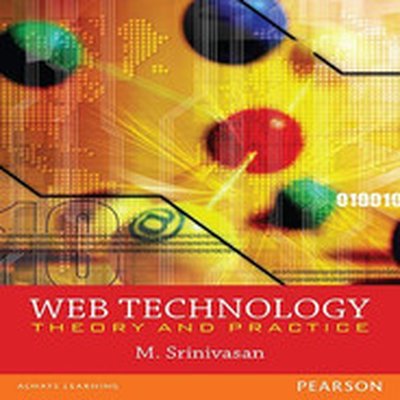
Web Technology, Theory and Practice

This book introduces the keyset technologies that are currently used to create applications on web. It explains the principal HTML concept, the client-side used JavaScript and the server-side used JSP with relevant coding examples. Emphasis is given on XML with examples including XML Transformations (XSTL). Apart from this, the book also dwells into the alternatives to XML such as the JSON.

Getting Started with CouchDB

CouchDB is a new breed of database for the Internet, geared to meet the needs of today’s dynamic web applications. With this concise introduction, you’ll learn how CouchDB’s simple model for storing, processing, and accessing data makes it ideal for the type of data and rapid response users now demand from your applications—and how easy CouchDB is to set up, deploy, maintain, and scale. The code-packed examples in this book will help you learn how to work with documents, populate a simple database, replicate data from one database to another, and a host of other tasks. Install CouchDB on Linux, Mac OS X, Windows, or (if you must) from the source code Interact with data through CouchDB’s RESTful API, and use standard HTTP operations, such as PUT, GET, POST, and DELETE Use Futon—CouchDB’s web-based interface— to manage databases and documents, and to configure replications Learn how to create, update, and delete documents in JSON format, and how to create and delete databases Work with design documents to get the formatting and indexing your application requires