talk-data.com talk-data.com

Topic

Kubernetes

container_orchestration devops microservices

560

tagged

Activity Trend

40 peak/qtr
2020-Q1 2026-Q1

Activities

560 activities · Newest first

Summary Data engineers have typically left the process of data labeling to data scientists or other roles because of its nature as a manual and process heavy undertaking, focusing instead on building automation and repeatable systems. Watchful is a platform to make labeling a repeatable and scalable process that relies on codifying domain expertise. In this episode founder Shayan Mohanty explains how he and his team are bringing software best practices and automation to the world of machine learning data preparation and how it allows data engineers to be involved in the process.

Announcements

Hello and welcome to the Data Engineering Podcast, the show about modern data management When you’re ready to build your next pipeline, or want to test out the projects you hear about on the show, you’ll need somewhere to deploy it, so check out our friends at Linode. With their new managed database service you can launch a production ready MySQL, Postgres, or MongoDB cluster in minutes, with automated backups, 40 Gbps connections from your application hosts, and high throughput SSDs. Go to dataengineeringpodcast.com/linode today and get a $100 credit to launch a database, create a Kubernetes cluster, or take advantage of all of their other services. And don’t forget to thank them for their continued support of this show! Data stacks are becoming more and more complex. This brings infinite possibilities for data pipelines to break and a host of other issues, severely deteriorating the quality of the data and causing teams to lose trust. Sifflet solves this problem by acting as an overseeing layer to the data stack – observing data and ensuring it’s reliable from ingestion all the way to consumption. Whether the data is in transit or at rest, Sifflet can detect data quality anomalies, assess business impact, identify the root cause, and alert data teams’ on their preferred channels. All thanks to 50+ quality checks, extensive column-level lineage, and 20+ connectors across the Data Stack. In addition, data discovery is made easy through Sifflet’s information-rich data catalog with a powerful search engine and real-time health statuses. Listeners of the podcast will get $2000 to use as platform credits when signing up to use Sifflet. Sifflet also offers a 2-week free trial. Find out more at dataengineeringpodcast.com/sifflet today! The biggest challenge with modern data systems is understanding what data you have, where it is located, and who is using it. Select Star’s data discovery platform solves that out of the box, with an automated catalog that includes lineage from where the data originated, all the way to which dashboards rely on it and who is viewing them every day. Just connect it to your database/data warehouse/data lakehouse/whatever you’re using and let them do the rest. Go to dataengineeringpodcast.com/selectstar today to double the length of your free trial and get a swag package when you convert to a paid plan. Data teams are increasingly under pressure to deliver. According to a recent survey by Ascend.io, 95% in fact reported being at or over capacity. With 72% of data experts reporting demands on their team going up faster than they can hire, it’s no surprise they are increasingly turning to automation. In fact, while only 3.5% report having current investments in automation, 85% of data teams plan on investing in automation in the next 12 months. 85%!!! That’s where our friends at Ascend.io come in. The Ascend Data Automation Cloud provides a unified platform for data ingestion, transformation, orchestration, and observability. Ascend users love its declarative pipelines, powerful SDK, elegant UI, and extensible plug-in architecture, as well as its support for Python, SQL, Scala, and Java. Ascend automates workloads on Snowflake, Databricks, BigQuery, and open source Spark, and can be deployed in AWS, Azure, or GCP. Go to dataengineeringpodcast.com/ascend and sign up for a free trial. If you’re
Summary Data is useless if it isn’t being used, and you can’t use it if you don’t know where it is. Data catalogs were the first solution to this problem, but they are only helpful if you know what you are looking for. In this episode Shinji Kim discusses the challenges of data discovery and how to collect and preserve additional context about each piece of information so that you can find what you need when you don’t even know what you’re looking for yet.

Announcements

Hello and welcome to the Data Engineering Podcast, the show about modern data management When you’re ready to build your next pipeline, or want to test out the projects you hear about on the show, you’ll need somewhere to deploy it, so check out our friends at Linode. With their new managed database service you can launch a production ready MySQL, Postgres, or MongoDB cluster in minutes, with automated backups, 40 Gbps connections from your application hosts, and high throughput SSDs. Go to dataengineeringpodcast.com/linode today and get a $100 credit to launch a database, create a Kubernetes cluster, or take advantage of all of their other services. And don’t forget to thank them for their continued support of this show! Data stacks are becoming more and more complex. This brings infinite possibilities for data pipelines to break and a host of other issues, severely deteriorating the quality of the data and causing teams to lose trust. Sifflet solves this problem by acting as an overseeing layer to the data stack – observing data and ensuring it’s reliable from ingestion all the way to consumption. Whether the data is in transit or at rest, Sifflet can detect data quality anomalies, assess business impact, identify the root cause, and alert data teams’ on their preferred channels. All thanks to 50+ quality checks, extensive column-level lineage, and 20+ connectors across the Data Stack. In addition, data discovery is made easy through Sifflet’s information-rich data catalog with a powerful search engine and real-time health statuses. Listeners of the podcast will get $2000 to use as platform credits when signing up to use Sifflet. Sifflet also offers a 2-week free trial. Find out more at dataengineeringpodcast.com/sifflet today! The biggest challenge with modern data systems is understanding what data you have, where it is located, and who is using it. Select Star’s data discovery platform solves that out of the box, with an automated catalog that includes lineage from where the data originated, all the way to which dashboards rely on it and who is viewing them every day. Just connect it to your database/data warehouse/data lakehouse/whatever you’re using and let them do the rest. Go to dataengineeringpodcast.com/selectstar today to double the length of your free trial and get a swag package when you convert to a paid plan. Data teams are increasingly under pressure to deliver. According to a recent survey by Ascend.io, 95% in fact reported being at or over capacity. With 72% of data experts reporting demands on their team going up faster than they can hire, it’s no surprise they are increasingly turning to automation. In fact, while only 3.5% report having current investments in automation, 85% of data teams plan on investing in automation in the next 12 months. 85%!!! That’s where our friends at Ascend.io come in. The Ascend Data Automation Cloud provides a unified platform for data ingestion, transformation, orchestration, and observability. Ascend users love its declarative pipelines, powerful SDK, elegant UI, and extensible plug-in architecture, as well as its support for Python, SQL, Scala, and Java. Ascend automates workloads on Snowflake, Databricks, BigQuery, and open source Spark, and can be deployed in AWS, Azure, or GCP. Go to dataengineeringpodcast.com/ascend and sign up for a free trial. If you’re a data engineering podcast listener, you get credits worth $5,000 when you become a customer. Your host is Tobias M
Summary Data mesh is a frequent topic of conversation in the data community, with many debates about how and when to employ this architectural pattern. The team at AgileLab have first-hand experience helping large enterprise organizations evaluate and implement their own data mesh strategies. In this episode Paolo Platter shares the lessons they have learned in that process, the Data Mesh Boost platform that they have built to reduce some of the boilerplate required to make it successful, and some of the considerations to make when deciding if a data mesh is the right choice for you.

Announcements

Hello and welcome to the Data Engineering Podcast, the show about modern data management When you’re ready to build your next pipeline, or want to test out the projects you hear about on the show, you’ll need somewhere to deploy it, so check out our friends at Linode. With their new managed database service you can launch a production ready MySQL, Postgres, or MongoDB cluster in minutes, with automated backups, 40 Gbps connections from your application hosts, and high throughput SSDs. Go to dataengineeringpodcast.com/linode today and get a $100 credit to launch a database, create a Kubernetes cluster, or take advantage of all of their other services. And don’t forget to thank them for their continued support of this show! Atlan is the metadata hub for your data ecosystem. Instead of locking your metadata into a new silo, unleash its transformative potential with Atlan’s active metadata capabilities. Push information about data freshness and quality to your business intelligence, automatically scale up and down your warehouse based on usage patterns, and let the bots answer those questions in Slack so that the humans can focus on delivering real value. Go to dataengineeringpodcast.com/atlan today to learn more about how Atlan’s active metadata platform is helping pioneering data teams like Postman, Plaid, WeWork & Unilever achieve extraordinary things with metadata and escape the chaos. Prefect is the modern Dataflow Automation platform for the modern data stack, empowering data practitioners to build, run and monitor robust pipelines at scale. Guided by the principle that the orchestrator shouldn’t get in your way, Prefect is the only tool of its kind to offer the flexibility to write code as workflows. Prefect specializes in glueing together the disparate pieces of a pipeline, and integrating with modern distributed compute libraries to bring power where you need it, when you need it. Trusted by thousands of organizations and supported by over 20,000 community members, Prefect powers over 100MM business critical tasks a month. For more information on Prefect, visit dataengineeringpodcast.com/prefect. The only thing worse than having bad data is not knowing that you have it. With Bigeye’s data observability platform, if there is an issue with your data or data pipelines you’ll know right away and can get it fixed before the business is impacted. Bigeye let’s data teams measure, improve, and communicate the quality of your data to company stakeholders. With complete API access, a user-friendly interface, and automated yet flexible alerting, you’ve got everything you need to establish and maintain trust in your data. Go to dataengineeringpodcast.com/bigeye today to sign up and start trusting your analyses. Your host is Tobias Macey and today I’m interviewing Paolo Platter about Agile Lab’s lessons learned through helping large enterprises establish their own data mesh

Interview

Introduction How did you get involved in the area of data management? Can you share your experiences working with data mesh implementations? What were the stated goals of project engagements that led to data mesh implementations? What are some examples of projects where you explored data mesh as an option and decided that it was a poor fit? What are some of the technical and process investments that are necessary to support a mesh str

Summary The optimal format for storage and retrieval of data is dependent on how it is going to be used. For analytical systems there are decades of investment in data warehouses and various modeling techniques. For machine learning applications relational models require additional processing to be directly useful, which is why there has been a growth in the use of vector databases. These platforms store direct representations of the vector embeddings that machine learning models rely on for computing relevant predictions so that there is no additional processing required to go from input data to inference output. In this episode Frank Liu explains how the open source Milvus vector database is implemented to speed up machine learning development cycles, how to think about proper storage and scaling of these vectors, and how data engineering and machine learning teams can collaborate on the creation and maintenance of these data sets.

Announcements

Hello and welcome to the Data Engineering Podcast, the show about modern data management When you’re ready to build your next pipeline, or want to test out the projects you hear about on the show, you’ll need somewhere to deploy it, so check out our friends at Linode. With their new managed database service you can launch a production ready MySQL, Postgres, or MongoDB cluster in minutes, with automated backups, 40 Gbps connections from your application hosts, and high throughput SSDs. Go to dataengineeringpodcast.com/linode today and get a $100 credit to launch a database, create a Kubernetes cluster, or take advantage of all of their other services. And don’t forget to thank them for their continued support of this show! Data stacks are becoming more and more complex. This brings infinite possibilities for data pipelines to break and a host of other issues, severely deteriorating the quality of the data and causing teams to lose trust. Sifflet solves this problem by acting as an overseeing layer to the data stack – observing data and ensuring it’s reliable from ingestion all the way to consumption. Whether the data is in transit or at rest, Sifflet can detect data quality anomalies, assess business impact, identify the root cause, and alert data teams’ on their preferred channels. All thanks to 50+ quality checks, extensive column-level lineage, and 20+ connectors across the Data Stack. In addition, data discovery is made easy through Sifflet’s information-rich data catalog with a powerful search engine and real-time health statuses. Listeners of the podcast will get $2000 to use as platform credits when signing up to use Sifflet. Sifflet also offers a 2-week free trial. Find out more at dataengineeringpodcast.com/sifflet today! RudderStack helps you build a customer data platform on your warehouse or data lake. Instead of trapping data in a black box, they enable you to easily collect customer data from the entire stack and build an identity graph on your warehouse, giving you full visibility and control. Their SDKs make event streaming from any app or website easy, and their state-of-the-art reverse ETL pipelines enable you to send enriched data to any cloud tool. Sign up free… or just get the free t-shirt for being a listener of the Data Engineering Podcast at dataengineeringpodcast.com/rudder. Data teams are increasingly under pressure to deliver. According to a recent survey by Ascend.io, 95% in fact reported being at or over capacity. With 72% of data experts reporting demands on their team going up faster than they can hire, it’s no surprise they are increasingly turning to automation. In fact, while only 3.5% report having current investments in automation, 85% of data teams plan on investing in automation in the next 12 months. 85%!!! That’s where our friends at Ascend.io come in. The Ascend Data Automation Cloud provides a unified platform for data ingestion, transformation, orchestration, and observability. Ascend users love its declarative pipelines

Summary Exploratory data analysis works best when the feedback loop is fast and iterative. This is easy to achieve when you are working on small datasets, but as they scale up beyond what can fit on a single machine those short iterations quickly become long and tedious. The Arkouda project is a Python interface built on top of the Chapel compiler to bring back those interactive speeds for exploratory analysis on horizontally scalable compute that parallelizes operations on large volumes of data. In this episode David Bader explains how the framework operates, the algorithms that are built into it to support complex analyses, and how you can start using it today.

Announcements

Hello and welcome to the Data Engineering Podcast, the show about modern data management When you’re ready to build your next pipeline, or want to test out the projects you hear about on the show, you’ll need somewhere to deploy it, so check out our friends at Linode. With their new managed database service you can launch a production ready MySQL, Postgres, or MongoDB cluster in minutes, with automated backups, 40 Gbps connections from your application hosts, and high throughput SSDs. Go to dataengineeringpodcast.com/linode today and get a $100 credit to launch a database, create a Kubernetes cluster, or take advantage of all of their other services. And don’t forget to thank them for their continued support of this show! Data stacks are becoming more and more complex. This brings infinite possibilities for data pipelines to break and a host of other issues, severely deteriorating the quality of the data and causing teams to lose trust. Sifflet solves this problem by acting as an overseeing layer to the data stack – observing data and ensuring it’s reliable from ingestion all the way to consumption. Whether the data is in transit or at rest, Sifflet can detect data quality anomalies, assess business impact, identify the root cause, and alert data teams’ on their preferred channels. All thanks to 50+ quality checks, extensive column-level lineage, and 20+ connectors across the Data Stack. In addition, data discovery is made easy through Sifflet’s information-rich data catalog with a powerful search engine and real-time health statuses. Listeners of the podcast will get $2000 to use as platform credits when signing up to use Sifflet. Sifflet also offers a 2-week free trial. Find out more at dataengineeringpodcast.com/sifflet today! RudderStack helps you build a customer data platform on your warehouse or data lake. Instead of trapping data in a black box, they enable you to easily collect customer data from the entire stack and build an identity graph on your warehouse, giving you full visibility and control. Their SDKs make event streaming from any app or website easy, and their state-of-the-art reverse ETL pipelines enable you to send enriched data to any cloud tool. Sign up free… or just get the free t-shirt for being a listener of the Data Engineering Podcast at dataengineeringpodcast.com/rudder. Data teams are increasingly under pressure to deliver. According to a recent survey by Ascend.io, 95% in fact reported being at or over capacity. With 72% of data experts reporting demands on their team going up faster than they can hire, it’s no surprise they are increasingly turning to automation. In fact, while only 3.5% report having current investments in automation, 85% of data teams plan on investing in automation in the next 12 months. 85%!!! That’s where our friends at Ascend.io come in. The Ascend Data Automation Cloud provides a unified platform for data ingestion, transformation, orchestration, and observability. Ascend users love its declarative pipelines, powerful SDK, elegant UI, and extensible plug-in architecture, as well as its support for Python, SQL, Scala, and Java. Ascend automates workloads on Snowflake, Databricks, BigQuery, and open source Spark, and can be deployed in AWS, Azure, or GCP. Go to dataengineeringpodc

Summary Data lineage is the roadmap for your data platform, providing visibility into all of the dependencies for any report, machine learning model, or data warehouse table that you are working with. Because of its centrality to your data systems it is valuable for debugging, governance, understanding context, and myriad other purposes. This means that it is important to have an accurate and complete lineage graph so that you don’t have to perform your own detective work when time is in short supply. In this episode Ernie Ostic shares the approach that he and his team at Manta are taking to build a complete view of data lineage across the various data systems in your organization and the useful applications of that information in the work of every data stakeholder.

Announcements

Hello and welcome to the Data Engineering Podcast, the show about modern data management When you’re ready to build your next pipeline, or want to test out the projects you hear about on the show, you’ll need somewhere to deploy it, so check out our friends at Linode. With their new managed database service you can launch a production ready MySQL, Postgres, or MongoDB cluster in minutes, with automated backups, 40 Gbps connections from your application hosts, and high throughput SSDs. Go to dataengineeringpodcast.com/linode today and get a $100 credit to launch a database, create a Kubernetes cluster, or take advantage of all of their other services. And don’t forget to thank them for their continued support of this show! Atlan is the metadata hub for your data ecosystem. Instead of locking your metadata into a new silo, unleash its transformative potential with Atlan’s active metadata capabilities. Push information about data freshness and quality to your business intelligence, automatically scale up and down your warehouse based on usage patterns, and let the bots answer those questions in Slack so that the humans can focus on delivering real value. Go to dataengineeringpodcast.com/atlan today to learn more about how Atlan’s active metadata platform is helping pioneering data teams like Postman, Plaid, WeWork & Unilever achieve extraordinary things with metadata and escape the chaos. The only thing worse than having bad data is not knowing that you have it. With Bigeye’s data observability platform, if there is an issue with your data or data pipelines you’ll know right away and can get it fixed before the business is impacted. Bigeye let’s data teams measure, improve, and communicate the quality of your data to company stakeholders. With complete API access, a user-friendly interface, and automated yet flexible alerting, you’ve got everything you need to establish and maintain trust in your data. Go to dataengineeringpodcast.com/bigeye today to sign up and start trusting your analyses. Prefect is the modern Dataflow Automation platform for the modern data stack, empowering data practitioners to build, run and monitor robust pipelines at scale. Guided by the principle that the orchestrator shouldn’t get in your way, Prefect is the only tool of its kind to offer the flexibility to write code as workflows. Prefect specializes in glueing together the disparate pieces of a pipeline, and integrating with modern distributed compute libraries to bring power where you need it, when you need it. Trusted by thousands of organizations and supported by over 20,000 community members, Prefect powers over 100MM business critical tasks a month. For more information on Prefect, visit dataengineeringpodcast.com/prefect. Your host is Tobias Macey and today I’m interviewing Ernie Ostic about Manta, an automated data lineage service for managing visibility and quality of your data workflows

Interview

Introduction How did you get involved in the area of data management? Can you describe what Manta is and the story behind it? What are the core problems that Manta aims to solve? Data lineage and metadata systems are a hot topic right now. What i

Summary The current stage of evolution in the data management ecosystem has resulted in domain and use case specific orchestration capabilities being incorporated into various tools. This complicates the work involved in making end-to-end workflows visible and integrated. Dagster has invested in bringing insights about external tools’ dependency graphs into one place through its "software defined assets" functionality. In this episode Nick Schrock discusses the importance of orchestration and a central location for managing data systems, the road to Dagster’s 1.0 release, and the new features coming with Dagster Cloud’s general availability.

Announcements

Hello and welcome to the Data Engineering Podcast, the show about modern data management When you’re ready to build your next pipeline, or want to test out the projects you hear about on the show, you’ll need somewhere to deploy it, so check out our friends at Linode. With their new managed database service you can launch a production ready MySQL, Postgres, or MongoDB cluster in minutes, with automated backups, 40 Gbps connections from your application hosts, and high throughput SSDs. Go to dataengineeringpodcast.com/linode today and get a $100 credit to launch a database, create a Kubernetes cluster, or take advantage of all of their other services. And don’t forget to thank them for their continued support of this show! RudderStack helps you build a customer data platform on your warehouse or data lake. Instead of trapping data in a black box, they enable you to easily collect customer data from the entire stack and build an identity graph on your warehouse, giving you full visibility and control. Their SDKs make event streaming from any app or website easy, and their state-of-the-art reverse ETL pipelines enable you to send enriched data to any cloud tool. Sign up free… or just get the free t-shirt for being a listener of the Data Engineering Podcast at dataengineeringpodcast.com/rudder. Data teams are increasingly under pressure to deliver. According to a recent survey by Ascend.io, 95% in fact reported being at or over capacity. With 72% of data experts reporting demands on their team going up faster than they can hire, it’s no surprise they are increasingly turning to automation. In fact, while only 3.5% report having current investments in automation, 85% of data teams plan on investing in automation in the next 12 months. 85%!!! That’s where our friends at Ascend.io come in. The Ascend Data Automation Cloud provides a unified platform for data ingestion, transformation, orchestration, and observability. Ascend users love its declarative pipelines, powerful SDK, elegant UI, and extensible plug-in architecture, as well as its support for Python, SQL, Scala, and Java. Ascend automates workloads on Snowflake, Databricks, BigQuery, and open source Spark, and can be deployed in AWS, Azure, or GCP. Go to dataengineeringpodcast.com/ascend and sign up for a free trial. If you’re a data engineering podcast listener, you get credits worth $5,000 when you become a customer. Your host is Tobias Macey and today I’m interviewing Nick Schrock about software defined assets and improving the developer experience for data orchestration with Dagster
Interview

Introduction How did you get involved in the area of data management? What are the notable updates in Dagster since the last time we spoke? (November, 2021) One of the core concepts that you introduced and then stabilized in recent releases is the "software defined asset" (SDA). How have your users reacted to this capability?

What are the notable outcomes in development and product practices that you have seen as a result?

What are the changes to the interfaces and internals of Dagster that were necessary to support SDA? How did the API design shift from the initial implementation once the community started providing feedback? You’re releasing the stable 1.0 version of Dagster as part of something call

Summary Data engineering is a difficult job, requiring a large number of skills that often don’t overlap. Any effort to understand how to start a career in the role has required stitching together information from a multitude of resources that might not all agree with each other. In order to provide a single reference for anyone tasked with data engineering responsibilities Joe Reis and Matt Housley took it upon themselves to write the book "Fundamentals of Data Engineering". In this episode they share their experiences researching and distilling the lessons that will be useful to data engineers now and into the future, without being tied to any specific technologies that may fade from fashion.

Announcements

Hello and welcome to the Data Engineering Podcast, the show about modern data management When you’re ready to build your next pipeline, or want to test out the projects you hear about on the show, you’ll need somewhere to deploy it, so check out our friends at Linode. With their new managed database service you can launch a production ready MySQL, Postgres, or MongoDB cluster in minutes, with automated backups, 40 Gbps connections from your application hosts, and high throughput SSDs. Go to dataengineeringpodcast.com/linode today and get a $100 credit to launch a database, create a Kubernetes cluster, or take advantage of all of their other services. And don’t forget to thank them for their continued support of this show! Atlan is the metadata hub for your data ecosystem. Instead of locking your metadata into a new silo, unleash its transformative potential with Atlan’s active metadata capabilities. Push information about data freshness and quality to your business intelligence, automatically scale up and down your warehouse based on usage patterns, and let the bots answer those questions in Slack so that the humans can focus on delivering real value. Go to dataengineeringpodcast.com/atlan today to learn more about how Atlan’s active metadata platform is helping pioneering data teams like Postman, Plaid, WeWork & Unilever achieve extraordinary things with metadata and escape the chaos. Prefect is the modern Dataflow Automation platform for the modern data stack, empowering data practitioners to build, run and monitor robust pipelines at scale. Guided by the principle that the orchestrator shouldn’t get in your way, Prefect is the only tool of its kind to offer the flexibility to write code as workflows. Prefect specializes in glueing together the disparate pieces of a pipeline, and integrating with modern distributed compute libraries to bring power where you need it, when you need it. Trusted by thousands of organizations and supported by over 20,000 community members, Prefect powers over 100MM business critical tasks a month. For more information on Prefect, visit dataengineeringpodcast.com/prefect today. Your host is Tobias Macey and today I’m interviewing Joe Reis and Matt Housley about their new book on the Fundamentals of Data Engineering

Interview

Introduction How did you get involved in the area of data management? Can you explain what possessed you to write such an ambitious book? What are your goals with this book? What was your process for determining what subject areas to include in the book?

How did you determine what level of granularity/detail to use for each subject area?

Closely linked to what subjects are necessary to be effective as a data engineer is the concept of what that title encompasses. How have the definitions shifted over the past few decades?

In your experiences working in industry and researching for the book, what is the prevailing view on what data engineers do? In the book you focus on what you term the "data lifecycle engineer". What are the skills and background that are needed to be successful in that role?

Any discussion of technological concepts and how to build systems tends to drift toward specific tools. How did you balance the need to be agnostic to speci

How To Make Apache Spark on Kubernetes Run Reliably on Spot Instances

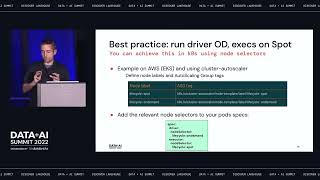
Since the general availability of Apache Spark’s native support for running on Kubernetes with Spark 3.1 in March 2021, the Spark community is increasingly choosing to run on k8s to benefit of containerization, efficient resource-sharing, and the tools from the cloud-native ecosystem.

Data teams are faced with complexities in this transition, including how to leverage spot VMs. These instances enable up to 90% cost savings but are not guaranteed to be available and face the risk of termination. This session will cover concrete guidelines on how to make Spark run reliably on spot instances, with code examples from real-world use cases.

Main topics: • Using spot nodes for Spark executors • Mixing instance types & sizes to reduce risk of spot interruptions - cluster autoscaling • Spark 3.0: Graceful Decommissioning - preserve shuffle files on executor shutdown • Spark 3.1: PVC reuse on executor restart - disaggregate compute & shuffle storage • What to look for in future Spark releases

Connect with us: Website: https://databricks.com Facebook: https://www.facebook.com/databricksinc Twitter: https://twitter.com/databricks LinkedIn: https://www.linkedin.com/company/data... Instagram: https://www.instagram.com/databricksinc/

Managing Straggler Executors at Apache Spark 3.3

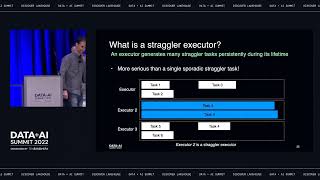
Tuning high-performance Apache Spark applications to handle mis-behaving executors is at best challenging and at worst impossible. Apache Spark does provide some built-in support to kill and recreate new executors under certain conditions such as long GC delays or due to application errors. However this still leaves-open various scenarios where slow-running executors can impact the overall performance of your application even when you enable features such as task speculation. In this talk, we are going to describe Apache Spark 3.3’s new feature, Executor Rolling. Apache Spark 3.3 (SPARK-37810) provides a built-in executor rolling driver plugin with three configurations.

spark.kubernetes.executor.rollInterval (default: '0s' which means being disabled.) spark.kubernetes.executor.rollPolicy (default: OUTLIER) spark.kubernetes.executor.minTasksPerExecutorBeforeRolling (default: 0)

This driver plugin tries to choose and decommission a single executor at every interval with the given policy. The followings are the built-in policies and their targets.

  • ID: An executor with the smallest executor ID
  • ADD_TIME: An executor with the smallest add-time
  • TOTAL_GC_TIME: An executor with the biggest GC time
  • TOTAL_DURATION: An executor with the biggest total task time
  • AVERAGE_DURATION: An executor with the biggest average task duration
  • FAILED_TASKS: An executor with the largest number of failed tasks
  • OUTLIER: An outlier executor or the biggest total task time

In short, Apache Spark 3.3 maintains the set of live executors literally freshly and reduces much engineering burdens to handle executors’ JVM misbehavior at diverse production jobs by utilizing the proposed built-in executor rolling policies in advance.

Connect with us: Website: https://databricks.com Facebook: https://www.facebook.com/databricksinc Twitter: https://twitter.com/databricks LinkedIn: https://www.linkedin.com/company/data... Instagram: https://www.instagram.com/databricksinc/

Apache Spark on Kubernetes—Lessons Learned from Launching Millions of Spark Executors

At Apple, data scientists and engineers are running enormous Spark workloads to deliver amazing cloud services. Apple Cloud Service supports the ever-increasing scale of Spark workloads and resource requirements with great user experience: from code to deployment management, one interface for all compute backends.

In this talk, Aaruna and Zhou would walk through the lessons we learnt and pitfalls encountered for supporting the service at Apple scale - we would share how Apple Cloud Services effectively orchestrate Spark applications, as well as the seamless switchover among different resource managers - be it in Mesos or Kubernetes, private or on-premise infrastructure. We will also cover the monitoring system and how it helps tuning Spark resource requirements with actual execution analysis.

Connect with us: Website: https://databricks.com Facebook: https://www.facebook.com/databricksinc Twitter: https://twitter.com/databricks LinkedIn: https://www.linkedin.com/company/data... Instagram: https://www.instagram.com/databricksinc/

Building Metadata and Lineage Driven Pipelines on Kubernetes

Machine Learning becomes a critical role in every industry amid its widespread adoption. Composing an ML pipeline at a rapid pace is an inevitable way for success. However, an ML pipeline consists of several components and needs various efforts of different teams, including data engineers, data scientists, ML engineers, etc. A typical cooperation strategy is to define a sequence of tasks, coordinate the integration, test, apply fixes and enhancements, and repeat. ML pipeline components produced by task-driven approach lack reusability only maintenance efforts. Kubeflow Pipelines, a platform making deployments of ML pipeline on Kubernetes straightforward and scalable, provides metadata and lineage-driven approach to develop platform-independent and portable ML pipelines. Data linkage and propagation become crystal clear within ML pipelines. It also nourishes ML pipeline composition.

Connect with us: Website: https://databricks.com Facebook: https://www.facebook.com/databricksinc Twitter: https://twitter.com/databricks LinkedIn: https://www.linkedin.com/company/data... Instagram: https://www.instagram.com/databricksinc/

Distributed Machine Learning at Lyft

Data collection, preprocessing, feature engineering are the fundamental steps in any Machine Learning Pipeline. After feature engineering, being able to parallelize training on multiple low cost machines helps to reduce cost and time both. And, then being able to train models in a distributed manner speeds up Hyperparameter Tuning. How can we unify these stages of ML Pipeline in one unified distributed training platform together? And that too on Kubernetes?

Our ML platform is completely based on Kubernetes because of its scalability and rapid bootstrapping time of resources. In this talk we will demonstrate how Lyft uses Spark on Kubernetes, Fugue (our home grown unifying compute abstraction layer) to design a holistic end to end ML Pipeline system for distributed feature engineering, training & prediction experience for our customers on our ML Platform on top of Spark on K8s. We will also do a deep dive to show how we are abstracting and hiding infrastructure complexities so that our Data Scientists and Research Scientist can focus only on the business logic for their models through simple pythonic APIs and SQL. We let the users focus on ''what to do'' and the platform takes care of ''how to do''. We will share our challenges, learning and the fun we had while implementing. Using Spark on K8s have helped us achieve large scale data processing with 90% less cost and at times bringing down processing time from 2 hours to less than 20 mins.

Connect with us: Website: https://databricks.com Facebook: https://www.facebook.com/databricksinc Twitter: https://twitter.com/databricks LinkedIn: https://www.linkedin.com/company/data... Instagram: https://www.instagram.com/databricksinc/

Efficient and Multi-Tenant Scheduling of Big Data and AI Workloads

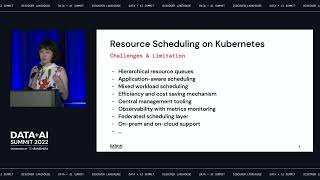
Many ML and big data teams in the open source community are looking to run their workloads in the cloud and they invariably face a common set of challenges such as multi-tenant cluster management, resource fairness and sharing, gang scheduling and cost-effective infrastructure operations. Kubernetes is the de-facto standard platform for running containerized applications in the cloud. However, the default resource scheduler in Kubernetes leaves more to be desired for AI scenarios when running ML/DL training workloads or large-scale data processing jobs for feature engineering.

In this talk, we will share how the community leverage and build upon Apache YuniKorn to address the unique resource scheduling needs for ML and big data teams.

Connect with us: Website: https://databricks.com Facebook: https://www.facebook.com/databricksinc Twitter: https://twitter.com/databricks LinkedIn: https://www.linkedin.com/company/data... Instagram: https://www.instagram.com/databricksinc/

How socat and UNIX Pipes Can Help Data Integration

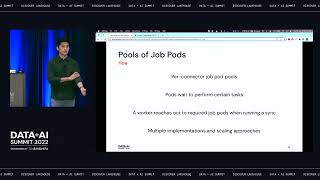
Nearly every developer is familiar with creating a CLI. Containerized CLIs provide a flexible, cross-language standard with a low barrier to entry for open-source contributors. The ETL process can be reduced to two CLIs: one that reads data and one that writes data. While this interface is simple enough to implement from the contributor’s side, Kubernetes’ distributed nature means orchestrating data transfer between the CLIs on Kubernetes presents an unsolved problem.

This talk describes a novel approach to reliably orchestrate CLIs on Kubernetes for data integration. Through this lens, we go through the evaluation of strategies and describe the pros and cons of each architecture for horizontally scaling containerised data integration workflows on Kubernetes. We also cover the journey of implementing a TCP-based “process” abstraction over CLIs using socat and UNIX pipes. This same approach powers all of Airbyte’s Kubernetes deployments and helps sync TBs of data daily.

Connect with us: Website: https://databricks.com Facebook: https://www.facebook.com/databricksinc Twitter: https://twitter.com/databricks LinkedIn: https://www.linkedin.com/company/data... Instagram: https://www.instagram.com/databricksinc/

Summary Data engineering is a large and growing subject, with new technologies, specializations, and "best practices" emerging at an accelerating pace. This podcast does its best to explore this fractal ecosystem, and has been at it for the past 5+ years. In this episode Joe Reis, founder of Ternary Data and co-author of "Fundamentals of Data Engineering", turns the tables and interviews the host, Tobias Macey, about his journey into podcasting, how he runs the show behind the scenes, and the other things that occupy his time.

Announcements

Hello and welcome to the Data Engineering Podcast, the show about modern data management When you’re ready to build your next pipeline, or want to test out the projects you hear about on the show, you’ll need somewhere to deploy it, so check out our friends at Linode. With their new managed database service you can launch a production ready MySQL, Postgres, or MongoDB cluster in minutes, with automated backups, 40 Gbps connections from your application hosts, and high throughput SSDs. Go to dataengineeringpodcast.com/linode today and get a $100 credit to launch a database, create a Kubernetes cluster, or take advantage of all of their other services. And don’t forget to thank them for their continued support of this show! RudderStack helps you build a customer data platform on your warehouse or data lake. Instead of trapping data in a black box, they enable you to easily collect customer data from the entire stack and build an identity graph on your warehouse, giving you full visibility and control. Their SDKs make event streaming from any app or website easy, and their state-of-the-art reverse ETL pipelines enable you to send enriched data to any cloud tool. Sign up free… or just get the free t-shirt for being a listener of the Data Engineering Podcast at dataengineeringpodcast.com/rudder. Data teams are increasingly under pressure to deliver. According to a recent survey by Ascend.io, 95% in fact reported being at or over capacity. With 72% of data experts reporting demands on their team going up faster than they can hire, it’s no surprise they are increasingly turning to automation. In fact, while only 3.5% report having current investments in automation, 85% of data teams plan on investing in automation in the next 12 months. 85%!!! That’s where our friends at Ascend.io come in. The Ascend Data Automation Cloud provides a unified platform for data ingestion, transformation, orchestration, and observability. Ascend users love its declarative pipelines, powerful SDK, elegant UI, and extensible plug-in architecture, as well as its support for Python, SQL, Scala, and Java. Ascend automates workloads on Snowflake, Databricks, BigQuery, and open source Spark, and can be deployed in AWS, Azure, or GCP. Go to dataengineeringpodcast.com/ascend and sign up for a free trial. If you’re a data engineering podcast listener, you get credits worth $5,000 when you become a customer. Your host is Tobias Macey and today we’re flipping the script. Joe Reis of Ternary Data will be interviewing me about my time as the host of this show and my perspectives on the data ecosystem
Interview

Introduction How did you get involved in the area of data management? Now I’ll hand it off to Joe…

Joe’s Notes

You do a lot of podcasts. Why? Podcast.init started in 2015, and your first episode of Data Engineering was published January 14, 2017. Walk us through the start of these podcasts. why not a data science podcast? why DE? You’ve published 306 of shows of the Data Engineering Podcast, plus 370 for the init podcast, then you’ve got a new ML podcast. How have you kept the motivation over the years? What’s the process for the show (finding guests, topics, etc….recording, publishing)? It’s a lot of work. Walk us through this process. You’ve done a ton of shows and have a lot of context with what’s going on in the field of both data engineering and Python. What have been some of the

Summary There are extensive and valuable data sets that are available outside the bounds of your organization. Whether that data is public, paid, or scraped it requires investment and upkeep to acquire and integrate it with your systems. Crux was built to reduce the total cost of acquisition and ownership for integrating external data, offering a fully managed service for delivering those data assets in the manner that best suits your infrastructure. In this episode Crux CTO Mark Etherington discusses the different costs involved in managing external data, how to think about the total return on investment for your data, and how the Crux platform is architected to reduce the toil involved in managing third party data.

Announcements

Hello and welcome to the Data Engineering Podcast, the show about modern data management When you’re ready to build your next pipeline, or want to test out the projects you hear about on the show, you’ll need somewhere to deploy it, so check out our friends at Linode. With their new managed database service you can launch a production ready MySQL, Postgres, or MongoDB cluster in minutes, with automated backups, 40 Gbps connections from your application hosts, and high throughput SSDs. Go to dataengineeringpodcast.com/linode today and get a $100 credit to launch a database, create a Kubernetes cluster, or take advantage of all of their other services. And don’t forget to thank them for their continued support of this show! Atlan is the metadata hub for your data ecosystem. Instead of locking your metadata into a new silo, unleash its transformative potential with Atlan’s active metadata capabilities. Push information about data freshness and quality to your business intelligence, automatically scale up and down your warehouse based on usage patterns, and let the bots answer those questions in Slack so that the humans can focus on delivering real value. Go to dataengineeringpodcast.com/atlan today to learn more about how Atlan’s active metadata platform is helping pioneering data teams like Postman, Plaid, WeWork & Unilever achieve extraordinary things with metadata and escape the chaos. Modern data teams are dealing with a lot of complexity in their data pipelines and analytical code. Monitoring data quality, tracing incidents, and testing changes can be daunting and often takes hours to days or even weeks. By the time errors have made their way into production, it’s often too late and damage is done. Datafold built automated regression testing to help data and analytics engineers deal with data quality in their pull requests. Datafold shows how a change in SQL code affects your data, both on a statistical level and down to individual rows and values before it gets merged to production. No more shipping and praying, you can now know exactly what will change in your database! Datafold integrates with all major data warehouses as well as frameworks such as Airflow & dbt and seamlessly plugs into CI workflows. Visit dataengineeringpodcast.com/datafold today to book a demo with Datafold. Tired of deploying bad data? Need to automate data pipelines with less red tape? Shipyard is the premier data orchestration platform built to help your data team quickly launch, monitor, and share workflows in a matter of minutes. Build powerful workflows that connect your entire data stack end-to-end with a mix of your code and their open-source, low-code templates. Once launched, Shipyard makes data observability easy with logging, alerting, and retries that will catch errors before your business team does. So whether you’re ingesting data from an API, transforming it with dbt, updating BI tools, or sending data alerts, Shipyard centralizes these operations and handles the heavy lifting so your data team can finally focus on what they’re good at — solving problems with data. Go to dataengineeringpodcast.com/shipyard to get started automating with their free developer plan today! Your host is Tobias M

Summary Building a data platform is a journey, not a destination. Beyond the work of assembling a set of technologies and building integrations across them, there is also the work of growing and organizing a team that can support and benefit from that platform. In this episode Inbar Yogev and Lior Winner share the journey that they and their teams at Riskified have been on for their data platform. They also discuss how they have established a guild system for training and supporting data professionals in the organization.

Announcements

Hello and welcome to the Data Engineering Podcast, the show about modern data management When you’re ready to build your next pipeline, or want to test out the projects you hear about on the show, you’ll need somewhere to deploy it, so check out our friends at Linode. With their new managed database service you can launch a production ready MySQL, Postgres, or MongoDB cluster in minutes, with automated backups, 40 Gbps connections from your application hosts, and high throughput SSDs. Go to dataengineeringpodcast.com/linode today and get a $100 credit to launch a database, create a Kubernetes cluster, or take advantage of all of their other services. And don’t forget to thank them for their continued support of this show! Atlan is the metadata hub for your data ecosystem. Instead of locking your metadata into a new silo, unleash its transformative potential with Atlan’s active metadata capabilities. Push information about data freshness and quality to your business intelligence, automatically scale up and down your warehouse based on usage patterns, and let the bots answer those questions in Slack so that the humans can focus on delivering real value. Go to dataengineeringpodcast.com/atlan today to learn more about how Atlan’s active metadata platform is helping pioneering data teams like Postman, Plaid, WeWork & Unilever achieve extraordinary things with metadata and escape the chaos. Modern data teams are dealing with a lot of complexity in their data pipelines and analytical code. Monitoring data quality, tracing incidents, and testing changes can be daunting and often takes hours to days or even weeks. By the time errors have made their way into production, it’s often too late and damage is done. Datafold built automated regression testing to help data and analytics engineers deal with data quality in their pull requests. Datafold shows how a change in SQL code affects your data, both on a statistical level and down to individual rows and values before it gets merged to production. No more shipping and praying, you can now know exactly what will change in your database! Datafold integrates with all major data warehouses as well as frameworks such as Airflow & dbt and seamlessly plugs into CI workflows. Visit dataengineeringpodcast.com/datafold today to book a demo with Datafold. Tired of deploying bad data? Need to automate data pipelines with less red tape? Shipyard is the premier data orchestration platform built to help your data team quickly launch, monitor, and share workflows in a matter of minutes. Build powerful workflows that connect your entire data stack end-to-end with a mix of your code and their open-source, low-code templates. Once launched, Shipyard makes data observability easy with logging, alerting, and retries that will catch errors before your business team does. So whether you’re ingesting data from an API, transforming it with dbt, updating BI tools, or sending data alerts, Shipyard centralizes these operations and handles the heavy lifting so your data team can finally focus on what they’re good at — solving problems with data. Go to dataengineeringpodcast.com/shipyard to get started automating with their free developer plan today! Your host is Tobias Macey and today I’m interviewing Inbar Yogev and Lior Winner about the data platform that the team at Riskified are building to power their fraud management service

Interview

Introduction How did

Summary Building and maintaining reliable data assets is the prime directive for data engineers. While it is easy to say, it is endlessly complex to implement, requiring data professionals to be experts in a wide range of disparate topics while designing and implementing complex topologies of information workflows. In order to make this a tractable problem it is essential that engineers embrace automation at every opportunity. In this episode Chris Riccomini shares his experiences building and scaling data operations at WePay and LinkedIn, as well as the lessons he has learned working with other teams as they automated their own systems.

Announcements

Hello and welcome to the Data Engineering Podcast, the show about modern data management When you’re ready to build your next pipeline, or want to test out the projects you hear about on the show, you’ll need somewhere to deploy it, so check out our friends at Linode. With their new managed database service you can launch a production ready MySQL, Postgres, or MongoDB cluster in minutes, with automated backups, 40 Gbps connections from your application hosts, and high throughput SSDs. Go to dataengineeringpodcast.com/linode today and get a $100 credit to launch a database, create a Kubernetes cluster, or take advantage of all of their other services. And don’t forget to thank them for their continued support of this show! RudderStack helps you build a customer data platform on your warehouse or data lake. Instead of trapping data in a black box, they enable you to easily collect customer data from the entire stack and build an identity graph on your warehouse, giving you full visibility and control. Their SDKs make event streaming from any app or website easy, and their state-of-the-art reverse ETL pipelines enable you to send enriched data to any cloud tool. Sign up free… or just get the free t-shirt for being a listener of the Data Engineering Podcast at dataengineeringpodcast.com/rudder. Data teams are increasingly under pressure to deliver. According to a recent survey by Ascend.io, 95% in fact reported being at or over capacity. With 72% of data experts reporting demands on their team going up faster than they can hire, it’s no surprise they are increasingly turning to automation. In fact, while only 3.5% report having current investments in automation, 85% of data teams plan on investing in automation in the next 12 months. 85%!!! That’s where our friends at Ascend.io come in. The Ascend Data Automation Cloud provides a unified platform for data ingestion, transformation, orchestration, and observability. Ascend users love its declarative pipelines, powerful SDK, elegant UI, and extensible plug-in architecture, as well as its support for Python, SQL, Scala, and Java. Ascend automates workloads on Snowflake, Databricks, BigQuery, and open source Spark, and can be deployed in AWS, Azure, or GCP. Go to dataengineeringpodcast.com/ascend and sign up for a free trial. If you’re a data engineering podcast listener, you get credits worth $5,000 when you become a customer. Your host is Tobias Macey and today I’m interviewing Chris Riccomini about building awareness of data usage into CI/CD pipelines for application development
Interview

Introduction How did you get involved in the area of data management? What are the pieces of data platforms and processing that have been most difficult to scale in an organizational sense? What are the opportunities for automation to alleviate some of the toil that data and analytics engineers get caught up in? The application delivery ecosystem has been going through ongoing transformation in the form of CI/CD, infrastructure as code, etc. What are the parallels in the data ecosystem that are still nascent? What are the principles that still need to be translated for data practitioners? Which are subject to impedance mismatch and may never make sense to translate? As someone with a software engineering background and extensive e

Summary The perennial challenge of data engineers is ensuring that information is integrated reliably. While it is straightforward to know whether a synchronization process succeeded, it is not always clear whether every record was copied correctly. In order to quickly identify if and how two data systems are out of sync Gleb Mezhanskiy and Simon Eskildsen partnered to create the open source data-diff utility. In this episode they explain how the utility is implemented to run quickly and how you can start using it in your own data workflows to ensure that your data warehouse isn’t missing any records from your source systems.

Announcements

Hello and welcome to the Data Engineering Podcast, the show about modern data management When you’re ready to build your next pipeline, or want to test out the projects you hear about on the show, you’ll need somewhere to deploy it, so check out our friends at Linode. With their new managed database service you can launch a production ready MySQL, Postgres, or MongoDB cluster in minutes, with automated backups, 40 Gbps connections from your application hosts, and high throughput SSDs. Go to dataengineeringpodcast.com/linode today and get a $100 credit to launch a database, create a Kubernetes cluster, or take advantage of all of their other services. And don’t forget to thank them for their continued support of this show! Random data doesn’t do it — and production data is not safe (or legal) for developers to use. What if you could mimic your entire production database to create a realistic dataset with zero sensitive data? Tonic.ai does exactly that. With Tonic, you can generate fake data that looks, acts, and behaves like production because it’s made from production. Using universal data connectors and a flexible API, Tonic integrates seamlessly into your existing pipelines and allows you to shape and size your data to the scale, realism, and degree of privacy that you need. The platform offers advanced subsetting, secure de-identification, and ML-driven data synthesis to create targeted test data for all of your pre-production environments. Your newly mimicked datasets are safe to share with developers, QA, data scientists—heck, even distributed teams around the world. Shorten development cycles, eliminate the need for cumbersome data pipeline work, and mathematically guarantee the privacy of your data, with Tonic.ai. Data Engineering Podcast listeners can sign up for a free 2-week sandbox account, go to dataengineeringpodcast.com/tonic today to give it a try! Data teams are increasingly under pressure to deliver. According to a recent survey by Ascend.io, 95% in fact reported being at or over capacity. With 72% of data experts reporting demands on their team going up faster than they can hire, it’s no surprise they are increasingly turning to automation. In fact, while only 3.5% report having current investments in automation, 85% of data teams plan on investing in automation in the next 12 months. 85%!!! That’s where our friends at Ascend.io come in. The Ascend Data Automation Cloud provides a unified platform for data ingestion, transformation, orchestration, and observability. Ascend users love its declarative pipelines, powerful SDK, elegant UI, and extensible plug-in architecture, as well as its support for Python, SQL, Scala, and Java. Ascend automates workloads on Snowflake, Databricks, BigQuery, and open source Spark, and can be deployed in AWS, Azure, or GCP. Go to dataengineeringpodcast.com/ascend and sign up for a free trial. If you’re a data engineering podcast listener, you get credits worth $5,000 when you become a customer. RudderStack helps you build a customer data platform on your warehouse or data lake. Instead of trapping data in a black box, they enable you to easily collect customer data from the entire stack and build an identity graph on your warehouse, giving you full visibility and control. Their SDKs make event streaming from any app or