Discussion of Rightmove's data hive and analytics platform.
 talk-data.com
Topic
Spark
Apache Spark
big_data
distributed_computing
analytics
581
tagged
Activity Trend
71
peak/qtr
2020-Q1
2026-Q2
Top Events
O'Reilly Data Engineering Books
143
Databricks DATA + AI Summit 2023
120
Data Engineering Podcast
84
Data + AI Summit 2025
66
O'Reilly Data Science Books
20
DATA MINER Big Data Europe Conference 2020
8
Microsoft Ignite 2025
7
Airflow Summit 2020
7
Google Cloud Next '24
6
Airflow Summit 2024
6
Big Data LDN 2025
5
Google Cloud Next '25
5
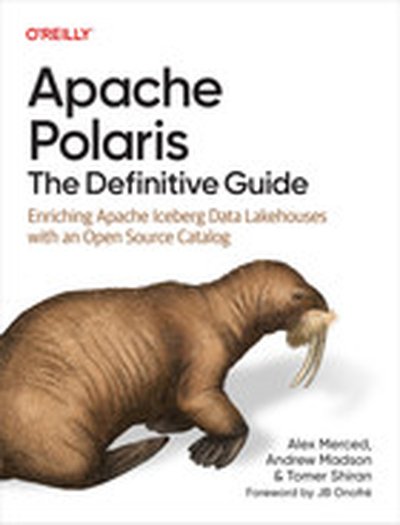
Revolutionize your understanding of modern data management with Apache Polaris (incubating), the open source catalog designed for data lakehouse industry standard Apache Iceberg. This comprehensive guide takes you on a journey through the intricacies of Apache Iceberg data lakehouses, highlighting the pivotal role of Iceberg catalogs. Authors Alex Merced, Andrew Madson, and Tomer Shiran explore Apache Polaris's architecture and features in detail, equipping you with the knowledge needed to leverage its full potential. Data engineers, data architects, data scientists, and data analysts will learn how to seamlessly integrate Apache Polaris with popular data tools like Apache Spark, Snowflake, and Dremio to enhance data management capabilities, optimize workflows, and secure datasets. Get a comprehensive introduction to Iceberg data lakehouses Understand how catalogs facilitate efficient data management and querying in Iceberg Explore Apache Polaris's unique architecture and its powerful features Deploy Apache Polaris locally, and deploy managed Apache Polaris from Snowflake and Dremio Perform basic table operations on Apache Spark, Snowflake, and Dremio
Discover how data management maturity assessments can spark group-wide excellence in data-driven decision making. We will explore the interview-based approach of OTP Group supported by DAMA Hungary, share how its results can be turned into practical value, and give a glimpse into OTP Group’s journey. You’ll also get a teaser of a potential AI-powered agent designed to make assessments smarter and faster, and a look at our vision for future innovation.
Summary In this episode of the Data Engineering Podcast Hannes Mühleisen and Mark Raasveldt, the creators of DuckDB, share their work on Duck Lake, a new entrant in the open lakehouse ecosystem. They discuss how Duck Lake, is focused on simplicity, flexibility, and offers a unified catalog and table format compared to other lakehouse formats like Iceberg and Delta. Hannes and Mark share insights into how Duck Lake revolutionizes data architecture by enabling local-first data processing, simplifying deployment of lakehouse solutions, and offering benefits such as encryption features, data inlining, and integration with existing ecosystems.
Announcements Hello and welcome to the Data Engineering Podcast, the show about modern data managementData teams everywhere face the same problem: they're forcing ML models, streaming data, and real-time processing through orchestration tools built for simple ETL. The result? Inflexible infrastructure that can't adapt to different workloads. That's why Cash App and Cisco rely on Prefect. Cash App's fraud detection team got what they needed - flexible compute options, isolated environments for custom packages, and seamless data exchange between workflows. Each model runs on the right infrastructure, whether that's high-memory machines or distributed compute. Orchestration is the foundation that determines whether your data team ships or struggles. ETL, ML model training, AI Engineering, Streaming - Prefect runs it all from ingestion to activation in one platform. Whoop and 1Password also trust Prefect for their data operations. If these industry leaders use Prefect for critical workflows, see what it can do for you at dataengineeringpodcast.com/prefect.Data migrations are brutal. They drag on for months—sometimes years—burning through resources and crushing team morale. Datafold's AI-powered Migration Agent changes all that. Their unique combination of AI code translation and automated data validation has helped companies complete migrations up to 10 times faster than manual approaches. And they're so confident in their solution, they'll actually guarantee your timeline in writing. Ready to turn your year-long migration into weeks? Visit dataengineeringpodcast.com/datafold today for the details. Your host is Tobias Macey and today I'm interviewing Hannes Mühleisen and Mark Raasveldt about DuckLake, the latest entrant into the open lakehouse ecosystemInterview IntroductionHow did you get involved in the area of data management?Can you describe what DuckLake is and the story behind it?What are the particular problems that DuckLake is solving for?How does this compare to the capabilities of MotherDuck?Iceberg and Delta already have a well established ecosystem, but so does DuckDB. Who are the primary personas that you are trying to focus on in these early days of DuckLake?One of the major factors driving the adoption of formats like Iceberg is cost efficiency for large volumes of data. That brings with it challenges of large batch processing of data. How does DuckLake account for these axes of scale?There is also a substantial investment in the ecosystem of technologies that support Iceberg. The most notable ecosystem challenge for DuckDB and DuckLake is in the query layer. How are you thinking about the evolution and growth of that capability beyond DuckDB (e.g. support in Trino/Spark/Flink)?What are your opinions on the viability of a future where DuckLake and Iceberg become a unified standard and implementation? (why can't Iceberg REST catalog implementations just use DuckLake under the hood?)Digging into the specifics of the specification and implementation, what are some of the capabilities that it offers above and beyond Iceberg?Is it now possible to enforce PK/FK constraints, indexing on underlying data?Given that DuckDB has a vector type, how do you think about the support for vector storage/indexing?How do the capabilities of DuckLake and the integration with DuckDB change the ways that data teams design their data architecture and access patterns?What are your thoughts on the impact of "data gravity" in today's data ecosystem, with engines like DuckDB, KuzuDB, LanceDB, etc. available for embedded and edge use cases?What are the most interesting, innovative, or unexpected ways that you have seen DuckLake used?What are the most interesting, unexpected, or challenging lessons that you have learned while working on DuckLake?When is DuckLake the wrong choice?What do you have planned for the future of DuckLake?Contact Info HannesWebsiteMarkWebsiteParting Question From your perspective, what is the biggest gap in the tooling or technology for data management today?Closing Announcements Thank you for listening! Don't forget to check out our other shows. Podcast.init covers the Python language, its community, and the innovative ways it is being used. The AI Engineering Podcast is your guide to the fast-moving world of building AI systems.Visit the site to subscribe to the show, sign up for the mailing list, and read the show notes.If you've learned something or tried out a project from the show then tell us about it! Email [email protected] with your story.Links DuckDBPodcast EpisodeDuckLakeDuckDB LabsMySQLCWIMonetDBIcebergIceberg REST CatalogDeltaHudiLanceDuckDB Iceberg ConnectorACID == Atomicity, Consistency, Isolation, DurabilityMotherDuckMotherDuck Managed DuckLakeTrinoSparkPrestoSpark DuckLake DemoDelta KernelArrowdltS3 TablesAttribute Based Access Control (ABAC)ParquetArrow FlightHadoopHDFSDuckLake RoadmapThe intro and outro music is from The Hug by The Freak Fandango Orchestra / CC BY-SA
Session on building an open lakehouse using Apache Spark and Apache Iceberg.
Session on achieving 3x cost-performance improvements with Spark.
Lightning Talks are short, 5-minute presentations open to all attendees. They’re a fun and fast-paced way to share ideas, showcase projects, spark discussions, or raise awareness about topics you care about — whether technical, community-related, or just inspiring.
No slides are required, and talks can be spontaneous or prepared. It’s a great chance to speak up and connect with the community!
The presentation will introduce the “Stile eco-system” developed at ING Analytics to speed up the time to market of machine learning models for the instant lending domain. The main issue to solve is the duality between Spark and Pandas for feature generation. Spark is used for development while dealing with the billions of transactions stored in the data warehouse. Pandas is used in production when applications are scored one by one in a real-time situation. During the presentation, Gilles will explain how the template for model development works, with a specific focus on feature creation. Additionally, Gilles will highlight how Pandas and PySpark are integrated in common functionalities, and the user-friendly testing framework developed to ensure consistency between the two worlds, and, finally, how to easily trim the code to only produce the features required for the final model. Gilles Verbockhaven is Chapter Lead at ING Retail Banking Analytics and manages a team of five Data Scientists. He has been working at ING for 20 years now and has experience in various domains, ranging from market risk to modelling. Since 2017, he has been working in the Machine Learning area and has specialized in designing analytic solutions for collections and pricing. In his free time, he spends his energy running and biking.
Sara Stoudt—Opening the Door: Designing Data Visualizations to Spark Creative Writing (Outlier 2025)
🌟Outlier is a one-of-a-kind data visualization conference hosted by the Data Visualization Society. Outlier brings together all corners of the data visualization community, from artists to business intelligence developers, working in various tech stacks and media. Attendees stretch their creativity and learn from practitioners who they may not otherwise connect with. Learn more on the Outlier website: https://www.outlierconf.com/
📈About the Data Visualization Society: The Data Visualization Society was founded to serve as a professional home for those working across the discipline. Our mission is to connect data visualizers across tech stacks, subject areas, and experience. Advance your skills and grow your network by joining our community: https://www.datavisualizationsociety.org/
Info session about LLM Mini Bootcamp; join to ask questions and receive a discount coupon.
Se desarrolló una solución en Microsoft Fabric que registra automáticamente la trazabilidad de datos en Purview desde notebooks Spark. Usando PyApacheAtlas y autenticación con Service Principal en Key Vault, se crean entidades y procesos que permiten visualizar el flujo de datos entre tablas del Lakehouse.
What moment or realization inspired you to pursue your career path?
Apache Bigtop is a time-proven open-source software stack for building data platform, which has been built around the Hadoop and Spark ecosystem since 2011. Its software composition has been changed during such a long period, and recently job scheduler is removed mainly due to the inactivity of its development. The speaker believes that Airflow perfectly fits into this gap and is proposing incorporating it in the Bigtop stack. This presentation will introduce how easily users can build a data platform with Bigtop including Airflow, and how Airflow can integrate those software with its wide range of providers and enterprise-readiness such as the Kerberos support.
KP Division of Research uses Airflow as a central technology for integrating diverse technologies in an agile setting. We wish to present a set of use-cases for AI/ML workloads, including imaging analysis (tissue segmentation, mammography), NLP (early identification of psychosis), LLM processing (identification of vessel diameter from radiological impressions), and other large data processing tasks. We create these “short-lived” project workflows to accomplish specific aims, and then may never run the job again, so leveraging generalized patterns are crucial to quickly implementing these jobs. Our Advanced Computational Infrastructure is comprised of multiple Kubernetes clusters, and we use Airflow to democratize the use of our batch level resources in those clusters. We use Airflow form-based parameters to deploy pods running R and Python scripts where generalized parameters are injected into scripts that follow internal programming patterns. Finally, we also leverage Airflow to create headless services inside Kubernetes for large computational workloads (Spark & H2O) that subsequent pods consume ephemerally.
As your organization scales to 20+ data science teams and 300+ DS/ML/DE engineers, you face a critical challenge: how to build a secure, reliable, and scalable orchestration layer that supports both fast experimentation and stable production workflows. We chose Airflow — and didn’t regret it! But to make it truly work at our scale, we had to rethink its architecture from the ground up. In this talk, we’ll share how we turned Airflow into a powerful MLOps platform through its core capability: running pipelines across multiple K8s GPU clusters from a single UI (!) using per-cluster worker pools. To support ease of use, we developed MLTool — our own library for fast and standardized DAG development, integrated Vault for secure secret management across teams, enabled real-time logging with S3 persistence and built a custom SparkSubmitOperator for Kerberos-authenticated Spark/Hadoop jobs in Kubernetes. We also streamlined the developer experience — users can generate a GitLab repo and deploy a versioned pipeline to prod in under 10 minutes! We’re proud of what we’ve built — and our users are too. Now we want to share it with the world!
OpenLineage has simplified collecting lineage metadata across the data ecosystem by standardizing its representation in an extensible model. It enabled a whole ecosystem improving data pipeline reliability and ease of troubleshooting in production environments. In this talk, we’ll briefly introduce the OpenLineage model and explore how this metadata is collected from Airflow, Spark, dbt, and Flink. We’ll demonstrate how to extract valuable insights and outline practical benefits and common challenges when building ingestion, processing and storage for OpenLineage data. We will also briefly show how OpenLineage events can be used to observe data pipelines exhastively and the benefits that brings.