talk-data.com talk-data.com

Topic

SQL

Structured Query Language (SQL)

database_language data_manipulation data_definition programming_language

1751

tagged

Activity Trend

107 peak/qtr
2020-Q1 2026-Q1

Activities

1751 activities · Newest first

Microsoft® SQL Server® Reporting Services Recipes: for Designing Expert Reports

Learn to design more effective and sophisticated business reports While most users of SQL Server Reporting Services are now comfortable designing and building simple reports, business today demands increasingly complex reporting. In this book, top Reporting Services design experts have contributed step-by-step recipes for creating various types of reports. Written by well-known SQL Server Reporting Services experts, this book gives you the tools to meet your clients' needs Coverage includes: Business Reporting Paradigms Basic Report Design Concepts Using Report Builder. Report Design Essentials Tabular and Matrix Reports Expressions and Custom Code Formatting Report Data Columnar and Grouped Reports Bi Dashboards and Elements Synchronizing Groups, Charts, and Sparklines Chart and Gauge Reports Creating a Personal Report Card Creating a Multi-Series Multi-Y Axis Chart Interactive Reporting Integrated Reporting Applications Offline Reporting Using The Report Viewer Control Creating a Calendar Report Creating Mailing Labels Barcodes Excel Worksheet Naming and Page Naming External Image Sources Language Localization Creating a Checkbox List To Show Existing Records Using a Checkbox List To Select and Deselect Records Using The Map Wizard Filtering and Parameterization Multiple Criterion Report Filtering Using Multi-Value Parameters with a Stored Procedure Using Multi-Value Parameters with a Subscription Report Creating Custom Sorting Reports Filtering User-Specific Report Data Custom and Dynamic Data Sources Using a Web Service As a Data Source Reporting On Sharepoint List Data Dynamics Ax Report Wizard and More! Microsoft® SQL Server® Reporting Services Recipes brings together great report designs that have been field-tested by the experts Note: CD-ROM/DVD and other supplementary materials are not included as part of eBook file.
The Excel® Analyst's Guide to Access®

The ultimate handbook for Excel analysts who need reporting solutions using Access Excel and Access are intended to work together. This book offers a comprehensive review of the extensive analytical and reporting functionality that Access provides and how it enhances Excel reporting functions. Sales managers, operations analysts, administrative assistants, office managers, and many others who rely heavily on data can benefit from learning to integrate Excel and Access, and this book shows you how. Coverage includes: Data Analysis in Access & the Basics of Access Beyond Select Queries Transforming Your Data with Access Working with Calculations and Dates Performing Conditional Analysis Adding Dimension with Subqueries and Domain Aggregate Functions Running Descriptive Statistics in Access Scheduling and Running Batch Analysis Leveraging VBA to Enhance Data Analysis Reports, Dashboards, and Visualization in Access Presenting Data with Access Reports Using Pivot Tables and Pivot Charts in Access Enhancing Queries and Reports with Visualizations Advanced Excel and Access Integration Techniques Getting Access Data into Excel Using VBA to Move Data between Excel and Access Exploring Excel and Access Automation Integrating Excel and Access with XML Integrating Excel and Other Of?ce Applications Access VBA Fundamentals Understanding and Using SQL and more! The Excel Analyst's Guide to Access helps you get more from both applications. Note: CD-ROM/DVD and other supplementary materials are not included as part of eBook file.
Microsoft® Business Intelligence For Dummies®

Learn to create an effective business strategy using Microsoft's BI stack Microsoft Business Intelligence tools are among the most widely used applications for gathering, providing access to, and analyzing data to enable the enterprise to make sound business decisions. The tools include SharePoint Server, the Office Suite, PerformancePoint Server, and SQL Server, among others. With so much jargon and so many technologies involved, Microsoft Business Intelligence For Dummies provides a much-needed step-by-step explanation of what's involved and how to use this powerful package to improve your business. Microsoft Business Intelligence encompasses a broad collection of tools designed to help business owners and managers direct the enterprise effectively This guide provides an overview of SharePoint, PerformancePoint, the SQL Server suite, Microsoft Office, and the BI development technologies Explains how the various technologies work together to solve functional problems Translates the buzzwords and shows you how to create your business strategy Examines related technologies including data warehousing, data marts, Online Analytical Processing (OLAP), data mining, reporting, dashboards, and Key Performance Indicators (KPIs) Simplifies this complex package to get you up and running quickly Microsoft Business Intelligence For Dummies demystifies these essential tools for enterprise managers, business analysts, and others who need to get up to speed.

Oracle Database 11g PL/SQL Programming Workbook

Ramp Up Your PL/SQL Programming Skills Master PL/SQL through the hands-on exercises, extensive examples, and real-world projects inside this Oracle Press guide. Filled with best practices, Oracle Database 11g PL/SQL Programming Workbook covers all the latest features and enhancements of the language. Mastery checks at the end of each chapter reinforce the material covered, and sample code from the book is available for download. Even experienced Oracle professionals will benefit from this practical resource. Understand the Oracle development architecture and the mechanics of connections Work with data types, structures, blocks, cursors, and PL/SQL semantics Write, deploy, and use functions, procedures, and packages Manage transactions and more Use dynamic SQL statements in real-world applications Support online transaction processing and data warehousing applications with external tables Find syntax samples and best practices to solve problems Write, deploy, and use object types For a complete list of Oracle Press titles, visit www.OraclePressBooks.com

SQL For Dummies®, 7th Edition

Learn SQL the fun and easy way – no programming experience needed! SQL For Dummies, 7th Edition, shows programmers and web developers how to use SQL to build relational databases and get valuable information from them. This book covers the core features of the SQL language. Topics covered include how to use SQL to structure a DBMS and implement a database design; secure a database; and retrieve information from a database. This edition will be revised to reflect the new enhancements of SQL/XML:2008. The latest update of the perennial bestselling SQL For Dummies, which has sold more than 210,000 units in six editions. SQL is the most popular database language in the world Covers creating, accessing, manipulating, maintaining, and storing information in relational database management systems (DBMS) such as Access, Oracle, SQL Server, and MySQL. Includes new content on using SQL with XML to power data-driven web sites and using SQL with Access 2010 Whether you're daunted by database development or a system admin star, SQL For Dummies, 7th Dummies will have you working your web site in no time at all.

Professional SQL Server® 2008 Internals and Troubleshooting

A hands-on resource for SQL Server 2008 troubleshooting methods and tools SQL Server administrators need to ensure that SQL Server remains running 24/7. Authored by leading SQL Server experts and MVPs, this book provides in-depth coverage of best practices based on a deep understanding of the internals of both SQL Server and the Windows operating system. You'll get a thorough look at the SQL Server database architecture and internals as well as Windows OS internals so that you can approach troubleshooting with a solid grasp of the total processing environment. Armed with this comprehensive understanding, readers will then learn how to use a suite of tools for troubleshooting performance problems whether they originate on the database server or operating system side. Topics Covered: SQL Server Architecture Understanding Memory SQL Server Waits and Extended Events Working with Storage CPU and Query Processing Locking and Latches Knowing Tempdb Defining Your Approach To Troubleshooting Viewing Server Performance with PerfMon and the PAL Tool Tracing SQL Server with SQL Trace and Profiler Consolidating Data Collection with SQLDiag and the PerfStats Script Introducing RML Utilities for Stress Testing and Trace File Analysis Bringing It All Together with SQL Nexus Using Management Studio Reports and the Performance Dashboard Using SQL Server Management Data Warehouse Shortcuts to Efficient Data Collection and Quick Analysis Note: CD-ROM/DVD and other supplementary materials are not included as part of eBook file.
Expert SQL Server 2008 Development

Expert SQL Server 2008 Development is aimed at SQL Server developers ready to move beyond Books Online. Author and experienced developer Alastair Aitchison shows you how to think about SQL Server development as if it were any other type of development. You'll learn to manage testing in SQL Server and to properly deal with errors and exceptions. The book also covers critical, database-centric topics such as managing concurrency and securing your data and code through proper privileges and authorization. Alastair places focus on sound development and architectural practices that will help you become a better developer, capable of designing high-performance, robust, maintainable database applications. He shows you how to apply notable features in SQL Server such as encryption and support for hierarchical data. If developing for SQL Server is what puts the bread on your table, you can do no better than to read this book and to assimilate the expert-level practices that it provides. Promotes expert-level practices Leads to high performance, scalable code Improves productivity, getting you home in time for dinner

Data Modeling, A Beginner's Guide

Essential Skills--Made Easy! Learn how to create data models that allow complex data to be analyzed, manipulated, extracted, and reported upon accurately. Data Modeling: A Beginner's Guide teaches you techniques for gathering business requirements and using them to produce conceptual, logical, and physical database designs. You'll get details on Unified Modeling Language (UML), normalization, incorporating business rules, handling temporal data, and analytical database design. The methods presented in this fast-paced tutorial are applicable to any database management system, regardless of vendor. Designed for Easy Learning Key Skills & Concepts--Chapter-opening lists of specific skills covered in the chapter Ask the expert--Q&A sections filled with bonus information and helpful tips Try This--Hands-on exercises that show you how to apply your skills Notes--Extra information related to the topic being covered Self Tests--Chapter-ending quizzes to test your knowledge Andy Oppel has taught database technology for the University of California Extension for more than 25 years. He is the author of Databases Demystified, SQL Demystified, and Databases: A Beginner's Guide, and the co-author of SQL: A Beginner's Guide, Third Edition, and SQL: The Complete Reference, Third Edition.

OCA Oracle Database SQL Certified Expert Exam Guide (Exam 1Z0-047)

A Fully Integrated Study System for OCA Exam 1Z0-047 Prepare for the Oracle Certified Associate SQL Certified Expert exam with help from this exclusive Oracle Press guide. In each chapter, you'll find challenging exercises, practice questions, and a two-minute drill to highlight what you've learned. This authoritative guide will help you pass the test and serve as your essential on-the-job reference. Get complete coverage of all objectives for exam 1Z0-047, including: DDL and SQL SELECT statements Manipulating, restricting, and sorting data Single-row and group functions Subqueries Schema objects Set operators Data dictionary views Large data sets Hierarchical retrieval Regular expression support User access control And more On the CD-ROM: One full practice exam Detailed answers and explanations Score report performance assessment tool Complete electronic book Bonus exam available with free online registration For a complete list of Oracle Press titles, visit www.OraclePressBooks.com

Oracle SQL Recipes: A Problem-Solution Approach

Have you ever been faced with a new type of query to write, or been asked to create an unfamiliar database object? In such situations, you have probably wanted a good, solid example upon which to build, and instead have been forced into the drudgery of parsing railroad-style syntax diagrams in Oracle's manual set. This book frees you from that drudgery by providing tested and working examples of SQL used to solve common problems faced by developers and database administrators on a daily basis. When you're under pressure to get results fast, Oracle SQL Recipes is there at your side. Example-based, providing quality solutions to everyday problems Respects your time by putting solutions first and keeping discussions short Solves the most commonly encountered SQL problems What you'll learn Recognize common query patterns and apply their corresponding solutions. Solve common reporting problems such as sorting rows into buckets. Troubleshoot SQL performance problems. Create and manage database objects such as tables, indexes, and views. Work with XML and tree-structured data. Take advantage of analytic functions, regular expressions, hierarchical query support, and other powerful aspects of Oracle SQL. Who is this book for? Oracle SQL Recipes is written for developers and database administrators who write SQL to run against an Oracle database. It is further written for those whose time is precious, and who just wish for a good example to help them get on with their work. If you want to spend your time writing SQL rather than reading about it, then this is the right book for you.

Microsoft® SQL Server® 2008 Integration Services: Problem-Design-Solution

An authoritative guide to designing effective solutions for data cleansing, ETL, and file management with SQL Server 2008 Integration Services SQL Server Integration Services (SSIS) is the leading tool in the data warehouse industry, used for performing extraction, transformation, and load operations. After an overview of SSIS architecture, the authors walk you a series of real-world problems and show various techniques for handling them. Shows you how to design SSIS solutions for data cleansing, ETL and file management Demonstrates how to integrate data from a variety of data sources, Shows how to monitor SSIS performance, Demonstrates how to avoid common pitfalls involved with SSIS deployment Explains how to ensure performance of the deployed solution and effectively handle unexpected system failures and outages The companion Web site provides sample code and database scripts that readers can directly implement This book shows you how to design, build, deploy, and manage solutions to real-world problems that SSIS administrators and developers face day-to-day.

Combining and Modifying SAS® Data Sets: Examples Second Edition

Building on the popularity of the first edition, Michele Burlew has revised this popular examples book to include expanded content and new features of SAS software. Completely updated for SAS 9.2, Combining and Modifying SAS Data Sets: Examples, Second Edition, presents examples that show solutions to common programming tasks that involve combining, modifying, and reshaping data sets. Expanded examples demonstrate how to combine data sets vertically and horizontally; retrieve data from lookup tables; modify and update data sets; combine summary and detail data sets; reshape and transpose observations in a data set; and manipulate data in a data set with utilities and functions. The tools used to combine and modify data sets include the SET, MERGE, MODIFY, and UPDATE statements in the DATA step; joins and set operators in PROC SQL; BY-group processing; indexes; hash objects in the DATA step; the use of PROC FORMAT and hash tables as table lookups; and generation data sets. Unique features of this book include the following: Examples are grouped by task, not by code, so you can easily find a solution to a particular task; alternative solutions are presented in addition to the main examples; most examples that combine and modify data sets include both a DATA step and a PROC SQL solution; many examples include a "Closer Look" section that describes in-depth how the example helps you complete the task; and each example stands on its own so you do not need to read the book from beginning to end. Designed for SAS programmers at all levels, this examples book will help simplify the challenging task of combining and modifying data sets.

SQL Server MVP Deep Dives

This is no ordinary SQL Server book. In SQL Server MVP Deep Dives, the world's leading experts and practitioners offer a masterful collection of techniques and best practices for SQL Server development and administration. 53 MVPs each pick an area of passionate interest to them and then share their insights and practical know-how with you. About the Technology About the Book SQL Server MVP Deep Dives is organized into five parts: Design and Architecture, Development, Administration, Performance Tuning and Optimization, and Business Intelligence. In each, you'll find concise, brilliantly clear chapters that take on key topics like mobile data strategies, Dynamic Management Views, or query performance. What's Inside Topics important for SQL Server pros Accessible to readers of all levels New features of SQL Server 2008 About the Reader Whether you're just getting started with SQL Server or you're an old master looking for new tricks, this book belongs on your bookshelf. About the Authors The authors of this book have generously donated 100% of their royalties to support War Child International. Quotes

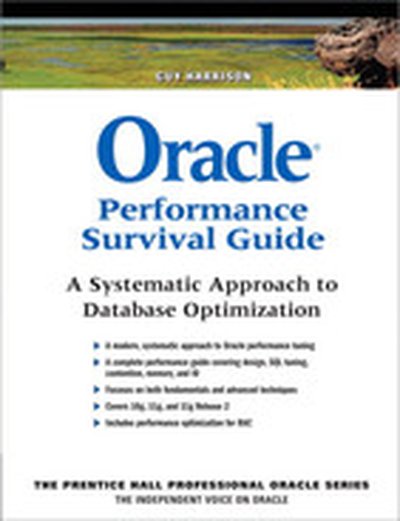
Oracle

Oracle Performance Survival Guide A Systematic Approach to Database Optimization The fast, complete, start-to-finish guide to optimizing Oracle performance Oracle Performance Survival Guide offers a structured, systematic, start-to-finish methodology for optimizing Oracle performance as efficiently as possible. Leading Oracle expert Guy Harrison shows how to maximize your tuning investment by focusing on causes rather than symptoms, and by quickly identifying the areas that deliver the greatest “bang for the buck.” Writing for DBAs and developers with all levels of experience, Harrison covers every area of Oracle performance management, from application design through SQL tuning, contention management through memory and physical IO management. He also presents up-to-the-minute guidance for optimizing the performance of the Oracle 11g Release 2. You’ll start by mastering Oracle structured performance tuning principles and tools, including techniques for tracing and monitoring Oracle execution. Harrison illuminates the interaction between applications and databases, guides you through choosing tuning tools, and introduces upfront design techniques that lead to higher-performance applications. He also presents a collection of downloadable scripts for reporting on all aspects of database performance. Coverage includes • “Tuning by layers,” the most effective, highest-value approach to Oracle performance optimization • Making the most of Oracle’s core tools for tracing, monitoring, and diagnosing performance • Highly efficient database logical and physical design, indexing, transaction design, and API use • SQL and PL/SQL tuning, including the use of parallel SQL techniques • Minimizing contention for locks, latches, shared memory, and other database resources • Optimizing memory and physical disk IO • Tuning Real Application Cluster (RAC) databases guyharrison.net informit.com/ph

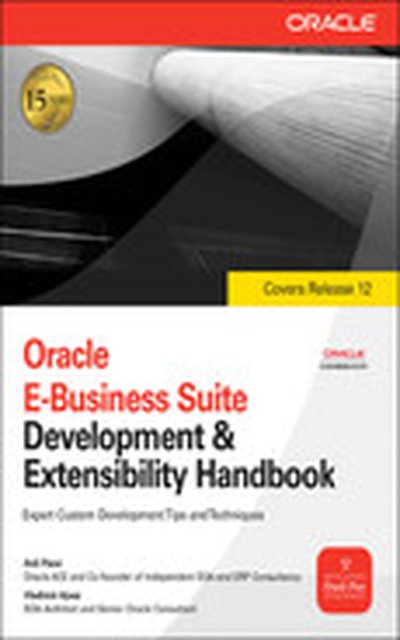
Oracle E-Business Suite Development & Extensibility Handbook

Extend and Customize Oracle E-Business Suite Transform your Oracle E-Business Suite infrastructure to suit enterprise requirements using the comprehensive development methods in this Oracle Press guide. Oracle E-Business Suite Development & Extensibility Handbook lays out each tool alongside reusable code and step-by-step examples. Learn how to create multiorg objects, integrate Java and PL/SQL, design custom user interfaces, and use Oracle Application Framework and Oracle Workflow. This detailed volume also explains how to work with Oracle XML Gateway, publish dynamic business intelligence reports, and tune your configuration. Manage an efficient development platform with Oracle Application Object Library Develop concurrent programs, customized forms, and personalized graphical user interfaces Securely share data between organizations Distribute business communiqués through Oracle Reports and Oracle Business Intelligence Publisher Develop Java extensions with Oracle JDeveloper and Oracle Application Framework Capture and graphically map business processes using Oracle Workflow Exchange data between applications via Oracle XML Gateway Change the appearance of applications using Custom Look and Feel Integrate Oracle E-Business Suite with service-oriented architecture using Oracle Applications Adapter On Demand

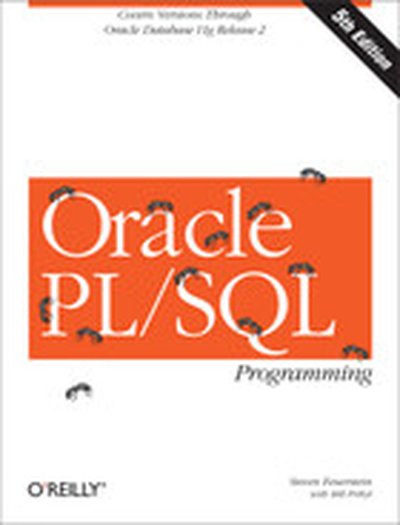
Oracle PL/SQL Programming, 5th Edition

This book is the definitive reference on PL/SQL, considered throughout the database community to be the best Oracle programming book available. Like its predecessors, this fifth edition of Oracle PL/SQL Programming covers language fundamentals, advanced coding techniques, and best practices for using Oracle's powerful procedural language. Thoroughly updated for Oracle Database 11g Release 2, this edition reveals new PL/SQL features and provides extensive code samples, ranging from simple examples to complex and complete applications, in the book and on the companion website. This indispensable reference for both novices and experienced Oracle programmers will help you: Get PL/SQL programs up and running quickly, with clear instructions for executing, tracing, testing, debugging, and managing PL/SQL code Optimize PL/SQL performance with the aid of a brand-new chapter in the fifth edition Explore datatypes, conditional and sequential control statements, loops, exception handling, security features, globalization and localization issues, and the PL/SQL architecture Understand and use new Oracle Database 11g features, including the edition-based redefinition capability, the function result cache, the new CONTINUE statement, fine-grained dependency tracking, sequences in PL/SQL expressions, supertype invocation from subtypes, and enhancements to native compilation, triggers, and dynamic SQL Use new Oracle Database 11g tools and techniques such as PL/Scope, the PL/SQL hierarchical profiler, and the SecureFiles technology for large objects Build modular PL/SQL applications using procedures, functions, triggers, and packages

Inside Microsoft® SQL Server® 2008: T-SQL Programming

Get a detailed look at the internal architecture of T-SQL with this comprehensive programming reference. Database developers and administrators get best practices, expert techniques, and code samples to master the intricacies of this programming language—solving complex problems with real-world solutions. Discover how to: Work with T-SQL and CLR user-defined functions, stored procedures, and triggers. Handle transactions, concurrency, and error handling. Efficiently use temporary objects, including temporary tables, table variables, and table expressions. Evaluate when to use set-based programming techniques and when to use cursors. Work with dynamic SQL in an efficient and secure manner. Treat date- and time-related data in a robust manner. Develop CLR user-defined types and learn about temporal support in the relational model. Use XML and XQuery and implement a dynamic schema solution. Work with spatial data using the new geometry and geography types and spatial indexes. Track access and changes to data using extended events, SQL Server Audit, change tracking, and change data capture. Use Service Broker for controlled asynchronous processing in database applications. All the book’s code samples will be available for download from the companion Web site.

Joe Celko's Data, Measurements and Standards in SQL

Joe Celko has looked deep into the code of SQL programmers and found a consistent and troubling pattern - a frightening lack of consistency between their individual encoding schemes and those of the industries in which they operate. This translates into a series of incompatible databases, each one an island unto itself that is unable to share information with others in an age of internationalization and business interdependence. Such incompatibility severely hinders information flow and the quality of company data. Data, Measurements and Standards in SQL reveals the shift these programmers need to make to overcome this deadlock. By collecting and detailing the diverse standards of myriad industries, and then giving a declaration for the units that can be used in an SQL schema, Celko enables readers to write and implement portable data that can interface to any number of external application systems! This book doesn't limit itself to one subject, but serves as a detailed synopsis of measurement scales and data standards for all industries, thereby giving RDBMS programmers and designers the knowledge and know-how they need to communicate effectively across business boundaries. * Collects and details the diverse data standards of myriad industries under one cover, thereby creating a definitive, one-stop-shopping opportunity for database programmers. * Enables readers to write and implement portable data that can interface to any number external application systems, allowing readers to cross business boundaries and move up the career ladder. * Expert advice from one of the most-read SQL authors in the world who is well known for his ten years of service on the ANSI SQL standards committee and Readers Choice Award winning column in Intelligent Enterprise.

TOAD® Handbook, Second Edition

TOAD ® Handbook, Second Edition , is the definitive, completely up-to-date guide to the newest version of TOAD, the world’s premier third-party Oracle utility. Packed with step-by-step recipes, screen snapshots, and hands-on exercises, this book brings together everything developers and DBAs need to maximize their productivity with TOAD in both administrative and development tasks. TOAD product architect Bert Scalzo and leading TOAD trainer Dan Hotka thoroughly cover every area of TOAD’s functionality, offering practical, proven solutions that can be applied immediately to leverage TOAD’s dramatically improved feature set. Comprehensive coverage includes TOAD setup and configuration Browsing databases and schemas Editing SQL and PL/SQL within TOAD Creating new databases Checking database health Performing common DBA tasks Reporting via standard and custom reports Optimizing database performance Throughout the text, the authors offer practical insights into each of TOAD’s most useful tools, from App Designer to Doc Generator, ER Diagrammer to Code Road Map. This book is the only current, comprehensive, and affordable guide to the latest version of TOAD–a must-have for any TOAD user.