Simba Khadder and Kevin Petrie discuss strategies to overcome technical debt in implementation, the pivotal role of data in the success of ML projects, navigating regulatory compliance in machine learning, and the future of AI governance.
 talk-data.com
Topic
Data Management
data_governance
data_quality
metadata_management
1097
tagged
Activity Trend
88
peak/qtr
2020-Q1
2026-Q1
Top Events
Data Engineering Podcast
485
O'Reilly Data Engineering Books
158
O'Reilly Data Science Books
53
Hub & Spoken: Data | Analytics | Chief Data Officer | CDO | Data Strategy
42
Secrets of Data Analytics Leaders
32
Data + AI Summit 2025
32
Big Data LDN 2024
28
Databricks DATA + AI Summit 2023
26
Big Data LDN 2025
16
gartner-data-analytics-uk-2025
16
Data Product Management in Action: The Practitioner's Podcast
15
gartner-data-analytics-us-2026
15
Summary
All software systems are in a constant state of evolution. This makes it impossible to select a truly future-proof technology stack for your data platform, making an eventual migration inevitable. In this episode Gleb Mezhanskiy and Rob Goretsky share their experiences leading various data platform migrations, and the hard-won lessons that they learned so that you don't have to.
Announcements
Hello and welcome to the Data Engineering Podcast, the show about modern data management Introducing RudderStack Profiles. RudderStack Profiles takes the SaaS guesswork and SQL grunt work out of building complete customer profiles so you can quickly ship actionable, enriched data to every downstream team. You specify the customer traits, then Profiles runs the joins and computations for you to create complete customer profiles. Get all of the details and try the new product today at dataengineeringpodcast.com/rudderstack Modern data teams are using Hex to 10x their data impact. Hex combines a notebook style UI with an interactive report builder. This allows data teams to both dive deep to find insights and then share their work in an easy-to-read format to the whole org. In Hex you can use SQL, Python, R, and no-code visualization together to explore, transform, and model data. Hex also has AI built directly into the workflow to help you generate, edit, explain and document your code. The best data teams in the world such as the ones at Notion, AngelList, and Anthropic use Hex for ad hoc investigations, creating machine learning models, and building operational dashboards for the rest of their company. Hex makes it easy for data analysts and data scientists to collaborate together and produce work that has an impact. Make your data team unstoppable with Hex. Sign up today at dataengineeringpodcast.com/hex to get a 30-day free trial for your team! Your host is Tobias Macey and today I'm interviewing Gleb Mezhanskiy and Rob Goretsky about when and how to think about migrating your data stack
Interview
Introduction How did you get involved in the area of data management? A migration can be anything from a minor task to a major undertaking. Can you start by describing what constitutes a migration for the purposes of this conversation? Is it possible to completely avoid having to invest in a migration? What are the signals that point to the need for a migration?
What are some of the sources of cost that need to be accounted for when considering a migration? (both in terms of doing one, and the costs of not doing one) What are some signals that a migration is not the right solution for a perceived problem?
Once the decision has been made that a migration is necessary, what are the questions that the team should be asking to determine the technologies to move to and the sequencing of execution? What are the preceding tasks that should be completed before starting the migration to ensure there is no breakage downstream of the changing component(s)? What are some of the ways that a migration effort might fail? What are the major pitfalls that teams need to be aware of as they work through a data platform migration? What are the opportunities for automation during the migration process? What are the most interesting, innovative, or unexpected ways that you have seen teams approach a platform migration? What are the most interesting, unexpected, or challenging lessons that you have learned while working on data platform migrations? What are some ways that the technologies and patterns that we use can be evolved to reduce the cost/impact/need for migraitons?
Contact Info
Gleb
LinkedIn @glebmm on Twitter
Rob
LinkedIn RobGoretsky on GitHub
Parting Question
From your perspective, what is the biggest gap in the tooling or technology for data management today?
Closing Announcements
Thank you for listening! Don't forget to check out our other shows. Podcast.init covers the Python language, its community, and the innovative ways it is being used. The Machine Learning Podcast helps you go from idea to production with machine learning. Visit the site to subscribe to the show, sign up for the mailing list, and read the show notes. If you've learned something or tried out a project from the show then tell us about it! Email [email protected]) with your story. To help other people find the show please leave a review on Apple Podcasts and tell your friends and co-workers
Links
Datafold
Podcast Episode
Informatica Airflow Snowflake
Podcast Episode
Redshift Eventbrite Teradata BigQuery Trino EMR == Elastic Map-Reduce Shadow IT
Podcast Episode
Mode Analytics Looker Sunk Cost Fallacy data-diff
Podcast Episode
SQLGlot Dagster dbt
The intro and outro music is from The Hug by The Freak Fandango Orchestra / CC BY-SA
Sponsored By:
Hex: 
Hex is a collaborative workspace for data science and analytics. A single place for teams to explore, transform, and visualize data into beautiful interactive reports. Use SQL, Python, R, no-code and AI to find and share insights across your organization. Empower everyone in an organization to make an impact with data. Sign up today at [dataengineeringpodcast.com/hex](https://www.dataengineeringpodcast.com/hex} and get 30 days free!Rudderstack: 
Introducing RudderStack Profiles. RudderStack Profiles takes the SaaS guesswork and SQL grunt work out of building complete customer profiles so you can quickly ship actionable, enriched data to every downstream team. You specify the customer traits, then Profiles runs the joins and computations for you to create complete customer profiles. Get all of the details and try the new product today at dataengineeringpodcast.com/rudderstackSupport Data Engineering Podcast
Data and AI are revolutionizing industries and transforming businesses at an unprecedented pace. These advancements pave the way for groundbreaking outcomes such as fresh revenue streams, optimized working capital, and captivating, personalized customer experiences.
Join Hugh Burgin, Luke Pritchard and Dan Diasio as we explore a range of real-world examples of AI and data-driven transformation opportunities being powered by Databricks, including business value realized and technical solutions implemented. We will focus on how to integrate and leverage business insights, a diverse network of cloud-based solutions and Databricks to unleash new business value opportunities. By highlighting real-world use cases we will discuss:
- Examples of how Manufacturing, Retail, Financial Services and other sectors are using Databricks services to scale AI, gain insights that matter and secure their data
- The ways data monetization are changing how companies view data and incentivizing better data management
- Examples of Generative AI and LLMs changing how businesses operate, how their customers engage, and what you can do about it
Talk by: Hugh Burgin and Luke Pritchard
Here’s more to explore: State of Data + AI Report: https://dbricks.co/44i2HBp The Data Team's Guide to the Databricks Lakehouse Platform: https://dbricks.co/46nuDpI
Connect with us: Website: https://databricks.com Twitter: https://twitter.com/databricks LinkedIn: https://www.linkedin.com/company/databricks Instagram: https://www.instagram.com/databricksinc Facebook: https://www.facebook.com/databricksin
We are starting to see a paradigm shift in how AI systems are built across enterprises. In 2023 and beyond, this shift is being propelled by the era of foundation models. Foundation models can be seen as the next evolution in using "pre-trained" models and transfer learning. In order to fully leverage these breakthrough models, we’ve seen a common formula for success: leading AI teams within enterprises need to be able successfully harness their own store of unstructured data and pair this with the right model in order to ship intelligent applications that deliver next-generation experiences to their customers.
In this session you will learn how to incorporate foundation models into your data and machine learning workflows so that anyone can build AI faster and, in many cases, get the business outcome without needing to build AI models altogether. Which foundation AI models can be used to pre-label / enrich data and what specific data pipeline (data engine) will enable this? Real-world use cases of when to incorporate large language models and fine-tuning to improve machine learning models in real-time. Discover the power of leveraging both Labelbox and Databricks to streamline this data management and model deployment process.
Talk by: Manu Sharma
Here’s more to explore: LLM Compact Guide: https://dbricks.co/43WuQyb Big Book of MLOps: https://dbricks.co/3r0Pqiz
Connect with us: Website: https://databricks.com Twitter: https://twitter.com/databricks LinkedIn: https://www.linkedin.com/company/databricks Instagram: https://www.instagram.com/databricksinc Facebook: https://www.facebook.com/databricksinc
Delta Lake is an open-source storage format that can be ideally used for storing large-scale datasets, which can be used for single-node and distributed training of deep learning models. Delta Lake storage format gives deep learning practitioners unique data management capabilities for working with their datasets. The challenge is that, as of now, it’s not possible to use Delta Lake to train PyTorch models directly.
PyTorch community has recently introduced a Torchdata library for efficient data loading. This library supports many formats out of the box, but not Delta Lake. This talk will demonstrate using the Delta Lake storage format for single-node and distributed PyTorch training using the torchdata framework and standalone delta-rs Delta Lake implementation.
Talk by: Michael Shtelma
Connect with us: Website: https://databricks.com Twitter: https://twitter.com/databricks LinkedIn: https://www.linkedin.com/company/databricks Instagram: https://www.instagram.com/databricksinc Facebook: https://www.facebook.com/databricksinc
This session focuses on one of the first Unity Catalog implementations for a large-scale enterprise. In this scenario, a cloud scale analytics platform with 7500 active users based on the lakehouse approach is used. In addition, there is potential for 1500 further users who are subject to special governance rules. They are consuming more than 600 TB of data stored in Delta Lake - continuously growing at more than 1TB per day. This might grow due to local country data. Therefore, the existing data platform must be extended to enable users to combine global and local data from their countries. A new data management was required, which reflects the strict information security rules at a need to know base. Core requirements are: read only from global data, write into local and share the results.
Due to a very pronounced information security awareness and a lack of the technological possibilities it was not possible to interdisciplinary analyze and exchange data so easy or at all so far. Therefore, a lot of business potential and gains could not be identified and realized.
With the new developments in the technology used and the basis of the lakehouse approach, thanks to Unity Catalog, we were able to develop a solution that could meet high requirements for security and process. And enables globally secured interdisciplinary data exchange and analysis at scale. This solution enables the democratization of the data. This results not only in the ability to gain better insights for business management, but also to generate entirely new business cases or products that require a higher degree of data integration and encourage the culture to change. We highlight technical challenges and solutions, present best practices and point out benefits of implementing Unity catalog for enterprises.
Talk by: Artem Meshcheryakov and Pascal van Bellen
Here’s more to explore: Data, Analytics, and AI Governance: https://dbricks.co/44gu3YU
Connect with us: Website: https://databricks.com Twitter: https://twitter.com/databricks LinkedIn: https://www.linkedin.com/company/databricks Instagram: https://www.instagram.com/databricksinc Facebook: https://www.facebook.com/databricksinc
To unlock all the competitive advantage Databricks offers your organization, you might need to update your strategy and methodology for the platform. With over 1,000+ Databricks projects completed globally in the last 18 months, we are going to share our insights on the best building blocks to target as you search for efficiency and competitive advantage.
These building blocks supporting this include enterprise metadata and data management services, data management foundation, and data services and products that enable business units to fully use their data and analytics at scale.
In this session, Avanade data leaders will highlight how Databricks’ modern data stack fits Azure PaaS and SaaS (such as Microsoft Fabric) ecosystem, how Unity catalog metadata supports automated data operations scenarios, and how we are helping clients measure modern analytics and governance business impact and value.
Talk by: Alan Grogan and Timur Mehmedbasic
Here’s more to explore: State of Data + AI Report: https://dbricks.co/44i2HBp Databricks named a Leader in 2022 Gartner® Magic QuadrantTM CDBMS: https://dbricks.co/3phw20d
Connect with us: Website: https://databricks.com Twitter: https://twitter.com/databricks LinkedIn: https://www.linkedin.com/company/databricks Instagram: https://www.instagram.com/databricksinc Facebook: https://www.facebook.com/databricksinc
As part of Comcast Effectv’s transformation into a completely digital advertising agency, it was key to develop an approach to manage and remediate data quality issues related to customer data so that the sales organization is using reliable data to enable data-driven decision making. Like many organizations, Effectv's customer lifecycle processes are spread across many systems utilizing various integrations between them. This results in key challenges like duplicate and redundant customer data that requires rationalization and remediation. Data is at the core of Effectv’s modernization journey with the intended result of winning more business, accelerating order fulfillment, reducing make-goods and identifying revenue.
In partnership with Slalom Consulting, Comcast Effectv built a traditional lakehouse on Databricks to ingest data from all of these systems but with a twist; they anchored every engineering decision in how it will enable their data governance program.
In this session, we will touch upon the data transformation journey at Effectv and dive deeper into the implementation of data governance leveraging Databricks solutions such as Delta Lake, Unity Catalog and DB SQL. Key focus areas include how we baked master data management into our pipelines by automating the matching and survivorship process, and bringing it all together for the data consumer via DBSQL to use our certified assets in bronze, silver and gold layers.
By making thoughtful decisions about structuring data in Unity Catalog and baking MDM into ETL pipelines, you can greatly increase the quality, reliability, and adoption of single-source-of-truth data so your business users can stop spending cycles on wrangling data and spend more time developing actionable insights for your business.
Talk by: Maggie Davis and Risha Ravindranath
Connect with us: Website: https://databricks.com Twitter: https://twitter.com/databricks LinkedIn: https://www.linkedin.com/company/databricks Instagram: https://www.instagram.com/databricksinc Facebook: https://www.facebook.com/databricksinc
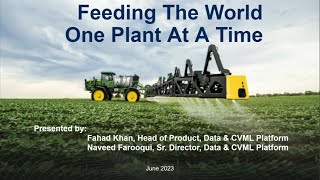
Join this session to learn how the CVML and Data Platform team at BlueRiver Technology utilized Databricks to maximize savings on herbicide usage and revolutionize Precision Agriculture.
Blue River Technology is an agricultural technology company that uses computer vision and machine learning (CVML) to revolutionize the way crops are grown and harvested. BRT’s See & Spray technology, which uses CVML to identify and precisely determine whether the plant is a weed or a crop so it can deliver a small, targeted dose of herbicide directly to the plant, while leaving the crop unharmed. By using this approach, Blue River significantly reduces the amount of herbicides used in agriculture by over 70% and has a positive impact on the environment and human health.
The technical challenges we seek to overcome are: - Processing massive petabytes of proprietary data at scale and in real time. Equipment in the field can generate up to 40TBs of data per hour per machine. - Aggregating, curating and visualizing at scale data can often be convoluted, error-prone and complex. - Streamlining pipelines runs from weeks to hours to ensure continuous delivery of data. - Abstracting and automating the infra, deployment and data management from each program. - Building downstream data products based on descriptive analysis, predictive analysis or prescriptive analysis to drive the machine behavior.
The business questions we seek to answer for any machine are: - Are we getting the spray savings we anticipated? - Are we reducing the use of herbicide at the scale we expected? - Are spraying nozzles performing at the expected rate? - Finding the relevant data to troubleshoot new edge conditions. - Providing a simple interface for data exploration to both technical and non-technical personas to help improve our model. - Identifying repetitive and new faults in our machines. - Filtering out data based on certain incidents. - Identifying anomalies for e.g. sudden drop in spray saving, like frequency of broad spray suddenly is too high.
How we are addressing and plan to address these challenges: - Designating Databricks as our purposeful DB for all data - using the bronze, silver and gold layer standards. - Processing new machine logs using a Delta Live table as a source both in batch and incremental manner. - Democratize access for data scientists, product managers, data engineers who are not proficient with the robotic software stack via notebooks for quick development as well as real time dashboards.
Talk by: Fahad Khan and Naveed Farooqui
Here’s more to explore: LLM Compact Guide: https://dbricks.co/43WuQyb Big Book of MLOps: https://dbricks.co/3r0Pqiz
Connect with us: Website: https://databricks.com Twitter: https://twitter.com/databricks LinkedIn: https://www.linkedin.com/company/databricks Instagram: https://www.instagram.com/databricksinc Facebook: https://www.facebook.com/databricksin
The trend that has made data easier to collect and analyze has only aggravated privacy risks. Luckily, a range of privacy technologies have emerged to enable private data management; differential privacy, synthetic data, confidential computing. In isolation, those technologies have had a limited impact because they did not always bring the 10x improvement expected by data leaders.
Combining these privacy technologies has been the real game changer. We will demonstrate that the right mix of technologies brings the optimal balance of privacy and flexibility at the scale of the data warehouse. We will illustrate this by real-life applications of Sarus in three domains:
- Healthcare: how to make hospital data available for research at scale in full compliance
- Finance: how to pool data between several banks to fight criminal transactions
- Marketing: how to build insights on combined data from partners and distributors
The examples will be illustrated using data stored in Databricks and queried using Sarus differential privacy engine.
Talk by: Maxime Agostini
Connect with us: Website: https://databricks.com Twitter: https://twitter.com/databricks LinkedIn: https://www.linkedin.com/company/databricks Instagram: https://www.instagram.com/databricksinc Facebook: https://www.facebook.com/databricksinc

The US Army Corps of Engineers (USACE) is responsible for maintaining and improving nearly 12,000 miles of shallow-draft (9'-14') inland and intracoastal waterways, 13,000 miles of deep-draft (14' and greater) coastal channels, and 400 ports, harbors, and turning basins throughout the United States. Because these components of the national waterway network are considered assets to both US commerce and national security, they must be carefully managed to keep marine traffic operating safely and efficiently.
The National DQM Program is tasked with providing USACE a nationally standardized remote monitoring and documentation system across multiple vessel types with timely data access, reporting, dredge certifications, data quality control, and data management. Government systems have often lagged commercial systems in modernization efforts, and the emergence of the cloud and Data Lakehouse Architectures have empowered USACE to successfully move into the modern data era.
This session incorporates aspects of these topics: Data Lakehouse Architecture: Delta Lake, platform security and privacy, serverless, administration, data warehouse, Data Lake, Apache Iceberg, Data Mesh GIS: H3, MOSAIC, spatial analysis data engineering: data pipelines, orchestration, CDC, medallion architecture, Databricks Workflows, data munging, ETL/ELT, lakehouses, data lakes, Parquet, Data Mesh, Apache Spark™ internals. Data Streaming: Apache Spark Structured Streaming, real-time ingestion, real-time ETL, real-time ML, real-time analytics, and real-time applications, Delta Live Tables. ML: PyTorch, TensorFlow, Keras, scikit-learn, Python and R ecosystems data governance: security, compliance, RMF, NIST data sharing: sharing and collaboration, delta sharing, data cleanliness, APIs.
Talk by: Jeff Mroz
Connect with us: Website: https://databricks.com Twitter: https://twitter.com/databricks LinkedIn: https://www.linkedin.com/company/databricks Instagram: https://www.instagram.com/databricksinc Facebook: https://www.facebook.com/databricksinc
A global franchise retailer was struggling to understand the value of its employees and had not fostered a data-driven enterprise. During the journey to use facts as the basis for decision making, Databricks became the facilitator of DataMesh and created the pipelines, analytics and source engine for a three-layer — bronze, silver, gold — lakehouse that supports the HR domain and drives the integration of multiple additional domains: sales, customer satisfaction, product quality and more. In this talk, we will walk through:
- The business rationale and drivers
- The core data sources
- The data products, analytics and pipelines
- The adoption of Unity Catalog for data privacy compliance /adherence and data management
- Data quality metrics
Join us to see the analytic product and the design behind this innovative view of employees and their business outcomes.
Talk by: Rebecca Bucnis
Here’s more to explore: State of Data + AI Report: https://dbricks.co/44i2HBp Databricks named a Leader in 2022 Gartner® Magic QuadrantTM CDBMS: https://dbricks.co/3phw20d
Connect with us: Website: https://databricks.com Twitter: https://twitter.com/databricks LinkedIn: https://www.linkedin.com/company/databricks Instagram: https://www.instagram.com/databricksinc Facebook: https://www.facebook.com/databricksinc
Fivetran helps Enterprise and Commercial companies improve the efficiency of their data movement, infrastructure, and analysis by providing a secure, scalable platform for high-volume data movement. In this fireside chat, we will dive into the pain points that drove Catalyst, a cloud-based platform that helps software companies grow revenue with advanced insights and workflows that strengthen customer adoption, retention, expansion and advocacy, to begin their search for a partnership that would automate and simplify data management along with the pivotal success driven by the implementation of Fivetran and Databricks.
Discover how together Fivetran and Databricks:
- Deliver scalable, real-time analytics to customers with minimal configuration and centralize customer data into customer success tools.
- Improve Catalyst’s visibility into customer health, opportunities, and risks across all teams.
- Turn data into revenue-driving insights around digital customer behavior with improved targeting and Ai/ Machine learning.
- Provide a robust and scalable data infrastructure that supports Catalyst’s growing data needs, with improvements in data availability, data quality, and overall efficiency in data operations.
Talk by: Edward Chiu and Lauren Schwartz
Connect with us: Website: https://databricks.com Twitter: https://twitter.com/databricks LinkedIn: https://www.linkedin.com/company/databricks Instagram: https://www.instagram.com/databricksinc Facebook: https://www.facebook.com/databricksinc
SEEK is Australia’s largest online employment marketplace and a market leader spanning ten countries across Asia Pacific and Latin America. SEEK provides employment opportunities for roughly 16 million monthly active users and process 25 million candidate applications to listings. Processing millions of resumes involves handling and managing highly sensitive candidate information, usually inputted in a highly unstructured format. With recent high-profile data leaks in Australia, personally identifiable information (PII) protection has become a major focus area for large digital organizations.
The first step is detection, and SEEK has developed a custom framework built using HuggingFace transformers fine-tuned with nuances around employment. For example, “Software Engineer at Databricks” is not PII, but “CEO at Databricks” is PII. After identifying and anonymizing PII in stream and batch data, SEEK uses Unity Catalog’s data lineage to track PII through their reporting, ETL, and other downstream ML use-cases and govern access control achieving an organization-wide data management capability driven by deep learning and enforcement using Databricks.
Talk by: Ajmal Aziz and Rachael Straiton
Connect with us: Website: https://databricks.com Twitter: https://twitter.com/databricks LinkedIn: https://www.linkedin.com/company/databricks Instagram: https://www.instagram.com/databricksinc Facebook: https://www.facebook.com/databricksinc
Delta Lake is an open-source storage format that can be ideally used for storing large-scale datasets, which can be used for single-node and distributed training of deep learning models. Delta Lake storage format gives deep learning practitioners unique data management capabilities for working with their datasets. The challenge is that, as of now, it’s not possible to use Delta Lake to train PyTorch models directly.
PyTorch community has recently introduced a Torchdata library for efficient data loading. This library supports many formats out of the box, but not Delta Lake. This talk will demonstrate using the Delta Lake storage format for single-node and distributed PyTorch training using the torchdata framework and standalone delta-rs Delta Lake implementation.
Talk by: Michael Shtelma
Connect with us: Website: https://databricks.com Twitter: https://twitter.com/databricks LinkedIn: https://www.linkedin.com/company/databricks Instagram: https://www.instagram.com/databricksinc Facebook: https://www.facebook.com/databricksinc
Learn how to attain an optimal return on investment (ROI) with MDM by choosing the appropriate architectural strategy and evaluating progress during the initial project implementation. Published at: https://www.eckerson.com/articles/driving-roi-with-master-data-management-part-ii-your-first-project
How can you maximize data collaboration across your organization without having to build integrations between individual applications, systems, and other data sources? Data collaboration architectures that don't depend on integrations aren't a new idea, but they've assumed greater urgency as organizations increasingly struggle to manage the ever-growing numbers of data sources that exist inside their IT estates. In this report, Cinchy cofounders Dan DeMers and Karanjot Jaswal show CIOs, CTOs, CDOs, and other IT leaders how to rethink their organization's approach to data architectures, data management, and data governance. You'll learn about different approaches to creating data platforms that liberate and autonomize data, enable agile data management, apply consistent data access controls, and maximize visibility without requiring application-specific integrations. With this report, you'll discover: Why data integration is often handled piecemeal—combining one app with another rather than integrating all apps together How data collaboration platforms enable data sharing across all apps, systems, and sources without application-specific integrations Four major platforms you can use to make data available to all applications and services: Cinchy, K2View, Microsoft Dataverse, and The Modern Data Company Principles and practices for deploying the data collaboration platform of your choice Dan DeMers is the CEO and cofounder of Cinchy. Karanjot Jaswal is cofounder and CTO of Cinchy.
Summary
Real-time data processing has steadily been gaining adoption due to advances in the accessibility of the technologies involved. Despite that, it is still a complex set of capabilities. To bring streaming data in reach of application engineers Matteo Pelati helped to create Dozer. In this episode he explains how investing in high performance and operationally simplified streaming with a familiar API can yield significant benefits for software and data teams together.
Announcements
Hello and welcome to the Data Engineering Podcast, the show about modern data management Introducing RudderStack Profiles. RudderStack Profiles takes the SaaS guesswork and SQL grunt work out of building complete customer profiles so you can quickly ship actionable, enriched data to every downstream team. You specify the customer traits, then Profiles runs the joins and computations for you to create complete customer profiles. Get all of the details and try the new product today at dataengineeringpodcast.com/rudderstack Modern data teams are using Hex to 10x their data impact. Hex combines a notebook style UI with an interactive report builder. This allows data teams to both dive deep to find insights and then share their work in an easy-to-read format to the whole org. In Hex you can use SQL, Python, R, and no-code visualization together to explore, transform, and model data. Hex also has AI built directly into the workflow to help you generate, edit, explain and document your code. The best data teams in the world such as the ones at Notion, AngelList, and Anthropic use Hex for ad hoc investigations, creating machine learning models, and building operational dashboards for the rest of their company. Hex makes it easy for data analysts and data scientists to collaborate together and produce work that has an impact. Make your data team unstoppable with Hex. Sign up today at dataengineeringpodcast.com/hex to get a 30-day free trial for your team! Your host is Tobias Macey and today I'm interviewing Matteo Pelati about Dozer, an open source engine that includes data ingestion, transformation, and API generation for real-time sources
Interview
Introduction How did you get involved in the area of data management? Can you describe what Dozer is and the story behind it?
What was your decision process for building Dozer as open source?
As you note in the documentation, Dozer has overlap with a number of technologies that are aimed at different use cases. What was missing from each of them and the center of their Venn diagram that prompted you to build Dozer? In addition to working in an interesting technological cross-section, you are also targeting a disparate group of personas. Who are you building Dozer for and what were the motivations for that vision?
What are the different use cases that you are focused on supporting? What are the features of Dozer that enable engineers to address those uses, and what makes it preferable to existing alternative approaches?
Can you describe how Dozer is implemented?
How have the design and goals of the platform changed since you first started working on it? What are the architectural "-ilities" that you are trying to optimize for?
What is involved in getting Dozer deployed and integrated into an existing application/data infrastructure? How can teams who are using Dozer extend/integrate with Dozer?
What does the development/deployment workflow look like for teams who are building on top of Dozer?
What is your governance model for Dozer and balancing the open source project against your business goals? What are the most interesting, innovative, or unexpected ways that you have seen Dozer used? What are the most interesting, unexpected, or challenging lessons that you have learned while working on Dozer? When is Dozer the wrong choice? What do you have planned for the future of Dozer?
Contact Info
LinkedIn @pelatimtt on Twitter
Parting Question
From your perspective, what is the bigge
Summary
Data has been one of the most substantial drivers of business and economic value for the past few decades. Bob Muglia has had a front-row seat to many of the major shifts driven by technology over his career. In his recent book "Datapreneurs" he reflects on the people and businesses that he has known and worked with and how they relied on data to deliver valuable services and drive meaningful change.
Announcements
Hello and welcome to the Data Engineering Podcast, the show about modern data management Introducing RudderStack Profiles. RudderStack Profiles takes the SaaS guesswork and SQL grunt work out of building complete customer profiles so you can quickly ship actionable, enriched data to every downstream team. You specify the customer traits, then Profiles runs the joins and computations for you to create complete customer profiles. Get all of the details and try the new product today at dataengineeringpodcast.com/rudderstack Your host is Tobias Macey and today I'm interviewing Bob Muglia about his recent book about the idea of "Datapreneurs" and the role of data in the modern economy
Interview
Introduction How did you get involved in the area of data management? Can you describe what your concept of a "Datapreneur" is?
How is this distinct from the common idea of an entreprenur?
What do you see as the key inflection points in data technologies and their impacts on business capabilities over the past ~30 years? In your role as the CEO of Snowflake you had a first-row seat for the rise of the "modern data stack". What do you see as the main positive and negative impacts of that paradigm?
What are the key issues that are yet to be solved in that ecosmnjjystem?
For technologists who are thinking about launching new ventures, what are the key pieces of advice that you would like to share? What do you see as the short/medium/long-term impact of AI on the technical, business, and societal arenas? What are the most interesting, innovative, or unexpected ways that you have seen business leaders use data to drive their vision? What are the most interesting, unexpected, or challenging lessons that you have learned while working on the Datapreneurs book? What are your key predictions for the future impact of data on the technical/economic/business landscapes?
Contact Info
Parting Question
From your perspective, what is the biggest gap in the tooling or technology for data management today?
Closing Announcements
Thank you for listening! Don't forget to check out our other shows. Podcast.init covers the Python language, its community, and the innovative ways it is being used. The Machine Learning Podcast helps you go from idea to production with machine learning. Visit the site to subscribe to the show, sign up for the mailing list, and read the show notes. If you've learned something or tried out a project from the show then tell us about it! Email [email protected]) with your story. To help other people find the show please leave a review on Apple Podcasts and tell your friends and co-workers
Links
Datapreneurs Book SQL Server Snowflake Z80 Processor Navigational Database System R Redshift Microsoft Fabric Databricks Looker Fivetran
Podcast Episode
Databricks Unity Catalog RelationalAI 6th Normal Form Pinecone Vector DB
Podcast Episode
Perplexity AI
The intro and outro music is from The Hug by The Freak Fandango Orchestra / CC BY-SA
Sponsored By:
Rudderstack:
Introducing RudderStack Profiles. RudderStack Profiles takes the SaaS guesswork and SQL grunt work out of building complete customer profiles so you can quickly ship actionable, enriched data to every downstream team. You specify the customer traits, then Profiles runs the joins and computations for you to create complete customer profiles. Get all of the details and try the new product today at dataengineeringpodcast.com/rudderstackSupport Data Engineering Podcast
Send us a text Welcome to the Making Data Simple Podcast, where we delve into the world of data empowerment and healthcare innovation with esteemed guest Carolyn Ward, Director of Clinical Strategy at Particle Health. Join us as we explore the transformative power of a modern API platform, ensuring simple and secure access to actionable patient data. Dive deep into discussions on patient engagement, the significance of healthcare interoperability, the role of AI in health data management, and the pressing issue of physician burnout. Gain valuable insights from Carolyn's expertise as we unravel the path towards empowering patients and revolutionizing healthcare through data. Tune in to stay informed and inspired by the possibilities of a data-driven healthcare ecosystem.
Carolyn Ward, Director of Clinical Strategy at Particle Health, is ensuring simple and secure access to actionable patient data through a modern API platform. Carolyn talks patient engagement and empowerment, health care interoperability, AI in health data management, and physician burnout. 02:23 Meet Carolyn Ward05:22 How to use patient data08:29 How many cups of coffee is ok? 10:30 Tailoring diagnosis to the individual 15:40 Why is healthcare moving so slow?18:04 Particle Health29:38 Target client and monetization30:52 Handing PHI34:46 The tech behind Particle Health38:15 Integrating wearables, claims, laboratories 41:27 The role of AILinkedIn: linkedin.com/in/carolynleeward Website: https://www.particlehealth.com/ Want to be featured as a guest on Making Data Simple? Reach out to us at [email protected] and tell us why you should be next. The Making Data Simple Podcast is hosted by Al Martin, WW VP Technical Sales, IBM, where we explore trending technologies, business innovation, and leadership ... while keeping it simple & fun. Want to be featured as a guest on Making Data Simple? Reach out to us at [email protected] and tell us why you should be next. The Making Data Simple Podcast is hosted by Al Martin, WW VP Technical Sales, IBM, where we explore trending technologies, business innovation, and leadership ... while keeping it simple & fun.