talk-data.com talk-data.com

Topic

Data Science

machine_learning statistics analytics

1516

tagged

Activity Trend

68 peak/qtr
2020-Q1 2026-Q1

Activities

1516 activities · Newest first

We talked about:

Luke’s background Luke’s podcast - AI Game Changers How Luke helps people get jobs What’s changed in the recruitment market over the last 6 months Getting ready for the interview process Stage “zero” – the filter between the candidate and the company Preparing for the introduction stage – research and communication Reviewing the fundamentals during preparation Preparing for the technical part of the interview Establishing the hiring company’s expectations Depth vs breadth Overly theoretical and mathematical questions in interviews Bombing (failing) in the middle of an interview Applying to different roles within the same company Luke’s resource recommendations

Links:

Luke's LinkedIn: https://www.linkedin.com/in/lukewhipps/

Free data engineering course: https://github.com/DataTalksClub/data-engineering-zoomcamp

Join DataTalks.Club: https://datatalks.club/slack.html

Our events: https://datatalks.club/events.html

Today I’m chatting with Bob Mason, Managing Partner at Argon Ventures. Bob is a VC who seeks out early-stage founders in the ML/AI space and helps them inform their go-to-market, product, and design strategies. In this episode, Bob reveals what he looks for in early-stage data and intelligence startups who are trying to leverage ML/AI. He goes on to explain why it’s important to identify what your strengths are and what you enjoy doing so you can surround yourself with the right team. Bob also shares valuable insight into how to earn trust with potential customers as an early-stage startup, how design impacts a product’s success, and his strategy for differentiating yourself and creating a valuable product outside of the ubiquitous “platform play.” 

Highlights/ Skip to:

Bob explains why and how Argon Ventures focuses their investments in intelligent industry companies (00:53) Brian and Bob discuss the importance of prioritizing go-to-market strategy over technology (03:42) How Bob views the career progression from data science to product management, and the ways in which his own career has paralleled that journey (07:21) The role customer adoption and user experience play for Bob and the companies he invests in, both pre-investment and post-investment (11:10) Brian and Bob discuss the design capabilities of different teams and why Bob feels it’s something leaders need to keep top of mind (15:25) Bob explains his recommendation to seek out quick wins for AI companies who can’t expect customers to wait for an ROI (19:09) The importance Bob sees in identifying early adopters during a sales cycle for early-stage startups (21:34) Bob describes how being customer-centric allows start-ups to build trust, garner quick wins, and inform their product strategy (23:42) Bob and Brian dive into Bob’s belief that solving intrinsic business problems by vertical increases a start-up’s chance of success substantially over “the platform play” (27:29) Bob gives insight into product trends he believes are going to be extremely impactful in the near future (29:05)

Quotes from Today’s Episode “In a former life, I was a software engineer, founder, and CTO myself, so I have to watch myself to not just geek out on the technology itself because the most important element when you’re determining if you want to move forward with investment or not, is this: is there a real problem here to be solved or is this technology in search of a problem?” — Bob Mason (01:51)

“User-centric research is really valuable, particularly at the earliest stages. If you’re just off by a degree or two, several years down the road, that can be a really material roadblock that you hit. And so, starting off on the right foot, I think is super, super valuable.” – Bob Mason (06:12)

“I don’t think the technical folks in an early-stage startup absolve themselves of not being really intimately involved with their go-to-market and who they’re ultimately creating value for.” – Bob Mason (07:07)

“When we’re making an investment decision, startups don’t generally have any customers, and so we don’t necessarily use the signal of long-term customer adoption as a driver for our initial investment decision. But it’s very much top of mind after investment and as we’re trying to build and bring the first version of the product to market. Being very thoughtful and mindful of sort of customer experience and long-term adoption is absolutely critical.” – Bob Mason (11:23)

“If you’re a scientist, the way you’re presenting both raw data and sort of summaries of data could be quite different than if you’re working with a business analyst that’s a few years out of college with a liberal arts degree. How you interpret results and then present those results, I think, is actually a very interesting design problem.” – Bob Mason (18:40)

“I think initially, a lot of early AI startups just kind of assumed that customers would be patient and let the system run, [waiting] 3, 6, 9, 12 months [to get this] magical ROI, and that’s just not how people (buyers) operate.” – Bob Mason (21:00)

“Re: platform plays: Obviously, you could still create a tremendous platform that’s very broad, but we think if you focus on the business problem of that particular vertical or domain, that actually creates a really powerful wedge so you can increase your value proposition. You could always increase the breadth of a platform over time. But if you’re not solving that intrinsic problem at the very beginning, you may never get the chance to survive.” – Bob Mason (28:24)

Links Argon Ventures: https://argon.vc/ LinkedIn: https://www.linkedin.com/in/robertmason/details/experience/ Email: [email protected]

In 2022, we saw significant developments in the field of data. From the emergence of generative AI to the growth of low-code data tools and AI assistants—these advancements signal an upcoming paradigm shift, where data-powered tools and machine learning systems will radically transform workflows across various professions. 2022 also saw digital transformation remain a major theme for organizations across industries as they sought to embrace new ways of working, reaching customers, and providing value. As 2023’s looming economic uncertainty puts pressure on organizations to maximize ROI from their investments, digital and data transformation will continue to be one of the key levers by which organizations can cut costs and scale value for their stakeholders. So we’ve invited DataCamp’s co-founders, CEO Jonathan Cornelissen and COO Martijn Theuwissen to break down the top data trends they are seeing in the data space today, as well as their predictions for the future of the data industry. Jonathan Cornelissen is the CEO and co-founder of DataCamp. As the CEO of DataCamp, he helped grow DataCamp to upskill over 10M+ learners and 2800+ teams and enterprise clients. He is interested in everything related to data science, education and entrepreneurship. He holds a PhD in financial econometrics, and was the original author of an R package for quantitative finance.

Martijn Theuwissen is the COO and co-founder of DataCamp. As the COO of DataCamp, he helps DataCamp’s enterprise clients on their data and digital transformation strategies, enabling them to make the most of DataCamp for Business’s offering, and helping them transform how their workforce uses data. 

In this episode, Jason Foster talks to Marco Lau, Director of Data Science and Analytics at Penguin Random House, the international publishing business. They discuss how data science can help create value in the publishing industry and the use of data to predict market trends and make informed business decisions. Marco also talks about his background and role and explains how different teams at Penguin Random House collaborate to blend data science, art and traditional methods to drive business growth.

Numerical Methods Using Kotlin: For Data Science, Analysis, and Engineering

This in-depth guide covers a wide range of topics, including chapters on linear algebra, root finding, curve fitting, differentiation and integration, solving differential equations, random numbers and simulation, a whole suite of unconstrained and constrained optimization algorithms, statistics, regression and time series analysis. The mathematical concepts behind the algorithms are clearly explained, with plenty of code examples and illustrations to help even beginners get started. In this book, you'll implement numerical algorithms in Kotlin using NM Dev, an object-oriented and high-performance programming library for applied and industrial mathematics. Discover how Kotlin has many advantages over Java in its speed, and in some cases, ease of use. In this book, you’ll see how it can help you easily create solutions for your complex engineering and data science problems. After reading this book, you'll come away with the knowledge to create your own numerical models and algorithms using the Kotlin programming language. What You Will Learn Program in Kotlin using a high-performance numerical library Learn the mathematics necessary for a wide range of numerical computing algorithms Convert ideas and equations into code Put together algorithms and classes to build your own engineering solutions Build solvers for industrial optimization problems Perform data analysis using basic and advanced statistics Who This Book Is For Programmers, data scientists, and analysts with prior experience programming in any language, especially Kotlin or Java.

Today I’m chatting with returning guest Tom Davenport, who is a Distinguished Professor at Babson College, a Visiting Professor at Oxford, a Research Fellow at MIT, and a Senior Advisor to Deloitte’s AI practice. He is also the author of three new books (!) on AI and in this episode, we’re discussing the role of product orientation in enterprise data science teams, the skills required, what he’s seeing in the wild in terms of teams adopting this approach, and the value it can create. Back in episode 26, Tom was a guest on my show and he gave the data science/analytics industry an approximate “2 out of 10” rating in terms of its ability to generate value with data. So, naturally, I asked him for an update on that rating, and he kindly obliged. How are you all doing? Listen in to find out!

Highlights / Skip to:

Tom provides an updated rating (between 1-10) as to how well he thinks data science and analytics teams are doing these days at creating economic value (00:44) Why Tom believes that “motivation is not enough for data science work” (03:06) Tom provides his definition of what data products are and some opinions on other industry definitions (04:22) How Tom views the rise of taking a product approach to data roles and why data products must be tied to value (07:55) Tom explains why he feels top down executive support is needed to drive a product orientation (11:51) Brian and Tom discuss how they feel companies should prioritize true data products versus more informal AI efforts (16:26) The trends Tom sees in the companies and teams that are implementing a data product orientation (19:18) Brian and Tom discuss the models they typically see for data teams and their key components (23:18) Tom explains the value and necessity of data product management (34:49) Tom describes his three new books (39:00)

Quotes from Today’s Episode “Data science in general, I think has been focused heavily on motivation to fit lines and curves to data points, and that particular motivation certainly isn’t enough in that even if you create a good model that fits the data, it doesn’t mean at all that is going to produce any economic value.” – Tom Davenport  (03:05)

“If data scientists don’t worry about deployment, then they’re not going to be in their jobs for terribly long because they’re not providing any value to their organizations.” – Tom Davenport (13:25)

“Product also means you got to market this thing if it’s going to be successful. You just can’t assume because it’s a brilliant algorithm with capturing a lot of area under the curve that it’s somehow going to be great for your company.” – Tom Davenport (19:04)

“[PM is] a hard thing, even for people in non-technical roles, because product management has always been a sort of ‘minister without portfolio’ sort of job, and you know, influence without formal authority, where you are responsible for a lot of things happening, but the people don’t report to you, generally.” – Tom Davenport (22:03)

“This collaboration between a human being making a decision and an AI system that might in some cases come up with a different decision but can’t explain itself, that’s a really tough thing to do [well].” – Tom Davenport (28:04)

“This idea that we’re going to use externally-sourced systems for ML is not likely to succeed in many cases because, you know, those vendors didn’t work closely with everybody in your organization” – Tom Davenport (30:21)

“I think it’s unlikely that [organizational gaps] are going to be successfully addressed by merging everybody together in one organization. I think that’s what product managers do is they try to address those gaps in the organization and develop a process that makes coordination at least possible, if not true, all the time.” – Tom Davenport (36:49)

Links Tom’s LinkedIn: https://www.linkedin.com/in/davenporttom/ Tom’s Twitter: https://twitter.com/tdav All-in On AI by Thomas Davenport & Nitin Mittal, 2023 Working With AI by Thomas Davenport & Stephen Miller, 2022 Advanced Introduction to AI in Healthcare by Thomas Davenport, John Glaser, & Elizabeth Gardner, 2022 Competing On Analytics by Thomas Davenport & Jeanne G. Harris, 2007

Pandas for Everyone: Python Data Analysis, 2nd Edition

Manage and Automate Data Analysis with Pandas in Python Today, analysts must manage data characterized by extraordinary variety, velocity, and volume. Using the open source Pandas library, you can use Python to rapidly automate and perform virtually any data analysis task, no matter how large or complex. Pandas can help you ensure the veracity of your data, visualize it for effective decision-making, and reliably reproduce analyses across multiple data sets. Pandas for Everyone, 2nd Edition, brings together practical knowledge and insight for solving real problems with Pandas, even if youre new to Python data analysis. Daniel Y. Chen introduces key concepts through simple but practical examples, incrementally building on them to solve more difficult, real-world data science problems such as using regularization to prevent data overfitting, or when to use unsupervised machine learning methods to find the underlying structure in a data set. New features to the second edition include: Extended coverage of plotting and the seaborn data visualization library Expanded examples and resources Updated Python 3.9 code and packages coverage, including statsmodels and scikit-learn libraries Online bonus material on geopandas, Dask, and creating interactive graphics with Altair Chen gives you a jumpstart on using Pandas with a realistic data set and covers combining data sets, handling missing data, and structuring data sets for easier analysis and visualization. He demonstrates powerful data cleaning techniques, from basic string manipulation to applying functions simultaneously across dataframes. Once your data is ready, Chen guides you through fitting models for prediction, clustering, inference, and exploration. He provides tips on performance and scalability and introduces you to the wider Python data analysis ecosystem. Work with DataFrames and Series, and import or export data Create plots with matplotlib, seaborn, and pandas Combine data sets and handle missing data Reshape, tidy, and clean data sets so theyre easier to work with Convert data types and manipulate text strings Apply functions to scale data manipulations Aggregate, transform, and filter large data sets with groupby Leverage Pandas advanced date and time capabilities Fit linear models using statsmodels and scikit-learn libraries Use generalized linear modeling to fit models with different response variables Compare multiple models to select the best one Regularize to overcome overfitting and improve performance Use clustering in unsupervised machine learning ...

The insurance industry thrives on data from utilizing data and analytics to determine policy rates for customers to working with relevant partners in the industry to improve their products and services, data is embedded in everything that insurance companies do.

But insurance companies also have a number of hurdles to overcome, whether it’s transitioning legacy data into new processes and technology, balancing new projects and models with ever-changing regulatory standards, and balancing the ethical considerations of how to best utilize data without resulting in unintended consequences for the end user.

That’s why we’ve brought Rob Reynolds onto the show. Rob is the VP and Chief Data & Analytics Officer at W. R. Berkley, a multinational insurance holding company specializing in property and casualty insurance. Rob brings over two decades of experience in Data Science, IT, and technology leadership, with a particular expertise in building departments and establishing highly functioning teams, especially in highly dynamic environments.

In this episode, we talk in-depth about how insurance companies utilize data, the most important skills for anyone looking for data science jobs in the insurance industry, why the need for thoughtful criticism is growing in data science, and how an expertise in communication will put you ahead of the pack.

We talked about:

Sadat’s background Sadat’s backend engineering experience Sadat’s pivot point as a backend engineer Sadat’s exposure to ML and Data Science Sadat’s Act Before you Think approach (with safety nets) Sadat’s street cred and transition into management The hiring process as an internal candidate The importance of people management skills The Brag List The most difficult part of transitioning to management Focusing on projects and setting milestones Sadat’s transition from EM to data science management How much domain knowledge is needed for management? The main difference between engineering and management How being an EM helped Sadat transition no DS management 53:32 Transitioning to DS management from other roles How to feel accomplished as a manager Sadat’s book recommendations Sadat’s meetups

Links:

Sadat's Meetup page: https://www.meetup.com/berlin-search-technology-meetup/ Meetup event "Bias in AI: how to measure it and how to fix it event": https://www.meetup.com/data-driven-ai-berlin-meetup/events/289927565/

ML Zoomcamp: https://github.com/alexeygrigorev/mlbookcamp-code/tree/master/course-zoomcamp

Join DataTalks.Club: https://datatalks.club/slack.html

Our events: https://datatalks.club/events.html

Python Data Science Handbook, 2nd Edition

Python is a first-class tool for many researchers, primarily because of its libraries for storing, manipulating, and gaining insight from data. Several resources exist for individual pieces of this data science stack, but only with the new edition of Python Data Science Handbook do you get them all—IPython, NumPy, pandas, Matplotlib, Scikit-Learn, and other related tools. Working scientists and data crunchers familiar with reading and writing Python code will find the second edition of this comprehensive desk reference ideal for tackling day-to-day issues: manipulating, transforming, and cleaning data; visualizing different types of data; and using data to build statistical or machine learning models. Quite simply, this is the must-have reference for scientific computing in Python. With this handbook, you'll learn how: IPython and Jupyter provide computational environments for scientists using Python NumPy includes the ndarray for efficient storage and manipulation of dense data arrays Pandas contains the DataFrame for efficient storage and manipulation of labeled/columnar data Matplotlib includes capabilities for a flexible range of data visualizations Scikit-learn helps you build efficient and clean Python implementations of the most important and established machine learning algorithms

How does a traditional bricks-and-mortar retailer transform itself into an omni-channel business with strong digital and data science capabilities? In this episode of Leaders of Analytics we learn from Bunnings General Manager, Data and Analytics, Genevieve Elliott, how the company is transforming its operations using data and analytics. As Australia and New Zealand’s largest retailer of home improvement products, Bunnings is a highly complex organisation with a large physical footprint, a wide product range and an elaborate supply chain. Bunnings is almost 130 years old and has undergone tremendous growth over the last three decades. The company’s well-known strategy of “lowest price, widest range and best customer experience” is increasingly being driven by the company’s growing data and analytics capability. In this episode we discuss: Genevieve’s career journey and how she ended up in data and analyticsHow Bunnings uses data to create operational efficiencies, improve customer experience and optimise pricingHow the team prioritises projects and engages with the organisationHow the Data & Analytics team is driving a data-driven culture through the companyGenevieve’s advice to other analytics leaders wanting to drive strategically important results for their organisation, and much more.Genevieve Elliott on LinkedIn: https://www.linkedin.com/in/genevieve-elliott/

We talked about:

Irina’s background Irina as a mentor Designing curriculum and program management at AI Guild Other things Irina taught at AI Guild Why Irina likes teaching Students’ reluctance to learn cloud Irina as a manager Cohort analysis in a nutshell How Irina started teaching formally Irina’s diversity project in the works How DataTalks.Club can attract more female students to the Zoomcamps How to get technical feedback at work Antipatterns and overrated/overhyped topics in data analytics Advice for young women who want to get into data science/engineering Finding Irina online Fundamentals for data analysts Suggestions for DataTalks.club collaborations Conclusions

Links:

LinkedIn Account: https://www.linkedin.com/in/irinabrudaru/

ML Zoomcamp: https://github.com/alexeygrigorev/mlbookcamp-code/tree/master/course-zoomcamp

Join DataTalks.Club: https://datatalks.club/slack.html

Our events: https://datatalks.club/events.html

The Art of Data-Driven Business

Learn how to integrate data-driven methodologies and machine learning into your business decision-making processes with 'The Art of Data-Driven Business.' This comprehensive guide shows you how to apply Python-based machine learning techniques to real-world challenges, transforming your organization into an innovative and well-informed enterprise. What this Book will help me do Create professional-quality data visualizations using Python's seaborn library to derive business insights. Analyze customer behavior, including predicting churn, with machine learning techniques. Apply clustering algorithms to segment customers for targeted marketing campaigns. Utilize pandas effectively for pricing and sales analytics to optimize your pricing strategies. Forecast outcomes of promotional strategies to determine costs and benefits and maximize performance. Author(s) None Palacio is an experienced data scientist and educator who specializes in the application of machine learning to solve business problems. With extensive real-world industry experience, Palacio brings practical insights and methodologies to learners. Their teaching connects technical knowledge to actionable business strategies. Who is it for? This book is ideal for business professionals aiming to incorporate data science into their strategies and technical experts seeking to leverage machine learning for business scenarios. Beginners to Python can find foundational help, while data scientists will appreciate the focused practical applications. It's perfect for individuals seeking a strong data-driven perspective in marketing, sales, and customer management.

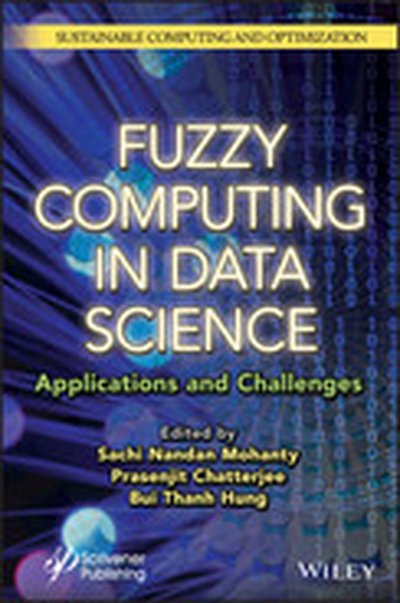
Fuzzy Computing in Data Science

FUZZY COMPUTING IN DATA SCIENCE This book comprehensively explains how to use various fuzzy-based models to solve real-time industrial challenges. The book provides information about fundamental aspects of the field and explores the myriad applications of fuzzy logic techniques and methods. It presents basic conceptual considerations and case studies of applications of fuzzy computation. It covers the fundamental concepts and techniques for system modeling, information processing, intelligent system design, decision analysis, statistical analysis, pattern recognition, automated learning, system control, and identification. The book also discusses the combination of fuzzy computation techniques with other computational intelligence approaches such as neural and evolutionary computation. Audience Researchers and students in computer science, artificial intelligence, machine learning, big data analytics, and information and communication technology.

Today I’m discussing something we’ve been talking about a lot on the podcast recently - the definition of a “data product.” While my definition is still a work in progress, I think it’s worth putting out into the world at this point to get more feedback. In addition to sharing my definition of data products (as defined the “producty way”), on today’s episode definition, I also discuss some of the non-technical skills that data product managers (DPMs) in the ML and AI space need if they want to achieve good user adoption of their solutions. I’ll also share my thoughts on whether data scientists can make good data product managers, what a DPM can do to better understand your users and stakeholders, and how product and UX design factors into this role. 

Highlights/ Skip to:

I introduce my reasons for sharing my definition of a data product (0:46) My definition of data product (7:26) Thinking the “producty” way (8:14) My thoughts on necessary skills for data PMs (in particular, AI & machine learning product management) (12:21) How data scientists can become good data product managers (DPMs) by taking off the data science hat (13:42) Understanding the role of UX design within the context of DPM (16:37) Crafting your sales and marketing strategies to emphasize the value of your product to the people who can use or purchase it (23:07) How to build a team that will help you increase adoption of your data product (30:01) How to build relationships with stakeholders/customers that allow you to find the right solutions for them (33:47) Letting go of a technical identity to develop a new identity as a DPM who can lead a team to build a product that actually gets used (36:32)

Quotes from Today’s Episode “This is what’s missing in some of the other definitions that I see around data products  [...] they’re not talking about it from the customer of the data product lens. And that orientation sums up all of the work that I’m doing and trying to get you to do as well, which is to put the people at the center of the work that you’re doing and not the data science, engineering, tech, or design. I want you to put the people at the center.” (6:12) “A data product is a data-driven, end-to-end, human-in-the-loop decision support solution that’s so valuable, users would potentially pay to use it.” (7:26) “I want to plunge all the way in and say, ‘if you want to do this kind of work, then you need to be thinking the product-y way.’ And this means inherently letting go of some of the data science-y way of thinking and the data-first kinds of ways of thinking.” (11:46) “I’ve read in a few places that data scientists don’t make for good data product managers. [While it may be true that they’re more introverted,] I don’t think that necessarily means that there’s an inherent problem with data scientists becoming good data product managers. I think the main challenge will be—and this is the same thing for almost any career transitioning into product management—is knowing when to let go of your former identity and wear the right hat at the right time.” (14:24) “Make better things for people that will improve their life and their outcomes and the business value will follow if you’ve properly aligned those two things together.” (17:21) “The big message here is this: there is always a design and experience, whether it is an API, or a platform, a dashboard, a full application, etc. Since there are no null design choices, how much are you going to intentionally shape that UX, or just pray that it comes out good on the other end? Prayer is not really a reliable strategy.  If you want to routinely do this work right, you need to put intention behind it.” (22:33)  “Relationship building is a must, and this is where applying user experience research can be very useful—not just for users, but also with stakeholders. It’s learning how to ask really good questions and learning the feelings, emotions, and reasons why people ask your team to build the thing that they’ve asked for. Learning how to dig into that is really important.” (26:26)

Links Designing for Analytics Community Work With Me Email Record a question

2022 was an incredible year for Generative AI. From text generation models like GPT-3 to the rising popularity of AI image generation tools, generative AI has rapidly evolved over the last few years in both its popularity and its use cases.

Martin Musiol joins the show this week to explore the business use cases of generative AI, and how it will continue to impact the way the society interacts with data. Martin is a Data Science Manager at IBM, as well as Co-Founder and an instructor at Generative AI, teaching people to develop their own AI that generates images, videos, music, text and other data. Martin has also been a keynote speaker at various events, such as Codemotion Milan. Having discovered his passion for AI in 2012, Martin has turned that passion into his expertise, becoming a thought leader in AI and machine learning space.

In this episode, we talk about the state of generative AI today, privacy and intellectual property concerns, the strongest use cases for generative AI, what the future holds, and much more.

Is your company good at customer success and retention? Chances are that you could be better. For most businesses with a recurring revenue model, customer churn is a very costly affair. Whenever a customer leaves, you lose out on recurring revenue, forgo the opportunity of expansion (cross sell) revenue and have to pay for another round of acquisition costs to cover the loss. In my personal experience, customer retention is both art and science. Machine learning and other data science techniques can be used to identify customers who are likely to churn, but it is equally important to craft meaningful and delightful interactions throughout the customer lifecycle. So, what’s required to become a lean, mean retention machine? In this episode of Leaders of Analytics, I speak to Sami Kaipa to learn the best practices of data-driven customer retention.  Sami is an experienced technology executive, serial entrepreneur and start-up advisor. He is co-founder of Tingono, an AI-driven customer retention platform. Listen to this episode as we discuss: Sami's journey as an entrepreneur and corporate technology executiveThe core elements of customer success and retention that every business should masterA deep dive into the concepts of customer retention, expansion and NRRThe economics of customer retention and expansionHow data science and machine learning can help with retention, and much more.Connect with Sami on LinkedIn: https://www.linkedin.com/in/samkaipa/ Tingono's blog: https://www.tingono.com/blog

podcast_episode
by Val Kroll , Julie Hoyer , Tim Wilson (Analytics Power Hour - Columbus (OH) , Renée Cummings (University of Virginia) , Moe Kiss (Canva) , Michael Helbling (Search Discovery)

Ethics in AI is a broad, deep, and tough subject. It's also, arguably, one of the most important subjects for analysts, data scientists, and organizations overall to deliberately and determinedly tackle as a standard part of how they do work. On this episode, Renée Cummings, Professor of Practice in Data Science and Data Activist in Residence at the University of Virginia (among many other roles), joined us for a discussion of the subject. Her knowledge of the topic is as deep as her passion for it, and both are bordering on the limitless, so it was an incredibly informative chat! For complete show notes, including links to items mentioned in this episode and a transcript of the show, visit the show page.

To become a data-driven organization, it takes a major shift in mindset and culture, investments in technology and infrastructure, skills transformation, and clearly evangelizing the usefulness of using data to drive better decision-making.

With all of these levers to scale, many organizations get stuck early in their data transformation journey, not knowing what to prioritize and how. In this episode, Ganes Kesari joins the show to share the frameworks and processes that organizations can follow to become data-driven, measure their data maturity, and win stakeholder support across the organization.

Ganes is Co-Founder and Chief Decision Scientist at Gramener, which helps companies make data-driven decisions through powerful data stories and analytics. He is an expert in data, analytics, organizational strategy, and hands-on execution. Throughout his 20-year career, Ganes has become an internationally-renowned speaker and has been published in Forbes, Entrepreneur, and has become a thought leader in Data Science.

Throughout the episode, we talk about how organizations can scale their data maturity, how to build an effective data science roadmap, how to successfully navigate the skills and people components of data maturity, and much more.

We talked about:

About Anna and METRO Anna’s background The importance of a technical background for data product owners What are product owners? Product owners vs product managers Anna’s work on recommender systems at METRO Expanding the data team Types of algorithms used for recommender systems What kind of knowledge and skills data product owners need to have Problems and ideas should come from the business How Anna handles all her responsibilities The process for starting work on new domains Product portfolio management ProductTank and Anna’s role in it Anna’s resource recommendations

Links:

Data Science for Business Book: https://www.amazon.de/-/en/Foster-Provost/dp/1449361323/ref=sr_1_1?keywords=data+science+for+business&qid=1666404807&qu=eyJxc2MiOiIxLjg3IiwicXNhIjoiMS41MiIsInFzcCI6IjEuNDYifQ%3D%3D&sr=8-1 Article on Data Science Products: https://www.linkedin.com/pulse/way-create-data-science-products-lessons-learnt-anna-hannemann-phd/

ML Zoomcamp: https://github.com/alexeygrigorev/mlbookcamp-code/tree/master/course-zoomcamp

Join DataTalks.Club: https://datatalks.club/slack.html

Our events: https://datatalks.club/events.html