talk-data.com talk-data.com

Topic

DataViz

Data Visualization

bi charts dashboards

434

tagged

Activity Trend

43 peak/qtr
2020-Q1 2026-Q1

Activities

434 activities · Newest first

Statistical Application Development with R and Python - Second Edition

This book, 'Statistical Application Development with R and Python', is your gateway to mastering statistical analysis and applying it effectively in real-world contexts. Through integrated R and Python code, you'll learn how to utilize data processing, explore advanced statistical models like regression and CART, and develop applications that solve complex analytical challenges. What this Book will help me do Fully understand data visualization and exploratory analysis methods to uncover insights from datasets. Master techniques such as regression models, clustering, and classification to enhance your analytical toolkit. Gain proficiency in R and Python for data processing and statistical modeling tasks. Apply CART and other machine learning tools to tackle nonlinear data challenges effectively. Equip yourself with a comprehensive approach to data exploration and decision-making for impactful results. Author(s) The author(s) of this book bring extensive experience in statistical analysis, computational modeling, and the use of R and Python for data science. They are professionals and educators passionate about making statistics accessible and practical. Their engaging writing style ensures readers not only understand but also enjoy the journey of learning statistics. Who is it for? This book is perfect for aspiring data scientists or professionals wanting to deepen their understanding of statistical analysis. Whether you're new to R or Python or looking to integrate both into your workflow, this guide provides comprehensive knowledge and practical techniques. It's suitable for beginners with no prior experience as well as seasoned users seeking to enhance their data processing and modeling skills.

Matplotlib 2.x By Example

"Matplotlib 2.x By Example" is your comprehensive guide to mastering data visualization in Python using the Matplotlib library. Through detailed explanations and hands-on examples, this book will teach you how to create stunning, insightful, and professional-looking visual representations of your data. You'll learn valuable skills tailored towards practical applications in science, marketing, and data analysis. What this Book will help me do Understand the core features of Matplotlib and how to use them effectively. Create professional 2D and 3D visualizations, such as scatter plots, line graphs, and more. Develop skills to transform raw data into meaningful insights through visualization. Enhance your data visualizations with interactive elements and animations. Leverage additional libraries such as Seaborn and Pandas to expand functionality. Author(s) Allen Yu, Claire Chung, and Aldrin Yim are seasoned data scientists and technical authors with extensive experience in Python and data visualization. Allen and his coauthors are dedicated to helping readers bridge the gap between their raw data and meaningful insights through visualization. With practical applications and real-world examples, their approachable writing makes complex libraries like Matplotlib accessible and production-ready. Who is it for? This book is perfect for data enthusiasts, analysts, and Python programmers looking to enhance their data visualization skills. Whether you're a professional aiming to create high-quality visual reports or a student eager to understand and present data effectively, this book provides practical and actionable insights. Basic Python knowledge is expected, while all Matplotlib-related aspects are thoroughly explained.

Advanced Analytics with R and Tableau

In "Advanced Analytics with R and Tableau," you will learn how to combine the statistical computing power of R with the excellent data visualization capabilities of Tableau to perform advanced analysis and present your findings effectively. This book guides you through practical examples to understand topics such as classification, clustering, and predictive analytics while creating compelling visual dashboards. What this Book will help me do Integrate advanced statistical computations in R with Tableau's visual analysis for comprehensive analytics. Master making R function calls from Tableau through practical applications such as RServe integration. Develop predictive and classification models in R, visualized wonderfully in Tableau dashboards. Understand clustering and unsupervised learning concepts, applied to real-world datasets for business insights. Leverage the combination of Tableau and R for making impactful, data-driven decisions in your organization. Author(s) Ruben Oliva Ramos, Jen Stirrup, and Roberto Rösler are accomplished professionals with extensive experience in data science and analytics. Their combined expertise brings practical insights into combining R and Tableau for advanced analytics. Advocates for hands-on learning, they emphasize clarity and actionable knowledge in their writing. Who is it for? "Advanced Analytics with R and Tableau" is ideal for business analysts, data scientists, and Tableau professionals eager to expand their capabilities into advanced analytics. Readers should be familiar with Tableau and have basic knowledge of R, though the book starts with accessible examples. If you're looking to enhance your analytics with R's statistical power seamlessly integrated into Tableau, this book is for you.

Interactive Data Visualization for the Web, 2nd Edition

Create and publish your own interactive data visualization projects on the webâ??even if you have little or no experience with data visualization or web development. Itâ??s inspiring and fun with this friendly, accessible, and practical hands-on introduction. This fully updated and expanded second edition takes you through the fundamental concepts and methods of D3, the most powerful JavaScript library for expressing data visually in a web browser. Ideal for designers with no coding experience, reporters exploring data journalism, and anyone who wants to visualize and share data, this step-by-step guide will also help you expand your web programming skills by teaching you the basics of HTML, CSS, JavaScript, and SVG. Learn D3 4.xâ??the latest D3 versionâ??with downloadable code and over 140 examples Create bar charts, scatter plots, pie charts, stacked bar charts, and force-directed graphs Use smooth, animated transitions to show changes in your data Introduce interactivity to help users explore your data Create custom geographic maps with panning, zooming, labels, and tooltips Walk through the creation of a complete visualization project, from start to finish Explore inspiring case studies with nine accomplished designers talking about their D3-based projects

Big data is flooding the business world. And we need a new generation of business analysts to make sense of it. A report from McKinsey predicts that the US workforce will be short 1.5 million big data managers and analysts by 2018. MIT Sloan is rising to the challenge with a new Master of Business Analytics Program, launched in 2016.

We speak with Dimitris Bertsimas, Professor of Management, and Director of the new MBAn program at MIT Sloan.Plus, we speak with MIT Sloan alum Ali Almossawi. His business school experience set him on a career path in data visualization; he now works for Apple. His new book, “Bad Choices,” explains computer algorithms to a wide audience.

SPSS Statistics for Data Analysis and Visualization

Dive deeper into SPSS Statistics for more efficient, accurate, and sophisticated data analysis and visualization SPSS Statistics for Data Analysis and Visualization goes beyond the basics of SPSS Statistics to show you advanced techniques that exploit the full capabilities of SPSS. The authors explain when and why to use each technique, and then walk you through the execution with a pragmatic, nuts and bolts example. Coverage includes extensive, in-depth discussion of advanced statistical techniques, data visualization, predictive analytics, and SPSS programming, including automation and integration with other languages like R and Python. You'll learn the best methods to power through an analysis, with more efficient, elegant, and accurate code. IBM SPSS Statistics is complex: true mastery requires a deep understanding of statistical theory, the user interface, and programming. Most users don't encounter all of the methods SPSS offers, leaving many little-known modules undiscovered. This book walks you through tools you may have never noticed, and shows you how they can be used to streamline your workflow and enable you to produce more accurate results. Conduct a more efficient and accurate analysis Display complex relationships and create better visualizations Model complex interactions and master predictive analytics Integrate R and Python with SPSS Statistics for more efficient, more powerful code These "hidden tools" can help you produce charts that simply wouldn't be possible any other way, and the support for other programming languages gives you better options for solving complex problems. If you're ready to take advantage of everything this powerful software package has to offer, SPSS Statistics for Data Analysis and Visualization is the expert-led training you need.

D3.js 4.x Data Visualization - Third Edition

Learn to build beautiful and interactive data visualizations with D3.js 4.x in this approachable and practical guide. From setting up the basics to mastering advanced techniques, this book empowers you to create engaging, sophisticated graphics and charts to communicate information effectively. What this Book will help me do Effectively map data sets to visual representations using D3.js scales. Generate dynamic and interactive SVG elements with D3's shape generators. Develop reusable D3 components for extensible and testing-friendly charts. Leverage advanced D3 layout patterns for large-scale data visualization. Write modern, efficient JavaScript for web-based data visualization systems. Author(s) Aendrew Rininsland, an experienced data visualization developer, and co-author bring a wealth of expertise to this book, drawing from years of implementing interactive solutions in professional contexts. Their engaging way of explaining concepts and demonstrating techniques with practical examples makes learning straightforward and impactful. Who is it for? This book is ideal for web developers, data analysts, and designers who are interested in enhancing their web-based data visualization skills with D3.js. Some familiarity with JavaScript is beneficial but not strictly required, as the book provides clear guidance to bring readers up to speed. If you aspire to effectively present data through captivating visuals and improve your technical proficiency, this book is a great fit for you.

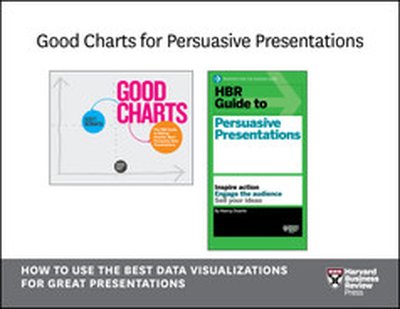
Good Charts for Persuasive Presentations

The right visual revealed at the right time can turn an unremarkable presentation into a resonant, emotional experience. This two-book collection provides you with the tools you need to craft and deliver presentations that will impress your audience, increase your influence in your organization, and advance your career. Good Charts: The HBR Guide to Making Smarter, More Persuasive Data Visualizations shows how a good visualization can communicate the nature and potential impact of information and ideas more powerfully than any other form of communication. For a long time "dataviz" was left to specialists--data scientists and professional designers. No longer. A new generation of tools and massive amounts of available data make it easy for anyone to create visualizations that communicate ideas far more effectively than generic spreadsheet charts ever could. What's more, building good charts is quickly becoming a need-to-have skill for managers. If you're not doing it, other managers are, and they're getting noticed for it and getting credit for contributing to your company's success. In Good Charts, dataviz maven Scott Berinato provides an essential guide to how visualization works and how to use this new language to impress and persuade. Dataviz today is where spreadsheets and word processors were in the early 1980s—on the cusp of changing how we work. Berinato lays out a system for thinking visually and building better charts through a process of talking, sketching, and prototyping. This book is much more than a set of static rules for making visualizations. It taps into both well-established and cutting-edge research in visual perception and neuroscience, as well as the emerging field of visualization science, to explore why good charts (and bad ones) create "feelings behind our eyes." Along the way, Berinato also includes many engaging vignettes of dataviz pros, illustrating the ideas in practice. Good Charts will help you turn plain, uninspiring charts that merely present information into smart, effective visualizations that powerfully convey ideas. HBR Guide to Persuasive Presentations will teach you to how to take the pain out of presentations. Terrified of speaking in front of a group? Or simply looking to polish your skills? No matter where you are on the spectrum, this guide will give you the confidence and the tools you need to get results. Written by presentation expert Nancy Duarte, the HBR Guide to Persuasive Presentations will help you: (1) Win over tough crowds, (2) Organize a coherent narrative, (3) Create powerful messages and visuals, (4) Connect with and engage your audience, (5) Show people why your ideas matter to them, and (6) Strike the right tone, in any situation.

The Big Book of Dashboards

The definitive reference book with real-world solutions you won't find anywhere else The Big Book of Dashboards presents a comprehensive reference for those tasked with building or overseeing the development of business dashboards. Comprising dozens of examples that address different industries and departments (healthcare, transportation, finance, human resources, marketing, customer service, sports, etc.) and different platforms (print, desktop, tablet, smartphone, and conference room display) The Big Book of Dashboards is the only book that matches great dashboards with real-world business scenarios. By organizing the book based on these scenarios and offering practical and effective visualization examples, The Big Book of Dashboards will be the trusted resource that you open when you need to build an effective business dashboard. In addition to the scenarios there's an entire section of the book that is devoted to addressing many practical and psychological factors you will encounter in your work. It's great to have theory and evidenced-based research at your disposal, but what will you do when somebody asks you to make your dashboard 'cooler' by adding packed bubbles and donut charts? The expert authors have a combined 30-plus years of hands-on experience helping people in hundreds of organizations build effective visualizations. They have fought many 'best practices' battles and having endured bring an uncommon empathy to help you, the reader of this book, survive and thrive in the data visualization world. A well-designed dashboard can point out risks, opportunities, and more; but common challenges and misconceptions can make your dashboard useless at best, and misleading at worst. The Big Book of Dashboards gives you the tools, guidance, and models you need to produce great dashboards that inform, enlighten, and engage.

No reliable, complete database cataloging home sales data at a transaction level is available for the average person to access. To a data scientist interesting in studying this data, our hands are complete tied. Opportunities like testing sociological theories, exploring economic impacts, study market forces, or simply research the value of an investment when buying a home are all blocked by the lack of easy access to this dataset. OpenHouse seeks to correct that by centralizing and standardizing all publicly available home sales transactional data. In this episode, we discuss the achievements of OpenHouse to date, and what plans exist for the future. Check out the OpenHouse gallery. I also encourage everyone to check out the project Zareen mentioned which was her Harry Potter word2vec webapp and Joy's project doing data visualization on Jawbone data. Guests Thanks again to @iamzareenf, @blueplastic, and @joytafty for coming on the show. Thanks to the numerous other volunteers who have helped with the project as well! Announcements and details If you're interested in getting involved in OpenHouse, check out the OpenHouse contributor's quickstart page. Kyle is giving a machine learning talk in Los Angeles on May 25th, 2017 at Zehr. Sponsor Thanks to our sponsor for this episode Periscope Data. The blog post demoing their maps option is on our blog titled Periscope Data Maps.

To start a free trial of their dashboarding too, visit http://periscopedata.com/skeptics Kyle recently did a youtube video exploring the Data Skeptic podcast download numbers using Periscope Data. Check it out at https://youtu.be/aglpJrMp0M4. Supplemental music is Lee Rosevere's Let's Start at the Beginning.  

D3.js: Cutting-edge Data Visualization

Turn your raw data into real knowledge by creating and deploying complex data visualizations with D3.js About This Book Understand how to best represent your data by developing the right kind of visualization Explore the concepts of D3.js through examples that enable you to quickly create visualizations including charts, network diagrams, and maps Get practical examples of visualizations using real-world data sets that show you how to use D3.js to visualize and interact with information to glean its underlying meaning Who This Book Is For Whether you are new to data and data visualization, a seasoned data scientist, or a computer graphics specialist, this Learning Path will provide you with the skills you need to create web-based and interactive data visualizations. Some basic JavaScript knowledge is expected, but no prior experience with data visualization or D3 is required What You Will Learn Gain a solid understanding of the common D3 development idioms Find out how to write basic D3 code for servers using Node.js Install and use D3.js to create HTML elements within a document Create and style graphical elements such as circles, ellipses, rectangles, lines, paths, and text using SVG Turn your data into bar and scatter charts, and add margins, axes, labels, and legends Use D3.js generators to perform the magic of creating complex visualizations from data Add interactivity to your visualizations, including tool-tips, sorting, hover-to-highlight, and grouping and dragging of visuals Write, test, and distribute a D3-based charting package Make a real-time application with Node and D3 In Detail D3 has emerged as one of the leading platforms to develop beautiful, interactive visualizations over the web. We begin the course by setting up a strong foundation, then build on this foundation as we take you through the entire world of reimagining data using interactive, animated visualizations created in D3.js. In the first module, we cover the various features of D3.js to build a wide range of visualizations. We also focus on the entire process of representing data through visualizations. By the end of this module, you will be ready to use D3 to transform any data into a more engaging and sophisticated visualization. In the next module, you will learn to master the creation of graphical elements from data. Using practical examples provided, you will quickly get to grips with the features of D3.js and use this learning to create your own spectacular data visualizations with D3.js. Over the last leg of this course, you will get acquainted with how to integrate D3 with mapping libraries to provide reverse geocoding and interactive maps among many other advanced features of D3. This module culminates by showing you how to create enterprise-level dashboards to display real-time data. This Learning Path combines some of the best that Packt has to offer in one complete, curated package. It includes content from the following Packt products: Learning D3.js Data Visualization, Second Edition by Andrew H. Rininsland D3.js By Example by Michael Heydt Mastering D3.js by Pablo Navarro Castillo Style and approach This course provides a comprehensive explanation of how to leverage the power of D3.js to create powerful and creative visualizations through step-by-step instructions in the form of modules. Each module help you skill up a level in creating meaningful visualizations. Downloading the example code for this book. You can download the example code files for all Packt books you have purchased from your account at http://www.PacktPub.com. If you purchased this book elsewhere, you can visit http://www.PacktPub.com/support and register to have the code file.

Python: Data Analytics and Visualization

Understand, evaluate, and visualize data About This Book Learn basic steps of data analysis and how to use Python and its packages A step-by-step guide to predictive modeling including tips, tricks, and best practices Effectively visualize a broad set of analyzed data and generate effective results Who This Book Is For This book is for Python Developers who are keen to get into data analysis and wish to visualize their analyzed data in a more efficient and insightful manner. What You Will Learn Get acquainted with NumPy and use arrays and array-oriented computing in data analysis Process and analyze data using the time-series capabilities of Pandas Understand the statistical and mathematical concepts behind predictive analytics algorithms Data visualization with Matplotlib Interactive plotting with NumPy, Scipy, and MKL functions Build financial models using Monte-Carlo simulations Create directed graphs and multi-graphs Advanced visualization with D3 In Detail You will start the course with an introduction to the principles of data analysis and supported libraries, along with NumPy basics for statistics and data processing. Next, you will overview the Pandas package and use its powerful features to solve data-processing problems. Moving on, you will get a brief overview of the Matplotlib API .Next, you will learn to manipulate time and data structures, and load and store data in a file or database using Python packages. You will learn how to apply powerful packages in Python to process raw data into pure and helpful data using examples. You will also get a brief overview of machine learning algorithms, that is, applying data analysis results to make decisions or building helpful products such as recommendations and predictions using Scikit-learn. After this, you will move on to a data analytics specialization - predictive analytics. Social media and IOT have resulted in an avalanche of data. You will get started with predictive analytics using Python. You will see how to create predictive models from data. You will get balanced information on statistical and mathematical concepts, and implement them in Python using libraries such as Pandas, scikit-learn, and NumPy. You'll learn more about the best predictive modeling algorithms such as Linear Regression, Decision Tree, and Logistic Regression. Finally, you will master best practices in predictive modeling. After this, you will get all the practical guidance you need to help you on the journey to effective data visualization. Starting with a chapter on data frameworks, which explains the transformation of data into information and eventually knowledge, this path subsequently cover the complete visualization process using the most popular Python libraries with working examples This Learning Path combines some of the best that Packt has to offer in one complete, curated package. It includes content from the following Packt products: Getting Started with Python Data Analysis, Phuong Vo.T.H &Martin Czygan Learning Predictive Analytics with Python, Ashish Kumar Mastering Python Data Visualization, Kirthi Raman Style and approach The course acts as a step-by-step guide to get you familiar with data analysis and the libraries supported by Python with the help of real-world examples and datasets. It also helps you gain practical insights into predictive modeling by implementing predictive-analytics algorithms on public datasets with Python. The course offers a wealth of practical guidance to help you on this journey to data visualization

R: Predictive Analysis

Master the art of predictive modeling About This Book Load, wrangle, and analyze your data using the world's most powerful statistical programming language Familiarize yourself with the most common data mining tools of R, such as k-means, hierarchical regression, linear regression, Naïve Bayes, decision trees, text mining and so on. We emphasize important concepts, such as the bias-variance trade-off and over-fitting, which are pervasive in predictive modeling Who This Book Is For If you work with data and want to become an expert in predictive analysis and modeling, then this Learning Path will serve you well. It is intended for budding and seasoned practitioners of predictive modeling alike. You should have basic knowledge of the use of R, although it’s not necessary to put this Learning Path to great use. What You Will Learn Get to know the basics of R’s syntax and major data structures Write functions, load data, and install packages Use different data sources in R and know how to interface with databases, and request and load JSON and XML Identify the challenges and apply your knowledge about data analysis in R to imperfect real-world data Predict the future with reasonably simple algorithms Understand key data visualization and predictive analytic skills using R Understand the language of models and the predictive modeling process In Detail Predictive analytics is a field that uses data to build models that predict a future outcome of interest. It can be applied to a range of business strategies and has been a key player in search advertising and recommendation engines. The power and domain-specificity of R allows the user to express complex analytics easily, quickly, and succinctly. R offers a free and open source environment that is perfect for both learning and deploying predictive modeling solutions in the real world. This Learning Path will provide you with all the steps you need to master the art of predictive modeling with R. We start with an introduction to data analysis with R, and then gradually you’ll get your feet wet with predictive modeling. You will get to grips with the fundamentals of applied statistics and build on this knowledge to perform sophisticated and powerful analytics. You will be able to solve the difficulties relating to performing data analysis in practice and find solutions to working with “messy data”, large data, communicating results, and facilitating reproducibility. You will then perform key predictive analytics tasks using R, such as train and test predictive models for classification and regression tasks, score new data sets and so on. By the end of this Learning Path, you will have explored and tested the most popular modeling techniques in use on real-world data sets and mastered a diverse range of techniques in predictive analytics. This Learning Path combines some of the best that Packt has to offer in one complete, curated package. It includes content from the following Packt products: Data Analysis with R, Tony Fischetti Learning Predictive Analytics with R, Eric Mayor Mastering Predictive Analytics with R, Rui Miguel Forte Style and approach Learn data analysis using engaging examples and fun exercises, and with a gentle and friendly but comprehensive "learn-by-doing" approach. This is a practical course, which analyzes compelling data about life, health, and death with the help of tutorials. It offers you a useful way of interpreting the data that’s specific to this course, but that can also be applied to any other data. This course is designed to be both a guide and a reference for moving beyond the basics of predictive modeling. Downloading the example code for this book. You can download the example code files for all Packt books you have purchased from your account at http://www.PacktPub.com. If you purchased this book elsewhere, you can visit http://www.PacktPub.com/support and register to have the code file.
Effective Business Intelligence with QuickSight

Effective Business Intelligence with QuickSight introduces you to Amazon QuickSight, a modern BI tool that enables interactive visualizations powered by the cloud. With comprehensive tutorials, you'll master how to load, prepare, and visualize your data for actionable insights. This book provides real-world examples to showcase how QuickSight integrates into the AWS ecosystem. What this Book will help me do Understand how to effectively use Amazon QuickSight for business intelligence. Learn how to connect QuickSight to data sources like S3, RDS, and more. Create interactive dashboards and visualizations with QuickSight tools. Gain expertise in managing users, permissions, and data security in QuickSight. Execute a real-world big data project using AWS Data Lakes and QuickSight. Author(s) None Nadipalli is a seasoned data architect with extensive experience in cloud computing and business intelligence. With expertise in the AWS ecosystem, she has worked on numerous large-scale data analytics projects. Her writing focuses on providing practical knowledge through easy-to-follow examples and actionable insights. Who is it for? This book is ideal for business intelligence architects, developers, and IT executives seeking to leverage Amazon QuickSight. It is suited for readers with foundational knowledge of AWS who want to enhance their capabilities in BI and data visualization. If your goal is to modernize your business intelligence systems and explore advanced analytics, this book is perfect for you.

Data Visualization, Volume II

This book discusses data and information visualization techniques-the decision-making tools with applications in health care, finance, manufacturing engineering, process improvement, product design, and others. These tools are an excellent means of viewing the current state of the process and improving them. The initial chapters discuss data analysis, the current trends in visualization, the concepts of systems and processes from which data are collected. The second part is devoted to quality tools-a set of graphical and information visualization tools in data analysis, decision-making, and Lean Six-Sigma quality. The eight basic tools of quality discussed are the Process Maps, Check Sheets, Histograms, Scatter Diagrams, Run Charts, Control Charts, Cause-and-Effect Diagrams, and Pareto Charts. The new quality tools presented are the Affinity, Tree, and Matrix Diagrams, Interrelationship Digraph, Prioritizing Matrices, Process Decision Program Chart, and Activity Network Diagram along with Quality Function Deployment (QFD) and Multivari Charts.

Data Science For Dummies, 2nd Edition

Your ticket to breaking into the field of data science! Jobs in data science are projected to outpace the number of people with data science skills—making those with the knowledge to fill a data science position a hot commodity in the coming years. Data Science For Dummies is the perfect starting point for IT professionals and students interested in making sense of an organization's massive data sets and applying their findings to real-world business scenarios. From uncovering rich data sources to managing large amounts of data within hardware and software limitations, ensuring consistency in reporting, merging various data sources, and beyond, you'll develop the know-how you need to effectively interpret data and tell a story that can be understood by anyone in your organization. Provides a background in data science fundamentals and preparing your data for analysis Details different data visualization techniques that can be used to showcase and summarize your data Explains both supervised and unsupervised machine learning, including regression, model validation, and clustering techniques Includes coverage of big data processing tools like MapReduce, Hadoop, Dremel, Storm, and Spark It's a big, big data world out there—let Data Science For Dummies help you harness its power and gain a competitive edge for your organization.

Big Data Visualization

Dive into 'Big Data Visualization' and uncover how to tackle the challenges of visualizing vast quantities of complex data. With a focus on scalable and dynamic techniques, this guide explores the nuances of effective data analysis. You'll master tools and approaches to display, interpret, and communicate data in impactful ways. What this Book will help me do Understand the fundamentals of big data visualization, including unique challenges and solutions. Explore practical techniques for using D3 and Python to visualize and detect anomalies in big data. Learn to leverage dashboards like Tableau to present data insights effectively. Address and improve data quality issues to enhance analysis accuracy. Gain hands-on experience with real-world use cases for tools such as Hadoop and Splunk. Author(s) James D. Miller is an IBM-certified expert specializing in data analytics and visualization. With years of experience handling massive datasets and extracting actionable insights, he is dedicated to sharing his expertise. His practical approach is evident in how he combines tool mastery with a clear understanding of data complexities. Who is it for? This book is designed for data analysts, data scientists, and others involved in interpreting and presenting big datasets. Whether you are a beginner looking to understand big data visualization or an experienced professional seeking advanced tools and techniques, this guide suits your needs perfectly. A foundational knowledge in programming languages like R and big data platforms such as Hadoop is recommended to maximize your learning.

Data Visualization with D3 4.x Cookbook - Second Edition

This book, 'Data Visualization with D3 4.x Cookbook' by Nick Zhu, is your ultimate guide to mastering data visualization using D3.js. Through practical recipes, you'll learn to create dynamic, data-driven visualizations and tackle real-world visualization challenges. The book also introduces techniques to manage and present data powerfully. What this Book will help me do Master D3.js 4.x features to create efficient data visualizations. Utilize pre-built recipes to generate diverse charts and graphs. Acquire expertise in manipulating datasets for visualization. Develop interactive, dynamic web applications with D3. Overcome common visualization challenges with practical solutions. Author(s) Nick Zhu is a professional data engineer and an expert in creating data-driven applications. With years of experience using D3.js, Nick brings his wealth of knowledge to writing, making complex concepts accessible to learners. He creates resources to help others enhance their data visualization skills. Who is it for? This book is ideal for developers and data analysts familiar with web technologies like HTML, CSS, and JavaScript, aiming to expand their skills with D3.js. Whether you're new to D3 or experienced and looking for a comprehensive reference, this book will empower you to create professional-grade visualizations.

Learning Kibana 5.0

Learning Kibana 5.0 is your gateway to mastering the art of data visualization using the powerful features of the Kibana platform. This book guides you through the process of creating stunning interactive dashboards and making data-driven insights accessible with real-time visualizations. Whether you're new to the Elastic stack or seeking to refine your expertise, this book equips you to harness Kibana's full potential. What this Book will help me do Build robust, real-time dashboards in Kibana to visualize complex datasets efficiently. Leverage Timelion to perform time-series data analysis and create metrics-based dashboards. Explore advanced analytics using the Graph plugin to uncover relationships and correlations in data. Learn how to create and deploy custom plugins to tailor Kibana to specific project needs. Understand how to use the Elastic stack to monitor, analyze, and optimize various types of data flows. Author(s) Bahaaldine Azarmi is a seasoned expert in the Elastic stack, known for his dedication to making complex technical topics approachable and practical. With years of experience in data analytics and software development, Bahaaldine shares not only his technical expertise but also his passion for helping professionals achieve their goals through clear, actionable guidance. His writing emphasizes hands-on learning and practical application. Who is it for? This book is perfect for developers, data visualization engineers, and data scientists who aim to hone their skills in data visualization and interactive dashboard development. It assumes a basic understanding of Elasticsearch and Logstash to maximize its practicality. If you aim to advance your career by learning how to optimize data architecture and solve real-world problems using the Elastic stack, this book is ideal for you.

Data Visualization, Volume I

Data visualization involves graphical and visual tools used in data analysis and decision making. The emphasis in this book is on recent trends and applications of visualization tools using conventional and big data. These tools are widely used in data visualization and quality improvement to analyze, enhance, and improve the quality of products and services. Data visualization is an easy way to obtain a first look at the data visually. The book provides a collection of visual and graphical tools widely used to gain an insight into the data before applying more complex analysis. The focus is on the key application areas of these tools including business process improvement, business data analysis, health care, finance, manufacturing, engineering, process improvement, and Lean Six Sigma. The key areas of application include data and data analysis concepts, recent trends in data visualization and ÒBig Data,Ó widely used charts and graphs and their applications, analysis of the relationships between two or more variables graphically using scatterplots, bubble graphs, matrix plots, etc., data visualization with big data, computer applications and implementation of widely used graphical and visual tools, and computer instructions to create the graphics presented along with the data files.