 talk-data.com
Topic
DevOps
software_development
it_operations
continuous_delivery
216
tagged
Activity Trend
25
peak/qtr
2020-Q1
2026-Q1
Top Events
O'Reilly Data Engineering Books
42
Data Engineering Podcast
24
Microsoft Ignite 2025
13
O'Reilly Data Science Books
10
Google Cloud Next '25
9
Google Cloud Next '24
9
DataTalks.Club
7
Data + AI Summit 2025
7
Databricks DATA + AI Summit 2023
6
Next-Gen DevOps on AWS: Empower Teams with Amazon Q and Generative AI
5
Next-Gen DevOps on AWS: Empower Teams with Amazon Q and Generative AI
4
Airflow Summit 2023
3
In today's fast-paced digital world, managing IT operations is more complex than ever. With the rise of cloud services, microservices, and constant software deployments, the pressure on IT teams to keep everything running smoothly is immense. But how do you keep up with the ever-growing flood of data and ensure your systems are always available? AIOps is the use of artificial intelligence to automate and scale IT operations. But what exactly is AIOps, and how can it transform your IT operations? Assaf Resnick is the CEO and Co-Founder of BigPanda. Before founding BigPanda, Assaf was an investor at Sequoia Capital, where he focused on early and growth-stage investing in software, internet, and mobile sectors. Assaf’s time at Sequoia gave him a front-row seat to the challenges of IT scale, complexity, and velocity faced by Operations teams in rapidly scaling and accelerating organizations. This is the problem that Assaf founded BigPanda to solve. In the episode, Richie and Assaf explore AIOps, how AIOps helps manage increasingly complex IT operations, how AIOps differs from DevOps and MLOps, examples of AIOps projects, a real world application of AIOps, the key benefits of AIOps, how to implement AIOps, excitement in the space, how GenAI is improving AIOps and much more. Links Mentioned in the Show: BigPandaGartner: Market Guide for AIOps Platforms[Course] Implementing AI Solutions in BusinessRelated Episode: Adding AI to the Data Warehouse with Sridhar Ramaswamy, CEO at SnowflakeSign up to RADAR: AI Edition New to DataCamp? Learn on the go using the DataCamp mobile app Empower your business with world-class data and AI skills with DataCamp for business
Application development in continuously breaking down silos. From Dev, DevTest, DevOps, DevSecOps, MLOps, Analytics, to… DevAI? Developers are now being thrust into the dynamic arena of real-time analytics and generative AI (GenAI): two forces shaping the next iteration of technology. This session dives deep into this intersection, demonstrating how developers can leverage these revolutionary tools to not only build applications, but craft game-changing business strategies.
Click the blue “Learn more” button above to tap into special offers designed to help you implement what you are learning at Google Cloud Next 25.
Ready to level up your infrastructure, Google Kubernetes Engine, and networking skills with the power of Gemini? Join this session to learn how large language models work and how it applies to roles in infrastructure, DevOps, and networking.
Click the blue “Learn more” button above to tap into special offers designed to help you implement what you are learning at Google Cloud Next 25.
Google Cloud is building the next generation of Observability solutions using Gemini and BigQuery. In this session, we’ll show you how we can remove fragmentation for your logs, metrics, traces, events, billing data sources using Google BigQuery on Google Cloud Operations Suite to perform Observability analytics. Targeted audience includes Developers, DevOps Engineers, SRE, and Cloud Architects.
Click the blue “Learn more” button above to tap into special offers designed to help you implement what you are learning at Google Cloud Next 25.
AppSec and Cloud teams have an opportunity to connect where they’re truly joined together and able to accelerate under a single, unified platform. This Palo Alto Networks cloud security session will show how to simultaneously enhance security and automation, reduce the attack surface, and lower both your team’s mean time to detection (MTTD) and mean time to resolution (MTTR) using Prisma Cloud best-of-breed capabilities in visibility, threat detection, compliance, and DevOps, from Code to Cloud.
By attending this session, your contact information may be shared with the sponsor for relevant follow up for this event only.
Click the blue “Learn more” button above to tap into special offers designed to help you implement what you are learning at Google Cloud Next 25.
In this session, Slalom and Bayer AG will discuss how Bayer AG leverages GKE Enterprise, to build an internal developer platform, integrating Anthos features like Config Sync and Service Mesh. You’ll hear how the implementation, automated through Cloud Build and Terraform, empowered Bayer AG to establish robust security and DevOps practices to support its data engineering teams. By attending this session, your contact information may be shared with the sponsor for relevant follow up for this event only.
Click the blue “Learn more” button above to tap into special offers designed to help you implement what you are learning at Google Cloud Next 25.
Learn how to get the most out of your CI/CD tools through new features. Find out the latest product updates to create secure and reliable application repositories, builds, and deployments.
Click the blue “Learn more” button above to tap into special offers designed to help you implement what you are learning at Google Cloud Next 25.
by
Nick Durkin
(Harness)
,
Sameer Nori
(Arm)
,
Utkarsh Guleri
(Google Cloud)
,
Clinton Herget
(Snyk)
,
Brian Wald
(Gitlab)
Sonatype’s State of Software Supply Chain report recorded a 650% year-over-year increase in software supply chain attacks in 2021. With increasing security breaches classified as software supply chain attacks over the last few years, it’s vital to keep your software supply chain secure. Join this discussion with Google Cloud and executives from industry-leading independent software vendors in the Developer tools ecosystem. They’ll cover what's trending at the intersection of DevOps, Security, and generative AI and understand best practices to secure your software delivery by building an AI-powered end-to-end secure software supply chain.
Click the blue “Learn more” button above to tap into special offers designed to help you implement what you are learning at Google Cloud Next 25.
Cloud-native applications can be complex, but securing them shouldn’t be. Learn how CrowdStrike Falcon Cloud Security enables DevOps and SecOps to discover weak spots in their container images, prevent malicious behavior on Kubernetes clusters, visualize sensitive data flows, and discover misconfigurations across all of their cloud accounts. This session is for anyone responsible for application or cloud security. By attending this session, your contact information may be shared with the sponsor for relevant follow up for this event only.
Click the blue “Learn more” button above to tap into special offers designed to help you implement what you are learning at Google Cloud Next 25.
With the emergence of generative AI and the dazzling success it has achieved in just a few months, companies are asking a lot of questions about the relevance of AI and its fields of application overall domains. After DevOps, FinOps or even DevSecOps, it was time to attach the term AI to the profession of ops to give birth to AIOps practices where we will use AI to help ops on a daily basis and enable them to win considerable time with prevention, optimization or even smart assistance in their everyday work.
Click the blue “Learn more” button above to tap into special offers designed to help you implement what you are learning at Google Cloud Next 25.
We talked about:
Nemanja’s background
When Nemanja first work as a data person Typical problems that ML Ops folks solve in the financial sector What Nemanja currently does as an ML Engineer The obstacle of implementing new things in financial sector companies Going through the hurdles of DevOps Working with an on-premises cluster “ML Ops on a Shoestring” (You don’t need fancy stuff to start w/ ML Ops) Tactical solutions Platform work and code work Programming and soft skills needed to be an ML Engineer The challenges of transitioning from and electrical engineering and sales to ML Ops The ML Ops tech stack for beginners Working on projects to determine which skills you need
Links:
LinkedIn: https://www.linkedin.com/in/radojkovic/
Free Data Engineering course: https://github.com/DataTalksClub/data-engineering-zoomcamp
Join DataTalks.Club: https://datatalks.club/slack.html Our events: https://datatalks.club/events.html
Explore the fusion of DevOps and DataOps with Sascha Giese, SolarWinds Global Tech Evangelist. Learn to optimize data efficiency, mitigate risks, and transform your database management for reliability and scalability. 🚀📊 #DataOps #devops
✨ H I G H L I G H T S ✨
🙌 A huge shoutout to all the incredible participants who made Big Data Conference Europe 2023 in Vilnius, Lithuania, from November 21-24, an absolute triumph! 🎉 Your attendance and active participation were instrumental in making this event so special. 🌍
Don't forget to check out the session recordings from the conference to relive the valuable insights and knowledge shared! 📽️
Once again, THANK YOU for playing a pivotal role in the success of Big Data Conference Europe 2023. 🚀 See you next year for another unforgettable conference! 📅 #BigDataConference #SeeYouNextYear
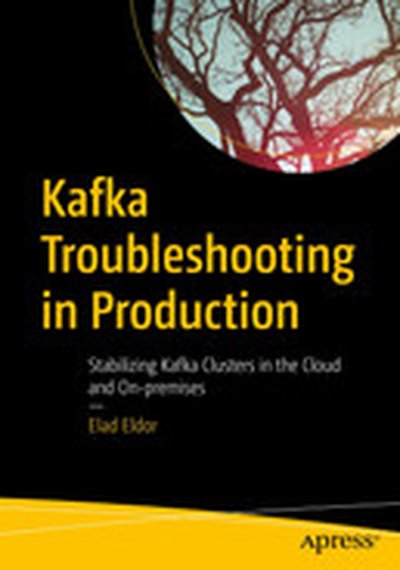
This book provides Kafka administrators, site reliability engineers, and DataOps and DevOps practitioners with a list of real production issues that can occur in Kafka clusters and how to solve them. The production issues covered are assembled into a comprehensive troubleshooting guide for those engineers who are responsible for the stability and performance of Kafka clusters in production, whether those clusters are deployed in the cloud or on-premises. This book teaches you how to detect and troubleshoot the issues, and eventually how to prevent them. Kafka stability is hard to achieve, especially in high throughput environments, and the purpose of this book is not only to make troubleshooting easier, but also to prevent production issues from occurring in the first place. The guidance in this book is drawn from the author's years of experience in helping clients and internal customers diagnose and resolve knotty production problems and stabilize their Kafka environments. The book is organized into recipe-style troubleshooting checklists that field engineers can easily follow when under pressure to fix an unstable cluster. This is the book you will want by your side when the stakes are high, and your job is on the line. What You Will Learn Monitor and resolve production issues in your Kafka clusters Provision Kafka clusters with the lowest costs and still handle the required loads Perform root cause analyses of issues affecting your Kafka clusters Know the ways in which your Kafka cluster can affect its consumers and producers Prevent or minimize data loss and delays in data streaming Forestall production issues through an understanding of common failure points Create checklists for troubleshooting your Kafka clusters when problems occur Who This Book Is For Site reliability engineers tasked with maintaining stability of Kafka clusters, Kafka administrators who troubleshoot production issues around Kafka, DevOps and DataOps experts who are involved with provisioning Kafka (whether on-premises or in the cloud), developers of Kafka consumers and producers who wish to learn more about Kafka
by
Ed Donahue
,
Stefan Schackow
,
Gaurav Seth
(Microsoft)
,
Tulika Chaudharie
,
Michael YenChi Ho
(Microsoft)
,
Scott Hunter
(Microsoft)
,
Byron Tardif
,
Yutang Lin
Discover why Azure App Service is as fast growing as the managed platform of choice for migrating on-premises .NET and Java apps to the cloud. Learn how to deploy your web applications with ease, using built-in support for containers like GitHub and DevOps. Secure your apps with SSL, authentication, and firewall features. We'll also share latest tools and innovations to lower the cost and time to complete your migration projects.
To learn more, please check out these resources: * https://aka.ms/Ignite23CollectionsBRK207H * https://info.microsoft.com/ww-landing-contact-me-for-events-m365-in-person-events.html?LCID=en-us&ls=407628-contactme-formfill * https://aka.ms/azure-ignite2023-dataaiblog
𝗦𝗽𝗲𝗮𝗸𝗲𝗿𝘀: * Gaurav Seth * Scott Hunter * Tulika Chaudharie * Byron Tardif * Ed Donahue * Michael YenChi Ho * Stefan Schackow * Yutang Lin
𝗦𝗲𝘀𝘀𝗶𝗼𝗻 𝗜𝗻𝗳𝗼𝗿𝗺𝗮𝘁𝗶𝗼𝗻: This video is one of many sessions delivered for the Microsoft Ignite 2023 event. View sessions on-demand and learn more about Microsoft Ignite at https://ignite.microsoft.com
BRK207H | English (US) | AI & Apps
MSIgnite
In today's cloud ecosystem, many laud the visible pillars of AWS's Well-Architected Framework, yet an essential component often remains in the shadows: Infrastructure as Code (IAC). Elizabeth Adeotun Adegbaju, a DevOps Engineer with a rich history in AWS cloud infrastructure, unravels the indispensable role of IAC in fortifying each of the renowned AWS pillars. Through this illuminating talk, attendees will gain insights into the intricate interplay between IAC and AWS's principles of operational excellence, cost optimization, reliability, performance efficiency, security, and sustainability. Dive deep into real-world examples, understand the potential pitfalls of overlooking IAC, and emerge with a renewed appreciation for its foundational significance in cloud architecture. This session is a clarion call for organizations to recognize and harness the power of IAC, positioning it not just as an option but as an imperative in achieving success in the cloud.
In this talk I will explore how Mobile DevOps can significantly accelerate the mobile development lifecycle. I will dive deep into the strategies, tools, and best practices that empower mobile development teams to seamlessly transition from the development phase to production, all while maintaining the highest standards of quality and reliability.\n\nDuring this talk, you will discover:\n\nThe Mobile DevOps mindset: Understand the core principles and mindset shifts that are essential for integrating DevOps practices into your mobile development workflow.\n\nStreamlining development workflows: Learn how to optimize your development process to reduce bottlenecks and streamline collaboration between development, QA, and operations teams.\n\nAutomation and Continuous Integration/Continuous Deployment (CI/CD): Explore how automation tools and CI/CD pipelines can help you automate repetitive tasks, increase efficiency, and ensure consistent app delivery.\n\nMonitoring and feedback loops: Discover the importance of real-time monitoring, performance analytics, and user feedback in shaping a continuous improvement cycle for your mobile apps.\n\nThis talk will equip you with the knowledge and insights needed to harness the power of Mobile DevOps and accelerate your mobile app development journey.
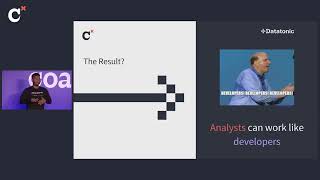
Behind any good DataOps within a Modern Data Stack (MDS) architecture is a solid DevOps design! This is particularly pressing when building an MDS solution at scale, as reliability, quality and availability of data requires a very high degree of process automation while remaining fast, agile and resilient to change when addressing business needs.
While DevOps in Data Engineering is nothing new - for a broad-spectrum solution that includes data warehouse, BI, etc seemed either a bit out of reach due to overall complexity and cost - or simply overlooked due to perceived issues around scaling often attributed to the challenges of automation in CI/CD processes. However, this has been fast changing with tools such as dbt having super cool features which allow a very high degree of autonomy in the CI/CD processes with relative ease, with flexible and cutting edge features around pre-commits, Slim CI, etc.
In this session, Datatonic covers the challenges around building and deploying enterprise-grade MDS solutions for analytics at scale and how they have used dbt to address those - especially around near-complete autonomy to the CI/CD processes!
Speaker: Ash Sultan, Lead Data Architect, Datatonic
Register for Coalesce at https://coalesce.getdbt.com