talk-data.com talk-data.com

Topic

Hive

Apache Hive

data_warehouse sql hadoop

41

tagged

Activity Trend

9 peak/qtr
2020-Q1 2026-Q1

Activities

Showing filtered results

Filtering by: O'Reilly Data Engineering Books ×
Data Munging with Hadoop

The Example-Rich, Hands-On Guide to Data Munging with Apache Hadoop TM Data scientists spend much of their time “munging” data: handling day-to-day tasks such as data cleansing, normalization, aggregation, sampling, and transformation. These tasks are both critical and surprisingly interesting. Most important, they deepen your understanding of your data’s structure and limitations: crucial insight for improving accuracy and mitigating risk in any analytical project. Now, two leading Hortonworks data scientists, Ofer Mendelevitch and Casey Stella, bring together powerful, practical insights for effective Hadoop-based data munging of large datasets. Drawing on extensive experience with advanced analytics, the authors offer realistic examples that address the common issues you’re most likely to face. They describe each task in detail, presenting example code based on widely used tools such as Pig, Hive, and Spark. This concise, hands-on eBook is valuable for every data scientist, data engineer, and architect who wants to master data munging: not just in theory, but in practice with the field’s #1 platform–Hadoop. Coverage includes A framework for understanding the various types of data quality checks, including cell-based rules, distribution validation, and outlier analysis Assessing tradeoffs in common approaches to imputing missing values Implementing quality checks with Pig or Hive UDFs Transforming raw data into “feature matrix” format for machine learning algorithms Choosing features and instances Implementing text features via “bag-of-words” and NLP techniques Handling time-series data via frequency- or time-domain methods Manipulating feature values to prepare for modeling Data Munging with Hadoop is part of a larger, forthcoming work entitled Data Science Using Hadoop. To be notified when the larger work is available, register your purchase of Data Munging with Hadoop at informit.com/register and check the box “I would like to hear from InformIT and its family of brands about products and special offers.”
Hadoop 2 Quick-Start Guide: Learn the Essentials of Big Data Computing in the Apache Hadoop 2 Ecosystem

Get Started Fast with Apache Hadoop ® 2, YARN, and Today’s Hadoop Ecosystem With Hadoop 2.x and YARN, Hadoop moves beyond MapReduce to become practical for virtually any type of data processing. Hadoop 2.x and the Data Lake concept represent a radical shift away from conventional approaches to data usage and storage. Hadoop 2.x installations offer unmatched scalability and breakthrough extensibility that supports new and existing Big Data analytics processing methods and models. Hadoop ® 2 Quick-Start Guide is the first easy, accessible guide to Apache Hadoop 2.x, YARN, and the modern Hadoop ecosystem. Building on his unsurpassed experience teaching Hadoop and Big Data, author Douglas Eadline covers all the basics you need to know to install and use Hadoop 2 on personal computers or servers, and to navigate the powerful technologies that complement it. Eadline concisely introduces and explains every key Hadoop 2 concept, tool, and service, illustrating each with a simple “beginning-to-end” example and identifying trustworthy, up-to-date resources for learning more. This guide is ideal if you want to learn about Hadoop 2 without getting mired in technical details. Douglas Eadline will bring you up to speed quickly, whether you’re a user, admin, devops specialist, programmer, architect, analyst, or data scientist. Coverage Includes Understanding what Hadoop 2 and YARN do, and how they improve on Hadoop 1 with MapReduce Understanding Hadoop-based Data Lakes versus RDBMS Data Warehouses Installing Hadoop 2 and core services on Linux machines, virtualized sandboxes, or clusters Exploring the Hadoop Distributed File System (HDFS) Understanding the essentials of MapReduce and YARN application programming Simplifying programming and data movement with Apache Pig, Hive, Sqoop, Flume, Oozie, and HBase Observing application progress, controlling jobs, and managing workflows Managing Hadoop efficiently with Apache Ambari–including recipes for HDFS to NFSv3 gateway, HDFS snapshots, and YARN configuration Learning basic Hadoop 2 troubleshooting, and installing Apache Hue and Apache Spark

Sams Teach Yourself: Big Data Analytics with Microsoft HDInsight in 24 Hours

Sams Teach Yourself Big Data Analytics with Microsoft HDInsight in 24 Hours In just 24 lessons of one hour or less, Sams Teach Yourself Big Data Analytics with Microsoft HDInsight in 24 Hours helps you leverage Hadoop’s power on a flexible, scalable cloud platform using Microsoft’s newest business intelligence, visualization, and productivity tools. This book’s straightforward, step-by-step approach shows you how to provision, configure, monitor, and troubleshoot HDInsight and use Hadoop cloud services to solve real analytics problems. You’ll gain more of Hadoop’s benefits, with less complexity–even if you’re completely new to Big Data analytics. Every lesson builds on what you’ve already learned, giving you a rock-solid foundation for real-world success. Practical, hands-on examples show you how to apply what you learn Quizzes and exercises help you test your knowledge and stretch your skills Notes and tips point out shortcuts and solutions Learn how to… Master core Big Data and NoSQL concepts, value propositions, and use cases Work with key Hadoop features, such as HDFS2 and YARN Quickly install, configure, and monitor Hadoop (HDInsight) clusters in the cloud Automate provisioning, customize clusters, install additional Hadoop projects, and administer clusters Integrate, analyze, and report with Microsoft BI and Power BI Automate workflows for data transformation, integration, and other tasks Use Apache HBase on HDInsight Use Sqoop or SSIS to move data to or from HDInsight Perform R-based statistical computing on HDInsight datasets Accelerate analytics with Apache Spark Run real-time analytics on high-velocity data streams Write MapReduce, Hive, and Pig programs Register your book at informit.com/register for convenient access to downloads, updates, and corrections as they become available.

Pro MongoDB™ Development

Pro MongoDB Development is a critical reference for anyone using MongoDB, a NoSQL database based on the BSON (binary JSON) document model. The book explores many aspects of implementing MongoDB in web applications, whether you are using Java, PHP, Ruby, and JavaScript. Noted expert Deepak Vohra walks you through accessing MongoDB databases with all these languages and working with various other technologies and databases. Vohra discusses using Java EE frameworks Kundera and Spring Data with MongoDB. You learn the nuts and bolts of migrating data from other NoSQL databases (Apache Cassandra and Couchbase) and from relational databases (Oracle Database). And, because NoSQL databases are commonly used with the Hadoop ecosystem, the book also covers using MongoDB with Apache Hive. Each chapter includes details about the software you need and hands on examples of working with MongoDB and these technologies so you know exactly what to do, whatever your MongoDB implementation requires.

Hadoop Essentials

In 'Hadoop Essentials,' you'll embark on an engaging journey to master the Hadoop ecosystem. This book covers fundamental to advanced topics, from HDFS and MapReduce to real-time analytics with Spark, empowering you to handle modern data challenges efficiently. What this Book will help me do Understand the core components of Hadoop, including HDFS, YARN, and MapReduce, for foundational knowledge. Learn to optimize Big Data architectures and improve application performance. Utilize tools like Hive and Pig for efficient data querying and processing. Master data ingestion technologies like Sqoop and Flume for seamless data management. Achieve fluency in real-time data analytics using modern tools like Apache Spark and Apache Storm. Author(s) None Achari is a seasoned expert in Big Data and distributed systems with in-depth knowledge of the Hadoop ecosystem. With years of experience in both development and teaching, they craft content that bridges practical know-how with theoretical insights in a highly accessible style. Who is it for? This book is perfect for system and application developers aiming to learn practical applications of Hadoop. It suits professionals seeking solutions to real-world Big Data challenges as well as those familiar with distributed systems basics and looking to deepen their expertise in advanced data analysis.

Hadoop: The Definitive Guide, 4th Edition

Get ready to unlock the power of your data. With the fourth edition of this comprehensive guide, youâ??ll learn how to build and maintain reliable, scalable, distributed systems with Apache Hadoop. This book is ideal for programmers looking to analyze datasets of any size, and for administrators who want to set up and run Hadoop clusters. Using Hadoop 2 exclusively, author Tom White presents new chapters on YARN and several Hadoop-related projects such as Parquet, Flume, Crunch, and Spark. Youâ??ll learn about recent changes to Hadoop, and explore new case studies on Hadoopâ??s role in healthcare systems and genomics data processing. Learn fundamental components such as MapReduce, HDFS, and YARN Explore MapReduce in depth, including steps for developing applications with it Set up and maintain a Hadoop cluster running HDFS and MapReduce on YARN Learn two data formats: Avro for data serialization and Parquet for nested data Use data ingestion tools such as Flume (for streaming data) and Sqoop (for bulk data transfer) Understand how high-level data processing tools like Pig, Hive, Crunch, and Spark work with Hadoop Learn the HBase distributed database and the ZooKeeper distributed configuration service

Field Guide to Hadoop

If your organization is about to enter the world of big data, you not only need to decide whether Apache Hadoop is the right platform to use, but also which of its many components are best suited to your task. This field guide makes the exercise manageable by breaking down the Hadoop ecosystem into short, digestible sections. You’ll quickly understand how Hadoop’s projects, subprojects, and related technologies work together. Each chapter introduces a different topic—such as core technologies or data transfer—and explains why certain components may or may not be useful for particular needs. When it comes to data, Hadoop is a whole new ballgame, but with this handy reference, you’ll have a good grasp of the playing field. Topics include: Core technologies—Hadoop Distributed File System (HDFS), MapReduce, YARN, and Spark Database and data management—Cassandra, HBase, MongoDB, and Hive Serialization—Avro, JSON, and Parquet Management and monitoring—Puppet, Chef, Zookeeper, and Oozie Analytic helpers—Pig, Mahout, and MLLib Data transfer—Scoop, Flume, distcp, and Storm Security, access control, auditing—Sentry, Kerberos, and Knox Cloud computing and virtualization—Serengeti, Docker, and Whirr

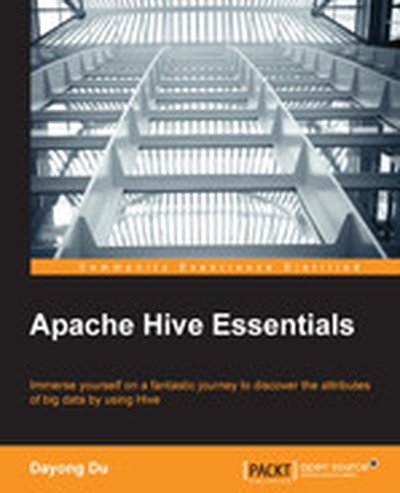
Apache Hive Essentials

Apache Hive Essentials is the perfect guide for understanding and mastering Hive, the SQL-like big data query language built on top of Hadoop. With this book, you will gain the skills to effectively use Hive to analyze and manage large data sets. Whether you're a developer, data analyst, or just curious about big data, this hands-on guide will enhance your capabilities. What this Book will help me do Understand the core concepts of Hive and its relation to big data and Hadoop. Learn how to set up a Hive environment and integrate it with Hadoop. Master the SQL-like query functionalities of Hive to select, manipulate, and analyze data. Develop custom functions in Hive to extend its functionality for your own specific use cases. Discover best practices for optimizing Hive performance and ensuring data security. Author(s) Dayong Du is an expert in big data analytics with extensive experience in implementing and using tools like Hive in professional settings. Having worked on practical big data solutions, Dayong brings a wealth of knowledge and insights to his writing. His clear, approachable style makes complex topics accessible to readers. Who is it for? This book is ideal for developers, data analysts, and data engineers looking to leverage Hive for big data analysis. If you are familiar with SQL and Hadoop basics and aim to enhance your understanding of Hive, this book is for you. Beginners with some programming background eager to dive into big data technologies will also benefit. It's tailored for learners wanting actionable knowledge to advance their data processing skills.

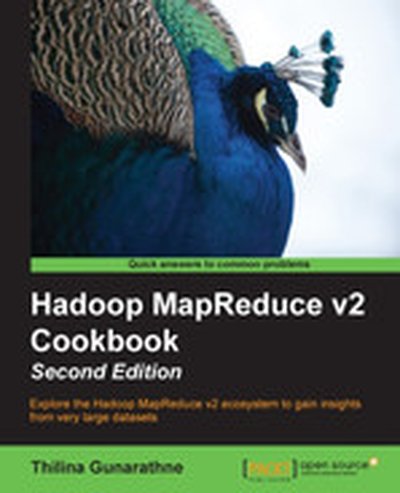
Hadoop MapReduce v2 Cookbook - Second Edition

Explore insights from vast datasets with "Hadoop MapReduce v2 Cookbook - Second Edition." This book serves as a practical guide for developers and system administrators who aim to master big data processing using Hadoop v2. By engaging with its step-by-step recipes, you will learn to harness the Hadoop MapReduce ecosystem for scalable and efficient data solutions. What this Book will help me do Master the configuration and management of Hadoop YARN, MapReduce v2, and HDFS clusters. Integrate big data tools such as Hive, HBase, Pig, Mahout, and Nutch with Hadoop v2. Develop analytics solutions for large-scale datasets using MapReduce-based applications. Address specific challenges like data classification, recommendations, and text analytics leveraging Hadoop MapReduce. Deploy and manage big data clusters effectively, including options for cloud environments. Author(s) The authors behind "Hadoop MapReduce v2 Cookbook - Second Edition" combine their deep expertise in big data technology and years of experience working directly with Hadoop. They have helped numerous organizations implement scalable data processing solutions and are passionate about teaching others. Their approach ensures readers gain both foundational knowledge and practical skills. Who is it for? This book is perfect for developers and system administrators who want to learn Hadoop MapReduce v2, including configuring and managing big data clusters. Beginners with basic Java knowledge can follow along to advance their skills in big data processing. Ideal for those transitioning to Hadoop v2 or requiring practical recipes for immediate application. Great for professionals aiming to deepen their expertise in scalable data technologies.

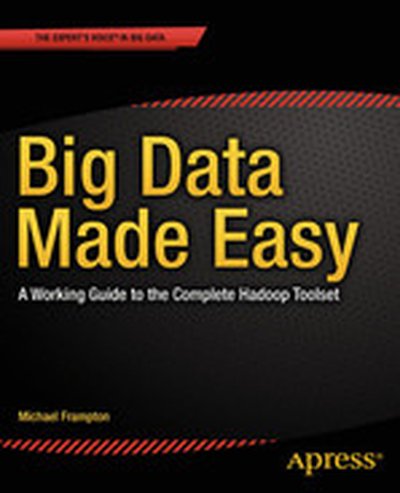
Big Data Made Easy: A Working Guide to the Complete Hadoop Toolset

Many corporations are finding that the size of their data sets are outgrowing the capability of their systems to store and process them. The data is becoming too big to manage and use with traditional tools. The solution: implementing a big data system. As Big Data Made Easy: A Working Guide to the Complete Hadoop Toolset shows, Apache Hadoop offers a scalable, fault-tolerant system for storing and processing data in parallel. It has a very rich toolset that allows for storage (Hadoop), configuration (YARN and ZooKeeper), collection (Nutch and Solr), processing (Storm, Pig, and Map Reduce), scheduling (Oozie), moving (Sqoop and Avro), monitoring (Chukwa, Ambari, and Hue), testing (Big Top), and analysis (Hive). The problem is that the Internet offers IT pros wading into big data many versions of the truth and some outright falsehoods born of ignorance. What is needed is a book just like this one: a wide-ranging but easily understood set of instructions to explain where to get Hadoop tools, what they can do, how to install them, how to configure them, how to integrate them, and how to use them successfully. And you need an expert who has worked in this area for a decade—someone just like author and big data expert Mike Frampton. Big Data Made Easy approaches the problem of managing massive data sets from a systems perspective, and it explains the roles for each project (like architect and tester, for example) and shows how the Hadoop toolset can be used at each system stage. It explains, in an easily understood manner and through numerous examples, how to use each tool. The book also explains the sliding scale of tools available depending upon data size and when and how to use them. Big Data Made Easy shows developers and architects, as well as testers and project managers, how to: Store big data Configure big data Process big data Schedule processes Move data among SQL and NoSQL systems Monitor data Perform big data analytics Report on big data processes and projects Test big data systems Big Data Made Easy also explains the best part, which is that this toolset is free. Anyone can download it and—with the help of this book—start to use it within a day. With the skills this book will teach you under your belt, you will add value to your company or client immediately, not to mention your career.

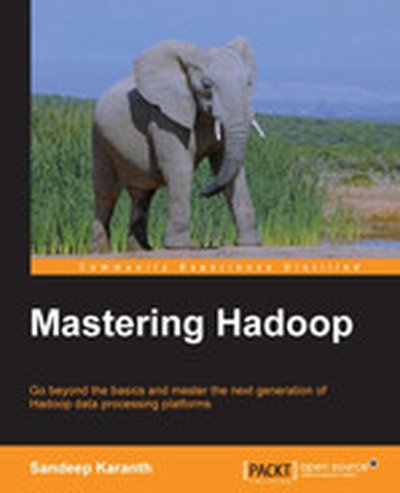
Mastering Hadoop

Embark on a journey to master Hadoop and its advanced features with this comprehensive book. "Mastering Hadoop" equips you with the knowledge needed to tackle complex data processing challenges and optimize your Hadoop workflows. With clear explanations and practical examples, this book is your guide to becoming proficient in leveraging Hadoop technologies. What this Book will help me do Optimize Hadoop MapReduce jobs, Pig scripts, and Hive queries for better performance. Understand and employ advanced data formats and Hadoop I/O techniques. Learn to integrate low-latency processing with Storm on YARN. Explore the cloud deployment of Hadoop and advanced HDFS alternatives. Enhance Hadoop security and master techniques for analytics using Hadoop. Author(s) None Karanth is an experienced Hadoop professional with years of expertise in data processing and distributed computing. With a practical and methodical approach, None has crafted this book to empower learners with the essentials and advanced features of Hadoop. None's focus on performance optimization and real-world applications helps bridge the gap between theory and practice. Who is it for? This book is ideal for data engineers and software developers familiar with the basics of Hadoop who seek to advance their understanding. If you aim to enhance Hadoop performance or adopt new features like YARN and Storm, this book is for you. Readers interested in Hadoop deployment, optimization, and newer capabilities will also greatly benefit. It's perfect for anyone aiming to become a Hadoop expert, from intermediate learners to advanced practitioners.

Data Just Right: Introduction to Large-Scale Data & Analytics

Making Big Data Work: Real-World Use Cases and Examples, Practical Code, Detailed Solutions Large-scale data analysis is now vitally important to virtually every business. Mobile and social technologies are generating massive datasets; distributed cloud computing offers the resources to store and analyze them; and professionals have radically new technologies at their command, including NoSQL databases. Until now, however, most books on “Big Data” have been little more than business polemics or product catalogs. is different: It’s a completely practical and indispensable guide for every Big Data decision-maker, implementer, and strategist. Data Just Right Michael Manoochehri, a former Google engineer and data hacker, writes for professionals who need practical solutions that can be implemented with limited resources and time. Drawing on his extensive experience, he helps you focus on building applications, rather than infrastructure, because that’s where you can derive the most value. Manoochehri shows how to address each of today’s key Big Data use cases in a cost-effective way by combining technologies in hybrid solutions. You’ll find expert approaches to managing massive datasets, visualizing data, building data pipelines and dashboards, choosing tools for statistical analysis, and more. Throughout, the author demonstrates techniques using many of today’s leading data analysis tools, including Hadoop, Hive, Shark, R, Apache Pig, Mahout, and Google BigQuery. Coverage includes Mastering the four guiding principles of Big Data success—and avoiding common pitfalls Emphasizing collaboration and avoiding problems with siloed data Hosting and sharing multi-terabyte datasets efficiently and economically “Building for infinity” to support rapid growth Developing a NoSQL Web app with Redis to collect crowd-sourced data Running distributed queries over massive datasets with Hadoop, Hive, and Shark Building a data dashboard with Google BigQuery Exploring large datasets with advanced visualization Implementing efficient pipelines for transforming immense amounts of data Automating complex processing with Apache Pig and the Cascading Java library Applying machine learning to classify, recommend, and predict incoming information Using R to perform statistical analysis on massive datasets Building highly efficient analytics workflows with Python and Pandas Establishing sensible purchasing strategies: when to build, buy, or outsource Previewing emerging trends and convergences in scalable data technologies and the evolving role of the Data Scientist

Programming Elastic MapReduce

Although you don’t need a large computing infrastructure to process massive amounts of data with Apache Hadoop, it can still be difficult to get started. This practical guide shows you how to quickly launch data analysis projects in the cloud by using Amazon Elastic MapReduce (EMR), the hosted Hadoop framework in Amazon Web Services (AWS). Authors Kevin Schmidt and Christopher Phillips demonstrate best practices for using EMR and various AWS and Apache technologies by walking you through the construction of a sample MapReduce log analysis application. Using code samples and example configurations, you’ll learn how to assemble the building blocks necessary to solve your biggest data analysis problems. Get an overview of the AWS and Apache software tools used in large-scale data analysis Go through the process of executing a Job Flow with a simple log analyzer Discover useful MapReduce patterns for filtering and analyzing data sets Use Apache Hive and Pig instead of Java to build a MapReduce Job Flow Learn the basics for using Amazon EMR to run machine learning algorithms Develop a project cost model for using Amazon EMR and other AWS tools

Apache Sqoop Cookbook

Integrating data from multiple sources is essential in the age of big data, but it can be a challenging and time-consuming task. This handy cookbook provides dozens of ready-to-use recipes for using Apache Sqoop, the command-line interface application that optimizes data transfers between relational databases and Hadoop. Sqoop is both powerful and bewildering, but with this cookbook’s problem-solution-discussion format, you’ll quickly learn how to deploy and then apply Sqoop in your environment. The authors provide MySQL, Oracle, and PostgreSQL database examples on GitHub that you can easily adapt for SQL Server, Netezza, Teradata, or other relational systems. Transfer data from a single database table into your Hadoop ecosystem Keep table data and Hadoop in sync by importing data incrementally Import data from more than one database table Customize transferred data by calling various database functions Export generated, processed, or backed-up data from Hadoop to your database Run Sqoop within Oozie, Hadoop’s specialized workflow scheduler Load data into Hadoop’s data warehouse (Hive) or database (HBase) Handle installation, connection, and syntax issues common to specific database vendors

Data Warehousing in the Age of Big Data

Data Warehousing in the Age of the Big Data will help you and your organization make the most of unstructured data with your existing data warehouse. As Big Data continues to revolutionize how we use data, it doesn't have to create more confusion. Expert author Krish Krishnan helps you make sense of how Big Data fits into the world of data warehousing in clear and concise detail. The book is presented in three distinct parts. Part 1 discusses Big Data, its technologies and use cases from early adopters. Part 2 addresses data warehousing, its shortcomings, and new architecture options, workloads, and integration techniques for Big Data and the data warehouse. Part 3 deals with data governance, data visualization, information life-cycle management, data scientists, and implementing a Big Data–ready data warehouse. Extensive appendixes include case studies from vendor implementations and a special segment on how we can build a healthcare information factory. Ultimately, this book will help you navigate through the complex layers of Big Data and data warehousing while providing you information on how to effectively think about using all these technologies and the architectures to design the next-generation data warehouse. Learn how to leverage Big Data by effectively integrating it into your data warehouse. Includes real-world examples and use cases that clearly demonstrate Hadoop, NoSQL, HBASE, Hive, and other Big Data technologies Understand how to optimize and tune your current data warehouse infrastructure and integrate newer infrastructure matching data processing workloads and requirements

Hadoop Beginner's Guide

Hadoop Beginner's Guide introduces you to the essential concepts and practical applications of Apache Hadoop, one of the leading frameworks for big data processing. You will learn how to set up and use Hadoop to store, manage, and analyze vast amounts of data efficiently. With clear examples and step-by-step instructions, this book is the perfect starting point for beginners. What this Book will help me do Understand the trends leading to the adoption of Hadoop and determine when to use it effectively in your projects. Build and configure Hadoop clusters tailored to your specific needs, enabling efficient data processing. Develop and execute applications on Hadoop using Java and Ruby, with practical examples provided. Leverage Amazon AWS and Elastic MapReduce to deploy Hadoop on the cloud and manage hosted environments. Integrate Hadoop with relational databases using tools like Hive and Sqoop for effective data transfer and querying. Author(s) The author of Hadoop Beginner's Guide is an experienced data engineer with a focus on big data technologies. They have extensive experience deploying Hadoop in various industries and are passionate about making complex systems accessible to newcomers. Their approach combines technical depth with an understanding of the needs of learners, ensuring clarity and relevance throughout the book. Who is it for? This book is designed for professionals who are new to big data processing and want to learn Apache Hadoop from scratch. It is ideal for system administrators, data analysts, and developers with basic programming knowledge in Java or Ruby looking to get started with Hadoop. If you have an interest in leveraging Hadoop for scalable data management and analytics, this book is for you. By the end, you'll gain the confidence and skills to utilize Hadoop effectively in your projects.

Programming Hive

Need to move a relational database application to Hadoop? This comprehensive guide introduces you to Apache Hive, Hadoop’s data warehouse infrastructure. You’ll quickly learn how to use Hive’s SQL dialect—HiveQL—to summarize, query, and analyze large datasets stored in Hadoop’s distributed filesystem. This example-driven guide shows you how to set up and configure Hive in your environment, provides a detailed overview of Hadoop and MapReduce, and demonstrates how Hive works within the Hadoop ecosystem. You’ll also find real-world case studies that describe how companies have used Hive to solve unique problems involving petabytes of data. Use Hive to create, alter, and drop databases, tables, views, functions, and indexes Customize data formats and storage options, from files to external databases Load and extract data from tables—and use queries, grouping, filtering, joining, and other conventional query methods Gain best practices for creating user defined functions (UDFs) Learn Hive patterns you should use and anti-patterns you should avoid Integrate Hive with other data processing programs Use storage handlers for NoSQL databases and other datastores Learn the pros and cons of running Hive on Amazon’s Elastic MapReduce

Hadoop: The Definitive Guide, 3rd Edition

Ready to unlock the power of your data? With this comprehensive guide, you’ll learn how to build and maintain reliable, scalable, distributed systems with Apache Hadoop. This book is ideal for programmers looking to analyze datasets of any size, and for administrators who want to set up and run Hadoop clusters. You’ll find illuminating case studies that demonstrate how Hadoop is used to solve specific problems. This third edition covers recent changes to Hadoop, including material on the new MapReduce API, as well as MapReduce 2 and its more flexible execution model (YARN). Store large datasets with the Hadoop Distributed File System (HDFS) Run distributed computations with MapReduce Use Hadoop’s data and I/O building blocks for compression, data integrity, serialization (including Avro), and persistence Discover common pitfalls and advanced features for writing real-world MapReduce programs Design, build, and administer a dedicated Hadoop cluster—or run Hadoop in the cloud Load data from relational databases into HDFS, using Sqoop Perform large-scale data processing with the Pig query language Analyze datasets with Hive, Hadoop’s data warehousing system Take advantage of HBase for structured and semi-structured data, and ZooKeeper for building distributed systems

Professional NoSQL

A hands-on guide to leveraging NoSQL databases NoSQL databases are an efficient and powerful tool for storing and manipulating vast quantities of data. Most NoSQL databases scale well as data grows. In addition, they are often malleable and flexible enough to accommodate semi-structured and sparse data sets. This comprehensive hands-on guide presents fundamental concepts and practical solutions for getting you ready to use NoSQL databases. Expert author Shashank Tiwari begins with a helpful introduction on the subject of NoSQL, explains its characteristics and typical uses, and looks at where it fits in the application stack. Unique insights help you choose which NoSQL solutions are best for solving your specific data storage needs. Professional NoSQL: Demystifies the concepts that relate to NoSQL databases, including column-family oriented stores, key/value databases, and document databases. Delves into installing and configuring a number of NoSQL products and the Hadoop family of products. Explains ways of storing, accessing, and querying data in NoSQL databases through examples that use MongoDB, HBase, Cassandra, Redis, CouchDB, Google App Engine Datastore and more. Looks at architecture and internals. Provides guidelines for optimal usage, performance tuning, and scalable configurations. Presents a number of tools and utilities relating to NoSQL, distributed platforms, and scalable processing, including Hive, Pig, RRDtool, Nagios, and more.

Hadoop in Action

Hadoop in Action introduces the subject and teaches you how to write programs in the MapReduce style. It starts with a few easy examples and then moves quickly to show Hadoop use in more complex data analysis tasks. Included are best practices and design patterns of MapReduce programming. About the Technology Big data can be difficult to handle using traditional databases. Apache Hadoop is a NoSQL applications framework that runs on distributed clusters. This lets it scale to huge datasets. If you need analytic information from your data, Hadoop's the way to go. About the Book What's Inside Introduction to MapReduce Examples illustrating ideas in practice Hadoop's Streaming API Other related tools, like Pig and Hive About the Reader This book requires basic Java skills. Knowing basic statistical concepts can help with the more advanced examples. About the Author Chuck Lam is a Senior Engineer at RockYou! He has a PhD in pattern recognition from Stanford University. Quotes A guide for beginners, a source of insight for advanced users. - Philipp K. Janert, Principal Value, LLC A nice mix of the what, why, and how of Hadoop. - Paul Stusiak, Falcon Technologies Corp. Demystifies Hadoop. A great resource! - Rick Wagner, Acxiom Corp. Covers it all! Plus, gives you sweet extras no one else does. - John S. Griffin, Overstock.com An excellent introduction to Hadoop and MapReduce. - Kenneth DeLong, BabyCenter, LLC