Combination of on- and offline data to gain more insights and underatand both sides of the Marketing Story. Case Studies to give examples on how to combine different data sources.
 talk-data.com
Topic
Marketing
advertising
branding
customer_acquisition
743
tagged
Activity Trend
49
peak/qtr
2020-Q1
2026-Q2
Top Events
O'Reilly Data Science Books
103
O'Reilly Data Engineering Books
57
The Pragmatic Engineer
46
Making Data Simple
35
DataFramed
32
How Music Charts
31
Data Engineering Podcast
30
Data + AI Summit 2025
29
The Analytics Power Hour
28
Google Cloud Next '24
23
Databricks DATA + AI Summit 2023
23
The Future of Data Podcast | conversation with leaders, influencers, and change makers in the World of Data & Analytics
18
The future of e-commerce industry will belong to online shops that invest in their users. Showing the right message to the right audience in the right moment is the key to succes. User data will help us do the magic.
Let's take two steps up from our dashboards, reports and normal day to day worries. Let's take a look at frameworks and optimal approaches to take when it comes to truly winning with digital.
You can measure practically anything in the age of social media, but if you don’t know what you’re looking for, collecting mountains of data won’t yield a grain of insight. This non-technical guide shows you how to extract significant business value from big data with Ask-Measure-Learn, a system that helps you ask the right questions, measure the right data, and then learn from the results. Authors Lutz Finger and Soumitra Dutta originally devised this system to help governments and NGOs sift through volumes of data. With this book, these two experts provide business managers and analysts with a high-level overview of the Ask-Measure-Learn system, and demonstrate specific ways to apply social media analytics to marketing, sales, public relations, and customer management, using examples and case studies.
Tired of boring spreadsheets and data overload from confusing graphs? Master the art of visualization with Rapid Graphs with Tableau 8! Tableau insiders Stephen and Eileen McDaniel expertly provide a hands-on case study approach and more than 225 illustrations that will teach you how to quickly explore and understand your data to make informed decisions in a wide variety of real-world situations. Rapid Graphs with Tableau 8 includes best practices of visual analytics for ideas on how to communicate your findings with audience-friendly graphs, tables and maps. "A picture is worth a thousand words" is a common saying that is more relevant today than ever as data volumes grow and the need for easy access to answers becomes more critical. This book covers the core of Tableau capabilities in easy-to-follow examples, updated and expanded for Version 8. Learn how to be successful with Tableau from the team that started the original training program as the founding Tableau Education Partner! "A must read for anyone interested in Tableau. Clear explanations, practical advice and beautiful examples!" Elissa Fink – Chief Marketing Officer, Tableau Software What you'll learn Connect to and review data visually Create insightful maps and take advantage of view shifting Understand the types of views available in Tableau Take advantage of the powerful Marks card and much more Who this book is for Rapid Graphs with Tableau 8 is a great resource for those new to Tableau, and also contains useful tips and tricks for advanced users as well.
Make information memorable with creative visual design techniques Research shows that visual information is more quickly and easily understood, and much more likely to be remembered. This innovative book presents the design process and the best software tools for creating infographics that communicate. Including a special section on how to construct the increasingly popular infographic resume, the book offers graphic designers, marketers, and business professionals vital information on the most effective ways to present data. Explains why infographics and data visualizations work Shares the tools and techniques for creating great infographics Covers online infographics used for marketing, including social media and search engine optimization (SEO) Shows how to market your skills with a visual, infographic resume Explores the many internal business uses of infographics, including board meeting presentations, annual reports, consumer research statistics, marketing strategies, business plans, and visual explanations of products and services to your customers With Cool Infographics, you'll learn to create infographics to successfully reach your target audience and tell clear stories with your data.
IBM® Flex System™ products are ideally suited for data center environments that require flexible, cost-effective, secure, and energy-efficient hardware. IBM Flex System V7000 Storage Node is the latest addition to the IBM Flex Systems product family and is a modular storage system designed to fit into the IBM Flex System Enterprise chassis. When purchased in the IBM PureFlex™ configurations, IBM Flex System V7000 Storage Node is configured from the factory into the hardware solution purchased. If, however, the configuration wanted is not offered in the predefined offerings, then a "Build to Order" configuration is designed to meet your needs. IBM Flex System V7000 Storage Node includes the capability to virtualize its own internal storage in the same manner as the IBM Storwize® V7000 does. It is designed to be a scalable internal storage system to support the compute nodes of the IBM Flex System environment. This IBM Redbooks® publication introduces the features and functions of IBM Flex System V7000 Storage Node through several examples. This book is aimed at pre-sales and post-sales technical support and marketing personnel and storage administrators. It can help you understand the architecture of IBM Flex System V7000 Storage Node, how to implement it, and how to take advantage of the industry leading functions and features.
JMP 11 Consumer Research focuses on analyses that help users observe and predict subject's behavior, particularly those in the market research field. The Uplift platform predicts consumer behavior based on shifts in marketing efforts. Learn how to tabulate and summarize categorical responses with the Categorical platform. Factor Analysis rotates principal components to help identify which directions have the most variation among the variables. The book also covers Item Analysis, a method for identifying latent traits that might affect an individual's choices. And read about the Choice platform, which market researchers use to estimate probability in consumer spending.
A guide to delivering a better user experience through A/B testing A/B Testing outlines a simple way to test several different versions of a web page with live traffic, and then measure the effect each version has on visitors. Using A/B testing you can determine the most effective way to increase conversion rate—the rate at which visitors convert into customers. The average conversion rate across the web is only 2%. That means 98% of visitors to most websites don't end up converting. Using A/B testing, companies can improve the effectiveness of their marketing and user experience and in doing so can sometimes double or triple their conversion rates. In the past, marketing teams were dependent on IT and engineering to implement A/B tests, and that proved to be a costly bottleneck. Today, the market for A/B testing is growing very fast, in no small part due to this transition from IT to marketing. Offers best practices and lessons learned from over 100,000 experiments run by over 2,000 Optimizely customers Details a roadmap for how to use A/B testing to personalize your customer's web experience and a practical guide to start A/B testing today Authors Dan Siroker and Pete Koomen are cofounders of Optimizely.com, an user-friendly testing system that more than 2,000 organizations use Marketers and web professionals will become obsolete if they don't embrace a data-driven approach to decision making. This book shows you how, no matter your technical expertise.
An updated new edition of the comprehensive guide to better business forecasting Many companies still look at quantitative forecasting methods with suspicion, but a new awareness is emerging across many industries as more businesses and professionals recognize the value of integrating demand data (point-of-sale and syndicated scanner data) into the forecasting process. Demand-Driven Forecasting equips you with solutions that can sense, shape, and predict future demand using highly sophisticated methods and tools. From a review of the most basic forecasting methods to the most advanced and innovative techniques in use today, this guide explains demand-driven forecasting, offering a fundamental understanding of the quantitative methods used to sense, shape, and predict future demand within a structured process. Offering a complete overview of the latest business forecasting concepts and applications, this revised Second Edition of Demand-Driven Forecasting is the perfect guide for professionals who need to improve the accuracy of their sales forecasts. Completely updated to include the very latest concepts and methods in forecasting Includes real case studies and examples, actual data, and graphical displays and tables to illustrate how effective implementation works Ideal for CEOs, CFOs, CMOs, vice presidents of supply chain, vice presidents of demand forecasting and planning, directors of demand forecasting and planning, supply chain managers, demand planning managers, marketing analysts, forecasting analysts, financial managers, and any other professional who produces or contributes to forecasts Accurate forecasting is vital to success in today's challenging business climate. Demand-Driven Forecasting offers proven and effective insight on making sure your forecasts are right on the money.
Companies face the challenge of measuring and analyzing the near-overwhelming quantities of data generated from their online businesses and then using that data to gain critical insights into their customersvto drive sales. Adobe Analytics (formerly SiteCatalyst) provides product and content managers, marketers, and analysts with real-time intelligence on customers’online behavior, helps businesses anticipate what their customers will want, personalizes their onlinev experience, and delivers relevant content across web and mobile channels. This quick lookup guide by Adobe Analytics expert Shane Closser uses clear, concise explanations and an easy-to-use format to jump in and start using Adobe’s powerful web analytics tool. You’ll learn the quickest way to: Create metrics Run and set options for reports Measure the effectiveness of marketing campaigns Engage and retain customers Track customers through the conversion funnel Share reports and set up dashboards
Help your organization determine the value of its customer relationships with Segmentation and Lifetime Value Models Using SAS. This book contains a wealth of information that will help you perform analyses to identify your customers and make informed marketing investments. It answers core questions on customer relationship management (CRM), provides an overall framework for thinking about CRM, and offers real-world examples across a variety of industries.
Edward C. Malthouse introduces you to a number of useful models, ranging from simple to more complicated examples, and discusses their applications. You'll learn about segmentation models for identifying groups of customers and about lifetime value models for estimating the future value of the segments. You'll learn how to prepare data and estimate models using Base SAS, SAS/STAT, SAS/IML, and SQL.
Marketing analysts, CRM analysts, database managers, and anyone looking to address the challenges of allocating marketing resources to different customer groups will benefit from the concepts and exercises in this book. Analysts will learn how to approach unique business problems. Managers will gain a sense of what's possible and what to ask of their analytics departments.
This book is part of the SAS Press program.
How to make simple sense of complex statistics--from the author of Numbers Rule Your World We live in a world of Big Data--and it's getting bigger every day. Virtually every choice we make hinges on how someone generates data . . . and how someone else interprets it--whether we realize it or not. Where do you send your child for the best education? Big Data. Which airline should you choose to ensure a timely arrival? Big Data. Who will you vote for in the next election? Big Data. The problem is, the more data we have, the more difficult it is to interpret it. From world leaders to average citizens, everyone is prone to making critical decisions based on poor data interpretations. In Numbersense, expert statistician Kaiser Fung explains when you should accept the conclusions of the Big Data "experts"--and when you should say, "Wait . . . what?" He delves deeply into a wide range of topics, offering the answers to important questions, such as: How does the college ranking system really work? Can an obesity measure solve America's biggest healthcare crisis? Should you trust current unemployment data issued by the government? How do you improve your fantasy sports team? Should you worry about businesses that track your data? Don't take for granted statements made in the media, by our leaders, or even by your best friend. We're on information overload today, and there's a lot of bad information out there. Numbersense gives you the insight into how Big Data interpretation works--and how it too often doesn't work. You won't come away with the skills of a professional statistician. But you will have a keen understanding of the data traps even the best statisticians can fall into, and you'll trust the mental alarm that goes off in your head when something just doesn't seem to add up. Praise for Numbersense " Numbersense correctly puts the emphasis not on the size of big data, but on the analysis of it. Lots of fun stories, plenty of lessons learned—in short, a great way to acquire your own sense of numbers!" Thomas H. Davenport, coauthor of Competing on Analytics and President’s Distinguished Professor of IT and Management, Babson College "Kaiser’s accessible business book will blow your mind like no other. You’ll be smarter, and you won’t even realize it. Buy. It. Now." Avinash Kaushik, Digital Marketing Evangelist, Google, and author, Web Analytics 2.0 "Each story in Numbersense goes deep into what you have to think about before you trust the numbers. Kaiser Fung ably demonstrates that it takes skill and resourcefulness to make the numbers confess their meaning." John Sall, Executive Vice President, SAS Institute "Kaiser Fung breaks the bad news—a ton more data is no panacea—but then has got your back, revealing the pitfalls of analysis with stimulating stories from the front lines of business, politics, health care, government, and education. The remedy isn’t an advanced degree, nor is it common sense. You need Numbersense." Eric Siegel, founder, Predictive Analytics World, and author, Predictive Analytics "I laughed my way through this superb-useful-fun book and learned and relearned a lot. Highly recommended!" Tom Peters, author of In Search of Excellence
Big Data Imperatives, focuses on resolving the key questions on everyone's mind: Which data matters? Do you have enough data volume to justify the usage? How you want to process this amount of data? How long do you really need to keep it active for your analysis, marketing, and BI applications? Big data is emerging from the realm of one-off projects to mainstream business adoption; however, the real value of big data is not in the overwhelming size of it, but more in its effective use. This book addresses the following big data characteristics: Very large, distributed aggregations of loosely structured data - often incomplete and inaccessible Petabytes/Exabytes of data Millions/billions of people providing/contributing to the context behind the data Flat schema's with few complex interrelationships Involves time-stamped events Made up of incomplete data Includes connections between data elements that must be probabilistically inferred Big Data Imperatives explains 'what big data can do'. It can batch process millions and billions of records both unstructured and structured much faster and cheaper. Big data analytics provide a platform to merge all analysis which enables data analysis to be more accurate, well-rounded, reliable and focused on a specific business capability. Big Data Imperatives describes the complementary nature of traditional data warehouses and big-data analytics platforms and how they feed each other. This book aims to bring the big data and analytics realms together with a greater focus on architectures that leverage the scale and power of big data and the ability to integrate and apply analytics principles to data which earlier was not accessible. This book can also be used as a handbook for practitioners; helping them on methodology,technical architecture, analytics techniques and best practices. At the same time, this book intends to hold the interest of those new to big data and analytics by giving them a deep insight into the realm of big data. What you'll learn Understanding the technology, implementation of big data platforms and their usage for analytics Big data architectures Big data design patterns Implementation best practices Who this book is for This book is designed for IT professionals, data warehousing, business intelligence professionals, data analysis professionals, architects, developers and business users.
In digital marketing, your goal is to funnel your potential customers from the point of making them aware of your website, through engagement and conversion, and ultimately retaining them as loyal customers. Your strategies must be based on careful analysis so you know what is working for you at each stage. Adobe Analytics with SiteCatalyst Classroom in a Book teaches effective techniques for using Adobe SiteCatalyst to establish and measure key performance indicators (KPIs) tailored to your business and website. For each phase of marketing funnel analytics, author Vidya Subramanian walks you through multiple reports, showing you how to interpret the data and highlighting implementation details that affect data quality. With this essential guide, you’ll learn to optimize your web analytics results with SiteCatalyst. Adobe Analytics with SiteCatalyst Classroom in a Book contains 10 lessons. The book covers the basics of learning Adobe SiteCatalyst and provides countless tips and techniques to help you become more productive with the program. You can follow the book from start to finish or choose only those lessons that interest you. Classroom in a Book®, the best-selling series of hands-on software training workbooks, helps you learn the features of Adobe software quickly and easily. Classroom in a Book offers what no other book or training program does—an official training series from Adobe Systems Incorporated, developed with the support of Adobe product experts. ..
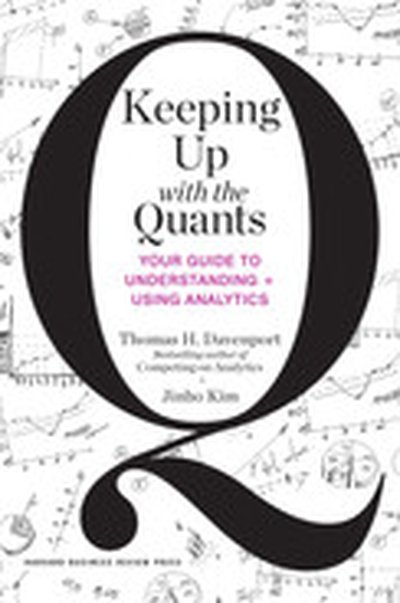
Why Everyone Needs Analytical Skills Welcome to the age of data. No matter your interests (sports, movies, politics), your industry (finance, marketing, technology, manufacturing), or the type of organization you work for (big company, nonprofit, small start-up)—your world is awash with data. As a successful manager today, you must be able to make sense of all this information. You need to be conversant with analytical terminology and methods and able to work with quantitative information. This book promises to become your “quantitative literacy" guide—helping you develop the analytical skills you need right now in order to summarize data, find the meaning in it, and extract its value. In Keeping Up with the Quants, authors, professors, and analytics experts Thomas Davenport and Jinho Kim offer practical tools to improve your understanding of data analytics and enhance your thinking and decision making. You’ll gain crucial skills, including: How to formulate a hypothesis How to gather and analyze relevant data How to interpret and communicate analytical results How to develop habits of quantitative thinking How to deal effectively with the “quants” in your organizationBig data and the analytics based on it promise to change virtually every industry and business function over the next decade. If you don’t have a business degree or if you aren’t comfortable with statistics and quantitative methods, this book is for you. Keeping Up with the Quants will give you the skills you need to master this new challenge—and gain a significant competitive edge.
IBM® Flex System™ products are ideally suited for data center environments that require flexible, cost-effective, secure, and energy-efficient hardware. The IBM Flex System V7000 Storage Node is the latest addition to the IBM Flex Systems product family and is a modular storage system designed to fit into the IBM Flex System Enterprise chassis. When purchased in the IBM PureFlex configurations, the IBM Flex System V7000 Storage Node is configured from the factory into the hardware solution purchased. If, however, the configuration wanted is not offered in the predefined offerings, then a "Build to Order" configuration is designed to meet your needs. The IBM Flex System V7000 Storage Node includes the capability to virtualize its own internal storage in the same manner as the IBM Storwize® V7000 does. It is designed to be a scalable internal storage system to support the compute nodes of the IBM Flex System environment. This IBM® Redbooks® publication introduces the features and functions of the IBM Flex System V7000 Storage Node through several examples. This book is aimed at pre-sales and post-sales technical support and marketing personnel and storage administrators. It can help you understand the architecture of the IBM Flex System V7000 Storage Node, how to implement it, and how to take advantage of the industry leading functions and features.
A highly accessible alternative approach to basic statistics Praise for the First Edition: "Certainly one of the most impressive little paperback 200-page introductory statistics books that I will ever see . . . it would make a good nightstand book for every statistician."—Technometrics Written in a highly accessible style, Introduction to Statistics through Resampling Methods and R, Second Edition guides students in the understanding of descriptive statistics, estimation, hypothesis testing, and model building. The book emphasizes the discovery method, enabling readers to ascertain solutions on their own rather than simply copy answers or apply a formula by rote. The Second Edition utilizes the R programming language to simplify tedious computations, illustrate new concepts, and assist readers in completing exercises. The text facilitates quick learning through the use of: More than 250 exercises—with selected "hints"—scattered throughout to stimulate readers' thinking and to actively engage them in applying their newfound skills An increased focus on why a method is introduced Multiple explanations of basic concepts Real-life applications in a variety of disciplines Dozens of thought-provoking, problem-solving questions in the final chapter to assist readers in applying statistics to real-life applications Introduction to Statistics through Resampling Methods and R, Second Edition is an excellent resource for students and practitioners in the fields of agriculture, astrophysics, bacteriology, biology, botany, business, climatology, clinical trials, economics, education, epidemiology, genetics, geology, growth processes, hospital administration, law, manufacturing, marketing, medicine, mycology, physics, political science, psychology, social welfare, sports, and toxicology who want to master and learn to apply statistical methods.
Unique prospective on the big data analytics phenomenon for both business and IT professionals The availability of Big Data, low-cost commodity hardware and new information management and analytics software has produced a unique moment in the history of business. The convergence of these trends means that we have the capabilities required to analyze astonishing data sets quickly and cost-effectively for the first time in history. These capabilities are neither theoretical nor trivial. They represent a genuine leap forward and a clear opportunity to realize enormous gains in terms of efficiency, productivity, revenue and profitability. The Age of Big Data is here, and these are truly revolutionary times. This timely book looks at cutting-edge companies supporting an exciting new generation of business analytics. Learn more about the trends in big data and how they are impacting the business world (Risk, Marketing, Healthcare, Financial Services, etc.) Explains this new technology and how companies can use them effectively to gather the data that they need and glean critical insights Explores relevant topics such as data privacy, data visualization, unstructured data, crowd sourcing data scientists, cloud computing for big data, and much more.
Data Insights: New Ways to Visualize and Make Sense of Data offers thought-provoking insights into how visualization can foster a clearer and more comprehensive understanding of data. The book offers perspectives from people with different backgrounds, including data scientists, statisticians, painters, and writers. It argues that all data is useless, or misleading, if we do not know what it means.Organized into seven chapters, the book explores some of the ways that data visualization and other emerging approaches can make data meaningful and therefore useful. It also discusses some fundamental ideas and basic questions in the data lifecycle; the process of interactions between people, data, and displays that lead to better questions and more useful answers; and the fundamentals, origins, and purposes of the basic building blocks that are used in data visualization. The reader is introduced to tried and true approaches to understanding users in the context of user interface design, how communications can get distorted, and how data visualization is related to thinking machines. Finally, the book looks at the future of data visualization by assessing its strengths and weaknesses. Case studies from business analytics, healthcare, network monitoring, security, and games, among others, as well as illustrations, thought-provoking quotes, and real-world examples are included.This book will prove useful to computer professionals, technical marketing professionals, content strategists, Web and product designers, and researchers. Demonstrates, with a variety of case studies, how visualizations can foster a clearer and more comprehensive understanding of data Answers the question, "How can data visualization help me?" with discussions of how it fits into a wide array of purposes and situations Makes the case that data visualization is not just about technology; it also involves a deeply human process