talk-data.com talk-data.com

Topic

Microsoft

technology software cloud

186

tagged

Activity Trend

556 peak/qtr
2020-Q1 2026-Q1

Activities

Showing filtered results

Filtering by: O'Reilly Data Science Books ×
Excel Power Pivot and Power Query For Dummies

A guide to PowerPivot and Power Query no data cruncher should be without! Want to familiarize yourself with the rich set of Microsoft Excel tools and reporting capabilities available from PowerPivot and Power Query? Look no further! Excel PowerPivot & Power Query For Dummies shows you how this powerful new set of tools can be leveraged to more effectively source and incorporate 'big data' Business Intelligence and Dashboard reports. You'll discover how PowerPivot and Power Query not only allow you to save time and simplify your processes, but also enable you to substantially enhance your data analysis and reporting capabilities. Gone are the days of relatively small amounts of data—today's data environment demands more from business analysts than ever before. Now, with the help of this friendly, hands-on guide, you'll learn to use PowerPivot and Power Query to expand your skill-set from the one-dimensional spreadsheet to new territories, like relational databases, data integration, and multi-dimensional reporting. Demonstrates how Power Query is used to discover, connect to, and import your data Shows you how to use PowerPivot to model data once it's been imported Offers guidance on using these tools to make analyzing data easier Written by a Microsoft MVP in the lighthearted, fun style you've come to expect from the For Dummies brand If you spend your days analyzing data, Excel PowerPivot & Power Query For Dummies will get you up and running with the rich set of Excel tools and reporting capabilities that will make your life—and work—easier.
Babylon.js Essentials

Embark on a journey to create stunning web-based 3D applications and games using Babylon.js, a powerful JavaScript framework. This essentials book takes you from the ground up, teaching the theory and practical applications of 3D development, with a particular focus on ease and accessibility. By the end of this guide, you'll possess the skills to design and implement dynamic 3D experiences. What this Book will help me do Gain a fundamental understanding of TypeScript and its advantages in large-scale projects like 3D engines. Master the foundational principles of 3D development with Babylon.js, emphasized through hands-on practice and clear theory. Learn to apply materials in Babylon.js, enabling you to alter and enrich the visual appeal of 3D objects. Incorporate collision physics and gameplay dynamics by understanding essential concepts like impostors in 3D simulations. Utilize advanced Babylon.js features, such as 3D audio spatialization and rendering post-process effects, to create immersive experiences. Author(s) None Moreau-Mathis, a software developer with significant experience, has worked on developing cutting-edge applications at companies like Microsoft. Their expertise in 3D development frameworks, particularly Babylon.js, has enabled them to break down complex technical concepts into approachable lessons. Moreau-Mathis combines a passion for sharing knowledge with years of hands-on experience to provide readers with practical and inspirational advice. Who is it for? This book is perfect for developers familiar with HTML5 and seeking to begin 3D Web application and game development using Babylon.js. Readers should have basic programming knowledge, such as in Object-Oriented Programming, and familiarity with web development concepts to grasp framework architecture effectively. Whether you are enhancing your web development toolkit or starting out with 3D, this book will help you achieve your aims.

Excel Dashboards and Reports for Dummies, 3rd Edition

Make the most of your data using the power of Excel When you think of data, do you think of endless rows and columns in spreadsheets? Excel Dashboards and Reports For Dummies, 3 shows you how to make the most of your data—and puts an end to mind-numbing spreadsheets by exploring new ways to conceptualize and present key information. There's often a gap between handling data and synthesizing it into meaningful reports, and this approachable text bridges this gap with quick and accessible information that answers key questions, like how to meaningfully capture data trends, how to show relationships in data, and when it's better to show variances than actual data values. rd Edition As a leading spreadsheet application, Microsoft Excel is the go-to data software. This tool allows you to use dashboard reports that leverage gauges, maps, charts, sliders, and other visual elements to present complex data in a manner that's easy to understand. Using Excel dashboards effectively can improve your professional capabilities by leaps and bounds. Analyze and report on large amounts of data in a meaningful way Look at data from different perspectives, and better visualize the information you're presenting by quickly slicing data on the fly Automate redundant reporting and analysis functions, making your data analysis and reporting routine more efficient Create visualizations, dashboards, and what-if analyses that are as visually appealing as they are substantial Excel Dashboards and Reports For Dummies, 3 is a fantastic resource if you're looking to spice up your reporting! rd Edition

Microsoft Visio 2016 Step By Step

The quick way to learn Microsoft Visio 2016!This is learning made easy. Get more done quickly with Visio 2016. Jump in wherever you need answers--brisk lessons and colorful screenshots show you exactly what to do, step by step. Get results faster with starter diagrams Diagram processes, organizations, networks, and datacenters Add styles, colors, and themes Enhance diagrams with data-driven visualizations Link to external data sources, websites, and documents Add structure to diagrams with containers, lists, and callouts Validate flowchart, swimlane, and BPMN diagrams Collaborate and publish with Visio Services and Microsoft SharePoint 2016 Look up just the tasks and lessons you need

Using Statistics for Better Business Decisions

More and more organizations around the globe are expecting that professionals will make data-driven decisions. Employees, team leaders, managers, and executives that can think quantitatively should be in high demand. The goal of this book is to increase ability to identify a problem, collect data, organize, and analyze data that will help aid in making more effective decisions. This book will provide you with a solid foundation for thinking quantitatively within your company. To help facilitate this objective, this book follows two fictitious companies that encounter a series of business problems, while demonstrating how managers would use the concepts in the book to solve these problems and determine the next course of action. This book is for beginners and does not require prior statistical training. All computations will be completed using Microsoft Excel.

Regression Analysis

The technique of regression analysis is used so often in business and economics today that an understanding of its use is necessary for almost everyone engaged in the field. This book covers essential elements of building and understanding regression models in a business/economic context in an intuitive manner. The book provides a non-theoretical treatment that is accessible to readers with even a limited statistical background. This book describes exactly how regression models are developed and evaluated. The data used in the book are the kind of data managers are faced with in the real world. The book provides instructions and screen shots for using Microsoft Excel to build business/economic regression models. Upon completion, the reader will be able to interpret the output of the regression models and evaluate the models for accuracy and shortcomings.

Beginning R: An Introduction to Statistical Programming, Second Edition

Beginning R, Second Edition is a hands-on book showing how to use the R language, write and save R scripts, read in data files, and write custom statistical functions as well as use built in functions. This book shows the use of R in specific cases such as one-way ANOVA analysis, linear and logistic regression, data visualization, parallel processing, bootstrapping, and more. It takes a hands-on, example-based approach incorporating best practices with clear explanations of the statistics being done. It has been completely re-written since the first edition to make use of the latest packages and features in R version 3. R is a powerful open-source language and programming environment for statistics and has become the de facto standard for doing, teaching, and learning computational statistics. R is both an object-oriented language and a functional language that is easy to learn, easy to use, and completely free. A large community of dedicated R users and programmers provides an excellent source of R code, functions, and data sets, with a constantly evolving ecosystem of packages providing new functionality for data analysis. R has also become popular in commercial use at companies such as Microsoft, Google, and Oracle. Your investment in learning R is sure to pay off in the long term as R continues to grow into the go to language for data analysis and research.

Beginning Big Data with Power BI and Excel 2013

In Beginning Big Data with Power BI and Excel 2013, you will learn to solve business problems by tapping the power of Microsoft’s Excel and Power BI to import data from NoSQL and SQL databases and other sources, create relational data models, and analyze business problems through sophisticated dashboards and data-driven maps. While Beginning Big Data with Power BI and Excel 2013 covers prominent tools such as Hadoop and the NoSQL databases, it recognizes that most small and medium-sized businesses don’t have the Big Data processing needs of a Netflix, Target, or Facebook. Instead, it shows how to import data and use the self-service analytics available in Excel with Power BI. As you’ll see through the book’s numerous case examples, these tools—which you already know how to use—can perform many of the same functions as the higher-end Apache tools many people believe are required to carry out in Big Data projects. Through instruction, insight, advice, and case studies, Beginning Big Data with Power BI and Excel 2013 will show you how to: Import and mash up data from web pages, SQL and NoSQL databases, the Azure Marketplace and other sources. Tap into the analytical power of PivotTables and PivotCharts and develop relational data models to track trends and make predictions based on a wide range of data. Understand basic statistics and use Excel with PowerBI to do sophisticated statistical analysis—including identifying trends and correlations. Use SQL within Excel to do sophisticated queries across multiple tables, including NoSQL databases. Create complex formulas to solve real-world business problems using Data Analysis Expressions (DAX).

Search-Driven Business Analytics

Compared to the speed and convenience of major web search engines, most business intelligence (BI) products are slow, stiff, and unresponsive. Business leaders today often wait days or weeks to get BI reports on inquiries about customers, products, or markets. But the latest BI products show that a significant change is taking place—a change led by search. This O’Reilly report examines three recent products with intelligent search capabilities: the ThoughtSpot Analytical Search Appliance, Microsoft’s Power BI service, and an offering from Adatao. You’ll learn how these products can provide you with answers and visualizations as quickly as questions come to mind. You’ll investigate: The convergence of BI and search What a search-driven user experience looks like The intelligence required for analytical search Data sources and their associated data modeling requirements Turning on-the-fly calculations into visualizations Applying enterprise scale and security to search

R For Dummies, 2nd Edition

Mastering R has never been easier Picking up R can be tough, even for seasoned statisticians and data analysts. R For Dummies, 2nd Edition provides a quick and painless way to master all the R you'll ever need. Requiring no prior programming experience and packed with tons of practical examples, step-by-step exercises, and sample code, this friendly and accessible guide shows you how to know your way around lists, data frames, and other R data structures, while learning to interact with other programs, such as Microsoft Excel. You'll learn how to reshape and manipulate data, merge data sets, split and combine data, perform calculations on vectors and arrays, and so much more. R is an open source statistical environment and programming language that has become very popular in varied fields for the management and analysis of data. R provides a wide array of statistical and graphical techniques, and has become the standard among statisticians for software development and data analysis. R For Dummies, 2nd Edition takes the intimidation out of working with R and arms you with the knowledge and know-how to master the programming language of choice among statisticians and data analysts worldwide. Covers downloading, installing, and configuring R Includes tips for getting data in and out of R Offers advice on fitting regression models and ANOVA Provides helpful hints for working with graphics R For Dummies, 2nd Edition is an ideal introduction to R for complete beginners, as well as an excellent technical reference for experienced R programmers.

Exchanging Data between SAS and Microsoft Excel

Master simple-to-complex techniques for transporting and managing data between SAS and Excel William Benjamin's Exchanging Data between SAS and Microsoft Excel: Tips and Techniques to Transfer and Manage Data More Efficiently describes many of the options and methods that enable a SAS programmer to transport data between SAS and Excel. The book includes examples that all levels of SAS and Excel users can apply to their everyday programming tasks. Because the book makes no assumptions about the skill levels of either SAS or Excel users, it has a wide-ranging application, providing detailed instructions about how to apply the techniques shown. It contains sections that gather instructional and syntactical information together that are otherwise widely dispersed, and it provides detailed examples about how to apply the software to everyday applications. These examples enable novice users and power developers alike the chance to expand their capabilities and enhance their skillsets. By moving from simple-to-complex applications and examples, the layout of the book allows it to be used as both a training and a reference tool. Excel users and SAS programmers are presented with tools that will assist in the integration of SAS and Excel processes in order to automate reporting and programming interfaces. This enables programming staff to request their own reports or processes and, in turn, support a much larger community.

Business Applications of Multiple Regression, Second Edition

This second edition of Business Applications of Multiple Regression describes the use of the statistical procedure called multiple regression in business situations, including forecasting and understanding the relationships between variables. The book assumes a basic understanding of statistics but reviews correlation analysis and simple regression to prepare the reader to understand and use multiple regression. The techniques described in the book are illustrated using both Microsoft Excel and a professional statistical program. Along the way, several real-world data sets are analyzed in detail to better prepare the reader for working with actual data in a business environment. This book will be a useful guide to managers at all levels who need to understand and make decisions based on data analysis performed using multiple regression. It also provides the beginning analyst with the detailed understanding required to use multiple regression to analyze data sets.

Introductory Statistics and Analytics: A Resampling Perspective

Concise, thoroughly class-tested primer that features basic statistical concepts in the concepts in the context of analytics, resampling, and the bootstrap A uniquely developed presentation of key statistical topics, Introductory Statistics and Analytics: A Resampling Perspective provides an accessible approach to statistical analytics, resampling, and the bootstrap for readers with various levels of exposure to basic probability and statistics. Originally class-tested at one of the first online learning companies in the discipline, www.statistics.com, the book primarily focuses on applications of statistical concepts developed via resampling, with a background discussion of mathematical theory. This feature stresses statistical literacy and understanding, which demonstrates the fundamental basis for statistical inference and demystifies traditional formulas. The book begins with illustrations that have the essential statistical topics interwoven throughout before moving on to demonstrate the proper design of studies. Meeting all of the Guidelines for Assessment and Instruction in Statistics Education (GAISE) requirements for an introductory statistics course, Introductory Statistics and Analytics: A Resampling Perspective also includes: Over 300 "Try It Yourself" exercises and intermittent practice questions, which challenge readers at multiple levels to investigate and explore key statistical concepts Numerous interactive links designed to provide solutions to exercises and further information on crucial concepts Linkages that connect statistics to the rapidly growing field of data science Multiple discussions of various software systems, such as Microsoft Office Excel®, StatCrunch, and R, to develop and analyze data Areas of concern and/or contrasting points-of-view indicated through the use of "Caution" icons Introductory Statistics and Analytics: A Resampling Perspective is an excellent primary textbook for courses in preliminary statistics as well as a supplement for courses in upper-level statistics and related fields, such as biostatistics and econometrics. The book is also a general reference for readers interested in revisiting the value of statistics.

Even You Can Learn Statistics and Analytics: An Easy to Understand Guide to Statistics and Analytics, Third Edition

Related Content Even You Can Learn Statistics, Fourth Edition, is now available with new and expanded content. Thought you couldn’t learn statistics? You can – and you will! Even You Can Learn Statistics and Analytics, Third Edition is the practical, up-to-date introduction to statistics – for everyone! Now fully updated for "big data" analytics and the newest applications, it'll teach you all the statistical techniques you’ll need for finance, marketing, quality, science, social science, and more – one easy step at a time. Simple jargon-free explanations help you understand every technique, and extensive practical examples and worked problems give you all the hands-on practice you'll need. This edition contains more practical examples than ever – all updated for the newest versions of Microsoft Excel. You'll find downloadable practice files, templates, data sets, and sample models – including complete solutions you can put right to work! Learn how to do all this, and more: Apply statistical techniques to analyze huge data sets and transform them into valuable knowledge Construct and interpret statistical charts and tables with Excel or OpenOffice.org Calc 3 Work with mean, median, mode, standard deviation, Z scores, skewness, and other descriptive statistics Use probability and probability distributions Work with sampling distributions and confidence intervals Test hypotheses with Z, t, chi-square, ANOVA, and other techniques Perform powerful regression analysis and modeling Use multiple regression to develop models that contain several independent variables Master specific statistical techniques for quality and Six Sigma programs Hate math? No sweat. You’ll be amazed at how little you need. Like math? Optional "Equation Blackboard" sections reveal the mathematical foundations of statistics right before your eyes. If you need to understand, evaluate, or use statistics in business, academia, or anywhere else, this is the book you've been searching for!

Discrete and Continuous Simulation

When it comes to discovering glitches inherent in complex systems—be it a railway or banking, chemical production, medical, manufacturing, or inventory control system—developing a simulation of a system can identify problems with less time, effort, and disruption than it would take to employ the original. Advantageous to both academic and industrial practitioners, Discrete and Continuous Simulation: Theory and Practice offers a detailed view of simulation that is useful in several fields of study. This text concentrates on the simulation of complex systems, covering the basics in detail and exploring the diverse aspects, including continuous event simulation and optimization with simulation. It explores the connections between discrete and continuous simulation, and applies a specific focus to simulation in the supply chain and manufacturing field. It discusses the Monte Carlo simulation, which is the basic and traditional form of simulation. It addresses future trends and technologies for simulation, with particular emphasis given to .NET technologies and cloud computing, and proposes various simulation optimization algorithms from existing literature. Includes chapters on input modeling and hybrid simulation Introduces general probability theory Contains a chapter on Microsoft ® Excel ™ and MATLAB ®/Simulink ® Discusses various probability distributions required for simulation Describes essential random number generators Discrete and Continuous Simulation: Theory and Practice defines the simulation of complex systems. This text benefits academic researchers in industrial/manufacturing/systems engineering, computer sciences, operations research, and researchers in transportation, operations management, healthcare systems, and human–machine systems.

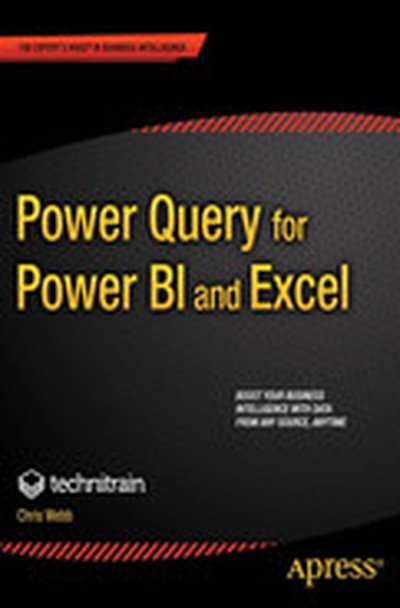
Power Query for Power BI and Excel

" Power Query for Power BI and Excel is a book for people who are tired of copying and pasting data into Excel worksheets. Power Query, part of the Microsoft Power BI suite, is a tool that automates the process of getting data into Excel and will save you hours of dull, repetitive, and error-prone work! Power Query makes it easy to extract data from many different data sources, filter that data, aggregate it, clean it and perform calculations on it, finally loading that data into either your worksheet or directly into the new Excel 2013 Data Model used by Power Pivot. This concise, practical book provides a complete guide to Power Query and how to use it to solve all of your Excel data-loading problems. Power Query for Power BI and Excel goes well beyond the surface of what Power Query can do. The book goes deep into the underlying M language, showing you how to do amazing things that aren't going to be possible from just the GUI interface that is covered in most other books. You'll have full command of the GUI, and you'll be able to drop into the M language to go beyond what the GUI provides. The depth in this book makes it a must-have item for anyone who is pushing Power BI and Excel to their limits in the pursuit of business intelligence from data analysis. " Teaches the basics of using Power Query to load data into Excel Helps you solve common, data-related problems with Power Query Shows how to write your own solutions in the powerful M language

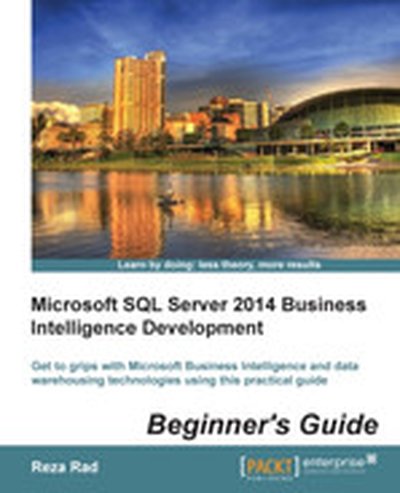
Microsoft SQL Server 2014 Business Intelligence Development Beginner's Guide

Microsoft SQL Server 2014 Business Intelligence Development Beginner's Guide introduces you to Microsoft's BI tools and systems. You'll gain hands-on experience building solutions that handle data warehousing, reporting, and predictive analytics. With step-by-step tutorials, you'll be equipped to transform data into actionable insights. What this Book will help me do Understand and implement multidimensional data models using SSAS and MDX. Write and use DAX queries and leverage SSAS tabular models effectively. Improve and maintain data integrity using MDS and DQS tools. Design and develop polished, insightful dashboards and reports using PerformancePoint, Power View, and SSRS. Explore advanced data analysis features, such as Power Query, Power Map, and basic data mining techniques. Author(s) Abolfazl Radgoudarzi and Reza Rad are experienced practitioners and educators in the field of business intelligence. They specialize in SQL Server BI technologies and have extensive careers helping organizations harness data for decision-making. Their approach combines clear explanations with practical examples, ensuring readers can effectively apply what they learn. Who is it for? This book is ideal for database developers, system analysts, and IT professionals looking to build strong foundations in Microsoft SQL Server's BI technologies. Beginners in business intelligence or data management will find the topics accessible. Intermediate practitioners will expand their ability to build complete BI solutions. It's designed for anyone eager to develop skills in data modeling, analysis, and visualization.

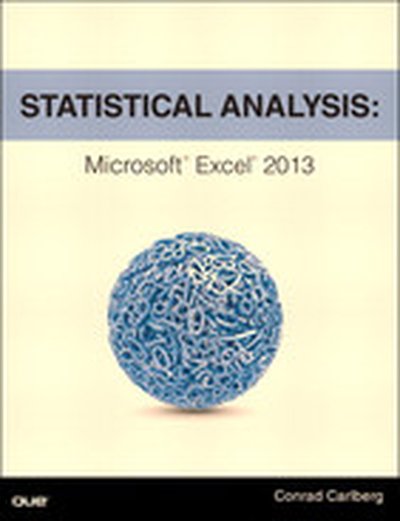
Statistical Analysis: Microsoft® Excel® 2013

Use Excel 2013’s statistical tools to transform your data into knowledge Conrad Carlberg shows how to use Excel 2013 to perform core statistical tasks every business professional, student, and researcher should master. Using real-world examples, Carlberg helps you choose the right technique for each problem and get the most out of Excel’s statistical features, including recently introduced consistency functions. Along the way, he clarifies confusing statistical terminology and helps you avoid common mistakes. You’ll learn how to use correlation and regression, analyze variance and covariance, and test statistical hypotheses using the normal, binomial, t, and F distributions. To help you make accurate inferences based on samples from a population, this edition adds two more chapters on inferential statistics, covering crucial topics ranging from experimental design to the statistical power of F tests. Becoming an expert with Excel statistics has never been easier! You’ll find crystal-clear instructions, insider insights, and complete step-by-step projects—all complemented by extensive web-based resources. Master Excel’s most useful descriptive and inferential statistical tools Tell the truth with statistics—and recognize when others don’t Accurately summarize sets of values Infer a population’s characteristics from a sample’s frequency distribution Explore correlation and regression to learn how variables move in tandem Use Excel consistency functions such as STDEV.S() and STDEV.P() Test differences between two means using z tests, t tests, and Excel’s Data Analysis Add-in Use ANOVA to test differences between more than two means Explore statistical power by manipulating mean differences, standard errors, directionality, and alpha Take advantage of Recommended PivotTables, Quick Analysis, and other Excel 2013 shortcuts

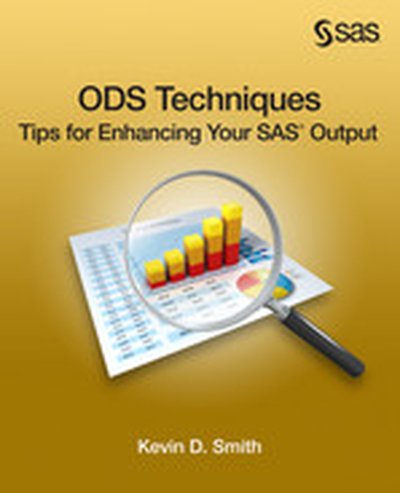
ODS Techniques

Enhance your SAS ODS output with this collection of basic to novel ideas.

SAS Output Delivery System (ODS) expert Kevin D. Smith has compiled a cookbook-style collection of his top ODS tips and techniques to teach you how to bring your reports to a new level and inspire you to see ODS in a new light.

This collection of code techniques showcases some of the most interesting and unusual methods you can use to enhance your reports within the SAS Output Delivery System. It includes general ODS tips, as well as techniques for styles, enhancing tabular output, ODS HTML, ODS PDF, ODS Microsoft Excel destinations, and ODS DOCUMENT.

Smith offers tips based on his own extensive knowledge of ODS, as well as those inspired by questions that frequently come up in his interactions with SAS users. There are simple techniques for beginners who have a minimal amount of ODS knowledge and advanced tips for the more adventurous SAS user. Together, these helpful methods provide a strong foundation for your ODS development and inspiration for building on and creating new, even more advanced techniques on your own.

This book is part of the SAS Press program.

Expert Cube Development with SSAS Multidimensional Models

"Expert Cube Development with SSAS Multidimensional Models" is a comprehensive guide designed for professionals looking to elevate their competence in creating and optimizing SSAS cube solutions. Focused on the multidimensional model, this book provides a detailed, pragmatic approach to delivering high-performance Business Intelligence solutions. What this Book will help me do Master the core features of multidimensional modeling with SSAS. Develop efficient and scalable OLAP cubes for business analysis. Implement advanced calculations and measures using MDX. Optimize and troubleshoot SSAS performance for real-world scenarios. Integrate SSAS models for insightful data visualization. Author(s) The authors of this book are seasoned SSAS consultants and developers, each with years of hands-on experience working with Microsoft Analysis Services in enterprise environments. Their deep understanding of multidimensional modeling shines through in this detailed and well-structured book, providing readers with not only practical guidance but also invaluable tips drawn from real-world projects. Who is it for? This book is tailored for BI developers and data professionals who already have some familiarity with Microsoft Analysis Services and want to deepen their expertise in SSAS multidimensional models. It is ideal for those looking to enhance their ability to design, implement, and optimize robust cube solutions for complex business scenarios. With step-by-step tutorials, it caters to intermediate to advanced learners seeking to take their SSAS skills to the next level.