talk-data.com talk-data.com

Topic

Pandas

data_manipulation data_analysis python

9

tagged

Activity Trend

17 peak/qtr
2020-Q1 2026-Q1

Activities

Showing filtered results

Filtering by: O'Reilly Data Engineering Books ×
Data Engineering for Machine Learning Pipelines: From Python Libraries to ML Pipelines and Cloud Platforms

This book covers modern data engineering functions and important Python libraries, to help you develop state-of-the-art ML pipelines and integration code. The book begins by explaining data analytics and transformation, delving into the Pandas library, its capabilities, and nuances. It then explores emerging libraries such as Polars and CuDF, providing insights into GPU-based computing and cutting-edge data manipulation techniques. The text discusses the importance of data validation in engineering processes, introducing tools such as Great Expectations and Pandera to ensure data quality and reliability. The book delves into API design and development, with a specific focus on leveraging the power of FastAPI. It covers authentication, authorization, and real-world applications, enabling you to construct efficient and secure APIs using FastAPI. Also explored is concurrency in data engineering, examining Dask's capabilities from basic setup to crafting advanced machine learning pipelines. The book includes development and delivery of data engineering pipelines using leading cloud platforms such as AWS, Google Cloud, and Microsoft Azure. The concluding chapters concentrate on real-time and streaming data engineering pipelines, emphasizing Apache Kafka and workflow orchestration in data engineering. Workflow tools such as Airflow and Prefect are introduced to seamlessly manage and automate complex data workflows. What sets this book apart is its blend of theoretical knowledge and practical application, a structured path from basic to advanced concepts, and insights into using state-of-the-art tools. With this book, you gain access to cutting-edge techniques and insights that are reshaping the industry. This book is not just an educational tool. It is a career catalyst, and an investment in your future as a data engineering expert, poised to meet the challenges of today's data-driven world. What You Will Learn Elevate your data wrangling jobs by utilizing the power of both CPU and GPU computing, and learn to process data using Pandas 2.0, Polars, and CuDF at unprecedented speeds Design data validation pipelines, construct efficient data service APIs, develop real-time streaming pipelines and master the art of workflow orchestration to streamline your engineering projects Leverage concurrent programming to develop machine learning pipelines and get hands-on experience in development and deployment of machine learning pipelines across AWS, GCP, and Azure Who This Book Is For Data analysts, data engineers, data scientists, machine learning engineers, and MLOps specialists
Software Engineering for Data Scientists

Data science happens in code. The ability to write reproducible, robust, scaleable code is key to a data science project's success—and is absolutely essential for those working with production code. This practical book bridges the gap between data science and software engineering, and clearly explains how to apply the best practices from software engineering to data science. Examples are provided in Python, drawn from popular packages such as NumPy and pandas. If you want to write better data science code, this guide covers the essential topics that are often missing from introductory data science or coding classes, including how to: Understand data structures and object-oriented programming Clearly and skillfully document your code Package and share your code Integrate data science code with a larger code base Learn how to write APIs Create secure code Apply best practices to common tasks such as testing, error handling, and logging Work more effectively with software engineers Write more efficient, maintainable, and robust code in Python Put your data science projects into production And more

Architecting a Modern Data Warehouse for Large Enterprises: Build Multi-cloud Modern Distributed Data Warehouses with Azure and AWS

Design and architect new generation cloud-based data warehouses using Azure and AWS. This book provides an in-depth understanding of how to build modern cloud-native data warehouses, as well as their history and evolution. The book starts by covering foundational data warehouse concepts, and introduces modern features such as distributed processing, big data storage, data streaming, and processing data on the cloud. You will gain an understanding of the synergy, relevance, and usage data warehousing standard practices in the modern world of distributed data processing. The authors walk you through the essential concepts of Data Mesh, Data Lake, Lakehouse, and Delta Lake. And they demonstrate the services and offerings available on Azure and AWS that deal with data orchestration, data democratization, data governance, data security, and business intelligence. After completing this book, you will be ready to design and architect enterprise-grade, cloud-based modern data warehouses using industry best practices and guidelines. What You Will Learn Understand the core concepts underlying modern data warehouses Design and build cloud-native data warehousesGain a practical approach to architecting and building data warehouses on Azure and AWS Implement modern data warehousing components such as Data Mesh, Data Lake, Delta Lake, and Lakehouse Process data through pandas and evaluate your model’s performance using metrics such as F1-score, precision, and recall Apply deep learning to supervised, semi-supervised, and unsupervised anomaly detection tasks for tabular datasets and time series applications Who This Book Is For Experienced developers, cloud architects, and technology enthusiasts looking to build cloud-based modern data warehouses using Azure and AWS

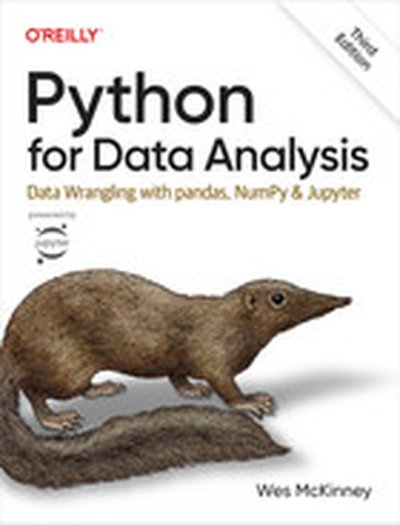
Python for Data Analysis, 3rd Edition

Get the definitive handbook for manipulating, processing, cleaning, and crunching datasets in Python. Updated for Python 3.10 and pandas 1.4, the third edition of this hands-on guide is packed with practical case studies that show you how to solve a broad set of data analysis problems effectively. You'll learn the latest versions of pandas, NumPy, and Jupyter in the process. Written by Wes McKinney, the creator of the Python pandas project, this book is a practical, modern introduction to data science tools in Python. It's ideal for analysts new to Python and for Python programmers new to data science and scientific computing. Data files and related material are available on GitHub. Use the Jupyter notebook and IPython shell for exploratory computing Learn basic and advanced features in NumPy Get started with data analysis tools in the pandas library Use flexible tools to load, clean, transform, merge, and reshape data Create informative visualizations with matplotlib Apply the pandas groupby facility to slice, dice, and summarize datasets Analyze and manipulate regular and irregular time series data Learn how to solve real-world data analysis problems with thorough, detailed examples

In-Memory Analytics with Apache Arrow

Discover the power of in-memory data analytics with "In-Memory Analytics with Apache Arrow." This book delves into Apache Arrow's unique capabilities, enabling you to handle vast amounts of data efficiently and effectively. Learn how Arrow improves performance, offers seamless integration, and simplifies data analysis in diverse computing environments. What this Book will help me do Gain proficiency with the datastore facilities and data types defined by Apache Arrow. Master the Arrow Flight APIs to efficiently transfer data between systems. Learn to leverage in-memory processing advantages offered by Arrow for state-of-the-art analytics. Understand how Arrow interoperates with popular tools like Pandas, Parquet, and Spark. Develop and deploy high-performance data analysis pipelines with Apache Arrow. Author(s) Matthew Topol, the author of the book, is an experienced practitioner in data analytics and Apache Arrow technology. Having contributed to the development and implementation of Arrow-powered systems, he brings a wealth of knowledge to readers. His ability to delve deep into technical concepts while keeping explanations practical makes this book an excellent guide for learners of the subject. Who is it for? This book is ideal for professionals in the data domain including developers, data analysts, and data scientists aiming to enhance their data manipulation capabilities. Beginners with some familiarity with data analysis concepts will find it beneficial, as well as engineers designing analytics utilities. Programming examples accommodate users of C, Go, and Python, making it broadly accessible.

Python for ArcGIS Pro

Python for ArcGIS Pro is your guide to automating geospatial tasks and maximizing your productivity using Python. Inside, you'll learn how to integrate Python scripting into ArcGIS workflows to streamline map production, data analysis, and data management. What this Book will help me do Automate map production and streamline repetitive cartography tasks. Conduct geospatial data analysis using Python libraries like pandas and NumPy. Integrate ArcPy and ArcGIS API for Python to manage geospatial data more effectively. Create script tools to improve repeatability and manage datasets. Publish and manage geospatial data to ArcGIS Online seamlessly. Author(s) None Toms and None Parker are both experienced GIS professionals and Python developers. With years of hands-on experience using Esri technology in real-world scenarios, they bring practical insights into the application's nuances. Their collaborative approach allows them to demystify technical concepts, making their teachings accessible to audiences of all skill levels. Who is it for? This book is for ArcGIS users looking to integrate Python into workflows, whether you're a GIS specialist, technician, or analyst. It's also suitable for those transitioning to roles requiring programming skills. A basic understanding of ArcGIS helps, but the book starts from the fundamentals.

Data Analysis with Python and PySpark

Think big about your data! PySpark brings the powerful Spark big data processing engine to the Python ecosystem, letting you seamlessly scale up your data tasks and create lightning-fast pipelines. In Data Analysis with Python and PySpark you will learn how to: Manage your data as it scales across multiple machines Scale up your data programs with full confidence Read and write data to and from a variety of sources and formats Deal with messy data with PySpark’s data manipulation functionality Discover new data sets and perform exploratory data analysis Build automated data pipelines that transform, summarize, and get insights from data Troubleshoot common PySpark errors Creating reliable long-running jobs Data Analysis with Python and PySpark is your guide to delivering successful Python-driven data projects. Packed with relevant examples and essential techniques, this practical book teaches you to build pipelines for reporting, machine learning, and other data-centric tasks. Quick exercises in every chapter help you practice what you’ve learned, and rapidly start implementing PySpark into your data systems. No previous knowledge of Spark is required. About the Technology The Spark data processing engine is an amazing analytics factory: raw data comes in, insight comes out. PySpark wraps Spark’s core engine with a Python-based API. It helps simplify Spark’s steep learning curve and makes this powerful tool available to anyone working in the Python data ecosystem. About the Book Data Analysis with Python and PySpark helps you solve the daily challenges of data science with PySpark. You’ll learn how to scale your processing capabilities across multiple machines while ingesting data from any source—whether that’s Hadoop clusters, cloud data storage, or local data files. Once you’ve covered the fundamentals, you’ll explore the full versatility of PySpark by building machine learning pipelines, and blending Python, pandas, and PySpark code. What's Inside Organizing your PySpark code Managing your data, no matter the size Scale up your data programs with full confidence Troubleshooting common data pipeline problems Creating reliable long-running jobs About the Reader Written for data scientists and data engineers comfortable with Python. About the Author As a ML director for a data-driven software company, Jonathan Rioux uses PySpark daily. He teaches the software to data scientists, engineers, and data-savvy business analysts. Quotes A clear and in-depth introduction for truly tackling big data with Python. - Gustavo Patino, Oakland University William Beaumont School of Medicine The perfect way to learn how to analyze and master huge datasets. - Gary Bake, Brambles Covers both basic and more advanced topics of PySpark, with a good balance between theory and hands-on. - Philippe Van Bergenl, P² Consulting For beginner to pro, a well-written book to help understand PySpark. - Raushan Kumar Jha, Microsoft

Apache Spark for Data Science Cookbook

In "Apache Spark for Data Science Cookbook," you'll delve into solving real-world analytical challenges using the robust Apache Spark framework. This book features hands-on recipes that cover data analysis, distributed machine learning, and real-time data processing. You'll gain practical skills to process, visualize, and extract insights from large datasets efficiently. What this Book will help me do Master using Apache Spark for processing and analyzing large-scale datasets effectively. Harness Spark's MLLib for implementing machine learning algorithms like classification and clustering. Utilize libraries such as NumPy, SciPy, and Pandas in conjunction with Spark for numerical computations. Apply techniques like Natural Language Processing and text mining using Spark-integrated tools. Perform end-to-end data science workflows, including data exploration, modeling, and visualization. Author(s) Nagamallikarjuna Inelu and None Chitturi bring their extensive experience working with data science and distributed computing frameworks like Apache Spark. Nagamallikarjuna specializes in applying machine learning algorithms to big data problems, while None has contributed to various big data system implementations. Together, they focus on providing practitioners with practical and efficient solutions. Who is it for? This book is primarily intended for novice and intermediate data scientists and analysts who are curious about using Apache Spark to tackle data science problems. Readers are expected to have some familiarity with basic data science tasks. If you want to learn practical applications of Spark in data analysis and enhance your big data analytics skills, this resource is for you.

Data Just Right: Introduction to Large-Scale Data & Analytics

Making Big Data Work: Real-World Use Cases and Examples, Practical Code, Detailed Solutions Large-scale data analysis is now vitally important to virtually every business. Mobile and social technologies are generating massive datasets; distributed cloud computing offers the resources to store and analyze them; and professionals have radically new technologies at their command, including NoSQL databases. Until now, however, most books on “Big Data” have been little more than business polemics or product catalogs. is different: It’s a completely practical and indispensable guide for every Big Data decision-maker, implementer, and strategist. Data Just Right Michael Manoochehri, a former Google engineer and data hacker, writes for professionals who need practical solutions that can be implemented with limited resources and time. Drawing on his extensive experience, he helps you focus on building applications, rather than infrastructure, because that’s where you can derive the most value. Manoochehri shows how to address each of today’s key Big Data use cases in a cost-effective way by combining technologies in hybrid solutions. You’ll find expert approaches to managing massive datasets, visualizing data, building data pipelines and dashboards, choosing tools for statistical analysis, and more. Throughout, the author demonstrates techniques using many of today’s leading data analysis tools, including Hadoop, Hive, Shark, R, Apache Pig, Mahout, and Google BigQuery. Coverage includes Mastering the four guiding principles of Big Data success—and avoiding common pitfalls Emphasizing collaboration and avoiding problems with siloed data Hosting and sharing multi-terabyte datasets efficiently and economically “Building for infinity” to support rapid growth Developing a NoSQL Web app with Redis to collect crowd-sourced data Running distributed queries over massive datasets with Hadoop, Hive, and Shark Building a data dashboard with Google BigQuery Exploring large datasets with advanced visualization Implementing efficient pipelines for transforming immense amounts of data Automating complex processing with Apache Pig and the Cascading Java library Applying machine learning to classify, recommend, and predict incoming information Using R to perform statistical analysis on massive datasets Building highly efficient analytics workflows with Python and Pandas Establishing sensible purchasing strategies: when to build, buy, or outsource Previewing emerging trends and convergences in scalable data technologies and the evolving role of the Data Scientist