talk-data.com talk-data.com

Topic

SQL

Structured Query Language (SQL)

database_language data_manipulation data_definition programming_language

73

tagged

Activity Trend

107 peak/qtr
2020-Q1 2026-Q1

Activities

Showing filtered results

Filtering by: Databricks DATA + AI Summit 2023 ×
Migrating Complex SAS Processes to Databricks - Case Study

Many federal agencies use SAS software for critical operational data processes. While SAS has historically been a leader in analytics, it has often been used by data analysts for ETL purposes as well. However, modern data science demands on ever-increasing volumes and types of data require a shift to modern, cloud architectures and data management tools and paradigms for ETL/ELT. In this presentation, we will provide a case study at Centers for Medicare and Medicaid Services (CMS) detailing the approach and results of migrating a large, complex legacy SAS process to modern, open-source/open-standard technology - Spark SQL & Databricks – to produce results ~75% faster without reliance on proprietary constructs of the SAS language, with more scalability, and in a manner that can more easily ingest old rules and better govern the inclusion of new rules and data definitions. Significant technical and business benefits derived from this modernization effort are described in this session.

Connect with us: Website: https://databricks.com Facebook: https://www.facebook.com/databricksinc Twitter: https://twitter.com/databricks LinkedIn: https://www.linkedin.com/company/data... Instagram: https://www.instagram.com/databricksinc/

Near Real-Time Analytics with Event Streaming, Live Tables, and Delta Sharing

Microservices is an increasingly popular architecture much loved by application teams, for it allows services to be developed and scaled independently. Data teams, though, often need a centralized repository where all data from different services come together to join and aggregate. The data platform can serve as a single source of company facts, enable near real time analytics, and secure sharing of massive data sets across clouds.

A viable microservices ingestion pattern is Change Data Capture, using AWS Database Migration Services or Debezium. CDC proves to be a scalable solution ideal for stable platforms, but it has several challenges for evolving services: Frequent schema changes, complex, unsupported DDL during migration, and automated deployments are but a few. An event streaming architecture can address these challenges.

Confluent, for example, provides a schema registry service where all services can register their event schemas. Schema registration helps with verifying that the events are being published based on the agreed contracts between data producers and consumers. It also provides a separation between internal service logic and the data consumed downstream. The services write their events to Kafka using the registered schemas with a specific topic based on the type of the event.

Data teams can leverage Spark jobs to ingest Kafka topics into Bronze tables in the Delta Lake. On ingestion, the registered schema from schema registry is used to validate the schema based on the provided version. A merge operation is sometimes called to translate events into final states of the records per business requirements.

Data teams can take advantage of Delta Live Tables on streaming datasets to produce Silver and Gold tables in near real time. Each input data source also has a set of expectations to ensure data quality and business rules. The pipeline allows Engineering and Analytics to collaborate by mixing Python and SQL. The refined data sets are then fed into Auto ML for discovery and baseline modeling.

To expose Gold tables to more consumers, especially non spark users across clouds, data teams can implement Delta Sharing. Recipients can accesses Silver tables from a different cloud and build their own analytics data sets. Analytics teams can also access Gold tables via pandas Delta Sharing client and BI tools.

Connect with us: Website: https://databricks.com Facebook: https://www.facebook.com/databricksinc Twitter: https://twitter.com/databricks LinkedIn: https://www.linkedin.com/company/data... Instagram: https://www.instagram.com/databricksinc/
Opening the Floodgates: Enabling Fast, Unmediated End User Access to Trillion-Row Datasets with SQL

Spreadsheets revolutionized IT by giving end users the ability to create their own analytics. Providing direct end user access to trillion-row datasets generated in financial markets or digital marketing is much harder. New SQL data warehouses like ClickHouse and Druid can provide fixed latency with constant cost on very large datasets, which opens up new possibilities.

Our talk walks through recent experience on analytic apps developed by ClickHouse users that enable end users like market traders to develop their own analytics directly off raw data. We’ll cover the following topics.

  1. Characteristics of new open source column databases and how they enable low-latency analytics at constant cost.

  2. Idiomatic ways to validate new apps by building MVPs that support a wide range of queries on source data including storing source JSON, schema design, applying compression on columns, and building indexes for needle-in-a-haystack queries.

  3. Incrementally identifying hotspots and applying easy optimizations to bring query performance into line with long term latency and cost requirements.

  4. Methods of building accessible interfaces, including traditional dashboards, imitating existing APIs that are already known, and creating app-specific visualizations.

We’ll finish by summarizing a few of the benefits we’ve observed and also touch on ways that analytic infrastructure could be improved to make end user access even more productive. The lessons are as general as possible so that they can be applied across a wide range of analytic systems, not just ClickHouse.

Connect with us: Website: https://databricks.com Facebook: https://www.facebook.com/databricksinc Twitter: https://twitter.com/databricks LinkedIn: https://www.linkedin.com/company/data... Instagram: https://www.instagram.com/databricksinc/

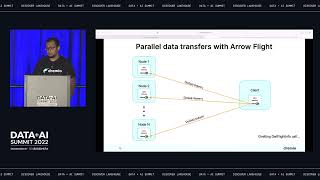
Apache Arrow Flight SQL: High Performance, Simplicity, and Interoperability for Data Transfers

Network protocols for transferring data generally have one of two problems: they’re slow for large data transfers but have simple APIs (e.g. JDBC) or they’re fast for large data transfers but have complex APIs specific to the system. Apache Arrow Flight addresses the former by providing high performance data transfers and half of the latter by having a standard API independent of systems. However, while the Arrow Flight API is performant and an open standard, it can be more complex to use than simpler APIs like JDBC.

Arrow Flight SQL rounds out the solution, providing both great performance and a simple universal API.

In this talk, we’ll show the performance benefits of Arrow Flight, the client difference between interacting with Arrow Flight and Arrow Flight SQL, and an overview of a JDBC driver built on Arrow Flight SQL, enabling clients to take advantage of this increased performance with zero application changes.

Connect with us: Website: https://databricks.com Facebook: https://www.facebook.com/databricksinc Twitter: https://twitter.com/databricks LinkedIn: https://www.linkedin.com/company/data... Instagram: https://www.instagram.com/databricksinc/

Apache Spark SQL Aggregate Improvement at Meta (Facebook)

Aggregate (group-by) is one of most important SQL operations in data warehouses. It is required when we want to get aggregated insights from input datasets. Over the last year, we added a series of aggregate optimizations internally at Facebook Spark SQL, and we started to contribute back to Apache Spark recently.

(1).sort aggregate (SPARK-32461): add code generation to improve query performance, replace hash with sort aggregate when child is sorted, etc. (2).object hash aggregate (SPARK-34286): adaptive sort-based fallback based on JVM heap memory usage during query execution. (3).hash aggregate (SPARK-31973): adaptive bypass partial aggregate when aggregate reduction ratio is low. (4).data source aggregate push down (SPARK-34960): aggregate push down to ORC data source by utilizing column statistics (5).files statistics aggregate: aggregate output files (and all columns) statistics distributively when writing query output

we’ll take deep dive of above features and lessons learned.

Connect with us: Website: https://databricks.com Facebook: https://www.facebook.com/databricksinc Twitter: https://twitter.com/databricks LinkedIn: https://www.linkedin.com/company/data... Instagram: https://www.instagram.com/databricksinc/
Build an Enterprise Lakehouse for Free with Trino and Delta Lake

Delta Lake has quickly grown in usage across data lakes everywhere due to the growing use cases that require DML capabilities that Delta Lake brings. Outside of support for ACID transactions, users want the ability to interactively query the data in their data lake. This is where a query engine like Trino (formerly PrestoSQL) comes in. Starburst provides an enterprise version of the popular Trino MPP SQL query engine and has recently open sourced their Delta Lake connector.

In this talk, Tom and Claudius will talk about the connector, its features, and how their users are taking advantage of expanding the functionality of their data lakes with improved performance and the ability to handle colliding modifications. Get started with this feature-rich and open stack without the need of a multi-million dollar budget.

Connect with us: Website: https://databricks.com Facebook: https://www.facebook.com/databricksinc Twitter: https://twitter.com/databricks LinkedIn: https://www.linkedin.com/company/data... Instagram: https://www.instagram.com/databricksinc/
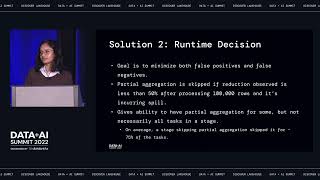
Presto On Spark: A Unified SQL Experience

Presto was originally designed to run interactive queries against data warehouses, but now it has evolved into a unified SQL engine on top of open data lake analytics for both interactive and batch workloads. However, Presto doesn't scale to very large and complex batch pipelines. Presto Unlimited was designed to address such scalability challenges but it didn’t fully solve fault tolerance, isolation, and resource management.

Spark is the tool of choice across the industry for running large scale complex batch ETL pipelines. This motivated the development of Presto On Spark. Presto on Spark runs Presto as a library that is submitted with spark-submit to a Spark cluster. It leverages Spark for scaling shuffle, worker execution, and resource management. It thereby eliminates any query conversion between interactive and batch use cases. This solution helps enable a performant and scalable platform with seamless end-to-end experience to explore and process data.

Many analysts at Intuit use Presto to explore data in the Data Lake/S3 and use Spark for batch processing. These analysts would earlier spend several hours converting these exploration SQLs written for Presto to Spark SQL to operationalize/schedule them as data pipelines. Presto On Spark is now used by analysts at Intuit to run thousands of critical jobs. No query conversion is required here, improved analysts' productivity and empowered them to deliver insights at high speed.

Benefits from session: Attendees will learn about Presto On Spark architecture Attendees will learn when To Use Spark's Execution Engine With Presto Attendees will learn how Intuit runs thousands of presto jobs daily leveraging databricks platform which they can apply to their own work

Connect with us: Website: https://databricks.com Facebook: https://www.facebook.com/databricksinc Twitter: https://twitter.com/databricks LinkedIn: https://www.linkedin.com/company/data... Instagram: https://www.instagram.com/databricksinc/

Radical Speed on the Lakehouse: Photon Under the Hood

Many organizations are standardizing on the lakehouse, however, this new architecture poses challenges with an underlying query execution engine for accessing structured and unstructured data. The execution engine needs to provide the performance of a data warehouse and the scalability of data lakes. To ensure optimum performance, the Databricks Lakehouse Platform offers Photon. This next-gen vectorized query execution engine outperforms existing data warehouses in SQL workloads and implements a more general execution framework for efficient processing of data with support of the Apache Spark™ API. With Photon, analytical queries are seeing a 3 to 5x speed increase, with a 40% reduction in compute hours for ETL workloads. In this session, we will dive into Photon, describe its integration with the Databricks Platform and Apache Spark™ runtimes, talk through customer use cases, and show how your SQL and DataFrame workloads can benefit from the performance of Photon.

Connect with us: Website: https://databricks.com Facebook: https://www.facebook.com/databricksinc Twitter: https://twitter.com/databricks LinkedIn: https://www.linkedin.com/company/data... Instagram: https://www.instagram.com/databricksinc/
Scaling Your Workloads with Databricks Serverless

Databricks SQL provides a first-class user experience for BI and SQL directly on the lakehouse platform. But you still need to administer and maintain clusters of virtual machines. What if you could focus on your Databricks SQL queries and never need to worry about the underlying compute infrastructure? Learn how Databricks Serverless, built into the Databricks Lakehouse Platform, eliminates cluster management, provides instant compute, and lowers total cost of ownership for Databricks SQL. In this session, you will see demos, hear from customers, learn how Databricks Serverless works under the hood, be equipped with everything you need to get started – and ultimately get the best out of Databricks Serverless.

Connect with us: Website: https://databricks.com Facebook: https://www.facebook.com/databricksinc Twitter: https://twitter.com/databricks LinkedIn: https://www.linkedin.com/company/data... Instagram: https://www.instagram.com/databricksinc/
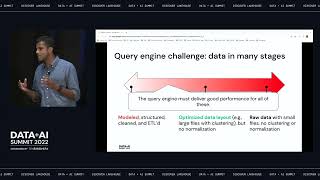
Simon Whiteley + Denny Lee Live Ask Me Anything

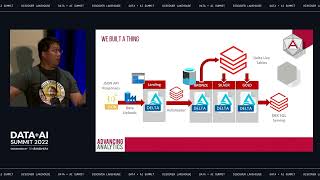
Simon and Denny Build A Thing is a live webshow, where Simon Whiteley (Advancing Analytics) and Denny Lee (Databricks) are building out a TV Ratings Analytics tool, working through the various challenges of building out a Data Lakehouse using Databricks. In this session, they'll be talking through their Lakehouse Platform, revisiting various pieces of functionality, and answering your questions, Live!

This is your chance to ask questions around structuring a lake for enterprise data analytics, the various ways we can use Delta Live Tables to simplify ETL or how to get started serving out data using Databricks SQL. We have a whole load of things to talk through, but we want to hear YOUR questions, which we can field from industry experience, community engagement and internal Databricks direction. There's also a chance we'll get distracted and talk about the Expanse for far too long.

Connect with us: Website: https://databricks.com Facebook: https://www.facebook.com/databricksinc Twitter: https://twitter.com/databricks LinkedIn: https://www.linkedin.com/company/data... Instagram: https://www.instagram.com/databricksinc/
Building Spatial Applications with Apache Spark and CARTO

CARTO’s Spatial Extension provides the fundamental building blocks for Location Intelligence in Databricks. Many of the largest organizations using CARTO leverage Databricks for their analytics. Customers very often build custom spatial applications that simplify either a spatial analysis use case or provide a more direct interface to access business intelligence or information. CARTO facilitates the creation of these apps with a complete set of development libraries and APIs. For visualization, CARTO makes use of the powerful deck.gl visualization library. You utilize CARTO Builder to design your maps and perform analytics using Spatial SQL similar to PostGIS, but with the scalability of Apache Spark and then you reference them in your code. CARTO will handle visualizing large datasets, updating the maps, and everything in between. In this talk we will walk you through the process to build spatial applications with CARTO hosted in Apache Spark.

Connect with us: Website: https://databricks.com Facebook: https://www.facebook.com/databricksinc Twitter: https://twitter.com/databricks LinkedIn: https://www.linkedin.com/company/data... Instagram: https://www.instagram.com/databricksinc/
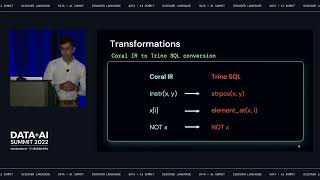
Coral and Transport Portable SQL and UDFs for the Interoperability of Spark and Other Engines

In this talk, we present two open source projects, Coral and Transport, that enable deep SQL and UDF interoperability between Spark and other engines, such as Trino and Hive. Coral is a SQL analysis, rewrite, and translation engine that enables compute engines to interoperate and analyze different SQL dialects and plans, through the conversion to a common relational algebraic intermediate representation. Transport is a UDF framework that enables users to write UDFs against a single API but execute them as native UDFs of multiple engines, such as Spark, Trino, and Hive. Further, we discuss how LinkedIn leverages Coral and Transport, and present a production use case for accessing views of other engines in Spark as well as enhancing Spark DataFrame and Dataset view schema. We discuss other potential applications such as automatic data governance and data obfuscation, query optimization, materialized view selection, incremental compute, and data source SQL and UDF communication.

Connect with us: Website: https://databricks.com Facebook: https://www.facebook.com/databricksinc Twitter: https://twitter.com/databricks LinkedIn: https://www.linkedin.com/company/data... Instagram: https://www.instagram.com/databricksinc/
Spark Data Source V2 Performance Improvement: Aggregate Push Down

Spark applications often need to query external data sources such as file-based data sources or relational data sources. In order to do this, Spark provides Data Source APIs to access structured data through Spark SQL.

Data Source APIs have optimization rules such as filter push down and column pruning to reduce the amount of data that needs to be processed to improve query performance. As part of our ongoing project to provide generic Data Source V2 push down APIs, we have introduced partial aggregate push down, which significantly speeds up spark jobs by dramatically reducing the amount of data transferred between data sources and Spark. We have implemented aggregate push down in both JDBC and parquet.

Connect with us: Website: https://databricks.com Facebook: https://www.facebook.com/databricksinc Twitter: https://twitter.com/databricks LinkedIn: https://www.linkedin.com/company/data... Instagram: https://www.instagram.com/databricksinc/
Unity Catalog: Journey to Unified Governance for Your Data and AI Assets on Lakehouse

Modern data assets take many forms: not just files or tables, but dashboards, ML models, and unstructured data like video and images, all of which cannot be governed and managed by legacy data governance solutions. Join this session to learn how data teams can use Unity Catalog to centrally manage all data and AI assets with a common governance model based on familiar ANSI SQL, ensuring much better native performance and security. Built-in automated data lineage provides end-to-end visibility into how data flows from source to consumption, so that organizations can identify and diagnose the impact of data changes. Unity Catalog delivers the flexibility to leverage existing data catalogs and solutions and establish a future-proof, centralized governance without expensive migration costs. It also creates detailed audit reports for data compliance and security, while ensuring data teams can quickly discover and reference data for BI, analytics, and ML workloads, accelerating time to value.

Connect with us: Website: https://databricks.com Facebook: https://www.facebook.com/databricksinc Twitter: https://twitter.com/databricks LinkedIn: https://www.linkedin.com/company/data... Instagram: https://www.instagram.com/databricksinc/
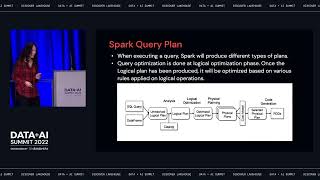
Databricks SQL Under the Hood: What's New with Live Demos

With serverless SQL compute and built-in governance, Databricks SQL lets every analyst and analytics engineer easily ingest, transform, and query the freshest data directly on your data lake, using their tools of choice like Fivetran, dbt, PowerBI or Tableau, and standard SQL. There is no need to move data to another system. All this takes place at virtually any scale, at a fraction of the cost of traditional cloud data warehouses. Join this session for a deep dive into how Databricks SQL works under the hood, and see a live end-to-end demo of the data and analytics on Databricks from data ingestion, transformation, and consumption, using the modern data stack along with Databricks SQL.

Connect with us: Website: https://databricks.com Facebook: https://www.facebook.com/databricksinc Twitter: https://twitter.com/databricks LinkedIn: https://www.linkedin.com/company/data... Instagram: https://www.instagram.com/databricksinc/
Deep Dive into the New Features of Apache Spark 3.2 and 3.3

Apache Spark has become the most widely-used engine for executing data engineering, data science and machine learning on single-node machines or clusters. The number of monthly maven downloads of Spark has rapidly increased to 20 million.

We will talk about the higher-level features and improvements in Spark 3.2 and 3.3. The talk also dives deeper into the following features + Introducing pandas API on Apache Spark to unify small data API and big data API. + Completing the ANSI SQL compatibility mode to simplify migration of SQL workloads. + Productionizing adaptive query execution to speed up Spark SQL at runtime. + Introducing RocksDB state store to make state processing more scalable

Connect with us: Website: https://databricks.com Facebook: https://www.facebook.com/databricksinc Twitter: https://twitter.com/databricks LinkedIn: https://www.linkedin.com/company/data... Instagram: https://www.instagram.com/databricksinc/
Distributed Machine Learning at Lyft

Data collection, preprocessing, feature engineering are the fundamental steps in any Machine Learning Pipeline. After feature engineering, being able to parallelize training on multiple low cost machines helps to reduce cost and time both. And, then being able to train models in a distributed manner speeds up Hyperparameter Tuning. How can we unify these stages of ML Pipeline in one unified distributed training platform together? And that too on Kubernetes?

Our ML platform is completely based on Kubernetes because of its scalability and rapid bootstrapping time of resources. In this talk we will demonstrate how Lyft uses Spark on Kubernetes, Fugue (our home grown unifying compute abstraction layer) to design a holistic end to end ML Pipeline system for distributed feature engineering, training & prediction experience for our customers on our ML Platform on top of Spark on K8s. We will also do a deep dive to show how we are abstracting and hiding infrastructure complexities so that our Data Scientists and Research Scientist can focus only on the business logic for their models through simple pythonic APIs and SQL. We let the users focus on ''what to do'' and the platform takes care of ''how to do''. We will share our challenges, learning and the fun we had while implementing. Using Spark on K8s have helped us achieve large scale data processing with 90% less cost and at times bringing down processing time from 2 hours to less than 20 mins.

Connect with us: Website: https://databricks.com Facebook: https://www.facebook.com/databricksinc Twitter: https://twitter.com/databricks LinkedIn: https://www.linkedin.com/company/data... Instagram: https://www.instagram.com/databricksinc/
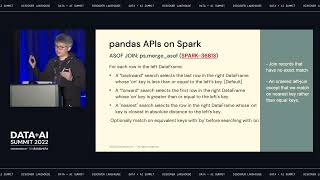
FugueSQL—The Enhanced SQL Interface for Pandas and Spark DataFrames

SQL users working with Pandas and Spark quickly realize SQL is a second-class interface, invoked between predominantly Python code.

We will introduce FugueSQL, an enhanced SQL interface that allows SQL lovers to express end-to-end workflows predominantly in SQL. With a Jupyter notebook extension, SQL commands can be used in Databricks notebooks for interactive handling of in-memory datasets. This allows heavy SQL users to fully leverage Spark in their preferred grammar.

Connect with us: Website: https://databricks.com Facebook: https://www.facebook.com/databricksinc Twitter: https://twitter.com/databricks LinkedIn: https://www.linkedin.com/company/data... Instagram: https://www.instagram.com/databricksinc/
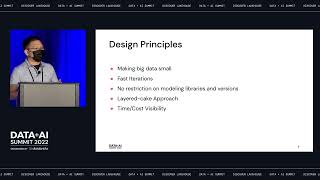
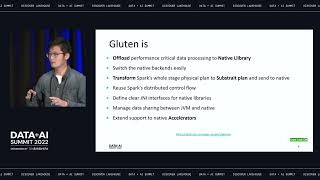
Gazelle-Jni: A Middle Layer to Offload Spark SQL to Native Engines for Execution Acceleration

This session will introduce Gazelle-Jni, which was proposed to better integrate the various native SQL engines as Spark SQL’s backend. It implemented a shared JVM and JNI middle layer. With the help of Gazlle-Jni, Spark SQL execution can be offloaded to native engines by passing Substrait transformed physical plan.

Examples will be presented on how to integrate native engines with Spark SQL.

Connect with us: Website: https://databricks.com Facebook: https://www.facebook.com/databricksinc Twitter: https://twitter.com/databricks LinkedIn: https://www.linkedin.com/company/data... Instagram: https://www.instagram.com/databricksinc/

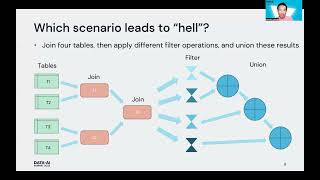
Goodbye Hell of Unions in Spark SQL

It is known that applications, which heavily use Spark SQL union() operation, cause performance problems. The union() operation combines multiple rows into one table. When union() operation merges many Dataframes, the size of the generated Spark SQL planning tree will be huge while the Spark SQL code is small. The huge planning tree may lead to performance problems. This talk reviews performance problems from the Spark SQL planning perspective and explains how to avoid the performance issues with common practices.

Connect with us: Website: https://databricks.com Facebook: https://www.facebook.com/databricksinc Twitter: https://twitter.com/databricks LinkedIn: https://www.linkedin.com/company/data... Instagram: https://www.instagram.com/databricksinc/