talk-data.com talk-data.com

Topic

SQL

Structured Query Language (SQL)

database_language data_manipulation data_definition programming_language

1751

tagged

Activity Trend

107 peak/qtr
2020-Q1 2026-Q1

Activities

1751 activities · Newest first

Enable Production ML with Databricks Feature Store

Productionalizing ML models is hard. In fact, very few ML projects make it to production, and one of the hardest problems is data! Most AI platforms are disconnected from the data platform, making it challenging to keep features constantly updated and available in real-time. Offline/online skew prevents models from being used in real-time or, worse, introduces bugs and biases in production. Building systems to enable real-time inference requires valuable production engineering resources. As a result of these challenges, most ML models do not see the light of day.

Learn how you can simplify production ML using Databricks Feature Store, the first feature store built on the data lakehouse. Data sources for features are drawn from a central data lakehouse, and the feature tables themselves are tables in the lakehouse, accessible in Spark and SQL for both machine learning and analytics use cases. Features, data pipelines, source data, and models can all be co-governed in a central platform. Feature Store is seamlessly integrated with Apache Spark™, enabling automatic lineage tracking, and with MLflow, enabling models to look up feature values at inference time automatically. See these capabilities in action and how you can use it for your ML projects.

Connect with us: Website: https://databricks.com Facebook: https://www.facebook.com/databricksinc Twitter: https://twitter.com/databricks LinkedIn: https://www.linkedin.com/company/data... Instagram: https://www.instagram.com/databricksinc/

Cloud Fetch: High-bandwidth Connectivity With BI Tools

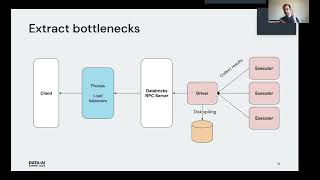
Business Intelligence (BI) tools such as Tableau and Microsoft Power BI are notoriously slow at extracting large query results from traditional data warehouses because they typically fetch the data in a single thread through a SQL endpoint that becomes a data transfer bottleneck. Data analysts can connect their BI tools to Databricks SQL endpoints to query data in tables through an ODBC/JDBC protocol integrated in our Simba drivers. With Cloud Fetch, which we released in Databricks Runtime 8.3 and Simba ODBC 2.6.17 driver, we introduce a new mechanism for fetching data in parallel via cloud storage such as AWS S3 and Azure Data Lake Storage to bring the data faster to BI tools. In our experiments using Cloud Fetch, we observed a 10x speed-up in extract performance due to parallelism.

Connect with us: Website: https://databricks.com Facebook: https://www.facebook.com/databricksinc Twitter: https://twitter.com/databricks LinkedIn: https://www.linkedin.com/company/data... Instagram: https://www.instagram.com/databricksinc/

Computational Data Governance at Scale

This talk is about the implementation of a Data Mesh in a Fozzy Group. In our experience, the biggest bottleneck in transition to Data Mesh is unclear data ownership. This and other issues can be solved with (federated) computational data governance. We will go through the process of building a global data lineage with 200k tables, 40k table replications, and 70k SQL stored procedures. Also, we will cover our lessons from building data product culture with explicit and automated tracking of ownership and data quality. Fozzy Group is a holding company that comprises about 40 different businesses with 60k employees in various domains: retail, banking, insurance, logistics, agriculture, HoReCa, E-Commerce, etc.

Connect with us: Website: https://databricks.com Facebook: https://www.facebook.com/databricksinc Twitter: https://twitter.com/databricks LinkedIn: https://www.linkedin.com/company/data... Instagram: https://www.instagram.com/databricksinc/

From PostGIS to Spark SQL: The History and Future of Spatial SQL

In this talk, we'll review the major milestones that have defined Spatial SQL as the powerful tool for geospatial analytics that it is today.

From the early foundations of the JTS Topology Suite and GEOS and its application on the PostGIS extension for PostgreSQL, to the latest implementation in Spark SQL using libraries such as the CARTO Analytics Toolbox for Databricks, Spatial SQL has been a key component of many geospatial analytics products and solutions, leveraging the computing power of different databases with SQL as lingua franca, allowing easy adoption by data scientists, analysts and engineers.

The latest innovation in this area is the CARTO Spatial Extension for Databricks, which makes the most of the near-unlimited scalability provided by Spark and the cutting-edge geospatial capabilities that CARTO offers.

Connect with us: Website: https://databricks.com Facebook: https://www.facebook.com/databricksinc Twitter: https://twitter.com/databricks LinkedIn: https://www.linkedin.com/company/data... Instagram: https://www.instagram.com/databricksinc/

Hassle-Free Data Ingestion into the Lakehouse

Ingesting data from hundreds of different data sources is critical before organizations can execute advanced analytics, data science, and machine learning. Unfortunately, ingesting and unifying this data to create a reliable single source of truth is usually extremely time-consuming and costly. In this session, discover how Databricks simplifies data ingestion, at low latency, with SQL-only ingestion capabilities. We will discuss and demonstrate how you can easily and quickly ingest any data into the lakehouse. The session will also cover newly-released features and tools that make data ingestion even simpler on the Databricks Lakehouse Platform.

Connect with us: Website: https://databricks.com Facebook: https://www.facebook.com/databricksinc Twitter: https://twitter.com/databricks LinkedIn: https://www.linkedin.com/company/data... Instagram: https://www.instagram.com/databricksinc/

Ingesting data into Lakehouse with COPY INTO

COPY INTO is a popular data ingestion SQL command for Databricks users, especially for customers using Databricks SQL. In this talk, we want to discuss the data ingestion use cases in Databricks and how COPY INTO fits your data ingestion needs. We will discuss a few new COPY INTO features and how to achieve the following use cases: 1. Loading data into a Delta Table incrementally ; 2. Fixing errors in already loaded data and helping you with data cleansing; 3. Evolving your schema over time; 4. Previewing data before ingesting; 5. Loading data from a third party data source. In this session, we will demo the new features, discuss the architecture for the implementation, and how other Databricks features are using COPY INTO under the hood.

Connect with us: Website: https://databricks.com Facebook: https://www.facebook.com/databricksinc Twitter: https://twitter.com/databricks LinkedIn: https://www.linkedin.com/company/data... Instagram: https://www.instagram.com/databricksinc/

Presto 101: An Introduction to Open Source Presto

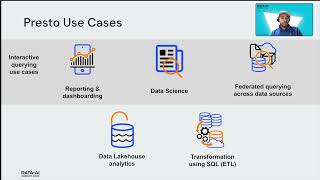
Presto is a widely adopted distributed SQL engine for data lake analytics. With Presto, you can perform ad hoc querying of data in place, which helps solve challenges around time to discover and the amount of time it takes to do ad hoc analysis. Additionally, new features like the disaggregated coordinator, Presto-on-Spark, scan optimizations, a reusable native engine, and a Pinot connector enable added benefits around performance, scale, and ecosystem.

In this session, Philip and Rohan will introduce the Presto technology and share why it’s becoming so popular – in fact, companies like Facebook, Uber, Twitter, Alibaba, and much more use Presto for interactive ad hoc queries, reporting & dashboarding data lake analytics, and much more. We’ll also show a quick demo on getting Presto running in AWS.

Connect with us: Website: https://databricks.com Facebook: https://www.facebook.com/databricksinc Twitter: https://twitter.com/databricks LinkedIn: https://www.linkedin.com/company/data... Instagram: https://www.instagram.com/databricksinc/

Summary Data engineering is a large and growing subject, with new technologies, specializations, and "best practices" emerging at an accelerating pace. This podcast does its best to explore this fractal ecosystem, and has been at it for the past 5+ years. In this episode Joe Reis, founder of Ternary Data and co-author of "Fundamentals of Data Engineering", turns the tables and interviews the host, Tobias Macey, about his journey into podcasting, how he runs the show behind the scenes, and the other things that occupy his time.

Announcements

Hello and welcome to the Data Engineering Podcast, the show about modern data management When you’re ready to build your next pipeline, or want to test out the projects you hear about on the show, you’ll need somewhere to deploy it, so check out our friends at Linode. With their new managed database service you can launch a production ready MySQL, Postgres, or MongoDB cluster in minutes, with automated backups, 40 Gbps connections from your application hosts, and high throughput SSDs. Go to dataengineeringpodcast.com/linode today and get a $100 credit to launch a database, create a Kubernetes cluster, or take advantage of all of their other services. And don’t forget to thank them for their continued support of this show! RudderStack helps you build a customer data platform on your warehouse or data lake. Instead of trapping data in a black box, they enable you to easily collect customer data from the entire stack and build an identity graph on your warehouse, giving you full visibility and control. Their SDKs make event streaming from any app or website easy, and their state-of-the-art reverse ETL pipelines enable you to send enriched data to any cloud tool. Sign up free… or just get the free t-shirt for being a listener of the Data Engineering Podcast at dataengineeringpodcast.com/rudder. Data teams are increasingly under pressure to deliver. According to a recent survey by Ascend.io, 95% in fact reported being at or over capacity. With 72% of data experts reporting demands on their team going up faster than they can hire, it’s no surprise they are increasingly turning to automation. In fact, while only 3.5% report having current investments in automation, 85% of data teams plan on investing in automation in the next 12 months. 85%!!! That’s where our friends at Ascend.io come in. The Ascend Data Automation Cloud provides a unified platform for data ingestion, transformation, orchestration, and observability. Ascend users love its declarative pipelines, powerful SDK, elegant UI, and extensible plug-in architecture, as well as its support for Python, SQL, Scala, and Java. Ascend automates workloads on Snowflake, Databricks, BigQuery, and open source Spark, and can be deployed in AWS, Azure, or GCP. Go to dataengineeringpodcast.com/ascend and sign up for a free trial. If you’re a data engineering podcast listener, you get credits worth $5,000 when you become a customer. Your host is Tobias Macey and today we’re flipping the script. Joe Reis of Ternary Data will be interviewing me about my time as the host of this show and my perspectives on the data ecosystem

Interview

Introduction How did you get involved in the area of data management? Now I’ll hand it off to Joe…

Joe’s Notes

You do a lot of podcasts. Why? Podcast.init started in 2015, and your first episode of Data Engineering was published January 14, 2017. Walk us through the start of these podcasts. why not a data science podcast? why DE? You’ve published 306 of shows of the Data Engineering Podcast, plus 370 for the init podcast, then you’ve got a new ML podcast. How have you kept the motivation over the years? What’s the process for the show (finding guests, topics, etc….recording, publishing)? It’s a lot of work. Walk us through this process. You’ve done a ton of shows and have a lot of context with what’s going on in the field of both data engineering and Python. What have been some of the

Summary There are extensive and valuable data sets that are available outside the bounds of your organization. Whether that data is public, paid, or scraped it requires investment and upkeep to acquire and integrate it with your systems. Crux was built to reduce the total cost of acquisition and ownership for integrating external data, offering a fully managed service for delivering those data assets in the manner that best suits your infrastructure. In this episode Crux CTO Mark Etherington discusses the different costs involved in managing external data, how to think about the total return on investment for your data, and how the Crux platform is architected to reduce the toil involved in managing third party data.

Announcements

Hello and welcome to the Data Engineering Podcast, the show about modern data management When you’re ready to build your next pipeline, or want to test out the projects you hear about on the show, you’ll need somewhere to deploy it, so check out our friends at Linode. With their new managed database service you can launch a production ready MySQL, Postgres, or MongoDB cluster in minutes, with automated backups, 40 Gbps connections from your application hosts, and high throughput SSDs. Go to dataengineeringpodcast.com/linode today and get a $100 credit to launch a database, create a Kubernetes cluster, or take advantage of all of their other services. And don’t forget to thank them for their continued support of this show! Atlan is the metadata hub for your data ecosystem. Instead of locking your metadata into a new silo, unleash its transformative potential with Atlan’s active metadata capabilities. Push information about data freshness and quality to your business intelligence, automatically scale up and down your warehouse based on usage patterns, and let the bots answer those questions in Slack so that the humans can focus on delivering real value. Go to dataengineeringpodcast.com/atlan today to learn more about how Atlan’s active metadata platform is helping pioneering data teams like Postman, Plaid, WeWork & Unilever achieve extraordinary things with metadata and escape the chaos. Modern data teams are dealing with a lot of complexity in their data pipelines and analytical code. Monitoring data quality, tracing incidents, and testing changes can be daunting and often takes hours to days or even weeks. By the time errors have made their way into production, it’s often too late and damage is done. Datafold built automated regression testing to help data and analytics engineers deal with data quality in their pull requests. Datafold shows how a change in SQL code affects your data, both on a statistical level and down to individual rows and values before it gets merged to production. No more shipping and praying, you can now know exactly what will change in your database! Datafold integrates with all major data warehouses as well as frameworks such as Airflow & dbt and seamlessly plugs into CI workflows. Visit dataengineeringpodcast.com/datafold today to book a demo with Datafold. Tired of deploying bad data? Need to automate data pipelines with less red tape? Shipyard is the premier data orchestration platform built to help your data team quickly launch, monitor, and share workflows in a matter of minutes. Build powerful workflows that connect your entire data stack end-to-end with a mix of your code and their open-source, low-code templates. Once launched, Shipyard makes data observability easy with logging, alerting, and retries that will catch errors before your business team does. So whether you’re ingesting data from an API, transforming it with dbt, updating BI tools, or sending data alerts, Shipyard centralizes these operations and handles the heavy lifting so your data team can finally focus on what they’re good at — solving problems with data. Go to dataengineeringpodcast.com/shipyard to get started automating with their free developer plan today! Your host is Tobias M

Summary Building a data platform is a journey, not a destination. Beyond the work of assembling a set of technologies and building integrations across them, there is also the work of growing and organizing a team that can support and benefit from that platform. In this episode Inbar Yogev and Lior Winner share the journey that they and their teams at Riskified have been on for their data platform. They also discuss how they have established a guild system for training and supporting data professionals in the organization.

Announcements

Hello and welcome to the Data Engineering Podcast, the show about modern data management When you’re ready to build your next pipeline, or want to test out the projects you hear about on the show, you’ll need somewhere to deploy it, so check out our friends at Linode. With their new managed database service you can launch a production ready MySQL, Postgres, or MongoDB cluster in minutes, with automated backups, 40 Gbps connections from your application hosts, and high throughput SSDs. Go to dataengineeringpodcast.com/linode today and get a $100 credit to launch a database, create a Kubernetes cluster, or take advantage of all of their other services. And don’t forget to thank them for their continued support of this show! Atlan is the metadata hub for your data ecosystem. Instead of locking your metadata into a new silo, unleash its transformative potential with Atlan’s active metadata capabilities. Push information about data freshness and quality to your business intelligence, automatically scale up and down your warehouse based on usage patterns, and let the bots answer those questions in Slack so that the humans can focus on delivering real value. Go to dataengineeringpodcast.com/atlan today to learn more about how Atlan’s active metadata platform is helping pioneering data teams like Postman, Plaid, WeWork & Unilever achieve extraordinary things with metadata and escape the chaos. Modern data teams are dealing with a lot of complexity in their data pipelines and analytical code. Monitoring data quality, tracing incidents, and testing changes can be daunting and often takes hours to days or even weeks. By the time errors have made their way into production, it’s often too late and damage is done. Datafold built automated regression testing to help data and analytics engineers deal with data quality in their pull requests. Datafold shows how a change in SQL code affects your data, both on a statistical level and down to individual rows and values before it gets merged to production. No more shipping and praying, you can now know exactly what will change in your database! Datafold integrates with all major data warehouses as well as frameworks such as Airflow & dbt and seamlessly plugs into CI workflows. Visit dataengineeringpodcast.com/datafold today to book a demo with Datafold. Tired of deploying bad data? Need to automate data pipelines with less red tape? Shipyard is the premier data orchestration platform built to help your data team quickly launch, monitor, and share workflows in a matter of minutes. Build powerful workflows that connect your entire data stack end-to-end with a mix of your code and their open-source, low-code templates. Once launched, Shipyard makes data observability easy with logging, alerting, and retries that will catch errors before your business team does. So whether you’re ingesting data from an API, transforming it with dbt, updating BI tools, or sending data alerts, Shipyard centralizes these operations and handles the heavy lifting so your data team can finally focus on what they’re good at — solving problems with data. Go to dataengineeringpodcast.com/shipyard to get started automating with their free developer plan today! Your host is Tobias Macey and today I’m interviewing Inbar Yogev and Lior Winner about the data platform that the team at Riskified are building to power their fraud management service

Interview

Introduction How did

Summary Building and maintaining reliable data assets is the prime directive for data engineers. While it is easy to say, it is endlessly complex to implement, requiring data professionals to be experts in a wide range of disparate topics while designing and implementing complex topologies of information workflows. In order to make this a tractable problem it is essential that engineers embrace automation at every opportunity. In this episode Chris Riccomini shares his experiences building and scaling data operations at WePay and LinkedIn, as well as the lessons he has learned working with other teams as they automated their own systems.

Announcements

Hello and welcome to the Data Engineering Podcast, the show about modern data management When you’re ready to build your next pipeline, or want to test out the projects you hear about on the show, you’ll need somewhere to deploy it, so check out our friends at Linode. With their new managed database service you can launch a production ready MySQL, Postgres, or MongoDB cluster in minutes, with automated backups, 40 Gbps connections from your application hosts, and high throughput SSDs. Go to dataengineeringpodcast.com/linode today and get a $100 credit to launch a database, create a Kubernetes cluster, or take advantage of all of their other services. And don’t forget to thank them for their continued support of this show! RudderStack helps you build a customer data platform on your warehouse or data lake. Instead of trapping data in a black box, they enable you to easily collect customer data from the entire stack and build an identity graph on your warehouse, giving you full visibility and control. Their SDKs make event streaming from any app or website easy, and their state-of-the-art reverse ETL pipelines enable you to send enriched data to any cloud tool. Sign up free… or just get the free t-shirt for being a listener of the Data Engineering Podcast at dataengineeringpodcast.com/rudder. Data teams are increasingly under pressure to deliver. According to a recent survey by Ascend.io, 95% in fact reported being at or over capacity. With 72% of data experts reporting demands on their team going up faster than they can hire, it’s no surprise they are increasingly turning to automation. In fact, while only 3.5% report having current investments in automation, 85% of data teams plan on investing in automation in the next 12 months. 85%!!! That’s where our friends at Ascend.io come in. The Ascend Data Automation Cloud provides a unified platform for data ingestion, transformation, orchestration, and observability. Ascend users love its declarative pipelines, powerful SDK, elegant UI, and extensible plug-in architecture, as well as its support for Python, SQL, Scala, and Java. Ascend automates workloads on Snowflake, Databricks, BigQuery, and open source Spark, and can be deployed in AWS, Azure, or GCP. Go to dataengineeringpodcast.com/ascend and sign up for a free trial. If you’re a data engineering podcast listener, you get credits worth $5,000 when you become a customer. Your host is Tobias Macey and today I’m interviewing Chris Riccomini about building awareness of data usage into CI/CD pipelines for application development

Interview

Introduction How did you get involved in the area of data management? What are the pieces of data platforms and processing that have been most difficult to scale in an organizational sense? What are the opportunities for automation to alleviate some of the toil that data and analytics engineers get caught up in? The application delivery ecosystem has been going through ongoing transformation in the form of CI/CD, infrastructure as code, etc. What are the parallels in the data ecosystem that are still nascent? What are the principles that still need to be translated for data practitioners? Which are subject to impedance mismatch and may never make sense to translate? As someone with a software engineering background and extensive e

Summary The perennial challenge of data engineers is ensuring that information is integrated reliably. While it is straightforward to know whether a synchronization process succeeded, it is not always clear whether every record was copied correctly. In order to quickly identify if and how two data systems are out of sync Gleb Mezhanskiy and Simon Eskildsen partnered to create the open source data-diff utility. In this episode they explain how the utility is implemented to run quickly and how you can start using it in your own data workflows to ensure that your data warehouse isn’t missing any records from your source systems.

Announcements

Hello and welcome to the Data Engineering Podcast, the show about modern data management When you’re ready to build your next pipeline, or want to test out the projects you hear about on the show, you’ll need somewhere to deploy it, so check out our friends at Linode. With their new managed database service you can launch a production ready MySQL, Postgres, or MongoDB cluster in minutes, with automated backups, 40 Gbps connections from your application hosts, and high throughput SSDs. Go to dataengineeringpodcast.com/linode today and get a $100 credit to launch a database, create a Kubernetes cluster, or take advantage of all of their other services. And don’t forget to thank them for their continued support of this show! Random data doesn’t do it — and production data is not safe (or legal) for developers to use. What if you could mimic your entire production database to create a realistic dataset with zero sensitive data? Tonic.ai does exactly that. With Tonic, you can generate fake data that looks, acts, and behaves like production because it’s made from production. Using universal data connectors and a flexible API, Tonic integrates seamlessly into your existing pipelines and allows you to shape and size your data to the scale, realism, and degree of privacy that you need. The platform offers advanced subsetting, secure de-identification, and ML-driven data synthesis to create targeted test data for all of your pre-production environments. Your newly mimicked datasets are safe to share with developers, QA, data scientists—heck, even distributed teams around the world. Shorten development cycles, eliminate the need for cumbersome data pipeline work, and mathematically guarantee the privacy of your data, with Tonic.ai. Data Engineering Podcast listeners can sign up for a free 2-week sandbox account, go to dataengineeringpodcast.com/tonic today to give it a try! Data teams are increasingly under pressure to deliver. According to a recent survey by Ascend.io, 95% in fact reported being at or over capacity. With 72% of data experts reporting demands on their team going up faster than they can hire, it’s no surprise they are increasingly turning to automation. In fact, while only 3.5% report having current investments in automation, 85% of data teams plan on investing in automation in the next 12 months. 85%!!! That’s where our friends at Ascend.io come in. The Ascend Data Automation Cloud provides a unified platform for data ingestion, transformation, orchestration, and observability. Ascend users love its declarative pipelines, powerful SDK, elegant UI, and extensible plug-in architecture, as well as its support for Python, SQL, Scala, and Java. Ascend automates workloads on Snowflake, Databricks, BigQuery, and open source Spark, and can be deployed in AWS, Azure, or GCP. Go to dataengineeringpodcast.com/ascend and sign up for a free trial. If you’re a data engineering podcast listener, you get credits worth $5,000 when you become a customer. RudderStack helps you build a customer data platform on your warehouse or data lake. Instead of trapping data in a black box, they enable you to easily collect customer data from the entire stack and build an identity graph on your warehouse, giving you full visibility and control. Their SDKs make event streaming from any app or

Summary The ecosystem for data tools has been going through rapid and constant evolution over the past several years. These technological shifts have brought about corresponding changes in data and platform architectures for managing data and analytical workflows. In this episode Colleen Tartow shares her insights into the motivating factors and benefits of the most prominent patterns that are in the popular narrative; data mesh and the modern data stack. She also discusses her views on the role of the data lakehouse as a building block for these architectures and the ongoing influence that it will have as the technology matures.

Announcements

Hello and welcome to the Data Engineering Podcast, the show about modern data management When you’re ready to build your next pipeline, or want to test out the projects you hear about on the show, you’ll need somewhere to deploy it, so check out our friends at Linode. With their new managed database service you can launch a production ready MySQL, Postgres, or MongoDB cluster in minutes, with automated backups, 40 Gbps connections from your application hosts, and high throughput SSDs. Go to dataengineeringpodcast.com/linode today and get a $100 credit to launch a database, create a Kubernetes cluster, or take advantage of all of their other services. And don’t forget to thank them for their continued support of this show! Atlan is the metadata hub for your data ecosystem. Instead of locking your metadata into a new silo, unleash its transformative potential with Atlan’s active metadata capabilities. Push information about data freshness and quality to your business intelligence, automatically scale up and down your warehouse based on usage patterns, and let the bots answer those questions in Slack so that the humans can focus on delivering real value. Go to dataengineeringpodcast.com/atlan today to learn more about how Atlan’s active metadata platform is helping pioneering data teams like Postman, Plaid, WeWork & Unilever achieve extraordinary things with metadata and escape the chaos. Modern data teams are dealing with a lot of complexity in their data pipelines and analytical code. Monitoring data quality, tracing incidents, and testing changes can be daunting and often takes hours to days or even weeks. By the time errors have made their way into production, it’s often too late and damage is done. Datafold built automated regression testing to help data and analytics engineers deal with data quality in their pull requests. Datafold shows how a change in SQL code affects your data, both on a statistical level and down to individual rows and values before it gets merged to production. No more shipping and praying, you can now know exactly what will change in your database! Datafold integrates with all major data warehouses as well as frameworks such as Airflow & dbt and seamlessly plugs into CI workflows. Visit dataengineeringpodcast.com/datafold today to book a demo with Datafold. Tired of deploying bad data? Need to automate data pipelines with less red tape? Shipyard is the premier data orchestration platform built to help your data team quickly launch, monitor, and share workflows in a matter of minutes. Build powerful workflows that connect your entire data stack end-to-end with a mix of your code and their open-source, low-code templates. Once launched, Shipyard makes data observability easy with logging, alerting, and retries that will catch errors before your business team does. So whether you’re ingesting data from an API, transforming it with dbt, updating BI tools, or sending data alerts, Shipyard centralizes these operations and handles the heavy lifting so your data team can finally focus on what they’re good at — solving problems with data. Go to dataengineeringpodcast.com/shipyard to get started automating with their free developer plan today! Your host is Tobias Macey and today I’m interviewing Colleen Tartow about her views on the forces shaping th

Imagine if you could chain together SQL models using nothing but python, write functions that treat Snowflake tables like dataframes and dataframes like SQL tables. Imagine if you could write a SQL airflow DAG using only python or without using any python at all. With Astro SDK, we at Astronomer have gone back to the drawing board around fundamental questions of what DAG writing could look like. Our goal is to empower Data Engineers, Data Scientists, and even the Business Analysts to write Airflow DAGs with code that reflects the data movement, instead of the system configuration. Astro will allow each group to focus on producing value in their respective fields with minimal knowledge of Airflow and high amounts of flexibility between SQL or python-based systems. This is way beyond just a new way of writing DAGs. This is a universal agnostic data transfer system. Users can run the exact same code against different databases (snowflake, bigquery, etc.) and datastores (GCS, S3, etc.) with no changes except to the connection IDs. Users will be able to promote a SQL flow from their dev postgres to their prod snowflake with a single variable change. We are ecstatic to reveal over eight months of work around building a new open-source project that will significantly improve your DAG authoring experience!

Every company, regardless of size, is dealing with a barrage of data. In any typical organisation, there is more information on hand than we know how to use or manage. While every team in the organisation is screaming for analytics professionals to turn data into insight, a strong data and analytics tech stack is foundational to being able to make sense of it all. The need for a robust and efficient data and analytics tech stack has created a sprawling industry for new technology solutions that sell the promise of seamless integration and faster insights. Today, there are a plethora of data and analytics platforms available, most with very high valuations attached to them. But do we really need all these tools to make us super-powered data users? To answer this question and many more related to the data and analytics tech stack, I recently spoke to Benn Stancil. Benn is the co-founder and Chief Analytics Officer at Mode. Mode is a modern analytics and BI solution that combines SQL, Python, R and visual analysis to answer questions for its users. In this episode of Leaders of Analytics, you will learn: What the perfect analytics tech stack looks like and why.Programmatic automation of the analytics workflow.What will cutting-edge analytics tech be able to do 5-10 years from now.Why Been thinks the Chief Analytics Officer role should be redefined, and much more.Connect with Benn Benn on LinkedIn: https://www.linkedin.com/in/benn-stancil/ Benn on Twitter: https://twitter.com/bennstancil Benn's (brilliant) Substack blog: https://benn.substack.com/

Summary The proliferation of sensors and GPS devices has dramatically increased the number of applications for spatial data, and the need for scalable geospatial analytics. In order to reduce the friction involved in aggregating disparate data sets that share geographic similarities the Unfolded team built a platform that supports working across raster, vector, and tabular data in a single system. In this episode Isaac Brodsky explains how the Unfolded platform is architected, their experience joining the team at Foursquare, and how you can start using it for analyzing your spatial data today.

Announcements

Hello and welcome to the Data Engineering Podcast, the show about modern data management When you’re ready to build your next pipeline, or want to test out the projects you hear about on the show, you’ll need somewhere to deploy it, so check out our friends at Linode. With their new managed database service you can launch a production ready MySQL, Postgres, or MongoDB cluster in minutes, with automated backups, 40 Gbps connections from your application hosts, and high throughput SSDs. Go to dataengineeringpodcast.com/linode today and get a $100 credit to launch a database, create a Kubernetes cluster, or take advantage of all of their other services. And don’t forget to thank them for their continued support of this show! Atlan is the metadata hub for your data ecosystem. Instead of locking your metadata into a new silo, unleash its transformative potential with Atlan’s active metadata capabilities. Push information about data freshness and quality to your business intelligence, automatically scale up and down your warehouse based on usage patterns, and let the bots answer those questions in Slack so that the humans can focus on delivering real value. Go to dataengineeringpodcast.com/atlan today to learn more about how Atlan’s active metadata platform is helping pioneering data teams like Postman, Plaid, WeWork & Unilever achieve extraordinary things with metadata and escape the chaos. Modern data teams are dealing with a lot of complexity in their data pipelines and analytical code. Monitoring data quality, tracing incidents, and testing changes can be daunting and often takes hours to days or even weeks. By the time errors have made their way into production, it’s often too late and damage is done. Datafold built automated regression testing to help data and analytics engineers deal with data quality in their pull requests. Datafold shows how a change in SQL code affects your data, both on a statistical level and down to individual rows and values before it gets merged to production. No more shipping and praying, you can now know exactly what will change in your database! Datafold integrates with all major data warehouses as well as frameworks such as Airflow & dbt and seamlessly plugs into CI workflows. Visit dataengineeringpodcast.com/datafold today to book a demo with Datafold. Unstruk is the DataOps platform for your unstructured data. The options for ingesting, organizing, and curating unstructured files are complex, expensive, and bespoke. Unstruk Data is changing that equation with their platform approach to manage your unstructured assets. Built to handle all of your real-world data, from videos and images, to 3d point clouds and geospatial records, to industry specific file formats, Unstruk streamlines your workflow by converting human hours into machine minutes, and automatically alerting you to insights found in your dark data. Unstruk handles data versioning, lineage tracking, duplicate detection, consistency validation, as well as enrichment through sources including machine learning models, 3rd party data, and web APIs. Go to dataengineeringpodcast.com/unstruk today to transform your messy collection of unstructured data files into actionable assets that power your business. Your host is Tobias Macey and today I’m interviewing Isaac Brodsky about Foursquare’s Unfolded platform for working w

Summary The most complicated part of data engineering is the effort involved in making the raw data fit into the narrative of the business. Master Data Management (MDM) is the process of building consensus around what the information actually means in the context of the business and then shaping the data to match those semantics. In this episode Malcolm Hawker shares his years of experience working in this domain to explore the combination of technical and social skills that are necessary to make an MDM project successful both at the outset and over the long term.

Announcements

Hello and welcome to the Data Engineering Podcast, the show about modern data management When you’re ready to build your next pipeline, or want to test out the projects you hear about on the show, you’ll need somewhere to deploy it, so check out our friends at Linode. With their new managed database service you can launch a production ready MySQL, Postgres, or MongoDB cluster in minutes, with automated backups, 40 Gbps connections from your application hosts, and high throughput SSDs. Go to dataengineeringpodcast.com/linode today and get a $100 credit to launch a database, create a Kubernetes cluster, or take advantage of all of their other services. And don’t forget to thank them for their continued support of this show! Random data doesn’t do it — and production data is not safe (or legal) for developers to use. What if you could mimic your entire production database to create a realistic dataset with zero sensitive data? Tonic.ai does exactly that. With Tonic, you can generate fake data that looks, acts, and behaves like production because it’s made from production. Using universal data connectors and a flexible API, Tonic integrates seamlessly into your existing pipelines and allows you to shape and size your data to the scale, realism, and degree of privacy that you need. The platform offers advanced subsetting, secure de-identification, and ML-driven data synthesis to create targeted test data for all of your pre-production environments. Your newly mimicked datasets are safe to share with developers, QA, data scientists—heck, even distributed teams around the world. Shorten development cycles, eliminate the need for cumbersome data pipeline work, and mathematically guarantee the privacy of your data, with Tonic.ai. Data Engineering Podcast listeners can sign up for a free 2-week sandbox account, go to dataengineeringpodcast.com/tonic today to give it a try! RudderStack helps you build a customer data platform on your warehouse or data lake. Instead of trapping data in a black box, they enable you to easily collect customer data from the entire stack and build an identity graph on your warehouse, giving you full visibility and control. Their SDKs make event streaming from any app or website easy, and their state-of-the-art reverse ETL pipelines enable you to send enriched data to any cloud tool. Sign up free… or just get the free t-shirt for being a listener of the Data Engineering Podcast at dataengineeringpodcast.com/rudder. Data teams are increasingly under pressure to deliver. According to a recent survey by Ascend.io, 95% in fact reported being at or over capacity. With 72% of data experts reporting demands on their team going up faster than they can hire, it’s no surprise they are increasingly turning to automation. In fact, while only 3.5% report having current investments in automation, 85% of data teams plan on investing in automation in the next 12 months. 85%!!! That’s where our friends at Ascend.io come in. The Ascend Data Automation Cloud provides a unified platform for data ingestion, transformation, orchestration, and observability. Ascend users love its declarative pipelines, powerful SDK, elegant UI, and extensible plug-in architecture, as well as its support for Python, SQL, Scala, and Java. Ascend automates workloads on Snowflake, Databricks, BigQuery, and open source Spark, and can be deployed in AWS, Azure

Summary Data analysis is a valuable exercise that is often out of reach of non-technical users as a result of the complexity of data systems. In order to lower the barrier to entry Ryan Buick created the Canvas application with a spreadsheet oriented workflow that is understandable to a wide audience. In this episode Ryan explains how he and his team have designed their platform to bring everyone onto a level playing field and the benefits that it provides to the organization.

Announcements

Hello and welcome to the Data Engineering Podcast, the show about modern data management When you’re ready to build your next pipeline, or want to test out the projects you hear about on the show, you’ll need somewhere to deploy it, so check out our friends at Linode. With their new managed database service you can launch a production ready MySQL, Postgres, or MongoDB cluster in minutes, with automated backups, 40 Gbps connections from your application hosts, and high throughput SSDs. Go to dataengineeringpodcast.com/linode today and get a $100 credit to launch a database, create a Kubernetes cluster, or take advantage of all of their other services. And don’t forget to thank them for their continued support of this show! Atlan is the metadata hub for your data ecosystem. Instead of locking your metadata into a new silo, unleash its transformative potential with Atlan’s active metadata capabilities. Push information about data freshness and quality to your business intelligence, automatically scale up and down your warehouse based on usage patterns, and let the bots answer those questions in Slack so that the humans can focus on delivering real value. Go to dataengineeringpodcast.com/atlan today to learn more about how Atlan’s active metadata platform is helping pioneering data teams like Postman, Plaid, WeWork & Unilever achieve extraordinary things with metadata and escape the chaos. Modern data teams are dealing with a lot of complexity in their data pipelines and analytical code. Monitoring data quality, tracing incidents, and testing changes can be daunting and often takes hours to days or even weeks. By the time errors have made their way into production, it’s often too late and damage is done. Datafold built automated regression testing to help data and analytics engineers deal with data quality in their pull requests. Datafold shows how a change in SQL code affects your data, both on a statistical level and down to individual rows and values before it gets merged to production. No more shipping and praying, you can now know exactly what will change in your database! Datafold integrates with all major data warehouses as well as frameworks such as Airflow & dbt and seamlessly plugs into CI workflows. Visit dataengineeringpodcast.com/datafold today to book a demo with Datafold. Unstruk is the DataOps platform for your unstructured data. The options for ingesting, organizing, and curating unstructured files are complex, expensive, and bespoke. Unstruk Data is changing that equation with their platform approach to manage your unstructured assets. Built to handle all of your real-world data, from videos and images, to 3d point clouds and geospatial records, to industry specific file formats, Unstruk streamlines your workflow by converting human hours into machine minutes, and automatically alerting you to insights found in your dark data. Unstruk handles data versioning, lineage tracking, duplicate detection, consistency validation, as well as enrichment through sources including machine learning models, 3rd party data, and web APIs. Go to dataengineeringpodcast.com/unstruk today to transform your messy collection of unstructured data files into actionable assets that power your business. Your host is Tobias Macey and today I’m interviewing Ryan Buick about Canvas, a spreadsheet interface for your data that lets everyone on your team explore data without having to learn SQL

Interview

Introduction How did you get involved

Summary Metadata is the lifeblood of your data platform, providing information about what is happening in your systems. A variety of platforms have been developed to capture and analyze that information to great effect, but they are inherently limited in their utility due to their nature as storage systems. In order to level up their value a new trend of active metadata is being implemented, allowing use cases like keeping BI reports up to date, auto-scaling your warehouses, and automated data governance. In this episode Prukalpa Sankar joins the show to talk about the work she and her team at Atlan are doing to push this capability into the mainstream.

Announcements

Hello and welcome to the Data Engineering Podcast, the show about modern data management When you’re ready to build your next pipeline, or want to test out the projects you hear about on the show, you’ll need somewhere to deploy it, so check out our friends at Linode. With their new managed database service you can launch a production ready MySQL, Postgres, or MongoDB cluster in minutes, with automated backups, 40 Gbps connections from your application hosts, and high throughput SSDs. Go to dataengineeringpodcast.com/linode today and get a $100 credit to launch a database, create a Kubernetes cluster, or take advantage of all of their other services. And don’t forget to thank them for their continued support of this show! RudderStack helps you build a customer data platform on your warehouse or data lake. Instead of trapping data in a black box, they enable you to easily collect customer data from the entire stack and build an identity graph on your warehouse, giving you full visibility and control. Their SDKs make event streaming from any app or website easy, and their state-of-the-art reverse ETL pipelines enable you to send enriched data to any cloud tool. Sign up free… or just get the free t-shirt for being a listener of the Data Engineering Podcast at dataengineeringpodcast.com/rudder. Data teams are increasingly under pressure to deliver. According to a recent survey by Ascend.io, 95% in fact reported being at or over capacity. With 72% of data experts reporting demands on their team going up faster than they can hire, it’s no surprise they are increasingly turning to automation. In fact, while only 3.5% report having current investments in automation, 85% of data teams plan on investing in automation in the next 12 months. 85%!!! That’s where our friends at Ascend.io come in. The Ascend Data Automation Cloud provides a unified platform for data ingestion, transformation, orchestration, and observability. Ascend users love its declarative pipelines, powerful SDK, elegant UI, and extensible plug-in architecture, as well as its support for Python, SQL, Scala, and Java. Ascend automates workloads on Snowflake, Databricks, BigQuery, and open source Spark, and can be deployed in AWS, Azure, or GCP. Go to dataengineeringpodcast.com/ascend and sign up for a free trial. If you’re a data engineering podcast listener, you get credits worth $5,000 when you become a customer. Today’s episode is Sponsored by Prophecy.io – the low-code data engineering platform for the cloud. Prophecy provides an easy-to-use visual interface to design & deploy data pipelines on Apache Spark & Apache Airflow. Now all the data users can use software engineering best practices – git, tests and continuous deployment with a simple to use visual designer. How does it work? – You visually design the pipelines, and Prophecy generates clean Spark code with tests on git; then you visually schedule these pipelines on Airflow. You can observe your pipelines with built in metadata search and column level lineage. Finally, if you have existing workflows in AbInitio, Informatica or other ETL formats that you want to move to the cloud, you can import them automatically into Prophecy making them run productively on Spark. Create your free account today at dataengineeringpodcast.com/prophecy. Your host is Tobias Macey and today I’m interviewing Prukalpa Sankar about how data platforms can benefit from the idea of "active metadata" and the work that she and her team at Atlan are doing to make it a reality

Interview

Introduction How did you get involved in the area of data management? Can you describe what "active metadata" is and how it differs from the current approaches to metadata systems? What are some of the use cases that "active metadata" can enable for data producers and consumers?

What are the points of friction that those users encounter in the current formulation of metadata systems?

Central metadata systems/data catalogs came about as a solution to the challenge of integrating every data tool with every other data tool, giving a single place to integrate. What are the lessons that are being learned from the "modern data stack" that can be applied to centralized metadata? Can you describe the approach that you are taking at Atlan to enable the adoption of "active metadata"?

What are the architectural capabilities that you had to build to power the outbound traffic flows?

How are you addressing the N x M integration problem for pushing metadata into the necessary contexts at Atlan?

What are the interfaces that are necessary for receiving systems to be able to make use of the metadata that is being delivered? How does the type/category of metadata impact the type of integration that is necessary?

What are some of the automation possibilities that metadata activation offers for data teams?

What are the cases where you still need a human in the loop?

What are the most interesting, innovative, or unexpected ways that you have seen active metadata capabilities used? What are the most interesting, unexpected, or challenging lessons that you have learned while working on activating metadata for your users? When is an active approach to metadata the wrong choice? What do you have planned for the future of Atlan and active metadata?

Contact Info

LinkedIn @prukalpa on Twitter

Parting Question

From your perspective, what is the biggest gap in the tooling or technology for data management today?

Closing Announcements

Thank you for listening! Don’t forget to check out our other shows. Podcast.init covers the Python language, its community, and the innovative ways it is being used. The Machine Learning Podcast helps you go from idea to production with machine learning. Visit the site to subscribe to the show, sign up for the mailing list, and read the show notes. If you’ve learned something or tried out a project from the show then tell us about it! Email [email protected]) with your story. To help other people find the show please leave a review on Apple Podcasts and tell your friends and co-workers

Links

Atlan What is Active Metadata? Segment

Podcast Episode

Zapier ArgoCD Kubernetes Wix AWS Lambda Modern Data Culture Blog Post

The intro and outro music is from The Hug by The Freak Fandango Orchestra / CC BY-SA

Support Data Engineering Podcast

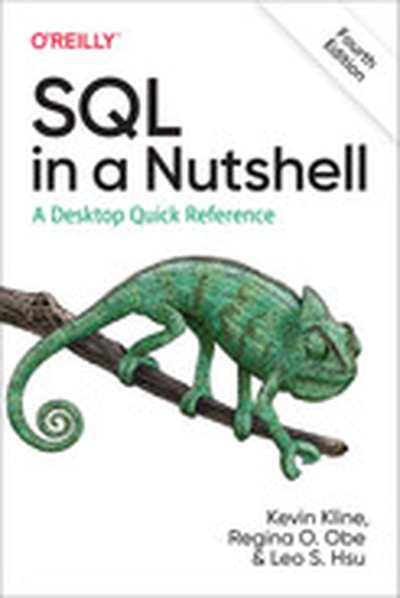
SQL in a Nutshell, 4th Edition

For programmers, analysts, and database administrators, this Nutshell guide is the essential reference for the SQL language used in today's most popular database products. This new fourth edition clearly documents SQL commands according to the latest ANSI/ISO standard and details how those commands are implemented in Microsoft SQL Server 2019 and Oracle 19c, as well as in the MySQL 8, MariaDB 10.5, and PostgreSQL 14 open source database products. You'll also get a concise overview of the relational database management system (RDBMS) model and a clear-cut explanation of foundational RDBMS concepts--all packed into a succinct, comprehensive, and easy-to-use format. Sections include: Background on the relational database model, including current and previous SQL standards Fundamental concepts necessary for understanding relational databases and SQL commands An alphabetical command reference to SQL statements, according to the SQL:2016 ANSI standard The implementation of each command by MySQL, Oracle, PostgreSQL, and SQL Server An alphabetical reference of the ANSI SQL:2016 functions and constructs as well as the vendor implementations Platform-specific functions unique to each implementation