talk-data.com talk-data.com

Topic

Cloud Computing

infrastructure saas iaas

4055

tagged

Activity Trend

471 peak/qtr
2020-Q1 2026-Q1

Activities

4055 activities · Newest first

SnowPro Core Certification Study Guide

The "SnowPro Core Certification Study Guide" provides a comprehensive resource for mastering Snowflake data cloud concepts and passing the SnowPro Core exam. Through detailed explanations and practical exercises, you will gain the knowledge and skills necessary to successfully implement and manage Snowflake's powerful features and integrate data solutions effectively. What this Book will help me do Efficiently load and manage data in Snowflake for modern data processing. Optimize queries and configure Snowflake's performance features for data analytics. Securely implement access control and user roles to ensure data privacy. Apply Snowflake's sharing features to collaborate within and between organizations. Prepare effectively for the SnowPro Core exam with mock tests and review tools. Author(s) Jatin Verma is a renowned expert in Snowflake technologies and a certified SnowPro Core professional. With years of hands-on experience working with data solutions, Jatin excels at breaking down complex concepts into digestible lessons. His approachable writing style and dedication to education make this book a trusted resource for both aspiring and current professionals. Who is it for? This book is perfect for data engineers, analysts, database administrators, and business intelligence professionals who are looking to gain expertise in Snowflake and achieve SnowPro Core certification. It is particularly suited for those with foundational knowledge of databases, data warehouses, and SQL, seeking to advance their skills in Snowflake and become certified professionals. By leveraging this guide, readers can solidify their Snowflake knowledge and confidently approach the SnowPro Core certification exam.
Send us a text Welcome to the cozy corner of the tech world where ones and zeros mingle with casual chit-chat. DataTopics Unpluggedis your go-to spot for relaxed discussions on tech, news, data, and society. This week, we’re unpacking everything from AI-powered vacations (or the lack thereof) to corporate drama, and even a deep dive into the quirks of COBOL. Join Morillo, Bart, and Alex as they navigate the latest happenings in data and tech, including: Airbnb AI: The CEO of Airbnb thinks AI trip planning is still a pipe dream. Is he right?Anthropic’s next AI model: A new Claude model could be just weeks away, promising a hybrid of deep reasoning and speed.OpenAI’s roadmap: Sam Altman lays out vague but ambitious plans, blurring the lines between AI models.Elon vs. OpenAI: Musk offers $97B for OpenAI, Altman claps back. Just another day in AI power struggles.RIP Viktor Antonov: The legendary art lead behind Half-Life 2 and Dishonored passes away at 52.Project Sid AI agents: 1,000 AI agents left to their own devices in Minecraft… What could go wrong?DeepSeek R1 breaks speed records: The latest AI model boasts a staggering 198 tokens per second.Perplexity’s Deep Research is now free: A game-changer for AI-powered search? We discuss.COBOL and the mystery of 1875-05-20: Why do old systems default to weird dates?Polars Cloud: A new distributed architecture to run Polars anywhere.Pickle AI avatars: Deepfake yourself into meetings. Ethical? Useful? Just plain weird?Vim after Bram: How the legendary text editor is surviving after its creator’s passing.Working Fast and Slow: A take on productivity, deep focus, and why some days just don’t work.We were wrong about GPUs: Fly.io admits they misjudged the demand for GPU-powered workloads.

Generative AI with SAP and Amazon Bedrock: Utilizing GenAI with SAP and AWS Business Use Cases

Explore Generative AI and understand its key concepts, architecture, and tangible business use cases. This book will help you develop the skills needed to use SAP AI Core service features available in the SAP Business Technology Platform. You’ll examine large language model (LLM) concepts and gain the practical knowledge to unleash the best use of Gen AI. As you progress, you’ll learn how to get started with your own LLM models and work with Generative AI use cases. Additionally, you’ll see how to take advantage Amazon Bedrock stack using AWS SDK for ABAP. To fully leverage your knowledge, Generative AI with SAP and Amazon Bedrock offers practical step-by-step instructions for how to establish a cloud SAP BTP account model and create your first GenAIartifacts. This work is an important prerequisite for those who want to take full advantage of generative AI with SAP. What You Will Learn Master the concepts and terminology of artificial intelligence and GenAI Understand opportunities and impacts for different industries with GenAI Become familiar with SAP AI Core, Amazon Bedrock, AWS SDK for ABAP and develop your firsts GenAI projects Accelerate your development skills Gain more productivity and time implementing GenAI use cases Who this Book Is For Anyone who wants to learn about Generative AI for Enterprise and SAP practitioners who want to take advantage of AI within the SAP ecosystem to support their systems and workflows.

Machine Learning for Tabular Data

Business runs on tabular data in databases, spreadsheets, and logs. Crunch that data using deep learning, gradient boosting, and other machine learning techniques. Machine Learning for Tabular Data teaches you to train insightful machine learning models on common tabular business data sources such as spreadsheets, databases, and logs. You’ll discover how to use XGBoost and LightGBM on tabular data, optimize deep learning libraries like TensorFlow and PyTorch for tabular data, and use cloud tools like Vertex AI to create an automated MLOps pipeline. Machine Learning for Tabular Data will teach you how to: Pick the right machine learning approach for your data Apply deep learning to tabular data Deploy tabular machine learning locally and in the cloud Pipelines to automatically train and maintain a model Machine Learning for Tabular Data covers classic machine learning techniques like gradient boosting, and more contemporary deep learning approaches. By the time you’re finished, you’ll be equipped with the skills to apply machine learning to the kinds of data you work with every day. About the Technology Machine learning can accelerate everyday business chores like account reconciliation, demand forecasting, and customer service automation—not to mention more exotic challenges like fraud detection, predictive maintenance, and personalized marketing. This book shows you how to unlock the vital information stored in spreadsheets, ledgers, databases and other tabular data sources using gradient boosting, deep learning, and generative AI. About the Book Machine Learning for Tabular Data delivers practical ML techniques to upgrade every stage of the business data analysis pipeline. In it, you’ll explore examples like using XGBoost and Keras to predict short-term rental prices, deploying a local ML model with Python and Flask, and streamlining workflows using large language models (LLMs). Along the way, you’ll learn to make your models both more powerful and more explainable. What's Inside Master XGBoost Apply deep learning to tabular data Deploy models locally and in the cloud Build pipelines to train and maintain models About the Reader For readers experienced with Python and the basics of machine learning. About the Authors Mark Ryan is the AI Lead of the Developer Knowledge Platform at Google. A three-time Kaggle Grandmaster, Luca Massaron is a Google Developer Expert (GDE) in machine learning and AI. He has published 17 other books. Quotes

Deepti Srivastava, Founder of Snow Leopard AI and former Spanner Product Lead at Google Cloud, joined Yuliia to chat what's wrong with current approaches to AI integration. Deepti introduces a paradigm shift away from ETL pipelines towards federated, real-time data access for AI applications. She explains how Snow Leopard's intelligent data retrieval platform enables enterprises to connect AI systems directly to operational data sources without compromising security or freshness. Through practical examples Deepti explains why conventional RAG approaches with vector stores are not good enough for business-critical AI applications, and how a systems thinking approach to AI infrastructure can unlock greater value while reducing unnecessary data movement.Deepti's linkedin - https://www.linkedin.com/in/thedeepti/Snowleopard.ai - http://snowleopard.ai/

Send us a text Welcome back to Making Data Simple, where we explore how data-driven strategies ignite innovation and transform businesses. In this exciting episode, we sit down with Marco Rota, VP of Strategic Technology Alliances at Lumen Technologies, whose incredible journey spans from the glitz of Hollywood to leading-edge telecommunications. Tune in as Marco reveals how embracing a vibrant culture, drawing on lessons from the entertainment industry, and championing new technologies can propel teams and organizations to new heights of success. Get ready for an inspiring, behind-the-scenes look at how “culture eats strategy for breakfast”—and why that’s a game-changer for your organization, too! 01:47 – Meet Marco Rota Marco shares his background and how his career path took him from the dynamic world of Hollywood to a leadership role at Lumen Technologies. He underscores his passion for storytelling, collaboration, and innovation—elements that continue to shape his work in tech.03:35 – Learnings from Hollywood Drawing on Hollywood’s fast-paced environment, Marco highlights the importance of creative thinking and adaptability. He explains how these traits help push organizations to stay ahead of disruption and continually evolve, just like the film industry does to meet audience demands.10:56 – Transitioning to Lumen Technologies Marco describes his shift from entertainment into the telecommunications and technology space. He emphasizes the parallels between Hollywood and tech—both thrive on communication, audience engagement, and cutting-edge production processes.15:55 – What IS Lumen Technologies Marco explains Lumen’s core mission: powering next-generation connectivity, cloud, edge computing, and security solutions. By marrying technology services with an innovative culture, Lumen seeks to help organizations accelerate data-driven transformation.18:29 – Culture versus Technology An organization’s culture can be its greatest asset—or its biggest hurdle. Culture “eats strategy for breakfast” because fostering collaboration, trust, and continuous learning is what truly drives successful technology initiatives forward.24:20 – The Management System Marco talks about the framework for leadership and team alignment at Lumen, which integrates vision, purpose, and measurable goals. This system ensures that cultural values and strategic objectives reinforce each other—resulting in cohesive, energized teams ready to tackle the biggest challenges in tech.Linkedin: linkedin.com/in/marcorotapix Website: https://www.lumen.com/en-us/home.html Want to be featured as a guest on Making Data Simple?  Reach out to us at [email protected] and tell us why you should be next.  The Making Data Simple Podcast is hosted by Al Martin, WW VP Technical Sales, IBM, where we explore trending technologies, business innovation, and leadership ... while keeping it simple & fun. 

MakingDataSimple #CultureEatsStrategy #DataInnovation #DigitalTransformation #TechLeadership #PodcastEpisode #HollywoodToTech #LumenTechnologies #BusinessInsights #Inspiration

Want to be featured as a guest on Making Data Simple? Reach out to us at [email protected] and tell us why you should be next. The Making Data Simple Podcast is hosted by Al Martin, WW VP Technical Sales, IBM, where we explore trending technologies, business innovation, and leadership ... while keeping it simple & fun.

In this podcast episode, we talked with Andrey Cheptsov about ​The future of AI infrastructure.

About the Speaker: Andrey Cheptsov is the founder and CEO of dstack, an open-source alternative to Kubernetes and Slurm, built to simplify the orchestration of AI infrastructure. Before dstack, Andrey worked at JetBrains for over a decade helping different teams make the best developer tools. During the event, the guest, Andrey Cheptsov, founder and CEO of dstack, discussed the complexities of AI infrastructure. We explore topics like the challenges of using Kubernetes for AI workloads, the need to rethink container orchestration, and the future of hybrid and cloud-only infrastructures. Andrey also shares insights into the role of on-premise and bare-metal solutions, edge computing, and federated learning. 00:00 Andrey's Career Journey: From JetBrains to DStack 5:00 The Motivation Behind DStack 7:00 Challenges in Machine Learning Infrastructure 10:00 Transitioning from Cloud to On-Prem Solutions 14:30 Reflections on OpenAI's Evolution 17:30 Open Source vs Proprietary Models: A Balanced Perspective 21:01 Monolithic vs. Decentralized AI businesses 22:05 The role of privacy and control in AI for industries like banking and healthcare 30:00 Challenges in training large AI models: GPUs and distributed systems 37:03 DeepSpeed's efficient training approach vs. brute force methods 39:00 Challenges for small and medium businesses: hosting and fine-tuning models 47:01 Managing Kubernetes challenges for AI teams 52:00 Hybrid vs. cloud-only infrastructure 56:03 On-premise vs. bare-metal solutions 58:05 Exploring edge computing and its challenges

🔗 CONNECT WITH ANDREY CHEPTSOV Twitter -  / andrey_cheptsov   Linkedin -  / andrey-cheptsov   GitHub - https://github.com/dstackai/dstack/ Website - https://dstack.ai/

🔗 CONNECT WITH DataTalksClub Join DataTalks.Club:⁠⁠⁠https://datatalks.club/slack.html⁠⁠⁠ Our events:⁠⁠⁠https://datatalks.club/events.html⁠⁠⁠ Datalike Substack -⁠⁠⁠https://datalike.substack.com/⁠⁠⁠ LinkedIn:⁠⁠⁠  / datatalks-club  ⁠

Fishing vessels are on track to generate 10 million hours of video footage annually, creating a massive machine learning operations challenge. At AI.Fish, we are building an end-to-end system enabling non-technical users to harness AI for catch monitoring and classification both on-board and in the cloud. This talk explores our journey in building these approachable systems and working toward answering an old question: How many fish are in the ocean?

Season 1 Episode 29: Navigating Trade-Offs and Balancing Priorities The Data Product Management In Action podcast, brought to you by executive producer Scott Hirleman, is a platform for data product management practitioners to share insights and experiences. In this episode of Data Product Management in Action, host Alexa Westlake talks with Anita Chen, diving into the complexities of managing data products. Anita, a product manager at PagerDuty, shares her approach to defining data products, prioritizing work, and balancing project work with interrupt-driven tasks. They discuss the critical roles of governance, security, and user enablement while emphasizing the importance of transparency and communication. The conversation also explores the transformative potential of generative AI in data product interactions and the build-vs-buy decision-making process. Gain insights into how data product management uniquely differs from traditional software product management and learn actionable strategies for success. Meet our Host Alexa Westlake: Alexa is a Data Analytics Leader in the Identity and Access Management space with a proven track record scaling high-growth SaaS companies. As a Staff Data Analyst at Okta, she brings a wealth of expertise in enterprise data, business intelligence, and strategic decision-making from the various industries she's worked in including telecommunications, strategy execution, and cloud computing. With a passion for harnessing the power of data for actionable insights, Alexa plays a crucial role in driving Okta's security, growth, and scale, helping the organization leverage data to execute on their market opportunity. Connect with Alexa on LinkedIn.

Meet our guest Anita Chen:  Anita is a Data Product Manager at PagerDuty, a digital operations company helping teams resolve issues faster, eliminate alert fatigue, and build more reliable services! Her background is mainly in the People Analytics space which has now expanded to data at scale with our Enterprise Data Team. She currently helps build data products that enable our teams to deliver the best possible customer experience. Anita is most passionate about how data can impact someone's lived experience and endeavor to democratize data in everything she builds. Connect with Anita on LinkedIn. All views and opinions expressed are those of the individuals and do not necessarily reflect their employers or anyone else.  Join the conversation on LinkedIn.  Apply to be a guest or nominate someone that you know.  Do you love what you're listening to? Please rate and review the podcast, and share it with fellow practitioners you know. Your support helps us reach more listeners and continue providing valuable insights! 

The Data Product Management In Action podcast, brought to you by  executive producer Scott Hirleman, is a platform for data product management practitioners to share insights and experiences. In Season 01, Episode 28, we are excited to introduce to you a new host, Alexa Westgate! Join us as we learn all about her data journey. She'll discuss how she got into DPM, some of her greatest moments and challenges. You'll be excited for her future episodes! About our host Alexa Westlake: Alexa is a Data Analytics Leader in the Identity and Access Management space with a proven track record scaling high-growth SaaS companies. As a Staff Data Analyst at Okta, she brings a wealth of expertise in enterprise data, business intelligence, and strategic decision-making from the various industries she's worked in including telecommunications, strategy execution, and cloud computing. With a passion for harnessing the power of data for actionable insights, Alexa plays a crucial role in driving Okta's security, growth, and scale, helping the organization leverage data to execute on their market opportunity. Connect with Alexa on LinkedIn. All views and opinions expressed are those of the individuals and do not necessarily reflect their employers or anyone else.  Join the conversation on LinkedIn.  Apply to be a guest or nominate someone that you know.  Do you love what you're listening to? Please rate and review the podcast, and share it with fellow practitioners you know. Your support helps us reach more listeners and continue providing valuable insights! 

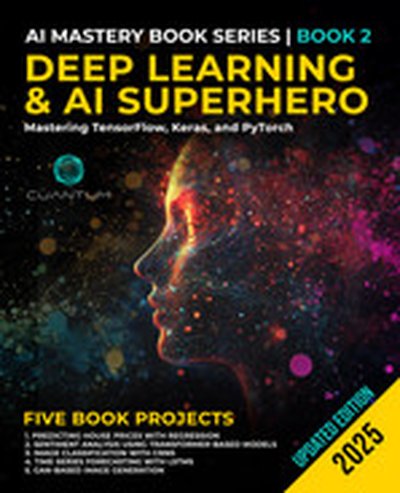
Deep Learning and AI Superhero

"Deep Learning and AI Superhero" is an extensive resource for mastering the core concepts and advanced techniques in AI and deep learning using TensorFlow, Keras, and PyTorch. This comprehensive guide walks you through topics from foundational neural network concepts to implementing real-world machine learning solutions. You will gain hands-on experience and theoretical knowledge to elevate your AI development skills. What this Book will help me do Develop a solid foundation in neural networks, their structure, and their training methodologies. Understand and implement deep learning models using TensorFlow and Keras effectively. Gain experience using PyTorch for creating, training, and optimizing advanced machine learning models. Learn advanced applications such as CNNs for computer vision, RNNs for sequential data, and Transformers for natural language processing. Deploy AI models on cloud and edge platforms through practical examples and optimized workflows. Author(s) Cuantum Technologies LLC has established itself as a pioneer in creating educational resources for advanced AI technologies. Their team consists of experts and practitioners in the field, combining years of industry and academic experience. Their books are crafted to ensure readers can practically apply cutting-edge AI techniques with clarity and confidence. Who is it for? This book is ideally suited for software developers, AI enthusiasts, and data scientists who have a basic understanding of programming and machine learning concepts. It's perfect for those seeking to enhance their skills and tackle real-world AI challenges. Whether your goals are professional development, research, or personal learning, you'll find practical and detailed guidance throughout this book.

Welcome to Data Unchained! In this episode, recorded live at the Supercomputing 24 Conference in Atlanta, Georgia, Molly Presley sits down with Mark Seamans from Penguin Solutions to explore the exciting intersection of high-performance computing (HPC) and AI innovations. Episode Highlights: - The explosive growth of AI and large language models in HPC. - How Penguin Solutions helps enterprises overcome GPU and AI complexity. - The role of OriginAI in simplifying AI project deployment. - Challenges of decentralized and unstructured data in AI workflows. - Emerging trends in hybrid cloud solutions and GPU-specific clouds. - The power of ClusterWare for optimizing high-performance clusters. Mark Seamans shares insights on how enterprises can effectively implement AI strategies, manage data complexity, and maximize their IT investments with innovative solutions like ClusterWare and OriginAI. Whether you're navigating AI for the first time or optimizing your HPC systems, this episode is packed with actionable takeaways!

AI #HighPerformanceComputing #DataScience #Supercomputing #PenguinSolutions #Hammerspace #CloudComputing #DataManagement #GPUComputing #AIProjects #TechInnovation #HybridCloud #ClusterWare #OriginAI #Supercomputing24 #Podcast

Cyberpunk by jiglr | https://soundcloud.com/jiglrmusic Music promoted by https://www.free-stock-music.com Creative Commons Attribution 3.0 Unported License https://creativecommons.org/licenses/by/3.0/deed.en_US Hosted on Acast. See acast.com/privacy for more information.

Dan Crosby, CEO and Founder of Legend Energy Advisors, joins Kirk once again to discuss the challenges at the intersection of energy demands and the data center industry, the rise of cloud computing and AI, and the importance of national security in energy independence.

For more about us: https://linktr.ee/overwatchmissioncritical

AWS re:Invent 2024 - Customer Keynote Autodesk

Design software pioneer Autodesk is transforming computer-aided design (CAD) by harnessing generative AI and Amazon Web Services (AWS). The company is developing advanced AI foundation models, like "Project Bernini," which can generate precise 2D and 3D geometric designs based on physical principles.

By utilizing AWS technologies such as Amazon DynamoDB, Elastic MapReduce (EMR), Amazon SageMaker, and Elastic Fabric Adapter, Autodesk has significantly enhanced its AI development process. These innovations have halved foundation model development time and increased AI productivity by 30%.

Learn more about AWS events: https://go.aws/events

Subscribe: More AWS videos: http://bit.ly/2O3zS75 More AWS events videos: http://bit.ly/316g9t4

ABOUT AWS Amazon Web Services (AWS) hosts events, both online and in-person, bringing the cloud computing community together to connect, collaborate, and learn from AWS experts. AWS is the world’s most comprehensive and broadly adopted cloud platform, offering over 200 fully featured services from data centers globally. Millions of customers—including the fastest-growing startups, largest enterprises, and leading government agencies—are using AWS to lower costs, become more agile, and innovate faster.

reInvent2024 #AWSreInvent2024 #AWSEvents

AI features and products are the hottest area of software development. Creating high quality AI software is both essential and challenging for many businesses. In this episode, we look at retrieval augmented generation, an important technique for improving text generation quality in AI applications. Beyond technical measures, we look at the broader quality problem for AI applications. How do you ensure your AI applications are effective and secure? What steps should you take to integrate AI into your existing data governance frameworks? And how do you measure the success of these AI-driven solutions? Theresa Parker is the Director of Product Management at Rocket Software. She has 25 years of experience as a technology executive with a focus on software development processes, consultancy, and business development. Her recent work in content management focuses on the use of AI and RAG to improve content discoverability. Sudhi Balan is the Chief Technology Officer for AI & Cloud. He leads the AI and data teams for data modernization, driving AI adoption of Rocket's structured and unstructured data products. He also shapes AI strategy for Rocket’s infrastructure and app portfolio. He has earned patents for safe and scalable applications of transformational technology. Previously, he led digital transformation and hybrid cloud strategy for Rocket’s unstructured data business and was Senior Director of Product Development at ASG. In the episode, Richie, Theresa, and Sudhi explore retrieval-augmented generation, its applications in customer support and loan processing, the importance of data governance and privacy, the role of testing and guardrails in AI, cost management strategies, and the potential of AI to transform customer experiences, and much more. Links Mentioned in the Show: Rocket SoftwareConnect with Theresa and SudhiCourse: Retrieval Augmented Generation (RAG) with LangChainRelated Episode: Getting Generative AI Into Production with Lin Qiao, CEO and Co-Founder of Fireworks AIRewatch sessions from RADAR: Forward Edition New to DataCamp? Learn on the go using the DataCamp mobile appEmpower your business with world-class data and AI skills with DataCamp for business