talk-data.com talk-data.com

Topic

data-science

2091

tagged

Activity Trend

1 peak/qtr
2020-Q1 2026-Q1

Activities

Showing filtered results

Filtering by: O'Reilly Data Science Books ×
Analyzing Websites

From a cluster of interconnected HTML pages to online service platforms, websites are constantly changing in form and function. These transformations have led, on the one hand, to human and social sciences renewing or inventing analytical methodologies; and on the other hand, to a reconsideration of the practices of non-specialists and digital professionals. The Web factory is equally included on the agenda of communication training, according to an alternative approach that is complementary to the one that has been implemented for computer scientists. From these two perspectives and drawing upon several case studies, Analyzing Websites presents epistemological and methodological contributions from researchers in Information and Communication Sciences exploring websites as sociotechnical, semi-discursive and communicational devices. This study covers website design as well as their integration into the digital strategies of organizations in the public, associative and private sectors.

Principles of Data Science - Third Edition

Principles of Data Science offers an end-to-end introduction to data science fundamentals, blending key mathematical concepts with practical programming. You'll learn how to clean and prepare data, construct predictive models, and leverage modern tools like pre-trained models for NLP and computer vision. By integrating theory and practice, this book sets the foundation for impactful data-driven decision-making. What this Book will help me do Develop a solid understanding of foundational statistics and machine learning. Learn how to clean, transform, and visualize data for impactful analysis. Explore transfer learning and pre-trained models for advanced AI tasks. Understand ethical implications, biases, and governance in AI and ML. Gain the knowledge to implement complete data pipelines effectively. Author(s) Sinan Ozdemir is an experienced data scientist, educator, and author with a deep passion for making complex topics accessible. With a background in computer science and applied statistics, Sinan has taught data science at leading institutions and authored multiple books on the topic. His practical approach to teaching combines real-world examples with insightful explanations, ensuring learners gain both competence and confidence. Who is it for? This book is ideal for beginners in data science who want to gain a comprehensive understanding of the field. If you have a background in programming or mathematics and are eager to combine these skills to analyze and extract insights from data, this book will guide you. Individuals working with machine learning or AI who need to solidify their foundational knowledge will find it invaluable. Some familiarity with Python is recommended to follow along seamlessly.

MATLAB for Machine Learning - Second Edition

"MATLAB for Machine Learning" is your comprehensive guide to leveraging MATLAB's powerful tools and toolbox for machine learning and deep learning tasks. Through this book, you will explore practical applications and processes that streamline the development of machine learning models while tackling real-world problems effectively. What this Book will help me do Gain proficiency in utilizing MATLAB's Machine Learning Toolbox for developing machine learning algorithms. Learn how to handle data preprocessing, from data cleansing to visualization, within MATLAB. Explore and implement foundational to advanced machine learning techniques, such as classification and regression models. Comprehend and apply the principles of neural networks for pattern recognition and cluster analysis. Dive into advanced concepts of deep learning, including convolutional networks, natural language processing, and time series analysis, using MATLAB's inbuilt functionality. Author(s) Giuseppe Ciaburro is an expert in the field of machine learning and MATLAB programming. With a robust academic background in data science and years of experience in applying these principles across domains, Giuseppe provides a clear and approachable pathway for learners in his writing. Who is it for? This book is ideal for machine learning professionals, data scientists, and engineers specializing in fields such as deep learning, computer vision, and natural language processing. It is suitable for those with a fundamental understanding of programming concepts who seek to apply MATLAB in solving complex learning problems. A prior familiarity with MATLAB basics will be advantageous.

Statistics Slam Dunk

Learn statistics by analyzing professional basketball data! In this action-packed book, you’ll build your skills in exploratory data analysis by digging into the fascinating world of NBA games and player stats using the R language. Statistics Slam Dunk is an engaging how-to guide for statistical analysis with R. Each chapter contains an end-to-end data science or statistics project delving into NBA data and revealing real-world sporting insights. Written by a former basketball player turned business intelligence and analytics leader, you’ll get practical experience tidying, wrangling, exploring, testing, modeling, and otherwise analyzing data with the best and latest R packages and functions. In Statistics Slam Dunk you’ll develop a toolbox of R programming skills including: Reading and writing data Installing and loading packages Transforming, tidying, and wrangling data Applying best-in-class exploratory data analysis techniques Creating compelling visualizations Developing supervised and unsupervised machine learning algorithms Executing hypothesis tests, including t-tests and chi-square tests for independence Computing expected values, Gini coefficients, z-scores, and other measures If you’re looking to switch to R from another language, or trade base R for tidyverse functions, this book is the perfect training coach. Much more than a beginner’s guide, it teaches statistics and data science methods that have tons of use cases. And just like in the real world, you’ll get no clean pre-packaged data sets in Statistics Slam Dunk. You’ll take on the challenge of wrangling messy data to drill on the skills that will make you the star player on any data team. About the Technology Statistics Slam Dunk is a data science manual with a difference. Each chapter is a complete, self-contained statistics or data science project for you to work through—from importing data, to wrangling it, testing it, visualizing it, and modeling it. Throughout the book, you’ll work exclusively with NBA data sets and the R language, applying best-in-class statistics techniques to reveal fun and fascinating truths about the NBA. About the Book Is losing basketball games on purpose a rational strategy? Which hustle statistics have an impact on wins and losses? Does spending more on player salaries translate into a winning record? You’ll answer all these questions and more. Plus, R’s visualization capabilities shine through in the book’s 300 plots and charts, including Pareto charts, Sankey diagrams, Cleveland dot plots, and dendrograms. What's Inside Transforming, tidying, and wrangling data Applying best-in-class exploratory data analysis techniques Developing supervised and unsupervised machine learning algorithms Executing hypothesis tests and effect size tests About the Reader For readers who know basic statistics. No advanced knowledge of R—or basketball—required. About the Author Gary Sutton is a former basketball player who has built and led high-performing business intelligence and analytics organizations across multiple verticals. Quotes In this journey of exploration, every computer scientist will find a valuable ally in understanding the language of data. - Kim Lokøy, areo Transcends other R titles by revealing the hidden narratives that lie within the numbers. - Christian Sutton, Shell International Exploration and Production Seamlessly blending theory and practical insights, this book serves as an indispensable guide for those venturing into the field of data analytics. - Juan Delgado, Sodexo BRS

Extending Dynamics 365 Finance and Operations Apps with Power Platform

This book, "Extending Dynamics 365 Finance and Operations Apps with Power Platform", is your comprehensive guide to mastering the integration of Power Platform tools with Dynamics 365 Finance and Operations (F&O). Dive into practical scenarios and learn how to leverage tools like Power Automate, Power Apps, and Power BI to maximize efficiency and streamline operations. What this Book will help me do Learn to extend Dynamics 365 F&O functionalities using Dataverse and other Power Platform tools. Understand practical integration techniques including dual-write and virtual tables. Explore automation of workflows and tasks with Power Automate in an F&O context. Utilize Power BI for creating insightful reports with Azure Data Lake Storage. Gain insights into governance and lifecycle management for the Power Platform in your F&O projects. Author(s) Adrià Ariste Santacreu, a seasoned expert in Power Platform and Microsoft Dynamics, shares his rich industry experience through this book. He has implemented numerous real-world solutions integrating Power Platform with Dynamics 365, and his expertise is evident in the clear and actionable guidance provided herein. Adrià's approach helps both novices and experts discover the true potential of these technologies. Who is it for? This book is ideal for Dynamics 365 Finance & Operations consultants and Power Platform professionals seeking to extend their knowledge and capabilities. It is particularly suitable for technical and solutions architects who aim to implement innovative solutions for business requirements using the Power Platform. If you aim to leverage low-code/no-code tools for dynamics projects, this book has you covered.

Business Statistics For Dummies, 2nd Edition

Make some headway in the notoriously tough subject of business statistics Business Statistics For Dummies helps you understand the core concepts and principles of business statistics, and how they relate to the business world. This book tracks to a typical introductory course offered at the undergraduate, so you know you’ll find all the content you need to pass your class and get your degree. You’ll get an introduction to statistical problems and processes common to the world of global business and economics. Written in clear and simple language, Business Statistics For Dummies gives you an introduction to probability, sampling techniques and distributions, and drawing conclusions from data. You’ll also discover how to use charts and graphs to visualize the most important properties of a data set. Grasp the core concepts, principles, and methods of business statistics Learn tricky concepts with simplified explanations and illustrative graphs See how statistics applies in the real world, thanks to concrete examples Read charts and graphs for a better understanding of how businesses operate Business Statistics For Dummies is a lifesaver for students studying business at the college level. This guide is also useful for business professionals looking for a desk reference on this complicated topic.

How to Become a Data Analyst

Start a brand-new career in data analytics with no-nonsense advice from a self-taught data analytics consultant In How to Become a Data Analyst: My Low-Cost, No Code Roadmap for Breaking into Tech, data analyst and analytics consultant Annie Nelson walks you through how she took the reins and made a dramatic career change to unlock new levels of career fulfilment and enjoyment. In the book, she talks about the adaptability, curiosity, and persistence you’ll need to break free from the 9-5 grind and how data analytics—with its wide variety of skills, roles, and options—is the perfect field for people looking to refresh their careers. Annie offers practical and approachable data portfolio-building advice to help you create one that’s manageable for an entry-level professional but will still catch the eye of employers and clients. You’ll also find: Deep dives into the learning journey required to step into a data analytics role Ways to avoid getting lost in the maze of online courses and certifications you can find online—while still obtaining the skills you need to be competitive Explorations of the highs and lows of Annie’s career-change journey and job search—including what was hard, what was easy, what worked well, and what didn’t Strategies for using ChatGPT to help you in your job search A must-read roadmap to a brand-new and exciting career in data analytics, How to Become a Data Analyst is the hands-on tutorial that shows you exactly how to succeed.

Data Science for Web3

Discover how to navigate the world of Web3 data with 'Data Science for Web3,' an expertly crafted guide by Gabriela Castillo Areco. Through practical examples, industry insights, and real-world use cases, you will learn the skills needed to analyze blockchain data and extract actionable business insights. What this Book will help me do Understand blockchain transactions and data structures to build robust datasets. Leverage on-chain and off-chain data for valuable Web3 business insights. Create DeFi- and NFT-specific datasets for targeted analysis. Develop machine learning models tailored for blockchain use cases. Apply data science techniques to innovate in the Web3 ecosystem. Author(s) Gabriela Castillo Areco is a seasoned data scientist and an expert in blockchain analytics. With years of experience in the technology and finance sectors, Gabriela brings a practical perspective to understanding intricate data within the emerging Web3 paradigm. Her engaging approach makes technical concepts accessible and actionable. Who is it for? This book is ideal for data professionals such as analysts, scientists, or engineers, aiming to harness the potential of blockchain analytics. It's also suitable for business professionals exploring data-driven opportunities within Web3. Whether you're a beginner or an experienced learner with some Python background, this book will meet you at your level.

Modern Software Testing Techniques: A Practical Guide for Developers and Testers

Many books have been written about software testing, but most of them discuss the general framework of testing from a traditional perspective. Unfortunately, traditional test design techniques are often ineffective and unreliable for revealing the various kinds of faults that may occur. This book introduces three new software testing techniques: Two-Phase Model-Based Testing, the Action-State Testing, and the General Predicate Testing, all of which work best when applied with efficient fault revealing capabilities. You’ll start with a short recap of software testing, focusing on why risk analysis is obligatory, how to classify bugs practically, and how fault-based testing can be used for improving test design. You’ll then see how action-state testing merges the benefits of state transition testing and use case testing into a unified approach. Moving on you’ll look at general predicate testing and how it serves as an extension of boundary value analysis, encompassing morecomplex predicates. Two-phase model-based testing represents an advanced approach where the model does not necessarily need to be machine-readable; human readability suffices. The first phase involves a high-level model from which abstract tests are generated. Upon manual execution of these tests, the test code is generated. Rather than calculating output values, they are merely checked for conformity. The last part of this book contains a chapter on how developers and testers can help each other and work as a collaborative team. What You'll Learn Apply efficient test design techniques for detecting domain faults Work with modeling techniques that combine all the advantages of state transition testing and uses case testing Grasp the two-phase model-based testing technique Use test design efficiently to find almost all the bugs in an application Who This Book Is For Software developers, QA engineers, and, business analysts

Learn Grafana 10.x - Second Edition

Learn Grafana 10.x is your essential guide to mastering the art of data visualization and monitoring through interactive dashboards. Whether you're starting from scratch or updating your knowledge to Grafana 10.x, this book walks you through installation, implementation, data transformation, and effective visualization techniques. What this Book will help me do Install and configure Grafana 10.x for real-time data visualization and analytics. Create and manage insightful dashboards with Grafana's enhanced features. Integrate Grafana with diverse data sources such as Prometheus, InfluxDB, and Elasticsearch. Set up dynamic templated dashboards and alerting systems for proactive monitoring. Implement Grafana's user authentication mechanisms for enhanced security. Author(s) None Salituro is a seasoned expert in data analytics and observability platforms with extensive experience working with time-series data using Grafana. Their practical teaching approach and passion for sharing insights make this book an invaluable resource for both newcomers and experienced users. Who is it for? This book is perfect for business analysts, data visualization enthusiasts, and developers interested in analyzing and monitoring time-series data. Whether you're a newcomer or have some background knowledge, this book offers accessible guidance and advanced tips suitable for all levels. If you're aiming to efficiently build and utilize Grafana dashboards, this is the book for you.

Bayesian Optimization in Action

Bayesian optimization helps pinpoint the best configuration for your machine learning models with speed and accuracy. Put its advanced techniques into practice with this hands-on guide. In Bayesian Optimization in Action you will learn how to: Train Gaussian processes on both sparse and large data sets Combine Gaussian processes with deep neural networks to make them flexible and expressive Find the most successful strategies for hyperparameter tuning Navigate a search space and identify high-performing regions Apply Bayesian optimization to cost-constrained, multi-objective, and preference optimization Implement Bayesian optimization with PyTorch, GPyTorch, and BoTorch Bayesian Optimization in Action shows you how to optimize hyperparameter tuning, A/B testing, and other aspects of the machine learning process by applying cutting-edge Bayesian techniques. Using clear language, illustrations, and concrete examples, this book proves that Bayesian optimization doesn’t have to be difficult! You’ll get in-depth insights into how Bayesian optimization works and learn how to implement it with cutting-edge Python libraries. The book’s easy-to-reuse code samples let you hit the ground running by plugging them straight into your own projects. About the Technology In machine learning, optimization is about achieving the best predictions—shortest delivery routes, perfect price points, most accurate recommendations—in the fewest number of steps. Bayesian optimization uses the mathematics of probability to fine-tune ML functions, algorithms, and hyperparameters efficiently when traditional methods are too slow or expensive. About the Book Bayesian Optimization in Action teaches you how to create efficient machine learning processes using a Bayesian approach. In it, you’ll explore practical techniques for training large datasets, hyperparameter tuning, and navigating complex search spaces. This interesting book includes engaging illustrations and fun examples like perfecting coffee sweetness, predicting weather, and even debunking psychic claims. You’ll learn how to navigate multi-objective scenarios, account for decision costs, and tackle pairwise comparisons. What's Inside Gaussian processes for sparse and large datasets Strategies for hyperparameter tuning Identify high-performing regions Examples in PyTorch, GPyTorch, and BoTorch About the Reader For machine learning practitioners who are confident in math and statistics. About the Author Quan Nguyen is a research assistant at Washington University in St. Louis. He writes for the Python Software Foundation and has authored several books on Python programming. Quotes Using a hands-on approach, clear diagrams, and real-world examples, Quan lifts the veil off the complexities of Bayesian optimization. - From the Foreword by Luis Serrano, Author of Grokking Machine Learning This book teaches Bayesian optimization, starting from its most basic components. You’ll find enough depth to make you comfortable with the tools and methods and enough code to do real work very quickly. - From the Foreword by David Sweet, Author of Experimentation for Engineers Combines modern computational frameworks with visualizations and infographics you won’t find anywhere else. It gives readers the confidence to apply Bayesian optimization to real world problems! - Ravin Kumar, Google

Distributed Machine Learning with PySpark: Migrating Effortlessly from Pandas and Scikit-Learn

Migrate from pandas and scikit-learn to PySpark to handle vast amounts of data and achieve faster data processing time. This book will show you how to make this transition by adapting your skills and leveraging the similarities in syntax, functionality, and interoperability between these tools. Distributed Machine Learning with PySpark offers a roadmap to data scientists considering transitioning from small data libraries (pandas/scikit-learn) to big data processing and machine learning with PySpark. You will learn to translate Python code from pandas/scikit-learn to PySpark to preprocess large volumes of data and build, train, test, and evaluate popular machine learning algorithms such as linear and logistic regression, decision trees, random forests, support vector machines, Naïve Bayes, and neural networks. After completing this book, you will understand the foundational concepts of data preparation and machine learning and will have the skills necessary toapply these methods using PySpark, the industry standard for building scalable ML data pipelines. What You Will Learn Master the fundamentals of supervised learning, unsupervised learning, NLP, and recommender systems Understand the differences between PySpark, scikit-learn, and pandas Perform linear regression, logistic regression, and decision tree regression with pandas, scikit-learn, and PySpark Distinguish between the pipelines of PySpark and scikit-learn Who This Book Is For Data scientists, data engineers, and machine learning practitioners who have some familiarity with Python, but who are new to distributed machine learning and the PySpark framework.

Alteryx Designer: The Definitive Guide

Analytics projects are frequently long, drawn-out affairs, requiring multiple teams and skills to clean, join, and eventually turn data into analysis for timely decision-making. Alteryx Designer changes all of that. With this low-code, self-service, drag-and-drop workflow platform, new and experienced data and business analysts can deliver results in hours instead of weeks. This practical book shows you how to master all areas of Alteryx Designer quickly. Author and Alteryx ACE Joshua Burkhow starts with the basics of building a workflow, then introduces more than 200 tools for working with intermediate and advanced analytics functionality. With Alteryx Designer's all-in-one toolkit, you'll migrate from legacy analytics software or Excel with ease. Ready to work with data quickly and efficiently? This guide gets you started. Learn the fundamentals of cleaning, prepping, and analyzing data with Alteryx Designer Install, navigate, and quickly become competent with the Alteryx Designer layout and functionality Construct accurate, performant, reliable, and well-documented workflows that automate business processes Learn intermediate techniques using spatial analytics, reporting, and in-database tools Dive into advanced Alteryx capabilities, including predictive and machine learning tools Get introduced to the entire Alteryx Analytic Process Automation (APA) Platform

Near Extensions and Alignment of Data in R(superscript)n

Near Extensions and Alignment of Data in Rn Comprehensive resource illustrating the mathematical richness of Whitney Extension Problems, enabling readers to develop new insights, tools, and mathematical techniques Near Extensions and Alignment of Data in Rn demonstrates a range of hitherto unknown connections between current research problems in engineering, mathematics, and data science, exploring the mathematical richness of near Whitney Extension Problems, and presenting a new nexus of applied, pure and computational harmonic analysis, approximation theory, data science, and real algebraic geometry. For example, the book uncovers connections between near Whitney Extension Problems and the problem of alignment of data in Euclidean space, an area of considerable interest in computer vision. Written by a highly qualified author, Near Extensions and Alignment of Data in Rn includes information on: Areas of mathematics and statistics, such as harmonic analysis, functional analysis, and approximation theory, that have driven significant advances in the field Development of algorithms to enable the processing and analysis of huge amounts of data and data sets Why and how the mathematical underpinning of many current data science tools needs to be better developed to be useful New insights, potential tools, and mathematical techniques to solve problems in Whitney extensions, signal processing, shortest paths, clustering, computer vision, optimal transport, manifold learning, minimal energy, and equidistribution Providing comprehensive coverage of several subjects, Near Extensions and Alignment of Data in Rn is an essential resource for mathematicians, applied mathematicians, and engineers working on problems related to data science, signal processing, computer vision, manifold learning, and optimal transport.

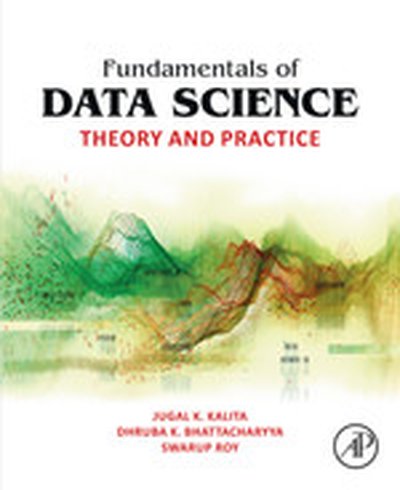
Fundamentals of Data Science

Fundamentals of Data Science: Theory and Practice presents basic and advanced concepts in data science along with real-life applications. The book provides students, researchers and professionals at different levels a good understanding of the concepts of data science, machine learning, data mining and analytics. Users will find the authors’ research experiences and achievements in data science applications, along with in-depth discussions on topics that are essential for data science projects, including pre-processing, that is carried out before applying predictive and descriptive data analysis tasks and proximity measures for numeric, categorical and mixed-type data. The book's authors include a systematic presentation of many predictive and descriptive learning algorithms, including recent developments that have successfully handled large datasets with high accuracy. In addition, a number of descriptive learning tasks are included. Presents the foundational concepts of data science along with advanced concepts and real-life applications for applied learning Includes coverage of a number of key topics such as data quality and pre-processing, proximity and validation, predictive data science, descriptive data science, ensemble learning, association rule mining, Big Data analytics, as well as incremental and distributed learning Provides updates on key applications of data science techniques in areas such as Computational Biology, Network Intrusion Detection, Natural Language Processing, Software Clone Detection, Financial Data Analysis, and Scientific Time Series Data Analysis Covers computer program code for implementing descriptive and predictive algorithms

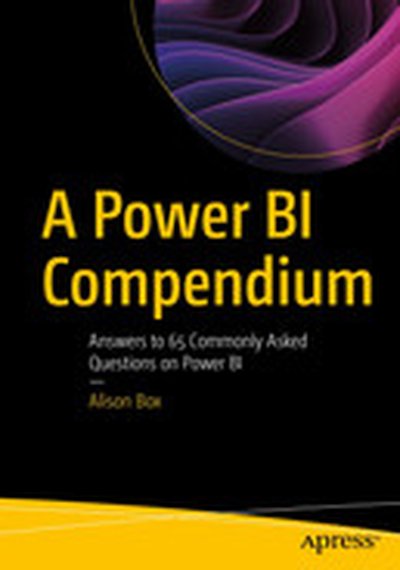
A Power BI Compendium: Answers to 65 Commonly Asked Questions on Power BI

Are you a reasonably competent Power BI user but still struggling to generate reports that truly tell the story of your data? Or do you simply want to extend your knowledge of Power BI by exploring more complex areas of visualizations, data modelling, DAX, and Power Query? If so, this book is for you. This book serves as a comprehensive resource for users to implement more challenging visuals, build better data models, use DAX with more confidence, and execute more complex queries so they can find and share important insights into their data. The contents of the chapters are in a question-and-answer format that explore everyday data analysis scenarios in Power BI. These questions have been generated from the author’s own client base and from commonly sought-for information from the Power BI community. They cover a wide and diverse range of topics that many Power BI users often struggle to get to grips with or don’t fully understand. Examples of suchquestions are: How can I generate dynamic titles for visuals? How can I control subtotals in a Matrix visual? Why do I need a date dimension? How can I show the previous N month’s sales in a column chart?Why do I need a Star Schema? Why aren't my totals correct? How can I bin measures into numeric ranges? Can I import a Word document? Can I dynamically append data from different source files? Solutions to these questions and many more are presented in non-technical and easy-to-follow explanations negating the requirement to perform tiresome and fruitless “google” searches. There are also companion Power BI Desktop files that set out the answers to each question so you can follow along with the examples given in the book.. After working through this book, you will have extended your knowledge of Power BI to an expert level, alleviating your existing frustrations and so enabling you to design Power BI reports where you are no longer limited by your lack of knowledge or experience. Who is This Book For: Power BI users who can build reports and now want to extend their knowledge of Power BI.