talk-data.com talk-data.com

Topic

DWH

Data Warehouse

analytics business_intelligence data_storage

568

tagged

Activity Trend

35 peak/qtr
2020-Q1 2026-Q1

Activities

568 activities · Newest first

Pro Power BI Architecture: Development, Deployment, Sharing, and Security for Microsoft Power BI Solutions

This book provides detailed guidance around architecting and deploying Power BI reporting solutions, including help and best practices for sharing and security. You’ll find chapters on dataflows, shared datasets, composite model and DirectQuery connections to Power BI datasets, deployment pipelines, XMLA endpoints, and many other important features related to the overall Power BI architecture that are new since the first edition. You will gain an understanding of what functionality each of the Power BI components provide (such as Dataflow, Shared Dataset, Datamart, thin reports, and paginated reports), so that you can make an informed decision about what components to use in your solution. You will get to know the pros and cons of each component, and how they all work together within the larger Power BI architecture. Commonly encountered problems you will learn to handle include content unexpectedly changing while users are in the process of creating reports and building analyses, methods of sharing analyses that don’t cover all the requirements of your business or organization, and inconsistent security models. Detailed examples help you to understand and choose from among the different methods available for sharing and securing Power BI content so that only intended recipients can see it. The knowledge provided in this book will allow you to choose an architecture and deployment model that suits the needs of your organization. It will also help ensure that you do not spend your time maintaining your solution, but on using it for its intended purpose: gaining business value from mining and analyzing your organization’s data. What You Will Learn Architect Power BI solutions that are reliable and easy to maintain Create development templates and structures in support of reusability Set up and configure the Power BI gateway as a bridge between on-premises data sourcesand the Power BI cloud service Select a suitable connection type—Live Connection, DirectQuery, Scheduled Refresh, or Composite Model—for your use case Choose the right sharing method for how you are using Power BI in your organization Create and manage environments for development, testing, and production Secure your data using row-level and object-level security Save money by choosing the right licensing plan Who This Book Is For Data analysts and developers who are building reporting solutions around Power BI, as well as architects and managers who are responsible for the big picture of how Power BI meshes with an organization’s other systems, including database and data warehouse systems.

Inside the Financial Times, we’ve been gradually moving our batching data processing from a custom solution to Airflow. To enable various teams within the company to use Airflow more effectively, we’ve been working on extending the system’s self-service capabilities. This includes giving ownership to teams of their DAGs and separating resources such as connections. The batch data ingestion processes are the main ETL - like jobs that we run on Airflow. The creation of a new job used to be a manual and repetitive task of receiving the data specification, creating the requisite tables in our data warehouse and writing the DAG that would move the data there. Airflow allowed us to automate this process to a degree that surprised us, completely removing the need to write DAG code. We will use the talk to describe what the current process of creating a new ETL workflow looks like and our plans for further improvements.

Workload Orchestration is at the heart of a successful Data lakehouse implementation. Especially for the “house” part which represents the Datawarehouse workloads which often are complex because of the very nature of warehouse data, which have dependency orchestration problems. We at Asurion have spent years in perfecting the Airflow solution to make it a super power for our Data Engineers. We have innovated in key areas like single operator for all use cases, auto DAG code generation, custom UI components for Data Engineers, monitoring tools etc. With over a few million job runs per year running on a platform with over 3 nines of availability, we have condensed years of our learnings into valuable ideas that can inspire and help all other Data enthusiasts. This session is going to walk the audience through some blind spots and pain points of Airflow architecture, scaling, engineering culture.

As a bank Monzo has seen exponential growth in active users, from 1.6 million in 2019 to 5.8 million in 2022. At the same time the number of data users and analysts has expanded from an initial team of 4 to 132. Alongside this growth, our infrastructure and tooling have had to evolve to deliver the same value at a new scale. From an Airflow installation deployed on a single monolithic instance we now deploy atop Kubernetes and have integrated our Airflow setup into the bank’s backend systems. This talk charts the story of that expansion and the growing pains we’ve faced, as well as looking to the future of our use of Airflow. We’ll first discuss how data at Monzo works, from event capture to arrival in our Data Warehouse, before assessing the challenges of our Airflow setup. We’ll then dive into the re-platforming that was required to meet our growing data needs, and some of the unique challenges that come with serving an ever growing user base and need for analysis and insight.

ETL data pipelines are the bread and butter of data teams that must design, develop, and author DAGs to accommodate the various business requirements. dbt is becoming one of the most used tools to perform SQL transformations on the Data Warehouse, allowing teams to harness the power of queries at scale. Airflow users are constantly finding new ways to integrate dbt with the Airflow ecosystem and build a single pane of glass where Data Engineers can manage and administer their pipelines. Astronomer Cosmos, an open-source product, has been introduced to integrate Airflow with dbt Core seamlessly. Now you can easily see your dbt pipelines fully integrated on Airflow. You will learn the following: How to integrate dbt Core with Airflow How to use Cosmos How to build data pipelines at scale

Volunteers in Saint Louis are using Airflow to build an open source data warehouse of real estate data (permits, assessments, violations, etc), with an eye towards creating a national open data standard. This talk will focus on the unique challenges of running an open source data warehouse, and what it looks like to work with volunteers to create data pipelines.

Summary

Architectural decisions are all based on certain constraints and a desire to optimize for different outcomes. In data systems one of the core architectural exercises is data modeling, which can have significant impacts on what is and is not possible for downstream use cases. By incorporating column-level lineage in the data modeling process it encourages a more robust and well-informed design. In this episode Satish Jayanthi explores the benefits of incorporating column-aware tooling in the data modeling process.

Announcements

Hello and welcome to the Data Engineering Podcast, the show about modern data management RudderStack helps you build a customer data platform on your warehouse or data lake. Instead of trapping data in a black box, they enable you to easily collect customer data from the entire stack and build an identity graph on your warehouse, giving you full visibility and control. Their SDKs make event streaming from any app or website easy, and their extensive library of integrations enable you to automatically send data to hundreds of downstream tools. Sign up free at dataengineeringpodcast.com/rudderstack- Your host is Tobias Macey and today I'm interviewing Satish Jayanthi about the practice and promise of building a column-aware data architecture through intentional modeling

Interview

Introduction How did you get involved in the area of data management? How has the move to the cloud for data warehousing/data platforms influenced the practice of data modeling?

There are ongoing conversations about the continued merits of dimensional modeling techniques in modern warehouses. What are the modeling practices that you have found to be most useful in large and complex data environments?

Can you describe what you mean by the term column-aware in the context of data modeling/data architecture?

What are the capabilities that need to be built into a tool for it to be effectively column-aware?

What are some of the ways that tools like dbt miss the mark in managing large/complex transformation workloads? Column-awareness is obviously critical in the context of the warehouse. What are some of the ways that that information can be fed into other contexts? (e.g. ML, reverse ETL, etc.) What is the importance of embedding column-level lineage awareness into transformation tool vs. layering on top w/ dedicated lineage/metadata tooling? What are the most interesting, innovative, or unexpected ways that you have seen column-aware data modeling used? What are the most interesting, unexpected, or challenging lessons that you have learned while working on building column-aware tooling? When is column-aware modeling the wrong choice? What are some additional resources that you recommend for individuals/teams who want to learn more about data modeling/column aware principles?

Contact Info

LinkedIn

Parting Question

From your perspective, what is the biggest gap in the tooling or technology for data management today?

Closing Announcements

Thank you for listening! Don't forget to check out our other shows. Podcast.init covers the Python language, its community, and the innovative ways it is being used. The Machine Learning Podcast helps you go from idea to production with machine learning. Visit the site to subscribe to the show, sign up for the mailing list, and read the show notes. If you've learned something or tried out a project from the show then tell us about it! Email [email protected]) with your story. To help other people find the show please leave a review on Apple Podcasts and tell your friends and co-workers

Links

Coalesce

Podcast Episode

Star Schema Conformed Dimensions Data Vault

The intro and outro music is from The Hug by The Freak Fandango Orchestra / CC BY-SA Sponsored By: Rudderstack: Rudderstack

RudderStack provides all your customer data pipeli

Summary

A significant portion of the time spent by data engineering teams is on managing the workflows and operations of their pipelines. DataOps has arisen as a parallel set of practices to that of DevOps teams as a means of reducing wasted effort. Agile Data Engine is a platform designed to handle the infrastructure side of the DataOps equation, as well as providing the insights that you need to manage the human side of the workflow. In this episode Tevje Olin explains how the platform is implemented, the features that it provides to reduce the amount of effort required to keep your pipelines running, and how you can start using it in your own team.

Announcements

Hello and welcome to the Data Engineering Podcast, the show about modern data management RudderStack helps you build a customer data platform on your warehouse or data lake. Instead of trapping data in a black box, they enable you to easily collect customer data from the entire stack and build an identity graph on your warehouse, giving you full visibility and control. Their SDKs make event streaming from any app or website easy, and their extensive library of integrations enable you to automatically send data to hundreds of downstream tools. Sign up free at dataengineeringpodcast.com/rudderstack Your host is Tobias Macey and today I'm interviewing Tevje Olin about Agile Data Engine, a platform that combines data modeling, transformations, continuous delivery and workload orchestration to help you manage your data products and the whole lifecycle of your warehouse

Interview

Introduction How did you get involved in the area of data management? Can you describe what Agile Data Engine is and the story behind it? What are some of the tools and architectures that an organization might be able to replace with Agile Data Engine?

How does the unified experience of Agile Data Engine change the way that teams think about the lifecycle of their data? What are some of the types of experiments that are enabled by reduced operational overhead?

What does CI/CD look like for a data warehouse?

How is it different from CI/CD for software applications?

Can you describe how Agile Data Engine is architected?

How have the design and goals of the system changed since you first started working on it? What are the components that you needed to develop in-house to enable your platform goals?

What are the changes in the broader data ecosystem that have had the most influence on your product goals and customer adoption? Can you describe the workflow for a team that is using Agile Data Engine to power their business analytics?

What are some of the insights that you generate to help your customers understand how to improve their processes or identify new opportunities?

In your "about" page it mentions the unique approaches that you take for warehouse automation. How do your practices differ from the rest of the industry? How have changes in the adoption/implementation of ML and AI impacted the ways that your customers exercise your platform? What are the most interesting, innovative, or unexpected ways that you have seen the Agile Data Engine platform used? What are the most interesting, unexpected, or challenging lessons that you have learned while working on Agile Data Engine? When is Agile Data Engine the wrong choice? What do you have planned for the future of Agile Data Engine?

Guest Contact Info

LinkedIn

Parting Question

From your perspective, what is the biggest gap in the tooling or technology for data management today?

About Agile Data Engine

Agile Data Engine unlocks the potential of your data to drive business value - in a rapidly changing world. Agile Data Engine is a DataOps Management platform for designing, deploying, operating and managing data products, and managing the whole lifecycle of a data warehouse. It combines data modeling, transformations, continuous delivery and workload orchestration into the same platform.

Links

Agile Data Engine Bill Inmon Ralph Kimball Snowflake Redshift BigQuery Azure Synapse Airflow

The intro and outro music is from The Hug by The Freak Fandango Orchestra / CC BY-SA Sponsored By: Rudderstack: Rudderstack

RudderStack provides all your customer data pipelines in one platform. You can collect, transform, and route data across your entire stack with its event streaming, ETL, and reverse ETL pipelines.

RudderStack’s warehouse-first approach means it does not store sensitive information, and it allows you to leverage your existing data warehouse/data lake infrastructure to build a single source of truth for every team.

RudderStack also supports real-time use cases. You can Implement RudderStack SDKs once, then automatically send events to your warehouse and 150+ business tools, and you’ll never have to worry about API changes again.

Visit dataengineeringpodcast.com/rudderstack to sign up for free today, and snag a free T-Shirt just for being a Data Engineering Podcast listener.Support Data Engineering Podcast

A zone-based data refinery creates an agile, adaptable data environment that supports new and unanticipated business requirements quickly. It turns a monolithic data warehouse into a flexible data environment that gracefully adapts to new and unanticipated business requirements while maximizing reuse and standards. Published at: https://www.eckerson.com/articles/how-zone-based-data-processing-turns-your-monolithic-data-warehouse-into-a-flexible-modern-data-architecture

Summary

All of the advancements in our technology is based around the principles of abstraction. These are valuable until they break down, which is an inevitable occurrence. In this episode the host Tobias Macey shares his reflections on recent experiences where the abstractions leaked and some observances on how to deal with that situation in a data platform architecture.

Announcements

Hello and welcome to the Data Engineering Podcast, the show about modern data management RudderStack helps you build a customer data platform on your warehouse or data lake. Instead of trapping data in a black box, they enable you to easily collect customer data from the entire stack and build an identity graph on your warehouse, giving you full visibility and control. Their SDKs make event streaming from any app or website easy, and their extensive library of integrations enable you to automatically send data to hundreds of downstream tools. Sign up free at dataengineeringpodcast.com/rudderstack Your host is Tobias Macey and today I'm sharing some thoughts and observances about abstractions and impedance mismatches from my experience building a data lakehouse with an ELT workflow

Interview

Introduction impact of community tech debt

hive metastore new work being done but not widely adopted

tensions between automation and correctness data type mapping

integer types complex types naming things (keys/column names from APIs to databases)

disaggregated databases - pros and cons

flexibility and cost control not as much tooling invested vs. Snowflake/BigQuery/Redshift

data modeling

dimensional modeling vs. answering today's questions

What are the most interesting, unexpected, or challenging lessons that you have learned while working on your data platform? When is ELT the wrong choice? What do you have planned for the future of your data platform?

Contact Info

LinkedIn

Parting Question

From your perspective, what is the biggest gap in the tooling or technology for data management today?

Closing Announcements

Thank you for listening! Don't forget to check out our other shows. Podcast.init covers the Python language, its community, and the innovative ways it is being used. The Machine Learning Podcast helps you go from idea to production with machine learning. Visit the site to subscribe to the show, sign up for the mailing list, and read the show notes. If you've learned something or tried out a project from the show then tell us about it! Email [email protected]) with your story. To help other people find the show please leave a review on Apple Podcasts and tell your friends and co-workers

Links

dbt Airbyte

Podcast Episode

Dagster

Podcast Episode

Trino

Podcast Episode

ELT Data Lakehouse Snowflake BigQuery Redshift Technical Debt Hive Metastore AWS Glue

The intro and outro music is from The Hug by The Freak Fandango Orchestra / CC BY-SA Sponsored By: Rudderstack: Rudderstack

RudderStack provides all your customer data pipelines in one platform. You can collect, transform, and route data across your entire stack with its event streaming, ETL, and reverse ETL pipelines.

RudderStack’s warehouse-first approach means it does not store sensitive information, and it allows you to leverage your existing data warehouse/data lake infrastructure to build a single source of truth for every team.

RudderStack also supports real-time use cases. You can Implement RudderStack SDKs once, then automatically send events to your warehouse and 150+ business tools, and you’ll never have to worry about API changes again.

Visit dataengineeringpodcast.com/rudderstack to sign up for free today, and snag a free T-Shirt just for being a Data Engineering Podcast listener.Support Data Engineering Podcast

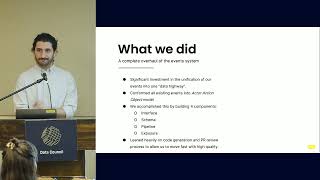
Data Contracts in the Modern Data Stack  | Whatnot

ABOUT THE TALK: After two years, three rounds of funding, and hundreds of new employees — Whatnot’s modern data stack has come from not existing to processing tens of millions of events across hundreds of different event types each day.

How does their small (but mighty!) team keep up? This talk explores data contracts — it covers the use of Interface Definition Language (Protobuf) to serve as the source of truth for event definitions, govern event construction in production, automatically generate DBT models in the data warehouse.

ABOUT THE SPEAKER: Zack Klein is a software engineer at Whatnot, where he thoroughly enjoys building data products and narrowly avoiding breaking production each day. Previously, he worked on big data platforms at Blackstone and HBO.

ABOUT DATA COUNCIL: Data Council (https://www.datacouncil.ai/) is a community and conference series that provides data professionals with the learning and networking opportunities they need to grow their careers.

Make sure to subscribe to our channel for the most up-to-date talks from technical professionals on data related topics including data infrastructure, data engineering, ML systems, analytics and AI from top startups and tech companies.

FOLLOW DATA COUNCIL: Twitter: https://twitter.com/DataCouncilAI LinkedIn: https://www.linkedin.com/company/datacouncil-ai/

A Deep Dive into the dbt Manifest | Squarespace

ABOUT THE TALK: Ever noticed the manifest.json file that dbt puts into your target folder? This little file contains rich information about your dbt project that enables numerous fun use cases! These include complex deployment configurations, quality enforcement, and streamlined development workflows. This talk will go over what the manifest is and how it is produced, along with case studies of how the manifest is used across the community and in Squarespace’s data pipelines.

ABOUT THE SPEAKER: Aaron Richter is a software developer with a passion for all things data. His work involves making sure data is clean and accessible, and that the tools to access it are at peak performance. Aaron is currently a data engineer at Squarespace, where he supports the company’s analytics platform. Previously, he built the data warehouse at Modernizing Medicine, and worked as a data science advocate at Saturn Cloud.

ABOUT DATA COUNCIL: Data Council (https://www.datacouncil.ai/) is a community and conference series that provides data professionals with the learning and networking opportunities they need to grow their careers.

Make sure to subscribe to our channel for the most up-to-date talks from technical professionals on data related topics including data infrastructure, data engineering, ML systems, analytics and AI from top startups and tech companies.

FOLLOW DATA COUNCIL: Twitter: https://twitter.com/DataCouncilAI LinkedIn: https://www.linkedin.com/company/datacouncil-ai/

Data Warehouses are Gilded Cages  What Comes Next | Motherduck

ABOUT THE TALK: If you squint, the data warehouse-centric analytics stack can look a lot like mainframe-era centralized control: shared distributed compute, some sandbox space if you are lucky, and no way to work locally that's equivalent. And it's been getting expensive! Yet the major vendors appear to be converging on features. Is this "The End of History" for OLAP? Your laptop is incredibly powerful and tragically underutilized. It has better I/O than servers from just a few years back, and with a solid analytic engine like DuckDB, it can handle surprising workloads.

In this talk Nicholas Ursa will share what makes DuckDB fast and show how far single node scale-up can take you. He will also show some ideas Motherduck is testing that blur the line between local and remote systems and shift some of that centralized control back to users.

ABOUT THIS SPEAKER: Nicholas Ursa is an Engineer at Motherduck. He led data engineering teams at The New York Times and better.com after cutting his teeth in ad tech.

ABOUT DATA COUNCIL: Data Council (https://www.datacouncil.ai/) is a community and conference series that provides data professionals with the learning and networking opportunities they need to grow their careers.

Make sure to subscribe to our channel for the most up-to-date talks from technical professionals on data related topics including data infrastructure, data engineering, ML systems, analytics and AI from top startups and tech companies.

FOLLOW DATA COUNCIL: Twitter: https://twitter.com/DataCouncilAI LinkedIn: https://www.linkedin.com/company/datacouncil-ai/

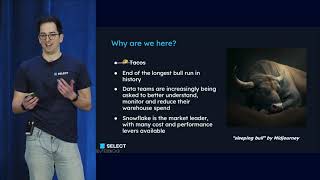
The Missing Manual: Everything You Need to Know about Snowflake Optimization | SELECT

ABOUT THE TALK Learn all about cost and performance optimization in Snowflake. This talk deep dive's into Snowflake’s architecture & billing model, covering key concepts like virtual warehouses, micro-partitioning, the lifecycle of a query and Snowflake’s two-tiered cache. It then goes in depth on the most important optimization strategies, like virtual warehouse configuration, table clustering and query writing best practices. Throughout the talk, code snippets and other resources are shared to help you get the most out of Snowflake.

ABOUT THE SPEAKERS Niall Woodward and Ian Whitestone are the co-founders at SELECT, a tool to help Snowflake users optimize their Snowflake cost & performance.

Niall Woodward has been well known in the data community for creating and contributing to open source packages.

Ian Whitestone previously led data teams at Shopify and Capital One. At Shopify, Ian spearheaded the efforts to reduce their data warehouse spend by over 50%.

ABOUT DATA COUNCIL: Data Council (https://www.datacouncil.ai/) is a community and conference series that provides data professionals with the learning and networking opportunities they need to grow their careers.

Make sure to subscribe to our channel for the most up-to-date talks from technical professionals on data related topics including data infrastructure, data engineering, ML systems, analytics and AI from top startups and tech companies.

FOLLOW DATA COUNCIL: Twitter: https://twitter.com/DataCouncilAI LinkedIn: https://www.linkedin.com/company/datacouncil-ai

Snowflake SnowPro™ Advanced Architect Certification Companion: Hands-on Preparation and Practice

Master the intricacies of Snowflake and prepare for the SnowPro Advanced Architect Certification exam with this comprehensive study companion. This book provides robust and effective study tools to help you prepare for the exam and is also designed for those who are interested in learning the advanced features of Snowflake. The practical examples and in-depth background on theory in this book help you unleash the power of Snowflake in building a high-performance system. The best practices demonstrated in the book help you use Snowflake more powerfully and effectively as a data warehousing and analytics platform. Reading this book and reviewing the concepts will help you gain the knowledge you need to take the exam. The book guides you through a study of the different domains covered on the exam: Accounts and Security, Snowflake Architecture, Data Engineering, and Performance Optimization. You’ll also be well positioned to apply your newly acquired practical skills to real-world Snowflake solutions. You will have a deep understanding of Snowflake to help you take full advantage of Snowflake’s architecture to deliver value analytics insight to your business. What You Will Learn Gain the knowledge you need to prepare for the exam Review in-depth theory on Snowflake to help you build high-performance systems Broaden your skills as a data warehouse designer to cover the Snowflake ecosystem Optimize performance and costs associated with your use of the Snowflake data platform Share data securely both inside your organization and with external partners Apply your practical skills to real-world Snowflake solutions Who This Book Is For Anyone who is planning to take the SnowPro Advanced Architect Certification exam, those who want to move beyond traditional database technologies and build their skills to design and architect solutions using Snowflake services, and veteran database professionals seeking an on-the-job reference to understand one of the newest and fastest-growing technologies in data

Summary

The customer data platform is a category of services that was developed early in the evolution of the current era of cloud services for data processing. When it was difficult to wire together the event collection, data modeling, reporting, and activation it made sense to buy monolithic products that handled every stage of the customer data lifecycle. Now that the data warehouse has taken center stage a new approach of composable customer data platforms is emerging. In this episode Darren Haken is joined by Tejas Manohar to discuss how Autotrader UK is addressing their customer data needs by building on top of their existing data stack.

Announcements

Hello and welcome to the Data Engineering Podcast, the show about modern data management RudderStack helps you build a customer data platform on your warehouse or data lake. Instead of trapping data in a black box, they enable you to easily collect customer data from the entire stack and build an identity graph on your warehouse, giving you full visibility and control. Their SDKs make event streaming from any app or website easy, and their extensive library of integrations enable you to automatically send data to hundreds of downstream tools. Sign up free at dataengineeringpodcast.com/rudderstack Your host is Tobias Macey and today I'm interviewing Darren Haken and Tejas Manohar about building a composable CDP and how you can start adopting it incrementally

Interview

Introduction How did you get involved in the area of data management? Can you describe what you mean by a "composable CDP"?

What are some of the key ways that it differs from the ways that we think of a CDP today?

What are the problems that you were focused on addressing at Autotrader that are solved by a CDP? One of the promises of the first generation CDP was an opinionated way to model your data so that non-technical teams could own this responsibility. What do you see as the risks/tradeoffs of moving CDP functionality into the same data stack as the rest of the organization?

What about companies that don't have the capacity to run a full data infrastructure?

Beyond the core technology of the data warehouse, what are the other evolutions/innovations that allow for a CDP experience to be built on top of the core data stack? added burden on core data teams to generate event-driven data models When iterating toward a CDP on top of the core investment of the infrastructure to feed and manage a data warehouse, what are the typical first steps?

What are some of the components in the ecosystem that help to speed up the time to adoption? (e.g. pre-built dbt packages for common transformations, etc.)

What are the most interesting, innovative, or unexpected ways that you have seen CDPs implemented? What are the most interesting, unexpected, or challenging lessons that you have learned while working on CDP related functionality? When is a CDP (composable or monolithic) the wrong choice? What do you have planned for the future of the CDP stack?

Contact Info

Darren

LinkedIn @DarrenHaken on Twitter

Tejas

LinkedIn @tejasmanohar on Twitter

Parting Question

From your perspective, what is the biggest gap in the tooling or technology for data management today?

Closing Announcements

Thank you for listening! Don't forget to check out our other shows. Podcast.init covers the Python language, its community, and the innovative ways it is being used. The Machine Learning Podcast helps you go from idea to production with machine learning. Visit the site to subscribe to the show, sign up for the mailing list, and read the show notes. If you've learned something or tried out a project from the show then tell us about it! Email [email protected]) with your story. To help other people find the show please leave a review on Apple Podcasts and tell your friends and co-workers

Links

Autotrader Hightouch

Customer Studio

CDP == Customer Data Platform Segment

Podcast Episode

mPar

Summary

With the rise of the web and digital business came the need to understand how customers are interacting with the products and services that are being sold. Product analytics has grown into its own category and brought with it several services with generational differences in how they approach the problem. NetSpring is a warehouse-native product analytics service that allows you to gain powerful insights into your customers and their needs by combining your event streams with the rest of your business data. In this episode Priyendra Deshwal explains how NetSpring is designed to empower your product and data teams to build and explore insights around your products in a streamlined and maintainable workflow.

Announcements

Hello and welcome to the Data Engineering Podcast, the show about modern data management Join in with the event for the global data community, Data Council Austin. From March 28-30th 2023, they'll play host to hundreds of attendees, 100 top speakers, and dozens of startups that are advancing data science, engineering and AI. Data Council attendees are amazing founders, data scientists, lead engineers, CTOs, heads of data, investors and community organizers who are all working together to build the future of data. As a listener to the Data Engineering Podcast you can get a special discount of 20% off your ticket by using the promo code dataengpod20. Don't miss out on their only event this year! Visit: dataengineeringpodcast.com/data-council today! RudderStack helps you build a customer data platform on your warehouse or data lake. Instead of trapping data in a black box, they enable you to easily collect customer data from the entire stack and build an identity graph on your warehouse, giving you full visibility and control. Their SDKs make event streaming from any app or website easy, and their extensive library of integrations enable you to automatically send data to hundreds of downstream tools. Sign up free at dataengineeringpodcast.com/rudder Your host is Tobias Macey and today I'm interviewing Priyendra Deshwal about how NetSpring is using the data warehouse to deliver a more flexible and detailed view of your product analytics

Interview

Introduction How did you get involved in the area of data management? Can you describe what NetSpring is and the story behind it?

What are the activities that constitute "product analytics" and what are the roles/teams involved in those activities?

When teams first come to you, what are the common challenges that they are facing and what are the solutions that they have attempted to employ? Can you describe some of the challenges involved in bringing product analytics into enterprise or highly regulated environments/industries?

How does a warehouse-native approach simplify that effort?

There are many different players (both commercial and open source) in the product analytics space. Can you share your view on the role that NetSpring plays in that ecosystem? How is the NetSpring platform implemented to be able to best take advantage of modern warehouse technologies and the associated data stacks?

What are the pre-requisites for an organization's infrastructure/data maturity for being able to benefit from NetSpring? How have the goals and implementation of the NetSpring platform evolved from when you first started working on it?

Can you describe the steps involved in integrating NetSpring with an organization's existing warehouse?

What are the signals that NetSpring uses to understand the customer journeys of different organizations? How do you manage the variance of the data models in the warehouse while providing a consistent experience for your users?

Given that you are a product organization, how are you using NetSpring to power NetSpring? What are the most interesting, innovative, or unexpected ways that you have seen NetSpring used? What are the most interesting, unexpected, or challenging lessons that you have learned while working on NetSpring? When is NetSpring the wrong choice? What do you have planned for the future of NetSpring?

Contact Info

LinkedIn

Parting Question

From your perspective, what is the biggest gap in the tooling or technology for data management today?

Closing Announcements

Thank you for listening! Don't forget to check out our other shows. Podcast.init covers the Python language, its community, and the innovative ways it is being used. The Machine Learning Podcast helps you go from idea to production with machine learning. Visit the site to subscribe to the show, sign up for the mailing list, and read the show notes. If you've learned something or tried out a project from the show then tell us about it! Email [email protected]) with your story. To help other people find the show please leave a review on Apple Podcasts and tell your friends and co-workers

Links

NetSpring ThoughtSpot Product Analytics Amplitude Mixpanel Customer Data Platform GDPR CCPA Segment

Podcast Episode

Rudderstack

Podcast Episode

The intro and outro music is from The Hug by The Freak Fandango Orchestra / CC BY-SA Sponsored By: TimeXtender: TimeXtender Logo TimeXtender is a holistic, metadata-driven solution for data integration, optimized for agility. TimeXtender provides all the features you need to build a future-proof infrastructure for ingesting, transforming, modelling, and delivering clean, reliable data in the fastest, most efficient way possible.
You can't optimize for everything all at once. That's why we take a holistic approach to data integration that optimises for agility instead of fragmentation. By unifying each layer of the data stack, TimeXtender empowers you to build data solutions 10x faster while reducing costs by 70%-80%. We do this for one simple reason: because time matters.

Go to dataengineeringpodcast.com/timextender today to get started for free!Rudderstack: Rudderstack

RudderStack provides all your customer data pipelines in one platform. You can collect, transform, and route data across your entire stack with its event streaming, ETL, and reverse ETL pipelines.

RudderStack’s warehouse-first approach means it does not store sensitive information, and it allows you to leverage your existing data warehouse/data lake infrastructure to build a single source of truth for every team.

RudderStack also supports real-time use cases. You can Implement RudderStack SDKs once, then automatically send events to your warehouse and 150+ business tools, and you’ll never have to worry about API changes again.

Visit dataengineeringpodcast.com/rudderstack to sign up for free today, and snag a free T-Shirt just for being a Data Engineering Podcast listener.Data Council: Data Council Logo Join us at the event for the global data community, Data Council Austin. From March 28-30th 2023, we'll play host to hundreds of attendees, 100 top speakers, and dozens of startups that are advancing data science, engineering and AI. Data Council attendees are amazing founders, data scientists, lead engineers, CTOs, heads of data, investors and community organizers who are all working together to build the future of data. As a listener to the Data Engineering Podcast you can get a special discount off tickets by using the promo code dataengpod20. Don't miss out on our only event this year! Visit: dataengineeringpodcast.com/data-council Promo Code: dataengpod20Support Data Engineering Podcast


Welcome to today's Data Warehouse vs. Lakehouse podcast for Data leaders and executives. In this episode, we will discuss the critical differences between these two approaches to data management and which one might be best suited for your organization. First, let's define what we mean by Data Warehouse and Lakehouse. A Data Warehouse is a centralized data repository optimized for querying and analysis. It is typically built using a structured, relational database. It supports business intelligence (BI) and analytics use cases. A Lakehouse, on the other hand, is a newer concept that combines the scalability and flexibility of a data lake with the structure and governance of a data warehouse. It supports BI and advanced analytics use cases like machine learning and AI.

In this episode, Jason Foster talks to Bill Inmon, a long-standing industry expert in the field of data, Founder and CEO of Forest Rim Technology, Best-Selling Author and recognised by many as the father of the data warehouse. Jason Foster and Bill discuss how to achieve business value from text, why using text is so important in decision-making, the challenges of using text in data and how organisations can effectively leverage data from text.

Summary

With all of the messaging about treating data as a product it is becoming difficult to know what that even means. Vishal Singh is the head of products at Starburst which means that he has to spend all of his time thinking and talking about the details of product thinking and its application to data. In this episode he shares his thoughts on the strategic and tactical elements of moving your work as a data professional from being task-oriented to being product-oriented and the long term improvements in your productivity that it provides.

Announcements

Hello and welcome to the Data Engineering Podcast, the show about modern data management When you're ready to build your next pipeline, or want to test out the projects you hear about on the show, you'll need somewhere to deploy it, so check out our friends at Linode. With their new managed database service you can launch a production ready MySQL, Postgres, or MongoDB cluster in minutes, with automated backups, 40 Gbps connections from your application hosts, and high throughput SSDs. Go to dataengineeringpodcast.com/linode today and get a $100 credit to launch a database, create a Kubernetes cluster, or take advantage of all of their other services. And don't forget to thank them for their continued support of this show! Modern data teams are dealing with a lot of complexity in their data pipelines and analytical code. Monitoring data quality, tracing incidents, and testing changes can be daunting and often takes hours to days or even weeks. By the time errors have made their way into production, it’s often too late and damage is done. Datafold built automated regression testing to help data and analytics engineers deal with data quality in their pull requests. Datafold shows how a change in SQL code affects your data, both on a statistical level and down to individual rows and values before it gets merged to production. No more shipping and praying, you can now know exactly what will change in your database! Datafold integrates with all major data warehouses as well as frameworks such as Airflow & dbt and seamlessly plugs into CI workflows. Visit dataengineeringpodcast.com/datafold today to book a demo with Datafold. RudderStack helps you build a customer data platform on your warehouse or data lake. Instead of trapping data in a black box, they enable you to easily collect customer data from the entire stack and build an identity graph on your warehouse, giving you full visibility and control. Their SDKs make event streaming from any app or website easy, and their extensive library of integrations enable you to automatically send data to hundreds of downstream tools. Sign up free at dataengineeringpodcast.com/rudder Build Data Pipelines. Not DAGs. That’s the spirit behind Upsolver SQLake, a new self-service data pipeline platform that lets you build batch and streaming pipelines without falling into the black hole of DAG-based orchestration. All you do is write a query in SQL to declare your transformation, and SQLake will turn it into a continuous pipeline that scales to petabytes and delivers up to the minute fresh data. SQLake supports a broad set of transformations, including high-cardinality joins, aggregations, upserts and window operations. Output data can be streamed into a data lake for query engines like Presto, Trino or Spark SQL, a data warehouse like Snowflake or Redshift., or any other destination you choose. Pricing for SQLake is simple. You pay $99 per terabyte ingested into your data lake using SQLake, and run unlimited transformation pipelines for free. That way data engineers and data users can process to their heart’s content without worrying about their cloud bill. For data engineering podcast listeners, we’re offering a 30 day trial with unlimited data, so go to dataengineeringpodcast.com/upsolver today and see for yourself how to avoid DAG hell. Your host is Tobias Macey and today I'm interviewing Vishal Singh about his experience