talk-data.com talk-data.com

Topic

DWH

Data Warehouse

analytics business_intelligence data_storage

568

tagged

Activity Trend

35 peak/qtr
2020-Q1 2026-Q1

Activities

568 activities · Newest first

Sponsored by: Alation | Unlocking the Power of Real-Time Data to Maximize Data Insights

It’s no secret that access to the right data at the right time is critical for data-driven decision making. In fact, as data culture becomes more and more ingrained in the enterprise, business users increasingly demand real-time, actionable data. But, what happens when it takes up to 24 hours to access your point-of-sale data? RaceTrac faced many of these data accessibility challenges as it sought to derive intelligence from its retail transaction data, specifically the data from their stores, information from their fuel purchasing arms, and delivery data for their fleet.

Through a combination of the Databricks Lakehouse and the lineage and self-discovery capabilities of the Alation Data Intelligence Platform, RaceTrac rose to the challenge. Hear from Raghu Jayachandran, Senior Manager of Enterprise Data at RaceTrac, and discover how RaceTrac gained real-time access to their transaction data in Databricks, and uses Alation to provide insight into which data can drive the business insights they needed.

Talk by: Diby Malakar and Raghu Jayachandran

Here’s more to explore: Why the Data Lakehouse Is Your next Data Warehouse: https://dbricks.co/3Pt5unq Lakehouse Fundamentals Training: https://dbricks.co/44ancQs

Connect with us: Website: https://databricks.com Twitter: https://twitter.com/databricks LinkedIn: https://www.linkedin.com/company/databricks Instagram: https://www.instagram.com/databricksinc Facebook: https://www.facebook.com/databricksin
Sponsored: Sisense-Developing Data Products: Infusion & Composability Are Changing Expectations

Composable analytics is the next progression of business intelligence. We will discuss how current analytics rely on two key principles: composability and agility. Through modularizing our analytics capabilities, we can rapidly “compose” new data applications. An organization uses these building blocks to deliver customized analytics experiences at a customer level.

This session will orientate business intelligence leaders to composable data and analytics.

  • How data teams can use composable analytics to decrease application development time.
  • How an organization can leverage existing and new tools to maximize value-based, data-driven insights.
    • Requirements for effectively deploying composable analytics.
    • Utilizing no, low-code and high-code analytics capabilities.
    • Extracting full value from your customer data and metadata.
    • Leveraging analytics building blocks to create new products and revenue streams.

Talk by: Scott Castle

Here’s more to explore: Why the Data Lakehouse Is Your next Data Warehouse: https://dbricks.co/3Pt5unq Lakehouse Fundamentals Training: https://dbricks.co/44ancQs

Connect with us: Website: https://databricks.com Twitter: https://twitter.com/databricks LinkedIn: https://www.linkedin.com/company/databricks Instagram: https://www.instagram.com/databricksinc Facebook: https://www.facebook.com/databricksinc

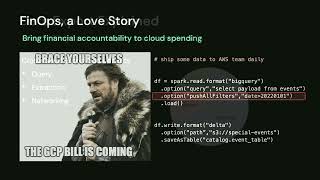
The Future is Open: Data Streaming in an Omni-Cloud Reality

This session begins with data warehouse trivia and lessons learned from production implementations of multicloud data architecture. You will learn to design future-proof low latency data systems that focus on openness and interoperability. You will also gain a gentle introduction to Cloud FinOps principles that can help your organization reduce compute spend and increase efficiency. 

Most enterprises today are multicloud. While an assortment of low-code connectors boasts the ability to make data available for analytics in real time, they post long-lasting challenges:

  • Inefficient EDW targets
  • Inability to evolve schema
  • Forbiddingly expensive data exports due to cloud and vendor lock-in

The alternative is an open data lake that unifies batch and streaming workloads. Bronze landing zones in open format eliminate the data extraction costs required by proprietary EDW. Apache Spark™ Structured Streaming provides a unified ingestion interface. Streaming triggers allow us to switch back and forth between batch and stream with one-line code changes. Streaming aggregation enables us to incrementally compute on data that arrives near each other.

Specific examples are given on how to use Autoloader to discover newly arrived data and ensure exactly once, incremental processing. How DLT can be configured effectively to further simplify streaming jobs and accelerate the development cycle. How to apply SWE best practices to Workflows and integrate with popular Git providers, either using the Databricks Project or Databricks Terraform provider. 

Talk by: Christina Taylor

Here’s more to explore: Big Book of Data Engineering: 2nd Edition: https://dbricks.co/3XpPgNV The Data Team's Guide to the Databricks Lakehouse Platform: https://dbricks.co/46nuDpI

Connect with us: Website: https://databricks.com Twitter: https://twitter.com/databricks LinkedIn: https://www.linkedin.com/company/databricks Instagram: https://www.instagram.com/databricksinc Facebook: https://www.facebook.com/databricksinc

Learnings From the Field: Migration From Oracle DW and IBM DataStage to Databricks on AWS

Legacy data warehouses are costly to maintain, unscalable and cannot deliver on data science, ML and real-time analytics use cases. Migrating from your enterprise data warehouse to Databricks lets you scale as your business needs grow and accelerate innovation by running all your data, analytics and AI workloads on a single unified data platform.

In the first part of this session we will guide you through the well-designed process and tools that will help you from the assessment phase to the actual implementation of an EDW migration project. Also, we will address ways to convert PL/SQL proprietary code to an open standard python code and take advantage of PySpark for ETL workloads and Databricks SQL’s data analytics workload power.

The second part of this session will be based on an EDW migration project of SNCF (French national railways); one of the major enterprise customers of Databricks in France. Databricks partnered with SNCF to migrate its real estate entity from Oracle DW and IBM DataStage to Databricks on AWS. We will walk you through the customer context, urgency to migration, challenges, target architecture, nitty-gritty details of implementation, best practices, recommendations, and learnings in order to execute a successful migration project in a very accelerated time frame.

Talk by: Himanshu Arora and Amine Benhamza

Connect with us: Website: https://databricks.com Twitter: https://twitter.com/databricks LinkedIn: https://www.linkedin.com/company/databricks Instagram: https://www.instagram.com/databricksinc Facebook: https://www.facebook.com/databricksinc

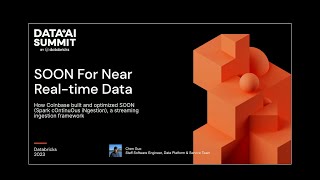
How Coinbase Built and Optimized SOON, a Streaming Ingestion Framework

Data with low latency is important for real-time incident analysis and metrics. Though we have up-to-date data in OLTP databases, they cannot support those scenarios. Data need to be replicated to a data warehouse to serve queries using GroupBy and Join across multiple tables from different systems. At Coinbase, we designed SOON (Spark cOntinuOus iNgestion) based on Kafka, Kafka Connect, and Apache Spark™ as an incremental table replication solution to replicate tables of any size from any database to Delta Lake in a timely manner. It also supports Kafka events ingestion naturally.

SOON incrementally ingests Kafka events as appends, updates, and deletes to an existing table on Delta Lake. The events are grouped into two categories: CDC (change data capture) events generated by Kafka Connect source connectors, and non-CDC events by the frontend or backend services. Both types can be appended or merged into the Delta Lake. Non-CDC events can be in any format, but CDC events must be in the standard SOON CDC schema. We implemented Kafka Connect SMTs to transform raw CDC events into this standardized format. SOON unifies all streaming ingestion scenarios such that users only need to learn one onboarding experience and the team only needs to maintain one framework.

We care about the ingestion performance. The biggest append-only table onboarded has ingress traffic at hundreds of thousands events per second; the biggest CDC-merge table onboarded has a snapshot size of a few TBs and CDC update traffic at hundreds of thousands events per second. A lot of innovative ideas are incorporated in SOON to improve its performance, such as min-max range merge optimization, KMeans merge optimization, no-update merge for deduplication, generated columns as partitions, etc.

Talk by: Chen Guo

Here’s more to explore: Big Book of Data Engineering: 2nd Edition: https://dbricks.co/3XpPgNV The Data Team's Guide to the Databricks Lakehouse Platform: https://dbricks.co/46nuDpI

Connect with us: Website: https://databricks.com Twitter: https://twitter.com/databricks LinkedIn: https://www.linkedin.com/company/databricks Instagram: https://www.instagram.com/databricksinc Facebook: https://www.facebook.com/databricksinc

Sponsored by: ThoughtSpot | Drive Self-Service Adoption Through the Roof with Embedded Analytics

When it comes to building stickier apps and products to grow your business, there's no greater opportunity than embedded analytics. Data apps that deliver superior user engagement and business value do analytics differently. They take a user-first approach and know how to deliver real-time, AI-powered insights - not just to internal employees - but to an organization’s customers and partners, as well.

Learn how ThoughtSpot Everywhere is helping companies like Emerald natively integrate analytics with other tools in their modern data stack to deliver a blazing-fast and instantly available analytics experience across all the data their users love. Join this session to learn how you can leverage embedded analytics to: Drive higher app engagement Get your app to market faster And create new revenue streams

Talk by: Krishti Bikal and Vika Smilansky

Here’s more to explore: Why the Data Lakehouse Is Your next Data Warehouse: https://dbricks.co/3Pt5unq Lakehouse Fundamentals Training: https://dbricks.co/44ancQs

Connect with us: Website: https://databricks.com Twitter: https://twitter.com/databricks LinkedIn: https://www.linkedin.com/company/databricks Instagram: https://www.instagram.com/databricksinc Facebook: https://www.facebook.com/databricksinc

Best Exploration of Columnar Shuffle Design

To significantly improve the performance of Spark SQL, there is a trend to offload Spark SQL execution to highly optimized native libraries or accelerators in past several years, like Photon from Databricks, Nvidia's Rapids plug-in, and Intel and Kyligence's initiated open source Gluten project. By the multi-fold performance improvement from these solutions, more and more Apache Spark™ users have started to adopt the new technology. One characteristics of native libraries is that they all use columnar data format as the basic data format. It's because the columnar data format has the intrinsic affinity to vectorized data processing using SIMD instructions. While vanilla Spark's shuffle is based on spark's internal row data format. The high overhead of the columnar to row and row to columnar conversion during the shuffle makes reusing current shuffle not possible. Due to the importance of shuffle service in Spark, we have to implement an efficient columnar shuffle, which brings couple of new challenges, like the split of columnar data, or the dictionary support during shuffle.

In this session, we will share the exploration process of the columnar shuffle design during our Gazelle and Gluten development, and best practices for implementing the columnar shuffle service. We will also share how we learned from the development of vanilla Spark's shuffle, for example, how to address the small files issue then we will propose the new shuffle solution. We will show the performance comparison between Columnar shuffle and vanilla Spark's row-based shuffle. Finally, we will share how the new built-in accelerators like QAT and IAA in the latest Intel processor are used in our columnar shuffle service and boost the performance.

Talk by: Binwei Yang and Rong Ma

Here’s more to explore: Why the Data Lakehouse Is Your next Data Warehouse: https://dbricks.co/3Pt5unq Lakehouse Fundamentals Training: https://dbricks.co/44ancQs

Connect with us: Website: https://databricks.com Twitter: https://twitter.com/databricks LinkedIn: https://www.linkedin.com/company/databricks Instagram: https://www.instagram.com/databricksinc Facebook: https://www.facebook.com/databricksinc

Databricks SQL: Why the Best Serverless Data Warehouse is a Lakehouse

Many organizations rely on complex cloud data architectures that create silos between applications, users and data. This fragmentation makes it difficult to access accurate, up-to-date information for analytics, often resulting in the use of outdated data. Enter the lakehouse, a modern data architecture that unifies data, AI, and analytics in a single location.

This session explores why the lakehouse is the best data warehouse, featuring success stories, use cases and best practices from industry experts. You'll discover how to unify and govern business-critical data at scale to build a curated data lake for data warehousing, SQL and BI. Additionally, you'll learn how Databricks SQL can help lower costs and get started in seconds with on-demand, elastic SQL serverless warehouses, and how to empower analytics engineers and analysts to quickly find and share new insights using their preferred BI and SQL tools such as Fivetran, dbt, Tableau, or Power BI.

Talk by: Miranda Luna and Cyrielle Simeone

Connect with us: Website: https://databricks.com Twitter: https://twitter.com/databricks LinkedIn: https://www.linkedin.com/company/databricks Instagram: https://www.instagram.com/databricksinc Facebook: https://www.facebook.com/databricksinc

Sponsored: dbt Labs | Modernizing the Data Stack: Lessons Learned From Evolution at Zurich Insurance

In this session, we will explore the path Zurich Insurance took to modernize its data stack and data engineering practices, and the lessons learned along the way. We'll touch on how and why the team chose to:

  • Adopt community standards in code quality, code coverage, code reusability, and CI/CD
  • Rebuild the way data engineering collaborates with business teams
  • Explore data tools accessible to non-engineering users, with considerations for code-first and no-code interfaces
  • Structure our dbt project and orchestration — and the factors that played into our decisions

Talk by: Jose L Sanchez Ros and Gerard Sola

Here’s more to explore: Why the Data Lakehouse Is Your next Data Warehouse: https://dbricks.co/3Pt5unq Lakehouse Fundamentals Training: https://dbricks.co/44ancQs

Connect with us: Website: https://databricks.com Twitter: https://twitter.com/databricks LinkedIn: https://www.linkedin.com/company/databricks Instagram: https://www.instagram.com/databricksinc Facebook: https://www.facebook.com/databricksinc

Sponsored: Kyvos | Analytics 100x Faster Lowest Cost w/ Kyvos & Databricks, Even on Trillions Rows

Databricks and Kyvos together are helping organizations build their next-generation cloud analytics platform. A platform that can process and analyze massive amounts of data, even trillions of rows, and provide multidimensional insights instantly. Combining the power of Databricks with the speed, scale and cost optimization capabilities of Kyvos Analytics Acceleration Platform, customers can go beyond the limit of their analytics boundaries. Join our session to know how and also learn about a real-world use case.

Talk by: Leo Duncan

Here’s more to explore: Why the Data Lakehouse Is Your next Data Warehouse: https://dbricks.co/3Pt5unq Lakehouse Fundamentals Training: https://dbricks.co/44ancQs

Connect with us: Website: https://databricks.com Twitter: https://twitter.com/databricks LinkedIn: https://www.linkedin.com/company/databricks Instagram: https://www.instagram.com/databricksinc Facebook: https://www.facebook.com/databricksin
Best Data Warehouse is a Lakehouse: Databricks Achieves Ops Efficiency w/ Lakehouse Architecture

At Databricks, we use the Lakehouse architecture to build an optimized data warehouse that drives better insights, increased operational efficiency, and reduces costs. In this session, Naveen Zutshi, CIO at Databricks and Romit Jadhwani, Senior Director Analytics and Integrations at Databricks will discuss the Databricks journey and provide technical and business insights into how these results were achieved.

The session will cover topics such as medallion architecture, building efficient third party integrations, how Databricks built various data products/services on the data warehouse, and how to use governance to break down data silos and achieve consistent sources of truth.

Talk by: Naveen Zutshi and Romit Jadhwani

Connect with us: Website: https://databricks.com Twitter: https://twitter.com/databricks LinkedIn: https://www.linkedin.com/company/databricks Instagram: https://www.instagram.com/databricksinc Facebook: https://www.facebook.com/databricksin
Building Apps on the Lakehouse with Databricks SQL

BI applications are undoubtedly one of the major consumers of a data warehouse. Nevertheless, the prospect of accessing data using standard SQL is appealing to many more stakeholders than just the data analysts. We’ve heard from customers that they experience an increasing demand to provide access to data in their lakehouse platforms from external applications beyond BI, such as e-commerce platforms, CRM systems, SaaS applications, or custom data applications developed in-house. These applications require an “always on” experience, which makes Databricks SQL Serverless a great fit.

In this session, we give an overview of the approaches available to application developers to connect to Databricks SQL and create modern data applications tailored to needs of users across an entire organization. We discuss when to choose one of the Databricks native client libraries for languages such as Python, Go, or node.js and when to use the SQL Statement Execution API, the newest addition to the toolset. We also explain when ODBC and JDBC might not be the best for the task and when they are your best friends. Live demos are included.

Talk by: Adriana Ispas and Chris Stevens

Connect with us: Website: https://databricks.com Twitter: https://twitter.com/databricks LinkedIn: https://www.linkedin.com/company/databricks Instagram: https://www.instagram.com/databricksinc Facebook: https://www.facebook.com/databricksinc

Combining Privacy Solutions to Solve Data Access at Scale

The trend that has made data easier to collect and analyze has only aggravated privacy risks. Luckily, a range of privacy technologies have emerged to enable private data management; differential privacy, synthetic data, confidential computing. In isolation, those technologies have had a limited impact because they did not always bring the 10x improvement expected by data leaders.

Combining these privacy technologies has been the real game changer. We will demonstrate that the right mix of technologies brings the optimal balance of privacy and flexibility at the scale of the data warehouse. We will illustrate this by real-life applications of Sarus in three domains:

  • Healthcare: how to make hospital data available for research at scale in full compliance
  • Finance: how to pool data between several banks to fight criminal transactions
  • Marketing: how to build insights on combined data from partners and distributors

The examples will be illustrated using data stored in Databricks and queried using Sarus differential privacy engine.

Talk by: Maxime Agostini

Connect with us: Website: https://databricks.com Twitter: https://twitter.com/databricks LinkedIn: https://www.linkedin.com/company/databricks Instagram: https://www.instagram.com/databricksinc Facebook: https://www.facebook.com/databricksinc

Improve Apache Spark™ DS v2 Query Planning Using Column Stats

When doing the TPC-DS benchmark using external v2 data source, we have observed that for several of the queries, DS v1 has better join plans than Apache Spark. The main reason is that DS v1 uses column stats, especially number of distinct values (NDV) for query optimization. Currently, Spark™ DS v2 only has interfaces for data sources to report table statistics such as size in bytes and number of rows. In order to use column stats in DS v2, we have added new interfaces to allow external data sources to report column stats to Spark.

For a data source with huge data, it’s always challenging to get the column stats, especially the NDV. We plan to calculate NDV using Apache DataSketches Theta sketch and save the serialized compact sketch in the statistics file. The NDV and other column stats will be reported to Spark for query plan optimization.

Talk by: Huaxin Gao and Parth Chandra

Here’s more to explore: Why the Data Lakehouse Is Your next Data Warehouse: https://dbricks.co/3Pt5unq Lakehouse Fundamentals Training: https://dbricks.co/44ancQs

Connect with us: Website: https://databricks.com Twitter: https://twitter.com/databricks LinkedIn: https://www.linkedin.com/company/databricks Instagram: https://www.instagram.com/databricksinc Facebook: https://www.facebook.com/databricksinc

Making the Shift to Application-Driven Intelligence

In the digital economy, application-driven intelligence delivered against live, real-time data will become a core capability of successful enterprises. It has the potential to improve the experience that you provide to your customers and deepen their engagement. But to make application-driven intelligence a reality, you can no longer rely only on copying live application data out of operational systems into analytics stores. Rather, it takes the unique real-time application-serving layer of a MongoDB database combined with the scale and real-time capabilities of a Databricks Lakehouse to automate and operationalize complex and AI-enhanced applications at scale.

In this session, we will show how it can be seamless for developers and data scientists to automate decisioning and actions on fresh application data and we'll deliver a practical demonstration on how operational data can be integrated in real time to run complex machine learning pipelines.

Talk by: Mat Keep and Ashwin Gangadhar

Here’s more to explore: Why the Data Lakehouse Is Your next Data Warehouse: https://dbricks.co/3Pt5unq Lakehouse Fundamentals Training: https://dbricks.co/44ancQs

Connect with us: Website: https://databricks.com Twitter: https://twitter.com/databricks LinkedIn: https://www.linkedin.com/company/databricks Instagram: https://www.instagram.com/databricksinc Facebook: https://www.facebook.com/databricksinc

Processing Delta Lake Tables on AWS Using AWS Glue, Amazon Athena, and Amazon Redshift

Delta Lake is an open source project that helps implement modern data lake architectures commonly built on cloud storages. With Delta Lake, you can achieve ACID transactions, time travel queries, CDC, and other common use cases on the cloud.

There are a lot of use cases of Delta tables on AWS. AWS has invested a lot in this technology, and now Delta Lake is available with multiple AWS services, such as AWS Glue Spark jobs, Amazon EMR, Amazon Athena, and Amazon Redshift Spectrum. AWS Glue is a serverless, scalable data integration service that makes it easier to discover, prepare, move, and integrate data from multiple sources. With AWS Glue, you can easily ingest data from multiple data sources such as on-prem databases, Amazon RDS, DynamoDB, MongoDB into Delta Lake on Amazon S3 even without expertise in coding.

This session will demonstrate how to get started with processing Delta Lake tables on Amazon S3 using AWS Glue, and querying from Amazon Athena, and Amazon Redshift. The session also covers recent AWS service updates related to Delta Lake.

Talk by: Noritaka Sekiyama and Akira Ajisaka

Here’s more to explore: Why the Data Lakehouse Is Your next Data Warehouse: https://dbricks.co/3Pt5unq Lakehouse Fundamentals Training: https://dbricks.co/44ancQs

Connect with us: Website: https://databricks.com Twitter: https://twitter.com/databricks LinkedIn: https://www.linkedin.com/company/databricks Instagram: https://www.instagram.com/databricksinc Facebook: https://www.facebook.com/databricksinc

US Army Corp of Engineers Enhanced Commerce & National Sec Through Data-Driven Geospatial Insight

The US Army Corps of Engineers (USACE) is responsible for maintaining and improving nearly 12,000 miles of shallow-draft (9'-14') inland and intracoastal waterways, 13,000 miles of deep-draft (14' and greater) coastal channels, and 400 ports, harbors, and turning basins throughout the United States. Because these components of the national waterway network are considered assets to both US commerce and national security, they must be carefully managed to keep marine traffic operating safely and efficiently.

The National DQM Program is tasked with providing USACE a nationally standardized remote monitoring and documentation system across multiple vessel types with timely data access, reporting, dredge certifications, data quality control, and data management. Government systems have often lagged commercial systems in modernization efforts, and the emergence of the cloud and Data Lakehouse Architectures have empowered USACE to successfully move into the modern data era.

This session incorporates aspects of these topics: Data Lakehouse Architecture: Delta Lake, platform security and privacy, serverless, administration, data warehouse, Data Lake, Apache Iceberg, Data Mesh GIS: H3, MOSAIC, spatial analysis data engineering: data pipelines, orchestration, CDC, medallion architecture, Databricks Workflows, data munging, ETL/ELT, lakehouses, data lakes, Parquet, Data Mesh, Apache Spark™ internals. Data Streaming: Apache Spark Structured Streaming, real-time ingestion, real-time ETL, real-time ML, real-time analytics, and real-time applications, Delta Live Tables. ML: PyTorch, TensorFlow, Keras, scikit-learn, Python and R ecosystems data governance: security, compliance, RMF, NIST data sharing: sharing and collaboration, delta sharing, data cleanliness, APIs.

Talk by: Jeff Mroz

Connect with us: Website: https://databricks.com Twitter: https://twitter.com/databricks LinkedIn: https://www.linkedin.com/company/databricks Instagram: https://www.instagram.com/databricksinc Facebook: https://www.facebook.com/databricksinc

Planning and Executing a Snowflake Data Warehouse Migration to Databricks

Organizations are going through a critical phase of data infrastructure modernization, laying the foundation for the future, and adapting to support growing data and AI needs. Organizations that embraced cloud data warehouses (CDW) such as Snowflake have ended up trying to use a data warehousing tool for ETL pipelines and data science. This created unnecessary complexity and resulted in poor performance since data warehouses are optimized for SQL-based analytics only.

Realizing the limitation and pain with cloud data warehouses, organizations are turning to a lakehouse-first architecture. Though a cloud platform to cloud platform migration should be relatively easy, the breadth of the Databricks platform provides flexibility and hence requires careful planning and execution. In this session, we present the migration methodology, technical approaches, automation tools, product/feature mapping, a technical demo and best practices using real-world case studies for migrating data, ELT pipelines and warehouses from Snowflake to Databricks.

Talk by: Satish Garla and Ramachandran Venkat

Connect with us: Website: https://databricks.com Twitter: https://twitter.com/databricks LinkedIn: https://www.linkedin.com/company/databricks Instagram: https://www.instagram.com/databricksinc Facebook: https://www.facebook.com/databricksin
What's New in Databricks SQL -- With Live Demos

We’ve been pushing ahead to make the lakehouse even better for data warehousing across several pillars: native serverless experience, best in class price performance, intelligent workload management & observability and enhanced connectivity, analyst & developer experiences. As we look to double down on that pace of innovation, we want to deep dive into everything that’s been keeping us busy.

In this session we will share an update on key roadmap items. To bring things to life, you will see live demos of the most recent capabilities, from data ingestion, transformation, and consumption, using the modern data stack along with Databricks SQL.

Talk by: Can Efeoglu

Connect with us: Website: https://databricks.com Twitter: https://twitter.com/databricks LinkedIn: https://www.linkedin.com/company/databricks Instagram: https://www.instagram.com/databricksinc Facebook: https://www.facebook.com/databricksinc

Build Your Data Lakehouse with a Modern Data Stack on Databricks

Are you looking for an introduction to the Lakehouse and what the related technology is all about? This session is for you. This session explains the value that lakehouses bring to the table using examples of companies that are actually modernizing their data, showing demos throughout. The data lakehouse is the future for modern data teams that want to simplify data workloads, ease collaboration, and maintain the flexibility and openness to stay agile as a company scales.

Come to this session and learn about the full stack, including data engineering, data warehousing in a lakehouse, data streaming, governance, and data science and AI. Learn how you can create modern data solutions of your own.

Talk by: Ari Kaplan and Pearl Ubaru

Connect with us: Website: https://databricks.com Twitter: https://twitter.com/databricks LinkedIn: https://www.linkedin.com/company/databricks Instagram: https://www.instagram.com/databricksinc Facebook: https://www.facebook.com/databricksinc