talk-data.com talk-data.com

Topic

DWH

Data Warehouse

analytics business_intelligence data_storage

568

tagged

Activity Trend

35 peak/qtr
2020-Q1 2026-Q1

Activities

568 activities · Newest first

Building the Snowflake Data Cloud: Monetizing and Democratizing Your Data

Implement the Snowflake Data Cloud using best practices and reap the benefits of scalability and low-cost from the industry-leading, cloud-based, data warehousing platform. This book provides a detailed how-to explanation, and assumes familiarity with Snowflake core concepts and principles. It is a project-oriented book with a hands-on approach to designing, developing, and implementing your Data Cloud with security at the center. As you work through the examples, you will develop the skill, knowledge, and expertise to expand your capability by incorporating additional Snowflake features, tools, and techniques. Your Snowflake Data Cloud will be fit for purpose, extensible, and at the forefront of both Direct Share, Data Exchange, and Snowflake Marketplace. Building the Snowflake Data Cloud helps you transform your organization into monetizing the value locked up within your data. As the digital economy takes hold, with data volume, velocity, and variety growing at exponential rates, you need tools and techniques to quickly categorize, collate, summarize, and aggregate data. You also need the means to seamlessly distribute to release value. This book shows how Snowflake provides all these things and how to use them to your advantage. The book helps you succeed by delivering faster than you can deliver with legacy products and techniques. You will learn how to leverage what you already know, and what you don’t, all applied in a Snowflake Data Cloud context. After reading this book, you will discover and embrace the future where the Data Cloud is central. You will be able to position your organization to take advantage by identifying, adopting, and preparing your tooling for the coming wave of opportunity around sharing and monetizing valuable, corporate data. What You Will Learn Understand why Data Cloud is important tothe success of your organization Up-skill and adopt Snowflake, leveraging the benefits of cloud platforms Articulate the Snowflake Marketplace and identify opportunities to monetize data Identify tools and techniques to accelerate integration with Data Cloud Manage data consumption by monitoring and controlling access to datasets Develop data load and transform capabilities for use in future projects Who This Book Is For Solution architects seeking implementation patterns to integrate with a Data Cloud; data warehouse developers looking for tips, tools, and techniques to rapidly deliver data pipelines; sales managers who want to monetize their datasets and understand the opportunities that Data Cloud presents; and anyone who wishes to unlock value contained within their data silos
Summary Data has permeated every aspect of our lives and the products that we interact with. As a result, end users and customers have come to expect interactions and updates with services and analytics to be fast and up to date. In this episode Shruti Bhat gives her view on the state of the ecosystem for real-time data and the work that she and her team at Rockset is doing to make it easier for engineers to build those experiences.

Announcements

Hello and welcome to the Data Engineering Podcast, the show about modern data management When you’re ready to build your next pipeline, or want to test out the projects you hear about on the show, you’ll need somewhere to deploy it, so check out our friends at Linode. With their new managed database service you can launch a production ready MySQL, Postgres, or MongoDB cluster in minutes, with automated backups, 40 Gbps connections from your application hosts, and high throughput SSDs. Go to dataengineeringpodcast.com/linode today and get a $100 credit to launch a database, create a Kubernetes cluster, or take advantage of all of their other services. And don’t forget to thank them for their continued support of this show! Data stacks are becoming more and more complex. This brings infinite possibilities for data pipelines to break and a host of other issues, severely deteriorating the quality of the data and causing teams to lose trust. Sifflet solves this problem by acting as an overseeing layer to the data stack – observing data and ensuring it’s reliable from ingestion all the way to consumption. Whether the data is in transit or at rest, Sifflet can detect data quality anomalies, assess business impact, identify the root cause, and alert data teams’ on their preferred channels. All thanks to 50+ quality checks, extensive column-level lineage, and 20+ connectors across the Data Stack. In addition, data discovery is made easy through Sifflet’s information-rich data catalog with a powerful search engine and real-time health statuses. Listeners of the podcast will get $2000 to use as platform credits when signing up to use Sifflet. Sifflet also offers a 2-week free trial. Find out more at dataengineeringpodcast.com/sifflet today! The biggest challenge with modern data systems is understanding what data you have, where it is located, and who is using it. Select Star’s data discovery platform solves that out of the box, with an automated catalog that includes lineage from where the data originated, all the way to which dashboards rely on it and who is viewing them every day. Just connect it to your database/data warehouse/data lakehouse/whatever you’re using and let them do the rest. Go to dataengineeringpodcast.com/selectstar today to double the length of your free trial and get a swag package when you convert to a paid plan. Data teams are increasingly under pressure to deliver. According to a recent survey by Ascend.io, 95% in fact reported being at or over capacity. With 72% of data experts reporting demands on their team going up faster than they can hire, it’s no surprise they are increasingly turning to automation. In fact, while only 3.5% report having current investments in automation, 85% of data teams plan on investing in automation in the next 12 months. 85%!!! That’s where our friends at Ascend.io come in. The Ascend Data Automation Cloud provides a unified platform for data ingestion, transformation, orchestration, and observability. Ascend users love its declarative pipelines, powerful SDK, elegant UI, and extensible plug-in architecture, as well as its support for Python, SQL, Scala, and Java. Ascend automates workloads on Snowflake, Databricks, BigQuery, and open source Spark, and can be deployed in AWS, Azure, or GCP. Go to dataengineeringpodcast.com/ascend and sign up for a free trial. If you’re a data engineering podcast listener, you get credits worth $5,000 when you become a customer. Your host is Tobias Macey and today I’m interviewing

Summary Data engineers have typically left the process of data labeling to data scientists or other roles because of its nature as a manual and process heavy undertaking, focusing instead on building automation and repeatable systems. Watchful is a platform to make labeling a repeatable and scalable process that relies on codifying domain expertise. In this episode founder Shayan Mohanty explains how he and his team are bringing software best practices and automation to the world of machine learning data preparation and how it allows data engineers to be involved in the process.

Announcements

Hello and welcome to the Data Engineering Podcast, the show about modern data management When you’re ready to build your next pipeline, or want to test out the projects you hear about on the show, you’ll need somewhere to deploy it, so check out our friends at Linode. With their new managed database service you can launch a production ready MySQL, Postgres, or MongoDB cluster in minutes, with automated backups, 40 Gbps connections from your application hosts, and high throughput SSDs. Go to dataengineeringpodcast.com/linode today and get a $100 credit to launch a database, create a Kubernetes cluster, or take advantage of all of their other services. And don’t forget to thank them for their continued support of this show! Data stacks are becoming more and more complex. This brings infinite possibilities for data pipelines to break and a host of other issues, severely deteriorating the quality of the data and causing teams to lose trust. Sifflet solves this problem by acting as an overseeing layer to the data stack – observing data and ensuring it’s reliable from ingestion all the way to consumption. Whether the data is in transit or at rest, Sifflet can detect data quality anomalies, assess business impact, identify the root cause, and alert data teams’ on their preferred channels. All thanks to 50+ quality checks, extensive column-level lineage, and 20+ connectors across the Data Stack. In addition, data discovery is made easy through Sifflet’s information-rich data catalog with a powerful search engine and real-time health statuses. Listeners of the podcast will get $2000 to use as platform credits when signing up to use Sifflet. Sifflet also offers a 2-week free trial. Find out more at dataengineeringpodcast.com/sifflet today! The biggest challenge with modern data systems is understanding what data you have, where it is located, and who is using it. Select Star’s data discovery platform solves that out of the box, with an automated catalog that includes lineage from where the data originated, all the way to which dashboards rely on it and who is viewing them every day. Just connect it to your database/data warehouse/data lakehouse/whatever you’re using and let them do the rest. Go to dataengineeringpodcast.com/selectstar today to double the length of your free trial and get a swag package when you convert to a paid plan. Data teams are increasingly under pressure to deliver. According to a recent survey by Ascend.io, 95% in fact reported being at or over capacity. With 72% of data experts reporting demands on their team going up faster than they can hire, it’s no surprise they are increasingly turning to automation. In fact, while only 3.5% report having current investments in automation, 85% of data teams plan on investing in automation in the next 12 months. 85%!!! That’s where our friends at Ascend.io come in. The Ascend Data Automation Cloud provides a unified platform for data ingestion, transformation, orchestration, and observability. Ascend users love its declarative pipelines, powerful SDK, elegant UI, and extensible plug-in architecture, as well as its support for Python, SQL, Scala, and Java. Ascend automates workloads on Snowflake, Databricks, BigQuery, and open source Spark, and can be deployed in AWS, Azure, or GCP. Go to dataengineeringpodcast.com/ascend and sign up for a free trial. If you’re

Summary Data is useless if it isn’t being used, and you can’t use it if you don’t know where it is. Data catalogs were the first solution to this problem, but they are only helpful if you know what you are looking for. In this episode Shinji Kim discusses the challenges of data discovery and how to collect and preserve additional context about each piece of information so that you can find what you need when you don’t even know what you’re looking for yet.

Announcements

Hello and welcome to the Data Engineering Podcast, the show about modern data management When you’re ready to build your next pipeline, or want to test out the projects you hear about on the show, you’ll need somewhere to deploy it, so check out our friends at Linode. With their new managed database service you can launch a production ready MySQL, Postgres, or MongoDB cluster in minutes, with automated backups, 40 Gbps connections from your application hosts, and high throughput SSDs. Go to dataengineeringpodcast.com/linode today and get a $100 credit to launch a database, create a Kubernetes cluster, or take advantage of all of their other services. And don’t forget to thank them for their continued support of this show! Data stacks are becoming more and more complex. This brings infinite possibilities for data pipelines to break and a host of other issues, severely deteriorating the quality of the data and causing teams to lose trust. Sifflet solves this problem by acting as an overseeing layer to the data stack – observing data and ensuring it’s reliable from ingestion all the way to consumption. Whether the data is in transit or at rest, Sifflet can detect data quality anomalies, assess business impact, identify the root cause, and alert data teams’ on their preferred channels. All thanks to 50+ quality checks, extensive column-level lineage, and 20+ connectors across the Data Stack. In addition, data discovery is made easy through Sifflet’s information-rich data catalog with a powerful search engine and real-time health statuses. Listeners of the podcast will get $2000 to use as platform credits when signing up to use Sifflet. Sifflet also offers a 2-week free trial. Find out more at dataengineeringpodcast.com/sifflet today! The biggest challenge with modern data systems is understanding what data you have, where it is located, and who is using it. Select Star’s data discovery platform solves that out of the box, with an automated catalog that includes lineage from where the data originated, all the way to which dashboards rely on it and who is viewing them every day. Just connect it to your database/data warehouse/data lakehouse/whatever you’re using and let them do the rest. Go to dataengineeringpodcast.com/selectstar today to double the length of your free trial and get a swag package when you convert to a paid plan. Data teams are increasingly under pressure to deliver. According to a recent survey by Ascend.io, 95% in fact reported being at or over capacity. With 72% of data experts reporting demands on their team going up faster than they can hire, it’s no surprise they are increasingly turning to automation. In fact, while only 3.5% report having current investments in automation, 85% of data teams plan on investing in automation in the next 12 months. 85%!!! That’s where our friends at Ascend.io come in. The Ascend Data Automation Cloud provides a unified platform for data ingestion, transformation, orchestration, and observability. Ascend users love its declarative pipelines, powerful SDK, elegant UI, and extensible plug-in architecture, as well as its support for Python, SQL, Scala, and Java. Ascend automates workloads on Snowflake, Databricks, BigQuery, and open source Spark, and can be deployed in AWS, Azure, or GCP. Go to dataengineeringpodcast.com/ascend and sign up for a free trial. If you’re a data engineering podcast listener, you get credits worth $5,000 when you become a customer. Your host is Tobias M

Snowflake: The Definitive Guide

Snowflake's ability to eliminate data silos and run workloads from a single platform creates opportunities to democratize data analytics, allowing users at all levels within an organization to make data-driven decisions. Whether you're an IT professional working in data warehousing or data science, a business analyst or technical manager, or an aspiring data professional wanting to get more hands-on experience with the Snowflake platform, this book is for you. You'll learn how Snowflake users can build modern integrated data applications and develop new revenue streams based on data. Using hands-on SQL examples, you'll also discover how the Snowflake Data Cloud helps you accelerate data science by avoiding replatforming or migrating data unnecessarily. You'll be able to: Efficiently capture, store, and process large amounts of data at an amazing speed Ingest and transform real-time data feeds in both structured and semistructured formats and deliver meaningful data insights within minutes Use Snowflake Time Travel and zero-copy cloning to produce a sensible data recovery strategy that balances system resilience with ongoing storage costs Securely share data and reduce or eliminate data integration costs by accessing ready-to-query datasets available in the Snowflake Marketplace

Summary Data lineage is the roadmap for your data platform, providing visibility into all of the dependencies for any report, machine learning model, or data warehouse table that you are working with. Because of its centrality to your data systems it is valuable for debugging, governance, understanding context, and myriad other purposes. This means that it is important to have an accurate and complete lineage graph so that you don’t have to perform your own detective work when time is in short supply. In this episode Ernie Ostic shares the approach that he and his team at Manta are taking to build a complete view of data lineage across the various data systems in your organization and the useful applications of that information in the work of every data stakeholder.

Announcements

Hello and welcome to the Data Engineering Podcast, the show about modern data management When you’re ready to build your next pipeline, or want to test out the projects you hear about on the show, you’ll need somewhere to deploy it, so check out our friends at Linode. With their new managed database service you can launch a production ready MySQL, Postgres, or MongoDB cluster in minutes, with automated backups, 40 Gbps connections from your application hosts, and high throughput SSDs. Go to dataengineeringpodcast.com/linode today and get a $100 credit to launch a database, create a Kubernetes cluster, or take advantage of all of their other services. And don’t forget to thank them for their continued support of this show! Atlan is the metadata hub for your data ecosystem. Instead of locking your metadata into a new silo, unleash its transformative potential with Atlan’s active metadata capabilities. Push information about data freshness and quality to your business intelligence, automatically scale up and down your warehouse based on usage patterns, and let the bots answer those questions in Slack so that the humans can focus on delivering real value. Go to dataengineeringpodcast.com/atlan today to learn more about how Atlan’s active metadata platform is helping pioneering data teams like Postman, Plaid, WeWork & Unilever achieve extraordinary things with metadata and escape the chaos. The only thing worse than having bad data is not knowing that you have it. With Bigeye’s data observability platform, if there is an issue with your data or data pipelines you’ll know right away and can get it fixed before the business is impacted. Bigeye let’s data teams measure, improve, and communicate the quality of your data to company stakeholders. With complete API access, a user-friendly interface, and automated yet flexible alerting, you’ve got everything you need to establish and maintain trust in your data. Go to dataengineeringpodcast.com/bigeye today to sign up and start trusting your analyses. Prefect is the modern Dataflow Automation platform for the modern data stack, empowering data practitioners to build, run and monitor robust pipelines at scale. Guided by the principle that the orchestrator shouldn’t get in your way, Prefect is the only tool of its kind to offer the flexibility to write code as workflows. Prefect specializes in glueing together the disparate pieces of a pipeline, and integrating with modern distributed compute libraries to bring power where you need it, when you need it. Trusted by thousands of organizations and supported by over 20,000 community members, Prefect powers over 100MM business critical tasks a month. For more information on Prefect, visit dataengineeringpodcast.com/prefect. Your host is Tobias Macey and today I’m interviewing Ernie Ostic about Manta, an automated data lineage service for managing visibility and quality of your data workflows

Interview

Introduction How did you get involved in the area of data management? Can you describe what Manta is and the story behind it? What are the core problems that Manta aims to solve? Data lineage and metadata systems are a hot topic right now. What i

Unlock Complex and Streaming Data with Declarative Data Pipelines

Unlocking the value of modern data is critical for data-driven companies. This report provides a concise, practical guide to building a data architecture that efficiently delivers big, complex, and streaming data to both internal users and customers. Authors Ori Rafael, Roy Hasson, and Rick Bilodeau from Upsolver examine how modern data pipelines can improve business outcomes. Tech leaders and data engineers will explore the role these pipelines play in the data architecture and learn how to intelligently consider tradeoffs between different data architecture patterns and data pipeline development approaches. You will: Examine how recent changes in data, data management systems, and data consumption patterns have made data pipelines challenging to engineer Learn how three data architecture patterns (event sourcing, stateful streaming, and declarative data pipelines) can help you upgrade your practices to address modern data Compare five approaches for building modern data pipelines, including pure data replication, ELT over a data warehouse, Apache Spark over data lakes, declarative pipelines over data lakes, and declarative data lake staging to a data warehouse

Building a Lakehouse for Data Science at DoorDash

DoorDash was using a data warehouse but found that they needed more data transparency, lower costs, and the ability to handle streaming data as well as batch data. With an engineering team rooted in big data backgrounds at Uber and LinkedIn, they moved to a Lakehouse architecture intuitively, without knowing about the term. In this session, learn more about how they arrived at that architecture, the process of making the move, and the results they have seen. While addressing both data analysts and data scientists from their lakehouse, this session will focus on their machine learning operations, and how their efficiencies are enabling them to tackle more advanced use cases such as NLP and image classification.

Connect with us: Website: https://databricks.com Facebook: https://www.facebook.com/databricksinc Twitter: https://twitter.com/databricks LinkedIn: https://www.linkedin.com/company/data... Instagram: https://www.instagram.com/databricksinc/

Secure Data Distribution and Insights with Databricks on AWS

Every industry must comply with some form of compliance or data security in order to operate. As data becomes more mission critical to the organization, so does the need to protect and secure it.

Public Sector organizations are responsible for securing sensitive data sets and complying with regulatory programs such as HIPAA, FedRAMP, and StateRAMP.

This does not come as a surprise given the many different attacks targeted at the industry and the extremely sensitive nature of the large volumes of data stored and analyzed. For a product owner or DBA, this can be extremely overwhelming with a security team issuing more restrictions and data access becoming more of a common request among business users. It can be difficult finding an effective governance model to democratize data while also managing compliance across your hybrid estate.

In this session, we will discuss challenges faced in the public sector when expanding to AWS cloud. We will review best practices for managing access and data integrity for a cloud-based data lakehouse with Databricks, and discuss recommended approaches for securing your AWS Cloud environment. We will highlight ways to enable compliance by developing a continuous monitoring strategy and providing tips for implementation of defense in depth. This guide will provide critical questions to ask, an overall strategy, and specific recommendations to serve all security leaders and data engineers in the Public Sector.

This talk is intended to educate on security design considerations when extending your data warehouse to the cloud. This guidance is expected to grow and evolve as new standards and offerings emerge for local, state, and federal government.

Connect with us: Website: https://databricks.com Facebook: https://www.facebook.com/databricksinc Twitter: https://twitter.com/databricks LinkedIn: https://www.linkedin.com/company/data... Instagram: https://www.instagram.com/databricksinc/

So Fresh and So Clean: Learn How to Build Real-Time Warehouses on Lakehouse

Warehouses? Where we are going, we won't need warehouses! Join Dillon, Franco, and Shannon as they take an industry-standard Data Warehouse integration benchmark, called TPC-DI, which is a typical 80s style data warehouse, and bring it into the future. We will review how to implement standard data warehousing practices on Lakehouse, and show you how to deliver optimal price/performance in the cloud and keep your data so fresh and so clean. We will take an assortment of structured, semi-structured, and unstructured data in the form of CSV, TXT, XML, and Fixed-Width files, and transform them warehouse-style into Lakehouse with a historical load and incremental CDC loads.

Connect with us: Website: https://databricks.com Facebook: https://www.facebook.com/databricksinc Twitter: https://twitter.com/databricks LinkedIn: https://www.linkedin.com/company/data... Instagram: https://www.instagram.com/databricksinc/

How To Use Databricks SQL for Analytics on Your Lakehouse

Most organizations run complex cloud data architectures that silo applications, users, and data. As a result, most analysis is performed with stale data and there isn’t a single source of truth of data for analytics.

Join this interactive follow-along deep dive demo to learn how Databricks SQL allows you to operate a multicloud lakehouse architecture that delivers data warehouse performance at data lake economics — with up to 12x better price/performance than traditional cloud data warehouses. Now data analysts and scientists can work with the freshest and most complete data and quickly derive new insights for accurate decision-making.

Here’s what we’ll cover: • Managing data access and permissions and monitoring how the data is being used and accessed in real time across your entire lakehouse infrastructure • Configuring and managing compute resources for fast performance, low latency, and high user concurrency to your data lake • Creating and working with queries, dashboards, query refresh, troubleshooting features and alerts • Creating connections to third-party BI and database tools (Power BI, Tableau, DbVisualizer, etc.) so that you can query your lakehouse without making changes to your analytical and dashboarding workflows

Connect with us: Website: https://databricks.com Facebook: https://www.facebook.com/databricksinc Twitter: https://twitter.com/databricks LinkedIn: https://www.linkedin.com/company/data... Instagram: https://www.instagram.com/databricksinc/

Backfill Streaming Data Pipelines in Kappa Architecture

Streaming data pipelines can fail due to various reasons. Since the source data, such as Kafka topics, often have limited retention, prolonged job failures can lead to data loss. Thus, streaming jobs need to be backfillable at all times to prevent data loss in case of failures. One solution is to increase the source's retention so that backfilling is simply replaying source streams, but extending Kafka retention is very costly for Netflix's data sizes. Another solution is to utilize source data stored in DWH, commonly known as the Lambda architecture. However, this method introduces significant code duplication, as it requires engineers to maintain a separate equivalent batch job. At Netflix, we have created the Iceberg Source Connector to provide backfilling capabilities to Flink streaming applications. It allows Flink to stream data stored in Apache Iceberg while mirroring Kafka's ordering semantics, enabling us to backfill large-scale stateful Flink pipelines at low retention cost.

Connect with us: Website: https://databricks.com Facebook: https://www.facebook.com/databricksinc Twitter: https://twitter.com/databricks LinkedIn: https://www.linkedin.com/company/data... Instagram: https://www.instagram.com/databricksinc/

Building an Analytics Lakehouse at Grab

Grab shares the story of their Lakehouse journey, from the drivers behind their shift to this new paradigm, to lessons learned along the way. From a starting point of a siloed, data warehouse centric architecture that had inherent challenges with scalability, performance and data duplication, Grab has standardized upon Databricks to serve as an open and unified Lakehouse platform to deliver insights at scale, democratizing data through the rapid deployment of AI and BI use cases across their operations.

Connect with us: Website: https://databricks.com Facebook: https://www.facebook.com/databricksinc Twitter: https://twitter.com/databricks LinkedIn: https://www.linkedin.com/company/data... Instagram: https://www.instagram.com/databricksinc/

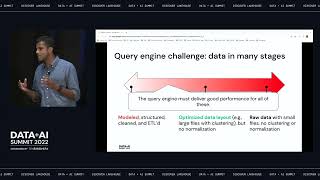
Radical Speed on the Lakehouse: Photon Under the Hood

Many organizations are standardizing on the lakehouse, however, this new architecture poses challenges with an underlying query execution engine for accessing structured and unstructured data. The execution engine needs to provide the performance of a data warehouse and the scalability of data lakes. To ensure optimum performance, the Databricks Lakehouse Platform offers Photon. This next-gen vectorized query execution engine outperforms existing data warehouses in SQL workloads and implements a more general execution framework for efficient processing of data with support of the Apache Spark™ API. With Photon, analytical queries are seeing a 3 to 5x speed increase, with a 40% reduction in compute hours for ETL workloads. In this session, we will dive into Photon, describe its integration with the Databricks Platform and Apache Spark™ runtimes, talk through customer use cases, and show how your SQL and DataFrame workloads can benefit from the performance of Photon.

Connect with us: Website: https://databricks.com Facebook: https://www.facebook.com/databricksinc Twitter: https://twitter.com/databricks LinkedIn: https://www.linkedin.com/company/data... Instagram: https://www.instagram.com/databricksinc/

Rethinking Orchestration as Reconciliation: Software-Defined Assets in Dagster

This talk discusses “software-defined assets”, a declarative approach to orchestration and data management that makes it drastically easier to trust and evolve datasets and ML models. Dagster is an open source orchestrator built for maintaining software-defined assets.

In traditional data platforms, code and data are only loosely coupled. As a consequence, deploying changes to data feels dangerous, backfills are error-prone and irreversible, and it’s difficult to trust data, because you don’t know where it comes from or how it’s intended to be maintained. Each time you run a job that mutates a data asset, you add a new variable to account for when debugging problems.

Dagster proposes an alternative approach to data management that tightly couples data assets to code - each table or ML model corresponds to the function that’s responsible for generating it. This results in a “Data as Code” approach that mimics the “Infrastructure as Code” approach that’s central to modern DevOps. Your git repo becomes your source of truth on your data, so pushing data changes feels as safe as pushing code changes. Backfills become easy to reason about. You trust your data assets because you know how they’re computed and can reproduce them at any time. The role of the orchestrator is to ensure that physical assets in the data warehouse match the logical assets that are defined in code, so each job run is a step towards order.

Software-defined assets is a natural approach to orchestration for the modern data stack, in part because dbt models are a type of software-defined asset.

Attendees of this session will learn how to build and maintain lakehouses of software-defined assets with Dagster.

Connect with us: Website: https://databricks.com Facebook: https://www.facebook.com/databricksinc Twitter: https://twitter.com/databricks LinkedIn: https://www.linkedin.com/company/data... Instagram: https://www.instagram.com/databricksinc/

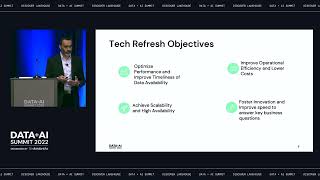
Data Lake for State Health Exchange Analytics using Databricks

One of the largest State based health exchanges in the country was looking to modernize their data warehouse (DWH) environment to support the vision that every decision to design, implement and evaluate their state-based health exchange portal is informed by timely and rigorous evidence about its consumers’ experiences. The scope of the project was to replace existing Oracle-based DWH with an analytics platform that could support a much broader range of requirements with an ability to provide unified analytics capabilities including machine learning. The modernized analytics platform comprises a cloud native data lake and DWH solution using Databricks. The solution provides significantly higher performance and elastic scalability to better handle larger and varying data volumes with a much lower cost of ownership compared to the existing solution. In this session, we will walk through the rationale behind tool selection, solution architecture, project timeline and benefits expected.

Connect with us: Website: https://databricks.com Facebook: https://www.facebook.com/databricksinc Twitter: https://twitter.com/databricks LinkedIn: https://www.linkedin.com/company/data... Instagram: https://www.instagram.com/databricksinc/

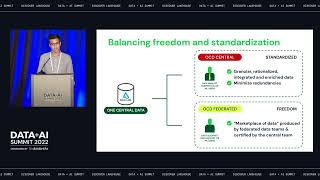
Data Lakehouse and Data Mesh—Two Sides of the Same Coin

Over the last few years two new approaches to data management have been developed in the data community: Data Mesh and Data Lakehouse. The latter is an open architecture that pushes the technological advancements of a Data Lake by adding data management capabilities proven by a long history of Data Warehousing practices. Data Mesh on the other hand is addressing data management challenges from an organizational angle, by advocating decentralized ownership of domain data while applying product thinking and domain-driven design to analytics data. At first one might think that those two architectural approaches are competing with each other, however in this talk you will learn that the two are rather orthogonal and can go very well together.

Connect with us: Website: https://databricks.com Facebook: https://www.facebook.com/databricksinc Twitter: https://twitter.com/databricks LinkedIn: https://www.linkedin.com/company/data... Instagram: https://www.instagram.com/databricksinc/

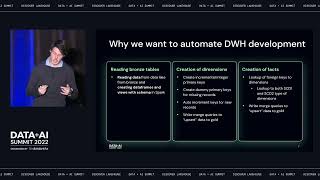
Enabling BI in a Lakehouse Environment: How Spark and Delta Can Help With Automating a DWH Develop

Traditional data warehouses typically struggle when it comes to handling large volumes of data and traffic, particularly when it comes to unstructured data. In contrast, data lakes overcome such issues and have become the central hub for storing data. We outline how we can enable BI Kimball data modelling in a Lakehouse environment.

We present how we built a Spark-based framework to modernize DWH development with data lake as central storage, assuring high data quality and scalability. The framework was implemented at over 15 enterprise data warehouses across Europe.

We present how one can tackle in Spark & with Delta Lake the data warehouse principles like surrogate, foreign and business keys, SCD type 1 and 2 etc. Additionally, we share our experiences on how such a unified data modelling framework can bridge BI with modern day use cases, such as machine learning and real time analytics. The session outlines the original challenges, the steps taken and the technical hurdles we faced.

Connect with us: Website: https://databricks.com Facebook: https://www.facebook.com/databricksinc Twitter: https://twitter.com/databricks LinkedIn: https://www.linkedin.com/company/data... Instagram: https://www.instagram.com/databricksinc/

Data Warehousing on the Lakehouse

Most organizations routinely operate their business with complex cloud data architectures that silo applications, users and data. As a result, there is no single source of truth of data for analytics, and most analysis is performed with stale data. To solve these challenges, the lakehouse has emerged as the new standard for data architecture, with the promise to unify data, AI and analytic workloads in one place. In this session, we will cover why the data lakehouse is the next best data warehouse. You will hear from the experts success stories, use cases, and best practices learned from the field and discover how the data lakehouse ingests, stores and governs business-critical data at scale to build a curated data lake for data warehousing, SQL and BI workloads. You will also learn how Databricks SQL can help you lower costs and get started in seconds with instant, elastic SQL serverless compute, and how to empower every analytics engineers and analysts to quickly find and share new insights using their favorite BI and SQL tools, like Fivetran, dbt, Tableau or PowerBI.

Connect with us: Website: https://databricks.com Facebook: https://www.facebook.com/databricksinc Twitter: https://twitter.com/databricks LinkedIn: https://www.linkedin.com/company/data... Instagram: https://www.instagram.com/databricksinc/

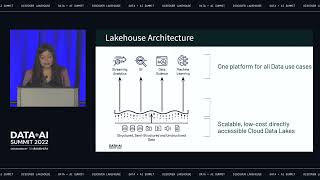
Evolution of Data Architectures and How to Build a Lakehouse

Data architectures are the key and part of a larger picture to building robust analytical and AI applications. One must take a holistic view of the entire data analytics realm when it comes to planning for data science initiatives.

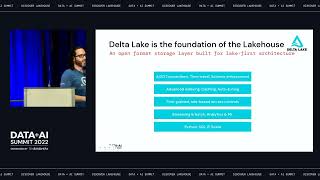
Through this talk, learn about the evolution of the data landscape and why Lakehouses are becoming a de facto for organizations building scalable data architectures. A lakehouse architecture combines data management capability including reliability, integrity, and quality from the data warehouse and supports all data workloads including BI and AI with the low cost and open approach of data lakes.

Data Practitioners will also learn some core concepts of building an efficient Lakehouse with Delta Lake.

Connect with us: Website: https://databricks.com Facebook: https://www.facebook.com/databricksinc Twitter: https://twitter.com/databricks LinkedIn: https://www.linkedin.com/company/data... Instagram: https://www.instagram.com/databricksinc/