talk-data.com talk-data.com

Topic

Python

programming_language data_science web_development

1446

tagged

Activity Trend

185 peak/qtr
2020-Q1 2026-Q1

Activities

1446 activities · Newest first

Many machine learning practitioners dedicate most of their attention to creating and deploying models that solve business problems. However, what happens post-deployment? And how should data teams go about monitoring models in production?

Hakim Elakhrass is the Co-Founder and CEO of NannyML, an open-source python library that allows users to estimate post-deployment model performance, detect data drift, and link data drift alerts back to model performance changes. Originally, Hakim started a machine learning consultancy with his NannyML co-founders, and the need for monitoring quickly arose, leading to the development of NannyML.

Hakim joins the show to discuss post-deployment data science, the real-world use cases for tools like NannyML, the potentially catastrophic effects of unmonitored models in production, the most important skills for modern data scientists to cultivate, and more.

Python for Data Science

Python is an ideal choice for accessing, manipulating, and gaining insights from data of all kinds. Python for Data Science introduces you to the Pythonic world of data analysis with a learn-by-doing approach rooted in practical examples and hands-on activities. Youâ??ll learn how to write Python code to obtain, transform, and analyze data, practicing state-of-the-art data processing techniques for use cases in business management, marketing, and decision support. You will discover Pythonâ??s rich set of built-in data structures for basic operations, as well as its robust ecosystem of open-source libraries for data science, including NumPy, pandas, scikit-learn, matplotlib, and more. Examples show how to load data in various formats, how to streamline, group, and aggregate data sets, and how to create charts, maps, and other visualizations. Later chapters go in-depth with demonstrations of real-world data applications, including using location data to power a taxi service, market basket analysis to identify items commonly purchased together, and machine learning to predict stock prices.

One of the biggest challenges facing the adoption of machine learning and AI in Data Science is understanding, interpreting, and explaining models and their outcomes to produce higher certainty, accountability, and fairness.

Serg Masis is a Climate & Agronomic Data Scientist at Syngenta and the author of the book, Interpretable Machine Learning with Python. For the last two decades, Serg has been at the confluence of the internet, application development, and analytics. Serg is a true polymath. Before his current role, he co-founded a search engine startup incubated by Harvard Innovation Labs, was the proud owner of a Bubble Tea shop, and more.

Throughout the episode, Serg spoke about the different challenges affecting model interpretability in machine learning, how bias can produce harmful outcomes in machine learning systems, the different types of technical and non-technical solutions to tackling bias, the future of machine learning interpretability, and much more.

Summary Exploratory data analysis works best when the feedback loop is fast and iterative. This is easy to achieve when you are working on small datasets, but as they scale up beyond what can fit on a single machine those short iterations quickly become long and tedious. The Arkouda project is a Python interface built on top of the Chapel compiler to bring back those interactive speeds for exploratory analysis on horizontally scalable compute that parallelizes operations on large volumes of data. In this episode David Bader explains how the framework operates, the algorithms that are built into it to support complex analyses, and how you can start using it today.

Announcements

Hello and welcome to the Data Engineering Podcast, the show about modern data management When you’re ready to build your next pipeline, or want to test out the projects you hear about on the show, you’ll need somewhere to deploy it, so check out our friends at Linode. With their new managed database service you can launch a production ready MySQL, Postgres, or MongoDB cluster in minutes, with automated backups, 40 Gbps connections from your application hosts, and high throughput SSDs. Go to dataengineeringpodcast.com/linode today and get a $100 credit to launch a database, create a Kubernetes cluster, or take advantage of all of their other services. And don’t forget to thank them for their continued support of this show! Data stacks are becoming more and more complex. This brings infinite possibilities for data pipelines to break and a host of other issues, severely deteriorating the quality of the data and causing teams to lose trust. Sifflet solves this problem by acting as an overseeing layer to the data stack – observing data and ensuring it’s reliable from ingestion all the way to consumption. Whether the data is in transit or at rest, Sifflet can detect data quality anomalies, assess business impact, identify the root cause, and alert data teams’ on their preferred channels. All thanks to 50+ quality checks, extensive column-level lineage, and 20+ connectors across the Data Stack. In addition, data discovery is made easy through Sifflet’s information-rich data catalog with a powerful search engine and real-time health statuses. Listeners of the podcast will get $2000 to use as platform credits when signing up to use Sifflet. Sifflet also offers a 2-week free trial. Find out more at dataengineeringpodcast.com/sifflet today! RudderStack helps you build a customer data platform on your warehouse or data lake. Instead of trapping data in a black box, they enable you to easily collect customer data from the entire stack and build an identity graph on your warehouse, giving you full visibility and control. Their SDKs make event streaming from any app or website easy, and their state-of-the-art reverse ETL pipelines enable you to send enriched data to any cloud tool. Sign up free… or just get the free t-shirt for being a listener of the Data Engineering Podcast at dataengineeringpodcast.com/rudder. Data teams are increasingly under pressure to deliver. According to a recent survey by Ascend.io, 95% in fact reported being at or over capacity. With 72% of data experts reporting demands on their team going up faster than they can hire, it’s no surprise they are increasingly turning to automation. In fact, while only 3.5% report having current investments in automation, 85% of data teams plan on investing in automation in the next 12 months. 85%!!! That’s where our friends at Ascend.io come in. The Ascend Data Automation Cloud provides a unified platform for data ingestion, transformation, orchestration, and observability. Ascend users love its declarative pipelines, powerful SDK, elegant UI, and extensible plug-in architecture, as well as its support for Python, SQL, Scala, and Java. Ascend automates workloads on Snowflake, Databricks, BigQuery, and open source Spark, and can be deployed in AWS, Azure, or GCP. Go to dataengineeringpodc

Simplifying Data Engineering and Analytics with Delta

This book will guide you through mastering Delta, a robust and versatile protocol for data engineering and analytics. You'll discover how Delta simplifies data workflows, supports both batch and streaming data, and is optimized for analytics applications in various industries. By the end, you will know how to create high-performing, analytics-ready data pipelines. What this Book will help me do Understand Delta's unique offering for unifying batch and streaming data processing. Learn approaches to address data governance, reliability, and scalability challenges. Gain technical expertise in building data pipelines optimized for analytics and machine learning use. Master core concepts like data modeling, distributed computing, and Delta's schema evolution features. Develop and deploy production-grade data engineering solutions leveraging Delta for business intelligence. Author(s) Anindita Mahapatra is an experienced data engineer and author with years of expertise in working on Delta and data-driven solutions. Her hands-on approach to explaining complex data concepts makes this book an invaluable resource for professionals in data engineering and analytics. Who is it for? Ideal for data engineers, data analysts, and anyone involved in AI/BI workflows, this book suits learners with some basic knowledge of SQL and Python. Whether you're an experienced professional or looking to upgrade your skills with Delta, this book will provide practical insights and actionable knowledge.

Summary The current stage of evolution in the data management ecosystem has resulted in domain and use case specific orchestration capabilities being incorporated into various tools. This complicates the work involved in making end-to-end workflows visible and integrated. Dagster has invested in bringing insights about external tools’ dependency graphs into one place through its "software defined assets" functionality. In this episode Nick Schrock discusses the importance of orchestration and a central location for managing data systems, the road to Dagster’s 1.0 release, and the new features coming with Dagster Cloud’s general availability.

Announcements

Hello and welcome to the Data Engineering Podcast, the show about modern data management When you’re ready to build your next pipeline, or want to test out the projects you hear about on the show, you’ll need somewhere to deploy it, so check out our friends at Linode. With their new managed database service you can launch a production ready MySQL, Postgres, or MongoDB cluster in minutes, with automated backups, 40 Gbps connections from your application hosts, and high throughput SSDs. Go to dataengineeringpodcast.com/linode today and get a $100 credit to launch a database, create a Kubernetes cluster, or take advantage of all of their other services. And don’t forget to thank them for their continued support of this show! RudderStack helps you build a customer data platform on your warehouse or data lake. Instead of trapping data in a black box, they enable you to easily collect customer data from the entire stack and build an identity graph on your warehouse, giving you full visibility and control. Their SDKs make event streaming from any app or website easy, and their state-of-the-art reverse ETL pipelines enable you to send enriched data to any cloud tool. Sign up free… or just get the free t-shirt for being a listener of the Data Engineering Podcast at dataengineeringpodcast.com/rudder. Data teams are increasingly under pressure to deliver. According to a recent survey by Ascend.io, 95% in fact reported being at or over capacity. With 72% of data experts reporting demands on their team going up faster than they can hire, it’s no surprise they are increasingly turning to automation. In fact, while only 3.5% report having current investments in automation, 85% of data teams plan on investing in automation in the next 12 months. 85%!!! That’s where our friends at Ascend.io come in. The Ascend Data Automation Cloud provides a unified platform for data ingestion, transformation, orchestration, and observability. Ascend users love its declarative pipelines, powerful SDK, elegant UI, and extensible plug-in architecture, as well as its support for Python, SQL, Scala, and Java. Ascend automates workloads on Snowflake, Databricks, BigQuery, and open source Spark, and can be deployed in AWS, Azure, or GCP. Go to dataengineeringpodcast.com/ascend and sign up for a free trial. If you’re a data engineering podcast listener, you get credits worth $5,000 when you become a customer. Your host is Tobias Macey and today I’m interviewing Nick Schrock about software defined assets and improving the developer experience for data orchestration with Dagster

Interview

Introduction How did you get involved in the area of data management? What are the notable updates in Dagster since the last time we spoke? (November, 2021) One of the core concepts that you introduced and then stabilized in recent releases is the "software defined asset" (SDA). How have your users reacted to this capability?

What are the notable outcomes in development and product practices that you have seen as a result?

What are the changes to the interfaces and internals of Dagster that were necessary to support SDA? How did the API design shift from the initial implementation once the community started providing feedback? You’re releasing the stable 1.0 version of Dagster as part of something call

State-of-the-Art Natural Language Processing with Apache Spark NLP

This session teaches how & why to use the open-source Spark NLP library. Spark NLP provides state-of-the-art accuracy, speed, and scalability for language understanding by delivering production-grade implementations of recent research advances. Spark NLP is the most widely used NLP library in the enterprise today; provides thousands of current, supported, pre-trained models for 200+ languages out of the box; and is the only open-source NLP library that can natively scale to use any Apache Spark cluster.

We’ll walk through Python code running common NLP tasks like document classification, named entity recognition, sentiment analysis, spell checking, question answering, and translation. The discussion of each task includes the latest advances in deep learning and transfer learning used to tackle it. We’ll also cover new free tools for data annotation, no-code active learning & transfer learning, easily deploying NLP models as production-grade services, and sharing models you’ve trained.

Connect with us: Website: https://databricks.com Facebook: https://www.facebook.com/databricksinc Twitter: https://twitter.com/databricks LinkedIn: https://www.linkedin.com/company/data... Instagram: https://www.instagram.com/databricksinc/

Power to the (SQL) People: Python UDFs in DBSQL

Databricks SQL (DB SQL) allows customers to leverage the simple and powerful Lakehouse architecture with up to 12x better price/performance compared to traditional cloud data warehouses. Analysts can use standard SQL to easily query data and share insights using a query editor, dashboards or a BI tool of their choice, and analytics engineers can build and maintain efficient data pipelines, including with tools like dbt.

While SQL is great at querying and transforming data, sometimes you need to extend its capabilities with the power of Python, a full programming language. Users of Databricks notebooks already enjoy seamlessly mixing SQL, Python and several other programming languages. Use cases include masking or encrypting and decrypting sensitive data, complex transformation logic, using popular open source libraries or simply reusing code that has already been written elsewhere in Databricks. In many cases, it is simply prohibitive or even impossible to rewrite the logic in SQL.

Up to now, there was no way to use Python from within DBSQL. We are removing this restriction with the introduction of Python User Defined Functions (UDFs). DBSQL users can now create, manage and use Python UDFs using standard SQL. UDFs are registered in Unity Catalog, which means they can be governed and used throughout Databricks, including in notebooks.

Connect with us: Website: https://databricks.com Facebook: https://www.facebook.com/databricksinc Twitter: https://twitter.com/databricks LinkedIn: https://www.linkedin.com/company/data... Instagram: https://www.instagram.com/databricksinc/

Learn to Efficiently Test ETL Pipelines

This talk is a story, using examples in Python and pySpark, about testing ETL pipelines efficiently. I won’t try to convince you that you need unit tests or automated tests – that’s up to you. If you do have unit tests for your ETL pipelines, or if you want them, it can be useful to make sure you aren’t testing more than you need.

I’ll be describing how a practical (non-pyramid shaped) heuristic helps me efficiently cover edge cases and unexpected bugs in my code by ensuring I test only the code needed for the feature I’m building.

Connect with us: Website: https://databricks.com Facebook: https://www.facebook.com/databricksinc Twitter: https://twitter.com/databricks LinkedIn: https://www.linkedin.com/company/data... Instagram: https://www.instagram.com/databricksinc/

Near Real-Time Analytics with Event Streaming, Live Tables, and Delta Sharing

Microservices is an increasingly popular architecture much loved by application teams, for it allows services to be developed and scaled independently. Data teams, though, often need a centralized repository where all data from different services come together to join and aggregate. The data platform can serve as a single source of company facts, enable near real time analytics, and secure sharing of massive data sets across clouds.

A viable microservices ingestion pattern is Change Data Capture, using AWS Database Migration Services or Debezium. CDC proves to be a scalable solution ideal for stable platforms, but it has several challenges for evolving services: Frequent schema changes, complex, unsupported DDL during migration, and automated deployments are but a few. An event streaming architecture can address these challenges.

Confluent, for example, provides a schema registry service where all services can register their event schemas. Schema registration helps with verifying that the events are being published based on the agreed contracts between data producers and consumers. It also provides a separation between internal service logic and the data consumed downstream. The services write their events to Kafka using the registered schemas with a specific topic based on the type of the event.

Data teams can leverage Spark jobs to ingest Kafka topics into Bronze tables in the Delta Lake. On ingestion, the registered schema from schema registry is used to validate the schema based on the provided version. A merge operation is sometimes called to translate events into final states of the records per business requirements.

Data teams can take advantage of Delta Live Tables on streaming datasets to produce Silver and Gold tables in near real time. Each input data source also has a set of expectations to ensure data quality and business rules. The pipeline allows Engineering and Analytics to collaborate by mixing Python and SQL. The refined data sets are then fed into Auto ML for discovery and baseline modeling.

To expose Gold tables to more consumers, especially non spark users across clouds, data teams can implement Delta Sharing. Recipients can accesses Silver tables from a different cloud and build their own analytics data sets. Analytics teams can also access Gold tables via pandas Delta Sharing client and BI tools.

Connect with us: Website: https://databricks.com Facebook: https://www.facebook.com/databricksinc Twitter: https://twitter.com/databricks LinkedIn: https://www.linkedin.com/company/data... Instagram: https://www.instagram.com/databricksinc/

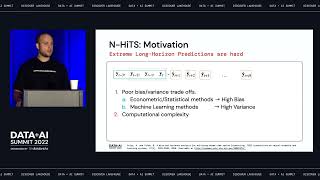
Nixtla: Deep Learning for Time Series Forecasting

Time series forecasting has a wide range of applications: finance, retail, healthcare, IoT, etc. Recently deep learning models such as ESRNN or N-BEATS have proven to have state-of-the-art performance in these tasks. Nixtlats is a python library that we have developed to facilitate the use of these state-of-the-art models to data scientists and developers, so that they can use them in productive environments. Written in pytorch, its design is focused on usability and reproducibility of experiments. For this purpose, nixtlats has several modules:

Data: contains datasets of various time series competencies. Models: includes state-of-the-art models. Evaluation: has various loss functions and evaluation metrics.

Objective:

  • To introduce attendees to the challenges of time series forecasting with deep learning.
  • Commercial applications of time series forecasting.
  • Describe nixtlats, their components and best practices for training and deploying state-of-the-art models in production.
  • Reproduction of state-of-the-art results using nixtlats from the winning model of the M4 time series competition (ESRNN).

Project repository: https://github.com/Nixtla/nixtlats.

Connect with us: Website: https://databricks.com Facebook: https://www.facebook.com/databricksinc Twitter: https://twitter.com/databricks LinkedIn: https://www.linkedin.com/company/data... Instagram: https://www.instagram.com/databricksinc/

PySpark in Apache Spark 3.3 and Beyond

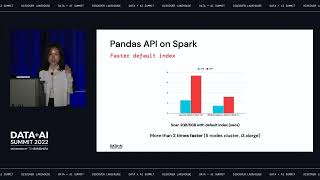
PySpark has rapidly evolved with the momentum of Project Zen introduced in Apache Spark 3.0. We improved error messages, added type hints for autocompletion, implemented visualization, etc. Most importantly, Pandas API on Spark was introduced from Apache Spark 3.2 which exposes the pandas API that runs on Apache Spark, and the Pandas API on Spark has gained a lot of popularity.

In Apache Spark 3.3, the effort of Project Zen continued and PySpark has many cool changes such as more API coverage & faster default index in Pandas API on Spark, datetime.timedelta support, new PyArrow batch interface, better autocompletion, Python & Pandas UDF profiler and new error classification.

In this talk, we will introduce what is new in PySpark at Apache Spark 3.3, and what is next beyond Apache Spark 3.3 with the current effort and roadmap in PySpark.

Connect with us: Website: https://databricks.com Facebook: https://www.facebook.com/databricksinc Twitter: https://twitter.com/databricks LinkedIn: https://www.linkedin.com/company/data... Instagram: https://www.instagram.com/databricksinc/

Scaling AI Workloads with the Ray Ecosystem

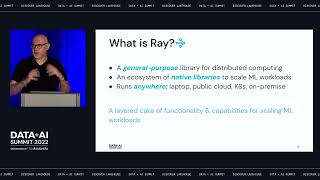
Modern machine learning (ML) workloads, such as deep learning and large-scale model training, are compute-intensive and require distributed execution. Ray is an open-source, distributed framework from U.C. Berkeley’s RISELab that easily scales Python applications and ML workloads from a laptop to a cluster, with an emphasis on the unique performance challenges of ML/AI systems. It is now used in many production deployments.

This talk will cover Ray’s overview, architecture, core concepts, and primitives, such as remote Tasks and Actors; briefly discuss Ray’s native libraries (Ray Tune, Ray Train, Ray Serve, Ray Datasets, RLlib); and Ray’s growing ecosystem to scale your Python or ML workloads.

Through a demo using XGBoost for classification, we will demonstrate how you can scale training, hyperparameter tuning, and inference—from a single node to a cluster, with tangible performance difference when using Ray.

The takeaways from this talk are :

Learn Ray architecture, core concepts, and Ray primitives and patterns Why Distributed computing will be the norm not an exception How to scale your ML workloads with Ray libraries: Training on a single node vs. Ray cluster, using XGBoost with/without Ray Hyperparameter search and tuning, using XGBoost with Ray and Ray Tune Inferencing at scale, using XGBoost with/without Ray

Connect with us: Website: https://databricks.com Facebook: https://www.facebook.com/databricksinc Twitter: https://twitter.com/databricks LinkedIn: https://www.linkedin.com/company/data... Instagram: https://www.instagram.com/databricksinc/

Tools for Assisted Apache Spark Version Migrations, From 2.1 to 3.2+

This talk will look at the current state of tools to automate library and language upgrades in Python and Scala and apply them to upgrading to new version of Apache Spark. After doing a very informal survey, it seems that many users are stuck on no longer supported versions of Spark, so this talk will expand on the first attempt at automating upgrades (2.4 - 3.0) to explore the problem all the way back to 2.1.

Connect with us: Website: https://databricks.com Facebook: https://www.facebook.com/databricksinc Twitter: https://twitter.com/databricks LinkedIn: https://www.linkedin.com/company/data... Instagram: https://www.instagram.com/databricksinc/

FugueSQL—The Enhanced SQL Interface for Pandas and Spark DataFrames

SQL users working with Pandas and Spark quickly realize SQL is a second-class interface, invoked between predominantly Python code.

We will introduce FugueSQL, an enhanced SQL interface that allows SQL lovers to express end-to-end workflows predominantly in SQL. With a Jupyter notebook extension, SQL commands can be used in Databricks notebooks for interactive handling of in-memory datasets. This allows heavy SQL users to fully leverage Spark in their preferred grammar.

Connect with us: Website: https://databricks.com Facebook: https://www.facebook.com/databricksinc Twitter: https://twitter.com/databricks LinkedIn: https://www.linkedin.com/company/data... Instagram: https://www.instagram.com/databricksinc/

X-FIPE: eXtended Feature Impact for Prediction Explanation

Many enterprises have built their own machine learning platforms in the cloud using Databricks, e.g. Humana FlorenceAI. In order to effectively drive the adoption of predictive models in daily business operations, data scientists and business teams need to work closely to make sure they serve the consumer needs in compliance with regulatory rules. Model interpretability is key. In this talk, we would like to share an explainable AI algorithm developed at Humana, X-FIPE, eXtended Feature Impact for Prediction Explanation.

X-FIPE is a top-driver algorithm to calculate feature importance for any machine learning predictive models, whether it is Python or PySpark, at a local level. Instead of showing the feature importance on a population level, it can find the top drivers for each observation or member. These top drivers could differ widely from one member to another member in the population. it not only helps explain the predictive model, but also offer users actionable insights.

Compared with widely used algorithms, e.g. LIME, SHAP, and FIPE, X-FIPE improves the time complexity from linear O(n) to logarithmic O(log(n)), where n is the number of used model features. Also, we discovered the connection between X-FIPE value and Shapley value -- X-FIPE a first order approximation of Shapley value. Our observation shows that the most contribution of Shapley value of a feature comes from the marginal contribution when it is first added and when it is last removed from the full features. This is why the X-FIPE keeps enough accuracy and also reduces the computation.

Hopefully this talk will provide you a path forward to include explainable AI into your machine learning workflows, you are encouraged to try out and contribute to our open source Python package xfipe soon to come.

Connect with us: Website: https://databricks.com Facebook: https://www.facebook.com/databricksinc Twitter: https://twitter.com/databricks LinkedIn: https://www.linkedin.com/company/data... Instagram: https://www.instagram.com/databricksinc/

dbt and Python—Better Together

Drew Banin is the co-founder of dbt Labs and one of the maintainers of dbt Core, the open source standard in data modeling and transformation. In this talk, he will demonstrate an approach to unifying SQL and Python workloads under a single dbt execution graph, illustrating the powerful, flexible nature of dbt running on Databricks.

Connect with us: Website: https://databricks.com Facebook: https://www.facebook.com/databricksinc Twitter: https://twitter.com/databricks LinkedIn: https://www.linkedin.com/company/data... Instagram: https://www.instagram.com/databricksinc/

dbt + Machine Learning: What Makes a Great Baton Pass?

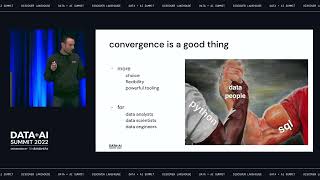
dbt has done a great job of building an elegant, common interface between data engineers and data analysts: uniting on SQL. As the data industry evolves, there's plenty of pain and room to grow in building that interface between data scientists and data analysts. There isn't a good answer for when things go wrong in the machine learning arena: should the data analyst own fine-tuning the pre-processing data(think: prepping transformed data even more for machine learning models to better work with the data). Should we increase the SQL surface area to build ML models or should we leave that to non-SQL interfaces(python/scala/etc.)? Does this have to be an either/or future? Whatever the interface evolves into, it must center people, create a low bar and high ceiling, and focus on outcomes and not the mystique of features/tools behind a learning curve.

Connect with us: Website: https://databricks.com Facebook: https://www.facebook.com/databricksinc Twitter: https://twitter.com/databricks LinkedIn: https://www.linkedin.com/company/data... Instagram: https://www.instagram.com/databricksinc/

Delta Lake 2.0 Overview

After three years of hard work by the Delta community, we are proud to announce the release of Delta Lake 2.0. Completing the work to open-source all of Delta Lake while tens of thousands of organizations were running in production was no small feat and we have the ever-expanding Delta community to thank! Join this session to learn about how the wider Delta community collaborated together to bring these features and integrations together.

Join this session to learn about how the wider Delta community collaborated together to bring these features and integrations together. This includes the Integrations with Apache Spark™, Apache Flink, Apache Pulsar, Presto, Trino, and more.

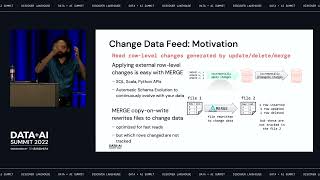
Features such as OPTIMIZE ZORDER, data skipping using column stats, S3 multi-cluster writes, Change Data Feed, and more.

Language APIs including Rust, Python, Ruby, GoLang, Scala, and Java.

Connect with us: Website: https://databricks.com Facebook: https://www.facebook.com/databricksinc Twitter: https://twitter.com/databricks LinkedIn: https://www.linkedin.com/company/data... Instagram: https://www.instagram.com/databricksinc/

ÀLaSpark: Gousto's Recipe for Building Scalable PySpark Pipelines

Find out how Gousto is developing its data pipelines at scale in a repeatable manner. At Gousto, we’ve developed Goustospark - a wrapper around pyspark that allows us to quickly and easily build data pipelines that are deployed into our Databricks environment.

This wrapper abstracts repetitive components of all data pipelines such as spark configurations and metastore interactions. This allows a developer to simply specify the blueprints of the pipeline before turning their attention to more pressing issues, such as data quality and data governance, whilst enjoying a high level of performance and reliability.

In this session we will deep dive into the design patterns we followed, some unique approaches we’ve taken on how we structure pipelines and show a live demo of implementing a new spark streaming pipeline in Databricks from scratch. We will even share some example python code and snippets to help you build your own.

Connect with us: Website: https://databricks.com Facebook: https://www.facebook.com/databricksinc Twitter: https://twitter.com/databricks LinkedIn: https://www.linkedin.com/company/data... Instagram: https://www.instagram.com/databricksinc/