talk-data.com talk-data.com

Topic

Rust

programming_language

18

tagged

Activity Trend

11 peak/qtr
2020-Q1 2026-Q1

Activities

18 activities · Newest first

Advancing Windows device security through Surface innovation

Discover how Surface and Microsoft boost Windows device security with memory-safe Rust firmware and drivers, reducing vulnerabilities and improving reliability. Learn about the open-source windows-drivers-rs project and how IT and engineering teams can help build safer, resilient devices through collaborative innovation and Microsoft’s commitment to secure, inclusive technology.

Advanced Polars: Lazy Queries and Streaming Mode

Do you find yourself struggling with Pandas' limitations when handling massive datasets or real-time data streams?

Discover Polars, the lightning-fast DataFrame library built in Rust. This talk presents two advanced features of the next-generation dataframe library: lazy queries and streaming mode.

Lazy evaluation in Polars allows you to build complex data pipelines without the performance bottlenecks of eager execution. By deferring computation, Polars optimises your queries using techniques like predicate and projection pushdown, reducing unnecessary computations and memory overhead. This leads to significant performance improvements, particularly with datasets larger than your system’s physical memory.

Polars' LazyFrames form the foundation of the library’s streaming mode, enabling efficient streaming pipelines, real-time transformations, and seamless integration with various data sinks.

This session will explore use cases and technical implementations of both lazy queries and streaming mode. We’ll also include live-coding demonstrations to introduce the tool, showcase best practices, and highlight common pitfalls.

Attendees will walk away with practical knowledge of lazy queries and streaming mode, ready to apply these tools in their daily work as data engineers or data scientists.

Using Delta-rs and Delta-Kernel-rs to Serve CDC Feeds

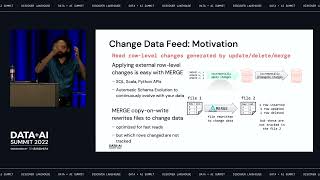
Change data feeds are a common tool for synchronizing changes between tables and performing data processing in a scalable fashion. Serverless architectures offer a compelling solution for organizations looking to avoid the complexity of managing infrastructure. But how can you bring CDFs into a serverless environment? In this session, we'll explore how to integrate Change Data Feeds into serverless architectures using Delta-rs and Delta-kernel-rs—open-source projects that allow you to read Delta tables and their change data feeds in Rust or Python. We’ll demonstrate how to use these tools with Lakestore’s serverless platform to easily stream and process changes. You’ll learn how to: Leverage Delta tables and CDFs in serverless environments Utilize Databricks and Unity Catalog without needing Apache Spark

Delta-Kernel-RS: Unparalleled Interoperability Across Query Engines

Join us as we introduce Delta-Kernel-RS, a new Rust implementation of the Delta Lake protocol designed for unparalleled interoperability across query engines. In this session, we will explore how maintaining a native implementation of the Delta specification — with native C and C++ FFI support — can deliver consistent benefits across diverse data processing systems, eliminating the need for repetitive, engine-specific reimplementations. We will dive deep into a real-world case study where a query engine harnessed Delta-Kernel-RS to unlock significant data skipping improvements — enhancements achieved “for free” by leveraging the kernel. Attendees will gain insights into the architectural decisions, interoperability strategies and the practical impact of this innovation on performance and development efficiency in modern data ecosystems.

Delta Kernel for Rust and Java

Delta Kernel makes it easy for engines and connectors to read and write Delta tables. It supports many Delta features and robust connectors, including DuckDB, Clickhouse, Spice AI and delta-dotnet. In this session, we'll cover lessons learned about how to build a high-performance library that lets engines integrate the way they want, while not having to worry about the details of the Delta protocol. We'll talk through how we streamlined the API as well as its changes and underlying motivations. We'll discuss some new highlight features like write support, and the ability to do CDF scans. Finally we'll cover the future roadmap for the Kernel project and what you can expect from the project over the coming year.

Delta-rs Turning Five: Growing Pains and Life Lessons

Five years ago, the delta-rs project embarked on a journey to bring Delta Lake's robust capabilities to the Rust & Python ecosystem. In this talk, we'll delve into the triumphs, tribulations and lessons learned along the way. We'll explore how delta-rs has matured alongside the thriving Rust data ecosystem, adapting to its evolving landscape and overcoming the challenges of maintaining a complex data project. Join us as we share insights into the project's evolution, the symbiotic relationship between delta-rs and the Rust community, and the current hurdles and future directions that lie ahead. Audio for this session is delivered in the conference mobile app, you must bring your own headphones to listen.

Matteo Pelati: Challenges of Building Blazing Fast Data APIs

Join Matteo Pelati as he delves into the world of blazing fast Data APIs, sharing his extensive experience in overcoming the challenges of crafting efficient, customer-facing data interfaces. 🚀📊 Discover valuable insights and leaner approaches, including the use of cutting-edge tools like Rust, in this enlightening session. 🛠️🔥 #DataAPIs #Efficiency

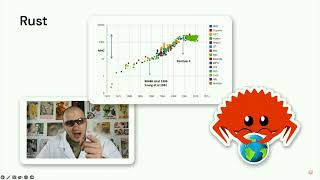
Delta-rs, Apache Arrow, Polars, WASM: Is Rust the Future of Analytics?

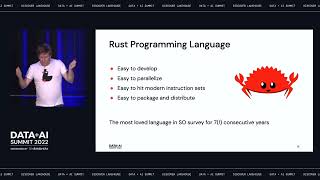
Rust is a unique language whose traits make it very appealing for data engineering. In this session, we'll walk through the different aspects of the language that make it such a good fit for big data processing including: how it improves performance and how it provides greater safety guarantees and compatibility with a wide range of existing tools that make it well positioned to become a major building block for the future of analytics.

We will also take a hands-on look through real code examples at a few emerging technologies built on top of Rust that utilize these capabilities, and learn how to apply them to our modern lakehouse architecture.

Talk by: Oz Katz

Here’s more to explore: Why the Data Lakehouse Is Your next Data Warehouse: https://dbricks.co/3Pt5unq Lakehouse Fundamentals Training: https://dbricks.co/44ancQs

Connect with us: Website: https://databricks.com Twitter: https://twitter.com/databricks LinkedIn: https://www.linkedin.com/company/databricks Instagram: https://www.instagram.com/databricksinc Facebook: https://www.facebook.com/databricksinc

Delta Kernel: Simplifying Building Connectors for Delta

Since the release of Delta 2.0, the project has been growing at a breakneck speed. In this session, we will cover all the latest capabilities that makes Delta Lake the best format for the lakehouse. Based on lessons learned from this past year, we will introduce Project Aqueduct and how we will simplify building Delta Lake APIs from Rust and Go to Trino, Flink, and PySpark.

Talk by: Tathagata Das and Denny Lee

Connect with us: Website: https://databricks.com Twitter: https://twitter.com/databricks LinkedIn: https://www.linkedin.com/company/databricks Instagram: https://www.instagram.com/databricksinc Facebook: https://www.facebook.com/databricksinc

How to Build a Streaming Database in Three Challenging Steps | Materialize

ABOUT THE TALK: A streaming database is a potentially intimidating product to build. Frank McSherry, Chief Scientist at Materialize, breaks down the manageable parts, through three foundational choices that fit together well. Frank also talks about the trade-offs, and how their simplifications lead to a much more manageable streaming database.

ABOUT THE SPEAKER: Frank McSherry is Chief Scientist at Materialize, where he (and others) convert SQL into scale-out, streaming, and interactive dataflows. Before this, he developed the timely and differential dataflow Rust libraries (with colleagues at ETHZ), and led the Naiad research project and co-invented differential privacy while at MSR Silicon Valley. He has a PhD in computer science from the University of Washington.

ABOUT DATA COUNCIL: Data Council (https://www.datacouncil.ai/) is a community and conference series that provides data professionals with the learning and networking opportunities they need to grow their careers.

Make sure to subscribe to our channel for the most up-to-date talks from technical professionals on data related topics including data infrastructure, data engineering, ML systems, analytics and AI from top startups and tech companies.

FOLLOW DATA COUNCIL: Twitter: https://twitter.com/DataCouncilAI LinkedIn: https://www.linkedin.com/company/datacouncil-ai/

Creating our Own Kubernetes & Docker to Run Our Data Infrastructure | Modal

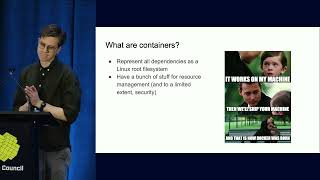
ABOUT THE TALK: In this talk, Erik Bernhardsson will share how Modal starts 1000s of large containers in seconds, and what they had to do under the surface to build this. This includes a custom file system written in Rust, their own container runtime, and their own container image builder. This talk will give you an idea of how containers work along with some of the low-level Linux details underneath. We'll also talk about many infrastructure tools hold data teams back, and why they deserve faster and better tools.

ABOUT THE SPEAKER: Erik Bernhardsson is the founder and CEO of Modal, which is an infrastructure provider for data teams. Before Modal, Erik was the CTO at Better for six years, and previously spent seven years at Spotify, building the music recommendation system and running data teams.

ABOUT DATA COUNCIL: Data Council (https://www.datacouncil.ai/) is a community and conference series that provides data professionals with the learning and networking opportunities they need to grow their careers.

Make sure to subscribe to our channel for the most up-to-date talks from technical professionals on data related topics including data infrastructure, data engineering, ML systems, analytics and AI from top startups and tech companies.

FOLLOW DATA COUNCIL: Twitter: https://twitter.com/DataCouncilAI LinkedIn: https://www.linkedin.com/company/datacouncil-ai/

Sound Data Engineering in Rust—From Bits to DataFrames

Spark applications often need to query external data sources such as file-based data sources or relational data sources. In order to do this, Spark provides Data Source APIs to access structured data through Spark SQL.

Data Source APIs have optimization rules such as filter push down and column pruning to reduce the amount of data that needs to be processed to improve query performance. As part of our ongoing project to provide generic Data Source V2 push down APIs, we have introduced partial aggregate push down, which significantly speeds up spark jobs by dramatically reducing the amount of data transferred between data sources and Spark. We have implemented aggregate push down in both JDBC and parquet.

Connect with us: Website: https://databricks.com Facebook: https://www.facebook.com/databricksinc Twitter: https://twitter.com/databricks LinkedIn: https://www.linkedin.com/company/data... Instagram: https://www.instagram.com/databricksinc/

Streaming Data into Delta Lake with Rust and Kafka

Scribd's data architecture was originally batch-oriented, but in the last couple years, we introduced streaming data ingestion to provide near-real-time ad hoc query capability, mitigate the need for more batch processing tasks, and set the foundation for building real-time data applications.

Kafka and Delta Lake are the two key components of our streaming ingestion pipeline. Various applications and services write messages to Kafka as events are happening. We were tasked with getting these messages into Delta Lake quickly and efficiently.

Our first solution was to deploy Spark Structured Streaming jobs. This got us off the ground quickly, but had some downsides.

Since Delta Lake and the Delta transaction protocol are open source, we kicked off a project to implement our own Rust ingestion daemon. We were confident we could deliver a Rust implementation since our ingestion jobs are append only. Rust offers high performance with a focus on code safety and modern syntax.

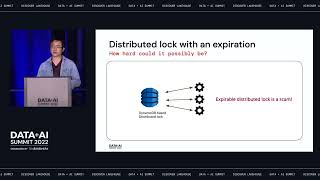
In this talk I will describe Scribd's unique approach to ingesting messages from Kafka topics into Delta Lake tables. I will describe the architecture, deployment model, and performance of our solution, which leverages the kafka-delta-ingest Rust daemon and the delta-rs crate hosted in auto-scaling ECS services. I will discuss foundational design aspects for achieving data integrity such as distributed locking with DynamoDb to overcome S3's lack of "PutIfAbsent" semantics, and avoiding duplicates or data loss when multiple concurrent tasks are handling the same stream. I'll highlight the reliability and performance characteristics we've observed so far. I'll also describe the Terraform deployment model we use to deliver our 70-and-growing production ingestion streams into AWS.

Connect with us: Website: https://databricks.com Facebook: https://www.facebook.com/databricksinc Twitter: https://twitter.com/databricks LinkedIn: https://www.linkedin.com/company/data... Instagram: https://www.instagram.com/databricksinc/
Ensuring Correct Distributed Writes to Delta Lake in Rust with Formal Verification

Rust guarantees zero memory access bug once a program compiles. However, one can still introduce logical bugs in the implementation.

In this talk, I will first give a high level overview on common formal verification methods used in distributed system designs and implementations. Then I will talk about our experiences with using TLA+ and Stateright to formally model delta-rs' multi-writer S3 backend implementation. The end result of combining both Rust and formal verification is we end up with an efficient native Delta Lake implementation that is both memory safe and logical bug free!

Connect with us: Website: https://databricks.com Facebook: https://www.facebook.com/databricksinc Twitter: https://twitter.com/databricks LinkedIn: https://www.linkedin.com/company/data... Instagram: https://www.instagram.com/databricksinc/
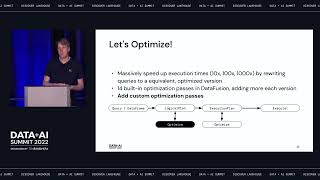
DataFusion and Arrow: Supercharge Your Data Analytical Tool with a Rusty Query Engine

Learn how Rust, the Apache Arrow project, and the Data Fusion Query Engine are increasingly being used to accelerate the creation of modern data stacks.

Connect with us: Website: https://databricks.com Facebook: https://www.facebook.com/databricksinc Twitter: https://twitter.com/databricks LinkedIn: https://www.linkedin.com/company/data... Instagram: https://www.instagram.com/databricksinc/
Delta Lake 2.0 Overview

After three years of hard work by the Delta community, we are proud to announce the release of Delta Lake 2.0. Completing the work to open-source all of Delta Lake while tens of thousands of organizations were running in production was no small feat and we have the ever-expanding Delta community to thank! Join this session to learn about how the wider Delta community collaborated together to bring these features and integrations together.

Join this session to learn about how the wider Delta community collaborated together to bring these features and integrations together. This includes the Integrations with Apache Spark™, Apache Flink, Apache Pulsar, Presto, Trino, and more.

Features such as OPTIMIZE ZORDER, data skipping using column stats, S3 multi-cluster writes, Change Data Feed, and more.

Language APIs including Rust, Python, Ruby, GoLang, Scala, and Java.

Connect with us: Website: https://databricks.com Facebook: https://www.facebook.com/databricksinc Twitter: https://twitter.com/databricks LinkedIn: https://www.linkedin.com/company/data... Instagram: https://www.instagram.com/databricksinc/
Polars: Blazingly Fast DataFrames in Rust and Python

This talk will introduce Polars a blazingly fast DataFrame library written in Rust on top of Apache Arrow. Its a DataFrame library that brings exploratory data analysis closer to the lessons learned in database research.

CPU's today's come with many cores and with their superscalar designs and SIMD registers allow for even more parallelism. Polars is written from the ground up to fully utilize the CPU's of this generation.

Besides blazingly fast algorithms, cache efficient memory layout and multi-threading, it consist of a lazy query engine, allowing Polars to do several optimizations that may improve query time and memory usage.

Read more:

https://github.com/pola-rs/polars https://www.ritchievink.com/blog/2021/02/28/i-wrote-one-of-the-fastest-dataframe-libraries/

Join the talk to learn more.

Connect with us: Website: https://databricks.com Facebook: https://www.facebook.com/databricksinc Twitter: https://twitter.com/databricks LinkedIn: https://www.linkedin.com/company/data... Instagram: https://www.instagram.com/databricksinc/
Язык Rust для высоконагруженного сетевого сервиса -  Александр Сербул

Big Data Days Онсайт и онлайн 22-25 ноября, 2022 Узнать больше о конференции: https://bit.ly/30YNt99 Присоединяйтесь к нашей следующей конференции Big Data Days 22-25 ноября в 2022 г. Здесь вы сможете получить знания от мировых экспертов, выступающих с техническими докладами и практическими мастер-классами в области Big Data, High Load, Data Science, Machine Learning и AI. В этом году конференция будет проходить в гибридной форме, это позволит вам послушать доклады и посетить мастер-классы онсайт и онлайн.