talk-data.com talk-data.com

Topic

Analytics

data_analysis insights metrics

4552

tagged

Activity Trend

398 peak/qtr
2020-Q1 2026-Q1

Activities

4552 activities · Newest first

Dashboards are at the forefront of today’s episode, and so I will be responding to some reader questions who wrote in to one of my weekly mailing list missives about this topic. I’ve not talked much about dashboards despite their frequent appearance in data product UIs, and in this episode, I’ll explain why. Here are some of the key points and the original questions asked in this episode:

My introduction to dashboards (00:00) Some overall thoughts on dashboards (02:50) What the risk is to the user if the insights are wrong or misinterpreted (4:56) Your data outputs create an experience, whether intentional or not (07:13) John asks: How do we figure out exactly what the jobs are that the dashboard user is trying to do? Are they building next year's budget or looking for broken widgets?  What does this user value today? Is a low resource utilization percentage something to be celebrated or avoided for this dashboard user today?  (13:05) Value is not intrinsically in the dashboard (18:47) Mareike asks: How do we provide Information in a way that people are able to act upon the presented Information?  How do we translate the presented Information into action? What can we learn about user expectation management when designing dashboard/analytics solutions? (22:00) The change towards predictive and prescriptive analytics (24:30) The upfront work that needs to get done before the technology is in front of the user (30:20) James asks: How can we get people to focus less on the assumption-laden and often restrictive term "dashboard", and instead worry about designing solutions focused on outcomes for particular personas and workflows that happen to have some or all of the typical ingredients associated with the catch-all term "dashboards?” (33:30) Stop measuring the creation of outputs and focus on the user workflows and the jobs to be done (37:00) The data product manager shouldn’t just be focused on deliverables (42:28)

Quotes from Today’s Episode “The term dashboards is almost meaningless today, it seems to mean almost any home default screen in a data product. It also can just mean a report. For others, it means an entire monitoring tool, for some, it means the summary of a bunch of data that lives in some other reports. The terms are all over the place.”- Brian (@rhythmspice) (01:36)

“The big idea here that I really want leaders to be thinking about here is you need to get your teams focused on workflows—sometimes called jobs to be done—and the downstream decisions that users want to make with machine-learning or analytical insights. ” - Brian (@rhythmspice) (06:12)

“This idea of human-centered design and user experience is really about trying to fit the technology into their world, from their perspective as opposed to building something in isolation where we then try to get them to adopt our thing.  This may be out of phase with the way people like to do their work and may lead to a much higher barrier to adoption.” - Brian (@rhythmspice) (14:30)

“Leaders who want their data science and analytics efforts to show value really need to understand that value is not intrinsically in the dashboard or the model or the engineering or the analysis.” - Brian (@rhythmspice) (18:45)

“There's a whole bunch of plumbing that needs to be done, and it’s really difficult. The tool that we end up generating in those situations tends to be a tool that’s modeled around the data and not modeled around [the customers] mental model of this space, the customer purchase space, the marketing spend space, the sales conversion, or propensity-to-buy space.” - Brian (@rhythmspice) (27:48)

“Data product managers should be these problem owners, if there has to be a single entity for this. When we’re talking about different initiatives in the enterprise or for a commercial software company, it’s really sits at this product management function.”  - Brian (@rhythmspice) (34:42)

“It’s really important that [data product managers] are not just focused on deliverables; they need to really be the ones that summarize the problem space for the entire team, and help define a strategy with the entire team that clarifies the direction the team is going in. They are not a project manager; they are someone responsible for delivering value.” - Brian (@rhythmspice) (42:23)

Links Referenced:

Mailing List: https://designingforanalytics.com/list CED UX Framework for Advanced Analytics:Original Article: https://designingforanalytics.com/ced Podcast/Audio Episode: https://designingforanalytics.com/resources/episodes/086-ced-my-ux-framework-for-designing-analytics-tools-that-drive-decision-making/ 

My LinkedIn Live about Measuring the Usability of Data Products: https://www.linkedin.com/video/event/urn:li:ugcPost:6911800738209800192/ Work With Me / My Services: https://designingforanalytics.com/services

podcast_episode
by Val Kroll , Julie Hoyer , Tim Wilson (Analytics Power Hour - Columbus (OH) , Andrew Marritt (OrganizationView) , Moe Kiss (Canva) , Michael Helbling (Search Discovery)

"The people" are often the most valuable asset for a company, so getting the ones who are a good fit, supporting them in their work and their careers, and figuring out what motivates (and demotivates) them is critical. And data—both quantitative and qualitative—can help with that. It's a topic we've wanted to tackle for a long time (well, Moe and Michael have; Tim was confused, as he thought it couldn't be that hard to analyze a data set consisting of a single "Do they do their f***ing job?" boolean flag), and we finally got to it, with Andrew Marritt from OrganizationView! For complete show notes, including links to items mentioned in this episode and a transcript of the show, visit the show page.

Summary The next paradigm shift in computing is coming in the form of quantum technologies. Quantum procesors have gained significant attention for their speed and computational power. The next frontier is in quantum networking for highly secure communications and the ability to distribute across quantum processing units without costly translation between quantum and classical systems. In this episode Prineha Narang, co-founder and CTO of Aliro, explains how these systems work, the capabilities that they can offer, and how you can start preparing for a post-quantum future for your data systems.

Announcements

Hello and welcome to the Data Engineering Podcast, the show about modern data management When you’re ready to build your next pipeline, or want to test out the projects you hear about on the show, you’ll need somewhere to deploy it, so check out our friends at Linode. With their managed Kubernetes platform it’s now even easier to deploy and scale your workflows, or try out the latest Helm charts from tools like Pulsar and Pachyderm. With simple pricing, fast networking, object storage, and worldwide data centers, you’ve got everything you need to run a bulletproof data platform. Go to dataengineeringpodcast.com/linode today and get a $100 credit to try out a Kubernetes cluster of your own. And don’t forget to thank them for their continued support of this show! Atlan is a collaborative workspace for data-driven teams, like Github for engineering or Figma for design teams. By acting as a virtual hub for data assets ranging from tables and dashboards to SQL snippets & code, Atlan enables teams to create a single source of truth for all their data assets, and collaborate across the modern data stack through deep integrations with tools like Snowflake, Slack, Looker and more. Go to dataengineeringpodcast.com/atlan today and sign up for a free trial. If you’re a data engineering podcast listener, you get credits worth $3000 on an annual subscription Modern data teams are dealing with a lot of complexity in their data pipelines and analytical code. Monitoring data quality, tracing incidents, and testing changes can be daunting and often takes hours to days or even weeks. By the time errors have made their way into production, it’s often too late and damage is done. Datafold built automated regression testing to help data and analytics engineers deal with data quality in their pull requests. Datafold shows how a change in SQL code affects your data, both on a statistical level and down to individual rows and values before it gets merged to production. No more shipping and praying, you can now know exactly what will change in your database! Datafold integrates with all major data warehouses as well as frameworks such as Airflow & dbt and seamlessly plugs into CI workflows. Visit dataengineeringpodcast.com/datafold today to book a demo with Datafold. Your host is Tobias Macey and today I’m interviewing Dr. Prineha Narang about her work at Aliro building quantum networking technologies and how it impacts the capabilities of data systems

Interview

Introduction How did you get involved in the area of data management? Can you describe what Aliro is and the story behind it? What are the use cases that you are focused on? What is the impact of quantum networks on distributed systems design? (what limitations does it remove?) What are the failure modes of quantum networks?

How do they differ from classical networks?

How can network technologies bridge between classical and quantum connections and where do those transitions happen?

What are the latency/bandwidth capacities of quantum networks? How does it influence the network protocols used during those communications?

How much error correction is necessary during the quantum communication stages of network transfers?

How does quantum computing technology change the landscape for AI technologies?

How does that impact the work of data engineers who are buildin

podcast_episode
by Mike Brisson (Moody's Analytics) , Cris deRitis , Mark Zandi (Moody's Analytics) , Jonathan Smoke (Cox Automotive)

Mark and Cris welcome Jonathan Smoke, Chief Economist of Cox Automotive and colleague Mike Brisson, Senior Economist at Moody's Analytics, to discuss the outlook in the vehicle market.  Full episode transcript For more from Jonathan Smoke, follow him on Twitter @SmokeonCars Follow Mark Zandi @MarkZandi, Ryan Sweet @RealTime_Econ and Cris deRitis on LinkedIn for additional insight. 

Questions or Comments, please email us at [email protected]. We would love to hear from you.    To stay informed and follow the insights of Moody's Analytics economists, visit Economic View.

We talked about:

Stefan’s background Applications of machine learning in healthcare Sidekick Health – gamified therapeutics How is working for King different from Sidekick Health? The rewards systems in gamified apps The importance of building a strong foundation for a data science team The challenges of building an app in the healthcare industry Dealing with ethics issues Sidekick Health’s personalized recommendations and content The importance of having the right approach in A/B tests (strong analytics and good data) The importance of having domain knowledge to work as a data professional in the healthcare industry Making a data-driven company Risks for Sidekick Health Sidekick Health growth strategy Using AI to help people live better lives

Links:

LinkedIn: https://www.linkedin.com/in/stefanfreyrgudmundsson/  Job listings: https://sidekickhealth.bamboohr.com/jobs/

Join DataTalks.Club: https://datatalks.club/slack.html

Our events: https://datatalks.club/events.html

Is the typical hiring and job search process broken? It is definitely full of bias. First, we get interested candidates to submit their resumes. Then someone (typically not the hiring manager) will pick out the resumes that look most interesting to them. Resumes that survive are typically carefully curated for someone to be able to form a positive opinion in just a few seconds. Then the hiring manager will pick their favourites out of that smaller pile. At this point, the lion’s share of candidates has been excluded purely based on resumes. Then comes the first interview. According to a study in the Journal of Occupational and Organisational Psychology, 60% of interviewers make their decision in the first 15 minutes. What’s more, according to Hubspot, 85% of jobs are filled through networking. We prefer to hire someone we already know, because we think we have an idea of their ability. We are genetically designed to make quick decisions based on limited data points, which is at odds with very complex decisions such as hiring the right candidate. We try to deal with this through resumes, but these documents are also heavily biased. How do we limit our own biases and measure all candidates objectively? How do we identify the rising stars and unique talents who don’t yet have a long resume full of experience? I recently spoke to Tim Freestone to get an answer to these questions and many more relating to hiring the right data and analytics candidates. Tim is the founder of Alooba, the world’s first data and analytics assessment platform. Alooba’s tools help organisations around the world objectively assess the skills and capabilities of new candidates and existing team members alike. In this episode of Leaders of Analytics, we discuss: The biggest challenges for hiring managers in the data and analytics industry and how we can solve theseThe typical mistakes hiring managers and candidates make when they recruit and apply for roles respectivelyThe biggest opportunities to improve the hiring process for data and analytics professionalsWhat skillsets make data & analytics candidates stand out in today’s job marketMust-have skills that hiring managers should look for in their candidates, and much more.Tim Freestone on LinkedIn: https://www.linkedin.com/in/tim-freestone-alooba/ Alooba's website: https://www.alooba.com/  

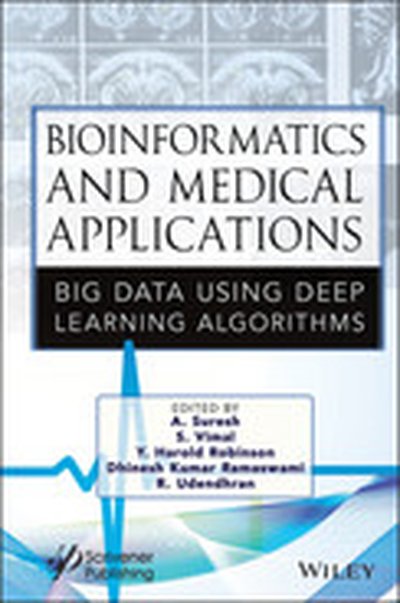
Bioinformatics and Medical Applications

BIOINFORMATICS AND MEDICAL APPLICATIONS The main topics addressed in this book are big data analytics problems in bioinformatics research such as microarray data analysis, sequence analysis, genomics-based analytics, disease network analysis, techniques for big data analytics, and health information technology. Bioinformatics and Medical Applications: Big Data Using Deep Learning Algorithms analyses massive biological datasets using computational approaches and the latest cutting-edge technologies to capture and interpret biological data. The book delivers various bioinformatics computational methods used to identify diseases at an early stage by assembling cutting-edge resources into a single collection designed to enlighten the reader on topics focusing on computer science, mathematics, and biology. In modern biology and medicine, bioinformatics is critical for data management. This book explains the bioinformatician’s important tools and examines how they are used to evaluate biological data and advance disease knowledge. The editors have curated a distinguished group of perceptive and concise chapters that presents the current state of medical treatments and systems and offers emerging solutions for a more personalized approach to healthcare. Applying deep learning techniques for data-driven solutions in health information allows automated analysis whose method can be more advantageous in supporting the problems arising from medical and health-related information. Audience The primary audience for the book includes specialists, researchers, postgraduates, designers, experts, and engineers, who are occupied with biometric research and security-related issues.

Visualizing Google Cloud

Easy-to-follow visual walkthrough of every important part of the Google Cloud Platform The Google Cloud Platform incorporates dozens of specialized services that enable organizations to offload technological needs onto the cloud. From routine IT operations like storage to sophisticated new capabilities including artificial intelligence and machine learning, the Google Cloud Platform offers enterprises the opportunity to scale and grow efficiently. In Visualizing Google Cloud: Illustrated References for Cloud Engineers & Architects, Google Cloud expert Priyanka Vergadia delivers a fully illustrated, visual guide to matching the best Google Cloud Platform services to your own unique use cases. After a brief introduction to the major categories of cloud services offered by Google, the author offers approximately 100 solutions divided into eight categories of services included in Google Cloud Platform: Compute Storage Databases Data Analytics Data Science, Machine Learning and Artificial Intelligence Application Development and Modernization with Containers Networking Security You’ll find richly illustrated flowcharts and decision diagrams with straightforward explanations in each category, making it easy to adopt and adapt Google’s cloud services to your use cases. With coverage of the major categories of cloud models—including infrastructure-, containers-, platforms-, functions-, and serverless—and discussions of storage types, databases and Machine Learning choices, Visualizing Google Cloud: Illustrated References for Cloud Engineers & Architects is perfect for Every Google Cloud enthusiast, of course. It is for anyone who is planning a cloud migration or new cloud deployment. It is for anyone preparing for cloud certification, and for anyone looking to make the most of Google Cloud. It is for cloud solutions architects, IT decision-makers, and cloud data and ML engineers. In short, this book is for YOU.

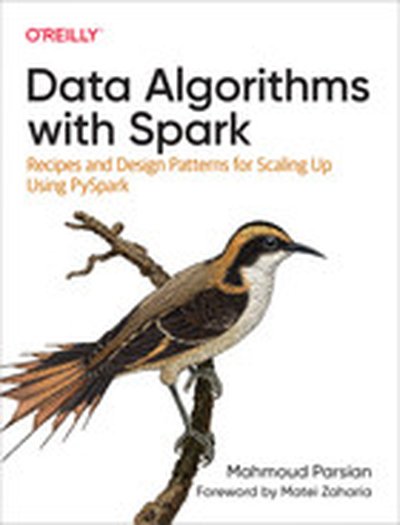
Data Algorithms with Spark

Apache Spark's speed, ease of use, sophisticated analytics, and multilanguage support makes practical knowledge of this cluster-computing framework a required skill for data engineers and data scientists. With this hands-on guide, anyone looking for an introduction to Spark will learn practical algorithms and examples using PySpark. In each chapter, author Mahmoud Parsian shows you how to solve a data problem with a set of Spark transformations and algorithms. You'll learn how to tackle problems involving ETL, design patterns, machine learning algorithms, data partitioning, and genomics analysis. Each detailed recipe includes PySpark algorithms using the PySpark driver and shell script. With this book, you will: Learn how to select Spark transformations for optimized solutions Explore powerful transformations and reductions including reduceByKey(), combineByKey(), and mapPartitions() Understand data partitioning for optimized queries Build and apply a model using PySpark design patterns Apply motif-finding algorithms to graph data Analyze graph data by using the GraphFrames API Apply PySpark algorithms to clinical and genomics data Learn how to use and apply feature engineering in ML algorithms Understand and use practical and pragmatic data design patterns

Summary Data engineering is a practice that is multi-faceted and requires integration with a large number of systems. This often means working across multiple tools to get the job done which can introduce significant cost to productivity due to the number of context switches. Rivery is a platform designed to reduce this incidental complexity and provide a single system for working across the different stages of the data lifecycle. In this episode CEO and founder Itamar Ben hemo explains how his experiences in the industry led to his vision for the Rivery platform as a single place to build end-to-end analytical workflows, including how it is architected and how you can start using it today for your own work.

Announcements

Hello and welcome to the Data Engineering Podcast, the show about modern data management When you’re ready to build your next pipeline, or want to test out the projects you hear about on the show, you’ll need somewhere to deploy it, so check out our friends at Linode. With their managed Kubernetes platform it’s now even easier to deploy and scale your workflows, or try out the latest Helm charts from tools like Pulsar and Pachyderm. With simple pricing, fast networking, object storage, and worldwide data centers, you’ve got everything you need to run a bulletproof data platform. Go to dataengineeringpodcast.com/linode today and get a $100 credit to try out a Kubernetes cluster of your own. And don’t forget to thank them for their continued support of this show! Atlan is a collaborative workspace for data-driven teams, like Github for engineering or Figma for design teams. By acting as a virtual hub for data assets ranging from tables and dashboards to SQL snippets & code, Atlan enables teams to create a single source of truth for all their data assets, and collaborate across the modern data stack through deep integrations with tools like Snowflake, Slack, Looker and more. Go to dataengineeringpodcast.com/atlan today and sign up for a free trial. If you’re a data engineering podcast listener, you get credits worth $3000 on an annual subscription Modern data teams are dealing with a lot of complexity in their data pipelines and analytical code. Monitoring data quality, tracing incidents, and testing changes can be daunting and often takes hours to days or even weeks. By the time errors have made their way into production, it’s often too late and damage is done. Datafold built automated regression testing to help data and analytics engineers deal with data quality in their pull requests. Datafold shows how a change in SQL code affects your data, both on a statistical level and down to individual rows and values before it gets merged to production. No more shipping and praying, you can now know exactly what will change in your database! Datafold integrates with all major data warehouses as well as frameworks such as Airflow & dbt and seamlessly plugs into CI workflows. Visit dataengineeringpodcast.com/datafold today to book a demo with Datafold. Are you looking for a structured and battle-tested approach for learning data engineering? Would you like to know how you can build proper data infrastructures that are built to last? Would you like to have a seasoned industry expert guide you and answer all your questions? Join Pipeline Academy, the worlds first data engineering bootcamp. Learn in small groups with likeminded professionals for 9 weeks part-time to level up in your career. The course covers the most relevant and essential data and software engineering topics that enable you to start your journey as a professional data engineer or analytics engineer. Plus we have AMAs with world-class guest speakers every week! The next cohort starts in April 2022. Visit dataengineeringpodcast.com/academy and apply now! Your host is Tobias Macey and today I’m interviewing Itamar Ben Hemo about Rivery, a SaaS platform designed to provide an end-to-end solution for Ingestion, Transformation, Orchestration,

Summary Any time that you are storing data about people there are a number of privacy and security considerations that come with it. Privacy engineering is a growing field in data management that focuses on how to protect attributes of personal data so that the containing datasets can be shared safely. In this episode Gretel co-founder and CTO John Myers explains how they are building tools for data engineers and analysts to incorporate privacy engineering techniques into their workflows and validate the safety of their data against re-identification attacks.

Announcements

Hello and welcome to the Data Engineering Podcast, the show about modern data management When you’re ready to build your next pipeline, or want to test out the projects you hear about on the show, you’ll need somewhere to deploy it, so check out our friends at Linode. With their managed Kubernetes platform it’s now even easier to deploy and scale your workflows, or try out the latest Helm charts from tools like Pulsar and Pachyderm. With simple pricing, fast networking, object storage, and worldwide data centers, you’ve got everything you need to run a bulletproof data platform. Go to dataengineeringpodcast.com/linode today and get a $100 credit to try out a Kubernetes cluster of your own. And don’t forget to thank them for their continued support of this show! This episode is brought to you by Acryl Data, the company behind DataHub, the leading developer-friendly data catalog for the modern data stack. Open Source DataHub is running in production at several companies like Peloton, Optum, Udemy, Zynga and others. Acryl Data provides DataHub as an easy to consume SaaS product which has been adopted by several companies. Signup for the SaaS product at dataengineeringpodcast.com/acryl Are you looking for a structured and battle-tested approach for learning data engineering? Would you like to know how you can build proper data infrastructures that are built to last? Would you like to have a seasoned industry expert guide you and answer all your questions? Join Pipeline Academy, the worlds first data engineering bootcamp. Learn in small groups with likeminded professionals for 9 weeks part-time to level up in your career. The course covers the most relevant and essential data and software engineering topics that enable you to start your journey as a professional data engineer or analytics engineer. Plus we have AMAs with world-class guest speakers every week! The next cohort starts in April 2022. Visit dataengineeringpodcast.com/academy and apply now! RudderStack helps you build a customer data platform on your warehouse or data lake. Instead of trapping data in a black box, they enable you to easily collect customer data from the entire stack and build an identity graph on your warehouse, giving you full visibility and control. Their SDKs make event streaming from any app or website easy, and their state-of-the-art reverse ETL pipelines enable you to send enriched data to any cloud tool. Sign up free… or just get the free t-shirt for being a listener of the Data Engineering Podcast at dataengineeringpodcast.com/rudder. Your host is Tobias Macey and today I’m interviewing John Myers about privacy engineering and use cases for synthetic data

Interview

Introduction How did you get involved in the area of data management? Can you describe what Gretel is and the story behind it? How do you define "privacy engineering"?

In an organization or data team, who is typically responsible for privacy engineering?

How would you characterize the current state of the art and adoption for privacy engineering? Who are the target users of Gretel and how does that inform the features and design of the product? What are the stages of the data lifecycle where Gretel is used? Can you describe a typical workflow for integrating Gretel into data pipelines for business analytics or ML model training? How is the Gretel platform implemented?

How have the design and goals of the system changed or evolved since you started working on it?

What are some of the nuances of synthetic data generation or masking that data engineers/data analysts need to be aware of as they start using Gretel? What are the most interesting, innovative, or unexpected ways that you have seen Gretel used? What are the most interesting, unexpected, or challenging lessons that you have learned while working on Gretel? When is Gretel the wrong choice? What do you have planned for the future of Gretel?

Contact Info

LinkedIn @jtm_tech on Twitter

Parting Question

From your perspective, what is the biggest gap in the tooling or technology for data management today?

Closing Announcements

Thank you for listening! Don’t forget to check out our other show, Podcast.init to learn about the Python language, its community, and the innovative ways it is being used. Visit the site to subscribe to the show, sign up for the mailing list, and read the show notes. If you’ve learned something or tried out a project from the show then tell us about it! Email [email protected]) with your story. To help other people find the show please leave a review on iTunes and tell your friends and co-workers

Links

Gretel Privacy Engineering Weights and Biases Red Team/Blue Team Generative Adversarial Network Capture The Flag in application security CVE == Common Vulnerabilities and Exposures Machine Learning Cold Start Problem Faker Mockaroo Kaggle Sentry

The intro and outro music is from The Hug by The Freak Fandango Orchestra / CC BY-SA

Support Data Engineering Podcast

podcast_episode
by Cris deRitis , Mark Zandi (Moody's Analytics) , Michael R. Strain (American Enterprise Institute (AEI)) , Ryan Sweet

The odds of a U.S. recession are on the rise. Michael Strain, Director of Economic Policy Studies at American Enterprise Institute, joins the podcast to discuss the risks driving a potential recession. Everyone shares their probability of a recession. Full episode transcript For more from Michael Strain, follow him on Twitter @MichaelRStrain Follow Mark Zandi @MarkZandi, Ryan Sweet @RealTime_Econ and Cris deRitis on LinkedIn for additional insight. 

Questions or Comments, please email us at [email protected]. We would love to hear from you.    To stay informed and follow the insights of Moody's Analytics economists, visit Economic View.

In this episode of SaaS Scaled, we’re talking to Brian Dreyer, VP of Product Management at SightCall. Brian is here to talk about his experience in SaaS product management, share what he’s learned over the years, and tell us how things have changed. Brian talks about how he would do product management today if he had to start a company from scratch, and why. We talk about how to successfully pivot and restart products and the challenges involved. Brian also mentions how SaaS has changed over the last couple of decades and the new challenges that have arisen. We also dive into how the relationship between product and marketing has changed over the years, and Brian talks about how cloud computing has evolved and where it’s headed. Finally, he shares some recommendations for further reading for anyone interested in SaaS product management.   This episode is brought to you by Qrvey The tools you need to take action with your data, on a platform built for maximum scalability, security, and cost efficiencies. If you’re ready to reduce complexity and dramatically lower costs, contact us today at qrvey.com. Qrvey, the modern no-code analytics solution for SaaS companies on AWS.

Summary The flexibility of software oriented data workflows is useful for fulfilling complex requirements, but for simple and repetitious use cases it adds significant complexity. Coalesce is a platform designed to reduce repetitive work for common workflows by adopting a visual pipeline builder to support your data warehouse transformations. In this episode Satish Jayanthi explains how he is building a framework to allow enterprises to move quickly while maintaining guardrails for data workflows. This allows everyone in the business to participate in data analysis in a sustainable manner.

Announcements

Hello and welcome to the Data Engineering Podcast, the show about modern data management When you’re ready to build your next pipeline, or want to test out the projects you hear about on the show, you’ll need somewhere to deploy it, so check out our friends at Linode. With their managed Kubernetes platform it’s now even easier to deploy and scale your workflows, or try out the latest Helm charts from tools like Pulsar and Pachyderm. With simple pricing, fast networking, object storage, and worldwide data centers, you’ve got everything you need to run a bulletproof data platform. Go to dataengineeringpodcast.com/linode today and get a $100 credit to try out a Kubernetes cluster of your own. And don’t forget to thank them for their continued support of this show! Atlan is a collaborative workspace for data-driven teams, like Github for engineering or Figma for design teams. By acting as a virtual hub for data assets ranging from tables and dashboards to SQL snippets & code, Atlan enables teams to create a single source of truth for all their data assets, and collaborate across the modern data stack through deep integrations with tools like Snowflake, Slack, Looker and more. Go to dataengineeringpodcast.com/atlan today and sign up for a free trial. If you’re a data engineering podcast listener, you get credits worth $3000 on an annual subscription Modern data teams are dealing with a lot of complexity in their data pipelines and analytical code. Monitoring data quality, tracing incidents, and testing changes can be daunting and often takes hours to days or even weeks. By the time errors have made their way into production, it’s often too late and damage is done. Datafold built automated regression testing to help data and analytics engineers deal with data quality in their pull requests. Datafold shows how a change in SQL code affects your data, both on a statistical level and down to individual rows and values before it gets merged to production. No more shipping and praying, you can now know exactly what will change in your database! Datafold integrates with all major data warehouses as well as frameworks such as Airflow & dbt and seamlessly plugs into CI workflows. Visit dataengineeringpodcast.com/datafold today to book a demo with Datafold. Are you looking for a structured and battle-tested approach for learning data engineering? Would you like to know how you can build proper data infrastructures that are built to last? Would you like to have a seasoned industry expert guide you and answer all your questions? Join Pipeline Academy, the worlds first data engineering bootcamp. Learn in small groups with likeminded professionals for 9 weeks part-time to level up in your career. The course covers the most relevant and essential data and software engineering topics that enable you to start your journey as a professional data engineer or analytics engineer. Plus we have AMAs with world-class guest speakers every week! The next cohort starts in April 2022. Visit dataengineeringpodcast.com/academy and apply now! Your host is Tobias Macey and today I’m interviewing Satish Jayanthi about how organizations can use data architectural patterns to stay competitive in today’s data-rich environment

Interview

Introduction How did you get involved in the area of data management? Can you describe what you are building at C

Summary Building a data platform for your organization is a challenging undertaking. Building multiple data platforms for other organizations as a service without burning out is another thing entirely. In this episode Brandon Beidel from Red Ventures shares his experiences as a data product manager in charge of helping his customers build scalable analytics systems that fit their needs. He explains the common patterns that have been useful across multiple use cases, as well as when and how to build customized solutions.

Announcements

Hello and welcome to the Data Engineering Podcast, the show about modern data management When you’re ready to build your next pipeline, or want to test out the projects you hear about on the show, you’ll need somewhere to deploy it, so check out our friends at Linode. With their managed Kubernetes platform it’s now even easier to deploy and scale your workflows, or try out the latest Helm charts from tools like Pulsar and Pachyderm. With simple pricing, fast networking, object storage, and worldwide data centers, you’ve got everything you need to run a bulletproof data platform. Go to dataengineeringpodcast.com/linode today and get a $100 credit to try out a Kubernetes cluster of your own. And don’t forget to thank them for their continued support of this show! This episode is brought to you by Acryl Data, the company behind DataHub, the leading developer-friendly data catalog for the modern data stack. Open Source DataHub is running in production at several companies like Peloton, Optum, Udemy, Zynga and others. Acryl Data provides DataHub as an easy to consume SaaS product which has been adopted by several companies. Signup for the SaaS product at dataengineeringpodcast.com/acryl Hey Data Engineering Podcast listeners, want to learn how the Joybird data team reduced their time spent building new integrations and managing data pipelines by 93%? Join our live webinar on April 20th. Joybird director of analytics, Brett Trani, will walk through how retooling their data stack with RudderStack, Snowflake, and Iterable made this possible. Visit www.rudderstack.com/joybird?utm_source=rss&utm_medium=rss to register today. The most important piece of any data project is the data itself, which is why it is critical that your data source is high quality. PostHog is your all-in-one product analytics suite including product analysis, user funnels, feature flags, experimentation, and it’s open source so you can host it yourself or let them do it for you! You have full control over your data and their plugin system lets you integrate with all of your other data tools, including data warehouses and SaaS platforms. Give it a try today with their generous free tier at dataengineeringpodcast.com/posthog Your host is Tobias Macey and today I’m interviewing Brandon Beidel about his data platform journey at Red Ventures

Interview

Introduction How did you get involved in the area of data management? Can you describe what Red Ventures is and your role there?

Given the relative newness of data product management, where do you draw inspiration and direction for how to approach your work?

What are the primary categories of data product that your data consumers are building/relying on? What are the types of data sources that you are working with to power those downstream use cases? Can you describe the size and composition/organization of your data team(s)? How do you approach the build vs. buy decision while designing and evolving your data platform? What are the tools/platforms/architectural and usage patterns that you and your team have developed for your platform?

What are the primary goals and constraints that have contributed to your decisions? How have the goals and design of the platform changed or evolved since you started working with the team?

You recently went through the process of establishing and reporting on SLAs for your data products. Can you describe the approach you took and the u

When you hear the term-digital first, you might think about tech, platforms and data.  But digital transformation succeeds when you put people first.

Gathering and analyzing data, then using it to provide the customer value and an unparalleled experience, is vital for an organization’s success.

Today’s guest, Bhavin Patel, Director o f Analytics and Innovation at J&J joins the show to share why people are the most important component to digital transformation.

Join us as we discuss:

Why you need to put people first The importance of customer value and experience Why digital transformation is an ongoing process, not an end-state 

Find every episode of DataFramed on Apple, Spotify, and more. Find us on our website and join the conversation on LinkedIn.

Listening on a desktop and can’t see the links? Just search for DataFramed in your favorite podcast player.

The number of women entering data professions is growing, and men need to adapt. This podcast is designed to enlighten men about the role of women in the data field. Our guests are all executives at data and analytics software companies who have held positions in other sectors of our field: Prukalpa Sankar, Cindi Howson, Debika Sharma.

podcast_episode
by Cris deRitis , Mark Zandi (Moody's Analytics) , Marisa DiNatale (Moody's Analytics) , Ryan Sweet

Mark, Ryan, and Cris welcome back Marisa DiNatale, Senior Director at Moody's Analytics, to breakdown the March U.S. Employment Report. They also discuss inflation, wage growth, and the current state of the economy. Full episode transcript. Follow Mark Zandi @MarkZandi, Ryan Sweet @RealTime_Econ and Cris deRitis on LinkedIn for additional insight. 

Questions or Comments, please email us at [email protected]. We would love to hear from you.    To stay informed and follow the insights of Moody's Analytics economists, visit Economic View.