talk-data.com talk-data.com

Topic

Computer Science

programming algorithms data_structures

78

tagged

Activity Trend

9 peak/qtr
2020-Q1 2026-Q1

Activities

78 activities · Newest first

Edge Artificial Intelligence

Secure your expertise in the next wave of computing with this essential book, which provides a comprehensive guide to Edge AI, detailing its foundational concepts, deployment strategies, and real-world applications for revolutionizing performance and privacy across various industries. Edge AI has the potential to bring the computational power of AI algorithms closer to where data is generated, processed, and utilized. Traditionally, AI models are deployed in centralized cloud environments, leading to latency issues, bandwidth constraints, and privacy concerns. Edge AI addresses these limitations by enabling AI inference and decision-making directly on edge devices, such as smartphones, IoT sensors, and edge servers. Despite its challenges, edge AI presents numerous opportunities across various domains. From real-time health monitoring and predictive maintenance in industrial IoT to personalized recommendations in retail and immersive experiences in augmented reality, edge AI has the potential to revolutionize how we interact with technology. This book aims to provide a comprehensive exploration of edge AI, covering its foundational concepts, development frameworks, deployment strategies, security considerations, ethical implications, emerging trends, and real-world applications. This guide is essential for anyone pushing the boundaries to leverage edge computing for enhanced performance and efficiency. Readers will find this volume: Dives deep into the world of edge AI with a comprehensive exploration covering foundational concepts, development frameworks, deployment strategies, security considerations, ethical implications, governance frameworks, optimization techniques, and real-world applications; Offers practical guidance on implementing edge AI solutions effectively in various domains, including architecture design, development frameworks, deployment strategies, and optimization techniques; Explores concrete examples of edge AI applications across diverse domains such as healthcare, industrial IoT, smart cities, and autonomous systems, providing insights into how edge AI is revolutionizing industries and everyday life; Provides insights into emerging trends and technologies in the field of edge AI, including convergence with blockchain, augmented reality, virtual reality, autonomous systems, personalized experiences, and cybersecurity. Audience Researchers, AI experts, and industry professionals in the field of computer science, IT, and business management.
Graph Theory for Computer Science

This book is a vital resource for anyone looking to understand the essential role of graph theory as the unifying thread that connects and provides innovative solutions across a wide spectrum of modern computer science disciplines. Graph theory is a traditional mathematical discipline that has evolved as a basic tool for modeling and analyzing the complex relationships between different technological landscapes. Graph theory helps explain the semantic and syntactic relationships in natural language processing, a technology behind many businesses. Disciplinary and industry developments are seeing a major transition towards more interconnected and data-driven decision-making, and the application of graph theory will facilitate this transition. Disciplines such as parallel and distributive computing will gain insights into how graph theory can help with resource optimization and job scheduling, creating considerable change in the design and development of scalable systems. This book provides comprehensive coverage of how graph theory acts as the thread that connects different areas of computer science to create innovative solutions to modern technological problems. Using a multi-faceted approach, the book explores the fundamentals and role of graph theory in molding complex computational processes across a wide spectrum of computer science.

Advances in Artificial Intelligence Applications in Industrial and Systems Engineering

Comprehensive guide offering actionable strategies for enhancing human-centered AI, efficiency, and productivity in industrial and systems engineering through the power of AI. Advances in Artificial Intelligence Applications in Industrial and Systems Engineering is the first book in the Advances in Industrial and Systems Engineering series, offering insights into AI techniques, challenges, and applications across various industrial and systems engineering (ISE) domains. Not only does the book chart current AI trends and tools for effective integration, but it also raises pivotal ethical concerns and explores the latest methodologies, tools, and real-world examples relevant to today’s dynamic ISE landscape. Readers will gain a practical toolkit for effective integration and utilization of AI in system design and operation. The book also presents the current state of AI across big data analytics, machine learning, artificial intelligence tools, cloud-based AI applications, neural-based technologies, modeling and simulation in the metaverse, intelligent systems engineering, and more, and discusses future trends. Written by renowned international contributors for an international audience, Advances in Artificial Intelligence Applications in Industrial and Systems Engineering includes information on: Reinforcement learning, computer vision and perception, and safety considerations for autonomous systems (AS) (NLP) topics including language understanding and generation, sentiment analysis and text classification, and machine translation AI in healthcare, covering medical imaging and diagnostics, drug discovery and personalized medicine, and patient monitoring and predictive analysis Cybersecurity, covering threat detection and intrusion prevention, fraud detection and risk management, and network security Social good applications including poverty alleviation and education, environmental sustainability, and disaster response and humanitarian aid. Advances in Artificial Intelligence Applications in Industrial and Systems Engineering is a timely, essential reference for engineering, computer science, and business professionals worldwide.

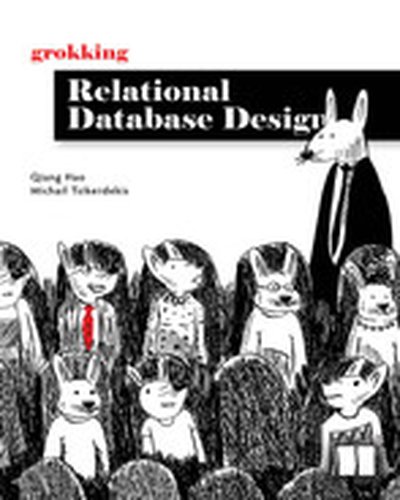
Grokking Relational Database Design

A friendly illustrated guide to designing and implementing your first database. Grokking Relational Database Design makes the principles of designing relational databases approachable and engaging. Everything in this book is reinforced by hands-on exercises and examples. In Grokking Relational Database Design, you’ll learn how to: Query and create databases using Structured Query Language (SQL) Design databases from scratch Implement and optimize database designs Take advantage of generative AI when designing databases A well-constructed database is easy to understand, query, manage, and scale when your app needs to grow. In Grokking Relational Database Design you’ll learn the basics of relational database design including how to name fields and tables, which data to store where, how to eliminate repetition, good practices for data collection and hygiene, and much more. You won’t need a computer science degree or in-depth knowledge of programming—the book’s practical examples and down-to-earth definitions are beginner-friendly. About the Technology Almost every business uses a relational database system. Whether you’re a software developer, an analyst creating reports and dashboards, or a business user just trying to pull the latest numbers, it pays to understand how a relational database operates. This friendly, easy-to-follow book guides you from square one through the basics of relational database design. About the Book Grokking Relational Database Design introduces the core skills you need to assemble and query tables using SQL. The clear explanations, intuitive illustrations, and hands-on projects make database theory come to life, even if you can’t tell a primary key from an inner join. As you go, you’ll design, implement, and optimize a database for an e-commerce application and explore how generative AI simplifies the mundane tasks of database designs. What's Inside Define entities and their relationships Minimize anomalies and redundancy Use SQL to implement your designs Security, scalability, and performance About the Reader For self-taught programmers, software engineers, data scientists, and business data users. No previous experience with relational databases assumed. About the Authors Dr. Qiang Hao and Dr. Michail Tsikerdekis are both professors of Computer Science at Western Washington University. Quotes If anyone is looking to improve their database design skills, they can’t go wrong with this book. - Ben Brumm, DatabaseStar Goes beyond SQL syntax and explores the core principles. An invaluable resource! - William Jamir Silva, Adjust Relational database design is best done right the first time. This book is a great help to achieve that! - Maxim Volgin, KLM Provides necessary notions to design and build databases that can stand the data challenges we face. - Orlando Méndez, Experian

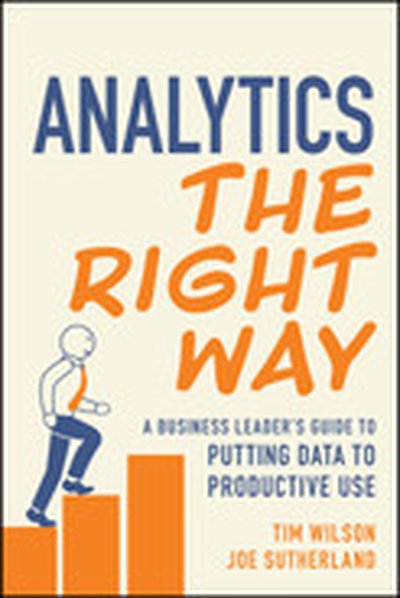
Analytics the Right Way

CLEAR AND CONCISE TECHNIQUES FOR USING ANALYTICS TO DELIVER BUSINESS IMPACT AT ANY ORGANIZATION Organizations have more data at their fingertips than ever, and their ability to put that data to productive use should be a key source of sustainable competitive advantage. Yet, business leaders looking to tap into a steady and manageable stream of “actionable insights” often, instead, get blasted with a deluge of dashboards, chart-filled slide decks, and opaque machine learning jargon that leaves them asking, “So what?” Analytics the Right Way is a guide for these leaders. It provides a clear and practical approach to putting analytics to productive use with a three-part framework that brings together the realities of the modern business environment with the deep truths underpinning statistics, computer science, machine learning, and artificial intelligence. The result: a pragmatic and actionable guide for delivering clarity, order, and business impact to an organization’s use of data and analytics. The book uses a combination of real-world examples from the authors’ direct experiences—working inside organizations, as external consultants, and as educators—mixed with vivid hypotheticals and illustrations—little green aliens, petty criminals with an affinity for ice cream, skydiving without parachutes, and more—to empower the reader to put foundational analytical and statistical concepts to effective use in a business context.

The Data Science Handbook, 2nd Edition

Practical, accessible guide to becoming a data scientist, updated to include the latest advances in data science and related fields. Becoming a data scientist is hard. The job focuses on mathematical tools, but also demands fluency with software engineering, understanding of a business situation, and deep understanding of the data itself. This book provides a crash course in data science, combining all the necessary skills into a unified discipline. The focus of The Data Science Handbook is on practical applications and the ability to solve real problems, rather than theoretical formalisms that are rarely needed in practice. Among its key points are: An emphasis on software engineering and coding skills, which play a significant role in most real data science problems. Extensive sample code, detailed discussions of important libraries, and a solid grounding in core concepts from computer science (computer architecture, runtime complexity, and programming paradigms). A broad overview of important mathematical tools, including classical techniques in statistics, stochastic modeling, regression, numerical optimization, and more. Extensive tips about the practical realities of working as a data scientist, including understanding related jobs functions, project life cycles, and the varying roles of data science in an organization. Exactly the right amount of theory. A solid conceptual foundation is required for fitting the right model to a business problem, understanding a tool’s limitations, and reasoning about discoveries. Data science is a quickly evolving field, and this 2nd edition has been updated to reflect the latest developments, including the revolution in AI that has come from Large Language Models and the growth of ML Engineering as its own discipline. Much of data science has become a skillset that anybody can have, making this book not only for aspiring data scientists, but also for professionals in other fields who want to use analytics as a force multiplier in their organization.

Apache Spark for Machine Learning

Dive into the power of Apache Spark as a tool for handling and processing big data required for machine learning. With this book, you will explore how to configure, execute, and deploy machine learning algorithms using Spark's scalable architecture and learn best practices for implementing real-world big data solutions. What this Book will help me do Understand the integration of Apache Spark with large-scale infrastructures for machine learning applications. Employ data processing techniques for preprocessing and feature engineering efficiently with Spark. Master the implementation of advanced supervised and unsupervised learning algorithms using Spark. Learn to deploy machine learning models within Spark ecosystems for optimized performance. Discover methods for analyzing big data trends and machine learning model tuning for improved accuracy. Author(s) The author, Deepak Gowda, is an experienced data scientist with over ten years of expertise in machine learning and big data. His career spans industries such as supply chain, cybersecurity, and more where he has utilized Apache Spark extensively. Deepak's teaching style is marked by clarity and practicality, making complex concepts approachable. Who is it for? Apache Spark for Machine Learning is tailored for data engineers, machine learning practitioners, and computer science students looking to advance their ability to process, analyze, and model using large datasets. If you're already familiar with basic machine learning and want to scale your solutions using Spark, this book is ideal for your studies and professional growth.

Computational Intelligence in Sustainable Computing and Optimization

Computational Intelligence in Sustainable Computing and Optimization: Trends and Applications focuses on developing and evolving advanced computational intelligence algorithms for the analysis of data involved in applications, such as agriculture, biomedical systems, bioinformatics, business intelligence, economics, disaster management, e-learning, education management, financial management, and environmental policies. The book presents research in sustainable computing and optimization, combining methods from engineering, mathematics, artificial intelligence, and computer science to optimize environmental resources Computational intelligence in the field of sustainable computing combines computer science and engineering in applications ranging from Internet of Things (IoT), information security systems, smart storage, cloud computing, intelligent transport management, cognitive and bio-inspired computing, and management science. In addition, data intelligence techniques play a critical role in sustainable computing. Recent advances in data management, data modeling, data analysis, and artificial intelligence are finding applications in energy networks and thus making our environment more sustainable. Presents computational, intelligence–based data analysis for sustainable computing applications such as pattern recognition, biomedical imaging, sustainable cities, sustainable transport, sustainable agriculture, and sustainable financial management Develops research in sustainable computing and optimization, combining methods from engineering, mathematics, and computer science to optimize environmental resources Includes three foundational chapters dedicated to providing an overview of computational intelligence and optimization techniques and their applications for sustainable computing

Artificial Intelligence

Artificial Intelligence (AI) revolves around creating and utilizing intelligent machines through science and engineering. This book delves into the theory and practical applications of computer science methods that incorporate AI across many domains. It covers techniques such as Machine Learning (ML), Convolutional Neural Networks (CNN), Deep Learning (DL), and Large Language Models (LLM) to tackle complex issues and overcome various challenges.

Concept Of Database Management System by Pearson

Concepts of Database Management System is designed to meet the syllabi requirements of undergraduate students of computer applications and computer science. It describes the concepts in an easy-to-understand language with sufficient number of examples. The overview of emerging trends in databases is thoroughly explained. A brief introduction to PL/SQL, MS-Access and Oracle is discussed to help students get a flavor of different types of database management systems.

Programming in MATLAB ®: A Problem-Solving Approach by Pearson

MATLAB provides an interactive programming interface for numerical computation and data visualization making it the default framework used for analysis, design and research in many domains of science and industry. Programming in MATLAB is intended as an aid to engineers and scientists with no prior programming expertise. The book focuses on the systematic development of practical programming skills through MATLAB language constructs, backed by several well-designed examples and exercises. Designed to be as much a MATLAB reference tool for researchers in varied fields as it is a guide for undergraduate readers, the book builds on the concepts sequentially as it progresses through the chapters. Each chapter is complete, independent of the book's remaining contents. Thus, for teaching purposes, one can suitably the relevant portions.

About The Authors –

Ramnarayan Patel did his Ph.D. in the area of power systems from Indian Institute of Technology Delhi, in 2003. He received his M.Tech. from IIT Delhi and a graduate degree in electrical engineering from SGSITS, Indore. His manifold fields of interest include power system stability, optimization in electric power systems, application of artificial intelligence techniques, design of intelligent controllers and renewable energy systems. He has over 14 years of hands-on experience working with MATLAB and Simulink, as an instructor, researcher and trainer.

Dr Patel has served as faculty in the electrical engineering department at IIT Roorkee and at the Birla Institute of Technology and Science, Pilani. Currently, he is Professorin the Department of Electrical and Electronics Engineering, Shri Shankaracharya Technical Campus (SSGI), Bhilai, and has many publications to his credit in various international journals of repute. He has presented his research at various international conferences and organized many workshops and conferences within the country. He is a recipient of the prestigious ‘Career Award for Young Teachers’ from All India Council for Technical Education (AICTE), New Delhi. Dr Patel has successfully handled many research projects funded by AICTE, New Delhi, and Department of Science and Technology, Government of India, New Delhi.

Ankush Mittal received his B.Tech. in computer science and engineering from Indian Institute of Technology Delhi in 1996, and later, his Master’s degree in 1998 from the same institute. He received his Ph.D. degree in electrical and computer engineering from the National University of Singapore in 2001 and was a faculty member in the Department of Computer Science, National University of Singapore, for two years. He has also served as Associate Professor at IIT Roorkee. Currently, he is Director (Research) at Graphic Era University, Dehradun.

Dr Mittal has contributed more than 250 research papers in journals and conferences of high repute with significant impact in academic circles. A dedicated teacher and active researcher, he is a recipient of the IIT Roorkee Outstanding Teacher Award and the IBM Faculty Award. He has taught more than 20 courses and worked on MATLAB extensively since his Ph.D.

Book Contents –

  1. Introduction to MATLAB® Desktop
  2. Matrix Operations and Applications
  3. MATLAB® Graphics and Plotting
  4. Control Structures, Loops, and File Handling
  5. Scripts and Functions
  6. Numerical Methods, Calculus, and Statistics
  7. Using Memory Efficiently
  8. Using the MATLAB® Debugger and Profiler
  9. Efficient Coding Using Vectorization Technique
  10. Precision and Errors
  11. Advanced Concepts in MATLAB®
  12. Modeling with Simulink®
  13. Digital Image Processing Index
Data Science Fundamentals with R, Python, and Open Data

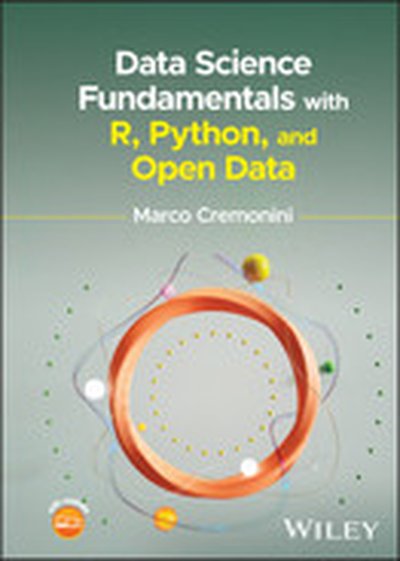
Data Science Fundamentals with R, Python, and Open Data Introduction to essential concepts and techniques of the fundamentals of R and Python needed to start data science projects Organized with a strong focus on open data, Data Science Fundamentals with R, Python, and Open Data discusses concepts, techniques, tools, and first steps to carry out data science projects, with a focus on Python and RStudio, reflecting a clear industry trend emerging towards the integration of the two. The text examines intricacies and inconsistencies often found in real data, explaining how to recognize them and guiding readers through possible solutions, and enables readers to handle real data confidently and apply transformations to reorganize, indexing, aggregate, and elaborate. This book is full of reader interactivity, with a companion website hosting supplementary material including datasets used in the examples and complete running code (R scripts and Jupyter notebooks) of all examples. Exam-style questions are implemented and multiple choice questions to support the readers’ active learning. Each chapter presents one or more case studies. Written by a highly qualified academic, Data Science Fundamentals with R, Python, and Open Data discuss sample topics such as: Data organization and operations on data frames, covering reading CSV dataset and common errors, and slicing, creating, and deleting columns in R Logical conditions and row selection, covering selection of rows with logical condition and operations on dates, strings, and missing values Pivoting operations and wide form-long form transformations, indexing by groups with multiple variables, and indexing by group and aggregations Conditional statements and iterations, multicolumn functions and operations, data frame joins, and handling data in list/dictionary format Data Science Fundamentals with R, Python, and Open Data is a highly accessible learning resource for students from heterogeneous disciplines where Data Science and quantitative, computational methods are gaining popularity, along with hard sciences not closely related to computer science, and medical fields using stochastic and quantitative models.

Principles of Data Science - Third Edition

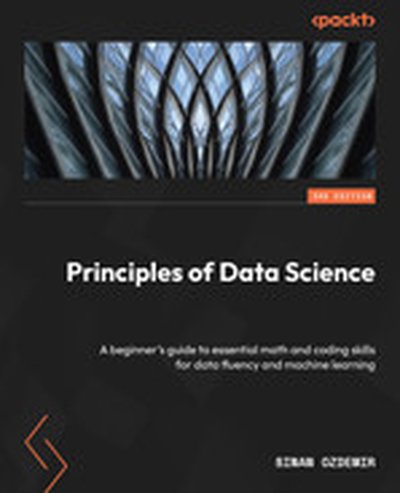
Principles of Data Science offers an end-to-end introduction to data science fundamentals, blending key mathematical concepts with practical programming. You'll learn how to clean and prepare data, construct predictive models, and leverage modern tools like pre-trained models for NLP and computer vision. By integrating theory and practice, this book sets the foundation for impactful data-driven decision-making. What this Book will help me do Develop a solid understanding of foundational statistics and machine learning. Learn how to clean, transform, and visualize data for impactful analysis. Explore transfer learning and pre-trained models for advanced AI tasks. Understand ethical implications, biases, and governance in AI and ML. Gain the knowledge to implement complete data pipelines effectively. Author(s) Sinan Ozdemir is an experienced data scientist, educator, and author with a deep passion for making complex topics accessible. With a background in computer science and applied statistics, Sinan has taught data science at leading institutions and authored multiple books on the topic. His practical approach to teaching combines real-world examples with insightful explanations, ensuring learners gain both competence and confidence. Who is it for? This book is ideal for beginners in data science who want to gain a comprehensive understanding of the field. If you have a background in programming or mathematics and are eager to combine these skills to analyze and extract insights from data, this book will guide you. Individuals working with machine learning or AI who need to solidify their foundational knowledge will find it invaluable. Some familiarity with Python is recommended to follow along seamlessly.

Fuzzy Computing in Data Science

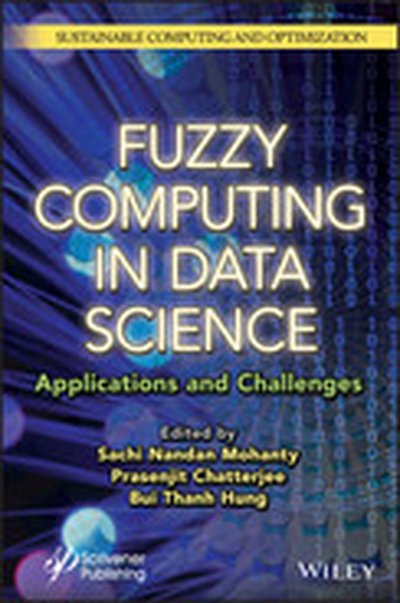
FUZZY COMPUTING IN DATA SCIENCE This book comprehensively explains how to use various fuzzy-based models to solve real-time industrial challenges. The book provides information about fundamental aspects of the field and explores the myriad applications of fuzzy logic techniques and methods. It presents basic conceptual considerations and case studies of applications of fuzzy computation. It covers the fundamental concepts and techniques for system modeling, information processing, intelligent system design, decision analysis, statistical analysis, pattern recognition, automated learning, system control, and identification. The book also discusses the combination of fuzzy computation techniques with other computational intelligence approaches such as neural and evolutionary computation. Audience Researchers and students in computer science, artificial intelligence, machine learning, big data analytics, and information and communication technology.

Data Conscience

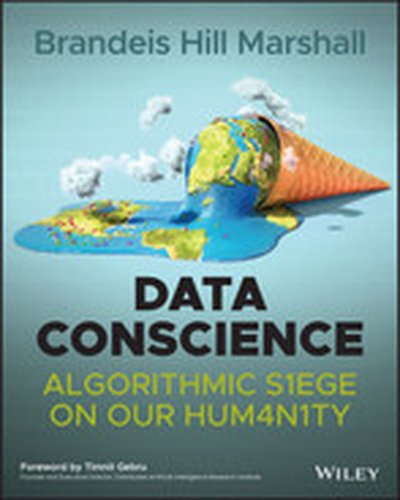
DATA CONSCIENCE ALGORITHMIC S1EGE ON OUR HUM4N1TY EXPLORE HOW D4TA STRUCTURES C4N HELP OR H1NDER SOC1AL EQU1TY Data has enjoyed ‘bystander’ status as we’ve attempted to digitize responsibility and morality in tech. In fact, data’s importance should earn it a spot at the center of our thinking and strategy around building a better, more ethical world. It’s use—and misuse—lies at the heart of many of the racist, gendered, classist, and otherwise oppressive practices of modern tech. In Data Conscience: Algorithmic Siege on our Humanity, computer science and data inclusivity thought leader Dr. Brandeis Hill Marshall delivers a call to action for rebel tech leaders, who acknowledge and are prepared to address the current limitations of software development. In the book, Dr. Brandeis Hill Marshall discusses how the philosophy of “move fast and break things” is, itself, broken, and requires change. You’ll learn about the ways that discrimination rears its ugly head in the digital data space and how to address them with several known algorithms, including social network analysis, and linear regression A can’t-miss resource for junior-level to senior-level software developers who have gotten their hands dirty with at least a handful of significant software development projects, Data Conscience also provides readers with: Discussions of the importance of transparency Explorations of computational thinking in practice Strategies for encouraging accountability in tech Ways to avoid double-edged data visualization Schemes for governing data structures with law and algorithms

Big Data Analytics and Machine Intelligence in Biomedical and Health Informatics

BIG DATA ANALYTICS AND MACHINE INTELLIGENCE IN BIOMEDICAL AND HEALTH INFORMATICS Provides coverage of developments and state-of-the-art methods in the broad and diversified data analytics field and applicable areas such as big data analytics, data mining, and machine intelligence in biomedical and health informatics. The novel applications of Big Data Analytics and machine intelligence in the biomedical and healthcare sector is an emerging field comprising computer science, medicine, biology, natural environmental engineering, and pattern recognition. Biomedical and health informatics is a new era that brings tremendous opportunities and challenges due to the plentifully available biomedical data and the aim is to ensure high-quality and efficient healthcare by analyzing the data. The 12 chapters in??Big Data Analytics and Machine Intelligence in Biomedical and Health Informatics??cover the latest advances and developments in health informatics, data mining, machine learning, and artificial intelligence. They have been organized with respect to the similarity of topics addressed, ranging from issues pertaining to the Internet of Things (IoT) for biomedical engineering and health informatics, computational intelligence for medical data processing, and Internet of Medical Things??(IoMT). New researchers and practitioners working in the field will benefit from reading the book as they can quickly ascertain the best performing methods and compare the different approaches. Audience Researchers and practitioners working in the fields of biomedicine, health informatics, big data analytics, Internet of Things, and machine learning.

Bioinformatics and Medical Applications

BIOINFORMATICS AND MEDICAL APPLICATIONS The main topics addressed in this book are big data analytics problems in bioinformatics research such as microarray data analysis, sequence analysis, genomics-based analytics, disease network analysis, techniques for big data analytics, and health information technology. Bioinformatics and Medical Applications: Big Data Using Deep Learning Algorithms analyses massive biological datasets using computational approaches and the latest cutting-edge technologies to capture and interpret biological data. The book delivers various bioinformatics computational methods used to identify diseases at an early stage by assembling cutting-edge resources into a single collection designed to enlighten the reader on topics focusing on computer science, mathematics, and biology. In modern biology and medicine, bioinformatics is critical for data management. This book explains the bioinformatician’s important tools and examines how they are used to evaluate biological data and advance disease knowledge. The editors have curated a distinguished group of perceptive and concise chapters that presents the current state of medical treatments and systems and offers emerging solutions for a more personalized approach to healthcare. Applying deep learning techniques for data-driven solutions in health information allows automated analysis whose method can be more advantageous in supporting the problems arising from medical and health-related information. Audience The primary audience for the book includes specialists, researchers, postgraduates, designers, experts, and engineers, who are occupied with biometric research and security-related issues.

Artificial Intelligence Programming with Python

A hands-on roadmap to using Python for artificial intelligence programming In Practical Artificial Intelligence Programming with Python: From Zero to Hero, veteran educator and photophysicist Dr. Perry Xiao delivers a thorough introduction to one of the most exciting areas of computer science in modern history. The book demystifies artificial intelligence and teaches readers its fundamentals from scratch in simple and plain language and with illustrative code examples. Divided into three parts, the author explains artificial intelligence generally, machine learning, and deep learning. It tackles a wide variety of useful topics, from classification and regression in machine learning to generative adversarial networks. He also includes: Fulsome introductions to MATLAB, Python, AI, machine learning, and deep learning Expansive discussions on supervised and unsupervised machine learning, as well as semi-supervised learning Practical AI and Python “cheat sheet” quick references This hands-on AI programming guide is perfect for anyone with a basic knowledge of programming—including familiarity with variables, arrays, loops, if-else statements, and file input and output—who seeks to understand foundational concepts in AI and AI development.

SQL for Data Scientists

Jump-start your career as a data scientist—l earn to develop datasets for exploration, analysis, and machine learning SQL for Data Scientists: A Beginner's Guide for Building Datasets for Analysis is a resource that’s dedicated to the Structured Query Language (SQL) and dataset design skills that data scientists use most. Aspiring data scientists will learn how to how to construct datasets for exploration, analysis, and machine learning. You can also discover how to approach query design and develop SQL code to extract data insights while avoiding common pitfalls. You may be one of many people who are entering the field of Data Science from a range of professions and educational backgrounds, such as business analytics, social science, physics, economics, and computer science. Like many of them, you may have conducted analyses using spreadsheets as data sources, but never retrieved and engineered datasets from a relational database using SQL, which is a programming language designed for managing databases and extracting data. This guide for data scientists differs from other instructional guides on the subject. It doesn’t cover SQL broadly. Instead, you’ll learn the subset of SQL skills that data analysts and data scientists use frequently. You’ll also gain practical advice and direction on "how to think about constructing your dataset." Gain an understanding of relational database structure, query design, and SQL syntax Develop queries to construct datasets for use in applications like interactive reports and machine learning algorithms Review strategies and approaches so you can design analytical datasets Practice your techniques with the provided database and SQL code In this book, author Renee Teate shares knowledge gained during a 15-year career working with data, in roles ranging from database developer to data analyst to data scientist. She guides you through SQL code and dataset design concepts from an industry practitioner’s perspective, moving your data scientist career forward!

Designing Big Data Platforms

DESIGNING BIG DATA PLATFORMS Provides expert guidance and valuable insights on getting the most out of Big Data systems An array of tools are currently available for managing and processing data—some are ready-to-go solutions that can be immediately deployed, while others require complex and time-intensive setups. With such a vast range of options, choosing the right tool to build a solution can be complicated, as can determining which tools work well with each other. Designing Big Data Platforms provides clear and authoritative guidance on the critical decisions necessary for successfully deploying, operating, and maintaining Big Data systems. This highly practical guide helps readers understand how to process large amounts of data with well-known Linux tools and database solutions, use effective techniques to collect and manage data from multiple sources, transform data into meaningful business insights, and much more. Author Yusuf Aytas, a software engineer with a vast amount of big data experience, discusses the design of the ideal Big Data platform: one that meets the needs of data analysts, data engineers, data scientists, software engineers, and a spectrum of other stakeholders across an organization. Detailed yet accessible chapters cover key topics such as stream data processing, data analytics, data science, data discovery, and data security. This real-world manual for Big Data technologies: Provides up-to-date coverage of the tools currently used in Big Data processing and management Offers step-by-step guidance on building a data pipeline, from basic scripting to distributed systems Highlights and explains how data is processed at scale Includes an introduction to the foundation of a modern data platform Designing Big Data Platforms: How to Use, Deploy, and Maintain Big Data Systems is a must-have for all professionals working with Big Data, as well researchers and students in computer science and related fields.