talk-data.com talk-data.com

Topic

data

5765

tagged

Activity Trend

3 peak/qtr
2020-Q1 2026-Q1

Activities

5765 activities · Newest first

Principles of Data Science - Second Edition

Dive into the intricacies of data science with 'Principles of Data Science'. This book takes you on a journey to explore, analyze, and transform data into actionable insights using mathematical models, Python programming, and machine learning concepts. With a clear and engaging style, you will progress from understanding theoretical foundations to implementing advanced techniques in real-world scenarios. What this Book will help me do Master the five critical steps in a practical data science workflow. Clean and prepare raw datasets for accurate machine learning models. Understand and apply statistical models and mathematical principles for data analysis. Build and evaluate predictive models using Python and effective metrics. Create impactful visualizations that clearly convey data insights. Author(s) Sinan Ozdemir is an expert in data science, with a background in developing and teaching advanced courses in machine learning and predictive analytics. With co-authors None Kakade and None Tibaldeschi, they bring years of hands-on experience in data science to this comprehensive guide. Their approach simplifies complex concepts, making them accessible without sacrificing depth, to empower readers to make data-driven decisions confidently. Who is it for? This book is ideal for aspiring data scientists seeking a practical introduction to the field. It's perfect for those with basic math skills looking to apply them to data science or experienced programmers who want to explore the mathematical foundation of data science. A basic understanding of Python programming will be invaluable, but the book builds up core concepts step-by-step, making it accessible to both beginners and experienced professionals.

Fast Data Architectures for Streaming Applications, 2nd Edition

Why have stream-oriented data systems become so popular, when batch-oriented systems have served big data needs for many years? In the updated edition of this report, Dean Wampler examines the rise of streaming systems for handling time-sensitive problems—such as detecting fraudulent financial activity as it happens. You’ll explore the characteristics of fast data architectures, along with several open source tools for implementing them. Batch processing isn’t going away, but exclusive use of these systems is now a competitive disadvantage. You’ll learn that, while fast data architectures using tools such as Kafka, Akka, Spark, and Flink are much harder to build, they represent the state of the art for dealing with mountains of data that require immediate attention. Learn how a basic fast data architecture works, step-by-step Examine how Kafka’s data backplane combines the best abstractions of log-oriented and message queue systems for integrating components Evaluate four streaming engines, including Kafka Streams, Akka Streams, Spark, and Flink Learn which streaming engines work best for different use cases Get recommendations for making real-world streaming systems responsive, resilient, elastic, and message driven Explore an example IoT streaming application that includes telemetry ingestion and anomaly detection

Numerical Python: Scientific Computing and Data Science Applications with Numpy, SciPy and Matplotlib

Leverage the numerical and mathematical modules in Python and its standard library as well as popular open source numerical Python packages like NumPy, SciPy, FiPy, matplotlib and more. This fully revised edition, updated with the latest details of each package and changes to Jupyter projects, demonstrates how to numerically compute solutions and mathematically model applications in big data, cloud computing, financial engineering, business management and more. Numerical Python, Second Edition, presents many brand-new case study examples of applications in data science and statistics using Python, along with extensions to many previous examples. Each of these demonstrates the power of Python for rapid development and exploratory computing due to its simple and high-level syntax and multiple options for data analysis. After reading this book, readers will be familiar with many computing techniques including array-based and symbolic computing, visualization and numerical file I/O, equation solving, optimization, interpolation and integration, and domain-specific computational problems, such as differential equation solving, data analysis, statistical modeling and machine learning. What You'll Learn Work with vectors and matrices using NumPy Plot and visualize data with Matplotlib Perform data analysis tasks with Pandas and SciPy Review statistical modeling and machine learning with statsmodels and scikit-learn Optimize Python code using Numba and Cython Who This Book Is For Developers who want to understand how to use Python and its related ecosystem for numerical computing.

Tableau 10 Complete Reference

Explore and understand data with the powerful data visualization techniques of Tableau, and then communicate insights in powerful ways Key Features Apply best practices in data visualization and chart types exploration Explore the latest version of Tableau Desktop with hands-on examples Understand the fundamentals of Tableau storytelling Book Description Graphical presentation of data enables us to easily understand complex data sets. Tableau 10 Complete Reference provides easy-to-follow recipes with several use cases and real-world business scenarios to get you up and running with Tableau 10. This Learning Path begins with the history of data visualization and its importance in today's businesses. You'll also be introduced to Tableau - how to connect, clean, and analyze data in this visual analytics software. Then, you'll learn how to apply what you've learned by creating some simple calculations in Tableau and using Table Calculations to help drive greater analysis from your data. Next, you'll explore different advanced chart types in Tableau. These chart types require you to have some understanding of the Tableau interface and understand basic calculations. You'll study in detail all dashboard techniques and best practices. A number of recipes specifically for geospatial visualization, analytics, and data preparation are also covered. Last but not least, you'll learn about the power of storytelling through the creation of interactive dashboards in Tableau. Through this Learning Path, you will gain confidence and competence to analyze and communicate data and insights more efficiently and effectively by creating compelling interactive charts, dashboards, and stories in Tableau. This Learning Path includes content from the following Packt products: Learning Tableau 10 - Second Edition by Joshua N. Milligan Getting Started with Tableau 2018.x by Tristan Guillevin What you will learn Build effective visualizations, dashboards, and story points Build basic to more advanced charts with step-by-step recipes Become familiar row-level, aggregate, and table calculations Dig deep into data with clustering and distribution models Prepare and transform data for analysis Leverage Tableau's mapping capabilities to visualize data Use data storytelling techniques to aid decision making strategy Who this book is for Tableau 10 Complete Reference is designed for anyone who wants to understand their data better and represent it in an effective manner. It is also used for BI professionals and data analysts who want to do better at their jobs. Downloading the example code for this book You can download the example code files for all Packt books you have purchased from your account at http://www.PacktPub.com. If you purchased this book elsewhere, you can visit http://www.PacktPub.com/support and register to have the files e-mailed directly to you.

Apache Spark 2: Data Processing and Real-Time Analytics

Build efficient data flow and machine learning programs with this flexible, multi-functional open-source cluster-computing framework Key Features Master the art of real-time big data processing and machine learning Explore a wide range of use-cases to analyze large data Discover ways to optimize your work by using many features of Spark 2.x and Scala Book Description Apache Spark is an in-memory, cluster-based data processing system that provides a wide range of functionalities such as big data processing, analytics, machine learning, and more. With this Learning Path, you can take your knowledge of Apache Spark to the next level by learning how to expand Spark's functionality and building your own data flow and machine learning programs on this platform. You will work with the different modules in Apache Spark, such as interactive querying with Spark SQL, using DataFrames and datasets, implementing streaming analytics with Spark Streaming, and applying machine learning and deep learning techniques on Spark using MLlib and various external tools. By the end of this elaborately designed Learning Path, you will have all the knowledge you need to master Apache Spark, and build your own big data processing and analytics pipeline quickly and without any hassle. This Learning Path includes content from the following Packt products: Mastering Apache Spark 2.x by Romeo Kienzler Scala and Spark for Big Data Analytics by Md. Rezaul Karim, Sridhar Alla Apache Spark 2.x Machine Learning Cookbook by Siamak Amirghodsi, Meenakshi Rajendran, Broderick Hall, Shuen MeiCookbook What you will learn Get to grips with all the features of Apache Spark 2.x Perform highly optimized real-time big data processing Use ML and DL techniques with Spark MLlib and third-party tools Analyze structured and unstructured data using SparkSQL and GraphX Understand tuning, debugging, and monitoring of big data applications Build scalable and fault-tolerant streaming applications Develop scalable recommendation engines Who this book is for If you are an intermediate-level Spark developer looking to master the advanced capabilities and use-cases of Apache Spark 2.x, this Learning Path is ideal for you. Big data professionals who want to learn how to integrate and use the features of Apache Spark and build a strong big data pipeline will also find this Learning Path useful. To grasp the concepts explained in this Learning Path, you must know the fundamentals of Apache Spark and Scala.

Microsoft Power BI Complete Reference

Design, develop, and master efficient Power BI solutions for impactful business insights Key Features Get to grips with the fundamentals of Microsoft Power BI Combine data from multiple sources, create visuals, and publish reports across platforms Understand Power BI concepts with real-world use cases Book Description Microsoft Power BI Complete Reference Guide gets you started with business intelligence by showing you how to install the Power BI toolset, design effective data models, and build basic dashboards and visualizations that make your data come to life. In this Learning Path, you will learn to create powerful interactive reports by visualizing your data and learn visualization styles, tips and tricks to bring your data to life. You will be able to administer your organization's Power BI environment to create and share dashboards. You will also be able to streamline deployment by implementing security and regular data refreshes. Next, you will delve deeper into the nuances of Power BI and handling projects. You will get acquainted with planning a Power BI project, development, and distribution of content, and deployment. You will learn to connect and extract data from various sources to create robust datasets, reports, and dashboards. Additionally, you will learn how to format reports and apply custom visuals, animation and analytics to further refine your data. By the end of this Learning Path, you will learn to implement the various Power BI tools such as on-premises gateway together along with staging and securely distributing content via apps. This Learning Path includes content from the following Packt products: Microsoft Power BI Quick Start Guide by Devin Knight et al. Mastering Microsoft Power BI by Brett Powell What you will learn Connect to data sources using both import and DirectQuery options Leverage built-in and custom visuals to design effective reports Administer a Power BI cloud tenant for your organization Deploy your Power BI Desktop files into the Power BI Report Server Build efficient data retrieval and transformation processes Who this book is for Microsoft Power BI Complete Reference Guide is for those who want to learn and use the Power BI features to extract maximum information and make intelligent decisions that boost their business. If you have a basic understanding of BI concepts and want to learn how to apply them using Microsoft Power BI, then Learning Path is for you. It consists of real-world examples on Power BI and goes deep into the technical issues, covers additional protocols, and much more.

Apache Superset Quick Start Guide

Apache Superset Quick Start Guide teaches you how to leverage Apache Superset to create interactive and insightful data visualizations. With this book, you'll understand how to integrate Superset with popular databases and build user-friendly dashboards tailored for business intelligence needs. What this Book will help me do Set up and configure Apache Superset for data visualization tasks. Integrate data from SQL databases into Superset for dashboards. Design dashboards tailored to represent business metrics and insights. Use Superset's visualization techniques to explore and present various datasets. Understand and apply user role management and security features in Superset. Author(s) None Shekhar is an experienced data visualization and business intelligence specialist with years of experience in working with Apache Superset. They have written several guides on utilizing open-source tools for enterprise needs. Their technical expertise and approachable writing style make this guide practical and engaging. Who is it for? This book is geared towards data analysts, business intelligence professionals, and developers. Beginners to Superset can quickly grasp the fundamentals, while those with prior experience in data visualization will appreciate the advanced techniques. It's perfect for anyone looking to enhance their data storytelling and dashboard design skills.

Vertically Integrated Architectures: Versioned Data Models, Implicit Services, and Persistence-Aware Programming

Understand how and why the separation between layers and tiers in service-oriented architectures holds software developers back from being truly productive, and how you can remedy that problem. Strong processes and development tools can help developers write more complex software, but large amounts of code can still be directly deduced from the underlying database model, hampering developer productivity. In a world with a shortage of developers, this is bad news. More code also increases maintenance costs and the risk of bugs, meaning less time is spent improving the quality of systems. You will learn that by making relationships first-class citizens within an item/relationship model, you can develop an extremely compact query language, inspired by natural language. You will also learn how this model can serve as both a database schema and an object model upon which to build business logic. Implicit services free you from writing code for standard read/write operations, while still supporting fine-grained authorization. Vertically Integrated Architectures explains how functional schema mappings can solve database migrations and service versioning at the same time, and how all this can support any client, from free-format to fully vertically integrated types. Unleash the potential and use VIA to drastically increase developer productivity and quality. What You'll Learn See how the separation between application server and database in a SOA-based architecture might be justifiable from a historical perspective, but can also hold us back Examine how the vertical integration of application logic and database functionality can drastically increase developer productivity and quality Review why application developers only need to write pure business logic if an architecture takes care of basic read/write client-server communication and data persistence Understand why a set-oriented and persistence-aware programming language would not only make it easier to build applications, but would also enable the fully optimized execution of incoming service requests Who This Book Is For Software architects, senior software developers, computer science professionals and students, and the open source community.

Computational Methods for Data Analysis

This graduate text covers a variety of mathematical and statistical tools for the analysis of big data coming from biology, medicine and economics. Neural networks, Markov chains, tools from statistical physics and wavelet analysis are used to develop efficient computational algorithms, which are then used for the processing of real-life data using Matlab.

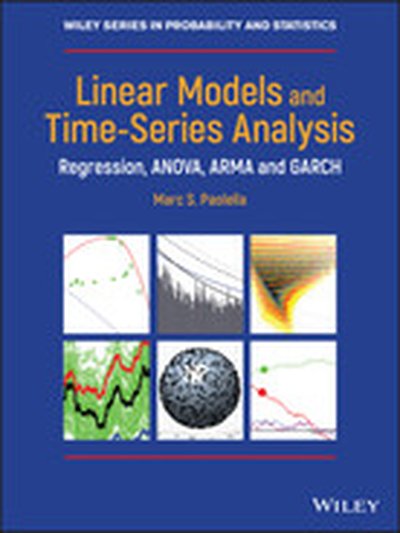
Linear Models and Time-Series Analysis

A comprehensive and timely edition on an emerging new trend in time series Linear Models and Time-Series Analysis: Regression, ANOVA, ARMA and GARCH sets a strong foundation, in terms of distribution theory, for the linear model (regression and ANOVA), univariate time series analysis (ARMAX and GARCH), and some multivariate models associated primarily with modeling financial asset returns (copula-based structures and the discrete mixed normal and Laplace). It builds on the author's previous book, Fundamental Statistical Inference: A Computational Approach, which introduced the major concepts of statistical inference. Attention is explicitly paid to application and numeric computation, with examples of Matlab code throughout. The code offers a framework for discussion and illustration of numerics, and shows the mapping from theory to computation. The topic of time series analysis is on firm footing, with numerous textbooks and research journals dedicated to it. With respect to the subject/technology, many chapters in Linear Models and Time-Series Analysis cover firmly entrenched topics (regression and ARMA). Several others are dedicated to very modern methods, as used in empirical finance, asset pricing, risk management, and portfolio optimization, in order to address the severe change in performance of many pension funds, and changes in how fund managers work. Covers traditional time series analysis with new guidelines Provides access to cutting edge topics that are at the forefront of financial econometrics and industry Includes latest developments and topics such as financial returns data, notably also in a multivariate context Written by a leading expert in time series analysis Extensively classroom tested Includes a tutorial on SAS Supplemented with a companion website containing numerous Matlab programs Solutions to most exercises are provided in the book Linear Models and Time-Series Analysis: Regression, ANOVA, ARMA and GARCH is suitable for advanced masters students in statistics and quantitative finance, as well as doctoral students in economics and finance. It is also useful for quantitative financial practitioners in large financial institutions and smaller finance outlets.

IBM Tape Library Guide for Open Systems

Abstract This IBM® Redbooks® publication presents a general introduction to the latest IBM tape and tape library technologies. Featured tape technologies include the IBM LTO Ultrium and Enterprise 3592 tape drives, and their implementation in IBM tape libraries. This 16th edition introduces the new TS1160 tape drive with up to 20 TB capacity on JE media and the latest updates to the IBM TS4500 and TS4300 tape libraries, It includes generalized sections about Small Computer System Interface (SCSI) and Fibre Channel connections, and multipath architecture configurations. This book also covers tools and techniques for library management. It is intended for anyone who wants to understand more about IBM tape products and their implementation. It is suitable for IBM clients, IBM Business Partners, IBM specialist sales representatives, and technical specialists. If you do not have a background in computer tape storage products, you might need to read other sources of information. In the interest of being concise, topics that are generally understood are not covered in detail.

Machine Learning with PySpark: With Natural Language Processing and Recommender Systems

Build machine learning models, natural language processing applications, and recommender systems with PySpark to solve various business challenges. This book starts with the fundamentals of Spark and its evolution and then covers the entire spectrum of traditional machine learning algorithms along with natural language processing and recommender systems using PySpark. Machine Learning with PySpark shows you how to build supervised machine learning models such as linear regression, logistic regression, decision trees, and random forest. You’ll also see unsupervised machine learning models such as K-means and hierarchical clustering. A major portion of the book focuses on feature engineering to create useful features with PySpark to train the machine learning models. The natural language processing section covers text processing, text mining, and embedding for classification. After reading thisbook, you will understand how to use PySpark’s machine learning library to build and train various machine learning models. Additionally you’ll become comfortable with related PySpark components, such as data ingestion, data processing, and data analysis, that you can use to develop data-driven intelligent applications. What You Will Learn Build a spectrum of supervised and unsupervised machine learning algorithms Implement machine learning algorithms with Spark MLlib libraries Develop a recommender system with Spark MLlib libraries Handle issues related to feature engineering, class balance, bias and variance, and cross validation for building an optimal fit model Who This Book Is For Data science and machine learning professionals.

SAS Certification Prep Guide

Must-have study guide for the SAS® Certified Statistical Business Analyst Using SAS®9: Regression and Modeling exam! Written for both new and experienced SAS programmers, the SAS® Certification Prep Guide: Statistical Business Analysis Using SAS®9 is an in-depth prep guide for the SAS® Certified Statistical Business Analyst Using SAS®9: Regression and Modeling exam. The authors step through identifying the business question, generating results with SAS, and interpreting the output in a business context. The case study approach uses both real and simulated data to master the content of the certification exam. Each chapter also includes a quiz aimed at testing the reader’s comprehension of the material presented. Major topics include: ANOVA Linear Regression Logistic Regression Inputs for Predictive Modeling Model Performance For those new to statistical topics or those needing a review of statistical foundations, this book also serves as an excellent reference guide for understanding descriptive and inferential statistics. This book is part of the SAS Press program.

2017 Data Science Salary Survey

Get a clear picture of the salaries and bonuses data science professionals around the world receive, as well as the tools and cloud providers they use, the tasks they perform, and how interpersonal ("soft") skills might affect their pay. The fifth edition of O’Reilly’s online Data Science Salary Survey provides complete results from nearly 800 participants from 69 different countries, 42 different US states, and Washington, DC. With five years of data, the survey’s results are consistent enough to reliably identify changes and trends. The survey asked specific questions about industry, team, and company size, but also posed questions such as, "How easy is it to move to another position?" or "What is your next career step?" You can plug in your own data points to the survey model and see how you compare to other data science professionals in your industry. With this report, you’ll learn: Where data scientists make the highest salaries—by country and by US state Tools that respondents most commonly use on the job, and tools that contribute most to salary Activities that contribute to higher earnings How gender and bargaining skills affect salaries when all other factors are equal Salary differences between those using open source tools vs those using proprietary tools How the increase in respondents outside of the US signal a rise in international companies starting and growing data organizations Participate in the 2018 Survey: Spend just 5 to 10 minutes and take the anonymous salary survey here: https://www.oreilly.com/ideas/take-the-​data-science-salary-survey.

Practical Apache Spark: Using the Scala API

Work with Apache Spark using Scala to deploy and set up single-node, multi-node, and high-availability clusters. This book discusses various components of Spark such as Spark Core, DataFrames, Datasets and SQL, Spark Streaming, Spark MLib, and R on Spark with the help of practical code snippets for each topic. Practical Apache Spark also covers the integration of Apache Spark with Kafka with examples. You’ll follow a learn-to-do-by-yourself approach to learning – learn the concepts, practice the code snippets in Scala, and complete the assignments given to get an overall exposure. On completion, you’ll have knowledge of the functional programming aspects of Scala, and hands-on expertise in various Spark components. You’ll also become familiar with machine learning algorithms with real-time usage. What You Will Learn Discover the functional programming features of Scala Understand the completearchitecture of Spark and its components Integrate Apache Spark with Hive and Kafka Use Spark SQL, DataFrames, and Datasets to process data using traditional SQL queries Work with different machine learning concepts and libraries using Spark's MLlib packages Who This Book Is For Developers and professionals who deal with batch and stream data processing.

SAS for Mixed Models

This book expands coverage of mixed models for non-normal data and mixed-model-based precision and power analysis, including the following topics: Discover the power of mixed models with SAS. Mixed models—now the mainstream vehicle for analyzing most research data—are part of the core curriculum in most master’s degree programs in statistics and data science. In a single volume, this book updates both SAS® for Linear Models, Fourth Edition, and SAS® for Mixed Models, Second Edition, covering the latest capabilities for a variety of applications featuring the SAS GLIMMIX and MIXED procedures. Written for instructors of statistics, graduate students, scientists, statisticians in business or government, and other decision makers, SAS® for Mixed Models is the perfect entry for those with a background in two-way analysis of variance, regression, and intermediate-level use of SAS. This book is part of the SAS Press program. Random-effect-only and random-coefficients models Multilevel, split-plot, multilocation, and repeated measures models Hierarchical models with nested random effects Analysis of covariance models Generalized linear mixed models

IBM Power Systems RAID Solutions Introduction and Technical Overview

This IBM® Redpaper™ publication given an overview and technical introduction to IBM Power Systems™ RAID solutions. The book is organized to start with an introduction to Redundant Array of Independent Disks (RAID), and various RAID levels with their benefits. A brief comparison of Direct Attached Storage (DAS) and networked storage systems such as SAN / NAS is provided with a focus on emerging applications that typically use the DAS model over networked storage models. The book focuses on IBM Power Systems I/O architecture and various SAS RAID adapters that are supported in IBM POWER8™ processor-based systems. A detailed description of the SAS adapters, along with their feature comparison tables, is included in Chapter 3, "RAID adapters for IBM Power Systems" on page 45. The book is aimed at readers who have the responsibility of configuring IBM Power Systems for individual solution requirements. This audience includes IT Architects, IBM Technical Sales Teams, IBM Business Partner Solution Architects and Technical Sales teams, and systems administrators who need to understand the SAS RAID hardware and RAID software solutions supported in POWER8 processor-based systems.

Dynamic Oracle Performance Analytics: Using Normalized Metrics to Improve Database Speed

Use an innovative approach that relies on big data and advanced analytical techniques to analyze and improve Oracle Database performance. The approach used in this book represents a step-change paradigm shift away from traditional methods. Instead of relying on a few hand-picked, favorite metrics, or wading through multiple specialized tables of information such as those found in an automatic workload repository (AWR) report, you will draw on all available data, applying big data methods and analytical techniques to help the performance tuner draw impactful, focused performance improvement conclusions. This book briefly reviews past and present practices, along with available tools, to help you recognize areas where improvements can be made. The book then guides you through a step-by-step method that can be used to take advantage of all available metrics to identify problem areas and work toward improving them. The method presented simplifies the tuning process and solves the problem of metric overload. You will learn how to: collect and normalize data, generate deltas that are useful in performing statistical analysis, create and use a taxonomy to enhance your understanding of problem performance areas in your database and its applications, and create a root cause analysis report that enables understanding of a specific performance problem and its likely solutions. What You'll Learn Collect and prepare metrics for analysis from a wide array of sources Apply statistical techniques to select relevant metrics Create a taxonomy to provide additional insight into problem areas Provide a metrics-based root cause analysis regarding the performance issue Generate an actionable tuning plan prioritized according to problem areas Monitor performance using database-specific normal ranges ​ Who This Book Is For Professional tuners: responsible for maintaining the efficient operation of large-scale databases who wish to focus on analysis, who want to expand their repertoire to include a big data methodology and use metrics without being overwhelmed, who desire to provide accurate root cause analysis and avoid the cyclical fix-test cycles that are inevitable when speculation is used

IBM TS4500 R5 Tape Library Guide

Abstract The IBM® TS4500 (TS4500) tape library is a next-generation tape solution that offers higher storage density and integrated management than previous solutions. This IBM Redbooks® publication gives you a close-up view of the new IBM TS4500 tape library. In the TS4500, IBM delivers the density that today’s and tomorrow’s data growth requires. It has the cost-effectiveness and the manageability to grow with business data needs, while you preserve existing investments in IBM tape library products. Now, you can achieve both a low cost per terabyte (TB) and a high TB density per square foot because the TS4500 can store up to 11 petabytes (PB) of uncompressed data in a single frame library or scale up to 2 PB per square foot to over 350 PB. The TS4500 offers the following benefits: High availability: Dual active accessors with integrated service bays reduce inactive service space by 40%. The Elastic Capacity option can be used to completely eliminate inactive service space. Flexibility to grow: The TS4500 library can grow from the right side and the left side of the first L frame because models can be placed in any active position. Increased capacity: The TS4500 can grow from a single L frame up to another 17 expansion frames with a capacity of over 23,000 cartridges. High-density (HD) generation 1 frames from the TS3500 library can be redeployed in a TS4500. Capacity on demand (CoD): CoD is supported through entry-level, intermediate, and base-capacity configurations. Advanced Library Management System (ALMS): ALMS supports dynamic storage management, which enables users to create and change logical libraries and configure any drive for any logical library. Support for IBM TS1160 while also supporting TS1155, TS1150, and TS1140 tape drive: The TS1160 gives organizations an easy way to deliver fast access to data, improve security, and provide long-term retention, all at a lower cost than disk solutions. The TS1160 offers high-performance, flexible data storage with support for data encryption. Also, this enhanced fifth-generation drive can help protect investments in tape automation by offering compatibility with existing automation. The new TS1160 Tape Drive Model 60E delivers a dual 10 Gb or 25 Gb Ethernet host attachment interface that is optimized for cloud-based and hyperscale environments. The TS1160 Tape Drive Model 60F delivers a native data rate of 400 MBps, the same load/ready, locate speeds, and access times as the TS1155, and includes dual-port 16 Gb Fibre Channel support. Support of the IBM Linear Tape-Open (LTO) Ultrium 8 tape drive: The LTO Ultrium 8 offering represents significant improvements in capacity, performance, and reliability over the previous generation, LTO Ultrium 7, while still protecting your investment in the previous technology. Support of LTO 8 Type M cartridge (M8): The LTO Program is introducing a new capability with LTO-8 drives. The ability of the LTO-8 drive to write 9 TB on a brand new LTO-7 cartridge instead of 6 TB as specified by the LTO-7 format. Such a cartridge is called an LTO-7 initialized LTO-8 Type M cartridge. Integrated TS7700 back-end Fibre Channel (FC) switches are available. Up to four library-managed encryption (LME) key paths per logical library are available. This book describes the TS4500 components, feature codes, specifications, supported tape drives, encryption, new integrated management console (IMC), and command-line interface (CLI). You learn how to accomplish the following specific tasks: Improve storage density with increased expansion frame capacity up to 2.4 times and support 33% more tape drives per frame. Manage storage by using the ALMS feature. Improve business continuity and disaster recovery with dual active accessor, automatic control path failover, and data path failover. Help ensure security and regulatory compliance with tape-drive encryption and Write Once Read Many (WORM) media. Support IBM LTO Ultrium 8, 7, 6, and 5, IBM TS1160, TS1155, TS1150, and TS1140 tape drives. Provide a flexible upgrade path for users who want to expand their tape storage as their needs grow. Reduce the storage footprint and simplify cabling with 10 U of rack space on top of the library. This guide is for anyone who wants to understand more about the IBM TS4500 tape library. It is particularly suitable for IBM clients, IBM Business Partners, IBM specialist sales representatives, and technical specialists.