talk-data.com talk-data.com

Topic

Data Engineering

etl data_pipelines big_data

1127

tagged

Activity Trend

127 peak/qtr
2020-Q1 2026-Q1

Activities

1127 activities · Newest first

Agile Data Engineering: Reliability and Continuous Delivery at Scale

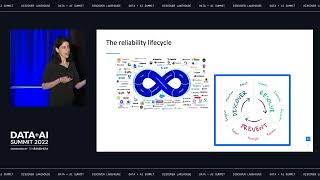
With businesses competing to deliver value while growing rapidly and adapting to changing markets, it is more important than ever for data teams to support faster and reliable insights. We need to fail fast, learn, adapt, release and repeat. For us, Trusted and unified data infrastructure with standardized practices is at the crux of it all

In this talk: we'll go over Atlassian's data engineering team organization, infrastructure and development practices

  • Team organization and roles
  • Overview of our data engineering technical stack
  • Code repositories and CICD setup
  • Testing framework
  • Development walkthrough
  • Production data quality & integrity
  • Alerting & Monitoring
  • Tracking operational metrics (SLI/SLO, Cost)

Connect with us: Website: https://databricks.com Facebook: https://www.facebook.com/databricksinc Twitter: https://twitter.com/databricks LinkedIn: https://www.linkedin.com/company/data... Instagram: https://www.instagram.com/databricksinc/

Amgen’s Journey To Building a Global 360 View of its Customers with the Lakehouse

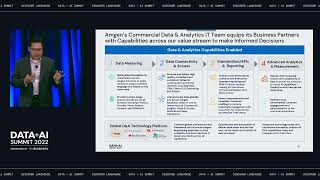
Serving patients in over 100 countries, Amgen is a leading global biotech company focused on developing therapies that have the power to save lives. Delivering on this mission requires our commercial teams to regularly meet with healthcare providers to discuss new treatments that can help patients in need. With the onset of the pandemic, where face-to-face interactions with doctors and other Healthcare Providers (HCPs) were severely impacted, Amgen had to rethink these interactions. With that in mind, the Amgen Commercial Data and Analytics team leveraged a modern data and AI architecture built on the Databricks Lakehouse to help accelerate its digital and data insights capabilities. This foundation enabled Amgen’s teams to develop a comprehensive, customer-centric view to support flexible go-to-market models and provide personalized experiences to our customers. In this presentation, we will share our recent journey of how we took an agile approach to bringing together over 2.2 petabytes of internally generated and externally sourced vendor data , and onboard into our AWS Cloud and Databricks environments to enable a standardized, scalable and robust capabilities to meet the business requirements in our fast-changing life sciences environment. We will share use cases of how we harmonized and managed our diverse sets of data to deliver efficiency, simplification, and performance outcomes for the business. We will cover the following aspects of our journey along with best practices we learned over time: • Our architecture to support Amgen’s Commercial Data & Analytics constant processing around the globe • Engineering best practices for building large scale Data Lakes and Analytics platforms such as Team organization, Data Ingestion and Data Quality Frameworks, DevOps Toolkit and Maturity Frameworks, and more • Databricks capabilities adopted such as Delta Lake, Workspace policies, SQL workspace endpoints, and MLflow for model registry and deployment. Also, various tools were built for Databricks workspace administration • Databricks capabilities being explored for future, such as Multi-task Orchestration, Container-based Apache Spark Processing, Feature Store, Repos for Git integration, etc. • The types of commercial analytics use cases we are building on the Databricks Lakehouse platform Attendees building global and Enterprise scale data engineering solutions to meet diverse sets of business requirements will benefit from learning about our journey. Technologists will learn how we addressed specific Business problems via reusable capabilities built to maximize value.

Connect with us: Website: https://databricks.com Facebook: https://www.facebook.com/databricksinc Twitter: https://twitter.com/databricks LinkedIn: https://www.linkedin.com/company/data... Instagram: https://www.instagram.com/databricksinc/

Announcing General Availability of Databricks Terraform Provider

We all live in the exciting times and the hype of Distributed Data Mesh (or just mess). This talk will cover a couple architectural and organizational approaches on achieving Distributed Data Mesh, which is essentially a combination of mindset, fully automated infrastructure, continuous integration for data pipelines, dedicated team collaborative environments, and security enforcement. As a Data Leader, you’ll learn what kinds of things you’d need to pay attention to, when starting (or reviving) a modern Data Engineering and Data Science strategy and how Databricks Unity Catalog may help you automating that. As DevOps, you’ll learn about the best practices and pitfalls of Continuous Deployment on Databricks With Terraform and Continuous Integration with Databricks Repos. You’ll be excited how you can automate Data Security with Unity Catalog and Terraform. As a Data Scientist, you’ll learn how you can get relevant infrastructure into “production” relatively faster.

Connect with us: Website: https://databricks.com Facebook: https://www.facebook.com/databricksinc Twitter: https://twitter.com/databricks LinkedIn: https://www.linkedin.com/company/data... Instagram: https://www.instagram.com/databricksinc/

Beyond Monitoring: The Rise of Data Observability

"Why did our dashboard break?" "What happened to my data?" "Why is this column missing?" If you've been on the receiving end of these messages (and many others!) from downstream stakeholders, you're not alone. Data engineering teams spend 40 percent or more of their time tackling data downtime, or periods of time when data is missing, erroneous, or otherwise inaccurate, and as data systems become increasingly complex and distributed, this number will only increase. To address this problem, data observability is becoming an increasingly important part of the cloud data stack, helping engineers and analysts reduce time to detection and resolution for data incidents caused by faulty data, code, and operational environments. But what does data observability actually look like in practice? During this presentation, Barr Moses, CEO and co-founder of Monte Carlo, will present on how some of today's best data leaders implement observability across their data lake ecosystem and share best practices for data teams seeking to achieve end-to-end visibility into their data at scale. Topics addressed will include: building automated lineage for Apache Spark, applying data reliability workflows, and extending beyond testing and monitoring to solve for unknown unknowns in your data pipelines.

Connect with us: Website: https://databricks.com Facebook: https://www.facebook.com/databricksinc Twitter: https://twitter.com/databricks LinkedIn: https://www.linkedin.com/company/data... Instagram: https://www.instagram.com/databricksinc/

Road to a Robust Data Lake: Utilizing Delta Lake & Databricks to Map 150 Million Miles of Roads

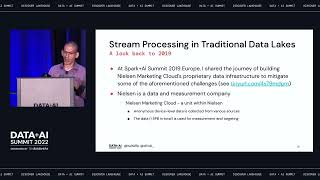
In the past, stream processing over data lakes required a lot of development efforts from data engineering teams, as Itai has shown in his talk at Spark+AI Summit 2019 (https://tinyurl.com/2s3az5td). Today, with Delta Lake and Databricks Auto Loader, this becomes a few minutes' work! Not only that, it unlocks a new set of ways to efficiently leverage your data.

Nexar, a leading provider of dynamic mapping solutions, utilizes Delta Lake and advanced features such as Auto Loader to map 150 million miles of roads a month and provide meaningful insights to cities, mobility companies, driving apps, and insurers. Nexar’s growing dataset contains trillions of images that are used to build and maintain a digital twin of the world. Nexar uses state-of-the-art technologies to detect road furniture (like road signs and traffic lights), surface markings, and road works.

In this talk, we will describe how you can efficiently ingest, process, and maintain a robust Data Lake, whether you’re a mapping solutions provider, a media measurement company, or a social media network. Topics include: * Incremental & efficient streaming over cloud storage such as S3 * Storage optimizations using Delta Lake * Supporting mutable data use-cases with Delta Lake

Connect with us: Website: https://databricks.com Facebook: https://www.facebook.com/databricksinc Twitter: https://twitter.com/databricks LinkedIn: https://www.linkedin.com/company/data... Instagram: https://www.instagram.com/databricksinc/

Take Databricks Lakehouse to the Max with Informatica​

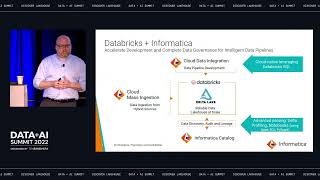
The hard part of ML and analytics is not building data models. It’s getting the data right and into production. Join us to learn how Informatica’s Intelligent Data Management Cloud (IDMC) helps you maximize the benefits of the Databricks’ Unified Analytics platform. Learn how our cloud-native capabilities can shorten your time to results. See how to enable more data users to easily load data and develop data engineering workflows on Databricks in ELT mode at scale. Find out how Informatica delivers all the necessary governance and compliance guardrails you need to operate analytics, AI and ML. Accelerate adoption and maximize agility while maintaining control of your data and lowering risk.

Connect with us: Website: https://databricks.com Facebook: https://www.facebook.com/databricksinc Twitter: https://twitter.com/databricks LinkedIn: https://www.linkedin.com/company/data... Instagram: https://www.instagram.com/databricksinc/

Deep Dive into the New Features of Apache Spark 3.2 and 3.3

Apache Spark has become the most widely-used engine for executing data engineering, data science and machine learning on single-node machines or clusters. The number of monthly maven downloads of Spark has rapidly increased to 20 million.

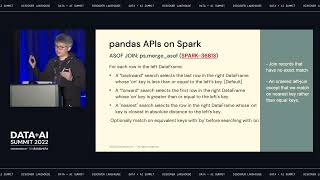
We will talk about the higher-level features and improvements in Spark 3.2 and 3.3. The talk also dives deeper into the following features + Introducing pandas API on Apache Spark to unify small data API and big data API. + Completing the ANSI SQL compatibility mode to simplify migration of SQL workloads. + Productionizing adaptive query execution to speed up Spark SQL at runtime. + Introducing RocksDB state store to make state processing more scalable

Connect with us: Website: https://databricks.com Facebook: https://www.facebook.com/databricksinc Twitter: https://twitter.com/databricks LinkedIn: https://www.linkedin.com/company/data... Instagram: https://www.instagram.com/databricksinc/

Destination Lakehouse: All Your Data, Analytics and AI on One Platform

The data lakehouse is the future for modern data teams seeking to innovate with a data architecture that simplifies data workloads, eases collaboration, and maintains the flexibility and openness to stay agile as a company scales. The Databricks Lakehouse Platform realizes this idea by unifying analytics, data engineering, machine learning, and streaming workloads across clouds on one simple, open data platform. In this session, learn how the Databricks Lakehouse Platform can meet your needs for every data and analytics workload, with examples of real-customer applications, reference architectures, and demos to showcase how you can create modern data solutions of your own.

Connect with us: Website: https://databricks.com Facebook: https://www.facebook.com/databricksinc Twitter: https://twitter.com/databricks LinkedIn: https://www.linkedin.com/company/data... Instagram: https://www.instagram.com/databricksinc/

Dive Deeper into Data Engineering on Databricks

To derive value from data, engineers need to collect, transform, and orchestrate data from various data types and source systems. However, today’s data engineering solutions support only a limited number of delivery styles, involve a significant amount of hand-coding, and have become resource-intensive. Modern data engineering requires more advanced data lifecycle for data ingestion, transformation, and processing. In this session, learn how the Databricks Lakehouse Platform provides an end-to-end data engineering solution — ingestion, processing and scheduling — that automates the complexity of building and maintaining pipelines and running ETL workloads directly on a data lake, so your team can focus on quality and reliability to drive valuable insights.

Connect with us: Website: https://databricks.com Facebook: https://www.facebook.com/databricksinc Twitter: https://twitter.com/databricks LinkedIn: https://www.linkedin.com/company/data... Instagram: https://www.instagram.com/databricksinc/

Elixir: The Wickedly Awesome Batch and Stream Processing Language You Should Have in Your Toolbox

Elixir is an Erlang-VM bytecode-compatible programming language that is growing in popularity.

In this session I will show how you can apply Elixir towards solving data engineering problems in novel ways.

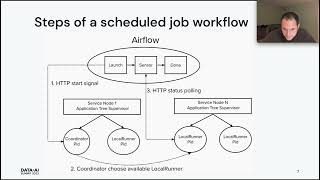
Examples include: • How to leverage Erlang's lightweight distributed process coordination to run clusters of workers across docker containers and perform data ingestion. • A framework that hooks Elixir functions as steps into Airflow graphs. • How to consume and process Kafka events directly within Elixir microservices.

For each of the above I'll show real system examples and walk through the key elements step by step. No prior familiarity with Erlang or Elixir will be required.

Connect with us: Website: https://databricks.com Facebook: https://www.facebook.com/databricksinc Twitter: https://twitter.com/databricks LinkedIn: https://www.linkedin.com/company/data... Instagram: https://www.instagram.com/databricksinc/

How AT&T Data Science Team Solved an Insurmountable Big Data Challenge on Databricks

Data driven personalization is an insurmountable challenge for AT&T’s data science team because of the size of datasets and complexity of data engineering. More often these data preparation tasks not only take several hours or days to complete but some of these tasks fail to complete affecting productivity.

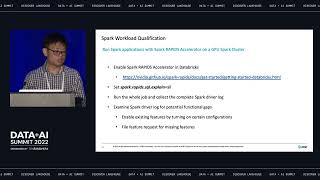
In this session, the AT&T Data Science team will talk about how RAPIDS Accelerator for Apache Spark and Photon runtime on Databricks can be leveraged to process these extremely large datasets resulting in improved content recommendation, classification, etc while reducing infrastructure costs. The team will compare speedups and costs to the regular Databricks runtime Apache Spark environment. The size of tested datasets vary from 2TB - 50TB which consists of data collected from for 1 day to 31 days.

The talk will showcase the results from both RAPIDS accelerator for Apache Spark and Databricks Photon runtime.

Connect with us: Website: https://databricks.com Facebook: https://www.facebook.com/databricksinc Twitter: https://twitter.com/databricks LinkedIn: https://www.linkedin.com/company/data... Instagram: https://www.instagram.com/databricksinc/

Analytics Engineering and the Great Convergence   Tristan Handy   Keynote Data + AI Summit 2022

We've come a long way from the way data analysis used to be done. The emergence of the analytics engineering workflow, with dbt at its center, has helped usher in a new era of productivity. Not quite data engineering or data analysis, analytics engineering has enabled new levels of collaboration between two key sets of practitioners.

But that's not the only coming together happening right now. Enabled by the open lakehouse, the worlds of data analysis and AI/ML are also converging under a single roof, hinting at a new future of intertwined workloads and silo-free collaboration. It's a future that's tantalizing, and entirely within reach. Let's talk about making it happen.

Connect with us: Website: https://databricks.com Facebook: https://www.facebook.com/databricksinc Twitter: https://twitter.com/databricks LinkedIn: https://www.linkedin.com/company/data... Instagram: https://www.instagram.com/databricksinc/

Summary Data engineering is a large and growing subject, with new technologies, specializations, and "best practices" emerging at an accelerating pace. This podcast does its best to explore this fractal ecosystem, and has been at it for the past 5+ years. In this episode Joe Reis, founder of Ternary Data and co-author of "Fundamentals of Data Engineering", turns the tables and interviews the host, Tobias Macey, about his journey into podcasting, how he runs the show behind the scenes, and the other things that occupy his time.

Announcements

Hello and welcome to the Data Engineering Podcast, the show about modern data management When you’re ready to build your next pipeline, or want to test out the projects you hear about on the show, you’ll need somewhere to deploy it, so check out our friends at Linode. With their new managed database service you can launch a production ready MySQL, Postgres, or MongoDB cluster in minutes, with automated backups, 40 Gbps connections from your application hosts, and high throughput SSDs. Go to dataengineeringpodcast.com/linode today and get a $100 credit to launch a database, create a Kubernetes cluster, or take advantage of all of their other services. And don’t forget to thank them for their continued support of this show! RudderStack helps you build a customer data platform on your warehouse or data lake. Instead of trapping data in a black box, they enable you to easily collect customer data from the entire stack and build an identity graph on your warehouse, giving you full visibility and control. Their SDKs make event streaming from any app or website easy, and their state-of-the-art reverse ETL pipelines enable you to send enriched data to any cloud tool. Sign up free… or just get the free t-shirt for being a listener of the Data Engineering Podcast at dataengineeringpodcast.com/rudder. Data teams are increasingly under pressure to deliver. According to a recent survey by Ascend.io, 95% in fact reported being at or over capacity. With 72% of data experts reporting demands on their team going up faster than they can hire, it’s no surprise they are increasingly turning to automation. In fact, while only 3.5% report having current investments in automation, 85% of data teams plan on investing in automation in the next 12 months. 85%!!! That’s where our friends at Ascend.io come in. The Ascend Data Automation Cloud provides a unified platform for data ingestion, transformation, orchestration, and observability. Ascend users love its declarative pipelines, powerful SDK, elegant UI, and extensible plug-in architecture, as well as its support for Python, SQL, Scala, and Java. Ascend automates workloads on Snowflake, Databricks, BigQuery, and open source Spark, and can be deployed in AWS, Azure, or GCP. Go to dataengineeringpodcast.com/ascend and sign up for a free trial. If you’re a data engineering podcast listener, you get credits worth $5,000 when you become a customer. Your host is Tobias Macey and today we’re flipping the script. Joe Reis of Ternary Data will be interviewing me about my time as the host of this show and my perspectives on the data ecosystem

Interview

Introduction How did you get involved in the area of data management? Now I’ll hand it off to Joe…

Joe’s Notes

You do a lot of podcasts. Why? Podcast.init started in 2015, and your first episode of Data Engineering was published January 14, 2017. Walk us through the start of these podcasts. why not a data science podcast? why DE? You’ve published 306 of shows of the Data Engineering Podcast, plus 370 for the init podcast, then you’ve got a new ML podcast. How have you kept the motivation over the years? What’s the process for the show (finding guests, topics, etc….recording, publishing)? It’s a lot of work. Walk us through this process. You’ve done a ton of shows and have a lot of context with what’s going on in the field of both data engineering and Python. What have been some of the

Summary There are extensive and valuable data sets that are available outside the bounds of your organization. Whether that data is public, paid, or scraped it requires investment and upkeep to acquire and integrate it with your systems. Crux was built to reduce the total cost of acquisition and ownership for integrating external data, offering a fully managed service for delivering those data assets in the manner that best suits your infrastructure. In this episode Crux CTO Mark Etherington discusses the different costs involved in managing external data, how to think about the total return on investment for your data, and how the Crux platform is architected to reduce the toil involved in managing third party data.

Announcements

Hello and welcome to the Data Engineering Podcast, the show about modern data management When you’re ready to build your next pipeline, or want to test out the projects you hear about on the show, you’ll need somewhere to deploy it, so check out our friends at Linode. With their new managed database service you can launch a production ready MySQL, Postgres, or MongoDB cluster in minutes, with automated backups, 40 Gbps connections from your application hosts, and high throughput SSDs. Go to dataengineeringpodcast.com/linode today and get a $100 credit to launch a database, create a Kubernetes cluster, or take advantage of all of their other services. And don’t forget to thank them for their continued support of this show! Atlan is the metadata hub for your data ecosystem. Instead of locking your metadata into a new silo, unleash its transformative potential with Atlan’s active metadata capabilities. Push information about data freshness and quality to your business intelligence, automatically scale up and down your warehouse based on usage patterns, and let the bots answer those questions in Slack so that the humans can focus on delivering real value. Go to dataengineeringpodcast.com/atlan today to learn more about how Atlan’s active metadata platform is helping pioneering data teams like Postman, Plaid, WeWork & Unilever achieve extraordinary things with metadata and escape the chaos. Modern data teams are dealing with a lot of complexity in their data pipelines and analytical code. Monitoring data quality, tracing incidents, and testing changes can be daunting and often takes hours to days or even weeks. By the time errors have made their way into production, it’s often too late and damage is done. Datafold built automated regression testing to help data and analytics engineers deal with data quality in their pull requests. Datafold shows how a change in SQL code affects your data, both on a statistical level and down to individual rows and values before it gets merged to production. No more shipping and praying, you can now know exactly what will change in your database! Datafold integrates with all major data warehouses as well as frameworks such as Airflow & dbt and seamlessly plugs into CI workflows. Visit dataengineeringpodcast.com/datafold today to book a demo with Datafold. Tired of deploying bad data? Need to automate data pipelines with less red tape? Shipyard is the premier data orchestration platform built to help your data team quickly launch, monitor, and share workflows in a matter of minutes. Build powerful workflows that connect your entire data stack end-to-end with a mix of your code and their open-source, low-code templates. Once launched, Shipyard makes data observability easy with logging, alerting, and retries that will catch errors before your business team does. So whether you’re ingesting data from an API, transforming it with dbt, updating BI tools, or sending data alerts, Shipyard centralizes these operations and handles the heavy lifting so your data team can finally focus on what they’re good at — solving problems with data. Go to dataengineeringpodcast.com/shipyard to get started automating with their free developer plan today! Your host is Tobias M

Today I am bringing you a recording of a live interview I did at the TDWI Munich conference for data leaders, and this episode is a bit unique as I’m in the “guest” seat being interviewed by the VP of TDWI Europe, Christoph Kreutz. 

Christoph wanted me to explain the new workshop I was giving later that day, which focuses on helping leaders increase user adoption of data products through design. In our chat, I explained the three main areas I pulled out of my full 4-week seminar to create this new ½-day workshop as well as the hands-on practice that participants would be engaging in. The three focal points for the workshop were: measuring usability via usability studies, identifying the unarticulated needs of stakeholders and users, and sketching in low fidelity to avoid over committing to solutions that users won’t value. 

Christoph also asks about the format of the workshop, and I explain how I believe data leaders will best learn design by doing it. As such, the new workshop was designed to use small group activities, role-playing scenarios, peer review…and minimal lecture! After discussing the differences between the abbreviated workshop and my full 4-week seminar, we talk about my consulting and training business “Designing for Analytics,” and conclude with a fun conversation about music and my other career as a professional musician. 

In a hurry? Skip to: 

I summarize the new workshop version of “Designing Human-Centered Data Products” I was premiering at TDWI (4:18) We talk about the format of my workshop (7:32) Christoph and I discuss future opportunities for people to participate in this workshop (9:37) I explain the format of the main 8-week seminar versus the new half-day workshop  (10:14) We talk about one on one coaching (12:22) I discuss my background, including my formal music training and my other career as a professional musician (14:03)

Quotes from Today’s Episode “We spend a lot of time building outputs and infrastructure and pipelines and data engineering and generating stuff, but not always generating outcomes. Users only care about how does this make my life better, my job better, my job easier? How do I look better? How do I get a promotion? How do I make the company more money? Whatever those goals are. And there’s a gap there sometimes, between the things that we ship and delivering these outcomes.” (4:36) “In order to run a usability study on a data product, you have to come up with some type of learning goals and some kind of scenarios that you’re going to give to a user and ask them to go show me how you would do x using the data thing that we built for you.” (5:54) “The reality is most data users and stakeholders aren’t designers and they’re not thinking about the user’s workflow and how a solution fits into their job. They don’t have that context. So, how do we get the really important requirements out of a user or stakeholder’s head? I teach techniques from qualitative UX interviewing, sales, and even hostage negotiation to get unarticulated needs out of people’s head.” (6:41) “How do we work in low fidelity to get data leaders on the same page with a stakeholder or a user? How do we design with users instead of for them? Because most of the time, when we communicate visually, it starts to click (or you’ll know it’s not clicking!)” (7:05) “There’s no right or wrong [in the workshop]. [The workshop] is really about the practice of using these design methods and not the final output that comes out of the end of it.” (8:14) “You learn design by doing design so I really like to get data people going by trying it instead of talking about trying it. More design doing and less design thinking!” (8:40) “The tricky thing [for most of my training clients], [and perhaps this is true with any type of adult education] is, ‘Yeah, I get the concept of what Brian’s talking about, but, how do I apply these design techniques to my situation? I work in this really weird domain, or on this particularly hard data space.’ Working on an exercise or real project, together, in small groups, is how I like start to make the conceptual idea of design into a tangible tool for data leaders..” (12:26)

Links Brian’s training seminar

Summary Building a data platform is a journey, not a destination. Beyond the work of assembling a set of technologies and building integrations across them, there is also the work of growing and organizing a team that can support and benefit from that platform. In this episode Inbar Yogev and Lior Winner share the journey that they and their teams at Riskified have been on for their data platform. They also discuss how they have established a guild system for training and supporting data professionals in the organization.

Announcements

Hello and welcome to the Data Engineering Podcast, the show about modern data management When you’re ready to build your next pipeline, or want to test out the projects you hear about on the show, you’ll need somewhere to deploy it, so check out our friends at Linode. With their new managed database service you can launch a production ready MySQL, Postgres, or MongoDB cluster in minutes, with automated backups, 40 Gbps connections from your application hosts, and high throughput SSDs. Go to dataengineeringpodcast.com/linode today and get a $100 credit to launch a database, create a Kubernetes cluster, or take advantage of all of their other services. And don’t forget to thank them for their continued support of this show! Atlan is the metadata hub for your data ecosystem. Instead of locking your metadata into a new silo, unleash its transformative potential with Atlan’s active metadata capabilities. Push information about data freshness and quality to your business intelligence, automatically scale up and down your warehouse based on usage patterns, and let the bots answer those questions in Slack so that the humans can focus on delivering real value. Go to dataengineeringpodcast.com/atlan today to learn more about how Atlan’s active metadata platform is helping pioneering data teams like Postman, Plaid, WeWork & Unilever achieve extraordinary things with metadata and escape the chaos. Modern data teams are dealing with a lot of complexity in their data pipelines and analytical code. Monitoring data quality, tracing incidents, and testing changes can be daunting and often takes hours to days or even weeks. By the time errors have made their way into production, it’s often too late and damage is done. Datafold built automated regression testing to help data and analytics engineers deal with data quality in their pull requests. Datafold shows how a change in SQL code affects your data, both on a statistical level and down to individual rows and values before it gets merged to production. No more shipping and praying, you can now know exactly what will change in your database! Datafold integrates with all major data warehouses as well as frameworks such as Airflow & dbt and seamlessly plugs into CI workflows. Visit dataengineeringpodcast.com/datafold today to book a demo with Datafold. Tired of deploying bad data? Need to automate data pipelines with less red tape? Shipyard is the premier data orchestration platform built to help your data team quickly launch, monitor, and share workflows in a matter of minutes. Build powerful workflows that connect your entire data stack end-to-end with a mix of your code and their open-source, low-code templates. Once launched, Shipyard makes data observability easy with logging, alerting, and retries that will catch errors before your business team does. So whether you’re ingesting data from an API, transforming it with dbt, updating BI tools, or sending data alerts, Shipyard centralizes these operations and handles the heavy lifting so your data team can finally focus on what they’re good at — solving problems with data. Go to dataengineeringpodcast.com/shipyard to get started automating with their free developer plan today! Your host is Tobias Macey and today I’m interviewing Inbar Yogev and Lior Winner about the data platform that the team at Riskified are building to power their fraud management service

Interview

Introduction How did

Summary Building and maintaining reliable data assets is the prime directive for data engineers. While it is easy to say, it is endlessly complex to implement, requiring data professionals to be experts in a wide range of disparate topics while designing and implementing complex topologies of information workflows. In order to make this a tractable problem it is essential that engineers embrace automation at every opportunity. In this episode Chris Riccomini shares his experiences building and scaling data operations at WePay and LinkedIn, as well as the lessons he has learned working with other teams as they automated their own systems.

Announcements

Hello and welcome to the Data Engineering Podcast, the show about modern data management When you’re ready to build your next pipeline, or want to test out the projects you hear about on the show, you’ll need somewhere to deploy it, so check out our friends at Linode. With their new managed database service you can launch a production ready MySQL, Postgres, or MongoDB cluster in minutes, with automated backups, 40 Gbps connections from your application hosts, and high throughput SSDs. Go to dataengineeringpodcast.com/linode today and get a $100 credit to launch a database, create a Kubernetes cluster, or take advantage of all of their other services. And don’t forget to thank them for their continued support of this show! RudderStack helps you build a customer data platform on your warehouse or data lake. Instead of trapping data in a black box, they enable you to easily collect customer data from the entire stack and build an identity graph on your warehouse, giving you full visibility and control. Their SDKs make event streaming from any app or website easy, and their state-of-the-art reverse ETL pipelines enable you to send enriched data to any cloud tool. Sign up free… or just get the free t-shirt for being a listener of the Data Engineering Podcast at dataengineeringpodcast.com/rudder. Data teams are increasingly under pressure to deliver. According to a recent survey by Ascend.io, 95% in fact reported being at or over capacity. With 72% of data experts reporting demands on their team going up faster than they can hire, it’s no surprise they are increasingly turning to automation. In fact, while only 3.5% report having current investments in automation, 85% of data teams plan on investing in automation in the next 12 months. 85%!!! That’s where our friends at Ascend.io come in. The Ascend Data Automation Cloud provides a unified platform for data ingestion, transformation, orchestration, and observability. Ascend users love its declarative pipelines, powerful SDK, elegant UI, and extensible plug-in architecture, as well as its support for Python, SQL, Scala, and Java. Ascend automates workloads on Snowflake, Databricks, BigQuery, and open source Spark, and can be deployed in AWS, Azure, or GCP. Go to dataengineeringpodcast.com/ascend and sign up for a free trial. If you’re a data engineering podcast listener, you get credits worth $5,000 when you become a customer. Your host is Tobias Macey and today I’m interviewing Chris Riccomini about building awareness of data usage into CI/CD pipelines for application development

Interview

Introduction How did you get involved in the area of data management? What are the pieces of data platforms and processing that have been most difficult to scale in an organizational sense? What are the opportunities for automation to alleviate some of the toil that data and analytics engineers get caught up in? The application delivery ecosystem has been going through ongoing transformation in the form of CI/CD, infrastructure as code, etc. What are the parallels in the data ecosystem that are still nascent? What are the principles that still need to be translated for data practitioners? Which are subject to impedance mismatch and may never make sense to translate? As someone with a software engineering background and extensive e

Summary The perennial challenge of data engineers is ensuring that information is integrated reliably. While it is straightforward to know whether a synchronization process succeeded, it is not always clear whether every record was copied correctly. In order to quickly identify if and how two data systems are out of sync Gleb Mezhanskiy and Simon Eskildsen partnered to create the open source data-diff utility. In this episode they explain how the utility is implemented to run quickly and how you can start using it in your own data workflows to ensure that your data warehouse isn’t missing any records from your source systems.

Announcements

Hello and welcome to the Data Engineering Podcast, the show about modern data management When you’re ready to build your next pipeline, or want to test out the projects you hear about on the show, you’ll need somewhere to deploy it, so check out our friends at Linode. With their new managed database service you can launch a production ready MySQL, Postgres, or MongoDB cluster in minutes, with automated backups, 40 Gbps connections from your application hosts, and high throughput SSDs. Go to dataengineeringpodcast.com/linode today and get a $100 credit to launch a database, create a Kubernetes cluster, or take advantage of all of their other services. And don’t forget to thank them for their continued support of this show! Random data doesn’t do it — and production data is not safe (or legal) for developers to use. What if you could mimic your entire production database to create a realistic dataset with zero sensitive data? Tonic.ai does exactly that. With Tonic, you can generate fake data that looks, acts, and behaves like production because it’s made from production. Using universal data connectors and a flexible API, Tonic integrates seamlessly into your existing pipelines and allows you to shape and size your data to the scale, realism, and degree of privacy that you need. The platform offers advanced subsetting, secure de-identification, and ML-driven data synthesis to create targeted test data for all of your pre-production environments. Your newly mimicked datasets are safe to share with developers, QA, data scientists—heck, even distributed teams around the world. Shorten development cycles, eliminate the need for cumbersome data pipeline work, and mathematically guarantee the privacy of your data, with Tonic.ai. Data Engineering Podcast listeners can sign up for a free 2-week sandbox account, go to dataengineeringpodcast.com/tonic today to give it a try! Data teams are increasingly under pressure to deliver. According to a recent survey by Ascend.io, 95% in fact reported being at or over capacity. With 72% of data experts reporting demands on their team going up faster than they can hire, it’s no surprise they are increasingly turning to automation. In fact, while only 3.5% report having current investments in automation, 85% of data teams plan on investing in automation in the next 12 months. 85%!!! That’s where our friends at Ascend.io come in. The Ascend Data Automation Cloud provides a unified platform for data ingestion, transformation, orchestration, and observability. Ascend users love its declarative pipelines, powerful SDK, elegant UI, and extensible plug-in architecture, as well as its support for Python, SQL, Scala, and Java. Ascend automates workloads on Snowflake, Databricks, BigQuery, and open source Spark, and can be deployed in AWS, Azure, or GCP. Go to dataengineeringpodcast.com/ascend and sign up for a free trial. If you’re a data engineering podcast listener, you get credits worth $5,000 when you become a customer. RudderStack helps you build a customer data platform on your warehouse or data lake. Instead of trapping data in a black box, they enable you to easily collect customer data from the entire stack and build an identity graph on your warehouse, giving you full visibility and control. Their SDKs make event streaming from any app or

Summary The ecosystem for data tools has been going through rapid and constant evolution over the past several years. These technological shifts have brought about corresponding changes in data and platform architectures for managing data and analytical workflows. In this episode Colleen Tartow shares her insights into the motivating factors and benefits of the most prominent patterns that are in the popular narrative; data mesh and the modern data stack. She also discusses her views on the role of the data lakehouse as a building block for these architectures and the ongoing influence that it will have as the technology matures.

Announcements

Hello and welcome to the Data Engineering Podcast, the show about modern data management When you’re ready to build your next pipeline, or want to test out the projects you hear about on the show, you’ll need somewhere to deploy it, so check out our friends at Linode. With their new managed database service you can launch a production ready MySQL, Postgres, or MongoDB cluster in minutes, with automated backups, 40 Gbps connections from your application hosts, and high throughput SSDs. Go to dataengineeringpodcast.com/linode today and get a $100 credit to launch a database, create a Kubernetes cluster, or take advantage of all of their other services. And don’t forget to thank them for their continued support of this show! Atlan is the metadata hub for your data ecosystem. Instead of locking your metadata into a new silo, unleash its transformative potential with Atlan’s active metadata capabilities. Push information about data freshness and quality to your business intelligence, automatically scale up and down your warehouse based on usage patterns, and let the bots answer those questions in Slack so that the humans can focus on delivering real value. Go to dataengineeringpodcast.com/atlan today to learn more about how Atlan’s active metadata platform is helping pioneering data teams like Postman, Plaid, WeWork & Unilever achieve extraordinary things with metadata and escape the chaos. Modern data teams are dealing with a lot of complexity in their data pipelines and analytical code. Monitoring data quality, tracing incidents, and testing changes can be daunting and often takes hours to days or even weeks. By the time errors have made their way into production, it’s often too late and damage is done. Datafold built automated regression testing to help data and analytics engineers deal with data quality in their pull requests. Datafold shows how a change in SQL code affects your data, both on a statistical level and down to individual rows and values before it gets merged to production. No more shipping and praying, you can now know exactly what will change in your database! Datafold integrates with all major data warehouses as well as frameworks such as Airflow & dbt and seamlessly plugs into CI workflows. Visit dataengineeringpodcast.com/datafold today to book a demo with Datafold. Tired of deploying bad data? Need to automate data pipelines with less red tape? Shipyard is the premier data orchestration platform built to help your data team quickly launch, monitor, and share workflows in a matter of minutes. Build powerful workflows that connect your entire data stack end-to-end with a mix of your code and their open-source, low-code templates. Once launched, Shipyard makes data observability easy with logging, alerting, and retries that will catch errors before your business team does. So whether you’re ingesting data from an API, transforming it with dbt, updating BI tools, or sending data alerts, Shipyard centralizes these operations and handles the heavy lifting so your data team can finally focus on what they’re good at — solving problems with data. Go to dataengineeringpodcast.com/shipyard to get started automating with their free developer plan today! Your host is Tobias Macey and today I’m interviewing Colleen Tartow about her views on the forces shaping th

We the Data Engineering Team here at WB Games implemented an internal Redshift Loader DAG(s) on Airflow that allow us to ingest data in near real-time at scale into Redshift, taking into account variable load on the DB and been able to quickly catch up data loads in case of various DB outages or high usage scenarios. Highlights: Handle any type of Redshift outages and system delays dynamically between multiple sources(S3) to sinks(Redshift). Auto tuning data copies for faster data backfill in case of delay without overwhelming commit queue. Supports schema evolution on Game data dynamically. Maintain data quality to ensure we do not create data gaps or dupes. Provide embedded custom metrics for deeper insights and anomaly detection. Airflow config based Declarative Dag implementation.