talk-data.com talk-data.com

Topic

dbt

dbt (data build tool)

data_transformation analytics_engineering sql

758

tagged

Activity Trend

134 peak/qtr
2020-Q1 2026-Q1

Activities

758 activities · Newest first

Summary

The data ecosystem has been building momentum for several years now. As a venture capital investor Matt Turck has been trying to keep track of the main trends and has compiled his findings into the MAD (ML, AI, and Data) landscape reports each year. In this episode he shares his experiences building those reports and the perspective he has gained from the exercise.

Announcements

Hello and welcome to the Data Engineering Podcast, the show about modern data management Businesses that adapt well to change grow 3 times faster than the industry average. As your business adapts, so should your data. RudderStack Transformations lets you customize your event data in real-time with your own JavaScript or Python code. Join The RudderStack Transformation Challenge today for a chance to win a $1,000 cash prize just by submitting a Transformation to the open-source RudderStack Transformation library. Visit dataengineeringpodcast.com/rudderstack today to learn more Your host is Tobias Macey and today I'm interviewing Matt Turck about his annual report on the Machine Learning, AI, & Data landscape and the insights around data infrastructure that he has gained in the process

Interview

Introduction How did you get involved in the area of data management? Can you describe what the MAD landscape report is and the story behind it?

At a high level, what is your goal in the compilation and maintenance of your landscape document? What are your guidelines for what to include in the landscape?

As the data landscape matures, how have you seen that influence the types of projects/companies that are founded?

What are the product categories that were only viable when capital was plentiful and easy to obtain? What are the product categories that you think will be swallowed by adjacent concerns, and which are likely to consolidate to remain competitive?

The rapid growth and proliferation of data tools helped establish the "Modern Data Stack" as a de-facto architectural paradigm. As we move into this phase of contraction, what are your predictions for how the "Modern Data Stack" will evolve?

Is there a different architectural paradigm that you see as growing to take its place?

How has your presentation and the types of information that you collate in the MAD landscape evolved since you first started it?~~ What are the most interesting, innovative, or unexpected product and positioning approaches that you have seen while tracking data infrastructure as a VC and maintainer of the MAD landscape? What are the most interesting, unexpected, or challenging lessons that you have learned while working on the MAD landscape over the years? What do you have planned for future iterations of the MAD landscape?

Contact Info

Website @mattturck on Twitter MAD Landscape Comments Email

Parting Question

From your perspective, what is the biggest gap in the tooling or technology for data management today?

Closing Announcements

Thank you for listening! Don't forget to check out our other shows. Podcast.init covers the Python language, its community, and the innovative ways it is being used. The Machine Learning Podcast helps you go from idea to production with machine learning. Visit the site to subscribe to the show, sign up for the mailing list, and read the show notes. If you've learned something or tried out a project from the show then tell us about it! Email [email protected]) with your story. To help other people find the show please leave a review on Apple Podcasts and tell your friends and co-workers

Links

MAD Landscape First Mark Capital Bayesian Learning AI Winter Databricks Cloud Native Landscape LUMA Scape Hadoop Ecosystem Modern Data Stack Reverse ETL Generative AI dbt Transform

Podcast Episode

Snowflake IPO Dataiku Iceberg

Podcast Episode

Hudi

Podcast Episode

DuckDB

Podcast Episode

Trino Y42

Podcast Episode

Mozart Data

Podcast Episode

Keboola MPP Database

The intro and outro music is f
Brad Culberson is a Principal Architect in the Field CTO's office at Snowflake. Niall Woodward is a co-founder of SELECT, a startup providing optimization and spend management software for Snowflake customers. In this conversation with Tristan and Julia, Brad and Niall discuss all things cost optimization: cloud vs on-prem, measuring ROI, and tactical ways to get more out of your budget. For full show notes and to read 6+ years of back issues of the podcast's companion newsletter, head to https://roundup.getdbt.com.  The Analytics Engineering Podcast is sponsored by dbt Labs.

Nick Handel, as co-founder at Transform, helped develop the popular open source metrics framework MetricFlow. Drew Banin, a co-founder at dbt Labs, helped build the initial version of the dbt Semantic Layer, which launched last year.   Transform was acquired in February by dbt Labs, and in this conversation with Tristan, they talk through their collective plans for the future of the dbt Semantic Layer. For full show notes and to read 7+ years of back issues of the podcast's companion newsletter, head to https://roundup.getdbt.com.  The Analytics Engineering Podcast is sponsored by dbt Labs.

Summary

The ecosystem for data professionals has matured to the point that there are a large and growing number of distinct roles. With the scope and importance of data steadily increasing it is important for organizations to ensure that everyone is aligned and operating in a positive environment. To help facilitate the nascent conversation about what constitutes an effective and productive data culture, the team at Data Council have dedicated an entire conference track to the subject. In this episode Pete Soderling and Maggie Hays join the show to explore this topic and their experience preparing for the upcoming conference.

Announcements

Hello and welcome to the Data Engineering Podcast, the show about modern data management Hey there podcast listener, are you tired of dealing with the headache that is the 'Modern Data Stack'? We feel your pain. It's supposed to make building smarter, faster, and more flexible data infrastructures a breeze. It ends up being anything but that. Setting it up, integrating it, maintaining it—it’s all kind of a nightmare. And let's not even get started on all the extra tools you have to buy to get it to do its thing. But don't worry, there is a better way. TimeXtender takes a holistic approach to data integration that focuses on agility rather than fragmentation. By bringing all the layers of the data stack together, TimeXtender helps you build data solutions up to 10 times faster and saves you 70-80% on costs. If you're fed up with the 'Modern Data Stack', give TimeXtender a try. Head over to dataengineeringpodcast.com/timextender where you can do two things: watch us build a data estate in 15 minutes and start for free today. Your host is Tobias Macey and today I'm interviewing Pete Soderling and Maggie Hays about the growing importance of establishing and investing in an organization's data culture and their experience forming an entire conference track around this topic

Interview

Introduction How did you get involved in the area of data management? Can you describe what your working definition of "Data Culture" is?

In what ways is a data culture distinct from an organization's corporate culture? How are they interdependent? What are the elements that are most impactful in forming the data culture of an organization?

What are some of the motivations that teams/companies might have in fighting against the creation and support of an explicit data culture?

Are there any strategies that you have found helpful in counteracting those tendencies?

In terms of the conference, what are the factors that you consider when deciding how to group the different presentations into tracks or themes?

What are the experiences that you have had personally and in community interactions that led you to elevate data culture to be it's own track?

What are the broad challenges that practitioners are facing as they develop their own understanding of what constitutes a healthy and productive data culture? What are some of the risks that you considered when forming this track and evaluating proposals? What are your criteria for determining whether this track is successful? What are the most interesting, innovative, or unexpected aspects of data culture that you have encountered through developing this track? What are the most interesting, unexpected, or challenging lessons that you have learned while working on selecting presentations for this year's event? What do you have planned for the future of this topic at Data Council events?

Contact Info

Pete

@petesoder on Twitter LinkedIn

Maggie

LinkedIn

Parting Question

From your perspective, what is the biggest gap in the tooling or technology for data management today?

Closing Announcements

Thank you for listening! Don't forget to check out our other shows. Podcast.init covers the Python language, its community, and the innovative ways it is being used. The Machine Learning Podcast helps you go from idea to production with machine learning. Visit the site to subscribe to the show, sign up for the mailing list, and read the show notes. If you've learned something or tried out a project from the show then tell us about it! Email [email protected]) with your story. To help other people find the show please leave a review on Apple Podcasts and tell your friends and co-workers

Links

Data Council

Podcast Episode

Data Community Fund DataHub

Podcast Episode

Database Design For Mere Mortals by Michael J. Hernandez (affiliate link) SOAP REST Econometrics DBA == Database Administrator Conway's Law dbt

Podcast Episode

The intro and outro music is from The Hug by The Freak Fandango Orchestra / CC BY-SA Sponsored By: TimeXtender: TimeXtender Logo TimeXtender is a holistic, metadata-driven solution for data integration, optimized for agility. TimeXtender provides all the features you need to build a future-proof infrastructure for ingesting, transforming, modelling, and delivering clean, reliable data in the fastest, most efficient way possible.
You can't optimize for everything all at once. That's why we take a holistic approach to data integration that optimises for agility instead of fragmentation. By unifying each layer of the data stack, TimeXtender empowers you to build data solutions 10x faster while reducing costs by 70%-80%. We do this for one simple reason: because time matters.

Go to dataengineeringpodcast.com/timextender today to get started for free!Support Data Engineering Podcast

Sarah and Chris are both at the forefront of bringing the promise of gen AI to our actual work as data people—which is a unique challenge!  Precise truth is critical for business questions in a way that it's not for a consumer search query. Sarah Nagy is the CEO of Seek AI, a startup that aims to use natural language processing to change how professionals work with data. Chris Aberger currently leads Numbers Station AI, a startup focused on data-intensive workflow automation. In this conversation with Tristan and Julia, they dive into what this future might actually look like, and tangibly what we can expect from gen AI in the short/medium term. For full show notes and to read 6+ years of back issues of the podcast's companion newsletter, head to https://roundup.getdbt.com.  The Analytics Engineering Podcast is sponsored by dbt Labs.

Auren Hoffman currently serves as the CEO and Chief Historian at SafeGraph, a data-as-a-service company he founded, which provides primarily location data.  In this conversation with Tristan and Julia, Auren shares how truly few companies are making use of 3rd-party datasets today, how opening up more datasets to public research could help us solve big problems, and a fun fact about Abraham Lincoln's (!) work in the industry.  For full show notes and to read 6+ years of back issues of the podcast's companion newsletter, head to https://roundup.getdbt.com.  The Analytics Engineering Podcast is sponsored by dbt Labs.

Summary

This podcast started almost exactly six years ago, and the technology landscape was much different than it is now. In that time there have been a number of generational shifts in how data engineering is done. In this episode I reflect on some of the major themes and take a brief look forward at some of the upcoming changes.

Announcements

Hello and welcome to the Data Engineering Podcast, the show about modern data management Your host is Tobias Macey and today I'm reflecting on the major trends in data engineering over the past 6 years

Interview

Introduction 6 years of running the Data Engineering Podcast Around the first time that data engineering was discussed as a role

Followed on from hype about "data science"

Hadoop era Streaming Lambda and Kappa architectures

Not really referenced anymore

"Big Data" era of capture everything has shifted to focusing on data that presents value

Regulatory environment increases risk, better tools introduce more capability to understand what data is useful

Data catalogs

Amundsen and Alation

Orchestration engine

Oozie, etc. -> Airflow and Luigi -> Dagster, Prefect, Lyft, etc. Orchestration is now a part of most vertical tools

Cloud data warehouses Data lakes DataOps and MLOps Data quality to data observability Metadata for everything

Data catalog -> data discovery -> active metadata

Business intelligence

Read only reports to metric/semantic layers Embedded analytics and data APIs

Rise of ELT

dbt Corresponding introduction of reverse ETL

What are the most interesting, unexpected, or challenging lessons that you have learned while working on running the podcast? What do you have planned for the future of the podcast?

Parting Question

From your perspective, what is the biggest gap in the tooling or technology for data management today?

Closing Announcements

Thank you for listening! Don't forget to check out our other shows. Podcast.init covers the Python language, its community, and the innovative ways it is being used. The Machine Learning Podcast helps you go from idea to production with machine learning. Visit the site to subscribe to the show, sign up for the mailing list, and read the show notes. If you've learned something or tried out a project from the show then tell us about it! Email [email protected]) with your story. To help other people find the show please leave a review on Apple Podcasts and tell your friends and co-workers

The intro and outro music is from The Hug by The Freak Fandango Orchestra / CC BY-SA Sponsored By: Materialize: Materialize

Looking for the simplest way to get the freshest data possible to your teams? Because let's face it: if real-time were easy, everyone would be using it. Look no further than Materialize, the streaming database you already know how to use.

Materialize’s PostgreSQL-compatible interface lets users leverage the tools they already use, with unsurpassed simplicity enabled by full ANSI SQL support. Delivered as a single platform with the separation of storage and compute, strict-serializability, active replication, horizontal scalability and workload isolation — Materialize is now the fastest way to build products with streaming data, drastically reducing the time, expertise, cost and maintenance traditionally associated with implementation of real-time features.

Sign up now for early access to Materialize and get started with the power of streaming data with the same simplicity and low implementation cost as batch cloud data warehouses.

Go to materialize.comSupport Data Engineering Podcast

Summary

Business intelligence has gone through many generational shifts, but each generation has largely maintained the same workflow. Data analysts create reports that are used by the business to understand and direct the business, but the process is very labor and time intensive. The team at Omni have taken a new approach by automatically building models based on the queries that are executed. In this episode Chris Merrick shares how they manage integration and automation around the modeling layer and how it improves the organizational experience of business intelligence.

Announcements

Hello and welcome to the Data Engineering Podcast, the show about modern data management Truly leveraging and benefiting from streaming data is hard - the data stack is costly, difficult to use and still has limitations. Materialize breaks down those barriers with a true cloud-native streaming database - not simply a database that connects to streaming systems. With a PostgreSQL-compatible interface, you can now work with real-time data using ANSI SQL including the ability to perform multi-way complex joins, which support stream-to-stream, stream-to-table, table-to-table, and more, all in standard SQL. Go to dataengineeringpodcast.com/materialize today and sign up for early access to get started. If you like what you see and want to help make it better, they're hiring across all functions! Your host is Tobias Macey and today I'm interviewing Chris Merrick about the Omni Analytics platform and how they are adding automatic data modeling to your business intelligence

Interview

Introduction How did you get involved in the area of data management? Can you describe what Omni Analytics is and the story behind it?

What are the core goals that you are trying to achieve with building Omni?

Business intelligence has gone through many evolutions. What are the unique capabilities that Omni Analytics offers over other players in the market?

What are the technical and organizational anti-patterns that typically grow up around BI systems?

What are the elements that contribute to BI being such a difficult product to use effectively in an organization?

Can you describe how you have implemented the Omni platform?

How have the design/scope/goals of the product changed since you first started working on it?

What does the workflow for a team using Omni look like?

What are some of the developments in the broader ecosystem that have made your work possible?

What are some of the positive and negative inspirations that you have drawn from the experience that you and your team-mates have gained in previous businesses?

What are the most interesting, innovative, or unexpected ways that you have seen Omni used?

What are the most interesting, unexpected, or challenging lessons that you have learned while working on Omni?

When is Omni the wrong choice?

What do you have planned for the future of Omni?

Contact Info

LinkedIn @cmerrick on Twitter

Parting Question

From your perspective, what is the biggest gap in the tooling or technology for data management today?

Closing Announcements

Thank you for listening! Don't forget to check out our other shows. Podcast.init covers the Python language, its community, and the innovative ways it is being used. The Machine Learning Podcast helps you go from idea to production with machine learning. Visit the site to subscribe to the show, sign up for the mailing list, and read the show notes. If you've learned something or tried out a project from the show then tell us about it! Email [email protected]) with your story. To help other people find the show please leave a review on Apple Podcasts and tell your friends and co-workers

Links

Omni Analytics Stitch RJ Metrics Looker

Podcast Episode

Singer dbt

Podcast Episode

Teradata Fivetran Apache Arrow

Podcast Episode

DuckDB

Podcast Episode

BigQuery Snowflake

Podcast Episode

The intro and outro music is from The Hug by The Freak Fandango Orchestra / CC BY-SA Sponsored By: Materialize: Materialize

Looking for the simplest way to get the freshest data possible to your teams? Because let's face it: if real-time were easy, everyone would be using it. Look no further than Materialize, the streaming database you already know how to use.

Materialize’s PostgreSQL-compatible interface lets users leverage the tools they already use, with unsurpassed simplicity enabled by full ANSI SQL support. Delivered as a single platform with the separation of storage and compute, strict-serializability, active replication, horizontal scalability and workload isolation — Materialize is now the fastest way to build products with streaming data, drastically reducing the time, expertise, cost and maintenance traditionally associated with implementation of real-time features.

Sign up now for early access to Materialize and get started with the power of streaming data with the same simplicity and low implementation cost as batch cloud data warehouses.

Go to materialize.comSupport Data Engineering Podcast

Mike Stonebraker is a veritable database pioneer and a Turing Award recipient. In addition to teaching at MIT, he is a serial entrepreneur and co-creator of Postgres. Andy Palmer is a veteran business leader who serves as the CEO of Tamr, a company he co-founded with Mike. Through his seed fund Koa Labs, Andy has helped found and/or fund numerous innovative companies in diverse sectors, including health care, technology, and the life sciences.  In this conversation with Tristan and Julia, Mike and Andy take us through the evolution of database technology over 5+ decades. They share unique insights into relational databases, the switch from row-based to columnar databases, and some of the patterns of database adoption they see repeated over time. For full show notes and to read 7+ years of back issues of the podcast's companion newsletter, head to https://roundup.getdbt.com.  The Analytics Engineering Podcast is sponsored by dbt Labs.

Summary

The modern data stack has made it more economical to use enterprise grade technologies to power analytics at organizations of every scale. Unfortunately it has also introduced new overhead to manage the full experience as a single workflow. At the Modern Data Company they created the DataOS platform as a means of driving your full analytics lifecycle through code, while providing automatic knowledge graphs and data discovery. In this episode Srujan Akula explains how the system is implemented and how you can start using it today with your existing data systems.

Announcements

Hello and welcome to the Data Engineering Podcast, the show about modern data management Truly leveraging and benefiting from streaming data is hard - the data stack is costly, difficult to use and still has limitations. Materialize breaks down those barriers with a true cloud-native streaming database - not simply a database that connects to streaming systems. With a PostgreSQL-compatible interface, you can now work with real-time data using ANSI SQL including the ability to perform multi-way complex joins, which support stream-to-stream, stream-to-table, table-to-table, and more, all in standard SQL. Go to dataengineeringpodcast.com/materialize today and sign up for early access to get started. If you like what you see and want to help make it better, they're hiring across all functions! Struggling with broken pipelines? Stale dashboards? Missing data? If this resonates with you, you’re not alone. Data engineers struggling with unreliable data need look no further than Monte Carlo, the leading end-to-end Data Observability Platform! Trusted by the data teams at Fox, JetBlue, and PagerDuty, Monte Carlo solves the costly problem of broken data pipelines. Monte Carlo monitors and alerts for data issues across your data warehouses, data lakes, dbt models, Airflow jobs, and business intelligence tools, reducing time to detection and resolution from weeks to just minutes. Monte Carlo also gives you a holistic picture of data health with automatic, end-to-end lineage from ingestion to the BI layer directly out of the box. Start trusting your data with Monte Carlo today! Visit dataengineeringpodcast.com/montecarlo to learn more. Data and analytics leaders, 2023 is your year to sharpen your leadership skills, refine your strategies and lead with purpose. Join your peers at Gartner Data & Analytics Summit, March 20 – 22 in Orlando, FL for 3 days of expert guidance, peer networking and collaboration. Listeners can save $375 off standard rates with code GARTNERDA. Go to dataengineeringpodcast.com/gartnerda today to find out more. Your host is Tobias Macey and today I'm interviewing Srujan Akula about DataOS, a pre-integrated and managed data platform built by The Modern Data Company

Interview

Introduction How did you get involved in the area of data management? Can you describe what your mission at The Modern Data Company is and the story behind it? Your flagship (only?) product is a platform that you're calling DataOS. What is the scope and goal of that platform?

Who is the target audience?

On your site you refer to the idea of "data as software". What are the principles and ways of thinking that are encompassed by that concept?

What are the platform capabilities that are required to make it possible?

There are 11 "Key Features" listed on your site for the DataOS. What was your process for identifying the "must have" vs "nice to have" features for launching the platform? Can you describe the technical architecture that powers your DataOS product?

What are the core principles that you are optimizing for in the design of your platform? How have the design and goals of the system changed or evolved since you started working on DataOS?

Can you describe the workflow for the different practitioners and stakeholders working on an installation of DataOS? What are the interfaces and escape hatches that are available for integrating with and ext

Summary

Managing end-to-end data flows becomes complex and unwieldy as the scale of data and its variety of applications in an organization grows. Part of this complexity is due to the transformation and orchestration of data living in disparate systems. The team at Upsolver is taking aim at this problem with the latest iteration of their platform in the form of SQLake. In this episode Ori Rafael explains how they are automating the creation and scheduling of orchestration flows and their related transforations in a unified SQL interface.

Announcements

Hello and welcome to the Data Engineering Podcast, the show about modern data management Data and analytics leaders, 2023 is your year to sharpen your leadership skills, refine your strategies and lead with purpose. Join your peers at Gartner Data & Analytics Summit, March 20 – 22 in Orlando, FL for 3 days of expert guidance, peer networking and collaboration. Listeners can save $375 off standard rates with code GARTNERDA. Go to dataengineeringpodcast.com/gartnerda today to find out more. Truly leveraging and benefiting from streaming data is hard - the data stack is costly, difficult to use and still has limitations. Materialize breaks down those barriers with a true cloud-native streaming database - not simply a database that connects to streaming systems. With a PostgreSQL-compatible interface, you can now work with real-time data using ANSI SQL including the ability to perform multi-way complex joins, which support stream-to-stream, stream-to-table, table-to-table, and more, all in standard SQL. Go to dataengineeringpodcast.com/materialize today and sign up for early access to get started. If you like what you see and want to help make it better, they're hiring across all functions! Struggling with broken pipelines? Stale dashboards? Missing data? If this resonates with you, you’re not alone. Data engineers struggling with unreliable data need look no further than Monte Carlo, the leading end-to-end Data Observability Platform! Trusted by the data teams at Fox, JetBlue, and PagerDuty, Monte Carlo solves the costly problem of broken data pipelines. Monte Carlo monitors and alerts for data issues across your data warehouses, data lakes, dbt models, Airflow jobs, and business intelligence tools, reducing time to detection and resolution from weeks to just minutes. Monte Carlo also gives you a holistic picture of data health with automatic, end-to-end lineage from ingestion to the BI layer directly out of the box. Start trusting your data with Monte Carlo today! Visit dataengineeringpodcast.com/montecarlo to learn more. Your host is Tobias Macey and today I'm interviewing Ori Rafael about the SQLake feature for the Upsolver platform that automatically generates pipelines from your queries

Interview

Introduction How did you get involved in the area of data management? Can you describe what the SQLake product is and the story behind it?

What is the core problem that you are trying to solve?

What are some of the anti-patterns that you have seen teams adopt when designing and implementing DAGs in a tool such as Airlow? What are the benefits of merging the logic for transformation and orchestration into the same interface and dialect (SQL)? Can you describe the technical implementation of the SQLake feature? What does the workflow look like for designing and deploying pipelines in SQLake? What are the opportunities for using utilities such as dbt for managing logical complexity as the number of pipelines scales?

SQL has traditionally been challenging to compose. How did that factor into your design process for how to structure the dialect extensions for job scheduling?

What are some of the complexities that you have had to address in your orchestration system to be able to manage timeliness of operations as volume and complexity of the data scales? What are some of the edge cases that you have had to provide escape hatches for? What are the most interesting, innova

Wes McKinney is the creator of pandas, co-creator of Apache Arrow, and now Co-founder/CTO at Voltron Data. In this conversation with Tristan and Julia, Wes takes us on a tour of the underlying guts, from hardware to data formats, of the data ecosystem. What innovations, down to the hardware level, will stack to lead to significantly better performance for analytics workloads in the coming years? To dig deeper on the Apache Arrow ecosystem, check out replays from their recent conference at https://thedatathread.com. For full show notes and to read 7+ years of back issues of the podcast's companion newsletter, head to https://roundup.getdbt.com.  The Analytics Engineering Podcast is sponsored by dbt Labs.

Summary

Making effective use of data requires proper context around the information that is being used. As the size and complexity of your organization increases the difficulty of ensuring that everyone has the necessary knowledge about how to get their work done scales exponentially. Wikis and intranets are a common way to attempt to solve this problem, but they are frequently ineffective. Rehgan Avon co-founded AlignAI to help address this challenge through a more purposeful platform designed to collect and distribute the knowledge of how and why data is used in a business. In this episode she shares the strategic and tactical elements of how to make more effective use of the technical and organizational resources that are available to you for getting work done with data.

Announcements

Hello and welcome to the Data Engineering Podcast, the show about modern data management When you're ready to build your next pipeline, or want to test out the projects you hear about on the show, you'll need somewhere to deploy it, so check out our friends at Linode. With their new managed database service you can launch a production ready MySQL, Postgres, or MongoDB cluster in minutes, with automated backups, 40 Gbps connections from your application hosts, and high throughput SSDs. Go to dataengineeringpodcast.com/linode today and get a $100 credit to launch a database, create a Kubernetes cluster, or take advantage of all of their other services. And don't forget to thank them for their continued support of this show! Atlan is the metadata hub for your data ecosystem. Instead of locking your metadata into a new silo, unleash its transformative potential with Atlan's active metadata capabilities. Push information about data freshness and quality to your business intelligence, automatically scale up and down your warehouse based on usage patterns, and let the bots answer those questions in Slack so that the humans can focus on delivering real value. Go to dataengineeringpodcast.com/atlan today to learn more about how Atlan’s active metadata platform is helping pioneering data teams like Postman, Plaid, WeWork & Unilever achieve extraordinary things with metadata and escape the chaos. Struggling with broken pipelines? Stale dashboards? Missing data? If this resonates with you, you’re not alone. Data engineers struggling with unreliable data need look no further than Monte Carlo, the leading end-to-end Data Observability Platform! Trusted by the data teams at Fox, JetBlue, and PagerDuty, Monte Carlo solves the costly problem of broken data pipelines. Monte Carlo monitors and alerts for data issues across your data warehouses, data lakes, dbt models, Airflow jobs, and business intelligence tools, reducing time to detection and resolution from weeks to just minutes. Monte Carlo also gives you a holistic picture of data health with automatic, end-to-end lineage from ingestion to the BI layer directly out of the box. Start trusting your data with Monte Carlo today! Visit dataengineeringpodcast.com/montecarlo to learn more. Your host is Tobias Macey and today I'm interviewing Rehgan Avon about her work at AlignAI to help organizations standardize their technical and procedural approaches to working with data

Interview

Introduction How did you get involved in the area of data management? Can you describe what AlignAI is and the story behind it? What are the core problems that you are focused on addressing?

What are the tactical ways that you are working to solve those problems?

What are some of the common and avoidable ways that analytics/AI projects go wrong?

What are some of the ways that organizational scale and complexity impacts their ability to execute on data and AI projects?

What are the ways that incomplete/unevenly distributed knowledge manifests in project design and execution? Can you describe the design and implementation of the AlignAI platform?

How have the goals and implementation of the product changed since you

Summary

With all of the messaging about treating data as a product it is becoming difficult to know what that even means. Vishal Singh is the head of products at Starburst which means that he has to spend all of his time thinking and talking about the details of product thinking and its application to data. In this episode he shares his thoughts on the strategic and tactical elements of moving your work as a data professional from being task-oriented to being product-oriented and the long term improvements in your productivity that it provides.

Announcements

Hello and welcome to the Data Engineering Podcast, the show about modern data management When you're ready to build your next pipeline, or want to test out the projects you hear about on the show, you'll need somewhere to deploy it, so check out our friends at Linode. With their new managed database service you can launch a production ready MySQL, Postgres, or MongoDB cluster in minutes, with automated backups, 40 Gbps connections from your application hosts, and high throughput SSDs. Go to dataengineeringpodcast.com/linode today and get a $100 credit to launch a database, create a Kubernetes cluster, or take advantage of all of their other services. And don't forget to thank them for their continued support of this show! Modern data teams are dealing with a lot of complexity in their data pipelines and analytical code. Monitoring data quality, tracing incidents, and testing changes can be daunting and often takes hours to days or even weeks. By the time errors have made their way into production, it’s often too late and damage is done. Datafold built automated regression testing to help data and analytics engineers deal with data quality in their pull requests. Datafold shows how a change in SQL code affects your data, both on a statistical level and down to individual rows and values before it gets merged to production. No more shipping and praying, you can now know exactly what will change in your database! Datafold integrates with all major data warehouses as well as frameworks such as Airflow & dbt and seamlessly plugs into CI workflows. Visit dataengineeringpodcast.com/datafold today to book a demo with Datafold. RudderStack helps you build a customer data platform on your warehouse or data lake. Instead of trapping data in a black box, they enable you to easily collect customer data from the entire stack and build an identity graph on your warehouse, giving you full visibility and control. Their SDKs make event streaming from any app or website easy, and their extensive library of integrations enable you to automatically send data to hundreds of downstream tools. Sign up free at dataengineeringpodcast.com/rudder Build Data Pipelines. Not DAGs. That’s the spirit behind Upsolver SQLake, a new self-service data pipeline platform that lets you build batch and streaming pipelines without falling into the black hole of DAG-based orchestration. All you do is write a query in SQL to declare your transformation, and SQLake will turn it into a continuous pipeline that scales to petabytes and delivers up to the minute fresh data. SQLake supports a broad set of transformations, including high-cardinality joins, aggregations, upserts and window operations. Output data can be streamed into a data lake for query engines like Presto, Trino or Spark SQL, a data warehouse like Snowflake or Redshift., or any other destination you choose. Pricing for SQLake is simple. You pay $99 per terabyte ingested into your data lake using SQLake, and run unlimited transformation pipelines for free. That way data engineers and data users can process to their heart’s content without worrying about their cloud bill. For data engineering podcast listeners, we’re offering a 30 day trial with unlimited data, so go to dataengineeringpodcast.com/upsolver today and see for yourself how to avoid DAG hell. Your host is Tobias Macey and today I'm interviewing Vishal Singh about his experience

Summary

Five years of hosting the Data Engineering Podcast has provided Tobias Macey with a wealth of insight into the work of building and operating data systems at a variety of scales and for myriad purposes. In order to condense that acquired knowledge into a format that is useful to everyone Scott Hirleman turns the tables in this episode and asks Tobias about the tactical and strategic aspects of his experiences applying those lessons to the work of building a data platform from scratch.

Announcements

Hello and welcome to the Data Engineering Podcast, the show about modern data management When you're ready to build your next pipeline, or want to test out the projects you hear about on the show, you'll need somewhere to deploy it, so check out our friends at Linode. With their new managed database service you can launch a production ready MySQL, Postgres, or MongoDB cluster in minutes, with automated backups, 40 Gbps connections from your application hosts, and high throughput SSDs. Go to dataengineeringpodcast.com/linode today and get a $100 credit to launch a database, create a Kubernetes cluster, or take advantage of all of their other services. And don't forget to thank them for their continued support of this show! Atlan is the metadata hub for your data ecosystem. Instead of locking your metadata into a new silo, unleash its transformative potential with Atlan's active metadata capabilities. Push information about data freshness and quality to your business intelligence, automatically scale up and down your warehouse based on usage patterns, and let the bots answer those questions in Slack so that the humans can focus on delivering real value. Go to dataengineeringpodcast.com/atlan today to learn more about how Atlan’s active metadata platform is helping pioneering data teams like Postman, Plaid, WeWork & Unilever achieve extraordinary things with metadata and escape the chaos. Struggling with broken pipelines? Stale dashboards? Missing data? If this resonates with you, you’re not alone. Data engineers struggling with unreliable data need look no further than Monte Carlo, the leading end-to-end Data Observability Platform! Trusted by the data teams at Fox, JetBlue, and PagerDuty, Monte Carlo solves the costly problem of broken data pipelines. Monte Carlo monitors and alerts for data issues across your data warehouses, data lakes, dbt models, Airflow jobs, and business intelligence tools, reducing time to detection and resolution from weeks to just minutes. Monte Carlo also gives you a holistic picture of data health with automatic, end-to-end lineage from ingestion to the BI layer directly out of the box. Start trusting your data with Monte Carlo today! Visit dataengineeringpodcast.com/montecarlo to learn more. Your host is Tobias Macey and today I'm being interviewed by Scott Hirleman about my work on the podcasts and my experience building a data platform

Interview

Introduction How did you get involved in the area of data management?

Data platform building journey

Why are you building, who are the users/use cases How to focus on doing what matters over cool tools How to build a good UX Anything surprising or did you discover anything you didn't expect at the start How to build so it's modular and can be improved in the future

General build vs buy and vendor selection process

Obviously have a good BS detector - how can others build theirs So many tools, where do you start - capability need, vendor suite offering, etc. Anything surprising in doing much of this at once How do you think about TCO in build versus buy Any advice

Guest call out

Be brave, believe you are good enough to be on the show Look at past episodes and don't pitch the same as what's been on recently And vendors, be smart, work with your customers to come up with a good pitch for them as guests...

Tobias' advice and learnings from building out a data platform:

Advice: when considering a tool, start from what are you act

Summary

Encryption and security are critical elements in data analytics and machine learning applications. We have well developed protocols and practices around data that is at rest and in motion, but security around data in use is still severely lacking. Recognizing this shortcoming and the capabilities that could be unlocked by a robust solution Rishabh Poddar helped to create Opaque Systems as an outgrowth of his PhD studies. In this episode he shares the work that he and his team have done to simplify integration of secure enclaves and trusted computing environments into analytical workflows and how you can start using it without re-engineering your existing systems.

Announcements

Hello and welcome to the Data Engineering Podcast, the show about modern data management When you're ready to build your next pipeline, or want to test out the projects you hear about on the show, you'll need somewhere to deploy it, so check out our friends at Linode. With their new managed database service you can launch a production ready MySQL, Postgres, or MongoDB cluster in minutes, with automated backups, 40 Gbps connections from your application hosts, and high throughput SSDs. Go to dataengineeringpodcast.com/linode today and get a $100 credit to launch a database, create a Kubernetes cluster, or take advantage of all of their other services. And don't forget to thank them for their continued support of this show! Modern data teams are dealing with a lot of complexity in their data pipelines and analytical code. Monitoring data quality, tracing incidents, and testing changes can be daunting and often takes hours to days or even weeks. By the time errors have made their way into production, it’s often too late and damage is done. Datafold built automated regression testing to help data and analytics engineers deal with data quality in their pull requests. Datafold shows how a change in SQL code affects your data, both on a statistical level and down to individual rows and values before it gets merged to production. No more shipping and praying, you can now know exactly what will change in your database! Datafold integrates with all major data warehouses as well as frameworks such as Airflow & dbt and seamlessly plugs into CI workflows. Visit dataengineeringpodcast.com/datafold today to book a demo with Datafold. RudderStack helps you build a customer data platform on your warehouse or data lake. Instead of trapping data in a black box, they enable you to easily collect customer data from the entire stack and build an identity graph on your warehouse, giving you full visibility and control. Their SDKs make event streaming from any app or website easy, and their extensive library of integrations enable you to automatically send data to hundreds of downstream tools. Sign up free at dataengineeringpodcast.com/rudder Build Data Pipelines. Not DAGs. That’s the spirit behind Upsolver SQLake, a new self-service data pipeline platform that lets you build batch and streaming pipelines without falling into the black hole of DAG-based orchestration. All you do is write a query in SQL to declare your transformation, and SQLake will turn it into a continuous pipeline that scales to petabytes and delivers up to the minute fresh data. SQLake supports a broad set of transformations, including high-cardinality joins, aggregations, upserts and window operations. Output data can be streamed into a data lake for query engines like Presto, Trino or Spark SQL, a data warehouse like Snowflake or Redshift., or any other destination you choose. Pricing for SQLake is simple. You pay $99 per terabyte ingested into your data lake using SQLake, and run unlimited transformation pipelines for free. That way data engineers and data users can process to their heart’s content without worrying about their cloud bill. For data engineering podcast listeners, we’re offering a 30 day trial with unlimited data, so go to dataengineeringpodcast.com/upsolver today an

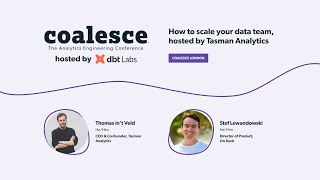
How to scale your data team, hosted by Tasman Analytics

Scaling data teams from zero is hard: there are no easy shortcuts, and it is hard to find clear examples to learn from. That’s why we are very excited to co-present the work we did at On Deck over the last year: starting in Summer 2021 we built a data team from scratch, relying heavily on dbt as the core data modelling environment. Come hear us talk about how we set up the team, prioritised the many different requirements from an ever expanding team of stakeholders and, after just a few months, succeeding in moving On Deck away from a no-code data architecture (with more than 400 SaaS tools) and towards a centralised data model in dbt. We think the lessons (and especially the pitfalls) are worth telling!

Coalesce 2023 is coming! Register for free at https://coalesce.getdbt.com/.

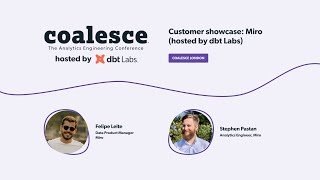
Customer showcase: Miro (hosted by dbt Labs)

How do you efficiently scale your analytics stack when your data and data team grows 10x in 2 years? How do you even start prioritizing what gets done when there's that much growth? In this talk, Felipe Leite and Stephen Pastan of Miro unpack their shift to a Modern Data Stack and share the vital technical changes they made to build a scalable and tech-forward data stack. Come join them in learning how they got to where they are today and what they’re working on for the future. More details coming soon!

Check the slides here: https://docs.google.com/presentation/d/1lLoRBYAv8wlJQuhSrflX4F6y4lqV3SnDNAU7BYxHYR8/edit#slide=id.p

Coalesce 2023 is coming! Register for free at https://coalesce.getdbt.com/.

Summary

One of the reasons that data work is so challenging is because no single person or team owns the entire process. This introduces friction in the process of collecting, processing, and using data. In order to reduce the potential for broken pipelines some teams have started to adopt the idea of data contracts. In this episode Abe Gong brings his experiences with the Great Expectations project and community to discuss the technical and organizational considerations involved in implementing these constraints to your data workflows.

Announcements

Hello and welcome to the Data Engineering Podcast, the show about modern data management When you're ready to build your next pipeline, or want to test out the projects you hear about on the show, you'll need somewhere to deploy it, so check out our friends at Linode. With their new managed database service you can launch a production ready MySQL, Postgres, or MongoDB cluster in minutes, with automated backups, 40 Gbps connections from your application hosts, and high throughput SSDs. Go to dataengineeringpodcast.com/linode today and get a $100 credit to launch a database, create a Kubernetes cluster, or take advantage of all of their other services. And don't forget to thank them for their continued support of this show! Atlan is the metadata hub for your data ecosystem. Instead of locking your metadata into a new silo, unleash its transformative potential with Atlan's active metadata capabilities. Push information about data freshness and quality to your business intelligence, automatically scale up and down your warehouse based on usage patterns, and let the bots answer those questions in Slack so that the humans can focus on delivering real value. Go to dataengineeringpodcast.com/atlan today to learn more about how Atlan’s active metadata platform is helping pioneering data teams like Postman, Plaid, WeWork & Unilever achieve extraordinary things with metadata and escape the chaos. Struggling with broken pipelines? Stale dashboards? Missing data? If this resonates with you, you’re not alone. Data engineers struggling with unreliable data need look no further than Monte Carlo, the leading end-to-end Data Observability Platform! Trusted by the data teams at Fox, JetBlue, and PagerDuty, Monte Carlo solves the costly problem of broken data pipelines. Monte Carlo monitors and alerts for data issues across your data warehouses, data lakes, dbt models, Airflow jobs, and business intelligence tools, reducing time to detection and resolution from weeks to just minutes. Monte Carlo also gives you a holistic picture of data health with automatic, end-to-end lineage from ingestion to the BI layer directly out of the box. Start trusting your data with Monte Carlo today! Visit dataengineeringpodcast.com/montecarlo to learn more. Your host is Tobias Macey and today I'm interviewing Abe Gong about the technical and organizational implementation of data contracts

Interview

Introduction How did you get involved in the area of data management? Can you describe what your conception of a data contract is?

What are some of the ways that you have seen them implemented?

How has your work on Great Expectations influenced your thinking on the strategic and tactical aspects of adopting/implementing data contracts in a given team/organization?

What does the negotiation process look like for identifying what needs to be included in a contract?

What are the interfaces/integration points where data contracts are most useful/necessary? What are the discussions that need to happen when deciding when/whether a contract "violation" is a blocking action vs. issuing a notification? At what level of detail/granularity are contracts most helpful? At the technical level, what does the implementation/integration/deployment of a contract look like? What are the most interesting, innovative, or unexpected ways that you have seen data contracts used? What are the most interesting, unexpected, or chall