talk-data.com talk-data.com

Topic

Marketing

advertising branding customer_acquisition

743

tagged

Activity Trend

49 peak/qtr
2020-Q1 2026-Q1

Activities

743 activities · Newest first

Sponsored by: Fivetran | Raw Data to Real-Time Insights: How Dropbox Revolutionized Data Ingestion

Dropbox, a leading cloud storage platform, is on a mission to accelerate data insights to better understand customers’ needs and elevate the overall customer experience. By leveraging Fivetran’s data movement platform, Dropbox gained real-time visibility into customer sentiment, marketing ROI, and ad performance-empowering teams to optimize spend, improve operational efficiency, and deliver greater business outcomes.Join this session to learn how Dropbox:- Cut data pipeline time from 8 weeks to 30 minutes by automating ingestion and streamlining reporting workflows.- Enable real-time, reliable data movement across tools like Zendesk Chat, Google Ads, MySQL, and more — at global operations scale.- Unify fragmented data sources into the Databricks Data Intelligence Platform to reduce redundancy, improve accessibility, and support scalable analytics.

Sponsored by: Slalom | Nasdaq's Journey from Fragmented Customer Data to AI-Ready Insights

Nasdaq’s rapid growth through acquisitions led to fragmented client data across multiple Salesforce instances, limiting cross-sell potential and sales insights. To solve this, Nasdaq partnered with Slalom to build a unified Client Data Hub on the Databricks Lakehouse Platform. This cloud-based solution merges CRM, product usage, and financial data into a consistent, 360° client view accessible across all Salesforce orgs with bi-directional integration. It enables personalized engagement, targeted campaigns, and stronger cross-sell opportunities across all business units. By delivering this 360 view directly in Salesforce, Nasdaq is improving sales visibility, client satisfaction, and revenue growth. The platform also enables advanced analytics like segmentation, churn prediction, and revenue optimization. With centralized data in Databricks, Nasdaq is now positioned to deploy next-gen Agentic AI and chatbots to drive efficiency and enhance sales and marketing experiences.

Databricks on Databricks: Powering Marketing Insights with Lakehouse

This presentation outlines the evolution of our marketing data strategy, focusing on how we’ve built a strong foundation using the Databricks Lakehouse. We will explore key advancements across data ingestion, strategy, and insights, highlighting the transition from legacy systems to a more scalable and intelligent infrastructure. Through real-world applications, we will showcase how unified Customer 360 insights drive personalization, predictive analytics enhance campaign effectiveness, and GenAI optimizes content creation and marketing execution. Looking ahead, we will demonstrate the next phase of our CDP, the shift toward an end-user-first analytics model powered by AIBI, Genie and Matik, and the growing importance of clean rooms for secure data collaboration. This is just the beginning, and we are poised to unlock even greater capabilities in the future.

​​Retail & Consumer Goods Industry Forum: How AI is Transforming How Brands Connect With Consumers | Sponsored by: Accenture & AWS

Consumer industries are being transformed by AI as physical and digital experiences converge. In this flagship session for retail, travel, restaurants and consumer goods attendees at Data + AI Summit, Databricks and a panel of industry leaders will explore how real-time data and machine learning are enabling brands to gain deeper consumer insights, personalize interactions and move closer to true 1:1 marketing. From AI agents shopping on behalf of consumers to consumer-centric supply chains, discover how the most innovative companies will use AI to reshape customer relationships and drive growth in an increasingly connected world.

AI Powering Epsilon's Identity Strategy: Unified Marketing Platform on Databricks

Join us to hear about how Epsilon Data Management migrated Epsilon’s unique, AI-powered marketing identity solution from multi-petabyte on-prem Hadoop and data warehouse systems to a unified Databricks Lakehouse platform. This transition enabled Epsilon to further scale its Decision Sciences solution and enable new cloud-based AI research capabilities on time and within budget, without being bottlenecked by the resource constraints of on-prem systems. Learn how Delta Lake, Unity Catalog, MLflow and LLM endpoints powered massive data volume, reduced data duplication, improved lineage visibility, accelerated Data Science and AI, and enabled new data to be immediately available for consumption by the entire Epsilon platform in a privacy-safe way. Using the Databricks platform as the base for AI and Data Science at global internet scale, Epsilon deploys marketing solutions across multiple cloud providers and multiple regions for many customers.

Powering Personalization at Scale with Data: How T-Mobile and Deep Sync Help Brands Connect with Consumers

Discover how T-Mobile and Deep Sync are redefining personalized marketing through the power of Databricks. Deep Sync, a leader in deterministic identity solutions, has brought its identity spine to Databricks Lakehouse, which covers over 97% of U.S. households with the most current and accurate attribute data available. T-Mobile is bringing to market for the first time a new data services business that introduces privacy-compliant, consent-based consumer data. Together, T-Mobile and Deep Sync are transforming how brands engage with consumers—enabling bespoke, hyper-personalized workflows, identity-driven insights, and closed-loop measurement through Databricks’ Multi-Party Cleanrooms. Join this session to learn how data and identity are converging to solve today’s modern marketing challenges so consumers can rediscover what it feels like to be seen, not targeted

Swimming at Our Own Lakehouse: How Databricks Uses Databricks

This session is repeated. Peek behind the curtain to learn how Databricks processes hundreds of petabytes of data across every region and cloud where we operate. Learn how Databricks leverages Data and AI to scale and optimize every aspect of the company. From facilities and legal to sales and marketing and of course product research and development. This session is a high-level tour inside Databricks to see how Data and AI enable us to be a better company. We will go into the architecture of things for how Databricks is used for internal use cases like business analytics and SIEM as well as customer-facing features like system tables and assistant. We will cover how data production of our data flow and how we maintain security and privacy while operating a large multi-cloud, multi-region environment.

Sponsored by: Domo | Behind the Brand: How Sol de Janeiro Powers Amazon Ops with Databricks + DOMO

How does one of the world’s fastest-growing beauty brands stay ahead of Amazon’s complexity and scale retail with precision? At Sol de Janeiro, we built a real-time Amazon Operations Hub—powered by Databricks and DOMO—that drives decisions across inventory, profitability, and marketing ROI. See how the Databricks Lakehouse and DOMO dashboards work together to simplify workflows, surface actionable insights, and enable smarter decisions across the business—from frontline operators to the executive suite. In this session, you’ll get a behind-the-scenes look at how we unified trillions of rows from NetSuite, Amazon, Shopify, and carrier systems into a single source of truth. We’ll show how this hub streamlined cross-functional workflows, eliminated manual reporting, and laid the foundation for AI-powered forecasting and automation.

Sponsored by: Amperity | Transforming Guest Experiences: GoTo Foods’ Data Journey with Amperity & Databricks

GoTo Foods, the platform company behind brands like Auntie Anne’s, Cinnabon, Jamba, and more, set out to turn a fragmented data landscape into a high-performance customer intelligence engine. In this session, CTO Manuel Valdes and Director of Marketing Technology Brett Newcome share how they unified data using Databricks Delta Sharing and Amperity’s Customer Data Cloud to speed up time to market. As part of GoTo’s broader strategy to support its brands with shared enterprise tools, the team: Unified loyalty, catering, and retail data into one customer view Cut campaign lead times from weeks to hours Activated audiences in real time without straining engineering Unlocked new revenue through smarter segmentation and personalization

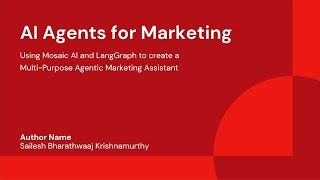
AI Agents for Marketing: Leveraging Mosaic AI to Create a Multi-Purpose Agentic Marketing Assistant

Marketing professionals build campaigns, create content and use effective copywriting to tell a good story to promote a product/offer. All of this requires a thorough and meticulous process for every individual campaign. In order to assist marketing professionals at 7-Eleven, we built a multi-purpose assistant that could: Use campaign briefs to generate campaign ideas and taglines Do copy-writing for marketing content Verify images for messaging accuracy Answer general questions and browse the web as a generic assistant We will walk you through how we created multiple agents as different personas with LangGraph and Mosaic AI to create a chat assistant that assumes a different persona based on the user query. We will also explain our evaluation methodology in choosing models and prompts and how we implemented guardrails for high reliability with sensitive marketing content. This assistant by 7-Eleven was showcased at the Databricks booth at NRF earlier this year.

Marketing Data + AI Leaders Forum
talk
by Derek Slager (Amperity) , Dan Morris (Databricks) , Calen Holbrooks (Airtable) , Bryan Saftler (Databricks) , Elizabeth Dobbs (Databricks) , David Geisinger (Deloitte) , Kristen Brophy (ThredUp) , Joyce Hwang (Dropbox) , Zeynep Inanoglu Ozdemir (Atlassian Pty Ltd.) , Alex Dean (Snowplow) , Rick Schultz (Databricks) , Bryce Peake (Domino's) , Julie Foley Long (Grammarly)

Join us Tuesday June 10th, 9:10-12:10 PM PT Hosted by Databricks CMO, Rick Schultz, hear from executives and speakers at PetSmart, Valentino, Domino’s, AirTable, Dropbox, ThredUp, Grammarly, Deloitte, and more. Come for actionable strategies and real-world examples: Hear from marketing experts on how to build data and AI-driven marketing organizations. Learn how Databricks Marketing supercharges impact using the Data Intelligence Platform; scaling personalization, building more efficient campaigns, and empowering marketers to self-serve insights.

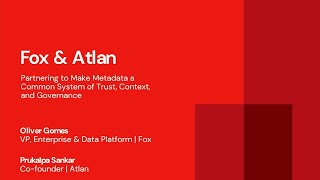
Sponsored by: Atlan | How Fox & Atlan are Partnering to Make Metadata a Common System of Trust, Context, and Governance

With hundreds of millions viewing broadcasts from news to sports, Fox relies on a sophisticated and trusted architecture ingesting 100+ data sources, carefully governed to improve UX across products, drive sales and marketing, and ensure KPI tracking. Join Oliver Gomes, VP of Enterprise and Data Platform at Fox, and Prukalpa Sankar of Atlan to learn how true partnership helps their team navigate opportunities from Governance to AI. To govern and democratize their multi-cloud data platform, Fox chose Atlan to make data accessible and understandable for more users than ever before. Their team then used a data product approach to create a shared language using context from sources like Unity Catalog at a single point of access, no matter the underlying technology. Now, Fox is defining an ambitious future for Metadata. With Atlan and Iceberg driving interoperability, their team prepares to build a “control plane”, creating a common system of trust and governance.

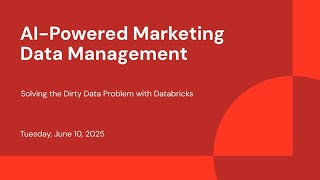
AI-Powered Marketing Data Management: Solving the Dirty Data Problem with Databricks

Marketing teams struggle with ‘dirty data’ — incomplete, inconsistent, and inaccurate information that limits campaign effectiveness and reduces the accuracy of AI agents. Our AI-powered marketing data management platform, built on Databricks, solves this with anomaly detection, ML-driven transformations and the built-in Acxiom Referential Real ID Graph with Data Hygiene.We’ll showcase how Delta Lake, Unity Catalog and Lakeflow Declarative Pipelines power our multi-tenant architecture, enabling secure governance and 75% faster data processing. Our privacy-first design ensures compliance with GDPR, CCPA and HIPAA through role-based access, encryption key management and fine-grained data controls.Join us for a live demo and Q&A, where we’ll share real-world results and lessons learned in building a scalable, AI-driven marketing data solution with Databricks.

Retrieval Augmented Generation (RAG) continues to be a foundational approach in AI despite claims of its demise. While some marketing narratives suggest RAG is being replaced by fine-tuning or long context windows, these technologies are actually complementary rather than competitive. But how do you build a truly effective RAG system that delivers accurate results in high-stakes environments? What separates a basic RAG implementation from an enterprise-grade solution that can handle complex queries across disparate data sources? And with the rise of AI agents, how will RAG evolve to support more dynamic reasoning capabilities? Douwe Kiela is the CEO and co-founder of Contextual AI, a company at the forefront of next-generation language model development. He also serves as an Adjunct Professor in Symbolic Systems at Stanford University, where he contributes to advancing the theoretical and practical understanding of AI systems. Before founding Contextual AI, Douwe was the Head of Research at Hugging Face, where he led groundbreaking efforts in natural language processing and machine learning. Prior to that, he was a Research Scientist and Research Lead at Meta’s FAIR (Fundamental AI Research) team, where he played a pivotal role in developing Retrieval-Augmented Generation (RAG)—a paradigm-shifting innovation in AI that combines retrieval systems with generative models for more grounded and contextually aware responses. In the episode, Richie and Douwe explore the misconceptions around the death of Retrieval Augmented Generation (RAG), the evolution to RAG 2.0, its applications in high-stakes industries, the importance of metadata and entitlements in data governance, the potential of agentic systems in enterprise settings, and much more. Links Mentioned in the Show: Contextual AIConnect with DouweCourse: Retrieval Augmented Generation (RAG) with LangChainRelated Episode: High Performance Generative AI Applications with Ram Sriharsha, CTO at PineconeRegister for RADAR AI - June 26 New to DataCamp? Learn on the go using the DataCamp mobile appEmpower your business with world-class data and AI skills with DataCamp for business

Supported by Our Partners •⁠ Statsig ⁠ — ⁠ The unified platform for flags, analytics, experiments, and more. •⁠ Sinch⁠ — Connect with customers at every step of their journey. •⁠ Modal⁠ — The cloud platform for building AI applications. — How has Microsoft changed since its founding in 1975, especially in how it builds tools for developers? In this episode of The Pragmatic Engineer, I sit down with Scott Guthrie, Executive Vice President of Cloud and AI at Microsoft. Scott has been with the company for 28 years. He built the first prototype of ASP.NET, led the Windows Phone team, led up Azure, and helped shape many of Microsoft’s most important developer platforms. We talk about Microsoft’s journey from building early dev tools to becoming a top cloud provider—and how it actively worked to win back and grow its developer base. In this episode, we cover: • Microsoft’s early years building developer tools  • Why Visual Basic faced resistance from devs back in the day: even though it simplified development at the time • How .NET helped bring a new generation of server-side developers into Microsoft’s ecosystem • Why Windows Phone didn’t succeed  • The 90s Microsoft dev stack: docs, debuggers, and more • How Microsoft Azure went from being the #7 cloud provider to the #2 spot today • Why Microsoft created VS Code • How VS Code and open source led to the acquisition of GitHub • What Scott’s excited about in the future of developer tools and AI • And much more! — Timestamps (00:00) Intro (02:25) Microsoft’s early years building developer tools (06:15) How Microsoft’s developer tools helped Windows succeed (08:00) Microsoft’s first tools were built to allow less technically savvy people to build things (11:00) A case for embracing the technology that’s coming (14:11) Why Microsoft built Visual Studio and .NET (19:54) Steve Ballmer’s speech about .NET (22:04) The origins of C# and Anders Hejlsberg’s impact on Microsoft  (25:29) The 90’s Microsoft stack, including documentation, debuggers, and more (30:17) How productivity has changed over the past 10 years  (32:50) Why Gergely was a fan of Windows Phone—and Scott’s thoughts on why it didn’t last (36:43) Lessons from working on (and fixing)  Azure under Satya Nadella  (42:50) Codeplex and the acquisition of GitHub (48:52) 2014: Three bold projects to win the hearts of developers (55:40) What Scott’s excited about in new developer tools and cloud computing  (59:50) Why Scott thinks AI will enhance productivity but create more engineering jobs — The Pragmatic Engineer deepdives relevant for this episode: • Microsoft is dogfooding AI dev tools’ future • Microsoft’s developer tools roots • Why are Cloud Development Environments spiking in popularity, now? • Engineering career paths at Big Tech and scaleups • How Linux is built with Greg Kroah-Hartman — See the transcript and other references from the episode at ⁠⁠https://newsletter.pragmaticengineer.com/podcast⁠⁠ — Production and marketing by ⁠⁠⁠⁠⁠⁠⁠⁠https://penname.co/⁠⁠⁠⁠⁠⁠⁠⁠. For inquiries about sponsoring the podcast, email [email protected].

Get full access to The Pragmatic Engineer at newsletter.pragmaticengineer.com/subscribe

Fidelity Investments is dedicated to enhancing and securing our customers' financial well-being by providing personalized experiences tailored to their unique financial journeys. Fidelity engage with customers through their preferred channels, generating valuable data that marketing teams leverage to make informed decisions and assess campaign effectiveness. To ensure consistent personalization, Fidelity are shifting to a product-centric strategy. As early adopters of Data Mesh principles within the financial services sector, Fidelity will showcase two use cases: the Measurement Data product and the Metric Data product.

Supported by Our Partners •⁠ Statsig ⁠ — ⁠ The unified platform for flags, analytics, experiments, and more. •⁠ Sinch⁠ — Connect with customers at every step of their journey. •⁠ Cortex⁠ — Your Portal to Engineering Excellence. — What does it take to land a job as an AI Engineer—and thrive in the role? In this episode of Pragmatic Engineer, I’m joined by Janvi Kalra, currently an AI Engineer at OpenAI. Janvi shares how she broke into tech with internships at top companies, landed a full-time software engineering role at Coda, and later taught herself the skills to move into AI Engineering: by things like building projects in her free time, joining hackathons, and ultimately proving herself and earning a spot on Coda’s first AI Engineering team. In our conversation, we dive into the world of AI Engineering and discuss three types of AI companies, how to assess them based on profitability and growth, and practical advice for landing your dream job in the field. We also discuss the following:  • How Janvi landed internships at Google and Microsoft, and her tips for interview prepping • A framework for evaluating AI startups • An overview of what an AI Engineer does • A mini curriculum for self-learning AI: practical tools that worked for Janvi • The Coda project that impressed CEO Shishir Mehrotra and sparked Coda Brain • Janvi’s role at OpenAI and how the safety team shapes responsible AI • How OpenAI blends startup speed with big tech scale • Why AI Engineers must be ready to scrap their work and start over • Why today’s engineers need to be product-minded, design-aware, full-stack, and focused on driving business outcomes • And much more! — Timestamps (00:00) Intro (02:31) How Janvi got her internships at Google and Microsoft (03:35) How Janvi prepared for her coding interviews  (07:11) Janvi’s experience interning at Google (08:59) What Janvi worked on at Microsoft  (11:35) Why Janvi chose to work for a startup after college (15:00) How Janvi picked Coda  (16:58) Janvi’s criteria for picking a startup now  (18:20) How Janvi evaluates ‘customer obsession’  (19:12) Fast—an example of the downside of not doing due diligence (21:38) How Janvi made the jump to Coda’s AI team (25:48) What an AI Engineer does  (27:30) How Janvi developed her AI Engineering skills through hackathons (30:34) Janvi’s favorite AI project at Coda: Workspace Q&A  (37:40) Learnings from interviewing at 46 companies (40:44) Why Janvi decided to get experience working for a model company  (43:17) Questions Janvi asks to determine growth and profitability (45:28) How Janvi got an offer at OpenAI, and an overview of the interview process (49:08) What Janvi does at OpenAI  (51:01) What makes OpenAI unique  (52:30) The shipping process at OpenAI (55:41) Surprising learnings from AI Engineering  (57:50) How AI might impact new graduates  (1:02:19) The impact of AI tools on coding—what is changing, and what remains the same (1:07:51) Rapid fire round — The Pragmatic Engineer deepdives relevant for this episode: •⁠ AI Engineering in the real world •⁠ The AI Engineering stack •⁠ Building, launching, and scaling ChatGPT Images — See the transcript and other references from the episode at ⁠⁠https://newsletter.pragmaticengineer.com/podcast⁠⁠ — Production and marketing by ⁠⁠⁠⁠⁠⁠⁠⁠https://penname.co/⁠⁠⁠⁠⁠⁠⁠⁠. For inquiries about sponsoring the podcast, email [email protected].

Get full access to The Pragmatic Engineer at newsletter.pragmaticengineer.com/subscribe

podcast_episode
by Val Kroll , Julie Hoyer , Tim Wilson (Analytics Power Hour - Columbus (OH) , Dan McCarthy (Robert H. Smith School of Business, University of Maryland) , Moe Kiss (Canva) , Michael Helbling (Search Discovery)

No matter how simple a metric's name makes it sound, the details are often downright devilish. What is a website visit? What is revenue? What is a customer? Go one level deeper with a metric like customer acquisition cost (CAC) or customer lifetime value (CLV or LTV, depending on how you acronym), and things can get messy in a hurry. In some cases, there are multiple "right" definitions, depending on how the metric is being used. In some cases, there are incentive structures to thumb the definitional scale one way or another. In some cases, a hastily made choice becomes a well-established, yet misguided, norm. In some cases, public companies simply throw their hands up and stop reporting a key metric! Dan McCarthy, Associate Professor of Marketing at the Robert H. Smith School of Business at the University of Maryland, spends a lot of time and thought culling through public filings and disclosures therein trying to make sense of metric definitions, so he was a great guest to have to dig into the topic! For complete show notes, including links to items mentioned in this episode and a transcript of the show, visit the show page.

podcast_episode
by Iwo Szapar (Various initiatives (Remote-how, Remote-First Institute, AI-Mentor, Saudi AI Leadership Forum)) , Richie (DataCamp) , Eryn Peters (AI Maturity Index)

AI maturity isn't achieved through technology alone—it requires organizational alignment, cultural readiness, and strategic implementation. Companies across industries are working to move beyond experimental AI use toward systematic integration that delivers measurable business value. How do you assess where your organization stands on the AI maturity spectrum? What frameworks can help prioritize your efforts? Eryn Peters, Co-founder & co-creator at AI Maturity Index, is a future of work evangelist. She is the co-creator of a tool for assessing AI maturity, and regularly advises companies on how to assess and improve their AI maturity. Eryn is also the Editor of the Weekly Workforce newsletter and the Principal at the Startup Consortium consultancy. Previously, she was the Global Director of the Association for the Future of Work, and VP of Marketing at Andela. Iwo Szapar is a serial entrepreneur with a passion for creating impactful solutions that enable people to work smarter, not harder. He is the co-founder of several innovative initiatives, including Remote-how, Remote-First Institute, AI-Mentor, and the Saudi AI Leadership Forum. Throughout his career, Iwo has helped transform how over 3,000 companies—including Microsoft, Walmart, and ING Bank—approach the future of work. In the episode, Richie, Eryn, and Iwo explore AI maturity in organizations, the balance between top-down and bottom-up AI adoption, the relationship between data and AI maturity, the importance of change management, practical steps for AI implementation, and much more. Links Mentioned in the Show: AI Maturity IndexEryn’s WebsiteIwo’s Book: Remote Work Is The WayConnect with Eryn and IwoState of Data & AI Literacy Report 2025Eryn’s previous webinar: Assessing Your Organization's AI MaturityRelated Episode: Scaling Responsible AI Literacy with Uthman Ali, Global Head of Responsible AI at BPRewatch sessions from RADAR: Skills Edition New to DataCamp? Learn on the go using the DataCamp mobile appEmpower your business with world-class data and AI skills with DataCamp for business