
talk-data.com talk-data.com

Topic

Spark

Apache Spark

big_data distributed_computing analytics

120

tagged

Activity Trend

71 peak/qtr
2020-Q1 2026-Q1

Activities

Showing filtered results

Filtering by: Databricks DATA + AI Summit 2023 ×
Tools for Assisted Apache Spark Version Migrations, From 2.1 to 3.2+

This talk will look at the current state of tools to automate library and language upgrades in Python and Scala and apply them to upgrading to new version of Apache Spark. After doing a very informal survey, it seems that many users are stuck on no longer supported versions of Spark, so this talk will expand on the first attempt at automating upgrades (2.4 - 3.0) to explore the problem all the way back to 2.1.

Connect with us: Website: https://databricks.com Facebook: https://www.facebook.com/databricksinc Twitter: https://twitter.com/databricks LinkedIn: https://www.linkedin.com/company/data... Instagram: https://www.instagram.com/databricksinc/
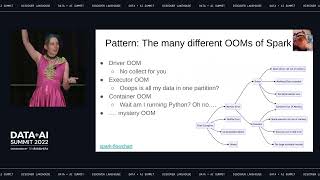
What to Do When Your Job Goes OOM in the Night (Flowcharts!)

Have you ever had a Spark job just stop working? No idea where to start debugging? Or maybe your job that used to be completed in minutes is now taking hours? Or are you just tired of answering user questions? Come join us for a fun detour into the world of out of memory exceptions, slow jobs, and other things that make our lives sad and leave with techniques to make our lives happy again. This flowchart is based on the initial work of Anya's Spark tuning flowchart updated with our collective experience fixing broken Spark jobs. The talk will wrap up with the methodology we used and how you can contribute to the flowchart (aka guilt you into writing pull requests).

Connect with us: Website: https://databricks.com Facebook: https://www.facebook.com/databricksinc Twitter: https://twitter.com/databricks LinkedIn: https://www.linkedin.com/company/data... Instagram: https://www.instagram.com/databricksinc/
Deep Dive into the New Features of Apache Spark 3.2 and 3.3

Apache Spark has become the most widely-used engine for executing data engineering, data science and machine learning on single-node machines or clusters. The number of monthly maven downloads of Spark has rapidly increased to 20 million.

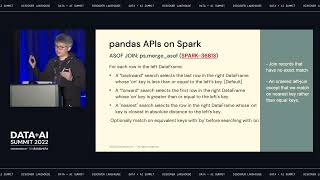
We will talk about the higher-level features and improvements in Spark 3.2 and 3.3. The talk also dives deeper into the following features + Introducing pandas API on Apache Spark to unify small data API and big data API. + Completing the ANSI SQL compatibility mode to simplify migration of SQL workloads. + Productionizing adaptive query execution to speed up Spark SQL at runtime. + Introducing RocksDB state store to make state processing more scalable

Connect with us: Website: https://databricks.com Facebook: https://www.facebook.com/databricksinc Twitter: https://twitter.com/databricks LinkedIn: https://www.linkedin.com/company/data... Instagram: https://www.instagram.com/databricksinc/
Distributed Machine Learning at Lyft

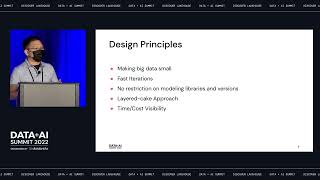
Data collection, preprocessing, feature engineering are the fundamental steps in any Machine Learning Pipeline. After feature engineering, being able to parallelize training on multiple low cost machines helps to reduce cost and time both. And, then being able to train models in a distributed manner speeds up Hyperparameter Tuning. How can we unify these stages of ML Pipeline in one unified distributed training platform together? And that too on Kubernetes?

Our ML platform is completely based on Kubernetes because of its scalability and rapid bootstrapping time of resources. In this talk we will demonstrate how Lyft uses Spark on Kubernetes, Fugue (our home grown unifying compute abstraction layer) to design a holistic end to end ML Pipeline system for distributed feature engineering, training & prediction experience for our customers on our ML Platform on top of Spark on K8s. We will also do a deep dive to show how we are abstracting and hiding infrastructure complexities so that our Data Scientists and Research Scientist can focus only on the business logic for their models through simple pythonic APIs and SQL. We let the users focus on ''what to do'' and the platform takes care of ''how to do''. We will share our challenges, learning and the fun we had while implementing. Using Spark on K8s have helped us achieve large scale data processing with 90% less cost and at times bringing down processing time from 2 hours to less than 20 mins.

Connect with us: Website: https://databricks.com Facebook: https://www.facebook.com/databricksinc Twitter: https://twitter.com/databricks LinkedIn: https://www.linkedin.com/company/data... Instagram: https://www.instagram.com/databricksinc/
Diving into Delta Lake 2.0

The Delta ecosystem rapidly expanded with the release of Delta Lake 1.2 which included integrations with Apache Spark™, Apache Flink, Presto, Trino, features such as OPTIMIZE, data skipping using column statistics, restore APIs, S3 multi-cluster writes, and more.

Join this session to learn about how the wider Delta community collaborated together to bring these features and integrations together; as well as the current roadmap. This will be an interactive session so come prepared with your questions—we should have answers!

Connect with us: Website: https://databricks.com Facebook: https://www.facebook.com/databricksinc Twitter: https://twitter.com/databricks LinkedIn: https://www.linkedin.com/company/data... Instagram: https://www.instagram.com/databricksinc/
Enabling BI in a Lakehouse Environment: How Spark and Delta Can Help With Automating a DWH Develop

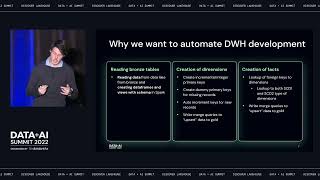
Traditional data warehouses typically struggle when it comes to handling large volumes of data and traffic, particularly when it comes to unstructured data. In contrast, data lakes overcome such issues and have become the central hub for storing data. We outline how we can enable BI Kimball data modelling in a Lakehouse environment.

We present how we built a Spark-based framework to modernize DWH development with data lake as central storage, assuring high data quality and scalability. The framework was implemented at over 15 enterprise data warehouses across Europe.

We present how one can tackle in Spark & with Delta Lake the data warehouse principles like surrogate, foreign and business keys, SCD type 1 and 2 etc. Additionally, we share our experiences on how such a unified data modelling framework can bridge BI with modern day use cases, such as machine learning and real time analytics. The session outlines the original challenges, the steps taken and the technical hurdles we faced.

Connect with us: Website: https://databricks.com Facebook: https://www.facebook.com/databricksinc Twitter: https://twitter.com/databricks LinkedIn: https://www.linkedin.com/company/data... Instagram: https://www.instagram.com/databricksinc/

Enabling Learning on Confidential Data

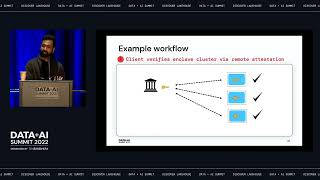
Multiple organizations often wish to aggregate their confidential data and learn from it, but they cannot do so because they cannot share their data with each other. For example, banks wish to train models jointly over their aggregate transaction data to detect money launderers more efficiently because criminals hide their traces across different banks.

To address such problems, we developed MC^2 at UC Berkeley, an open-source framework for multi-party confidential computation, on top of Apache Spark. MC^2 enables organizations to share encrypted data and perform analytics and machine learning on the encrypted data without any organization or the cloud seeing the data. Our company Opaque brings the MC^2 technology in an easy-to-use form to organizations in the financial, medical, ad tech, and other sectors.

Connect with us: Website: https://databricks.com Facebook: https://www.facebook.com/databricksinc Twitter: https://twitter.com/databricks LinkedIn: https://www.linkedin.com/company/data... Instagram: https://www.instagram.com/databricksinc/
FugueSQL—The Enhanced SQL Interface for Pandas and Spark DataFrames

SQL users working with Pandas and Spark quickly realize SQL is a second-class interface, invoked between predominantly Python code.

We will introduce FugueSQL, an enhanced SQL interface that allows SQL lovers to express end-to-end workflows predominantly in SQL. With a Jupyter notebook extension, SQL commands can be used in Databricks notebooks for interactive handling of in-memory datasets. This allows heavy SQL users to fully leverage Spark in their preferred grammar.

Connect with us: Website: https://databricks.com Facebook: https://www.facebook.com/databricksinc Twitter: https://twitter.com/databricks LinkedIn: https://www.linkedin.com/company/data... Instagram: https://www.instagram.com/databricksinc/
Gazelle-Jni: A Middle Layer to Offload Spark SQL to Native Engines for Execution Acceleration

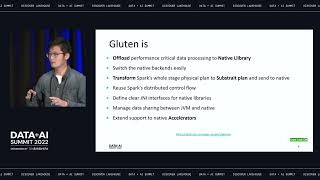
This session will introduce Gazelle-Jni, which was proposed to better integrate the various native SQL engines as Spark SQL’s backend. It implemented a shared JVM and JNI middle layer. With the help of Gazlle-Jni, Spark SQL execution can be offloaded to native engines by passing Substrait transformed physical plan.

Examples will be presented on how to integrate native engines with Spark SQL.

Connect with us: Website: https://databricks.com Facebook: https://www.facebook.com/databricksinc Twitter: https://twitter.com/databricks LinkedIn: https://www.linkedin.com/company/data... Instagram: https://www.instagram.com/databricksinc/
Goodbye Hell of Unions in Spark SQL

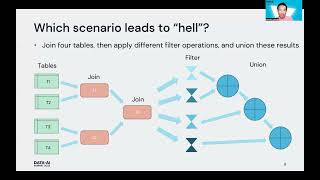
It is known that applications, which heavily use Spark SQL union() operation, cause performance problems. The union() operation combines multiple rows into one table. When union() operation merges many Dataframes, the size of the generated Spark SQL planning tree will be huge while the Spark SQL code is small. The huge planning tree may lead to performance problems. This talk reviews performance problems from the Spark SQL planning perspective and explains how to avoid the performance issues with common practices.

Connect with us: Website: https://databricks.com Facebook: https://www.facebook.com/databricksinc Twitter: https://twitter.com/databricks LinkedIn: https://www.linkedin.com/company/data... Instagram: https://www.instagram.com/databricksinc/
Auditing Your Data and Answering the Lifelong Question—Is It the End of the Day Yet?

Huge volumes of data flow through a robust Kafka architecture, into several ETLs, receiving, transforming and storing the data. We clearly understood our ETLs’ workflow and our data architecture, from source to destination.

But how much did we know about the way our data makes though our systems? And what about the life long question, is it the end of the day yet?

In this talk I’m going to present to you the design process behind our Data Auditing system, Life Line. From tracking and producing, to analyzing and storing auditing information, using technologies such as Kafka, Avro, Spark, Lambda functions and complex SQL queries. We’re going to cover: * AVRO Audit header * Auditing heart beat - designing your metadata * Designing and optimizing your auditing table - what does this data look like anyway? * Creating an alert based monitoring system * Answering the most important question of all - is it the end of the day yet?

Connect with us: Website: https://databricks.com Facebook: https://www.facebook.com/databricksinc Twitter: https://twitter.com/databricks LinkedIn: https://www.linkedin.com/company/data... Instagram: https://www.instagram.com/databricksinc/
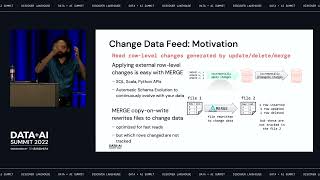
DELETE, UPDATE, MERGE Operations in Data Source

If you’ve ever had to delete a set of records for regulatory compliance, update a set of records to fix an issue in the ingestion pipeline, or apply changes in a transaction log to a fact table, you know that row-level operations are becoming critical for modern data lake workflows. This talk will focus on some of the upcoming features in Spark 3.3 that will enable execution of row-level operations and allow Spark to only pass to connectors what rows to delete, update, or insert. As a result, data sources won’t have to provide low-level SQL extensions for Spark and will be able to benefit from a scalable built-in implementation that works across all connectors. The presentation will be useful for data source developers as well as data engineers and analysts interested in performing DELETE, UPDATE, MERGE operations in Spark.

Connect with us: Website: https://databricks.com Facebook: https://www.facebook.com/databricksinc Twitter: https://twitter.com/databricks LinkedIn: https://www.linkedin.com/company/data... Instagram: https://www.instagram.com/databricksinc/

Delta Lake 2.0 Overview

After three years of hard work by the Delta community, we are proud to announce the release of Delta Lake 2.0. Completing the work to open-source all of Delta Lake while tens of thousands of organizations were running in production was no small feat and we have the ever-expanding Delta community to thank! Join this session to learn about how the wider Delta community collaborated together to bring these features and integrations together.

Join this session to learn about how the wider Delta community collaborated together to bring these features and integrations together. This includes the Integrations with Apache Spark™, Apache Flink, Apache Pulsar, Presto, Trino, and more.

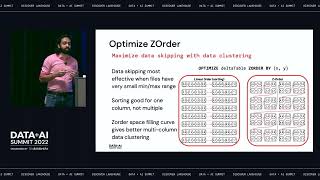
Features such as OPTIMIZE ZORDER, data skipping using column stats, S3 multi-cluster writes, Change Data Feed, and more.

Language APIs including Rust, Python, Ruby, GoLang, Scala, and Java.

Connect with us: Website: https://databricks.com Facebook: https://www.facebook.com/databricksinc Twitter: https://twitter.com/databricks LinkedIn: https://www.linkedin.com/company/data... Instagram: https://www.instagram.com/databricksinc/

Discover Data Lakehouse With End-to-End Lineage

Data Lineage is key for managing change, ensuring data quality and implementing Data Governance in an organization. There are a few use cases for Data Lineage: Data Governance: For compliance and regulatory purposes our customers are required to prove the data/reports they are submitting came from a trusted and verified source.

This typically means identifying the tables and data sets used in a report or dashboard and tracing the source of these tables and fields. Another use case for the Governance scenario is to understand the spread of sensitive data within the lakehouse. Data Discovery: Data analysts looking to self-serve and build their own analytics and models typically spend time exploring and understanding the data in their lakehouse.

Lineage is a key piece of information which enhances the understanding and trustworthiness of the data the analyst plans to use. Problem Identification: Data teams are often called to solve errors in analysts dashboards and reports (“Why is the total number of widgets different in this report than the one I have built?”). This usually leads to an expensive forensic exercise by the DE team to understand the sources of data and the transformations applied to it before it hits the report. Change Management : It is not uncommon for data sources to change, a new source may stop delivering data or a field in the source system changes its semantics.

In this scenario the DE team would like to understand the downstream impact of this change - to get a sense of how many datasets and users will be affected by this change. This will help them determine the impact of the change, manage user expectations and address issues ahead of time In this talk, we will talk about how we capture table and column lineage for spark / delta and unity catalog for our customers in details and how users could leverage data lineage to serve various use cases mentioned above.

Connect with us: Website: https://databricks.com Facebook: https://www.facebook.com/databricksinc Twitter: https://twitter.com/databricks LinkedIn: https://www.linkedin.com/company/data... Instagram: https://www.instagram.com/databricksinc/

Enable Production ML with Databricks Feature Store

Productionalizing ML models is hard. In fact, very few ML projects make it to production, and one of the hardest problems is data! Most AI platforms are disconnected from the data platform, making it challenging to keep features constantly updated and available in real-time. Offline/online skew prevents models from being used in real-time or, worse, introduces bugs and biases in production. Building systems to enable real-time inference requires valuable production engineering resources. As a result of these challenges, most ML models do not see the light of day.

Learn how you can simplify production ML using Databricks Feature Store, the first feature store built on the data lakehouse. Data sources for features are drawn from a central data lakehouse, and the feature tables themselves are tables in the lakehouse, accessible in Spark and SQL for both machine learning and analytics use cases. Features, data pipelines, source data, and models can all be co-governed in a central platform. Feature Store is seamlessly integrated with Apache Spark™, enabling automatic lineage tracking, and with MLflow, enabling models to look up feature values at inference time automatically. See these capabilities in action and how you can use it for your ML projects.

Connect with us: Website: https://databricks.com Facebook: https://www.facebook.com/databricksinc Twitter: https://twitter.com/databricks LinkedIn: https://www.linkedin.com/company/data... Instagram: https://www.instagram.com/databricksinc/
Fugue Tune: Distributed Hybrid Hyperparameter Tuning

Hyperparameter optimization on Spark is commonly memory-bound, where the model training is done on data that doesn’t fit on a single machine. We introduce Fugue-tune, an intuitive interface focusing on compute-bound hyperparameter tuning that scales Hyperopt and Optuna by allowing them to leverage Spark and Dask without code change.

Connect with us: Website: https://databricks.com Facebook: https://www.facebook.com/databricksinc Twitter: https://twitter.com/databricks LinkedIn: https://www.linkedin.com/company/data... Instagram: https://www.instagram.com/databricksinc/
ÀLaSpark: Gousto's Recipe for Building Scalable PySpark Pipelines

Find out how Gousto is developing its data pipelines at scale in a repeatable manner. At Gousto, we’ve developed Goustospark - a wrapper around pyspark that allows us to quickly and easily build data pipelines that are deployed into our Databricks environment.

This wrapper abstracts repetitive components of all data pipelines such as spark configurations and metastore interactions. This allows a developer to simply specify the blueprints of the pipeline before turning their attention to more pressing issues, such as data quality and data governance, whilst enjoying a high level of performance and reliability.

In this session we will deep dive into the design patterns we followed, some unique approaches we’ve taken on how we structure pipelines and show a live demo of implementing a new spark streaming pipeline in Databricks from scratch. We will even share some example python code and snippets to help you build your own.

Connect with us: Website: https://databricks.com Facebook: https://www.facebook.com/databricksinc Twitter: https://twitter.com/databricks LinkedIn: https://www.linkedin.com/company/data... Instagram: https://www.instagram.com/databricksinc/
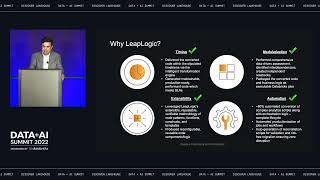
How AARP Services, Inc. automated SAS transformation to Databricks using LeapLogic

While SAS has been a standard in analytics and data science use cases, it is not cloud-native and does not scale well. Join us to learn how AARP automated the conversion of hundreds of complex data processing, model scoring, and campaign workloads to Databricks using LeapLogic, an intelligent code transformation accelerator that can transform any and all legacy ETL, analytics, data warehouse and Hadoop to modern data platforms.

In this session experts from AARP and Impetus will share about collaborating with Databricks and how they were able to: • Automate modernization of SAS marketing analytics based on coding best practices • Establish a rich library of Spark and Python equivalent functions on Databricks with the same capabilities as SAS procedures, DATA step operations, macros, and functions • Leverage Databricks-native services like Delta Live Tables to implement waterfall techniques for campaign execution and simplify pipeline monitoring

Connect with us: Website: https://databricks.com Facebook: https://www.facebook.com/databricksinc Twitter: https://twitter.com/databricks LinkedIn: https://www.linkedin.com/company/data... Instagram: https://www.instagram.com/databricksinc/
Welcome &  Destination Lakehouse    Ali Ghodsi   Keynote Data + AI Summit 2022

Join the Day 1 keynote to hear from Databricks co-founders - and original creators of Apache Spark and Delta Lake - Ali Ghodsi, Matei Zaharia, and Reynold Xin on how Databricks and the open source community is taking on the biggest challenges in data. The talks will address the latest updates on the Apache Spark and Delta Lake projects, the evolution of data lakehouse architecture, and how companies like Adobe and Amgen are using lakehouse architecture to advance their data goals.

Connect with us: Website: https://databricks.com Facebook: https://www.facebook.com/databricksinc Twitter: https://twitter.com/databricks LinkedIn: https://www.linkedin.com/company/data... Instagram: https://www.instagram.com/databricksinc/

Apache Spark Community Update | Reynold Xin Streaming Lakehouse | Karthik Ramasamy

Data + AI Summit Keynote talks from Reynold Xin and Karthik Ramasamy

Connect with us: Website: https://databricks.com Facebook: https://www.facebook.com/databricksinc Twitter: https://twitter.com/databricks LinkedIn: https://www.linkedin.com/company/data... Instagram: https://www.instagram.com/databricksinc/