talk-data.com talk-data.com

Topic

XML

Extensible Markup Language (XML)

markup_language data_exchange data_storage file_format

289

tagged

Activity Trend

1 peak/qtr
2020-Q1 2026-Q1

Activities

289 activities · Newest first

SQL: A Beginner's Guide, Fourth Edition, 4th Edition

This fully revised, self-paced learning tool lays out all the necessary steps to quickly and easily start writing SQL programs Thoroughly updated to reflect the most recent ANSI/ISO standard, SQL: A Beginner's Guide, Fourth Edition will get you up-and-running with SQL programming right away. Clear tutorials, annotated code, and proven instructional tools guide you to easily performing queries and modifications, building databases, creating and reviewing embedded statements, troubleshooting system- and data-related problems, and much more. You will learn how to retrieve, insert, update, and delete database data, and perform management and administrative functions. The book also covers new features, including SQL/XML and the long-awaited temporal support. Code examples are provided throughout along with notes on using them with the latest RDBMS software versions such as MySQL 5.7, SQL Server 2014, and Oracle Database 12 c. Platform-neutral coverage; all skills can be applied to any database product, and any SQL version Features hands-on exercises and self-tests that reinforce basic knowledge ”Ask the Expert” sections throughout are filled with bonus information and useful tips

Access 2016 Bible

Master database creation and management Access 2016 Bible is your, comprehensive reference to the world's most popular database management tool. With clear guidance toward everything from the basics to the advanced, this go-to reference helps you take advantage of everything Access 2016 has to offer. Whether you're new to Access or getting started with Access 2016, you'll find everything you need to know to create the database solution perfectly tailored to your needs, with expert guidance every step of the way. The companion website features all examples and databases used in the book, plus trial software and a special offer from Database Creations. Start from the beginning for a complete tutorial, or dip in and grab what you need when you need it — this book gives you an expert Access 2016 companion on call 24/7. Access enables database novices and programmers to store, organize, view, analyze, and share data, as well as build powerful, integrable, custom database solutions — but databases can be complex, and difficult to navigate. This book helps you harness the power of the database with a solid understanding of their purpose, construction, and application. Understand database objects and design systems objects Build forms, create tables, manipulate datasheets, and add data validation Use Visual Basic automation and XML Data Access Page design Exchange data with other Office applications, including Word, Excel, and more From database fundamentals and terminology to XML and Web services, this book has everything you need to maximize Access 2016 and build the database you need.

Advanced Data Management

Advanced data management has always been at the core of efficient database and information systems. Recent trends like big data and cloud computing have aggravated the need for sophisticated and flexible data storage and processing solutions. This book provides a comprehensive coverage of the principles of data management developed in the last decades with a focus on data structures and query languages. It treats a wealth of different data models and surveys the foundations of structuring, processing, storing and querying data according these models. Starting off with the topic of database design, it further discusses weaknesses of the relational data model, and then proceeds to convey the basics of graph data, tree-structured XML data, key-value pairs and nested, semi-structured JSON data, columnar and record-oriented data as well as object-oriented data. The final chapters round the book off with an analysis of fragmentation, replication and consistency strategies for data management in distributed databases as well as recommendations for handling polyglot persistence in multi-model databases and multi-database architectures. While primarily geared towards students of Master-level courses in Computer Science and related areas, this book may also be of benefit to practitioners looking for a reference book on data modeling and query processing. It provides both theoretical depth and a concise treatment of open source technologies currently on the market.

Oracle SOA Suite 12c Handbook

Master Oracle SOA Suite 12 c Design, implement, manage, and maintain a highly flexible service-oriented computing infrastructure across your enterprise using the detailed information in this Oracle Press guide. Written by an Oracle ACE director, Oracle SOA Suite 12c Handbook uses a start-to-finish case study to illustrate each concept and technique. Learn expert techniques for designing and implementing components, assembling composite applications, integrating Java, handling complex business logic, and maximizing code reuse. Runtime administration, governance, and security are covered in this practical resource. Get started with the Oracle SOA Suite 12 c development and run time environment Deploy and manage SOA composite applications Expose SOAP/XML REST/JSON through Oracle Service Bus Establish interactions through adapters for Database, JMS, File/FTP, UMS, LDAP, and Coherence Embed custom logic using Java and the Spring component Perform fast data analysis in real time with Oracle Event Processor Implement Event Drive Architecture based on the Event Delivery Network (EDN) Use Oracle Business Rules to encapsulate logic and automate decisions Model complex processes using BPEL, BPMN, and human task components Establish KPIs and evaluate performance using Oracle Business Activity Monitoring Control traffic, audit system activity, and encrypt sensitive data

Introduction to JavaScript Object Notation

What is JavaScript Object Notation (JSON) and how can you put it to work? This concise guide helps busy IT professionals get up and running quickly with this popular data interchange format, and provides a deep understanding of how JSON works. Author Lindsay Bassett begins with an overview of JSON syntax, data types, formatting, and security concerns before exploring the many ways you can apply JSON today. From Web APIs and server-side language libraries to NoSQL databases and client-side frameworks, JSON has emerged as a viable alternative to XML for exchanging data between different platforms. If you have some programming experience and understand HTML and JavaScript, this is your book. Learn why JSON syntax represents data in name-value pairs Explore JSON data types, including object, string, number, and array Find out how you can combat common security concerns Learn how the JSON schema verifies that data is formatted correctly Examine the relationship between browsers, web APIs, and JSON Understand how web servers can both request and create data Discover how jQuery and other client-side frameworks use JSON Learn why the CouchDB NoSQL database uses JSON to store data

Learning NHibernate 4

Dive into the essentials of NHibernate 4 with this comprehensive guide. Designed for .NET developers, you will discover how to map domain models to databases effectively, perform various database operations, optimize performance, and apply powerful data access patterns using NHibernate. What this Book will help me do Understand how to map domain entities to a database schema using NHibernate's mapping mechanisms. Efficiently configure NHibernate for your application using XML configuration files. Perform CRUD operations and craft data retrieval strategies with NHibernate. Optimize your database-oriented application in terms of performance and memory. Apply NHibernate in real-world projects, including interaction with legacy databases. Author(s) Suhas H. Chatekar is an experienced software engineer who specializes in .NET development and database integration using ORM tools like NHibernate. With a passion for creating clear and operational technical resources, his comprehensive expertise ensures that his works empower developers to achieve practical outcomes. Who is it for? This book is perfect for .NET developers who are new to ORM tools and want to skillfully integrate NHibernate into their projects. Readers who have tried ORM solutions before or used NHibernate but wish to delve deeper into its capabilities will find this book invaluable. If your goal is to model databases effectively and utilize NHibernate for real-world applications, this guide is for you. Beginners to intermediate-level developers will benefit greatly from the step-by-step approach and clear explanations.

Pro XAML with C#: Application Development Strategies

Pro XAML with C#: Application Development Strategies is your guide to real-world development practices on Microsoft’s XAML-based platforms, with examples in WPF, Windows 8.1, and Windows Phone 8.1. Learn how to properly plan and architect an application on one or more of these platforms for a robust, scalable solution. In Part I, authors Buddy James and Lori Lalonde introduce you to XAML and reveal proven techniques for developing successful line-of-business applications. You’ll also find out about some of the conflicting needs and interests that you might encounter as an enterprise XAML developer. Part II begins to lay the groundwork to help you properly architect your application, providing you with a deeper understanding of domain-driven design and the Model-View-ViewModel design pattern. You will also learn about proper exception handling and logging techniques, and how to cover your code with unit tests to reduce bugs and validate your design. Part III explores implementation and deployment details for each of Microsoft’s XAML UIs, along with advice on deploying and maintaining your application across different devices using version control repositories and continuous integration. Pro XAML with C# Application Development Strategies is for intermediate to experienced developers looking to improve their professional practice. Readers should have experience working with C# and at least one XAML-based technology (WPF, Silverlight, Windows Store, or Windows Phone).

Implementation Best Practices for IBM DB2 BLU Acceleration with SAP BW on IBM Power Systems

BLU Acceleration is a new technology that has been developed by IBM® and integrated directly into the IBM DB2® engine. BLU Acceleration is a new storage engine along with integrated run time (directly into the core DB2 engine) to support the storage and analysis of column-organized tables. The BLU Acceleration processing is parallel to the regular, row-based table processing found in the DB2 engine. This is not a bolt-on technology nor is it a separate analytic engine that sits outside of DB2. Much like when IBM added XML data as a first class object within the database along with all the storage and processing enhancements that came with XML, now IBM has added column-organized tables directly into the storage and processing engine of DB2. This IBM Redbooks® publication shows examples on an IBM Power Systems™ entry server as a starter configuration for small organizations, and build larger configurations with IBM Power Systems larger servers. This publication takes you through how to build a BLU Acceleration solution on IBM POWER® having SAP Landscape integrated to it. This publication implements SAP NetWeaver Business Warehouse Systems as part of the scenario using another DB2 Feature called Near-Line Storage (NLS), on IBM POWER virtualization features to develop and document best recommendation scenarios. This publication is targeted towards technical professionals (DBAs, data architects, consultants, technical support staff, and IT specialists) responsible for delivering cost-effective data management solutions to provide the best system configuration for their clients' data analytics on Power Systems.

Application Development for IBM CICS Web Services

This IBM® Redbooks® publication focuses on developing Web service applications in IBM CICS®. It takes the broad view of developing and modernizing CICS applications for XML, Web services, SOAP, and SOA support, and lays out a reference architecture for developing these kinds of applications. We start by discussing Web services in general, then review how CICS implements Web services. We offer an overview of different development approaches: bottom-up, top-down, and meet-in-the-middle. We then look at how you would go about exposing a CICS application as a Web service provider, again looking at the different approaches. The book then steps through the process of creating a CICS Web service requester. We follow this by looking at CICS application aggregation (including 3270 applications) with IBM Rational® Application Developer for IBM System z® and how to implement CICS Web Services using CICS Cloud technology. The first part is concluded with hints and tips to help you when implementing this technology. Part two of this publication provides performance figures for a basic Web service. We investigate some common variables and examine their effects on the performance of CICS as both a requester and provider of Web services.

Automated Data Collection with R: A Practical Guide to Web Scraping and Text Mining

A hands on guide to web scraping and text mining for both beginners and experienced users of R Introduces fundamental concepts of the main architecture of the web and databases and covers HTTP, HTML, XML, JSON, SQL. Provides basic techniques to query web documents and data sets (XPath and regular expressions). An extensive set of exercises are presented to guide the reader through each technique. Explores both supervised and unsupervised techniques as well as advanced techniques such as data scraping and text management. Case studies are featured throughout along with examples for each technique presented. R code and solutions to exercises featured in the book are provided on a supporting website.

eXist

Get a head start with eXist, the open source NoSQL database and application development platform built entirely around XML technologies. With this hands-on guide, you’ll learn eXist from the ground up, from using this feature-rich database to work with millions of documents to building complex web applications that take advantage of eXist’s many extensions. If you’re familiar with XML—as a student, professor, publisher, or developer—you’ll find that eXist is ideal for all kinds of documents.

Data Science at the Command Line

This hands-on guide demonstrates how the flexibility of the command line can help you become a more efficient and productive data scientist. You’ll learn how to combine small, yet powerful, command-line tools to quickly obtain, scrub, explore, and model your data. To get you started—whether you’re on Windows, OS X, or Linux—author Jeroen Janssens introduces the Data Science Toolbox, an easy-to-install virtual environment packed with over 80 command-line tools. Discover why the command line is an agile, scalable, and extensible technology. Even if you’re already comfortable processing data with, say, Python or R, you’ll greatly improve your data science workflow by also leveraging the power of the command line. Obtain data from websites, APIs, databases, and spreadsheets Perform scrub operations on plain text, CSV, HTML/XML, and JSON Explore data, compute descriptive statistics, and create visualizations Manage your data science workflow using Drake Create reusable tools from one-liners and existing Python or R code Parallelize and distribute data-intensive pipelines using GNU Parallel Model data with dimensionality reduction, clustering, regression, and classification algorithms

Oracle PL/SQL Performance Tuning Tips & Techniques

Proven PL/SQL Optimization Solutions In Oracle PL/SQL Performance Tuning Tips & Techniques, Oracle ACE authors with decades of experience building complex production systems for government, industry, and educational organizations present a hands-on approach to enabling optimal results from PL/SQL. The book begins by describing the discovery process required to pinpoint performance problems and then provides measurable and repeatable test cases. In-depth coverage of linking SQL and PL/SQL is followed by deep dives into essential Oracle Database performance tuning tools. Real-world examples and best practices are included throughout this Oracle Press guide. Follow a request-driven nine-step process to identify and address performance problems in web applications Use performance-related database tools, including data dictionary views, logging, tracing, PL/SQL Hierarchical Profiler, PL/Scope, and RUNSTATS Instrument code to pinpoint performance issues using call stack APIs, error stack APIs, and timing markers Embed PL/SQL in SQL and manage user-defined functions Embed SQL in PL/SQL using a set-based approach to handle large volumes of data Properly write and deploy data manipulation language triggers to avoid performance problems Work with advanced datatypes, including LOBs and XML Use caching techniques to avoid redundant operations Effectively use dynamic SQL to reduce the amount of code needed and streamline system management Manage version control and ensure that performance fixes are successfully deployed Code examples in the book are available for download.

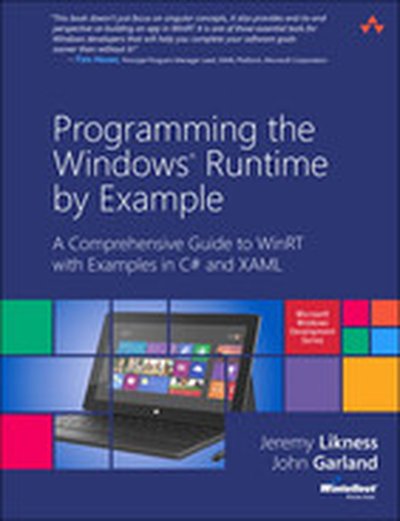
Programming the Windows Runtime by Example: A Comprehensive Guide to WinRT with Examples in C# and XAML

Master Windows 8.1/Windows Runtime Programming Through 80 Expert Projects This is the most complete, hands-on, solutions-focused guide to programming modern Windows applications with the Windows Runtime. Leading Windows development consultants Jeremy Likness and John Garland present easy-to-adapt C# and XAML example code for more than 80 projects. Their real-world application examples help you apply Windows 8.1’s best improvements, including large tiles, the new search control, flyouts, command bars, native WinRT networking, and new deployment and sideloading options. Drawing on their pioneering experience, they illuminate key areas of the Windows Runtime API, offering uniquely detailed coverage of encryption, cloud connectivity, devices, printers, and media integration. You’ll find cutting-edge tips and tricks available in no other book. This is an indispensable resource for all intermediate-to-advanced Windows developers, and for any architect building desktop, tablet, or mobile solutions with Microsoft technologies. Its focus on both C# and XAML will make it valuable to millions of Windows developers already familiar with Silverlight, WPF, and/or .NET. Coverage includes • Creating robust app interfaces with the newest XAML controls, including flyouts and command bars • Saving data in a persistent “roaming zone” for syncing across Windows 8.1 devices • Using Visual State Manager (VSM) to build apps that adapt to various device resolutions and orientations • Integrating virtually any form of data into your apps • Connecting with web services, RSS, Atom feeds, and social networks • Securing apps via authentication, encrypting, signing, and single sign-on with Microsoft Account, Facebook, Google, and more • Leveraging Windows 8.1 media enhancements that improve battery life and app performance • Networking more effectively with Windows 8.1’s revamped HTTP implementation and new location APIs • Using Tiles and Toasts to keep apps alive and connected, even when they aren’t running • Enabling users to send content between devices via NFC tap and send • Ensuring accessibility and globalizing your apps • Efficiently debugging, optimizing, packaging, and deploying your apps • Building sideloadable apps that don’t have to be published in Windows Store “This book doesn’t just focus on singular concepts, it also provides end-to-end perspective on building an app in WinRT. It is one of those essential tools for Windows developers that will help you complete your software goals sooner than without it!” —Tim Heuer, Principal Program Manager Lead, XAML Platform, Microsoft Corporation

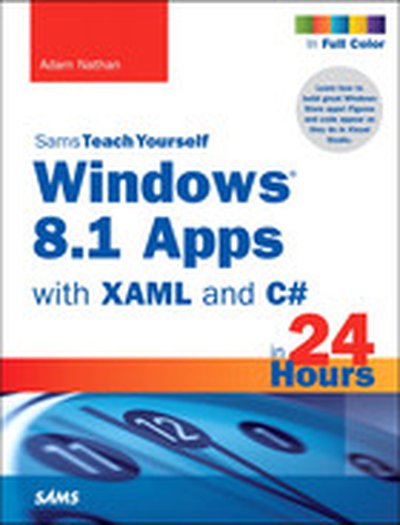
Windows® 8.1 Apps with XAML and C# Sams Teach Yourself in 24 Hours

Learn how to build great Windows Store apps! Figures and code appear as they do in Visual Studio. In just 24 sessions of one hour or less, Sams Teach Yourself Windows 8.1 Apps with XAML and C# in 24 Hours will help you build compelling apps for Windows 8.1 devices of all kinds. Using this book’s straightforward approach, you’ll learn to design and build apps, create flexible user interfaces, handle inputs, integrate controls, and more. Step by step, you’ll discover how to leverage XAML’s visual richness and the immense power of Windows 8.1. Every lesson builds on what you’ve already learned, giving you a rock-solid foundation for real-world success! Step-by-step instructions carefully walk you through today’s most common XAML and C# development tasks. Quizzes at the end of each chapter help you test your knowledge. Notes present interesting information related to the discussion. Tips offer advice or show you easier ways to perform tasks. Cautions alert you to possible problems and give you advice on how to avoid them. Learn how to… Create user interfaces that adapt to any device, from tablets to high-def TVs Handle input from touch, mouse, pen, and keyboard Manage the entire Windows 8.1 app lifecycle and all execution states Master powerful XAML controls for text, images, audio, video, and more Integrate vector graphics that scale perfectly to any size Apply rich animations Work with styles, templates, and visual states Exploit the Windows charms within your apps Take full advantage of data binding and contracts Read data from sensors and control external devices Provide dynamic updates via live tiles, notifications, and the lock screen Discover the many ways to monetize your Windows Store apps

Beginning Hibernate, Third Edition

Beginning Hibernate, Third Edition is ideal if you're experienced in Java with databases (the traditional, or "connected," approach), but new to open-source, lightweight Hibernate, a leading object-relational mapping and database-oriented application development framework. This book packs in information about the release of the Hibernate 4.x persistence layer and provides a clear introduction to the current standard for object-relational persistence in Java. And since the book keeps its focus on Hibernate without wasting time on nonessential third-party tools, you'll be able to immediately start building transaction-based engines and applications. Experienced authors Joseph Ottinger with Dave Minter and Jeff Linwood provide more in-depth examples than any other book for Hibernate beginners. The authors also present material in a lively, example-based manner—not a dry, theoretical, hard-to-read fashion. What you'll learn How to build enterprise Java-based transaction-type applications that access complex data with Hibernate How to work with Hibernate 4 Where to integrate into the persistence life cycle How to map using annotations, Hibernate XML files, and more How to search and query with the new version of Hibernate How to integrate with MongoDB using NoSQL Who this book is for This book is for Java developers who want to learn about Hibernate.

Getting Started with Beautiful Soup

"Getting Started with Beautiful Soup" is your practical guide to website scraping using Python. It teaches you how to use Beautiful Soup and the urllib2 module to extract data from websites efficiently and effectively. Through hands-on examples and clear explanations, you'll gain the skills to navigate, search, and modify HTML content. What this Book will help me do Navigate and scrape web pages using the Beautiful Soup Python library. Understand and implement the urllib2 module to access web content programmatically. Search and analyze HTML structures efficiently to extract the needed data. Modify and format extracted HTML and XML content effectively. Handle encoding and manage output formats for diverse scraping requirements. Author(s) Vineeth G. Nair is an experienced Python developer with a strong focus on web technologies, data extraction, and automation. His expertise in Python's Beautiful Soup library has helped countless learners and professionals tackle the challenges of web scraping. Vineeth combines a methodical approach to teaching with practical examples, making complex concepts accessible and actionable. Who is it for? This book is ideal for Python enthusiasts, data analysts, and budding developers looking to explore web scraping. Whether you're a beginner or have some programming experience, this book will guide you through the fundamental concepts of extracting web data. If you're aiming to delve into practical, real-world implementations of web scraping, this is the book for you.

PROC REPORT by Example

PROC REPORT by Example: Techniques for Building Professional Reports Using SAS provides real-world examples using PROC REPORT to create a wide variety of professional reports. Written from the point of view of the programmer who produces the reports, this book explains and illustrates creative techniques used to achieve the desired results.

Each chapter focuses on a different concrete example, shows an image of the final report, and then takes you through the process of creating that report. You will be able to break each report down to find out how it was produced, including any data manipulation you have to do.

The book clarifies solutions to common, everyday programming challenges and typical daily tasks that programmers encounter. For example: obtaining desired report formats using style templates supplied by SAS and PROC TEMPLATE, PROC REPORT STYLE options, and COMPUTE block features employing different usage options (DISPLAY, ORDER, GROUP, ANALYSIS, COMPUTED) to create a variety of detail and summary reports using BREAK statements and COMPUTE blocks to summarize and report key findings producing reports in various Output Delivery System (ODS) destinations including RTF, PDF, XML, TAGSETS.RTF embedding images in a report and combining graphical and tabular data with SAS 9.2 and beyond

Applicable to SAS users from all disciplines, the real-life scenarios will help elevate your reporting skills learned from other books to the next level.

With PROC REPORT by Example: Techniques for Building Professional Reports Using SAS, what seemed complex will become a matter of practice.

This book is part of the SAS Press program.

Professional Hadoop Solutions

The go-to guidebook for deploying Big Data solutions with Hadoop Today's enterprise architects need to understand how the Hadoop frameworks and APIs fit together, and how they can be integrated to deliver real-world solutions. This book is a practical, detailed guide to building and implementing those solutions, with code-level instruction in the popular Wrox tradition. It covers storing data with HDFS and Hbase, processing data with MapReduce, and automating data processing with Oozie. Hadoop security, running Hadoop with Amazon Web Services, best practices, and automating Hadoop processes in real time are also covered in depth. With in-depth code examples in Java and XML and the latest on recent additions to the Hadoop ecosystem, this complete resource also covers the use of APIs, exposing their inner workings and allowing architects and developers to better leverage and customize them. The ultimate guide for developers, designers, and architects who need to build and deploy Hadoop applications Covers storing and processing data with various technologies, automating data processing, Hadoop security, and delivering real-time solutions Includes detailed, real-world examples and code-level guidelines Explains when, why, and how to use these tools effectively Written by a team of Hadoop experts in the programmer-to-programmer Wrox style Professional Hadoop Solutions is the reference enterprise architects and developers need to maximize the power of Hadoop.

Mondrian in Action

Mondrian in Action teaches business users and developers how to use Mondrian and related tools for strategic business analysis. You'll learn how to design and populate a data warehouse and present the data via a multidimensional model. You'll follow examples showing how to create a Mondrian schema and then expand it to add basic security based on the users' roles. About the Technology Mondrian is an open source, lightning-fast data analysis engine designed to help you explore your business data and perform speed-of-thought analysis. Mondrian can be integrated into a wide variety of business analysis applications and learning it requires no specialized technical knowledge. About the Book Mondrian in Action teaches you to use Mondrian for strategic business analysis. In it, you'll learn how to organize and present data in a multidimensional manner. You'll follow apt and thoroughly explained examples showing how to create a Mondrian schema and then expand it to add basic security based on users' roles. Developers will discover how to integrate Mondrian using its olap4j Java API and web service calls via XML for Analysis. What's Inside Mondrian from the ground up -- no experience required A primer on business analytics Using Mondrian with a variety of leading applications Optimizing and restricting business data for fast, secure analysis About the Reader Written for developers building data analysis solutions. Appropriate for tech-savvy business users and DBAs needing to query and report on data. About the Authors William D. Back is an Enterprise Architect and Director of Pentaho Services. Nicholas Goodman is a Business Intelligence pro who has authored training courses on OLAP and Mondrian. Julian Hyde founded Mondrian and is the project's lead developer. Quotes A wonderful introduction to Business Intelligence and Analytics. - Lorenzo De Leon, Authentify, Inc. A great overview of the Mondrian engine that guided me through all the technical details. - Alexander Helf, veenion GmbH A significant complement to the online documentation, and an excellent introduction to how to think about designing a data warehouse. - Mark Newman, Heads Up Analytics Comprehensive ... highly recommended. - Najib Coutya, IMD Group