Explore how AI-powered Generative Agents can evolve in real time using live data streams. Inspired by Stanford's 'Generative Agents' paper, this session dives into building dynamic, AI-driven worlds with Apache Kafka, Flink, and Iceberg - plus LLMs, RAG, and Python. Demos and practical examples included!
 talk-data.com
Topic
Flink
Apache Flink
stream_processing
batch_processing
big_data
74
tagged
Activity Trend
7
peak/qtr
2020-Q1
2026-Q2
Top Events
Data Engineering Podcast
21
O'Reilly Data Engineering Books
15
Databricks DATA + AI Summit 2023
8
DATA MINER Big Data Europe Conference 2020
6
Data + AI Summit 2025
5
AWS re:Invent 2024
4
PyData Amsterdam 2025
2
Data Council 2023
2
Airflow Summit 2022
2
Airflow Summit 2025
2
PyData London 2025
1
Microsoft Ignite 2023
1
Summary In this episode of the Data Engineering Podcast Tulika Bhatt, a senior software engineer at Netflix, talks about her experiences with large-scale data processing and the future of data engineering technologies. Tulika shares her journey into the data engineering field, discussing her work at BlackRock and Verizon before joining Netflix, and explains the challenges and innovations involved in managing Netflix's impression data for personalization and user experience. She highlights the importance of balancing off-the-shelf solutions with custom-built systems using technologies like Spark, Flink, and Iceberg, and delves into the complexities of ensuring data quality and observability in high-speed environments, including robust alerting strategies and semantic data auditing.
Announcements Hello and welcome to the Data Engineering Podcast, the show about modern data managementData migrations are brutal. They drag on for months—sometimes years—burning through resources and crushing team morale. Datafold's AI-powered Migration Agent changes all that. Their unique combination of AI code translation and automated data validation has helped companies complete migrations up to 10 times faster than manual approaches. And they're so confident in their solution, they'll actually guarantee your timeline in writing. Ready to turn your year-long migration into weeks? Visit dataengineeringpodcast.com/datafold today for the details.Your host is Tobias Macey and today I'm interviewing Tulika Bhatt about her experiences working on large scale data processing and her insights on the future trajectory of the supporting technologiesInterview IntroductionHow did you get involved in the area of data management?Can you start by outlining the ways that operating at large scale change the ways that you need to think about the design of data systems?When dealing with small-scale data systems it can be feasible to have manual processes. What are the elements of large scal data systems that demand autopmation?How can those large-scale automation principles be down-scaled to the systems that the rest of the world are operating?A perennial problem in data engineering is that of data quality. The past 4 years has seen a significant growth in the number of tools and practices available for automating the validation and verification of data. In your experience working with high volume data flows, what are the elements of data validation that are still unsolved?Generative AI has taken the world by storm over the past couple years. How has that changed the ways that you approach your daily work?What do you see as the future realities of working with data across various axes of large scale, real-time, etc.?What are the most interesting, innovative, or unexpected ways that you have seen solutions to large-scale data management designed?What are the most interesting, unexpected, or challenging lessons that you have learned while working on data management across axes of scale?What are the ways that you are thinking about the future trajectory of your work??Contact Info LinkedInParting Question From your perspective, what is the biggest gap in the tooling or technology for data management today?Closing Announcements Thank you for listening! Don't forget to check out our other shows. Podcast.init covers the Python language, its community, and the innovative ways it is being used. The AI Engineering Podcast is your guide to the fast-moving world of building AI systems.Visit the site to subscribe to the show, sign up for the mailing list, and read the show notes.If you've learned something or tried out a project from the show then tell us about it! Email [email protected] with your story.Links BlackRockSparkFlinkKafkaCassandraRocksDBNetflix Maestro workflow orchestratorPagerdutyIcebergThe intro and outro music is from The Hug by The Freak Fandango Orchestra / CC BY-SA
🌟 Session Overview 🌟
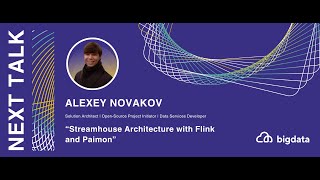
Session Name: Speaker: Alexey Novakov Session Description: Today, many data teams choose lakehouse architecture for their data platforms. But what if they process all data in streaming mode? Then they end up building a streaming lakehouse, or 'streamhouse' for short! This means they use stream processing engines to ingest, transform, and analyze business data in near real-time. However, they still want to use inexpensive storage infrastructure. How can they achieve that?
This talk introduces data teams to tools like Apache Paimon in combination with Flink. Paimon has been built with a strong focus on streaming workflows, serving as a table format in a lakehouse. It takes the stream processing approach in lakehouse architecture to the next level compared to other table formats that are more oriented towards batch data. After this talk, data teams will know how to use Paimon and Flink to build a cost-efficient and fast data layer for different data processing scenarios.
🚀 About Big Data and RPA 2024 🚀
Unlock the future of innovation and automation at Big Data & RPA Conference Europe 2024! 🌟 This unique event brings together the brightest minds in big data, machine learning, AI, and robotic process automation to explore cutting-edge solutions and trends shaping the tech landscape. Perfect for data engineers, analysts, RPA developers, and business leaders, the conference offers dual insights into the power of data-driven strategies and intelligent automation. 🚀 Gain practical knowledge on topics like hyperautomation, AI integration, advanced analytics, and workflow optimization while networking with global experts. Don’t miss this exclusive opportunity to expand your expertise and revolutionize your processes—all from the comfort of your home! 📊🤖✨
📅 Yearly Conferences: Curious about the evolution of QA? Check out our archive of past Big Data & RPA sessions. Watch the strategies and technologies evolve in our videos! 🚀 🔗 Find Other Years' Videos: 2023 Big Data Conference Europe https://www.youtube.com/playlist?list=PLqYhGsQ9iSEpb_oyAsg67PhpbrkCC59_g 2022 Big Data Conference Europe Online https://www.youtube.com/playlist?list=PLqYhGsQ9iSEryAOjmvdiaXTfjCg5j3HhT 2021 Big Data Conference Europe Online https://www.youtube.com/playlist?list=PLqYhGsQ9iSEqHwbQoWEXEJALFLKVDRXiP
💡 Stay Connected & Updated 💡
Don’t miss out on any updates or upcoming event information from Big Data & RPA Conference Europe. Follow us on our social media channels and visit our website to stay in the loop!
🌐 Website: https://bigdataconference.eu/, https://rpaconference.eu/ 👤 Facebook: https://www.facebook.com/bigdataconf, https://www.facebook.com/rpaeurope/ 🐦 Twitter: @BigDataConfEU, @europe_rpa 🔗 LinkedIn: https://www.linkedin.com/company/73234449/admin/dashboard/, https://www.linkedin.com/company/75464753/admin/dashboard/ 🎥 YouTube: http://www.youtube.com/@DATAMINERLT
🌟 Session Overview 🌟
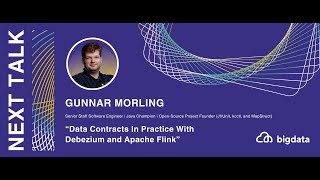
Session Name: Data Contracts In Practice With Debezium and Apache Flink Speaker: Gunnar Morling Session Description: Log-based change data capture (CDC) is an invaluable part of the data engineering toolbox: it enables a variety of use cases such as real-time analytics, full-text search, or cache invalidation by publishing data change events from your database. But when publishing change event streams across context or team boundaries, aren’t you tying external consumers to your application’s data model, thus limiting yourself in evolving the same?
Enter data contracts—consciously designed abstractions between your internal data model and the outside world. Come and join us for this session to learn about:
Challenges you may encounter when exposing table-level change event streams and how data contracts can mitigate them Implementation strategies for data contracts, such as the outbox pattern and stream processing Evolving your data model and the corresponding data contracts without breaking any existing consumers We’ll also touch on some advanced topics at the intersection of CDC and stream processing, such as hydrating partial change events, using the popular change stream processing duo of Debezium and Apache Flink.
🚀 About Big Data and RPA 2024 🚀
Unlock the future of innovation and automation at Big Data & RPA Conference Europe 2024! 🌟 This unique event brings together the brightest minds in big data, machine learning, AI, and robotic process automation to explore cutting-edge solutions and trends shaping the tech landscape. Perfect for data engineers, analysts, RPA developers, and business leaders, the conference offers dual insights into the power of data-driven strategies and intelligent automation. 🚀 Gain practical knowledge on topics like hyperautomation, AI integration, advanced analytics, and workflow optimization while networking with global experts. Don’t miss this exclusive opportunity to expand your expertise and revolutionize your processes—all from the comfort of your home! 📊🤖✨
📅 Yearly Conferences: Curious about the evolution of QA? Check out our archive of past Big Data & RPA sessions. Watch the strategies and technologies evolve in our videos! 🚀 🔗 Find Other Years' Videos: 2023 Big Data Conference Europe https://www.youtube.com/playlist?list=PLqYhGsQ9iSEpb_oyAsg67PhpbrkCC59_g 2022 Big Data Conference Europe Online https://www.youtube.com/playlist?list=PLqYhGsQ9iSEryAOjmvdiaXTfjCg5j3HhT 2021 Big Data Conference Europe Online https://www.youtube.com/playlist?list=PLqYhGsQ9iSEqHwbQoWEXEJALFLKVDRXiP
💡 Stay Connected & Updated 💡
Don’t miss out on any updates or upcoming event information from Big Data & RPA Conference Europe. Follow us on our social media channels and visit our website to stay in the loop!
🌐 Website: https://bigdataconference.eu/, https://rpaconference.eu/ 👤 Facebook: https://www.facebook.com/bigdataconf, https://www.facebook.com/rpaeurope/ 🐦 Twitter: @BigDataConfEU, @europe_rpa 🔗 LinkedIn: https://www.linkedin.com/company/73234449/admin/dashboard/, https://www.linkedin.com/company/75464753/admin/dashboard/ 🎥 YouTube: http://www.youtube.com/@DATAMINERLT
🌟 Session Overview 🌟
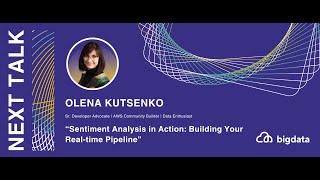
Session Name: Sentiment Analysis in Action: Building Your Real-time Pipeline Speaker: Olena Kutsenko Session Description: Monitoring and interpreting the sentiment of data records is important for a variety of use cases. However, traditional human-based methods fall short in handling huge volumes of information with the required speed and efficiency. AI, however, can address this challenge.
AI is only part of the solution. We need to build a data pipeline that ingests data from various channels, processes it using AI-driven sentiment analysis models to classify the sentiment of each individual record, and prepares it to be consumed by applications for aggregation and analysis.
In this session, we'll build a system using open-source technologies Apache Kafka and Apache Flink with AI models to obtain real-time sentiment from social media data. Apache Kafka's scalability ensures that no record is left behind, making it a reliable foundation for sentiment analysis. Apache Flink, with its adaptability to fluctuations in data volume and velocity, will enable the analysis of a continuous data stream using an AI model.
🚀 About Big Data and RPA 2024 🚀
Unlock the future of innovation and automation at Big Data & RPA Conference Europe 2024! 🌟 This unique event brings together the brightest minds in big data, machine learning, AI, and robotic process automation to explore cutting-edge solutions and trends shaping the tech landscape. Perfect for data engineers, analysts, RPA developers, and business leaders, the conference offers dual insights into the power of data-driven strategies and intelligent automation. 🚀 Gain practical knowledge on topics like hyperautomation, AI integration, advanced analytics, and workflow optimization while networking with global experts. Don’t miss this exclusive opportunity to expand your expertise and revolutionize your processes—all from the comfort of your home! 📊🤖✨
📅 Yearly Conferences: Curious about the evolution of QA? Check out our archive of past Big Data & RPA sessions. Watch the strategies and technologies evolve in our videos! 🚀 🔗 Find Other Years' Videos: 2023 Big Data Conference Europe https://www.youtube.com/playlist?list=PLqYhGsQ9iSEpb_oyAsg67PhpbrkCC59_g 2022 Big Data Conference Europe Online https://www.youtube.com/playlist?list=PLqYhGsQ9iSEryAOjmvdiaXTfjCg5j3HhT 2021 Big Data Conference Europe Online https://www.youtube.com/playlist?list=PLqYhGsQ9iSEqHwbQoWEXEJALFLKVDRXiP
💡 Stay Connected & Updated 💡
Don’t miss out on any updates or upcoming event information from Big Data & RPA Conference Europe. Follow us on our social media channels and visit our website to stay in the loop!
🌐 Website: https://bigdataconference.eu/, https://rpaconference.eu/ 👤 Facebook: https://www.facebook.com/bigdataconf, https://www.facebook.com/rpaeurope/ 🐦 Twitter: @BigDataConfEU, @europe_rpa 🔗 LinkedIn: https://www.linkedin.com/company/73234449/admin/dashboard/, https://www.linkedin.com/company/75464753/admin/dashboard/ 🎥 YouTube: http://www.youtube.com/@DATAMINERLT
Enterprises use Apache Kafka and Apache Flink for an increasing number of mission-critical use cases, real-time analytics, application messaging, and machine learning. As this usage grows in size and scale, so does the criticality, scale, and cost of managing the Kafka and Flink clusters. Learn how AWS customers can achieve the same or higher availability and durability of their growing clusters, both at lower unit costs and with operational simplicity, with Amazon MSK and Amazon Managed Service for Apache Flink.
Learn more: AWS re:Invent: https://go.aws/reinvent. More AWS events: https://go.aws/3kss9CP
Subscribe: More AWS videos: http://bit.ly/2O3zS75 More AWS events videos: http://bit.ly/316g9t4
About AWS: Amazon Web Services (AWS) hosts events, both online and in-person, bringing the cloud computing community together to connect, collaborate, and learn from AWS experts. AWS is the world's most comprehensive and broadly adopted cloud platform, offering over 200 fully featured services from data centers globally. Millions of customers—including the fastest-growing startups, largest enterprises, and leading government agencies—are using AWS to lower costs, become more agile, and innovate faster.
AWSreInvent #AWSreInvent2024
by
Denny Lee
(Databricks)
,
Prashanth Babu
(Databricks)
,
Tristen Wentling
(Databricks)
,
Scott Haines
(Databricks)
Ready to simplify the process of building data lakehouses and data pipelines at scale? In this practical guide, learn how Delta Lake is helping data engineers, data scientists, and data analysts overcome key data reliability challenges with modern data engineering and management techniques. Authors Denny Lee, Tristen Wentling, Scott Haines, and Prashanth Babu (with contributions from Delta Lake maintainer R. Tyler Croy) share expert insights on all things Delta Lake--including how to run batch and streaming jobs concurrently and accelerate the usability of your data. You'll also uncover how ACID transactions bring reliability to data lakehouses at scale. This book helps you: Understand key data reliability challenges and how Delta Lake solves them Explain the critical role of Delta transaction logs as a single source of truth Learn the Delta Lake ecosystem with technologies like Apache Flink, Kafka, and Trino Architect data lakehouses with the medallion architecture Optimize Delta Lake performance with features like deletion vectors and liquid clustering
TBA
Summary
Stripe is a company that relies on data to power their products and business. To support that functionality they have invested in Trino and Iceberg for their analytical workloads. In this episode Kevin Liu shares some of the interesting features that they have built by combining those technologies, as well as the challenges that they face in supporting the myriad workloads that are thrown at this layer of their data platform.
Announcements
Hello and welcome to the Data Engineering Podcast, the show about modern data management Data lakes are notoriously complex. For data engineers who battle to build and scale high quality data workflows on the data lake, Starburst is an end-to-end data lakehouse platform built on Trino, the query engine Apache Iceberg was designed for, with complete support for all table formats including Apache Iceberg, Hive, and Delta Lake. Trusted by teams of all sizes, including Comcast and Doordash. Want to see Starburst in action? Go to dataengineeringpodcast.com/starburst and get $500 in credits to try Starburst Galaxy today, the easiest and fastest way to get started using Trino. Your host is Tobias Macey and today I'm interviewing Kevin Liu about his use of Trino and Iceberg for Stripe's data lakehouse
Interview
Introduction How did you get involved in the area of data management? Can you describe what role Trino and Iceberg play in Stripe's data architecture?
What are the ways in which your job responsibilities intersect with Stripe's lakehouse infrastructure?
What were the requirements and selection criteria that led to the selection of that combination of technologies?
What are the other systems that feed into and rely on the Trino/Iceberg service?
what kinds of questions are you answering with table metadata
what use case/team does that support
comparative utility of iceberg REST catalog What are the shortcomings of Trino and Iceberg? What are the most interesting, innovative, or unexpected ways that you have seen Iceberg/Trino used? What are the most interesting, unexpected, or challenging lessons that you have learned while working on Stripe's data infrastructure? When is a lakehouse on Trino/Iceberg the wrong choice? What do you have planned for the future of Trino and Iceberg at Stripe?
Contact Info
Substack LinkedIn
Parting Question
From your perspective, what is the biggest gap in the tooling or technology for data management today?
Closing Announcements
Thank you for listening! Don't forget to check out our other shows. Podcast.init covers the Python language, its community, and the innovative ways it is being used. The Machine Learning Podcast helps you go from idea to production with machine learning. Visit the site to subscribe to the show, sign up for the mailing list, and read the show notes. If you've learned something or tried out a project from the show then tell us about it! Email [email protected] with your story.
Links
Trino Iceberg Stripe Spark Redshift Hive Metastore Python Iceberg Python Iceberg REST Catalog Trino Metadata Table Flink
Podcast Episode
Tabular
Podcast Episode
Delta Table
Podcast Episode
Databricks Unity Catalog Starburst AWS Athena Kevin Trinofest Presentation Alluxio
Podcast Episode
Parquet Hudi Trino Project Tardigrade Trino On Ice
The intro and outro music is from The Hug by The Freak Fandango Orchestra / CC BY-SA
Sponsored By:
Starburst: 
This episode is brought to you by Starburst - an end-to-end data lakehouse platform for data engineers who are battling to build and scale high quality data pipelines on the data lake. Powered by Trino, the query engine Apache Iceberg was designed for, Starburst is an open platform with support for all table formats including Apache Iceberg, Hive, and Delta Lake.
Trusted by the teams at Comcast and Doordash, Starburst del
Summary
Streaming data processing enables new categories of data products and analytics. Unfortunately, reasoning about stream processing engines is complex and lacks sufficient tooling. To address this shortcoming Datorios created an observability platform for Flink that brings visibility to the internals of this popular stream processing system. In this episode Ronen Korman and Stav Elkayam discuss how the increased understanding provided by purpose built observability improves the usefulness of Flink.
Announcements
Hello and welcome to the Data Engineering Podcast, the show about modern data management This episode is supported by Code Comments, an original podcast from Red Hat. As someone who listens to the Data Engineering Podcast, you know that the road from tool selection to production readiness is anything but smooth or straight. In Code Comments, host Jamie Parker, Red Hatter and experienced engineer, shares the journey of technologists from across the industry and their hard-won lessons in implementing new technologies. I listened to the recent episode "Transforming Your Database" and appreciated the valuable advice on how to approach the selection and integration of new databases in applications and the impact on team dynamics. There are 3 seasons of great episodes and new ones landing everywhere you listen to podcasts. Search for "Code Commentst" in your podcast player or go to dataengineeringpodcast.com/codecomments today to subscribe. My thanks to the team at Code Comments for their support. Data lakes are notoriously complex. For data engineers who battle to build and scale high quality data workflows on the data lake, Starburst is an end-to-end data lakehouse platform built on Trino, the query engine Apache Iceberg was designed for, with complete support for all table formats including Apache Iceberg, Hive, and Delta Lake. Trusted by teams of all sizes, including Comcast and Doordash. Want to see Starburst in action? Go to dataengineeringpodcast.com/starburst and get $500 in credits to try Starburst Galaxy today, the easiest and fastest way to get started using Trino. Your host is Tobias Macey and today I'm interviewing Ronen Korman and Stav Elkayam about pulling back the curtain on your real-time data streams by bringing intuitive observability to Flink streams
Interview
Introduction How did you get involved in the area of data management? Can you describe what Datorios is and the story behind it? Data observability has been gaining adoption for a number of years now, with a large focus on data warehouses. What are some of the unique challenges posed by Flink?
How much of the complexity is due to the nature of streaming data vs. the architectural realities of Flink?
How has the lack of visibility into the flow of data in Flink impacted the ways that teams think about where/when/how to apply it? How have the requirements of generative AI shifted the demand for streaming data systems?
What role does Flink play in the architecture of generative AI systems?
Can you describe how Datorios is implemented?
How has the design and goals of Datorios changed since you first started working on it?
How much of the Datorios architecture and functionality is specific to Flink and how are you thinking about its potential application to other streaming platforms? Can you describe how Datorios is used in a day-to-day workflow for someone building streaming applications on Flink? What are the most interesting, innovative, or unexpected ways that you have seen Datorios used? What are the most interesting, unexpected, or challenging lessons that you have learned while working on Datorios? When is Datorios the wrong choice? What do you have planned for the future of Datorios?
Contact Info
Ronen
Stav
Parting Question
From your perspective, what is the biggest gap in the tooling or technology for data management today?
Closing Announcements
Thank you for listening! Don't forget to
Traditional data architecture patterns are severely limited. To use these patterns, you have to ETL data into each tool—a cost-prohibitive process for making warehouse features available to all of your data. The lack of flexibility with these patterns requires you to lock into a set of priority tools and formats, which creates data silos and data drift. This practical book shows you a better way. Apache Iceberg provides the capabilities, performance, scalability, and savings that fulfill the promise of an open data lakehouse. By following the lessons in this book, you'll be able to achieve interactive, batch, machine learning, and streaming analytics with this high-performance open source format. Authors Tomer Shiran, Jason Hughes, and Alex Merced from Dremio show you how to get started with Iceberg. With this book, you'll learn: The architecture of Apache Iceberg tables What happens under the hood when you perform operations on Iceberg tables How to further optimize Iceberg tables for maximum performance How to use Iceberg with popular data engines such as Apache Spark, Apache Flink, and Dremio Discover why Apache Iceberg is a foundational technology for implementing an open data lakehouse.
Join Volker Janz to unlock the magic of Real-Time Customer Engagement in gaming with Kafka and Flink, processing 1.5 billion daily events for immersive player experiences. 🎮✨ #Gaming #RealTimeEngagement
✨ H I G H L I G H T S ✨
🙌 A huge shoutout to all the incredible participants who made Big Data Conference Europe 2023 in Vilnius, Lithuania, from November 21-24, an absolute triumph! 🎉 Your attendance and active participation were instrumental in making this event so special. 🌍
Don't forget to check out the session recordings from the conference to relive the valuable insights and knowledge shared! 📽️
Once again, THANK YOU for playing a pivotal role in the success of Big Data Conference Europe 2023. 🚀 See you next year for another unforgettable conference! 📅 #BigDataConference #SeeYouNextYear
Join Timothy Spann as he takes you on a journey of 'Building Real-time Travel Alerts' 🌍🚀. Learn how to construct a dynamic streaming application using Apache NiFi, Apache Kafka, and Apache Flink, ensuring optimal performance, productivity, and development simplicity in delivering timely travel advisories. 🌐🛫 #RealTimeAlerts #Streaming #ApacheStack
✨ H I G H L I G H T S ✨
🙌 A huge shoutout to all the incredible participants who made Big Data Conference Europe 2023 in Vilnius, Lithuania, from November 21-24, an absolute triumph! 🎉 Your attendance and active participation were instrumental in making this event so special. 🌍
Don't forget to check out the session recordings from the conference to relive the valuable insights and knowledge shared! 📽️
Once again, THANK YOU for playing a pivotal role in the success of Big Data Conference Europe 2023. 🚀 See you next year for another unforgettable conference! 📅 #BigDataConference #SeeYouNextYear
This session focuses on the use of open-source connectors to enable real-time analytics in Microsoft Fabric and will cover the use of connectors such as Apache Kafka, Apache Flink, Apache Spark, Open Telemetry, Logstash etc. to ingest and process data in real-time. Attendees will learn how to analyze data ingested via open-source connectors to generate insights.
𝗦𝗽𝗲𝗮𝗸𝗲𝗿𝘀: * Akshay Dixit
𝗦𝗲𝘀𝘀𝗶𝗼𝗻 𝗜𝗻𝗳𝗼𝗿𝗺𝗮𝘁𝗶𝗼𝗻: This video is one of many sessions delivered for the Microsoft Ignite 2023 event. View sessions on-demand and learn more about Microsoft Ignite at https://ignite.microsoft.com
OD46 | English (US) | Data
MSIgnite
Summary
Building streaming applications has gotten substantially easier over the past several years. Despite this, it is still operationally challenging to deploy and maintain your own stream processing infrastructure. Decodable was built with a mission of eliminating all of the painful aspects of developing and deploying stream processing systems for engineering teams. In this episode Eric Sammer discusses why more companies are including real-time capabilities in their products and the ways that Decodable makes it faster and easier.
Announcements
Hello and welcome to the Data Engineering Podcast, the show about modern data management Introducing RudderStack Profiles. RudderStack Profiles takes the SaaS guesswork and SQL grunt work out of building complete customer profiles so you can quickly ship actionable, enriched data to every downstream team. You specify the customer traits, then Profiles runs the joins and computations for you to create complete customer profiles. Get all of the details and try the new product today at dataengineeringpodcast.com/rudderstack This episode is brought to you by Datafold – a testing automation platform for data engineers that finds data quality issues before the code and data are deployed to production. Datafold leverages data-diffing to compare production and development environments and column-level lineage to show you the exact impact of every code change on data, metrics, and BI tools, keeping your team productive and stakeholders happy. Datafold integrates with dbt, the modern data stack, and seamlessly plugs in your data CI for team-wide and automated testing. If you are migrating to a modern data stack, Datafold can also help you automate data and code validation to speed up the migration. Learn more about Datafold by visiting dataengineeringpodcast.com/datafold You shouldn't have to throw away the database to build with fast-changing data. You should be able to keep the familiarity of SQL and the proven architecture of cloud warehouses, but swap the decades-old batch computation model for an efficient incremental engine to get complex queries that are always up-to-date. With Materialize, you can! It’s the only true SQL streaming database built from the ground up to meet the needs of modern data products. Whether it’s real-time dashboarding and analytics, personalization and segmentation or automation and alerting, Materialize gives you the ability to work with fresh, correct, and scalable results — all in a familiar SQL interface. Go to dataengineeringpodcast.com/materialize today to get 2 weeks free! As more people start using AI for projects, two things are clear: It’s a rapidly advancing field, but it’s tough to navigate. How can you get the best results for your use case? Instead of being subjected to a bunch of buzzword bingo, hear directly from pioneers in the developer and data science space on how they use graph tech to build AI-powered apps. . Attend the dev and ML talks at NODES 2023, a free online conference on October 26 featuring some of the brightest minds in tech. Check out the agenda and register today at Neo4j.com/NODES. Your host is Tobias Macey and today I'm interviewing Eric Sammer about starting your stream processing journey with Decodable
Interview
Introduction How did you get involved in the area of data management? Can you describe what Decodable is and the story behind it?
What are the notable changes to the Decodable platform since we last spoke? (October 2021) What are the industry shifts that have influenced the product direction?
What are the problems that customers are trying to solve when they come to Decodable? When you launched your focus was on SQL transformations of streaming data. What was the process for adding full Java support in addition to SQL? What are the developer experience challenges that are particular to working with streaming data?
How have you worked to address that in the Decodable platform and interfaces?
As you evolve the technical and product direction, what is your heuristic for balancing the unification of interfaces and system integration against the ability to swap different components or interfaces as new technologies are introduced? What are the most interesting, innovative, or unexpected ways that you have seen Decodable used? What are the most interesting, unexpected, or challenging lessons that you have learned while working on Decodable? When is Decodable the wrong choice? What do you have planned for the future of Decodable?
Contact Info
esammer on GitHub LinkedIn
Parting Question
From your perspective, what is the biggest gap in the tooling or technology for data management today?
Closing Announcements
Thank you for listening! Don't forget to check out our other shows. Podcast.init covers the Python language, its community, and the innovative ways it is being used. The Machine Learning Podcast helps you go from idea to production with machine learning. Visit the site to subscribe to the show, sign up for the mailing list, and read the show notes. If you've learned something or tried out a project from the show then tell us about it! Email [email protected]) with your story. To help other people find the show please leave a review on Apple Podcasts and tell your friends and co-workers
Links
Decodable
Podcast Episode
Understanding the Apache Flink Journey Flink
Podcast Episode
Debezium
Podcast Episode
Kafka Redpanda
Podcast Episode
Kinesis PostgreSQL
Podcast Episode
Snowflake
Podcast Episode
Databricks Startree Pinot
Podcast Episode
Rockset
Podcast Episode
Druid InfluxDB Samza Storm Pulsar
Podcast Episode
ksqlDB
Podcast Episode
dbt GitHub Actions Airbyte Singer Splunk Outbox Pattern
The intro and outro music is from The Hug by The Freak Fandango Orchestra / CC BY-SA
Sponsored By:
Neo4J: 
NODES 2023 is a free online conference focused on graph-driven innovations with content for all skill levels. Its 24 hours are packed with 90 interactive technical sessions from top developers and data scientists across the world covering a broad range of topics and use cases. The event tracks: - Intelligent Applications: APIs, Libraries, and Frameworks – Tools and best practices for creating graph-powered applications and APIs with any software stack and programming language, including Java, Python, and JavaScript - Machine Learning and AI – How graph technology provides context for your data and enhances the accuracy of your AI and ML projects (e.g.: graph neural networks, responsible AI) - Visualization: Tools, Techniques, and Best Practices – Techniques and tools for exploring hidden and unknown patterns in your data and presenting complex relationships (knowledge graphs, ethical data practices, and data representation)
Don’t miss your chance to hear about the latest graph-powered implementations and best practices for free on October 26 at NODES 2023. Go to Neo4j.com/NODES today to see the full agenda and register!Rudderstack: 
Introducing RudderStack Profiles. RudderStack Profiles takes the SaaS guesswork and SQL grunt work out of building complete customer profiles so you can quickly ship actionable, enriched data to every downstream team. You specify the customer traits, then Profiles runs the joins and computations for you to create complete customer profiles. Get all of the details and try the new product today at dataengineeringpodcast.com/rudderstackMaterialize: 
You shouldn't have to throw away the database to build with fast-changing data. Keep the familiar SQL, keep the proven architecture of cloud warehouses, but swap the decades-old batch computation model for an efficient incremental engine to get complex queries that are always up-to-date.
That is Materialize, the only true SQL streaming database built from the ground up to meet the needs of modern data products: Fresh, Correct, Scalable — all in a familiar SQL UI. Built on Timely Dataflow and Differential Dataflow, open source frameworks created by cofounder Frank McSherry at Microsoft Research, Materialize is trusted by data and engineering teams at Ramp, Pluralsight, Onward and more to build real-time data products without the cost, complexity, and development time of stream processing.
Go to materialize.com today and get 2 weeks free!Datafold: 
This episode is brought to you by Datafold – a testing automation platform for data engineers that finds data quality issues before the code and data are deployed to production. Datafold leverages data-diffing to compare…
There are more data tools available than ever before, and it is easier to build a pipeline than it has ever been. These tools and advancements have created an explosion of innovation, resulting in data within today's organizations becoming increasingly distributed and can't be contained within a single brain, a single team, or a single platform. Data lineage can help by tracing the relationships between datasets and providing a map of your entire data universe.
OpenLineage provides a standard for lineage collection that spans multiple platforms, including Apache Airflow, Apache Spark™, Flink®, and dbt. This empowers teams to diagnose and address widespread data quality and efficiency issues in real time. In this session, we will show how to trace data lineage across Apache Spark and Apache Airflow. There will be a walk-through of the OpenLineage architecture and a live demo of a running pipeline with real-time data lineage.
Talk by: Julien Le Dem,Willy Lulciuc
Here’s more to explore: Data, Analytics, and AI Governance: https://dbricks.co/44gu3YU
Connect with us: Website: https://databricks.com Twitter: https://twitter.com/databricks LinkedIn: https://www.linkedin.com/company/databricks Instagram: https://www.instagram.com/databricksinc Facebook: https://www.facebook.com/databricksinc
Since the release of Delta 2.0, the project has been growing at a breakneck speed. In this session, we will cover all the latest capabilities that makes Delta Lake the best format for the lakehouse. Based on lessons learned from this past year, we will introduce Project Aqueduct and how we will simplify building Delta Lake APIs from Rust and Go to Trino, Flink, and PySpark.
Talk by: Tathagata Das and Denny Lee
Connect with us: Website: https://databricks.com Twitter: https://twitter.com/databricks LinkedIn: https://www.linkedin.com/company/databricks Instagram: https://www.instagram.com/databricksinc Facebook: https://www.facebook.com/databricksinc
ABOUT THE TALK: Microservices are one of the big trends in software engineering of the last few years.
In this session we'll discuss and showcase how open-source change data capture (CDC) with Debezium can help developers with typical challenges they often face when working on microservices.
Learn how to:
- Employ the outbox pattern for reliable, eventually consistent data exchange between microservices, without incurring unsafe dual writes or tight coupling
- Gradually extract microservices from existing monolithic applications, using CDC, the strangler fig pattern and Apache Flink
- Coordinate long-running business transactions across multiple services using CDC-based saga orchestration, ensuring such activity gets consistently applied or aborted by all participating services.
ABOUT THE SPEAKER: Gunnar Morling is a software engineer and open-source enthusiast by heart, currently working at Decodable on stream processing based on Apache Flink. In his prior role as a software engineer at Red Hat, he led the Debezium project, a distributed platform for change data capture. He is a Java Champion and has founded multiple open source projects such as JfrUnit, kcctl, and MapStruct. Gunnar is an avid blogger (morling.dev) and has spoken at a wide range of conferences like QCon, Java One, and Devoxx. He lives in Hamburg, Germany.
ABOUT DATA COUNCIL: Data Council (https://www.datacouncil.ai/) is a community and conference series that provides data professionals with the learning and networking opportunities they need to grow their careers.
Make sure to subscribe to our channel for the most up-to-date talks from technical professionals on data related topics including data infrastructure, data engineering, ML systems, analytics and AI from top startups and tech companies.
FOLLOW DATA COUNCIL: Twitter: https://twitter.com/DataCouncilAI LinkedIn: https://www.linkedin.com/company/datacouncil-ai/
ABOUT THE TALK: In this talk, we highlight what it means for Apache Flink to be a general data processor that acts as a data integration hub. Looking under the hood, we demonstrate Flink's SQL engine as a changelog processor that ships with an ecosystem tailored to processing CDC data and maintaining materialized views. We will discuss the semantics of different data sources and how to perform joins or stream enrichment between them. This talk illustrates how Flink can be used with systems such as Kafka (for upsert logging), Debezium, JDBC, and others.
ABOUT THE SPEAKER: Timo Walther is a long-term member of the management committee and among the top committers in the Apache Flink project. Timo worked as a software engineer at Data Artisans and lead of the SQL team at Ververica. He was a Co-Founder of Immerok which was acquired by Confluent in 2023. In Flink, he is working on various topics in the Table & SQL ecosystem to make stream processing accessible for everyone.
ABOUT DATA COUNCIL: Data Council (https://www.datacouncil.ai/) is a community and conference series that provides data professionals with the learning and networking opportunities they need to grow their careers.
Make sure to subscribe to our channel for the most up-to-date talks from technical professionals on data related topics including data infrastructure, data engineering, ML systems, analytics and AI from top startups and tech companies.
FOLLOW DATA COUNCIL: Twitter: https://twitter.com/DataCouncilAI LinkedIn: https://www.linkedin.com/company/datacouncil-ai/